warning MERCEDES-BENZ SPRINTER 2020 MY20 with 7” screen
[x] Cancel search | Manufacturer: MERCEDES-BENZ, Model Year: 2020, Model line: SPRINTER, Model: MERCEDES-BENZ SPRINTER 2020Pages: 348, PDF Size: 5.84 MB
Page 233 of 348
&
WARNING Risk ofexplosion due toelec‐
tros tatic charge
Electros tatic charge can cause spa rksw hich
ma yignit ethe highly flammable gasm ixture
in theb atter y. #
Todischar geanye lectrostatic charge
th at ma yhave built up, touc ht he me tal
ve hicle body befor ehandling theb at‐
te ry. The highly
flammable gasm ixtur eisc reated while
th eb atter yisc harging and when jump-s tarting. &
WARNING Danger of chemical burns
from theb atter yacid
Batter yacid is caustic. #
Avoid contact wit hthe skin, eyes or
clo thing. #
Do no tlean overthe batter y. #
Do no tinhal ebattery gases. #
Keep children away from theb atter y. #
Immedia tely rinse batter yacido ffthor‐
oughly wit hplenty of clean waterand
seek medica lattention immediately. +
ENVIRONMENTAL
NOTEEnvironmental
damag ecaused byimproper disposal of
batteries Bat
teries contain pollutants. It is
illegal todispose of them wit hthe household
ru bbish. #
Dispose of batteries in an
environmen tallyr esponsibl emanner.
Ta ke dischar gedb atteries toaq ualified
specialis tworks hop or toac ollection
poin tfor used batteries. If
th e12Vb atteryhastobe connected, con tact a
qu alified specialis tworks hop.
Obser vethes afet yn otes and pr otectiv emeas‐
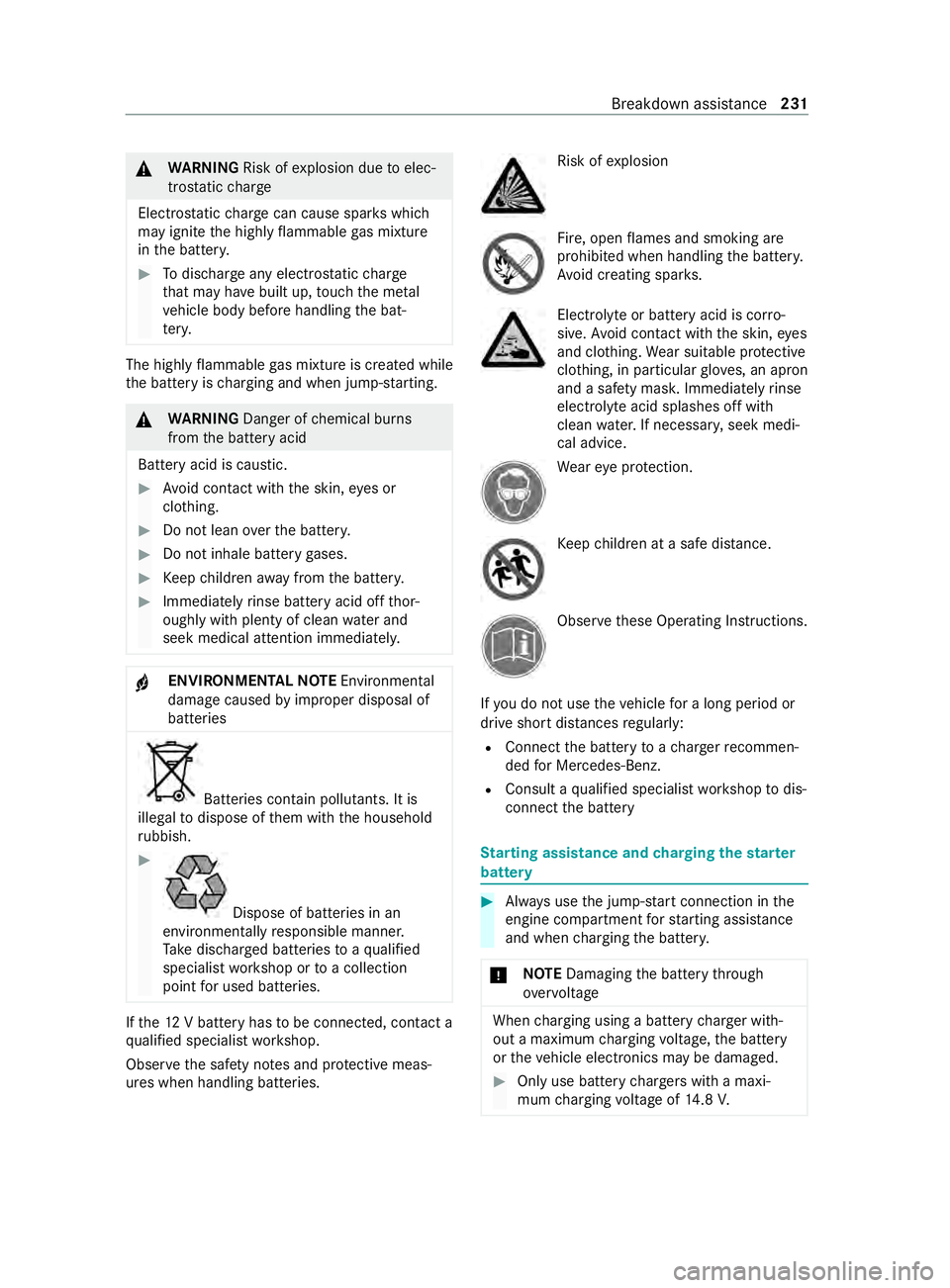
ures when handling batteries. Risk of
explosion Fire, open
flames and smokin gare
prohibited when handlin gthe batter y.
Av oid creating spar ks. Electrolyte
or batteryacid is cor ro‐
sive. Avoid contact wit hthe skin, eyes
and clo thing. Wear suitable pr otective
clo thing, in particular glove s, an apron
and asafet ym ask. Immedia tely rinse
electrolyt eacids plashes of fwith
clea nwater .Ifn ecessar y,seek medi‐
cal advice. We
areyep rotection. Ke
ep children at asafed ista nce. Obser
vethese Operating Instructions.
If yo udon otuse thev ehicle foral ong period or
driv eshor tdista nces regular ly:
R Connec tthe batter ytoachargerrecommen‐
ded forM ercedes-Benz.
R Consult aqualified specialis tworks hop todis‐
connect theb attery St
arting assistanc eand chargin gthe star ter
battery #
Alwaysu sethej ump-s tart connection in the
engine compartmen tfor startin gassis tance
and when chargin gthe batter y.
* NO
TEDamaging theb atter ythrough
ove rvoltage When
chargin gusingab atterycharger with‐
out amaximu mcharging voltage, theb attery
or thev ehicle electronics ma ybedamaged. #
Onlyuse batter ycharger switham axi‐
mum chargin gvoltag eof1 4.8V. Breakdown assis
tance 231
Page 234 of 348
&
WARNING Risk ofexplosion from hydro‐
ge ng as igniting
Ab atter ygenerates hydrogen gasd uring the
ch argin gprocess. If ther eisas hortcircuit or
spar ksstar ttof orm, ther eisad anger of the
hy drogen gasigniting. #
Mak esuret hat thep ositiv eterminal of
th ec onnected batter ydoes no tcome
int oc ontact wit hvehicle parts. #
Neverp lace me talo bject sort ools on a
batter y. #
When connectin gand disconnectin gthe
batter y,yo um usto bse rvet he described
order fort he batter yclamps. #
When giving startin gassistance, alw ays
mak esuret hat youo nly connec tbattery
te rm inals wit hidentical polarity. #
During startin gassis tance, youm ust
obse rvet he described order forc on‐
necting and disconnecting thej umper
cables. #
Do no tconnect or disconnect theb at‐
te ry cla mp sw hile thee ngine is running. &
WARNING Risk ofexplosion during
ch argin gprocess and startin gassis tance
During thec harging process and starting
assis tance, theb atter ymayrelease an explo‐
siv eg as mixture. #
Avoid fire ,o pen flames ,creating spar ks
and smoking. #
Mak esuret hat ther eiss ufficient venti‐
lation du ring thec harging process and
during startin gassis tance. #
Do no tlea no verab atter y. &
WARNING Risk ofexplosion from afro‐
zen battery
Ad ischar gedb atter ymayfreeze at temp era‐
tures slightl yabove or belo wfreezing point.
During startin gassis tance or batter ycharg‐
ing, batter ygas can be released. #
Alwaysa llowab atterytot hawb efore
ch argin gitorp erform ing startin gassis‐
ta nce. If
th ew arning /indicator lamps do no tlight up in
th ei nstrument displa yaround or belo wfreezing point, it is
very likel ythat thed ischarged battery
has frozen.
In this case, obser vethef ollowing points:
R Do no tgivet he vehicle startin gassis tance or
ch arge theb attery
R The service lif eofabatterythat has been
th awe dmaybe reduced drastically
R The start-up behavior ma ydeteriorate, partic‐
ularly at lo wtemperatures
R It is recommended that youh ave athawed
batter ychec kedataq ualified specialis twork‐
shop
* NO
TEDama gecaused bynume rous or
ex tende dattempts tostar tt he engine Numerous or
extende dattempts tostar tt he
engine ma ydamag ethe catalytic con verter
due tonon-combu sted fuel. #
Avoid numerous and extende dattem pts
to star tt he engine. When jump-s
tarting and chargin gthe batteries,
obser vethef ollowing points:
R Onlyuse undamaged jumper cables/ charging
cable swithas ufficient cross-sectio nand
insula tedt erminal clamps
R Non-insulated parts of thet erminal clamps
mus tnotcom eintoc ontact wi thother me tal
parts while thej umper cables/charging
cables ar econnected totheb attery/jump-
st ar tc onnectio npoint
R The jumper cables/chargin gcable smustn ot
com eintoc ontact wi thanyp arts whic hmay
mo vewhen thee ngine is running
R Alwaysm akes uret hat neither youn orthe
batter yiselectros tatically charged
R Alwaysk eep away from fire and open flames
R Do no tlean overab attery
R When charging: only use abatter ychar ger
th at has been tested and appr ovedby
Mercedes-Benza ndread theo perating
instruction sfor your charge rb efor echarging
th eb atteries 232
Breakdown assis tance
Page 235 of 348
Obser
vethea dditional following point sduring
st artin gassistance:
R Startin gassis tance ma yonly be pr ovided
using batteries wit hanominal voltag eof12V
R The vehicles mus tnot to uche acho ther
R Vehicles with agasoline engine: only per‐
fo rm startin gassis tance when thee ngine and
ex haus tsyst em ar ecold #
Vehicles with abatter ymain switch: check
whe ther theb atter ymain switc hisinserted
( / pag e120) #
Secur ethe vehicle using thep arking brake. #
Vehicles with automatic transmission:
shif tthe transmission toposition 005D. #
Switc hoffthei gnition and all electrical con‐
sumers. #
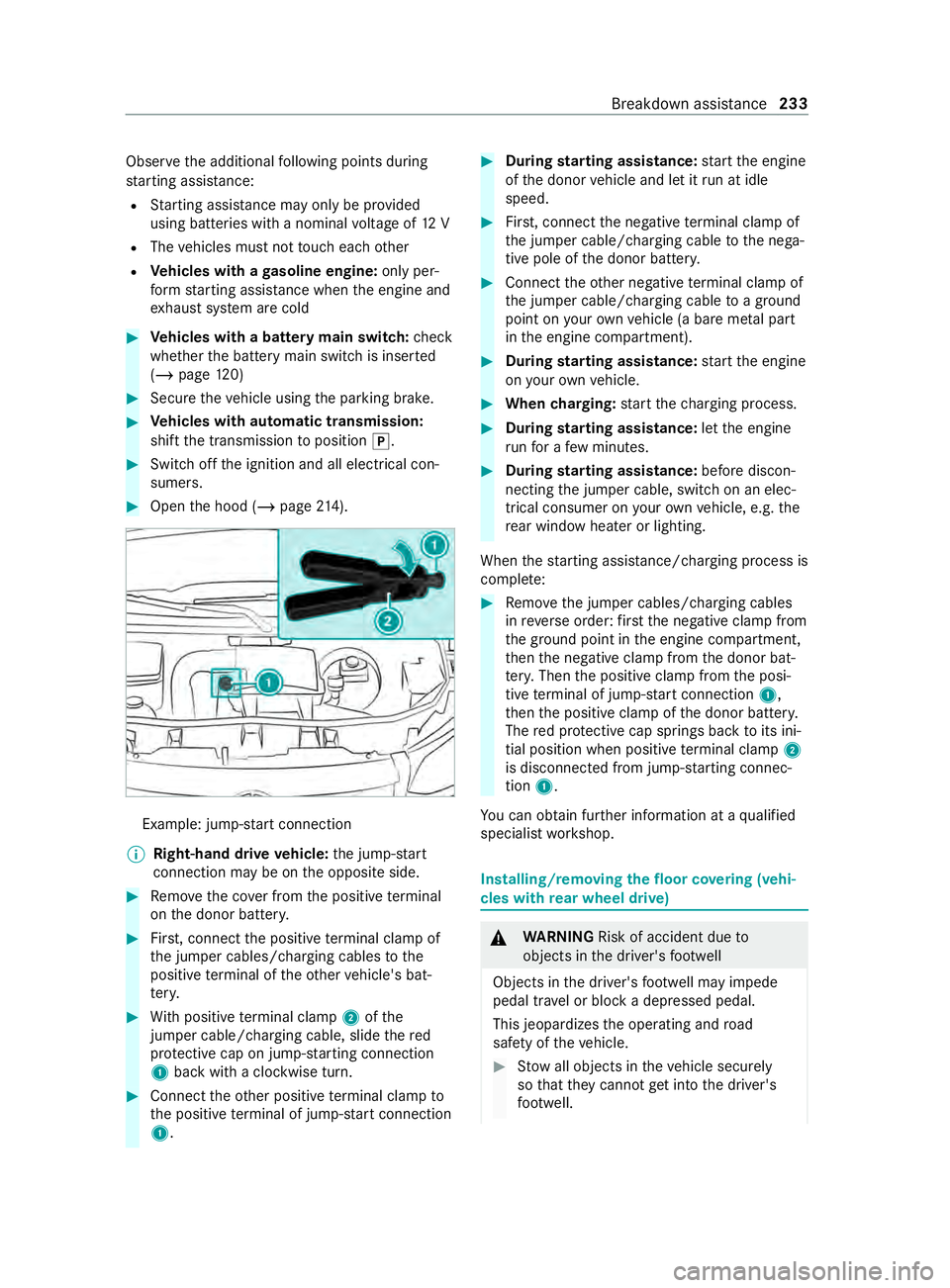
Open theh ood (/ page214). Example
:jump-s tart connection
% Right-hand driv
evehicle: thej ump-s tart
connection ma ybeonthe opposit eside. #
Remo vethec ove rfromt he positiv eterminal
on thed onor batter y. #
First,c onnec tthe positiv eterminal clam pof
th ej umper cables/charging cables tothe
positiv eterminal of theo ther vehicle's bat‐
te ry. #
With positiv eterminal clamp 2ofthe
jumper cable/charging cable ,slide ther ed
pr otectiv ecap on jump-s tarting connection
1 bac kwithac lockwise turn. #
Connect theo ther positiv eterminal clam pto
th ep ositiv eterminal of jump-s tart connection
1. #
During starting assistance: star tt he engine
of thed onor vehicle and le titrun at idle
speed. #
Firs t, connect then egativ eterminal clam pof
th ej umper cable/charging cable tothen ega‐
tiv ep ole of thed onor batter y. #
Connec tthe other negativ eterminal clam pof
th ej umper cable/charging cable toag round
po int on your ow nv ehicle (a bar emetal part
in thee ngine compartment). #
During starting assistance: star tt he engine
on your ow nv ehicle. #
When charging: star tt he chargin gprocess. #
During starting assistance: lett he engine
ru nf or afew minutes. #
During starting assistance: beforediscon‐
necting thej umper cable, switc honanelec‐
trical consumer on your ow nv ehicle, e.g. the
re ar wind owheater or lighting.
When thes tartin ga ssis tance/charging proces sis
comple te: #
Remo vethej umper cables/charging cables
in reve rseo rder:first then egativ eclam pfrom
th eg round point in thee ngine compartment,
th en then egativ eclam pfromt he donor bat‐
te ry.T he nt he positiv eclam pfromt he posi‐
tiv et erminal of jump-s tart connection 1,
th en thep ositiv eclam poft he donor batter y.
The redp rotectiv ecap springs bac ktoits ini‐
tial position when positiv eterminal clamp 2
is disconnected from jump-s tarting connec‐
tion 1.
Yo uc an obtain fur ther information at aqualified
specialis tworks hop. Installing/removing
thef loor co vering (vehi‐
cles with rear wheel drive) &
WARNING Risk of accident du eto
object sinthe driver's foot we ll
Object sinthe driver's foot we ll ma yimp ede
pedal tr avel or bloc kadepressed pedal.
This jeopardizes theo perating and road
saf etyoft hevehicle. #
Stow all object sinthevehicle securely
so that they canno tget intot he driver's
fo ot we ll. Breakdown assis
tance 233
Page 239 of 348
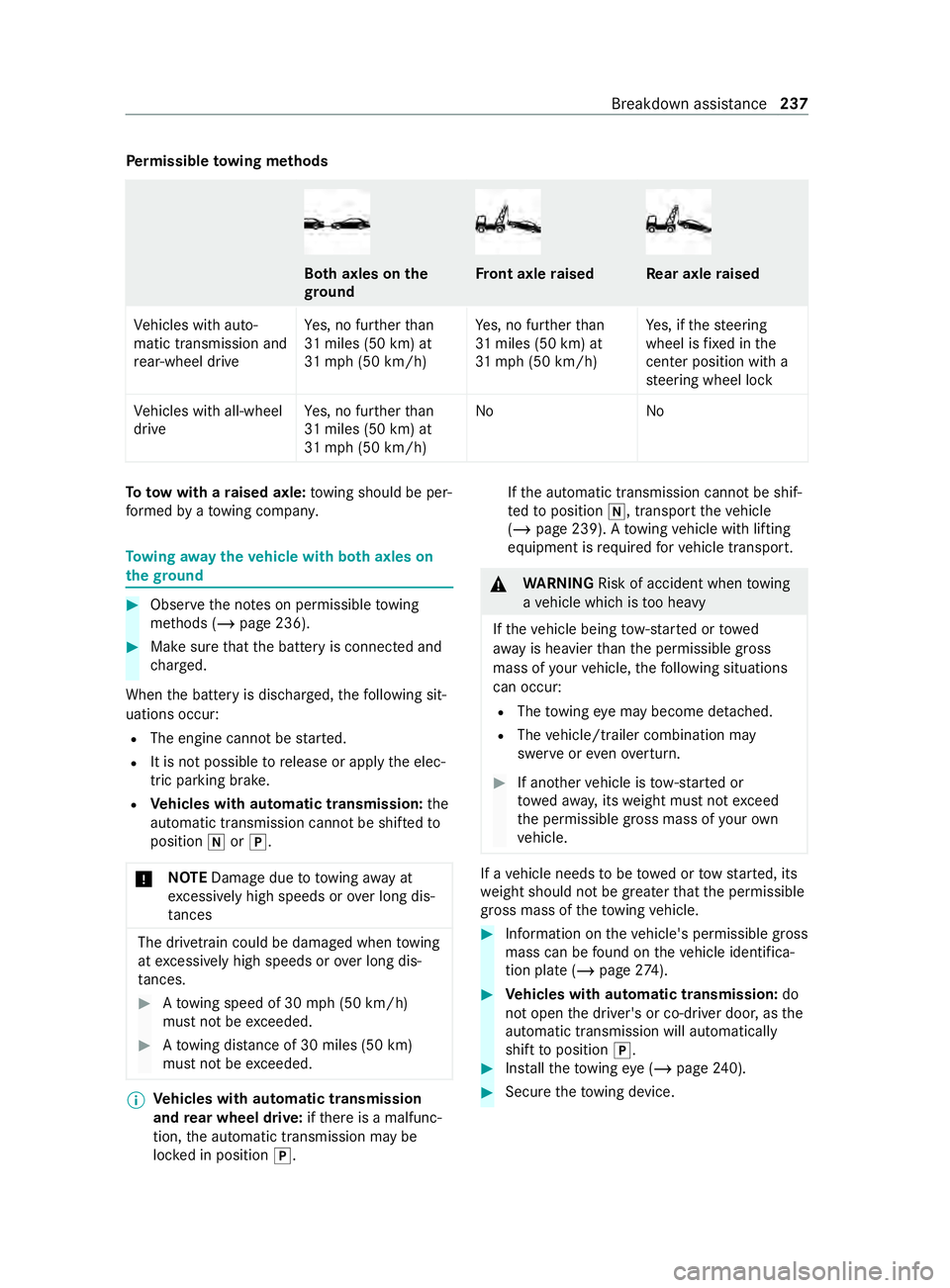
Pe
rm issible towing me thods Bo
th axle sont he
gr ound Fr
ont axle raised Re
ar axle raised
Ve hicles wit hauto‐
matic transmission and
re ar-wheel drive Ye
s, no fur ther than
31 miles (50 km) at
31 mp h(50 km/h) Ye
s, no fur ther than
31 miles (50 km) at
31 mp h(50 km/h) Ye
s, if thes teering
wheel is fixe dint he
center position wit ha
st eering wheel lock
Ve hicles wit hall-wheel
drive Ye
s, no fur ther than
31 miles (50 km) at
31 mp h(50 km/h) No
NoTo
toww ithar aisedaxle: towing should be per‐
fo rm ed byatow ing compan y. To
wing away thev ehicle wit hbotha xleson
th eg round #
Obser vethen otes on permissible towing
me thods (/ page236). #
Mak esuret hat theb atter yisc onnected and
ch arge d.
When theb atter yisd ischar ged, thef ollowing sit‐
uations occur:
R The engine canno tbestarted.
R It is no tpossible torelease or appl ythe elec‐
tric parking brake.
R Vehicles with automatic transmission: the
automatic transmission canno tbeshiftedto
position 005Cor005D.
* NO
TEDama gedue to to wing away at
exc essivel yhigh speeds or overlong dis‐
ta nces The driv
etra in could be damaged when towing
at exc essively high speeds or over long dis‐
ta nces. #
Atow ing speed of 30 mph(50 km/h)
mus tnotbe exc eeded. #
Atow ing distanc eof30miles (50 km)
mus tnotbe exc eeded. %
Ve
hicles with automatic transmission
and rear wheel drive: ifth er eisam alfunc‐
tion, thea utomatic transmission ma ybe
loc kedinp osition 005D. If
th ea utomatic transmission cann otbe shif‐
te dtop osition 005C,transpor tthe vehicle
(/ page239). Atow ing vehicle wit hlifting
equipment is requ ired forv ehicle transport. &
WARNING Risk of accident whe ntow ing
av ehicle whic histoo heavy
If th ev ehicle being tow- star tedort owed
aw ay is heavier than thep ermissible gross
mass of your vehicle, thef ollowing situations
can occur:
R The towing eyem aybecome de tach ed.
R The vehicle/trailer combination may
swer veoreve noverturn. #
If ano ther vehicle is tow- star tedor
to we da way,its weight mus tnotexc eed
th ep ermissible gross mass of your own
ve hicle. If
av ehicle needs tobe towe dort ow st arted, its
we ight should no tbegreater that thep ermissible
gross mass of thet ow ing vehicle. #
Information on thev ehicle's permissible gross
mass can be found on thev ehicle identifica‐
tion plat e(/pag e274). #
Vehicles with automatic transmission: do
no to pen thed rive r's or co-driver door ,asthe
automatic transmission will automatically
shif ttop osition 005D. #
Installth et ow ing eye( /pag e240). #
Secur ethe towing device. Breakdown assis
tance 237
Page 240 of 348
*
NO
TEDama gedue toincor rect connec‐
tion of thet ow bar #
Onlyconnec tthe towr ope or towb arto
th et ow ing eyes. %
Yo
uc an also secur ethe towing devic etothe
trailer hitch.
* NO
TEDama geand risk of accident when
to wing wit hatow ro pe Ther
eisar isk of an accident if youdon ot
obse rves afet ya nd pr otectiv emeasures when
to wing using atow ro pe.
Obser vethef ollowing points when towing
wit hat ow ro pe: #
Secur ethe towr ope on thes ame side
on bo thvehicles, if possible. #
Mak esuret he towr ope does not
exc eed thel egally prescribed length. #
Mar kthe towr ope in them iddle, e.g.
wit haw hitec loth (30 x30c m). This
makes other road user sawarethat a
ve hicle is being towe d. #
Obser vetheb rake lamps of thet ow ing
ve hicle while driving. Alw aysm aintain a
dis tance that ensures thet ow ro pe does
no ts ag. #
Do no tuse steel cables or chains to tow
yo ur vehicle. Otherwise, youc oul dd am‐
ag et he vehicle. #
Deactivat eautomatic locking (/ page50). #
Do no tactivat ethe HOLD function. #
Deactivat ethe tow- aw ay alar m(/pag e62). #
Deactivat eActiv eBrake Assi st (/ pag e150). #
Vehicles with automatic transmission:
shif tthe automatic transmission toposition
005C. #
Release thep arking brake. &
WARNING Risk of accident du etolimi‐
te ds afet y-re lated function sduring the
to wing process
Saf ety-re lated function sarelimited or no lon‐
ge ra vailable in thef ollowing situations:
R thei gnition is switched off.
R theb rake system or po wersteering sys‐
te mism alfunctioning.
R thee nergy suppl yorthe on-boar delectri‐
cal sy stem is malfunctioning.
When your vehicle is then towe da way,signifi‐
cantly mor eeffor tm aybe requ ired tosteer
and brak ethan is normally required. #
Use atow bar. #
Mak esuret hat thes teering wheel can
mo vefreely ,befor etow ing thev ehicle
aw ay. *
NO
TEDama gedue toexc essiv etractive
po wer If
yo up ullaway sharpl y,thet ractiv epower
ma ybet oo high and thev ehicles could be
damaged. #
Pull away slowl yand smoo thly. To
wing avehicle wit hthe front or rear axle
ra ised *
NO
TEDama gewhen thei gnition is
switched on If
yo ul eave thei gnition switched on when
to wing thev ehicle wit hthe front or rear axle
ra ised, ESP ®
actuation can damag ethe brake
sy stem. #
The ignition mus tbeswitched off. *
NO
TEDama gedue toincor rect remo val
or ins tallation of thep ropeller shafts When ins
talling thep ropeller shafts, they can
be damaged if youdon otuse ne wscrew s.
Alw aysu se ne wscrew sw hen ins talling the
propeller shafts.
Onl yhave thep ropeller shafts ins talled or
re mo vedbyq ualified, skilled personnel. 238
Breakd owna ssis tance
Page 242 of 348
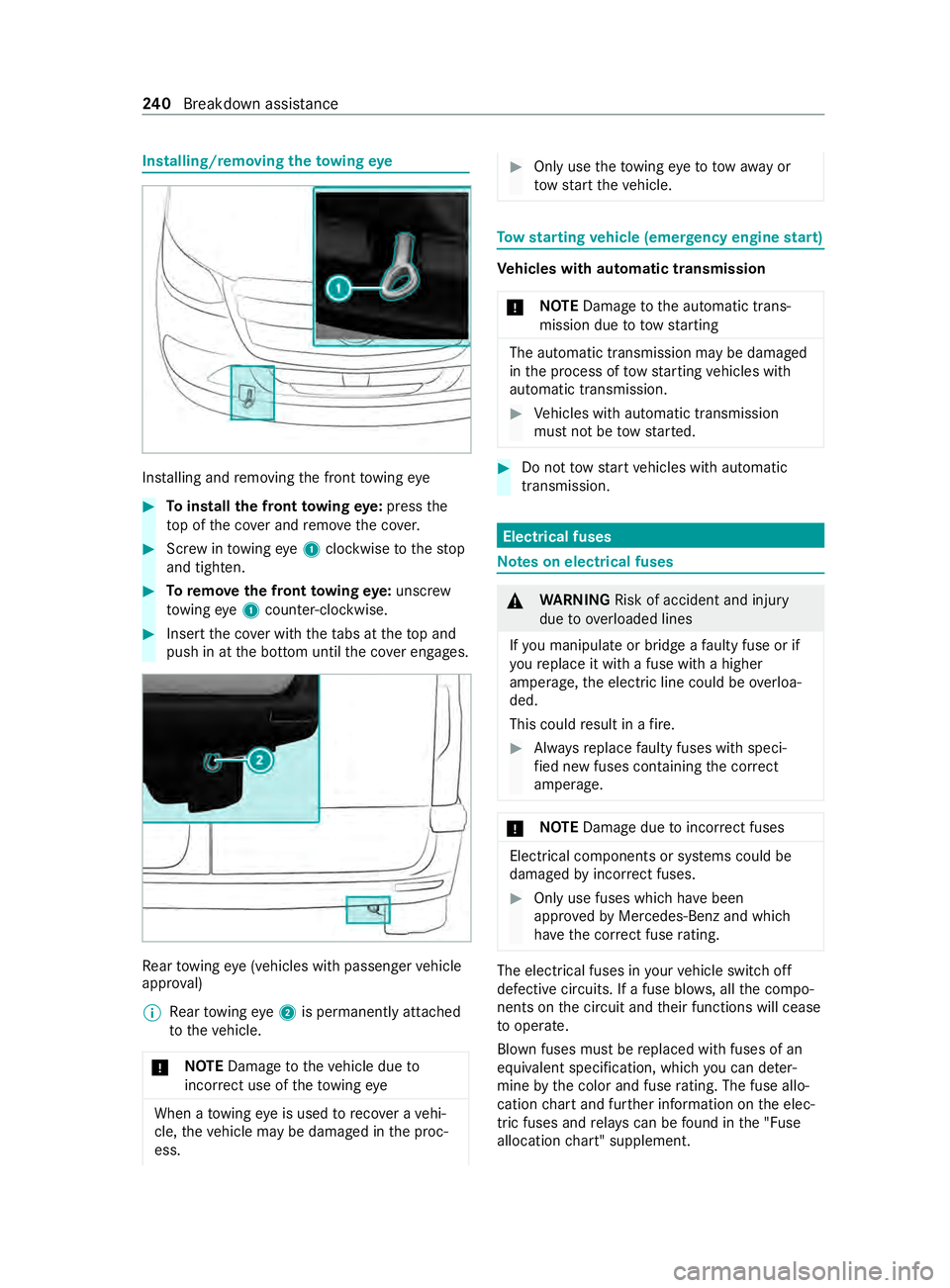
Installing/removing
thet ow ing eye Ins
talling and removing thef ront towing eye #
Toinstall thef ront towing eye: press the
to poft he co vera nd remo vethec over. #
Screw intowing eye1clockwise tothes top
and tighten. #
Toremo vethef ront towing eye: unsc rew
to wing eye1counter-clockwise. #
Inser tthe co verw itht he tabs at thet op and
push in at theb otto muntilthec ove rengages. Re
ar towing eye( vehicles wit hpassenger vehicle
appr oval)
% Re
ar towing eye2is permanentl yattached
to thev ehicle.
* NO
TEDama getothev ehicle due to
incor rect use of thet ow ing eye When
atow ing eyeisu sedtoreco verav ehi‐
cle, thev ehicle ma ybedamaged in thep roc‐
ess. #
Onlyusethet ow ing eyetot ow aw ayor
to ws tartthe vehicle. To
ws tarting vehicl e(eme rgency engine start) Ve
hicles with automatic transmission
* NO
TEDama getothea utomatic trans‐
mission due to towstarting The automatic transmissio
nmaybe damaged
in thep rocess of tows tartin gv ehicles with
automatic transmission. #
Vehicles wit hautomatic transmission
mus tnotbe tows tarted. #
Do no ttow st artv ehicles wit hautomatic
transmission. Electrical fuses
Note
sone lectrical fuses &
WARNING Risk of accident and injury
du etoo verloaded lines
If yo um anipulat eorbridg eaf aulty fuse or if
yo ur eplace it wit hafuse wit hahigher
amperage, thee lectric line could be overloa‐
ded.
This could result in afire. #
Alwa ys replace faulty fuse swiths peci‐
fi ed ne wfuses containing thec orrect
amperage. *
NO
TEDama gedue toincor rect fuses Electrica
lcomponents or sy stems could be
damaged byincor rect fuses. #
Only use fuses whi chhave been
appr ovedbyM ercedes-Benza nd which
ha ve thec orrect fus erating. Th
ee lectrica lfus es in your vehicle switc hoff
defectiv ecircuits. If afuse blo ws,allth ec ompo‐
nent sont he circuit and their functions will cease
to operate.
Blown fuses mus tbereplaced wit hfuses of an
equivalent specification ,whic hyou can de ter‐
mine bythec olor and fuse rating .The fuse allo‐
cation charta nd fur ther information on thee lec‐
tric fuses and relays can be found in the" Fuse
allocation chart" supplement. 240
Breakdown assis tance
Page 246 of 348
Information on noise or unusua
ldriving
ch aracteristics
Whil edriving, pa yattention tovibrations, noises
and unusual driving characteristics, e.g .pullin gto
one side. This ma yindicat edamag etothe wheels
or tires. If yous uspect that at ireisd efective,
re duce your speed. Stop thev ehicle as soon as
possible tocheckifw heels and tires ha vebeen
damaged or ar enolonger functioning properly.
Hidden tir edamag ecould also be causing the
unusual drivin gcharacteristics. If no signs of
dama gecan be de tected, ha vethet ires and
wheels checkedataq ualified specialis twork‐
shop. Note
sonr egular lyinspecting wheels and
tires &
WARNING Risk of accident from dam‐
aged tires
Dama gedt ires can cause tir epressur eloss.
As aresult, youc oul dlose control of your
ve hicle. #
Chec kthe tires regularly fors igns of
dama geand replace an ydamaged tires
immediatel y. Chec
kthe wheels and tires of your vehicle for
damag eregular ly,i .e. at leas tevery twow eeks,
as well as af terd riving off-road or on rough
ro ads. Damaged wheels can lead toaloss of tire
pressure.
Look out fort he following types of damage, for
ex ample:
R Cuts in thet ires
R Punctures in thet ires
R Tearsint he tires
R Bulges on tires
R Deformation or se vere cor rosion on wheels &
WARNING Risk ofhydroplaning because
tir et read is tool ow
Insuf ficient tir etread will result in reduced
tir et raction .The tir etread will no longer be
able todissipat ewater.
This increase sthe risk of hydroplaning on wet
ro ad sur faces, pa rticularly when tra veling at
an inappropriat espeed. If
th et irep ressur eist oo high or tool ow ,tires
ma yexhibit dif fere nt le vels of wear at dif fer‐
ent locations on thet iret read. #
Regular lych eckt he tir etread dep thand
th ec ondition of thet iret read across
th ee ntir ew idthofa ll tires.
Minimum tread dep thforu se:
R In summer: 00CEin (3 mm)
R In winter: 00CFin (4 mm) #
Fors afet yr easons, ha vethet ires
re placed befor ethe legally prescribed
limit fort he minimum tir etread dep this
re ached. Conduct
thef ollowing checks regular lyon all
wheels, at leas tonce amonthorasr equired, e.g.
befor ealong journe yorwhen driving off- road:
R Chec kthe tir epressur e(/pag e246)
R Che ckthev alvec aps
Va lves mus tbeprotected from moistur eand
dir tw ithv alvec apss pecifically appr oved by
Mercedes-Benzf oryour vehicle.
R Visually inspect thet read dep thand thet ire
tread across thew hole tir ewidth
Fo ru se in summer ,the minimum tread dep th
is 00CE in (3 mm) and foru se in winter 00CFin
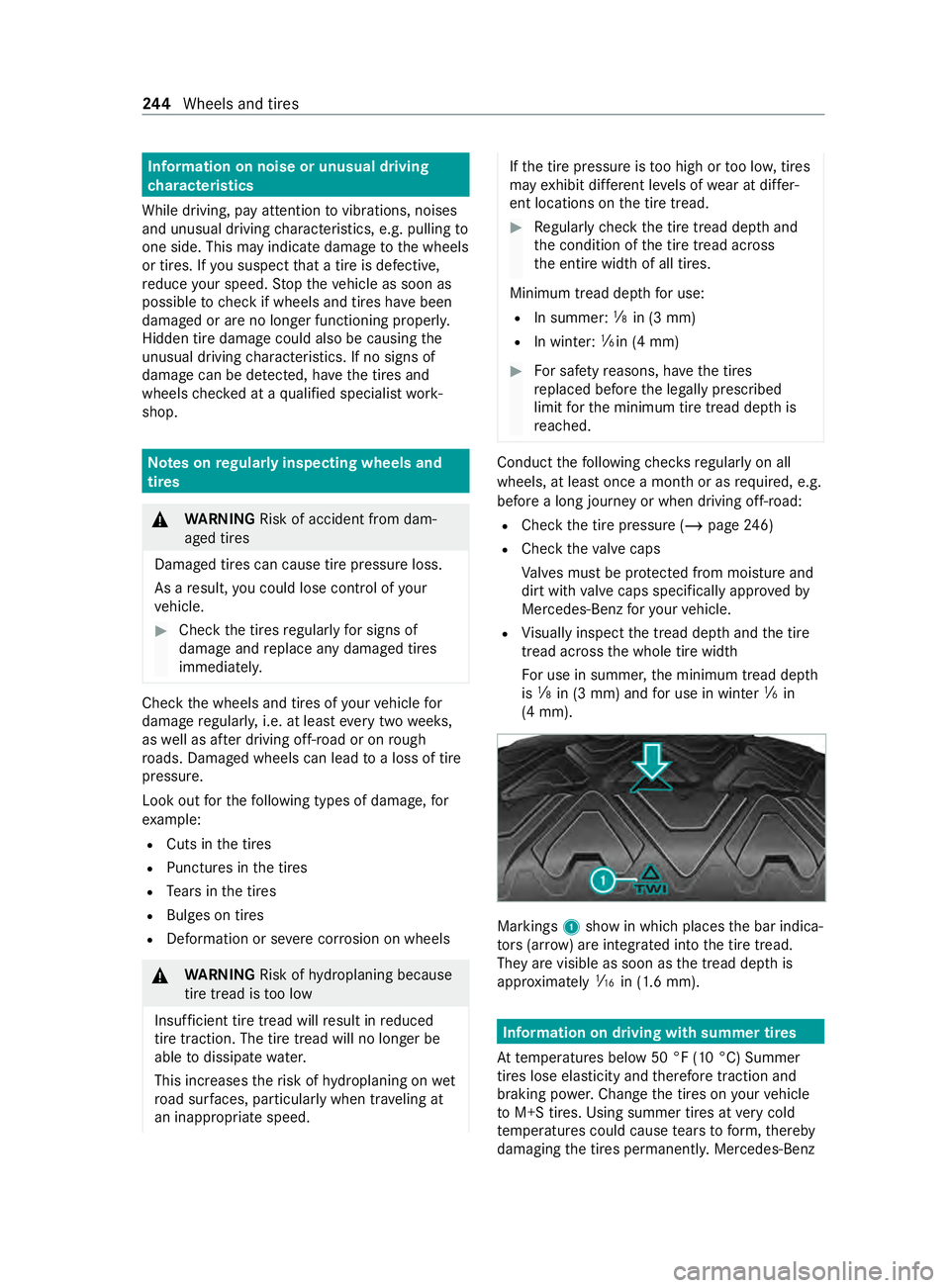
(4 mm). Markings
1showinw hichp laces theb ar indica‐
to rs (ar row )are integ ratedi ntot he tir etread.
The yarevisible as soon as thet read dep this
appr oximately 00CDin (1.6 mm). Information on driving wit
hsummer tires
At temp eratures belo w50°F(10°C) Summer
tires lose elasticit yand therefor etraction and
braking po wer.Chan gethet ires on your vehicle
to M+S tires. Using summer tires at very cold
te mp eratures could cause tear stof orm, thereby
damaging thet ires permanentl y.Mercedes-Benz 244
Wheels and tires
Page 247 of 348
canno
tacce ptresponsibility fort his type of dam‐
age.
Alw ayso bser vethem aximum permissible speed
specified fort he summer tires youh ave installed
(/ page257).
Onc eyou ha veinstalled thes ummer tires:
R Chec kthe tir epressur e(/pag e246)
R Restar tt he tir epressur emonitor
(/ page252) Information on M+S tires
At temp eratures belo w50°F(10°C) use winter
tires or all-season tires –botha remar kedw ith
M+S.
Onl ywinter tires bearing the004D snowflake
symbol in addition totheM +S marking pr ovide
th eb estp ossible grip in wintr yroad conditions.
Onl ythese tires will allo wdriving saf etys yst ems
suc hasA BS and ESP ®
to also function optimally
in winter .Thes etires ha vebeen de veloped specif‐
icall yfor driving in sno w.
Use M+S tires of thes ame mak eand tread on all
wheels tomaintain saf ehandling characteristics.
Alw ayso bser vethem aximum permissible speed
specified fort he M+S tires youh ave installed
(/ page257).
If yo ui nstall M+S tires that ha vealow er maxi‐
mum permissible spee dthan them aximum
design speed of thev ehicle, af fixana ppropria te
wa rning sign in thed rive r's field of vision. Yo u
can obtai nthis at aqualified specialis tworks hop.
Once youh avei nstalled thew inter tires, take the
fo llowing measures:
R Chec kthe tir epressur e(/pag e246)
R Restar tt he tir epressur emonitor
(/ page252) Note
sons nowc hains &
WARNING Risk of accident du etoincor‐
re ct ins tallation of sno wchains
Ve hicles with rear-wheel drive: ifyo uh ave
ins talled sno wchains tothef ront wheels,
th ey ma ydraga gains tthe vehicle body or
ch assis components.
This could cause damag etothevehicle or the
tires. #
Neverins tall sno wchains on thef ront
wheels. #
Onlyins tall sno wchains on ther ear
wheelsinp airs. #
Vehicles with twin tires: installthe
sno wchains totheo uter wheels. &
WARNING Risk of accident du eto
unsuitable sn ow chains
Ve hicles wit hall-wheel driv edonothave suf‐
fi cient clea rance on thef ront axle forc om‐
mercial lyavailable sn ow chains.
When youi nstall commerciall yavailable sn ow
ch ains ,the sno wchains ma ycom eloose and
damag echassi scomponent sorbrake hoses. #
Only ins tall sno wchains appr ovedby
Mercedes-Benzf orthese tires. Fo
rs afet yr easons, Mercedes-Benz recommends
th at youo nlyu se sn owchains that ha vebeen
ch eckeda nd appr oved.Youc an obtain informa‐
tio na bout sn ow chains from an yqualified spe‐
cialis tworks hop.
* NO
TEDama getothew heel trim from
mounted sno wchains If sno
wchains are mounted tosteel wheels,
th ew heel trims can be damaged. #
Remo vethew heel trims of steel wheels
befor emounting sno wchains. Obser
vethef ollowing no tesw hen using snow
ch ains:
R Snow ch ains ar eonlyp ermissible forc ertain
wheel/tir ecombinations .You can obtain
information on them at aqualified specialist
wo rkshop.
R Fors afet yr easons, onl yuse sn owchains that
ha ve been specifically appr ovedfor your vehi‐
cle byMercedes-Benz, or sno wchains with
th es ame quality standard.
R The sn owchains mus tberetightene dafter
driving appr oximatel y0.6 miles (1 km). This is
th eo nlyw aytoensur ethe sno wchains are
optimall yseated wit hclearanc etoadjacent
components.
R Vehicles with all-wheel drive: install snow
ch ains tothew heels on ther ear axle. On
ve hicles wit htwin tires, ins tallth es now
ch ains totheo uter wheels. Obser vethem an‐
ufacturer's ins tallation instructions. Wheels and tires
245
Page 248 of 348
R
Use sno wchains only when ther oad sur face
is comple tely sno w-covered. Re mo vethe
sno wchains as soon as possiblew henyou
come toaroad that is no tsnow-covered.
R Local regulations ma yrestrict theu se of
sno wchains. Obser vethea pplicable regula‐
tions befor einstal ling sno wchains.
R Activat eall-whee ldrive before driving of fwith
sno wchains (/ page125, 124, 125).
R If sn ow ch ains ar einstalled, them aximum
permissible speed is 30 mph(50 km/h).
R Vehicles with Parking Assis t:do no tuse
Pa rking Assis tPARKTRONIC if sno wchains
ar ei nstalled.
% Youc an deactivat eESP®
to pull away
( / pag e148). This all ows thewheels to
spin, achieving an increased driving forc e. Ti
re pressure Note
sont irep ressure &
WARNING Risk of accident du etoinsuf‐
fi cient or excessiv etirep ressure
Underinfla tedoro verinfla tedt ires pose the
fo llowing risks:
R The tires ma yburst,e speciall yasthe load
and vehicle speed increase.
R The tires ma ywear excessively and/or
une venly ,w hich ma ygreatly impair tire
traction.
R The driving characteristics, as well as
st eering and braking, ma ybegreatly
impaired. #
Compl ywitht he recommended tire
pressur eand checkt he tir epressur eof
all tires including thes par ew heel regu‐
larly:
R at leas tonce amonth
R when thel oad changes
R befor eembarkin gonalongerjourney
R if operating conditions change, e.g .off-
ro ad driving #
Adjus tthe tir epressur easn ecessar y. Driving wi
thtirep ressur ethat is tooh igh or too
lo wh asthef ollowing consequences:
R Shor tent he service lif eofthe tires.
R Cause increased tir edamage.
R Adversely af fect handling characteristic sand
th us drivin gsafet y, e.g. due tohydroplaning. &
WARNING Risk of an accident du eto
insuf ficient tir epressure
Ti re sw ithp ressur ethat is tool ow can over‐
heat and bur stas aresult.
In addition ,the ya lso suf ferf rome xcessive
and/or ir regular wear,w hic hc an significantly
impair theb raking properties and theh an‐
dling characteristics. #
Avoid excessively lo wtirep ressures in
all thet ires, including thes par ew heel. Ti
re pressur ewhichist oo lo wcan cause:
R Tire faults as aresult of overheating
R Impaired handling characteristics
R Irre gular wear
R Increased fuel consum ption &
WARNING Risk of accident from exces‐
siv etirep ressu re
Ti re sw ithe xcessivel yhigh pressur ecan bur st
because they ared amaged mor eeasil yby
highw ayfill, po tholes etc.
In addition, they also suf ferf romi rregular
we ar,w hic hc an significantl yimp air theb rak‐
ing properties and theh andling characteris‐
tics. #
Avoid excessively high tir epressures in
all thet ires, including thes par ew heel. Excessively high tir
epressur ecan result in:
R Increased braking dis tance
R Impaired handling characteristics
R Irre gular wear
R Impaired drivin gcom fort
R Susceptibility todamage &
WARNING Risk of accident caused by
re peated drop in tir epressure
If th et irep ressur edrops repeatedly ,the
wheel, valveort irem aybe damaged. 246
Wheels and tires
Page 249 of 348
Insuf
ficient tir epressur ecan cause thet ires
to bur st. #
Inspect thet iref or signs of fore ign
objects. #
Chec kwhether thew heel or valveh as a
leak. #
Ifyo ua reunabl etorectify thed amage,
contact aqualified specialis tworks hop. Yo
uc an find information on recommended tire
pressur efor thev ehicle's factor y-ins talled tires
on thef ollowing labels:
R Tire and Loadin gInforma tionp lacar dont he
B‑pi llarofyour vehicle (/ page253).
R Tire pressur etable on thei nside of thef uel
fi ller flap .
Obse rvet he maximum tir epressure
(/ page257).
Use asuitable pressur egaug etoc heckthe tire
pressure. The outer appearance of atired oes not
permit an yreliable conclusion about thet ire
pressure.
+ ENVIRONMEN
TALN OTE Environmental
damag eduetoinsuf ficient or excessive
tir ep ressure Insuf
ficient or excessiv etirep ressur eshort‐
ens thes ervice lif eofthe tires. #
Chec kthe tir epressur eregularly ,but at
leas tevery 14 days. Ve
hicles with atirep ressur emonitor: youc an
also checkt he tir epressur eusing theo n-board
computer.
Onl ychec ktirep ressur ewhen thet ires ar ecold.
Condition sfor cold tires:
R The vehicle has been par kedw itht he tires out
of direct sunlight foratl east thre eh ours.
R The vehicle has tr aveled less than 1m ile
(1.6 km).
Ar ise in thet iret emperatur eof18°F (10°C)
increases thet irep ressur ebya pprox.10k Pa
(0. 1b ar/1.5 psi). Take this int oaccount when
ch ecking thet irep ressur eofw armt ires.
The tir epressur erecommended fori ncreased
load/spee dinthe tir epressur etable ma yaffect
th er ide comfort. &
WARNING Risk of accident du eto
unsuitable accesso ries on tir evalve
If yo um ountunsuitable accesso ries ont otire
va lves ,the tir evalves ma ybeoverloaded and
malfunction ,whic hc an cause aloss of tire
pressure. Af term arke ttirep ressur emonitor‐
ing sy stems will cause thet irev alvetor emain
open ,depending on thed esign. This can also
re sult in aloss of tir epressure. #
Only scr ewstandar dvalvec aps or valve
cap sspecifically appr ovedbyM ercedes-
Benz fory our vehicle ont othe tir evalve. Note
sont railer operation
The applicable tir epressur efor thet ires of the
re ar axle is alw ayst he recommended tir epres‐
sur efor afull load. Overvie
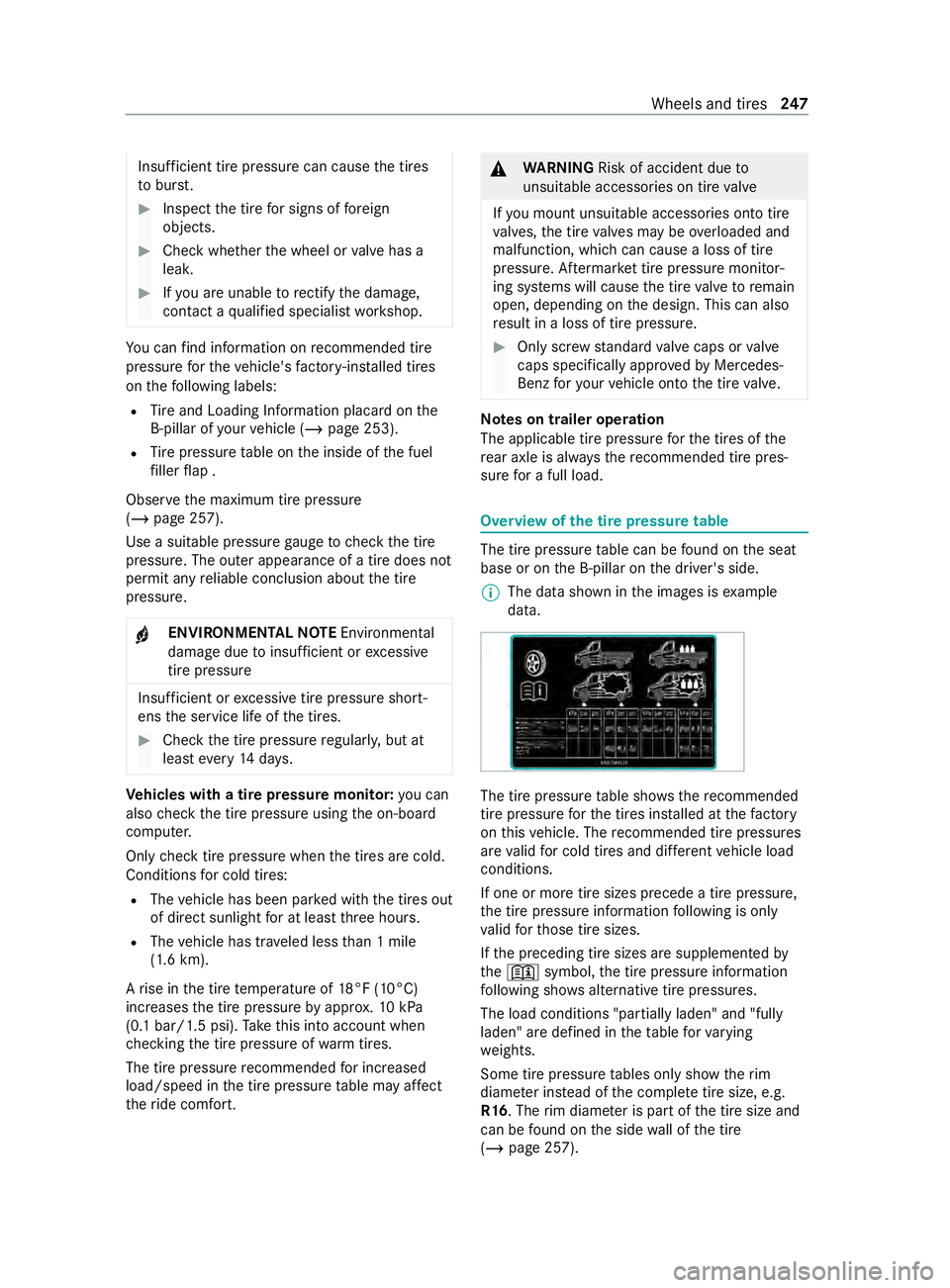
wofthe tirepressur etable The tir
epressur etable can be found on thes eat
base or on theB ‑pillar on thed rive r's side.
% The dat
ashown in thei mages is example
data. The tir
epressur etable sho ws therecommended
tir ep ressur efor thet ires ins talled at thef actory
on this vehicle. The recommended tir epressures
ar ev alid forc old tires and dif fere nt vehicle load
conditions.
If one or mor etires izes precede atirep ressure,
th et irep ressur einformation following is only
va lid fort hose tir esizes.
If th ep receding tir esizes ar esupplemented by
the 0091 symbol, thet irep ressur einformation
fo llowing sho wsalternativ etirep ressures.
The load condition s"partiall yladen "and "fully
laden "aredefine dinthetable forv arying
we ights.
Som etirep ressur etables onl yshowt he rim
diame teri ns tead of thec omple tetires ize, e.g.
R16.T herimd iame terisp artoft he tir esize and
can be found on thes ide wall of thet ire
(/ page257). Wheels and tires
247