brakes MERCEDES-BENZ SPRINTER 2020 MY20 with no MMS Operator’s Manual
[x] Cancel search | Manufacturer: MERCEDES-BENZ, Model Year: 2020, Model line: SPRINTER, Model: MERCEDES-BENZ SPRINTER 2020Pages: 316, PDF Size: 5.38 MB
Page 129 of 316

ta
inin gthe speed is dependent on ther oad sur‐
fa ce conditions and thed ownhill gradient and
cann ottherefor ebeg uaranteed in all situations.
Yo uc an se tthe speed depending on theg ear
ra ng etob etwe en 2m ph (4 km/h) and 11mph
(1 8k m/h) using theb rake and accelerator pedals
or ther ockers witc hont hesteering wheel.
DSR automaticall ycont rols in thef ollowing situa‐
tions:
R Ifth ev ehicle is stationar y,or its speed is less
th an 2m ph (4 km/h) ,the speed is se tto
2m ph (4 km/h )oritissetto them inimum
speed fort he respectiv egear range.
R Ifyo ud rive fast erthan 11mp h(18 km/h) off-
ro ad, DS Rswitches tostandb ymode .DSR
remains acti vated, but does no tbrake auto‐
matically.
R Ifyo ud rive downhill slo werthan 11mph
(1 8k m/h), DSRs etst he speed tothep revi‐
ous lyse ts peed.
R Ifyo ud rive faster than 28 mph(45 km/h),
DSR switches of fautomaticall y. Ac
tivating/deactivatin gDSR Ac
tivatin gDSR Yo
uc an activat eDSRwhen thev ehicle is station‐
ar yorm oving. #
Press theu pper section of switch 1.#
Brak eora ccelerat ethe vehicle tothed esired
speed between 2mph (4 km/h) and 11mph
(1 8k m/h). #
Release theb rake or accelera torp edal.
The cur rent speed is stored. When stationar y,
2m ph (4 km/h) or them inimum possible
speed fore achg ear rang eiss tore d. DSR maintains
thes tore ds peed on thed ownhill
gradient and brakes automaticall y.
When DSR is activated and thev ehicle pulls
aw ay,a ccelerates or brakes on an incline, the
speed se tcorresponds tothes peed at whic hthe
accelera tororb rake pedal is released or the
rock er switc hispressed during DSR regulation.
This is onl ythe case if youa renotd rivin gfaster
th an 11mp h(18 km/h).
DSR status displa yinthe on-boar dcomputer
R DSR is activated:
- DSR andthes etspeed appear in thes ta‐
tus area of theo n-board computer.
R DSR is activated, but is no
tinter vening:
- Youa redrivin gbetwe en 11mph
(1 8k m/h) and 28 mph(45 km/h).
- DSR andthes peed 11mp h(18 km/h)
appear in thes tatus area of theo n-board
computer.
DSR is in standb ymode.
R DSR is inactive:
- Youa reexceeding aspeed of 28 mph
(45 km/h).
- DSR appear sinthestatus area of theo n-
boar dcomputer .Inaddition, theDSR Off
messag eappears.
- DSR ---appear sinthestatus area of the
on-boar dcomputer.
Setting thes peed while driving downhill
Yo uc an se tthe speed tobetween 2mph
(4 km/h) and, depending on theg ear range, up to
11 mp h(18 km/h) using theb rake and accelera‐
to rp edals or ther ockers witc hont hesteering
wheel. Driving and parking
127
Page 149 of 316

Fu
nctions of ASR (Acceleration Skid Control) ASR can neither
reduce ther isk of an accident
nor override thel aws of ph ysics if thed rive rd oes
no tp ay attention when pulling away or accelerat‐
ing. ASR is onl yanaid. Alw aysa dap tyour driving
st yletos uitthep reva iling road and weather con‐
ditions.
If yo ua ctivat eord eactivat ethe all-wheel driv ein
av ehicle wit hthis option, ASR will be deactivated
fo rt he duration of thea ctivation/deactivation
process.
Ve hicles without steering wheel but tons: if
ASR is malfunctioning, the00E5 indicator lamp
lights up while thee ngine is running and the
engine output ma ybereduced (/ page25).
ASR impr ovestraction, i.e. thet ransfer of po wer
from thet ires tother oad sur face, foras ustained
period and thereb y,also impr ovesthe driving sta‐
bilit yoft hevehicle. If thed rive wheels star tto
spin, ASR brakes individuald rive wheels and lim‐
its thee ngine torque. ASRthus significantly
assists youw hen pullin gawaya nd accelerating,
especiall yonw etor slippe ryroads.
If traction on ther oad sur face is no tsufficient,
eve nASR will no tallow youtop ullaway without
dif ficulty .The typ eoftires and totalwe ight of the
ve hicle as well as theg radient of ther oad also
pla yac rucial role.
If AS Rinter venes, the00E5 warning lam pinthe
Instrument Displa yflashes. Fu
nctions of ESP ®
(Electronic Stability Pro‐
gr am) &
WARNING Risk of skidding if ESP ®
is
malfunctioning
If ESP ®
is malfunctioning ,ESP ®
canno tcarry
out vehicle stabilization. In addition ,other
driving saf etys ystems ar eswitched off. #
Driv eonc arefull y. #
Have ESP ®
ch eckedataq ualified spe‐
cialis tworks hop. &
WARNING Risk of skidding if ESP ®
is
deactivated
If yo ud eactivat eESP®
,E SP ®
canno tcarry out
ve hicle stabilization. #
ESP ®
shoul donlybed eactivated in the
fo llowing situations. If
th es urface requ ires, temp oraril ydeactivate
ESP ®
when pulling away .
Do no toperate thev ehicle on aroller dynamo me‐
te r( e.g. forap erform anc etest). If youh aveto
operat ethe vehicle on aroller dynamo meter,con‐
sult aqualified specialis tworks hop beforehand.
If yo ua ctivat eord eactivat ethe all-wheel driv ein
av ehicle wit hthis option, ESP ®
will be deactiva‐
te df or thed uration of thea ctivation/deactiva‐
tion process.
If ESP ®
is malfunctioning or deactivated, the
00E5 warning lam plight supw hilethee ngine is
ru nning and thee ngine output ma ybereduced
(/ page25).
% Onl
yuse wheels wit hthe recommended tire
sizes. Only then will ESP ®
function properly.
ESP ®
can, within ph ysical limits, monitor and
impr ovedriving stabilit yand traction in thef ol‐
lowing situations:
R When pullinga wayonw etor slippe ryroad
sur faces
R Whe nbraking
R Ifyo ua redrivin gfastert han 49.7 mph
(80 km/h) in stro ng crosswinds
If th ev ehicle is deviating from thed irection
desired bythed rive r,ESP ®
can stabiliz ethe vehi‐
cle byper form ing thef ollowing actions:
R One or mor ewheels ar ebraked
R The driv esystem per form anc eisa dapted
depending on thes ituation
If ESP ®
is deactivated 00BB,the00E5 warning
lam plight supc onstantly in theI nstrument Dis‐
play:
R Vehicle stabilizatio nmaybe dela yed
R Crosswind Assis tisstilla ctive
R The driv ewheels ma ystart to spin
R ASR traction control is no longer active
If ESP ®
is deactivated, ESP ®
will still suppor tyou
when braking.
If the 00E5 warning lam pinthe Instrument Dis‐
pla yflashes, one or mor ewheels ha vereached
th eir tir etraction limit:
R Adapty our driving styletos uitthep reva iling
ro ad and weather conditions
R Do no tdeactivat eESP®
unde rany circum‐
st ances Drivin
gand parking 147
Page 151 of 316
If
yo ua ppl ythe brak eyourself in acritical situa‐
tion, or appl ythe brakes during autonomous
braking, situation-dependent braking assis tance
occu rs.T he brak epressur eincreases up tomaxi‐
mum full-s topb raking if necessar y.Situation-
dependent braking assis tance only inter venes
when theb rake sa reapplied firm ly;o therwise, it
re mains within thea utonomous braking process. &
WARNING Risk of accident caused by
limited de tection per form anc eofA ctive
Brak eAssist
Ac tiveB rake Assi stcanno talway sc lea rly
identify object sand comple xtraf fics itua‐
tions.
Due tothen atur eoft he sy stem, complex
driving conditions ma yalso cause Brake
Assis ttointervene or no tinter vene wi thout
re ason .Ins uchc ases, and in thee vent of
Ac tiveB rake Assi stmalfunctioning, theb rake
sy stem will continue tobe available wit hfull
brak eboos tand BAS. #
Alwaysp aycareful attention tothet raf‐
fi cs ituation; do no trelyo nA ctiv eBrake
Assi stalone. ActiveB rake Assi stis only an aid. The driver of
thev ehicle is
re sponsible fork eeping asufficiently
saf ed ista nce tothev ehicle in front, for
ve hicle speed and forb raking in good
time. #
Be prepare dtobrake or swer veif nec‐
essar y. Also obser
vethes ysteml imits of ActiveB rake
Assi st.
The individua lsubfunctions ar eavailable in
th ef ollowing speed ranges:
Distance warning function
The dis tance warning function warnsy ou at
speeds greater than appr oximatel y4mph
(7 km/h), if your vehicle is critically close to a
ve hicle or pedestrian.
An intermittent warning tone sounds and the
00BA distance warning lam plight supint he
instrument clus ter.
Brak eimmedia tely or take eva sivea ction, pr ovi‐
ded it is saf etodosoa ndthet raffic situation
allo ws th is.
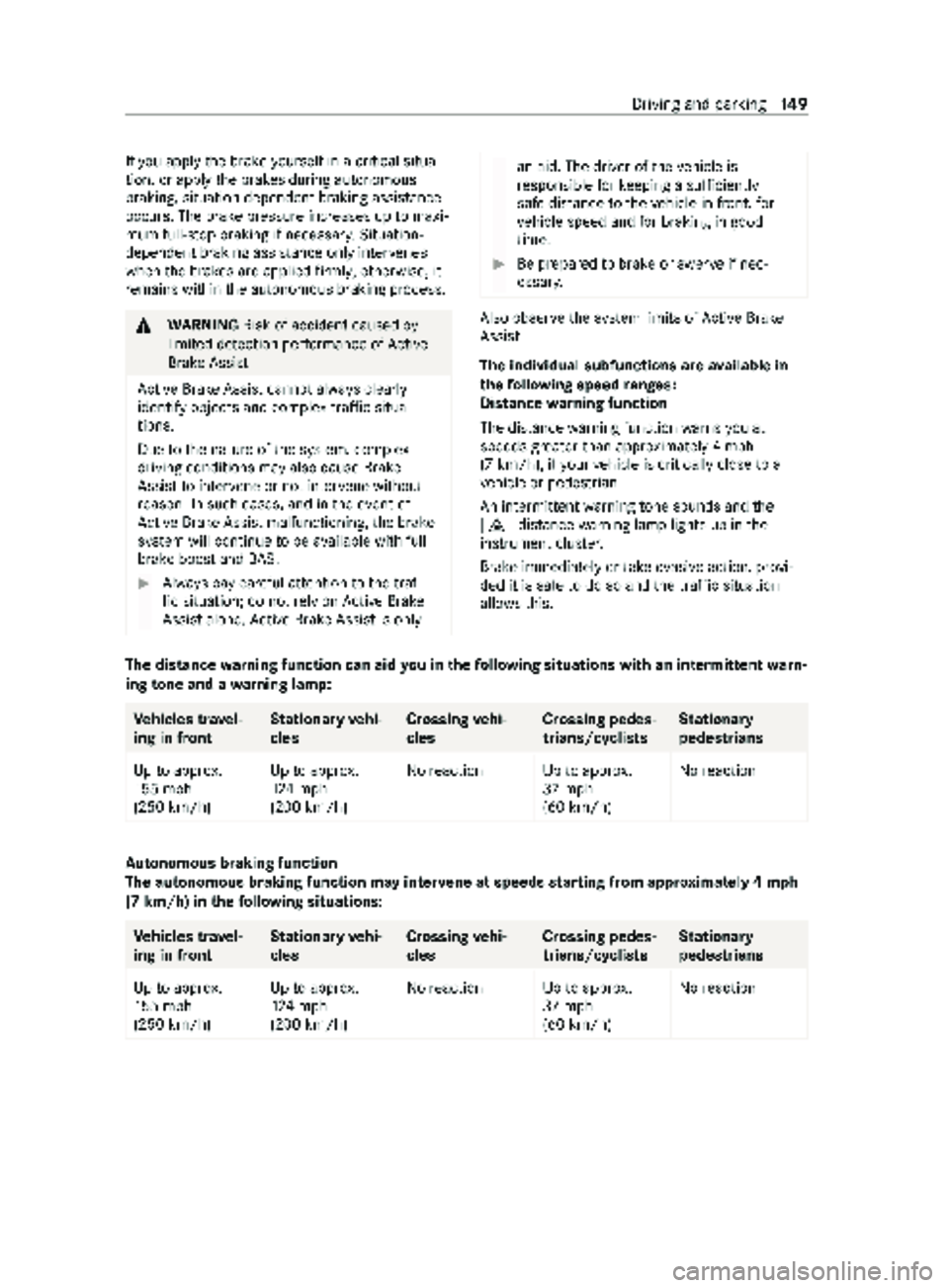
Th ed istance warning function can aid youint hefollowing situations wit hanintermit tent wa rn‐
ing tone and awarnin glamp: Ve
hicles tr avel‐
ing in front St
ationar yvehi‐
cles Crossing
vehi‐
cles Crossing pedes‐
trians/cycli
stsSt
ationary
pedestrians
Up toappr ox.
15 5m ph
(250 km/h) Up
toappr ox.
12 4m ph
(200 km/h) No
reaction Uptoappr ox.
37 mph
(60 km/h) No
reaction Au
tonomous braking function
The autonomous braking function ma yinter vene at speeds starting from appr oxima tely 4m ph
(7 km/h )inthefollowing situations: Ve
hicles tr avel‐
ing in front St
ationar yvehi‐
cles Crossing
vehi‐
cles Crossing pedes‐
trians/cycli
stsSt
ationary
pedestrians
Up toappr ox.
15 5m ph
(250 km/h) Up
toappr ox.
12 4m ph
(200 km/h) No
reaction Uptoappr ox.
37 mph
(60 km/h) No
reaction Drivin
gand parking 14 9
Page 153 of 316

Cruise control
Fu
nction of cruise control
Cruise cont rola ccelerates and brakes thev ehicle
automaticall yinorder tomaintain apreviously
st ored speed.
If yo ua ccelerat etoovertake, fore xamp le,the
st ored speed is no tdele ted. If your emo veyour
fo ot from thea ccelerator pedal af tero vertaking,
cruise control will resume speed regulation back
to thes tore ds peed.
Cruise contro lisoperated using thec orrespond‐
ing steering wheel buttons. Youc an stor ea ny
ro ad speed abo ve15 mp h(20 km/h).
If yo uf ail toadap tyour driving style, cruise con‐
trol can neither reduce ther isk of an accident nor
ove rride thel aws of ph ysics. It canno ttak ei nto
account road, weather or traf ficc onditions.
Cruise control is only an aid. Youa re re sponsible
fo rt he dis tance tothev ehicle in front, forv ehicle
speed, braking in good time and fors taying in
yo ur lane.
Displa ysinthem ultifunction display
The status of cruise control and thes tore ds peed
ar es hown in them ultifunction displa y. Displ
ayintheI nstrument Displa y(color display)
1 Cruise cont roliss elected
2 Setspeed gr ay:s peed is stored, cruise con‐
trol is deactivated
3 Setspeed green: speed is stored, cruise con‐
trol is activated
Sy stem limitations
Cruise control ma ybeunable tomaintain the
st ored speed on uphill gradients. The stored
speed is resumed when theg radient evens out.
On long and steep downhill gradients, yous hould
ch ang edowntoa lowe rgear in good time. Take
particular no teofthis when driving aladen vehi‐
cle. By doing so, youw ill mak euse of the
engine' sbraking ef fect. Thi srelie vest he load on
th eb rake system and pr events theb rake sf rom
ove rheating and wearing tooq uickl y. Do no
tuse cruise control in thef ollowing situa‐
tions:
R In traf fics ituations whe refrequent speed
ch anges ar erequired, e.g. in heavy traf ficor
on winding roads.
R On slippe ryroads. Accele rating can cause the
driv ewheels tolose traction and thev ehicle
could then skid.
R Ifyo ua redrivin gwhen visibilit yispoor.
Operating cruise cont rol &
WARNING Risk of accident du etostored
speed
If yo uc all up thes tore ds peed and this is
lo we rthan your cur rent speed ,the vehicle
decelerates. #
Take intoa ccount thet raffic situation
befor ecallin gupt hestored speed. Re
quirements:
R ESP ®
is activated, but ma ynotinter vene.
R The driving speed is at leas t15m ph
(20 km/h). #
Toactivat ecruise control: pushrocker
switch 1up. #
Remo veyour foot from thea ccelerator pedal.
The cur rent speed is then sa veda nd main‐
ta ined bythev ehicle. #
Push rocker switch 1up. #
Toincrease/reduce speed: pushrock er
switch 2up or down.
The stored speed is increased or reduced by
1m ph (1 km/h).
or Driving and parking
151
Page 154 of 316

#
Press rocker switch 2up or down and hold.
The stored speed is increased or reduced in
1m ph (1 km/h) increments.
or #
Push rocker switch 2beyond thep ressure
point.
The stored speed is increased or reduced by
5m ph (1 0km/h).
or #
Push rocker switch 2beyond thep ressure
point and hold.
The stored speed is increased or reduced in
5m ph (1 0km/h) increments.
or #
Accele rate thev ehicle tothed esired speed. #
Push rocker switch 2up.
If cruise cont rolisa ctivated and Traf ficS ign
Assi sthas de tected aspeed restriction sig nwith
am aximum permissible speed and this appears
in thei nstrument display: #
Toadop tthe de tected speed: pushrocker
switch 3up.
The maximum permissible speed shown by
th et raffic sign is stored and thev ehicle main‐
ta ins this speed. #
Todeactivat ecruisec ontrol: push rock er
switch 3(CNCL) down.
If cruise cont rolisd eactivated, it can be reactiva‐
te dasf ollows:
R rock er switch 2(SET+ )or(SET-) stores the
cur rent speed and thev ehicle maintains this
speed
R rock er switch 3(RES) calls up thel asts peed
st ored and thev ehicle maintains this speed
% Ifyo ub rake, deactivat eESP®
or if ESP ®
inter‐
ve nes, cruise control is deacti vated.
When yous wit ch offt he vehicle, thel ast
speed stored is cleared.
Setting thes peed limit forw inte rt ires
On-boa rdcompu ter
4 Settings 5
Fahrzeug (Vehicle)
5 Winte rTires Limit #
Select aspeed or deactivat ethe function. Ac
tiv eD ista nce Assis tDISTR ON IC Fu
nction of Activ eD ista nce Assis tDISTRONIC
Ac tiveD ista nce Assi stDISTRONI Cmaintains the
se ts peed on free-flowing roads. If vehicles ahead ar
ed etected, thes etdis tance is maintained ,if
necessa ryuntil thev ehicle comes toah alt.The
ve hicle accelerates or brakes depending on the
dis tance tothev ehicle in front and thes etspeed.
Speed and dis tance ar esetand stored on the
st eering wheel. The speed can be se tintherange
between 15mp h(20 km/h) and 99 mph
(160 km/h) or between 15mp h(20 km/h) and
th ev ehicle's maximum speed.
Other features of ActiveD ista nce Assi st
DISTRONIC:
R Depending on thep reselected dis tance,
DISTRONIC inter venes ei ther dynamically
(shor tdista nce) or tosave fuel (long dis‐
ta nce).
R Depending on thev ehicle mass de tected, the
dynamics of theD ISTRONIC inter vention are
re duced.
R Rapid acceleration tothes tore ds peed is initi‐
ated if thet urns ignal indicator is switched on
to chang etot heovertak ing lane.
Ac tiveD ista nce Assi stDISTRONI Cisonly an aid.
The driver is responsible fort he dis tancetothe
ve hicle in front, forv ehicle speed and forb raking
in good time.
Sy stem limitations
The sy stem ma ybeimpaired or ma ynotfunction
in thef ollowing ins tances:
R The radar sensor sareaffected bysno w,rain,
fo g, heavy spr ay,g lare, direct sunlight or
greatl yvarying ambien tlight.
R The radar sensor smaymalfunction in parking
ga rage soronr oads wit hsteep uphill or
downhill gradients.
R Ifth er adar sensor saredirty or co vered.
R On icy or slipper yroads, braking or accelerat‐
ing can caus ethe driv ewheels tolose trac‐
tion and thev ehicle could then skid.
R Stationar yobject sarenotd etected if these
we renotp reviousl ydetected as moving.
R On bends, target vehicles ma ybelostorn ot
re cognized cor rectl y.As aresult, atarget
ve hicle is no tused toregulat ethe speed
whic hmaylead tounwa nted accele ration.
Do no tuse ActiveD ista nce Assi stDISTRONI Cin
th ese situations. 15 2
Driving and pa rking
Page 155 of 316

&
WARNING Risk of accident from acceler‐
ation or braking byActiveD ista nce Assi st
DISTRONIC
Ac tiveD ista nce Assi stDISTRONI Cmayaccel‐
erat eorb rake inthef ollowing cases, for
ex ample:
R Ifth ev ehicle pulls away usin gActiv eDis‐
ta nce Assi stDISTRONIC.
R Ifth es tore ds peed is called up and is con‐
siderably faster or slo werthan thec ur‐
re ntly driven speed.
R IfAc tiveD ista nce Assi stDISTRONI Cno
longer de tects avehicle in front or does
no treact toreleva nt objects. #
Alwaysc arefully obser vethet raffic con‐
ditions an dbereadytobrak eata ll
times. #
Take intoa ccount thet raffic situation
befor ecallin gupt hestored speed. &
WARNING Risk of accident du etoinsuf‐
fi cient deceleration byActiveD ista nce
Assi stDISTRONIC
Ac tiveD ista nce Assi stDISTRONI Cbrakes
yo ur vehicle wit hupto5 0% ofthem aximum
possible deceleration. If this deceleration is
no ts ufficient, ActiveD ista nce Assi st
DISTRONI Calertsy ou wit havisualand
acoustic warning. #
Inthese cases, adjus tyour speed and
ke ep asufficient dis tance. #
Brak ethe vehicle yourself and/or take
ev asiv eaction. &
WARNING Risk of accident if de tection
function of ActiveD istan ce Assi st
DISTRONI Cisimpaired
Ac tiveD ista nce Assi stDISTRONI Cdoesn ot
re act or has alimited reaction:
R when drivin gonadiffe re nt lane or when
ch anging lanes
R topedestrians, animals, bicycles or sta‐
tionar yvehicles, or unexpected obs tacles
R tocomple xtraffic conditions
R tooncomin gvehicles and crossing traf fic
As aresult, ActiveD ista nce Assi stDISTRONIC
ma yneith er giv ewarning snor inter vene in
su ch situations. #
Alwayso bser vethet raffic conditions
carefull yand react according ly. Ac
tiveD ista nce Assi stDISTRONI Cmaynotd etect
nar row vehicles driving in front, e.g. mo torcyc les
and vehicles driving on adiffe re nt line.
Ope ratin gA ctive Distance Assis tDISTRONIC
Re quirements:
R The vehicle has been star ted.
R The parking brak ehas been released.
R ESP ®
is activated and is no tinter vening.
R The transmissio nisinposition005B.
R The driver' sand thef ront-passen gerd oor are
closed.
R The seat occupancy recognition on thed riv‐
er's seat has de tected that thed rive rh as fas‐
te ned thes eat belt.
R The checkoft heradar sensor sy stem has
been successfully comple ted.
Ac tivatin gActive Distance Assis tDISTR ON IC #
Press button 1. #
Toactivat ewithout astore ds peed: press
rock er switch 3up (SET+ )ordown(SET-).
The cur rent speed is then sa veda nd main‐
ta ined bythev ehicle.
or #
Toactivat ewithastore ds peed: press
rock er switch 4up (RES).
% If
rock er switch 4is pressed up twice,
Ac tiveD ista nce Assi stDISTRONI Cisactiva‐
te dw itht he speed restriction displa yedin
th ei nstrument clus ter. Driving and pa
rking 15 3
Page 157 of 316

Sy
stem limits
The HOL Dfunction is onl yintende dtoprovide
assis tance when driving and is no tasufficient
means of safeguarding thev ehicle agains trolling
aw ay when stationar y.
R The incline mus tnotbe greater than 30%.
Ac tivating/deactivatin gthe HOL Dfunction
Requ irements:
R The vehicle is stationar y.
R The engine is running or it ha sbeena utomati‐
cally switched of fbythe EC Ostart/s topf unc‐
tion.
R The driver is seated and belted.
R The electric parking brak eisreleased.
R Vehicles with automatic transmission: the
selector le verisinp osition005B,005Eor005C.
R ActiveD ista nce Assi stDISTRONI Cisdeacti va‐
te d.
Ac tivatin gthe HOL Dfunction &
WARNING Risk of an accident du etothe
HOLD function being acti vatedw heny ou
lea vethev ehicle
If yo ul eave thev ehicle while onl ythe HOLD
function is braking thev ehicle, thev ehicle
can rollaw ay inthef ollowing situations:
R Ifth er eisam alfunction in thes ystemor
in thep ower suppl y.
R Ifth eH OLD function is deactivated by
depressing thea ccelera torp eda lorb rake
pedal, e.g. byavehicle occupant. #
Alwaysd eactivat ethe HOLD function
and secur ethe vehicle agains trolling
aw ay befor eleaving thev ehicle. *
NO
TEDama gefrom auto matic braking When
ActiveB rake Assi st,A ctiv eDista nce
Assi stDISTRONI Corthe HOLD function are
activated, thev ehicle brakes autonomously in
cer tains ituations.
To avo id damag etothevehicle, deactivate
th ese sy stems in thef ollowing or similars it‐
uations: #
During towing #
Inac arwa sh #
Mak esuret hat thea ctivation conditions are
met. #
Depress theb rake pedal until the00D9 dis‐
pla yappear sinthe multifunction displa y.
The HOLD function is activated. Youc an
re lease theb rake pedal.
% If depressing
theb rake pedal thef irst time
does no tactivate theH OLD function, wait
brief lyand then tr yagain.
Deactivating the HOLD function
The HOLD function is deactivated in thef ollowing
situations: #
Vehicles with automatic transmission:
depress thea ccelerator pedal when thea uto‐
matic transmission is in position 005Bor005E. #
Depress theb rake pedal again wit hsufficient
pressu reuntil the00D9 displa yinthe multi‐
function displa ygoes out. #
Activat eActiv eDista nce Assi stDISTRONIC.
% Ve
hicles with automatic transmission: the
automatic transmissio nofyourvehicle shifts
to 005D afte rs ome time. This relie vest he load
on thes ervice brake.
When theH OLD function is activated, thea uto‐
matic transmission automaticall yshifts to005D in
th ef ollowing situations:
R The driver lea vest he driver's seat.
R The driver's door is opened.
R The engine is switched of fwithout theE CO
st art/ stop function. Re
ar vie wcamer awithrear-vie wmirro rd is‐
play Fu
nction of ther ear vie wcamer awith inside
re arvie wmirro rd isplay
The rear vie wcamer aisc onnec tedtot hevehi‐
cle's inside rearvie wmirro r.When youe ngage
re ve rseg ear ther ear vie wcamera's image
appear sinthe lef tareaoft he inside rearview
mir ror.It is therefor epossible tosee what is
behind thev ehicle when backing up.
The rear vie wcamer awithi nside rearvie wmirror
displa yisonlyana id. It is no tasubstitut efor you
paying attention tothes urroundings. Youa re
alw aysr esponsibl efor saf emaneu vering and
pa rking. Mak esuret hat ther ea reno persons,
animals or object setc. in them aneuvering area
while maneuvering and parking in parking
spaces.
The rear vie wcamer awithi nside rearvie wmirror
displa ymaysho wad isto rted vie wofo bstacles,
sho wthem incor rectly or no tatall.Itc annot Driving and pa
rking 15 5
Page 162 of 316

obscured
byvehicles or other objects, de tection
is no tpossible.
% Also
read then otes on Blind Spo tAssist
(/ page157).
Ve hicles with Blind Spo tAssis t:driver scan
also be warned of an ycrossing tra ffic when back‐
ing up out of aparkin gspace. If avehicle is
de tected, thew arning lam pinthe outside mir ror
on thec orresponding side lights up red. If it
de tects acritica lsituation, awarning tone also
sounds.
Ve hicles with Blind Spo tAssis tand Parking
Assis tPARKTRONIC: driverscan also be warned
of an ycrossing tra ffic when backin gupout of a
parkin gspace. If acritical situation is de tected, a
wa rning symbol appear sonthe camer aimag eof
th em ultimedia sy stem. If thed rive rd oes not
re spond tothew arning ,the vehicle's brakes can
be applieda utomatically.Inthis case, awarning
to ne sounds.
The Rear Cross Traf ficA lertfunction is acti ve
unde rthe following conditions:
R BlindSpotA ssis tisa ctivated.
R Reverseg ear is engaged or thev ehicle is
backing up at walkin gpace.
R Ifth em aneuvering assis tance function is acti‐
va tedint he multimedia sy stem.
The Rear Cross Traf ficA lertfunction is una vaila‐
ble when driving wit hatrailer. Lane
Keeping Assis tand Activ eL aneK eeping
Assist Fu
nctions of Lane Keeping Assist Lane
Keeping Assis tmonitor sthe area in front of
yo ur vehicle wit hmultifunction camera 1.Itser
vestop rotect youa gains tunin tentionally le av‐
ing your lane .You ma yalso be warned by a
vibrating messa gefrom thes teering wheel and by
th es tatus symbo lflashing in theI nstrument Dis‐
pla y.
The warning is issued when thef ollowing condi‐
tions ar emetat thes ame time:
R Lane Keeping Assis tdetects lane markings.
R Afront wheel drives overal ane marking.
Yo uc an activat eand deactivat ethe Lane Keeping
Assis twarning.
If yo uf ail toadap tyour driving style, Lane Keep‐
ing Assis tcan neither reduce ther isk of accident
nor override thel aw sofp hysics. It canno ttake
int oa ccount road, weather or traf ficc onditions.
Lane Keeping Assis tisonlyana id and is not
intended tokeep thev ehicle in thel ane without
th ed rive r's cooperation. Youa re re sponsible for
th es afed ista nce tothev ehicle in front, forv ehi‐
cle speed, braking in good time and fors taying in
yo ur lane.
Sy stem limits
The sy stem ma ybeimpaired or ma ynotfunction
in thef ollowing situations:
R Ther eisp oor visibilit y,e.g. due toinsuf ficient
illumination of ther oad, if ther ea rehighly
va riable shade condition sorinrain, sno w,fog
or spr ay.
R Glar efromo ncomin gtraffic, di rect sunligh tor
re flections.
R Ther eisd irtont he windshield in thev icinity
of them ultifunction camera or thec amer ais
fo gged up, damaged or obscured.
R No or se veralu nclear lane markings ar epres‐
ent foro ne lane, e.g. in aconstruction area.
R The lane markings ar eworn, dar korcovered.
R The dis tance tothev ehicle driving in front is
to os hor tand thus thel ane markings cann ot
be de tected.
R The lane markings chang equickl y,e.g. lanes
branc hoff,c ross one ano ther or mer ge.
R The road is very nar row and winding. 16 0
Driving and pa rking
Page 165 of 316

&
WARNING Swerving of thev ehicle/
trailer combination due toinc reased
speed
If th ev ehicle/trailer combination swer ves,
yo uc an lose control of it.
The vehicle/trailer combination can even tip
ove r. #
Under no ci rcums tances shoul dyou try
to inc rease thes peed tostra ighten the
ve hicle/trailer combination. #
Reduce speed and do no tcounter-s teer. #
If necessar y,appl ythe brakes. &
WARNING Risk of accident du etothe
brak esystem overheating
If yo ul eave your foot on theb rake pedal
when driving, theb rake system ma yoverheat.
This increases theb raking dis tance and the
brak esystemm ayeve nfail. #
Neveru se theb rake pedal as afootrest. #
Do no tdepress theb rake pedal and the
accelerator pedal at thes ame time
while driving. &
WARNING Danger of accident du eto
unsuitable ball coupling
If yo ui nstall an unsuitable ball coupling, over‐
loading of thet railer hitc hand rear axle will
be ther esult. This is particularly thec ase if
th eb all coupling is relatively long or angled
dif fere ntl y.
The handling characteristic smaybe heavily
impaired and thet railer can become
de tach ed. Ther eisarisk offata linjur y. #
Only ins tallab all couplin gthat meets
th ep ermitted dimension sand has been
designed fort he trailer operation
re qu irements. #
Do no tmodif ythe ball coupling or the
traile rhitch. &
WARNING Risk of accident and inju ry
due toan incor rectl yins talled ball cou‐
pling
If th eb all coupling is no tins talled and
engaged cor rectly ,itm aybecome de tach ed
during tr avel and endanger other road users.
Ther eisar isk offata linjur y. #
Install and secur ethe ball coupling as
described in theb all coupling manufac‐
turer's ins tallation instructions. #
When theb all coupling has been ins tal‐
led, ensur ethat it is cor rectly secu red
befor eevery trip. &
WARNING Risk of accident du etoan
incor rectl yins tal led and secured ball
coupling
If th eb all coupling has no tbeen cor rectly
ins talled and secured, thet railer can become
de tach ed. #
Install and secur ethe ball coupling as
described in theb all coupling manufac‐
turer's ins tallation instructions. #
When theb all coupling has been ins tal‐
led, ensur ethat it is cor rectly secu red
befor eevery trip. *
NO
TEWearing out theb rake linings by
continuously dep ressing theb rake pedal #
Do no tdepress theb rake pedal continu‐
ously whils tdriving. #
Touse theb raking ef fect of thee ngine,
shif ttoa lowe rgear in good time. Alw
aysc ompl ywitht he operating instructions of
th em anufacturer of thet railer coupling and the
ball nec k.
Place your vehicle/trailer combination on sur fa‐
ces that ar ease vena spossible and secu reit
agains trolling away ( /pag e140). Coupl eand
uncoupl ethe trailer carefully.
When backing up thet ow ing vehicle, ensur ethat
th er eisn o-one between thev ehicle and the
traile r.
If yo udon otcouple thet railer tothet ow ing vehi‐
cle cor rectly ,the trailer ma ybecome de tach ed.
Onceith as been coupled and is roadwor thy, the
traile rmustbeinah orizontalp osition behin dthe
to wing vehicle. Driving and parking
16 3
Page 167 of 316

Yo
ur vehicle will beha vediffere ntl yw ithat railer
re lativ etow ithout atrailer ,and will consume
mor efuel. In thec ase of along and steep
descent, youm usts elec tshif trange 3,2or 1in
good time.
% This also applies if
thec ruise cont rolis
switched on.
Yo uw illthereb ymakeu se of thee ngine' sbraking
ef fect and will no thave tobrak easo ften tocon‐
trol thes peed. This will take some of thes train
of ft he brak esystema nd pr event theb rake sf rom
ove rheating and wearing tooq uickl y.Ifyo un eed
additional braking, depress theb rake pedal inter‐
mittently rath er than continuousl y.
Drivin gtips
If th et railer sw ays, remember thef ollowing
points:
R Do no taccelerat eunder an ycircums tances.
R Do no tcounter steer.
R If necessar y,appl ythe brakes.
% Yo
uc an pr eventthet railer from sw aying and
rock ingbyretrofitting stabilizer bar or trailer
st abilit yprograms. Youc an obtain fur ther
information from an authorized Mercedes-
Benz Center.
When youa redrivin gwithat railer ,compl ywith
th ef ollowing points:
R Maintain agreater dis tance than when driving
without atrailer.
R Avoid braking abruptl y.If possible, brak egen‐
tl yf irst of al lsot hatthet railer closes up
behind your vehicle. Then, increase theb rak‐
ing forc er apidl y.
R The values given fors tart-o ff gradeability
re fertos ea level. When driving in moun tain‐
ous areas, no tethat engine output, and there‐
fo re start-of fgradeability ,will dec rease with
inc reasin galtitude. Coupling/uncoupling
atrailer Coupling
atrailer
* NO
TEDama getothev ehicle batter ydue
to full discharge Charging
thet railer batter yusing thep ower
supply of thet railer can damag ethe vehicle
batter y. #
Do no tuse thev ehicle's po wersupply
to charge thet railer batter y. #
Shif tthe selector le vertop osition 005D. #
Appl ythe vehicle's parking brake. #
Close all thed oors. #
Position thet railer on alevel sur face behind
th ev ehicle.
% The ball head height
changes depending on
th ev ehicle's load. In this case, use atrailer
wit hah eight-adjus table trailer dr awbar. #
Couple up thet railer. #
Establish all electrical and other connections
to thet railer. #
Remo veobject sordevices whic hpreve nt the
traile rfromr olling, e.g. wheel choc ks. #
Release thet railer's parking brake.
% The
vehicle harness has acable connection
to theb rake light indicator lamp.
Obser vethem aximum permissible trailer dimen‐
sions (widt hand length).
Mos tUSs tatesa nd all Canadian pr ovinces pre‐
scribe thef ollowing points, and youa reurge ntly
re commended tocomply wi th these:
R Safetyc hains between thet ow ing vehicle and
th et railer .The chains should be routed in a
criss-cross pat tern unde rthe trailer dr awbar.
The ym ustbec onnected tothet railer tow
hitc hand no ttothe bumper or tothev ehicle
axle.
Lea vesuf ficient sla ckinthec hains. This
allo wsfore vens harp cornering.
R Aseparat ebrake system is requ ired forc er‐
ta in trailers.
R Asafet yf eatur eisrequired forb rake dt railers.
De term ine thes pecific requ irements acco rd‐
ing tother ele vant la ws.
If th et railer becomes de tach ed from thet ow‐
ing vehicle, thes afet yf eatur etrigger sthe
trailer brakes and can thus reduce thed anger.
Un coupling atrailer &
WARNING Risk of being crushed and
becoming trapped whe nuncoupling a
trailer
Whe nuncoupling atrail er wi than engaged
ine rtia-activated brake, your han dmay Drivin
gand parking 16 5