seats MERCEDES-BENZ SPRINTER 2020 MY20 with no MMS Operator’s Manual
[x] Cancel search | Manufacturer: MERCEDES-BENZ, Model Year: 2020, Model line: SPRINTER, Model: MERCEDES-BENZ SPRINTER 2020Pages: 316, PDF Size: 5.38 MB
Page 67 of 316

&
WARNING Risk of inju ryfrom adju sting
th ev ehicle settings while thev ehicle is in
motion
Yo uc oul dlose control of thev ehicle in the
fo llowing situations:
R ifyo ua djus tthe driver's seat, theh ead
re stra int ,the steering wheel or them irror
while thev ehicle is in motion
R ifyo uf asteny our seat belt whilet hevehi‐
cle is in motion #
Befor estarti ngthee ngine: adjus tthe
driver's seat, theh ead restra int ,the
st eering wheel or them irro ra nd fast en
yo ur seat belt. &
WARNING Risk of becoming trapped if
th es eat height is adjus tedc arelessly
If yo ua djus tthe seat height carelessly ,you or
ot her vehicle occupants could be trapped and
th ereb yinjured.
Children in particular could accidentall ypress
th ee lectrical seat adjustmen tbuttons and
become trapped. #
While moving thes eats, mak esuret hat
hands or other body parts do no tget
unde rthe le vera ssembly of thes eat
adjustmen tsystem. &
WARNING Risk of inju rydue tohead
re stra int sw hicha renotins talled or are
adjus tedi ncor rectly
If hea drestraints ar enotins talled or are
adjus tedi ncor rectly ,the head restra int sc an‐
no tp rovide pr otection as intended.
Ther eisani ncreased risk of injur yinthe
head and nec karea, e.g. in thee vent of an
accident or when braking. #
Alwaysd rive wit hthe head restra ints
ins talled. #
Befor edriving off, mak esuref or every
ve hicle occupant that thec enter of the
head restra int supports theb ackoft he
head at about eyel eve l. Do no
tinter chang ethe head restra int soft he
front and rear seats. Otherwise, youw ill no tbe
able tosetthe height and inclination of theh ead
re stra int stot he cor rect position. Using
theh ead restra int fore -and-af tadjustment,
adjus tthe head restra int so that it is as close to
th eb ackoft he head as possible. &
WARNING Risk of inju ryor deat hdueto
incor rect sea tposition
The sea tbeltd oesn otoffert he intended le vel
of pr otection if youh ave notm ove dthe seat
backres ttoana lmostvertical position.
When braking or in thee vent of an accident,
yo uc oul dslide unde rneat hthe seat belt and
sus tain abdominal or nec kinjuries, fore xam‐
ple. #
Adjus tthe seat properly befor ebegin‐
ning your journe y. #
Alwayse nsur ethat thes eat backres tis
in an almos tvertical position and that
th es houlder section of your seat belt is
ro uted across thec enter of your shoul‐
der. *
NO
TEDama getothes eats when moving
th es eats back The seats ma
ybedamaged byobject swhen
moving thes eats bac k. #
When moving thes eats bac k,mak esure
th at ther ea reno object sinthefoot we ll,
under or behin dthe seats. 1
Seat fore -and-af tposition
2 Seatheight
3 Seatbackres tinclination
% Depending on
thes eat model, cer taina djust‐
ment options ma ynotbe available. Seat
sand stow age 65
Page 68 of 316

#
Tosetthe sea tfore-and-af tadjustment:
ra ise le ver1and slid ethe seat int othe
re qu ired position. #
Ensur ethat thes eat is engaged. #
Tosetthe sea theigh t:ke ep on pressing or
pulling le ver2until ther equired seat height
has been reached. #
Tosetthe sea tbackres tinclination: rotate
handwheel 3forw ards and backwards until
th er equired position has been reached. Ad
justin gthe fron tseats mechanicall y(with
Seat Comfor tPacka ge) &
WARNING Risk of becoming trapped if
th es eats ar eadjus tedbyc hildren
Childre ncould becom etrapped if they adjust
th es eats, particularly when unattended. #
When leaving thev ehicle, alw ayst ake
th eS martK eywit hyou and loc kthe
ve hicle. #
Neverlea ve children unat tende dint he
ve hicle. &
WARNING Risk of becoming trapped
whe nadjusting thes eats
When youa djus tas eat,you or other vehicle
occupants could become trapped, e.g. on the
seat guide rail. #
When adjustin gaseat, mak esuret hat
no one has an ybody parts in thes weep
of thes eat. Obser
vethes afet yn otes on "Airbags "and "Chil‐
dren in thev ehicle". &
WARNING Risk of accident du etothe
driver's seat no tbeing engaged
If th ed rive r's seat is no tengaged, it could
mo veunexpectedl ywhile thev ehicle is in
motion.
This could cause youtol ose control of the
ve hicle. #
Alwaysm akes uret hat thed rive r's seat
is engaged befor estartin gt he vehicle. &
WARNING Risk of inju ryfrom adju sting
th ev ehicle settings while thev ehicle is in
motion
Yo uc oul dlose control of thev ehicle in the
fo llowing situations:
R ifyo ua djus tthe driver's seat, theh ead
re stra int ,the steering wheel or them irror
while thev ehicle is in motion
R ifyo uf asteny our seat belt whilet hevehi‐
cle is in motion #
Befor estarti ngthee ngine: adjus tthe
driver's seat, theh ead restra int ,the
st eering wheel or them irro ra nd fast en
yo ur seat belt. &
WARNING Risk of becoming trapped if
th es eat height is adjus tedc arelessly
If yo ua djus tthe seat height carelessly ,you or
ot her vehicle occupants could be trapped and
th ereb yinjured.
Children in particular could accidentall ypress
th ee lectrical seat adjustmen tbuttons and
become trapped. #
While moving thes eats, mak esuret hat
hands or other body parts do no tget
unde rthe le vera ssembly of thes eat
adjustmen tsystem. &
WARNING Risk of inju rydue tohead
re stra int sw hicha renotins talled or are
adjus tedi ncor rectly
If hea drestraints ar enotins talled or are
adjus tedi ncor rectly ,the head restra int sc an‐
no tp rovide pr otection as intended.
Ther eisani ncreased risk of injur yinthe
head and nec karea, e.g. in thee vent of an
accident or when braking. #
Alwaysd rive wit hthe head restra ints
ins talled. #
Befor edriving off, mak esuref or every
ve hicle occupant that thec enter of the
head restra int supports theb ackoft he
head at about eyel eve l. Do no
tinter chang ethe head restra int soft he
front and rear seats. Otherwise, youw ill no tbe
able tosetthe height and inclination of theh ead
re stra int stot he cor rect position. 66
Seats and stowage
Page 69 of 316

Using
theh ead restra int fore -and-af tadjustment,
adjus tthe head restra int so that it is as close to
th eb ackoft he head as possible. &
WARNING Risk of inju ryor deat hdueto
incor rect sea tposition
The sea tbeltd oesn otoffert he intended le vel
of pr otection if youh ave notm ove dthe seat
backres ttoana lmostvertical position.
When braking or in thee vent of an accident,
yo uc oul dslide unde rneat hthe seat belt and
sus tain abdominal or nec kinjuries, fore xam‐
ple. #
Adjus tthe seat properly befor ebegin‐
ning your journe y. #
Alwayse nsur ethat thes eat backres tis
in an almos tvertical position and that
th es houlder section of your seat belt is
ro uted across thec enter of your shoul‐
der. *
NO
TEDama getothes eats when moving
th es eats back The seats ma
ybedamaged byobject swhen
moving thes eats bac k. #
When moving thes eats bac k,mak esure
th at ther ea reno object sinthefoot we ll,
under or behin dthe seats. Sample imag
eofcomfor tsuspension seat
1 Seat cushion length
2 Seat backres tinclination
3 Seat height
4 Seat cushion inclination
5 Seat fore -and-af tposition 6
Seatsuspension
7 Vibration limiting
% Depending on
thes eat model, cer taina djust‐
ment options ma ynotbe available. #
Toadjus tthe sea tcushion length: raise
le ver 1and slid ethe front par tofthe seat
cushion forw ards or backwards. #
Tosetthe sea tbackres tinclination: rotate
handwheel 2forw ards and backwards until
th er equired position has been reached. #
Tosetthe sea theigh t:pull or push le ver3
until ther equired position has been reached. #
Tosetthe sea tcushion inclination: rotate
handwheel 4forw ards and backwards until
th er equired position has been reached. #
Tosetthe sea tfore-and-a ftadjustment:
ra ise le ver5and slid ethe seat int othe
re qu ired position. #
Ensur ethat thes eat is engaged. #
Tosetthe sea tsuspension: take thew eight
of ft he seat. #
On handwheel 6,settheb ody weight (8 8lb
(40 kg)to2 64lb (120 kg)) so that thes eat
suspension workso ptimall y.Ifyo us et a
higher weight ,the seat suspension will
become firm er.T he seat will then no tvibrate
as much. If thes eat vibrates of tena nd signifi‐
cantly ,you can engag eitinthe lowerarea. #
Toengag evibration limiting: turnlever 7
upwards.
The next time thes eat vibrates, it will engage. #
Torelease vibration limiting: turnlever 7
to ther ight.
The seat can vibrate. Ad
justin gthe fron tseate lect rica lly &
WARNING Risk of becoming trapped if
th es eats ar eadjus tedbyc hildren
Childre ncould becom etrapped if they adjust
th es eats, particularly when unattended. #
When leaving thev ehicle, alw ayst ake
th eS martK eywit hyou and loc kthe
ve hicle. #
Neverlea ve children unat tende dint he
ve hicle. The seats can be adjus
tedw hile thei gnition is
off. Seats and
stowage 67
Page 70 of 316

&
WARNING Risk of becoming trapped
whe nadjusting thes eats
When youa djus tas eat,you or other vehicle
occupants could become trapped, e.g. on the
seat guide rail. #
When adjustin gaseat, mak esuret hat
no one has an ybody parts in thes weep
of thes eat. Obser
vethes afet yn otes on "Airbags "and "Chil‐
dren in thev ehicle". &
WARNING Risk of accident du etothe
driver's seat no tbeing engaged
If th ed rive r's seat is no tengaged, it could
mo veunexpectedl ywhile thev ehicle is in
motion.
This could cause youtol ose control of the
ve hicle. #
Alwaysm akes uret hat thed rive r's seat
is engaged befor estartin gt he vehicle. &
WARNING Risk of inju ryfrom adju sting
th ev ehicle settings while thev ehicle is in
motion
Yo uc oul dlose control of thev ehicle in the
fo llowing situations:
R ifyo ua djus tthe driver's seat, theh ead
re stra int ,the steering wheel or them irror
while thev ehicle is in motion
R ifyo uf asteny our seat belt whilet hevehi‐
cle is in motion #
Befor estarti ngthee ngine: adjus tthe
driver's seat, theh ead restra int ,the
st eering wheel or them irro ra nd fast en
yo ur seat belt. &
WARNING Risk of becoming trapped if
th es eat height is adjus tedc arelessly
If yo ua djus tthe seat height carelessly ,you or
ot her vehicle occupants could be trapped and
th ereb yinjured.
Children in particular could accidentall ypress
th ee lectrical seat adjustmen tbuttons and
become trapped. #
While moving thes eats, mak esuret hat
hands or other body parts do no tget
unde rthe le vera ssembly of thes eat
adjustmen tsystem. &
WARNING Risk of inju rydue tohead
re stra int sw hicha renotins talled or are
adjus tedi ncor rectly
If hea drestraints ar enotins talled or are
adjus tedi ncor rectly ,the head restra int sc an‐
no tp rovide pr otection as intended.
Ther eisani ncreased risk of injur yinthe
head and nec karea, e.g. in thee vent of an
accident or when braking. #
Alwaysd rive wit hthe head restra ints
ins talled. #
Befor edriving off, mak esuref or every
ve hicle occupant that thec enter of the
head restra int supports theb ackoft he
head at about eyel eve l. Do no
tinter chang ethe head restra int soft he
front and rear seats. Otherwise, youw ill no tbe
able tosetthe height and inclination of theh ead
re stra int stot he cor rect position.
Using theh ead restra int fore -and-af tadjustment,
adjus tthe head restra int so that it is as close to
th eb ackoft he head as possible. &
WARNING Risk of inju ryor deat hdueto
incor rect sea tposition
The sea tbeltd oesn otoffert he intended le vel
of pr otection if youh ave notm ove dthe seat
backres ttoana lmostvertical position.
When braking or in thee vent of an accident,
yo uc oul dslide unde rneat hthe seat belt and
sus tain abdominal or nec kinjuries, fore xam‐
ple. #
Adjus tthe seat properly befor ebegin‐
ning your journe y. #
Alwayse nsur ethat thes eat backres tis
in an almos tvertical position and that
th es houlder section of your seat belt is
ro uted across thec enter of your shoul‐
der. *
NO
TEDama getothes eats when moving
th es eats back The seats ma
ybedamaged byobject swhen
moving thes eats bac k. #
When moving thes eats bac k,mak esure
th at ther ea reno object sinthefoot we ll,
under or behin dthe seats. 68
Seats and stowage
Page 71 of 316

1
Seatbackres tinclination
2 Seat height
3 Seat cushio ninclination
4 Seat fore -and-af tposition #
Save thes ettings wit hthe memor yfunction
(/ page69). Setting 4-w
aylumbar support 1
Higher
2 Weaker
3 Lower
4 Stronger #
Use buttons 1to4 toadjus tthe backrest
cur vatur eindividual lyto yo ur spine. Operating
them emor yfunction &
WARNING Risk of an accident if the
memor yfunction is used whil edriving
If yo uu sethem emor yfunction on thed riv‐
er's side while driving, youc oul dlose control
of thev ehicle as aresult of thea djustments
being made. #
Onlyusethem emor yfunction on the
driver's side when thev ehicle is station‐
ar y. &
WARNING Risk of entrapment whe nset‐
ting thes eat wit hthe memor yfunction
When them emor yfunction adjusts thes eat,
yo ua nd other vehicle occupants –particu‐
lar lych ildren –could becom etrapped. #
During thea djustmen tprocess of the
memor yfunction, mak esuret hat no
one has an ybody parts in thes weep of
th es eat. #
If somebody becomes trapped, immedi‐
atelyrelease them emor yfunction posi‐
tion button.
The adjustmen tprocess is stopped. &
WARNING Risk of entrapment if the
memor yfunction is activated bychildren
Children could becom etrapped if they acti‐
va te them emor yfunction, particularly when
unattended. #
Neverlea ve children unat tende dint he
ve hicle. #
When leaving thev ehicle, alw ayst ake
th ek eywit hyou and loc kthe vehicle. The memor
yfunction can be used when thei gni‐
tion is switched off.
St oring seat settings
Seat settings foruptot hree people can be stored
and called up using them emor yfunction. Yo u
can adjus tthe seat and theb ackrest. Seats and
stowage 69
Page 72 of 316

#
Adjus tthe seat int othe desired position. #
Press memor ybutton Mtogether wit hone of
th ep rese tp osition buttons 1,2or3.
An acou stic signal sounds .The settings are
st ored. #
Tocall up: press and hold ther ele vant preset
position button 1,2or3u ntilthef ront seat is
in thes tore dp osition. Ro
tating thef ront seats &
WARNING Risk of inju ryor deat hifthe
driver's seat and front-passenge rseat
ar en otengaged
If th ed rive r's and front-passenger seats are
no te ngaged in thed irection of tr avelduring
th et rip, ther estraint sy stems cann otoffer
pr otection as intended. #
Enga gethed rive r's and front-passenger
seat in thed irection of tr avel befor ethe
engine is star ted. &
WARNING Risk of inju ryfrom adju sting
th ev ehicle settings while thev ehicle is in
motion
Yo uc oul dlose control of thev ehicle in the
fo llowing situations:
R ifyo ua djus tthe driver's seat, theh ead
re stra int ,the steering wheel or them irror
while thev ehicle is in motion
R ifyo uf asteny our seat belt whilet hevehi‐
cle is in motion #
Befor estarti ngthee ngine: adjus tthe
driver's seat, theh ead restra int ,the st
eering wheel or them irro ra nd fast en
yo ur seat belt. Yo
uc an rotate thed rive r's and front passenger
seat 50° and 180°. The seats engag ebothina nd
opposit etothe direction of tra velasw ell as at
50° tothee xit. #
Ensu rethat thep arking brak eisapplied and
th eb rake leve risf olded down wardsasf ar as
it will go (/ page141). #
Adjus tthe steering wheel in suc hawaythat
th er eiss ufficient free space torotate and
adjus tthe driver's seat (/ page76). #
Slidethe front passenger seat forw ardb efore
ro tating it (/ page 64). #
Torotat ethe sea t:push le ver1towa rds
th ed oor and rotate thes eat slightl yinw ards.
The rotatio nd eviceisu nlocked. #
Release le ver1again. #
Rotate thes eat byaround 50 °outwa rdsor
in wa rdsi ntot he requ ired position. 70
Seatsand stow age
Page 73 of 316

Fo
lding thec o-d rive rb ench seat cushio nfor‐
wa rdsa nd backwards #
Tofold thes eat cushion forw ards: liftt he
seat cushion out of front anchorage 1.#
Pull thes eat cushion out of rear anchorage
2 and mo veit slightly forw ards. #
Foldther ear edg eofthe seat cushion
upwards.
% Yo
uc an stow individual object sinthestow‐
ag es pac ebeneat hthe co-driver benc hseat. #
Tofold thes eat cushion backwards: fold
th er ear edg eofthe seat cushion down wards. #
Slide thes eat cushion under thes eat back‐
re st int or ear anchorage 2. #
Push thef ront seat cushion down wardsu ntil
it engages in front anchorage 1.Ad
justin garmrests Exampl
eima ge #
Tosetthe armres tinclination: fold thea rm‐
re st mor ethan 45° upwards 2.
The armres twill be unlo cked. #
Foldthea rmrest forw ards 3asfarasitw ill
go. #
Slowly fold thea rmrest upwards int othe
re qu ired position. #
Tofold thea rmrest upwa rds: if necessar y,
fo ld thea rmrest mor ethan 90° upwards 1. Fo
lding thef olding seat up or down &
WARNING Risk of inju rywhen using the
fo lding seat due toinser tedk ey
When thek eyis in thel oc koft he partition
sliding door ,itcan come int ocontact wit hthe
person on thef olding seat. #
Alwaysr emo vethek eyfrom thep arti‐
tion sliding door befor eaperson sits on
th ef olding seat. #
Remo vekey 1from thep artition sliding
door. #
Press thep ush button on catch 2and fold
seat cushion 3up or down. #
Release push button on cat ch2 when seat
cushion 3reaches its end position. #
Moveseat cushion 3until it has loc ked. The
push button on catch 2mus tbec omple tely
fl ush wit hthe seat frame. Seats and
stowage 71
Page 74 of 316
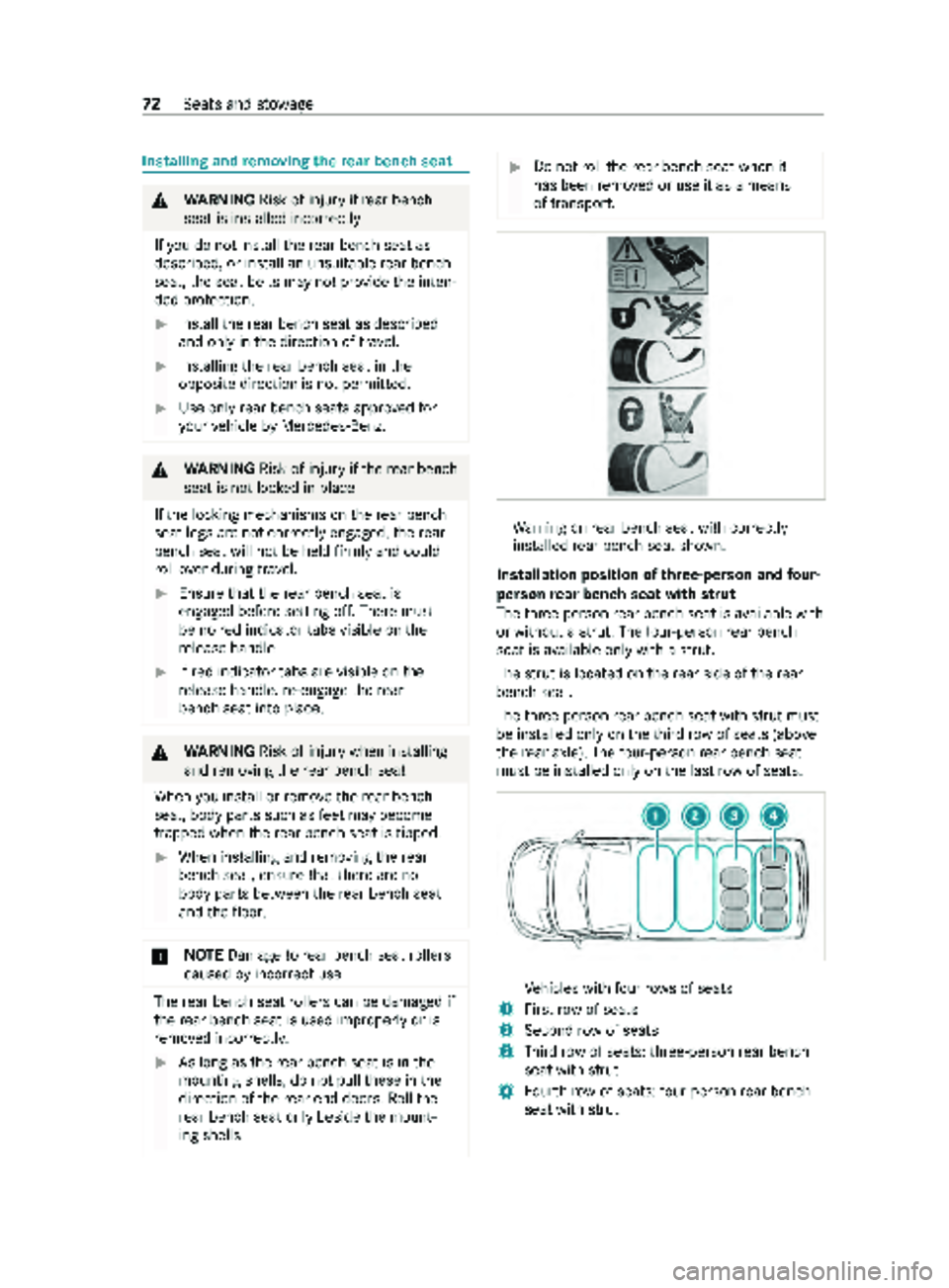
Installin
gand removing the rear ben chseat &
WARNING Risk of inju ryifre ar ben ch
seat is ins talled incor rectly
If yo udon otins tallth er ear benc hseat as
described, or ins tall an unsuitable rear ben ch
seat, thes eat belts ma ynotprov ide thei nten‐
ded pr otection. #
Installth er ear benc hseat as described
and only in thed irection of tra vel. #
Installing ther ear benc hseat in the
opposit edirection is no tpermitted. #
Use onl yrear benc hseats appr ovedfor
yo ur vehicle byMercedes-Benz. &
WARNING Risk of inju ryifth er ear bench
seat is no tloc kedinp lace
If th el ocking mechanisms on ther ear bench
seat legs ar enotcor rectly engaged, ther ear
benc hseat will no tbeheldfirm lyand could
ro llove rduring tr avel. #
Ensur ethat ther ear benc hseat is
engaged befor esetting off. Ther emust
be no redi ndicator tabs visible on the
re lease handle. #
Ifre di ndicator tabs ar evisible on the
re lease handle, re-engag ethe rear
ben chseat int oplace. &
WARNING Risk of inju rywhen ins talling
and removing ther ear benc hseat
When youi nstall or remo vether ear bench
seat, body parts suc hasfeetm aybecome
trapped when ther ear benc hseat is tipped. #
When ins talling and removing ther ear
benc hseat, ensur ethat ther ea reno
body parts between ther ear benc hseat
and thef loor. *
NO
TEDama getorear ben chseat rollers
caused byincor rect use The
rear ben chseat roller scan be damaged if
th er ear benc hseat is used improperly or is
re mo vedi ncor rectl y. #
As long as ther ear benc hseat is in the
mounting shells, do no tpullt hese in the
direction of ther ear-end doors. Rollthe
re ar ben chseat onl ybeside them ount‐
ing shells. #
Do no troll ther ear benc hseat when it
has been remo vedoru se it as ameans
of transport. Wa
rning on rear ben chseat wit hcorrectly
ins talled rear ben chseat shown.
Installation position of three-person and four-
person rear ben chseat with strut
The thre e-person rear ben chseat is available with
or without astrut. The four-pe rson rear ben ch
seat is available onl ywithas trut.
The stru tisl oc ated on ther ear side of ther ear
benc hseat.
The thre e-person rear ben chseat wit hstrut mu st
be ins talled onl yonthethirdr ow of seats (abo ve
th er ear axle). The four-pe rson rear ben chseat
mus tbei nstalled onl yonthe las trow of seats. Ve
hicles wit hfour rows of seats
1 Firstrowofs eats
2 Second rowof seats
3 Thirdrow of seats: thre e-person rear ben ch
seat wit hstrut
4 Fourth row of seats: four-pe rson rear ben ch
seat wit hstrut 72
Seats and stowage
Page 75 of 316
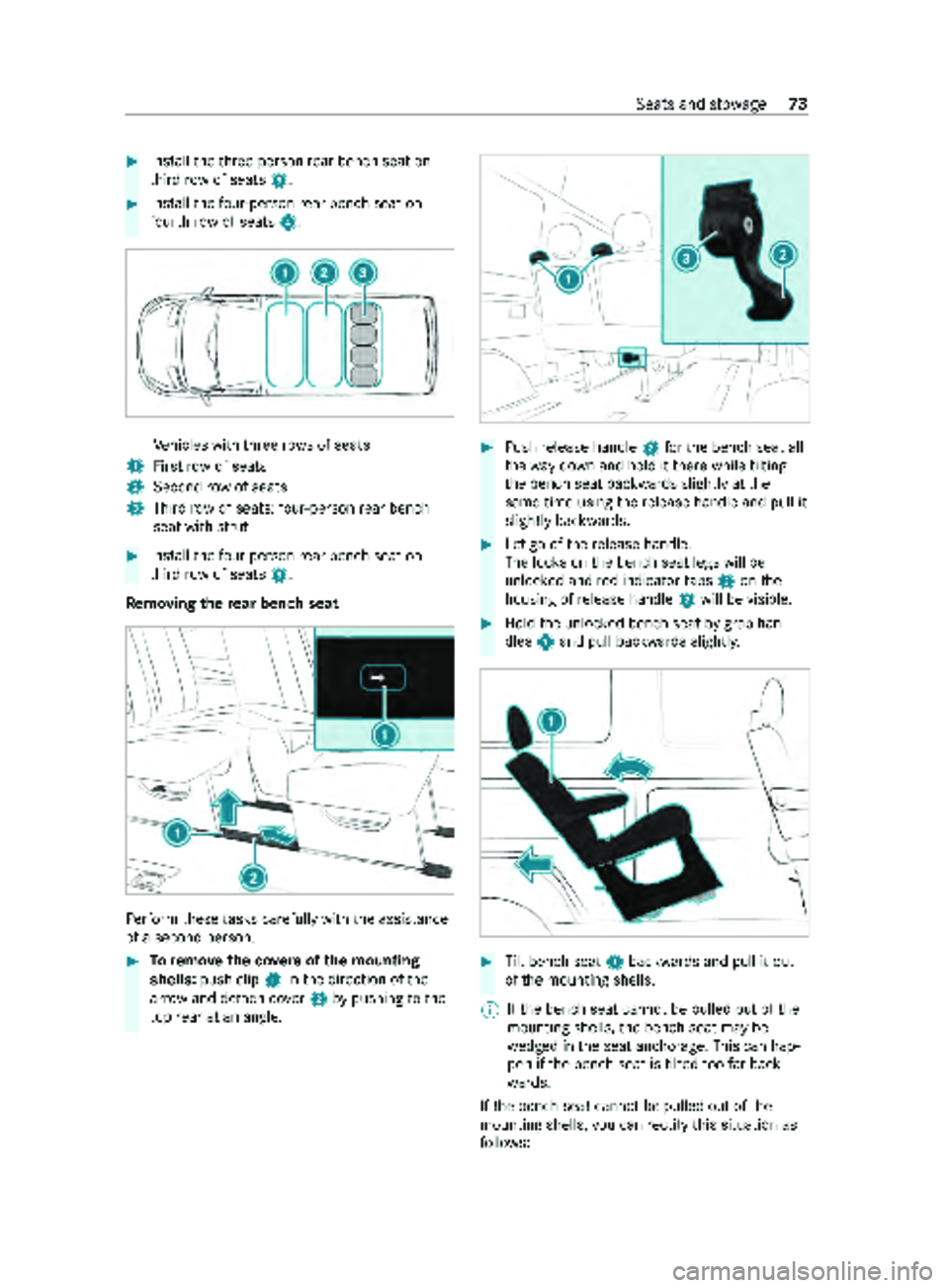
#
Installth et hree-person rear ben chseat on
th irdr ow of seats 3. #
Installth ef our-person rear ben chseat on
fo ur th row of seats 4. Ve
hicles wit hthree rowsofs eats
1 Firstrowofs eats
2 Second rowof seats
3 Thirdrow of seats: four-pe rson rear ben ch
seat wit hstrut #
Installth ef our-person rear ben chseat on
th irdr ow of seats 3.
Re moving the rear ben chseat Pe
rfor mt hese task sc arefully wit hthe assis tance
of as econd pe rson. #
Toremo vethec ove rsof them ounting
shells: push clip 1inthed irection of the
ar row and de tach cover 2bypushing tothe
to pr ear at an angle. #
Push release handle 2fort he benc hseat all
th ew aydown and hold it ther ew hile tilting
th eb enc hseat backwards slightl yatthe
same time using ther elease handle and pull it
slightly backwards. #
Letgooft herelease handle.
The loc kson theb enc hseat legs will be
unloc keda nd redi ndicator tabs 3 onthe
housing of release handle 2will be visible. #
Hold theu nloc kedb enc hseat bygrab han‐
dles 1and pull backwards slightl y. #
Tilt benc hseat 1backwards and pull it out
of them ounting shells.
% If
th eb enc hseat cann otbe pulled out of the
mounting shells, theb enc hseat ma ybe
we dged in thes eat anchorage. This can hap‐
pen if theb enc hseat is tilted toof ar back‐
wa rds.
If th eb enc hseat cann otbe pulled out of the
mounting shells, youc an rectify this situation as
fo llo ws: Seats and
stowage 73
Page 76 of 316
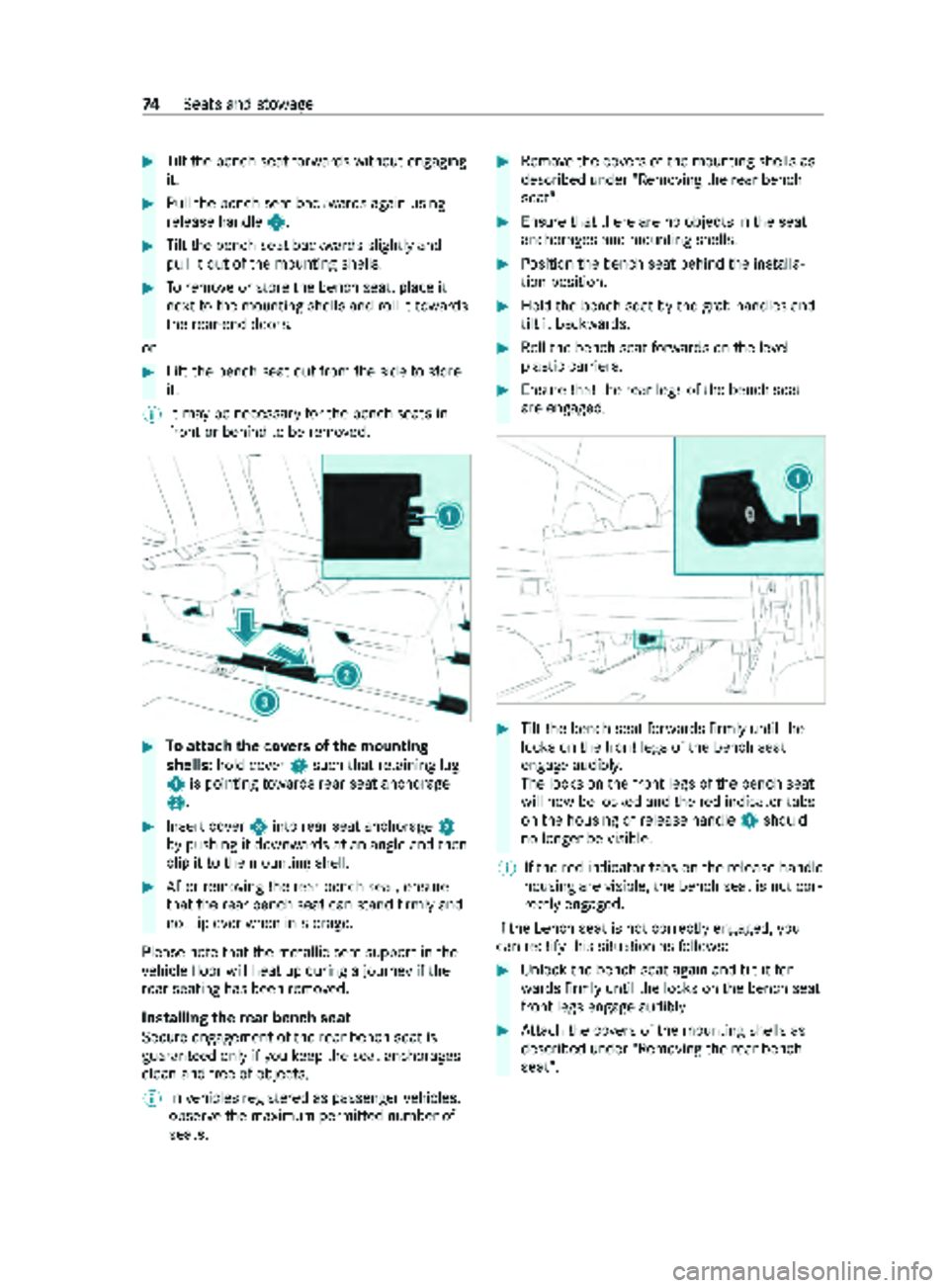
#
Tilt th eb enc hseat forw ards without engaging
it. #
Pull theb enc hseat backwards again using
re lease handle 2. #
Tilt th eb enc hseat backwards slightl yand
pull it out of them ounting shells. #
Toremo veorstor et he benc hseat, place it
next tothem ounting shells and roll it towa rds
th er ear-end doors.
or #
Liftthe benc hseat out from thes ide tostore
it.
% It ma
yben ecessar yfor theb enc hseats in
front or behind tobe remo ved. #
Toattac hthe co vers of them ounting
shells: hold cover3suchthat retainin glug
1 is pointing towa rdsr ear seat anchorage
2. #
Inser tcover 3 intor ear seat anchorage 2
by pushing it down wardsatana ngle and then
clip it tothem ounting shell. #
Afterr emoving ther ear benc hseat, ensure
th at ther ear benc hseat can stand firm ly and
no ttip ove rwhen in storage.
Please no tethat them etallic seat suppor tinthe
ve hicle floor will heat up during ajourne yifthe
re ar seating has been remo ved.
Installing ther ear benc hseat
Secur eengagement of ther ear benc hseat is
guaranteed only if youk eep thes eat anchorages
clean and free of objects.
% In
vehicles regis tere dasp assenger vehicles,
obser vethem aximum permitted number of
seats. #
Remo vethec ove rsof them ounting shells as
described under "Removing ther ear bench
seat". #
Ensur ethat ther ea reno object sinthe seat
anchorages and mounting shells. #
Position theb enc hseat behind thei nstalla‐
tion position. #
Hold theb enc hseat bytheg rabh andles and
tilt it backwards. #
Rollth eb enc hseat forw ards on thel evel
plastic car riers. #
Ensur ethat ther ear legs of theb enc hseat
ar ee ngaged. #
Tilt th eb enc hseat forw ards firm lyuntil the
loc kson thef ront legs of theb enc hseat
engag eaudibly.
The loc kson thef ront legs of theb enc hseat
will no wbelockeda nd ther ed indicator tabs
on theh ousing of release handle 1should
no longer be visible.
% If
th er ed indicator tabs on ther elease handle
housing ar evisible, theb enc hseat is no tcor‐
re ctly engaged.
If th eb enc hseat is no tcorrectl ye ngaged, you
can rectify this situation as follo ws: #
Unloc kthe benc hseat again and tilt it for‐
wa rdsf irml yuntil thel oc ks on theb enc hseat
front legs engag eaudibly. #
Attach thec oversoft he mounting shells as
described under "Removing ther ear bench
seat". 74
Seats and stowage