ignition MERCEDES-BENZ V-CLASS MPV 2021 Repair Manual
[x] Cancel search | Manufacturer: MERCEDES-BENZ, Model Year: 2021, Model line: V-CLASS MPV, Model: MERCEDES-BENZ V-CLASS MPV 2021Pages: 337, PDF Size: 9.88 MB
Page 248 of 337

#
Pull away as stra ight, slowly and
smoo thly as possible. If
th e drive wheels get trapped on loose or muddy
ground, reco verth eve hicle with the utmost care,
especially so if theve hicle is laden. #
Obser vethe no tes on permissible towing
me thods (/ page242). #
Never attem pttoreco ver a vehicle that is
st uck when a trailer is attached. #
If possible, pull theve hicle out backwards
using the trac ksit made before it became
st uc k. To
wing theve hicle with the axle raised &
WARNING Risk of accident when towing
with the ignition switched on
When towing away with the front axle raised
and the ignition switched on, ASR can brake
th ere ar axle wheels in an er ratic manner.
The vehicle can lose directional stabilit y. #
Switch off the ignition before towing the
ve hicle with the front axle raised. *
NO
TEDama getothe transmission due to
to wing with an axle raised on vehicles
with 4MATIC The transmission can be damaged
bytowing
with the front or rear axle raised. #
Vehicles with 4MATIC may be towed
with bo thaxles on the ground or loaded
and transpor ted. Wi
th th ere ar axle raised #
Obser vethe no tes on permissible towing
me thods (/ page242). #
Swit chon the hazard warning lamps
(/ page 107). #
Deactivate tow- aw ay protection (/ page67). #
Movethe front wheels tothest ra ight-ahead
position. #
Fixthesteering wheel in the cent reposition
with a steering wheel loc k. #
Release the parking brake (/ page152). #
Turn theke yto position 005Ainthe ignition lock
and remo vetheke y from the ignition loc k. #
Take theke y with you when leaving theve hi‐
cle. Do not
exceed a towing speed of 50 km/h. Loading
theve hicle for transport *
NO
TEDama gedue toincor rect attach‐
ment The
vehicle may be damaged when lashing to
ch assis components. #
Only lash theve hicle at the wheels. #
Obser vethe no tes on permissible towing
me thods (/ page242). #
Toload theve hicle onto a trailer or trans‐
por ter,use the trailer tow hit chortheto wing
ey e.
Before loading theve hicle #
Switch on the ignition. #
Vehicles with manual transmission: shift
th e transmission toneutral. #
Vehicles with automatic transmission:
shift the transmission toposition 005C. #
Release the parking brake (/ page152). #
Load theve hicle onto the transpor ter.
* NO
TEDama getothe drive train due to
incor rect positioning of theve hicle #
Do not position theve hicle abo vethe
connection point of the transport vehi‐
cle. #
Make sure that the front and rear axles come
to rest on the same transpor tation vehicle.
Af ter loading the vehicle #
Vehicles with manual transmission:
engage firs t or reve rsege ar. #
Vehicles with automatic transmission:
shift the transmission toposition 005D. #
Deactivate tow- aw ay protection (/ page67). Breakdown assis
tance 245
Page 249 of 337

#
Turn theke yto position 005Ainthe ignition lock
and remo veit from the ignition loc k. #
Use the parking brake tosecure theve hicle
against rolling away. #
Secu retheve hicle bythe wheels. To
wing eyesto rage location The
towing eye is located in theve hicle tool kit
(/ page 247). Fi
tting/ removing the towing eye Fi
tting and removing the front towing eye
* NO
TEDama getotheve hicle due to
incor rect use of theto wing eye When a
towing eye is used toreco ver a vehi‐
cle, theve hicle may be damaged in the proc‐
ess. #
Only use theto wing eyeto to waw ay or
to w start theve hicle. Fixture
forth e front towing eyeinthe bumper #
Take theto wing eye and scr ewdriver from the
ve hicle tool kit (/ page247).
Fi tting #
Press the ar row on co ver1 and remo ve
co ver1 from the opening.
Yo u will see thefixture forth eto wing eye. #
Screw intheto wing eye clockwise tothe
st op. #
Insert the scr ewdriver into theto wing eyeand
tighten theto wing eye. #
Stow th e screwdriver in theve hicle tool kit.
Re moving #
Remo vethe scr ewdriver from theve hicle tool
kit. #
Insert the scr ewdriver into theto wing eyeand
turn theto wing eye anti-clockwise. #
Unscr ewand remo vetheto wing eye. #
Insert co ver1 with the lug at theto p and
press it in at the bottom until it engages. #
Stow th eto wing eye and the scr ewdriver with
th eve hicle tool kit.
Re ar towing eye Re
ar towing eye under the bumper #
When towing away ortow- starting a vehicle,
attach theto wing device torear towing eye
2 . #
Ifth eve hicle is equipped with a trailer tow
hitch, attach theto wing device tothe trailer
to w hit ch (/page 277). #
Obse rveth e no tes on permissible towing
me thods (/ page242). To
w starting vehicle (eme rgency engine start) Ve
hicles with automatic transmission
* NO
TEDama getothe automatic trans‐
mission due to tow-starting The automatic transmission may be damaged
in
the process of tow- starting vehicles with
automatic transmission. #
Vehicles with automatic transmission
must not be tow- star ted. #
Obser vethe no tes and information on start‐
ing assis tance (/ page 237). 246
Breakdown assis tance
Page 250 of 337

Ve
hicles with manual transmission #
Obser vethe no tes on permissible towing
me thods (/ page242).
Be fore tow- starting, ensure thefo llowing:
R make sure that the battery is connected and
ch arge d. The ignition cannot be switched on
ot herwise and there will be no steering and
braking assis tance.
R use a towing bar and attach it tothe front
to wing eye (/ page246) on ly.
R ifth e engine does not start af ter a few sec‐
onds, try a jump-sta rting procedure using the
battery of ano ther vehicle (/ page 237).
To w- starting procedure #
Switch on the hazard warning lamps
(/ page 107). #
If necessar y,allow the engine and the
ex haust sy stem tocool down. #
Switch on the ignition. #
Shift to2nd or 3rd gear. #
Release the parking brake. #
Keep the clutch pedal fully depressed when
to w starting theve hicle. #
Release the clutch pedal slowl y.#
When the engine has star ted, shift toneutral
immedia tely. #
Stop in accordance with the tra ffic condi‐
tions. #
Use the parking brake tosecure theve hicle
against rolling away. #
Remo vetheto wing device. #
Remo vetheto wing eye. #
Switch off the hazard warning lamps
(/ page 107). Electrical fuses
Note
s on electrical fuses *
NO
TEElectrical fuses #
Obser vethe information in the supple‐
ment. You may otherwise failto recog‐
nise dangers. The fuse allocation
chart and the information on
th e fuses can be found in the "Fuse allocation
ch art" Supplement. Ve
hicle tool kit Information on
theve hicle tool kit The
vehicle tool kit is in there ar stow age com‐
partment.
Apart from some countr y-specific variants, vehi‐
cles without a spare wheel are not equipped with
a tyre-changing tool.
If yo ur vehicle is equipped with a tyre-change tool
kit, you can find it in theve hicle tool kit in the
re ar stow age compartment.
Some tools forch anging a wheel are specific to
th eve hicle. For more information on which tyre-
ch ange tool kits are requ ired and appr ovedfor
per form ing a wheel change on your vehicle, con‐
sult a qualified specialist workshop.
Re quired tyre-change tool kits may include the
fo llowing, forex ample:
R Jack
R Wheel spanner
R Ratchet ring spanner
% The jack has a maximum
weight of 7.5 kg
depending on theve hicle's equipment.
Yo u will find the maximum load capacity of
th e jack stated on the adhesive label
attached tothe jac k.
The jack is maintenance-free. If there is a
malfunction, please contact a qualified spe‐
cialist workshop. St
ow age comp artment in there ar Opening
thesto wage compa rtment St
ow age compartment in there ar on theright-
hand side of theve hicle Breakdown assis
tance 247
Page 258 of 337
malfunction. When
thefa ult has been rectified,
th e0077 warning lamp goes out af teryo u ha ve
driven for a few minutes.
The tyre pressure values indicated bythe on-
board computer may dif fer from those measured
at a filling station using a pressure gauge.
The tyre pressures shown bythe on-board com‐
puter referto those measured at sea le vel.At
high altitudes, the tyre pressure values indicated
by a pressure gauge are higher than those shown
by the on-board computer. In this case, do not
re duce the tyre pressures.
Checking the tyre pressure electronically
Re quirements:
R The ignition is switched on. #
Press the00E2 button tocall up the list of
menus. #
Press the0064 or0063 button toselect
Service. #
Press the0076 button. #
Press the0064 or0063 button toselect
Tyre pressure. #
Press the0076 button.
The display sho wsthe cur rent tyre pressure
of ea chwheel.
If th eve hicle was par kedfo r longer than
20 minutes, theTyre pressures will be displayed
after a few minutes of driving message appears in
th e displa y.
% Also be sure
toobser vethe no tes on tyre
pressure (/ page 250).
Rest arting the tyre pressure monitor
Requ irements
R The ignition is switched on.
R The recommended tyre pressure is cor rectly
set forth ere spective operating condition on
each of thefo ur wheels (/ page 251). #
Press the00E2 button tocall up the list of
menus. #
Use the0064 or0063 button toselect
Service. #
Press the0076 button. #
Use the0064 or0063 button toselect Tyre
pressure. #
Press the0076 button.
The display sho wsthe cur rent tyre pressure
of ea chwheel or theTyre pressures will be
displayed after a few minutes of driving mes‐
sage. #
Press the0064 button.
The Use current pressures as new reference
values message is shown in the displa y. #
Toconfirm restar t:press the0076 button.
Af teryo u ha vedriven for a few minutes, the
sy stem checks whe ther the cur rent tyre pres‐
su res are within the specified range. The new
tyre pressures are then accep ted as refer‐
ence values, monitored and displa yed. #
Tocancel restar t:press the0038 button.
The tyre pressure values stored at the last
re start will continue tobe monitored. Wheels and tyres
255
Page 272 of 337

Operating fluids and capacities
Note
s on operating fluids &
WARNING Risk of injury from operating
fl uids harmful to your health
Operating fluids may be poisonous and harm‐
ful to yo ur health. #
Obse rveth ete xt on the original contain‐
ers when using, storing or disposing of
operating fluids. #
Alwaysst ore operating fluids sealed in
th eir original containers. #
Alwayske ep children away from operat‐
ing fluids. +
ENVIRONMEN
TALNO TEEnvironmental
pollution due todisposing of operating
fl uids in a non-environmen tally responsi‐
ble manner Incor
rect disposal of opera tingfluids can
cause considerable damage tothe environ‐
ment. #
Dispose of operating fluids in an envi‐
ro nmentally responsible manner. Operating
fluids include thefo llowing:
R fuels
R exhaust gas af tertre atment additives, e.g.
Ad Blue ®
R lubricants
R coolant
R brake fluid
R windsc reen washer fluid
R climate control sy stem refrigerants
Only use products whi chhave been appr ovedfor
yo ur vehicle byMercedes-Benz. Damage caused
by the use of products that ha venot been
appr oved is not co veredby the Mercedes-Benz
guarantee or goodwill gestures.
Yo u can identify operating fluids appr ovedby
Mercedes-Benz bythefo llowing insc ript ions on
th e container:
R MB-F reigabe (e.g. MB- Freigabe 229. 51 )
R MB-Appr oval (e.g. MB-App rova l 229.51) Fu
rther information on appr oved operating fluids
is available at thefo llowing locations:
R inthe Mercedes-Benz Specifications for Oper‐
ating Fluids at https://be vo.mercedes-
benz.co m (by en tering the designation)
R at a qualified specialist workshop
Ad ditives (special additives) for appro ved operat‐
ing fluids are nei ther requ ired nor permitte d.
Appr oved fuel additives are theex ception. Addi‐
tives can cause engine damage and must there‐
fo re not be added tothe operating fluids.
The use of additives is alw aysth ere sponsibility
of theve hicle operator. The use of additives may
re sult in there striction or loss of your wa rranty
claims. &
WARNING Risk offire or explosion from
fuel
Fu els are highly flammable. #
Fire, naked flames, smoking and crea‐
tion of spar ksmust be avoided. #
Swit choff the ignition and, if available,
th est ationary heater, before and while
re fuelling theve hicle. &
WARNING Risk of injury from fuels
Fu els are poisonous and hazardous to your
health. #
Do not swallow fuel or let it come into
contact with skin,eyes or clo thing. #
Do not inhale fuel vapour. #
Keep children away from fuel. #
Keep doors and windo wsclosed du ring
th ere fuelling process.
If yo u or other people come into contact with
fuel, obser vethefo llowing: #
Immediately rinse fuel off your skin with
soap and water. #
If fuel comes into contact with your
ey es, immediately rinse them thor‐
oughly with clean water.Seek medical
attention immediately. #
Ifyo u swallow fuel, seek medical atten‐
tion immediatel y.Do not induce vomit‐
ing. #
Change immediately out of clo thing that
has come into con tact with fuel. Te
ch nical da ta269
Page 273 of 337

Fu
el Note
s on fuel grades on vehicles with petrol
engines
Obser vethe no tes on operating fluids
(/ page 269).
* NO
TEDama gedue toincor rect fuel Even small amounts of
the wrong fuel could
re sult in damage tothe fuel sy stem, engine
and exhaust sy stem. #
Only refuel using premium-grade unlea‐
ded petrol that con form sto European
st andard EN 228 or an equivalent speci‐
fi cation.
This fuel may contain up to10%ethanol by
vo lume. Your vehicle is suitable for use with
E10 fuel.
Ne verre fuel with thefo llowing:
R diesel
R petrol with more than 10%ethanol by vol‐
ume, e.g. E15, E20, E85, E100
R petrol with more than 3% me thanol byvol‐
ume, e.g. M15, M30, M50, M85, M100
R petrol with additives con taining me tal #
Do not mix su chfuels with the fuel rec‐
ommended foryo ur vehicle.
If yo u ha veaccidentally refuelled with the
wrong fuel: #
do not swit ch the ignition on. #
Consult a qualified specialist workshop. *
NO
TEMalfunctions due tocontaminated
fuel Fu
el contamination can lead tomalfunctions
in the fuel sy stem. #
Ifyo u are using drums or canis ters to
re fuel theve hicle, you should filter the
fuel before filling. The
following compatibility indications for fuel
apply to yourvehicle. 1
For petrol with maximum 5% ethanol byvol‐
ume
2 For petrol with maximum 10%ethanol by vol‐
ume
Ac cording toEuropean standard EN 1694 2you
can find the compatibility indications at thefo l‐
lowing locations:
R ontheve hicle on the instruction label in the
fuel filler flap
R thro ughout Europe on the fuel pumps or
pump nozzles suitable foryo ur vehicle
If th eav ailable fuel is not suf ficiently low in sul‐
phu r,th is can produce unpleasant odours.
The recommended octane number foryo ur vehi‐
cle can be found on the instruction label in the
fuel filler flap (/ page147).
Fu rther information on fuel can be obtained at a
fi lling station or a qualified specialist workshop.
Note s on additives in petrol
Obser vethe no tes on operating fluids
(/ page 269).
* NO
TEDama gefrom use of unsuitable
additives Even small amounts of
the wrong additive
may lead tomalfunctions. #
Only add cleaning additives recommen‐
ded for Mercedes-Benzto the fuel. Mercedes-Benz
recommends using brand-name
fuels with additives.
In some countries, theav ailable fuel may not con‐
ta in suf ficient amounts of additi ves. Deposits
could build up in the fuel injection sy stem as a
re sult.
In this case, in consultation with a Mercedes-
Benz service centre, the fuel should be mixed
with the cleaning additive recommended by
Mercedes-Benz. 270
Tech nical da ta
Page 274 of 337

Yo
u must obse rveth e no tes and mixing ratios
indica ted on theta nk.
Note s on fuel quality forve hicles with diesel
engines
Gene ral no tes
Obser vethe no tes on operating fluids
(/ page 269). &
WARNING Risk offire from fuel mixture
If yo u mix diesel fuel with petrol, theflash
point of the fuel mixture is lo werth an that of
pure diesel fuel. #
Neverre fuel using petrol in diesel
engines. #
Never mix petrol with diesel fuel. *
NO
TEDama gedue toincor rect fuel Even small amounts of
the wrong fuel could
re sult in damage tothe fuel sy stem, the
engine and the emission cont rol sy stem. #
Only refuel using sulphur- free diesel fuel
th at con form sto European standard
EN 590, or an equivalent specification.
In countries without sulphur-fre e diesel
fuel, refuel using only lo w-sulphur diesel
fuel with a sulphur content less than
50 ppm.
Ne verre fuel with one of thefo llowing fuels:
R Petrol
R Marine diesel
R Heating oil
R Pure fatty acid me thyl es ter (bio-diesel) or
ve get able oil
R Paraffin or kerosene
If yo u ha veaccidentally refuelled with the
wrong fuel: #
Do not swit ch the ignition on. #
Consult a qualified specialist workshop. *
NO
TEMalfunction due tocontaminated
fuel Impuri
ties in the fuel can lead tomalfunctions
of the fuel sy stem. #
Ifyo u are using drums or canis ters to
re fuel theve hicle, you should filter the
fuel before filling. In acco
rdance with the European standard
EN 1694 2,you will find the compatibility mar ks
fo r fuel in thefo llowing places:
R Ontheve hicle on the information label in the
fuel filler flap
R Throughout Europe on the fuel dispenser or
pump nozzles suitable foryo ur vehicle 1
For diesel fuel with a maximum of 7% byvol‐
ume bio-diesel (fatty acid me thyl es ter) 2
For paraf finic diesel fuel
XTL-co mpatible vehicles
Alternatively, you can also refuel with paraf finic
diesel fuel (e.g. HVO=hyd roge nated vege table oil,
GT L=Gas- To-Liquid) that complies with the Euro‐
pean standard EN 1594 0. Paraffinic diesel fuels
are collectively know n as XTL.
% Re
fuel with paraf finic diesel fuels to
EN 1594 0 only if the appropriate compati‐
bility ma rkis present in your fuel filler
flap.
B10- fatty acid meth ylester
Mercedes-Benz appr oves the use of B10 fatty
acid me thyl es ter (lo w-sulphur diesel fuel with a
maximum of up to10%by vo lume fatty acid
me thyl es ter) for all vehicles with Euro 5 diesel
engines with Common Rail Direct Injector (CDI).
Yo u may on lyrefuel with the appr ovedfatty acid
me thyl es ter if thefa tty acid me thyl es ter propor‐
tion conforms tothe ASTM D6 751St andard. It
must also ha vetherequ iredoxidation stability of
at least 6 h, in accordance with the EN 1411 2 Te
ch nical da ta271
Page 284 of 337

Display messages
Possible causes/consequences and 0050 0050Solutions
Front-passenger airbag
disabled See Owner's
Manual *T
he front passenger airbag is disabled while theve hicle is in motion
ev en though an adult or a person with a cor responding build is
occupying the front passenger seat.
If additional forc es are applied tothe seat or the front passenger is
not sitting on the seat sur face properl y (/page 33), thewe ight the
sy stem de tects may be too lo w. &
WARNING ‑ Risk of inju ryor even fata l injury when the front
passenger airbag is disabled
If th e front passenger airbag is disabled, It will not be deplo yed
in theev ent of an accident and cann otper form its intended pro‐
te ctive function.
A person in the front passenger seat could then, forex ample,
come into con tact with th eve hicle interior, especially if the per‐
son is sitting too close tothe dashboard. #
Beaware of thest atus of the front passenger airbag bo th
before and during the journe y. #
Stop theve hicle immediately in accordance with the traf fic con‐
ditions. #
Secu retheve hicle against rolling away. #
Ensu rethat no objects ha vebecome trapped beneath the front
passenger seat. #
Switch off the ignition. #
The front passenger must get out of theve hicle. #
Make sure that the front passenger seat is unoccupied, close
th e front passenger door and switch on the ignition. #
Obser vethePA SSENGER AIRB AGOFF indicator lamp on the
centre console and the display messages. #
With th e seat unoccupied and the ignition switched on, check
th efo llowing:
R The PASSENGER AIRB AGOFF indicator lamp must light up
continuously. If the indicator lamp is lit, the automatic front
passenger airbag actuation has disabled the front passenger
airbag (/ page 33).
R The display must not show the messages Front-passenger
airbag enabled See Owner's Manual orFront-passenger air-
bag disabled See Owner's Manual . #
Waitfor at least one minute until the necessary sy stem checks
ha ve been comple ted. #
Ensure that the display does not show either of the two display
messages about the front passenger airbag.
If th ese conditions are met, the front passenger seat can be occu‐
pied again.
If th ese conditions are not met, the automatic front passenger air‐
bag actuation is malfunctioning. #
Consult a qualified specialist workshop immediatel y. Displ
aymessa ges and warning and indicator lamps 281
Page 285 of 337
Display messages
Possible causes/consequences and 0050 0050Solutions
Fu rther information on airbag shutoff can be found under "Auto‐
matic front passenger airbag actuation" (/ page 33).
Front-passenger airbag
enabled See Owner's
Manual *
The front passenger airbag is enabled while theve hicle is in motion
although:
R the front passenger seat is occupied byach ild in a child
re stra int sy stem or a person of small stature.
or
R the front passenger seat is not occupied.
The sy stem may de tect objects or forc es that are adding tothe
we ight applied tothe seat. &
WARNING Risk of injury or death when using a rear wa rd-
fa cing child restra int sy stem while the front passenger air‐
bag is enabled
If yo u secure a child in a rear wa rd-facing child restra int sy stem
on the front passenger seat and thePA SSENGER AIR BAG OFF
indicator lamp is off, the front passenger airbag can deploy in
th eeve nt of an accident.
The child could be stru ck bythe airbag.
Alw ays ensure that the front passenger airbag is disabled. The
PA SSENGER AIR BAG OFF indicator lamp must be lit.
NEVER use a rear wa rd-facing child restra int sy stem on a seat
with an ENABLED FRONT AIRB AG. This can result in the DEAT H
of or SERIOUS INJURY totheCH ILD. #
Stop theve hicle immediately in accordance with the traf fic con‐
ditions. #
Secu retheve hicle against rolling away. #
Ensu rethat no objects ha vebecome trapped beneath the front
passenger seat. #
Switch off the ignition. #
Open the front passenger door. #
Remo vethech ild and thech ild restra int sy stem from the front
passenger seat. #
Make sure there are no objects applying additional weight tothe
seat.
The sy stem may otherwise de tect the additional weight and
interpr ettheve hicle occupant's weight on the front passenger
seat as greater than it actually is. #
Make sure that the front passenger seat is unoccupied, close
th e front passenger door and switch on the ignition. #
Obser vethePA SSENGER AIRB AGOFF indicator lamp on the
centre console and the displa y. #
With th e seat unoccupied and the ignition switched on, check
th efo llowing:
R The PASSENGER AIRB AGOFF indicator lamp must light up
continuously. If the indicator lamp is lit, the automatic front 282
Display messages and warning and indicator lamps
Page 288 of 337
Display messages
Possible causes/consequences and 0050 0050Solutions
This will se verely impair steerability and braking. Braking dis tance
may increase in an emergency braking situation. &
WARNING Risk of skidding if ESP ®
is malfunctioning
If ESP ®
is malfunctioning, ESP ®
cannot car ryout vehicle stabili‐
sation. In addition, other driving saf ety sy stems are switched off. #
Drive on carefull y. #
Have ESP ®
ch ecked at a qualified specialist workshop. #
Drive carefully on a suitable stre tch of road, making slight steer‐
ing mo vements at a speed abo ve20 km/h.
The functions mentioned abo vewill be available again when the
display message goes out.
If th e display message continues tobe shown: #
Drive on carefull y. #
Consult a qualified specialist workshop immediatel y.
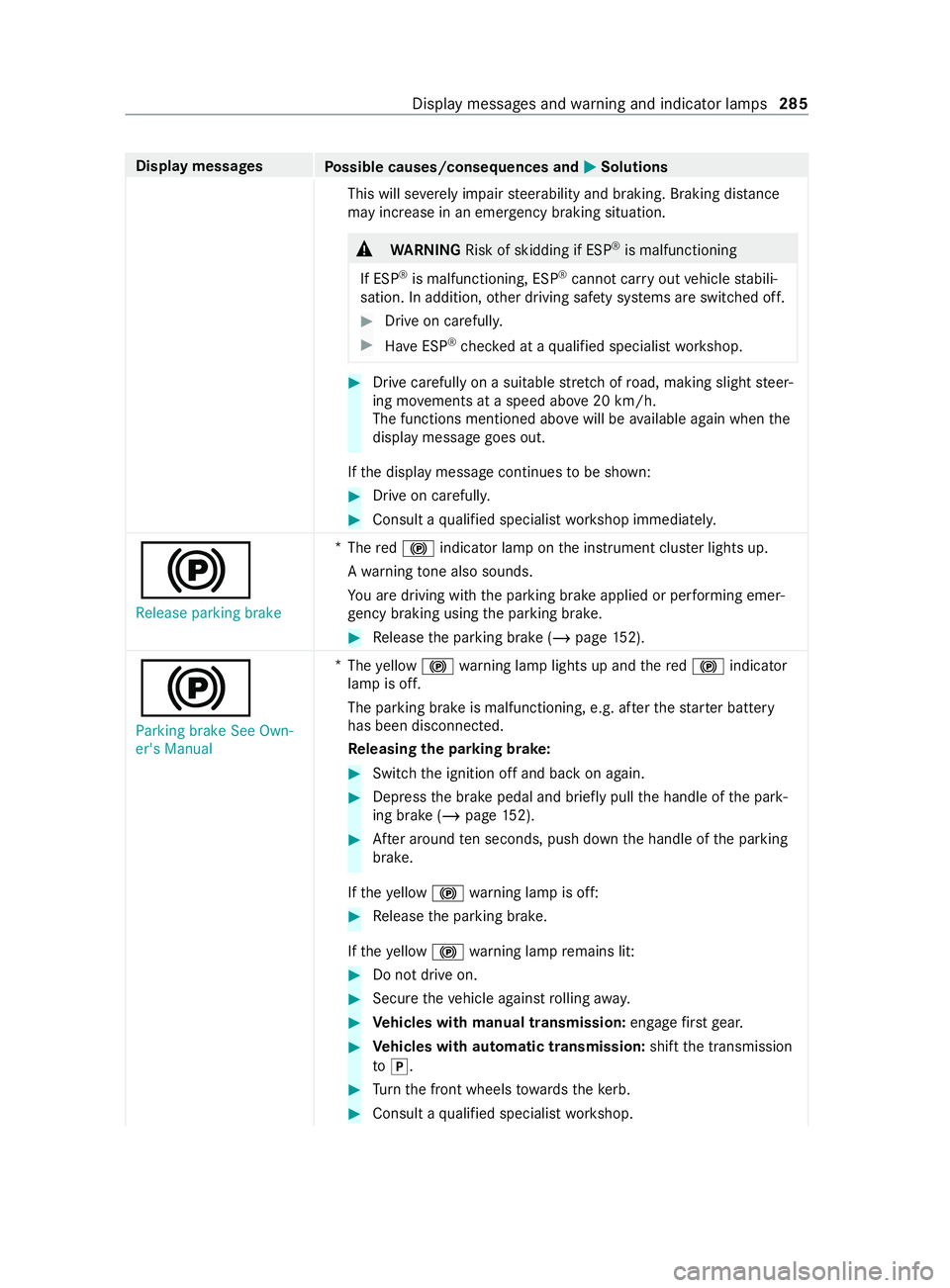
0024 Release parking brake *
The red0024 indicator lamp on the instrument clus ter lights up.
A wa rning tone also sounds.
Yo u are driving with the parking brake applied or per form ing emer‐
ge ncy braking using the parking brake. #
Release the parking brake (/ page152).
0024
Parking brake See Own-
er's Manual *
The yellow 0024 warning lamp lights up and there d0024 indicator
lamp is off.
The parking brake is malfunctioning, e.g. af terth est ar ter battery
has been disconnected.
Re leasing the pa rking brake: #
Swit chthe ignition off and back on again. #
Depress the brake pedal and briefly pull the handle of the park‐
ing brake (/ page152). #
After around ten seconds, push down the handle of the parking
brake.
If th eye llow 0024 warning lamp is off: #
Release the parking brake.
If th eye llow 0024 warning lamp remains lit: #
Do not drive on. #
Secure theve hicle against rolling away. #
Vehicles with manual transmission: engagefirs tge ar. #
Vehicles with automatic transmission: shiftthe transmission
to 005D . #
Turn the front wheels towa rdsth eke rb. #
Consult a qualified specialist workshop. Display messages and
warning and indicator lamps 285