tow MERCEDES-BENZ WAGON 2016 Repair Manual
[x] Cancel search | Manufacturer: MERCEDES-BENZ, Model Year: 2016, Model line: WAGON, Model: MERCEDES-BENZ WAGON 2016Pages: 350, PDF Size: 6.71 MB
Page 284 of 350
!When towing, pull away slowly and
smoothly. If the tractive power is too high,
the vehicles could be damaged.
!Do not tow with sling-type equipment.
This could damage the vehicle.
!When towing vehicles with KEYLESS-GO,
use the key instead of the Start/Stop but-
ton. Otherwise, the automatic transmission
may shift to position Pwhen the driver's or
front-passenger door are opened, which
could lead to damage to the transmission.
!The vehicle can be towed a maximum of
30 miles (50km). The towing speed of
30 mph (50 km/h) must not be exceeded.
If the vehicle has to be towed more than
30 miles (50km), the entire vehicle must be
raised and transported.
!If you tow or tow-start another vehicle, its
weight must not exceed the maximum per-
missible gross vehicle weight of your vehi-
cle.
HYBRID vehicles : make sure that you read
the "HYBRID" supplement included in the
vehicle literature. You could otherwise fail to
recognize dangers e.g. due to high voltage.
It is better to have the vehicle transported
than to have it towed away.
If the vehicle has suffered transmission dam-
age, have it transported on a transporter or
trailer.
The automatic transmission must be in posi-
tion Nwhen the vehicle is being towed.
The battery must be connected and charged. Otherwise, you:
Rcannot turn the SmartKey to position 2in
the ignition lock
Rcannot shift the automatic transmission to position N
In the event of damage to the electrical
system
If the battery is defective, the automatic
transmission will be locked in position P. To
shift the automatic transmission to position N, you must provide power to the vehicle's
electrical system in the same way as when
jump-starting (
Ypage 279).
Have the vehicle transported on a transporter
or trailer.
iDisarm the automatic locking feature
(
Ypage 95). You could otherwise be locked
out when pushing or towing the vehicle.
Installing/removing the towing eye
Installing the towing eye
GWARNING
The exhaust tail pipe may be very hot. There is
a risk of burns when removing the rear cover.
Do not touch the exhaust pipe. Take particular
care when removing the rear cover.
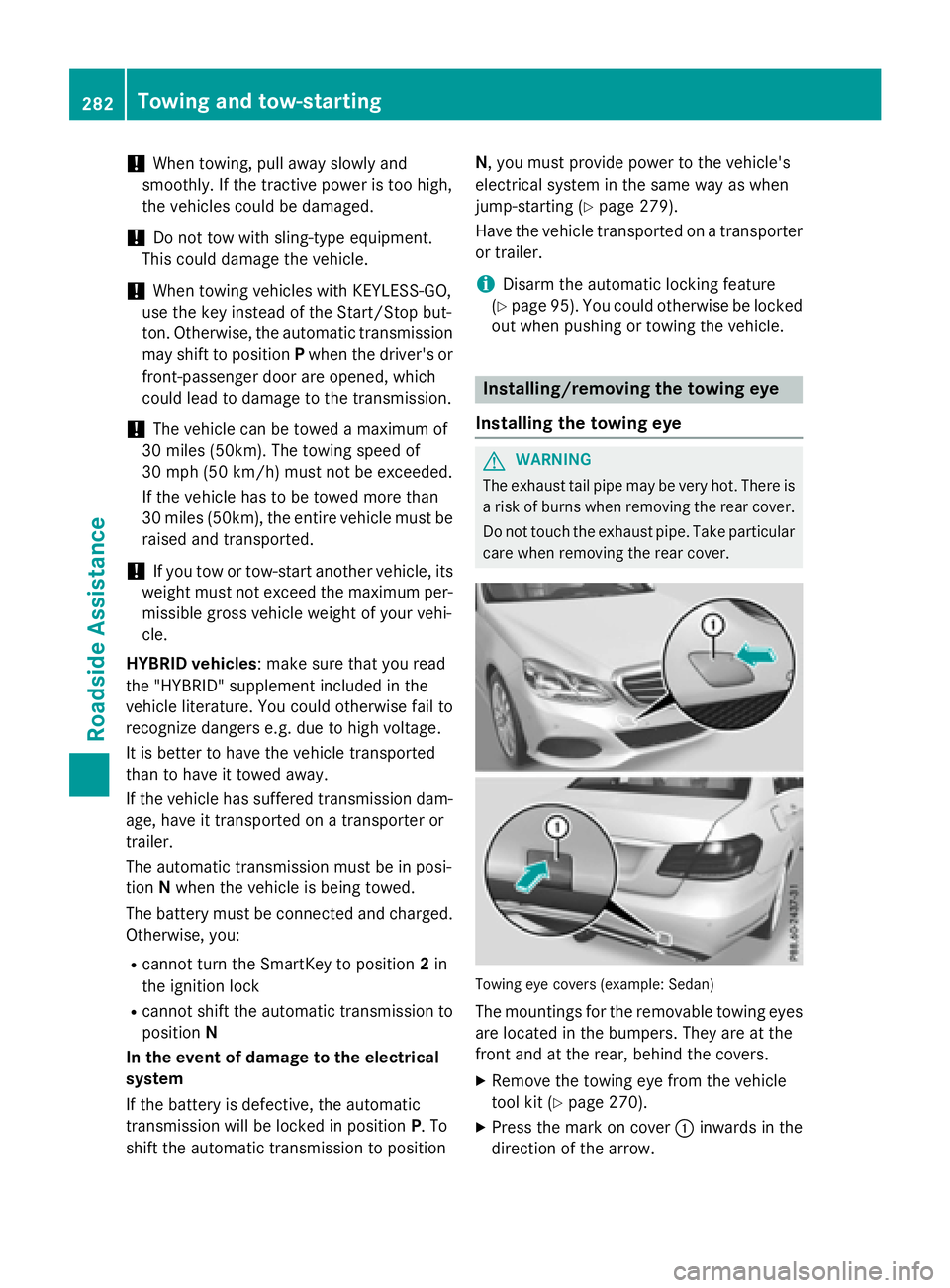
Towing eye covers (example: Sedan)
The mountings for the removable towing eyes
are located in the bumpers. They are at the
front and at the rear, behind the covers.
XRemove the towing eye from the vehicle
tool kit (
Ypage 270).
XPress the mark on cover :inwards in the
direction of the arrow.
282Towing and tow-starting
Roadside Assistance
Page 285 of 350
XTake cover:off the opening.
XScrew in the towing eye clockwise as far as
it will go and tighten it.
Removing the towing eye
XUnscrew and remove the towing eye.
XAttach cover :to the bumper and press
until it engages.
XPlace the towing eye in the vehicle tool kit.
Towing a vehicle with both axles on
the ground
It is important that you observe the safety
instructions when towing away your vehicle
(
Ypage 281).
The automatic transmission automatically
shifts to position Pwhen you open the driver's
or front-passenger door or when you remove
the SmartKey from the ignition lock. In order
to ensure that the automatic transmission
stays in position Nwhen towing the vehicle,
you must observe the following points:
XMake sure that the vehicle is stationary and
the SmartKey in the ignition lock is in posi- tion 0.
XTurn the SmartKey to position 2in the igni-
tion lock.
On vehicles with KEYLESS-GO, use the
SmartKey instead of the Start/Stop button
(
Ypage 139).
XDepress and hold the brake pedal.
XShift the automatic transmission to posi-
tion N.
XRelease the brake pedal.
XRelease the parking brake.
XSwitch on the hazard warning lamps, see
the Digital Operator's Manual.
XLeave the SmartKey in position 2in the
ignition lock.
iWhen towing with the hazard warning
lamps switched on, use the combination
switch as usual to signal a change of direc- tion. In this case, only the indicator lamps
for the direction of travel flash. After reset-
ting the combination switch, the hazard
warning lamp starts flashing again.
Towing the vehicle with the rear axle
raised
!
Vehicles with 4MATIC must not be towed
with either the front or the rear axle raised,
as doing so will damage the transmission.
!Vehicles with automatic transmission
must not be towed with the rear axle raised.
The vehicle/trailer combination may oth-
erwise swerve or even roll over.
!The ignition must be switched off if you
are towing the vehicle with the rear axle
raised. Intervention by ESP
®could other-
wise damage the brake system.
Transporting the vehicle
!
You may only secure the vehicle by the
wheels, not by parts of the vehicle such as
axle or steering components. Otherwise,
the vehicle could be damaged.
The towing eye can be used to pull the vehicle
onto a trailer or transporter for transporting
purposes.
XTurn the SmartKey to position 2in the igni-
tion lock.
XShift the automatic transmission to posi-
tion N.
As soon as the vehicle has been loaded:
XPrevent the vehicle from rolling away by
applying the parking brake.
XShift the automatic transmission to posi-
tion P.
XTurn the SmartKey to position 0in the igni-
tion lock and remove the SmartKey from
the ignition lock.
XSecure the vehicle.
Towing and tow-starting283
Roadside Assistance
Z
Page 286 of 350
Notes on 4MATIC vehicles
!
Vehicles with 4MATIC must not be towed
with either the front or the rear axle raised,
as doing so will damage the transmission.
If the vehicle has transmission damage or
damage to the front or rear axle, have it trans- ported on a transporter or trailer.
In the event of damage to the electrical
system
If the battery is defective, the automatic
transmission will be locked in position P. To
shift the automatic transmission to position
N, you must provide power to the vehicle's
electrical system in the same way as when
jump-starting (
Ypage 279).
Have the vehicle transported on a transporter
or trailer.
Tow-starting (emergency engine
starting)
!
Vehicles with automatic transmission
must not be started by tow-starting. This
could otherwise damage the transmission.
iYou can find information on "Jump-start-
ing" under (
Ypage 279).
Fuses
Important safety notes
GWARNING
If you manipulate or bridge a faulty fuse or if
you replace it with a fuse with a higher amper- age, the electric cables could be overloaded.
This could result in a fire. There is a risk of an
accident and injury.
Always replace faulty fuses with the specified
new fuses having the correct amperage.
!Only use fuses that have been approved
for Mercedes-Benz vehicles and which
have the correct fuse rating for the system concerned. Otherwise, components or sys-
tems could be damaged. The fuses in your vehicle serve to close down
faulty circuits. If a fuse blows, all the compo-
nents on the circuit and their functions stop
operating.
Blown fuses must be replaced with fuses of
the same rating, which you can recognize by
the color and value. The fuse ratings are listed
in the fuse allocation chart.
If a newly inserted fuse also blows, have the
cause traced and rectified at a qualified spe-
cialist workshop, e.g. an authorized
Mercedes-Benz Center.
Before changing a fuse
Pay attention to the important safety notes
(
Ypage 284).
XSecure the vehicle against rolling away
(
Ypage 151).
XSwitch off the engine.
XSwitch off all electrical consumers.
XRemove the SmartKey from the ignition
lock.
or, on vehicles with KEYLESS ‑GO:
XOpen the driver's door.
The on-board electronics now have status
0. This is the same as the SmartKey having
been removed.
The driver’s door can be closed again.
All indicator lamps in the instrument cluster
must be off.
The fuses are located in various fuse boxes:
RFuse box in the engine compartment on the left-hand side of the vehicle, when viewed
in the direction of travel
RFuse box in the trunk/cargo compartment
on the right-hand side of the vehicle, when
viewed in the direction of travel
The fuse allocation chart is located in the
vehicle tool kit in the stowage compartment
under the trunk/cargo compartment floor
(
Ypage 270).
284Fuses
Roadside Assistance
Page 316 of 350
XTurn the crank of the jack counter-clock-
wise until the vehicle is once again standing
firmly on the ground.
XPlace the jack to one side.
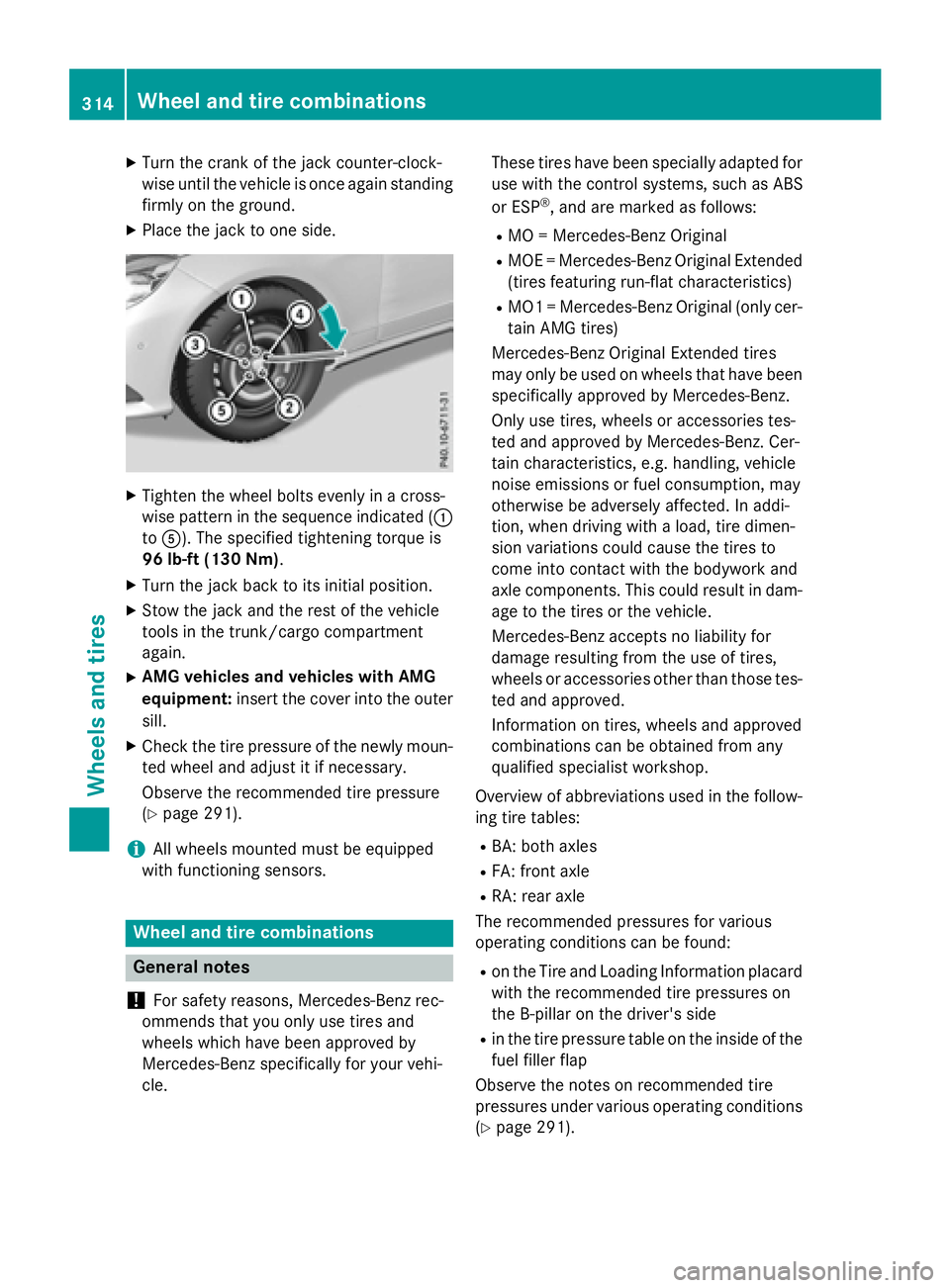
XTighten the wheel bolts evenly in a cross-
wise pattern in the sequence indicated (:
to A). The specified tightening torque is
96 lb-ft (130 Nm).
XTurn the jack back to its initial position.
XStow the jack and the rest of the vehicle
tools in the trunk/cargo compartment
again.
XAMG vehicles and vehicles with AMG
equipment: insert the cover into the outer
sill.
XCheck the tire pressure of the newly moun-
ted wheel and adjust it if necessary.
Observe the recommended tire pressure
(
Ypage 291).
iAll wheels mounted must be equipped
with functioning sensors.
Wheel and tire combinations
General notes
!
For safety reasons, Mercedes-Benz rec-
ommends that you only use tires and
wheels which have been approved by
Mercedes-Benz specifically for your vehi-
cle. These tires have been specially adapted for
use with the control systems, such as ABS
or ESP
®, and are marked as follows:
RMO = Mercedes-Benz Original
RMOE = Mercedes-Benz Original Extended
(tires featuring run-flat characteristics)
RMO1 = Mercedes-Benz Original (only cer-
tain AMG tires)
Mercedes-Benz Original Extended tires
may only be used on wheels that have been
specifically approved by Mercedes-Benz.
Only use tires, wheels or accessories tes-
ted and approved by Mercedes-Benz. Cer-
tain characteristics, e.g. handling, vehicle
noise emissions or fuel consumption, may
otherwise be adversely affected. In addi-
tion, when driving with a load, tire dimen-
sion variations could cause the tires to
come into contact with the bodywork and
axle components. This could result in dam-
age to the tires or the vehicle.
Mercedes-Benz accepts no liability for
damage resulting from the use of tires,
wheels or accessories other than those tes-
ted and approved.
Information on tires, wheels and approved
combinations can be obtained from any
qualified specialist workshop.
Overview of abbreviations used in the follow-
ing tire tables:
RBA: both axles
RFA: front axle
RRA: rear axle
The recommended pressures for various
operating conditions can be found:
Ron the Tire and Loading Information placard with the recommended tire pressures on
the B-pillar on the driver's side
Rin the tire pressure table on the inside of the
fuel filler flap
Observe the notes on recommended tire
pressures under various operating conditions
(
Ypage 291).
314Wheel and tire combinations
Wheels and tires
Page 331 of 350
Emergency spare wheel
Important safety notes
GWARNING
The wheel or tire size as well as the tire type of the spare wheel or emergency spare wheel
and the wheel to be replaced may differ.
Mounting an emergency spare wheel may
severely impair the driving characteristics.
There is a risk of an accident.
To avoid hazardous situations:
Radapt your driving style accordingly and
drive carefully.
Rnever mount more than one spare wheel or
emergency spare wheel that differs in size.
Ronly use a spare wheel or emergency spare
wheel of a different size briefly.
Rdo not switch ESP®off.
Rhave a spare wheel or emergency spare
wheel of a different size replaced at the
nearest qualified specialist workshop.
Observe that the wheel and tire dimensions
as well as the tire type must be correct.
When using an emergency spare wheel or
spare wheel of a different size, you must not
exceed the maximum speed of 50 mph
(80 km/h).
Snow chains must not be mounted on emer-
gency spare wheels.
General notes
You should regularly check the pressure of
the emergency spare wheel, particularly prior
to long trips, and correct the pressure as nec-
essary (
Ypage 291). The value on the wheel is
valid. In addition, the emergency spare wheel
tire pressure can be found under "Technical
data" (
Ypage 332).
An emergency spare wheel may also be
mounted against the direction of rotation.
Observe the time restriction on use as well as
the speed limitation specified on the emer-
gency spare wheel. Replace the tires after six years at the latest,
regardless of wear. This also applies to the
emergency spare wheel.
iWhen you are driving with the emergency
spare wheel mounted, the tire pressure
monitor cannot function reliably. Only
restart the tire pressure monitor when the
defective wheel has been replaced with a
new wheel.
If an emergency spare wheel is mounted,
the system may continue to show the tire
pressure of the wheel that has been
removed for a few minutes. The value dis-
played for the mounted emergency spare
wheel is not the same as the current tire
pressure of the emergency spare wheel.
"Minispare" emergency spare wheel/ collapsible spare wheel
Opening the stowage well
Sedan: the emergency spare wheel can be
found in the stowage well under the trunk
floor.
XLift the trunk floor upwards (Ypage 248).
Wagon: the emergency spare wheel is loca-
ted in the stowage well under the cargo com-
partment floor.
XRemove the seat cushions of the folding
bench seat; see the Digital Operator's Man-
ual, keyword "Folding bench seat (cargo
compartment)".
XLift the cargo compartment floor up.
Emergency spare wheel329
Wheels and tires
Z
Page 332 of 350
Removing the emergency spare wheel
(Sedan)
(Example: equipment and country-specific varia-
tions possible)
XRemove vehicle tool kit tray:.
XTurn stowage well;counter-clockwise
and remove it.
XRemove "Minispare" emergency spare
wheel =.
Removing the emergency spare wheel
(Wagon)
Example: emergency spare wheel
XRemove vehicle tool kit tray :by
recess ;.
XRemove "Minispare" emergency spare
wheel=.
Removing the emergency spare wheel
(AMG vehicles)
XReach into cutout :in the tool holder and
lift it up.
XRemove collapsible spare wheel ;.
Always observe the instructions and safety
notes in the "Mounting a wheel" section
(
Ypage 309).
Stowing a used collapsible spare
wheel
!
Only place the collapsible spare wheel in
the vehicle when it is dry. Otherwise, mois-
ture may get into the vehicle.
Take the following steps to stow a used col-
lapsible spare wheel. It will not otherwise fit
into the spare wheel well. Mercedes-Benz
recommends that you have this work per-
formed at a qualified specialist workshop, e.g.
at an authorized Mercedes-Benz Center.
XUnscrew the valve cap from the valve.
XUse the back of the valve cap to unscrew
the valve insert from the valve and release
the air.
iFully deflating the tires can take a few
minutes.
XScrew the valve insert back into the valve.
XScrew the valve cap back on.
330Emergency spare wheel
Wheels and tires
Page 333 of 350

XRemove theprotective sheet from th evehi-
cle tool ki tand pull it ove rth ecollapsible
spar ewheel.
XStow th ecollapsible spar ewhee lin th e
emergenc yspar ewhee lwell under th e
trunk/carg ocompartment.
Inflating th ecollapsible spar ewheel
!
Inflat eth ecollapsible spar ewhee lusin g
th etire inflation compressor before lower -
in g th evehicle. The whee lrim could other -
wise be damaged.
!Do no toperate th etire inflation compres-
sor for longer than eigh tminute sat atime
without abreak. It may otherwise overheat .
The tire inflation compressor can be oper -
ate dagain once it has cooled down .
XMountth ecollapsible spar ewhee las
described (
Ypage 309).
The collapsible spar ewhee lmus tbe moun -
te dbefore it is inflated.
XPull connecto r? and th ehos eout of th e
housing.
XRemove th ecap from th evalv eon th ecol-
lapsible spar ewheel.
XScrew union nut :of th ehos eonto th e
valve.
XMak esur eon/off switch Aof th etire
inflation compressor is set to 0.
XInsertconnecto r? into a12 Vsocke t
(
Ypage 251) in your vehicle.
XTurn th eSmartKey to position 1in th eigni-
tion loc k (
Ypage 137).
XPress on/off switch Aon th etire inflation
compressor to I.
The tire inflation compressor is switched
on .The tire is inflated. The tire pressur eis
shown on pressur egauge =.
XInflateth etire to th especified tire pres-
sure.
The specified tire pressur eis printed on th e
yellow label of th eemergenc yspar ewheel.
XWhe nth especified tire pressur ehas been
reached, press on/off switch Aon th e
electric air pump to 0.
The tire inflation compressor is switched
off .
XTurn th eSmartKey to position 0in th eigni-
tion lock.
XIf th etire pressur eis higher than th especi-
fie dpressure, press pressur erel ease va
lv e
butto n; until th ecorrec ttire pressur ehas
been reached.
XUnscrew air hos eunion nut :from th e
valve.
XScrew th ecap onto th evalv eof th ecol-
lapsible spar ewhee lagain .
XStow connecto r? and th ehos ein th e
lower section of th etire inflation compres-
sor .
XStow th etire inflation compressor in th e
vehicle.
Emergency spare wheel331
Wheels and tires
Z