lock Mercury Monterey 2004 s Workshop Manual
[x] Cancel search | Manufacturer: MERCURY, Model Year: 2004, Model line: Monterey, Model: Mercury Monterey 2004Pages: 272, PDF Size: 4.29 MB
Page 163 of 272
When the key is in position between OFF/LOCK and RUN, the
automatic transmission shift lever can be moved from the P
(Park) position without the brake pedal depressed. To avoid unwanted
vehicle movement, always set the parking brake.
3. Start the vehicle.
If it is necessary to use the above procedure to move the gearshift lever,
it is possible that a fuse has blown or the vehicle’s brakelamps are not
operating properly. Refer toFuses and relaysin theRoadside
emergencieschapter.
Do not drive your vehicle until you verify that the brakelamps
are working.
Always set the parking brake fully and make sure the gearshift is
latched in P (Park). Turn the ignition to the LOCK position and
remove the key whenever you leave your vehicle.
If the parking brake is fully released, but the brake warning lamp
remains illuminated, the brakes may not be working properly.
See your dealer or a qualified service technician.
Driving with an automatic overdrive transaxle with column gearshift
Your transaxle is equipped with an adaptive learning strategy found in
the vehicle computer. This feature is designed to increase durability and
provide consistent shift feel over the life of the vehicle. A new vehicle or
transaxle may have firm and/or soft shifts. This operation is considered
normal and will not affect function or durability of the transaxle. Over
time, the adaptive learning process will fully update transaxle operation.
Additionally, whenever the battery is disconnected or a new battery
installed, the strategy must be relearned.
Your automatic overdrive transaxle provides fully automatic operation in
either D (Drive) or 3. Driving with the gearshift lever in D (Drive) gives
the best fuel economy for normal driving conditions. For manual control
start in 1 (First) and then shift manually.
To put your vehicle in gear, start the engine, depress the brake pedal,
then move gearshift lever out of P (Park). Once you place the gearshift
lever securely into position, gradually release the brake pedal and use
the accelerator as necessary.
2004 Monterey(mty)
Owners Guide (post-2002-fmt)
USA English(fus)
Driving
163
Page 164 of 272

Understanding the gearshift positions of the 4–speed automatic
transaxle
P (Park)
This position locks the transaxle and prevents the front wheels from
turning.
To put your vehicle in gear:
•Start the engine
•Depress the brake pedal
•Move the gearshift lever into the desired gear
To put your vehicle in P (Park):
•Come to a complete stop
•Move the gearshift lever and securely latch it in P (Park)
Always set the parking brake fully and make sure the gearshift is
latched in P (Park). Turn the ignition to the LOCK position and
remove the key whenever you leave your vehicle.
R (Reverse)
With the gearshift lever in R (Reverse), the vehicle will move backward.
Always come to a complete stop before shifting into and out of R
(Reverse).
N (Neutral)
With the gearshift lever in N (Neutral), the vehicle can be started and is
free to roll. Hold the brake pedal down while in this position.
D (Drive) with Overdrive
The normal driving position for the best fuel economy. The transaxle
operates in gears one through four.
3 (Third)
•This position allows for all forward gears except overdrive.
•Provides more engine braking than D (Drive).
•Use when driving conditions cause excessive shifting from D (Drive)
to other gears. Examples: city traffic, hilly terrain, heavy loads, trailer
towing and when engine braking is required.
2004 Monterey(mty)
Owners Guide (post-2002-fmt)
USA English(fus)
Driving
164
Page 168 of 272

Certain add-on devices such as large trailer hitches, bike or
surfboard racks and any device that may block the normal
detection zone of the forward and reverse sensing system may create
false beeps.
The system will sound a tone to warn the driver of obstacles near either
bumper in the following manner:
•The front sensors will sound a high pitched tone which will appear to
come from the dashboard
•The rear sensors will sound a lower pitched tone which will appear to
come from the rear interior of the vehicle
•The sensing system will report the obstacle which is closest to the
front or rear of the vehicle. For example, if an obstacle is 30 cm (12
in.) from the front of the vehicle and, at the same time, an obstacle is
only 15 cm (6 in.) from the rear of the vehicle, the lower pitched tone
will sound.
The reverse sensing portion of the system will assist the driver in
detecting certain objects while:
•the vehicle is in R (Reverse) and moving toward a stationary object at
a speed of 5 km/h (3 mph) or less.
•the vehicle is in R (Reverse) but not moving, and a moving object is
approaching the front or rear of the vehicle at a speed of 5 km/h (3
mph) or less.
•the vehicle is in R (Reverse) and moving at a speed of less than 5
km/h (3 mph) and a moving object is approaching the rear of the
vehicle at a speed of less than 5 km/h (3 mph).
The system is automatically enabled
when the gear selector is placed in
D (Drive) or R (Reverse) and the
ignition is ON. The park aid disable
switch allows the driver to disable
the system only when the ignition is
ON, and the gear selector is in D
(Drive) or R (Reverse). The OFF
indicator remains illuminated when
the system is disabled. If the indicator light illuminates when the system
is enabled, it may indicate a failure in the RSS.
The system defaults toenabledevery time the ignition is turned on.
Press the control to disable or enable the system
OFF
2004 Monterey(mty)
Owners Guide (post-2002-fmt)
USA English(fus)
Driving
168
Page 177 of 272

GETTING ROADSIDE ASSISTANCE
To fully assist you should you have a vehicle concern, Ford Motor
Company offers a complimentary roadside assistance program. This
program is separate from the New Vehicle Limited Warranty. The service
is available:
•24–hours, seven days a week
•for the New Vehicle Limited Warranty period of three years or 60,000
km (36,000 miles), whichever occurs first on Ford and Mercury
vehicles, and four years or 80,000 km (50,000 miles) on Lincoln
vehicles.
Roadside assistance will cover:
•changing a flat tire
•jump-starts
•lock-out assistance
•limited fuel delivery
•towing of your disabled vehicle to the nearest Ford Motor Company
dealership, or your selling dealer if within 56.3 km (35 miles) of the
nearest Ford Motor Company dealership (one tow per disablement).
Even non-warranty related tows, like accidents or getting stuck in the
mud or snow, are covered (some exclusions apply, such as impound
towing or repossession).
Canadian customers refer to your Owner Information Guide for
information on:
•coverage period
•exact fuel amounts
•towing of your disabled vehicle
•emergency travel expense reimbursement
•travel planning benefits
USING ROADSIDE ASSISTANCE
Complete the roadside assistance identification card and place it in your
wallet for quick reference. In the United States, this card is found in the
Owner Guide portfolio in the glove compartment in Ford vehicles and is
mailed to you if you own a Mercury or Lincoln. In Canada, the card is
found in the Owner Information Guide in the glove compartment.
U.S. Ford or Mercury vehicle customers who require roadside assistance,
call 1–800–241–3673; Lincoln vehicle customers call 1–800–521–4140.
2004 Monterey(mty)
Owners Guide (post-2002-fmt)
USA English(fus)
Roadside Emergencies
Roadside Emergencies
177
Page 181 of 272
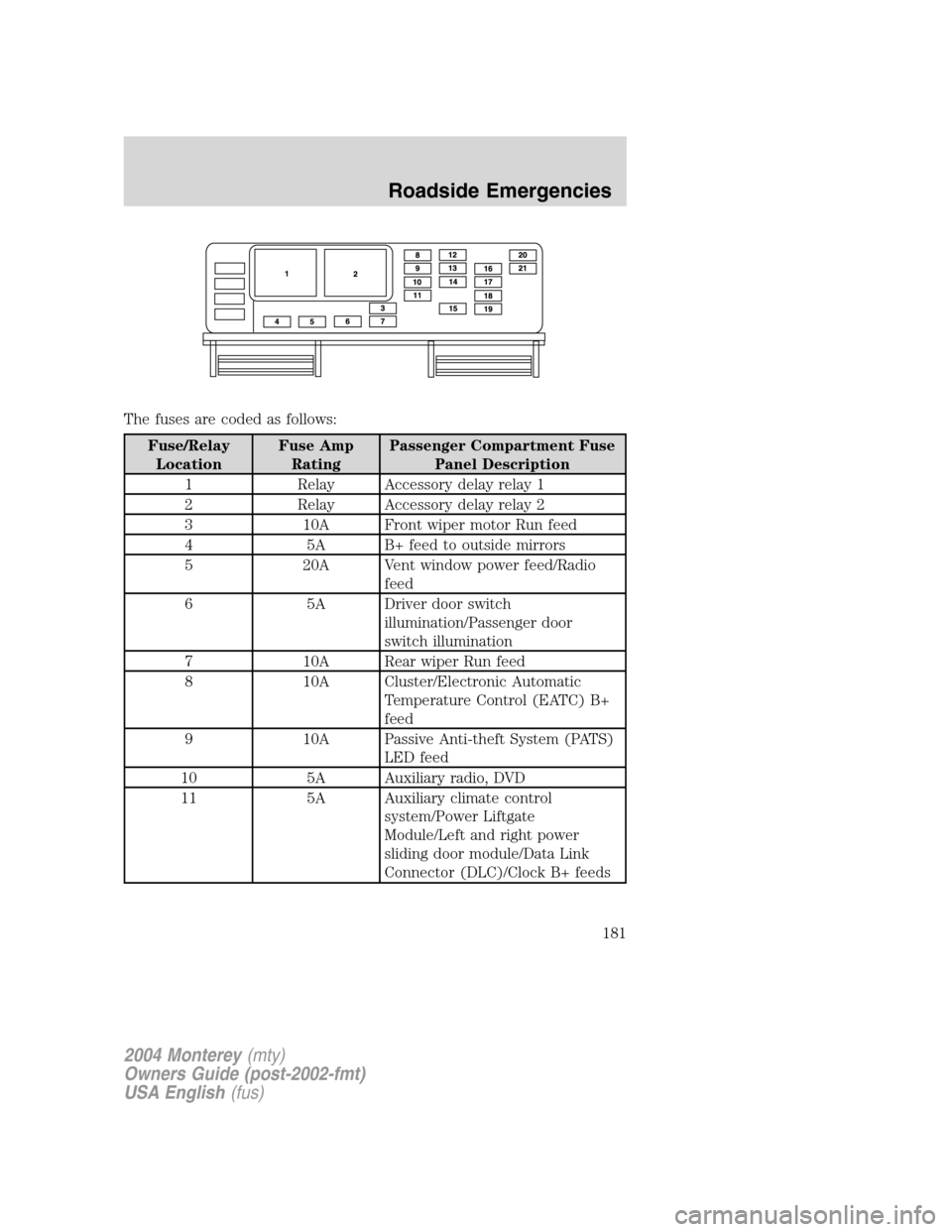
The fuses are coded as follows:
Fuse/Relay
LocationFuse Amp
RatingPassenger Compartment Fuse
Panel Description
1 Relay Accessory delay relay 1
2 Relay Accessory delay relay 2
3 10A Front wiper motor Run feed
4 5A B+ feed to outside mirrors
5 20A Vent window power feed/Radio
feed
6 5A Driver door switch
illumination/Passenger door
switch illumination
7 10A Rear wiper Run feed
8 10A Cluster/Electronic Automatic
Temperature Control (EATC) B+
feed
9 10A Passive Anti-theft System (PATS)
LED feed
10 5A Auxiliary radio, DVD
11 5A Auxiliary climate control
system/Power Liftgate
Module/Left and right power
sliding door module/Data Link
Connector (DLC)/Clock B+ feeds
2004 Monterey(mty)
Owners Guide (post-2002-fmt)
USA English(fus)
Roadside Emergencies
181
Page 182 of 272
Fuse/Relay
LocationFuse Amp
RatingPassenger Compartment Fuse
Panel Description
12 5A Brake-Shift Interlock (BSI) Run
feed, Climate control system Run
feed
13 5A Compass/Driver heated
seat/Passenger heated
seats/Reverse sensing
system/Power Liftgate
Module/Power sliding door Run
feeds
14 5A Underhood fuse box Run feed,
Front blower Run feed
15 10A Brake On-Off (BOO) switch B+
16 5A Steering angle/Cluster/Power
sliding door and power liftgate
inhibit LED/Electrochromatic
mirror Run/Start
17 10A Restraint Control Module
(RCM)/Passenger Air bag Disable
Indicator (PADI)/Passenger
Occupant Detection System
(PODS) Run/Start
18 10A Anti-lock Brake System (ABS)
module/Brake pressure
switch/Speed control Run/Start
19 5A PATS/Cluster/Air bag
LED/Powertrain Control Module
(PCM) relay Run/Start
20 10A Liftgate Start feed, Radio Start
feed
21 10A Starter relay power START
Power distribution box
The power distribution box is located in the engine compartment. The
power distribution box contains high-current fuses that protect your
vehicle’s main electrical systems from overloads.
2004 Monterey(mty)
Owners Guide (post-2002-fmt)
USA English(fus)
Roadside Emergencies
182
Page 184 of 272
Fuse/Relay
LocationFuse Amp
RatingPower Distribution Box
Description
8 40A** Anti-lock Brake System (ABS) #2
(coil power)
9 30A** Power liftgate
10 30A** SJB accessory #1 (passenger
window, radio, vent windows)
11 30A** Left power seat/heated seat
12 40A** ABS #1 (pump motor)
13 40A** Rear defroster
14 30A** Front climate control system
blower motor
15 30A** Right power seat/heated seat
16 30A** Left-hand power sliding door
20 Mini relay Powertrain Control Module (PCM)
power
21 Mini relay Horn
22 Micro relay A/C clutch
23 Micro relay High beams
24 Mini relay Starter
25 Micro relay Fuel pump
26 Micro relay Fog lamps
27—Not used
28 Mini relay Auxiliary blower
29 Micro relay Trailer park lamps
30 Micro relay Left trailer stop/turn lamps
31 Micro relay Right trailer stop/turn lamps
32 Mini relay Rear defroster
40 15A* Engine #1 (A/C relay coil, IMRC,
HEGO sensors, Canister purge,
Transaxle, Canister vent)
41 25A* Horn
42 10A* A/C clutch
2004 Monterey(mty)
Owners Guide (post-2002-fmt)
USA English(fus)
Roadside Emergencies
184
Page 185 of 272
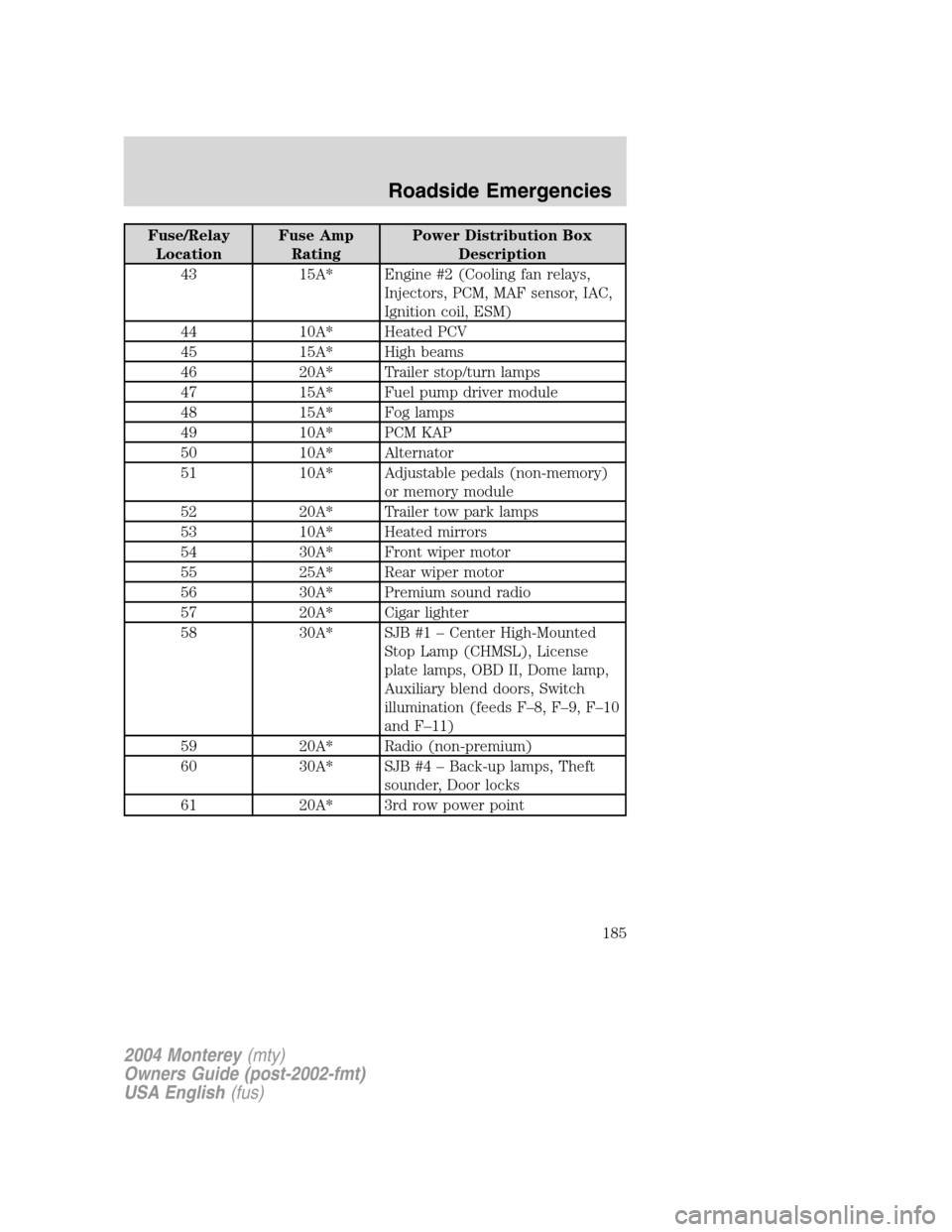
Fuse/Relay
LocationFuse Amp
RatingPower Distribution Box
Description
43 15A* Engine #2 (Cooling fan relays,
Injectors, PCM, MAF sensor, IAC,
Ignition coil, ESM)
44 10A* Heated PCV
45 15A* High beams
46 20A* Trailer stop/turn lamps
47 15A* Fuel pump driver module
48 15A* Fog lamps
49 10A* PCM KAP
50 10A* Alternator
51 10A* Adjustable pedals (non-memory)
or memory module
52 20A* Trailer tow park lamps
53 10A* Heated mirrors
54 30A* Front wiper motor
55 25A* Rear wiper motor
56 30A* Premium sound radio
57 20A* Cigar lighter
58 30A* SJB #1–Center High-Mounted
Stop Lamp (CHMSL), License
plate lamps, OBD II, Dome lamp,
Auxiliary blend doors, Switch
illumination (feeds F–8, F–9, F–10
and F–11)
59 20A* Radio (non-premium)
60 30A* SJB #4–Back-up lamps, Theft
sounder, Door locks
61 20A* 3rd row power point
2004 Monterey(mty)
Owners Guide (post-2002-fmt)
USA English(fus)
Roadside Emergencies
185
Page 186 of 272
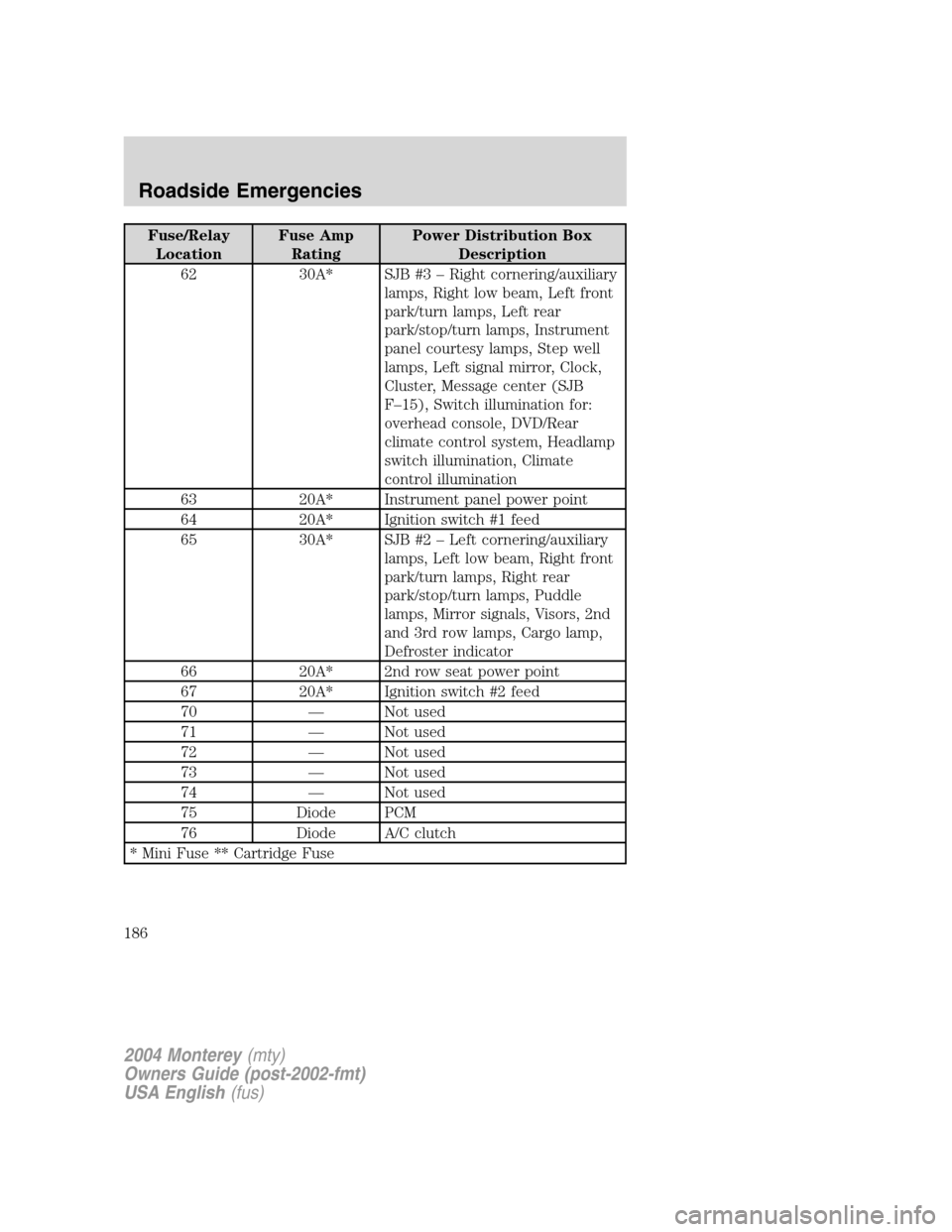
Fuse/Relay
LocationFuse Amp
RatingPower Distribution Box
Description
62 30A* SJB #3–Right cornering/auxiliary
lamps, Right low beam, Left front
park/turn lamps, Left rear
park/stop/turn lamps, Instrument
panel courtesy lamps, Step well
lamps, Left signal mirror, Clock,
Cluster, Message center (SJB
F–15), Switch illumination for:
overhead console, DVD/Rear
climate control system, Headlamp
switch illumination, Climate
control illumination
63 20A* Instrument panel power point
64 20A* Ignition switch #1 feed
65 30A* SJB #2–Left cornering/auxiliary
lamps, Left low beam, Right front
park/turn lamps, Right rear
park/stop/turn lamps, Puddle
lamps, Mirror signals, Visors, 2nd
and 3rd row lamps, Cargo lamp,
Defroster indicator
66 20A* 2nd row seat power point
67 20A* Ignition switch #2 feed
70—Not used
71—Not used
72—Not used
73—Not used
74—Not used
75 Diode PCM
76 Diode A/C clutch
* Mini Fuse ** Cartridge Fuse
2004 Monterey(mty)
Owners Guide (post-2002-fmt)
USA English(fus)
Roadside Emergencies
186
Page 188 of 272
•use tire chains
•drive through an automatic car wash, because of the vehicle’s reduced
ground clearance
•try to repair the temporary spare tire or remove it from its wheel
•use the wheel for any other type of vehicle
Use of a temporary spare tire at any one wheel location can lead to
impairment of the following:
•handling, stability and braking performance
•comfort and noise
•ground clearance and parking at curbs
•Winter driving capability
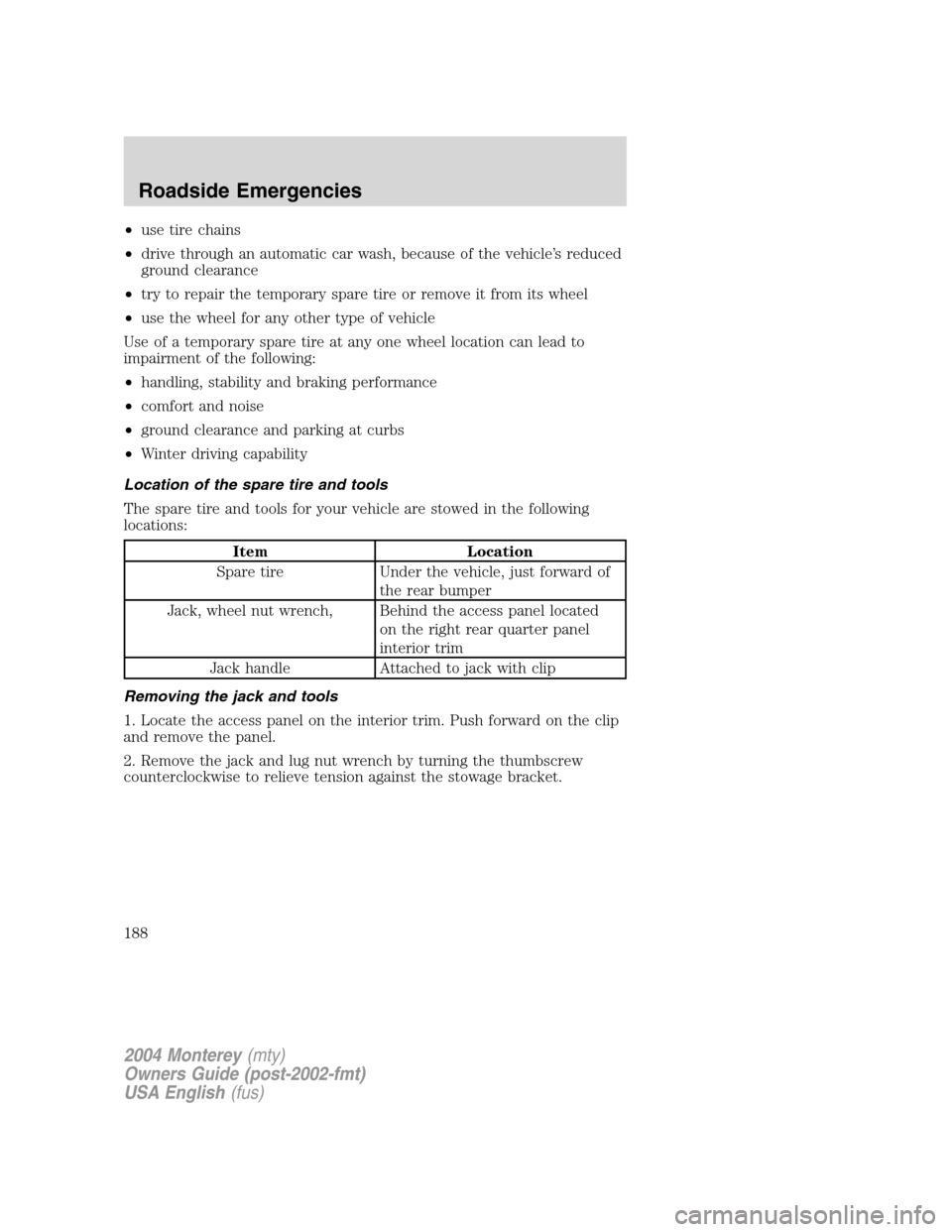
Location of the spare tire and tools
The spare tire and tools for your vehicle are stowed in the following
locations:
Item Location
Spare tire Under the vehicle, just forward of
the rear bumper
Jack, wheel nut wrench, Behind the access panel located
on the right rear quarter panel
interior trim
Jack handle Attached to jack with clip
Removing the jack and tools
1. Locate the access panel on the interior trim. Push forward on the clip
and remove the panel.
2. Remove the jack and lug nut wrench by turning the thumbscrew
counterclockwise to relieve tension against the stowage bracket.
2004 Monterey(mty)
Owners Guide (post-2002-fmt)
USA English(fus)
Roadside Emergencies
188