fuel pump Mercury Sable 2003 s User Guide
[x] Cancel search | Manufacturer: MERCURY, Model Year: 2003, Model line: Sable, Model: Mercury Sable 2003Pages: 216, PDF Size: 1.66 MB
Page 183 of 216

possible. Fuel expense, frequency of fill-ups or fuel gauge readings are
NOT accurate as a measure of fuel economy. We do not recommend
taking fuel economy measurements during the first 1,600 km (1,000
miles) of driving (engine break-in period). You will get a more accurate
measurement after 3,000 km–5,000 km (2,000 miles-3,000 miles).
Filling the tank
The advertised fuel capacity of the fuel tank on your vehicle is equal to
the rated refill capacity of the fuel tank as listed in theRefill capacities
section of this chapter.
The advertised capacity is the amount of the indicated capacity and the
empty reserve combined. Indicated capacity is the difference in the
amount of fuel in a full tank and a tank when the fuel gauge indicates
empty. Empty reserve is the small amount of fuel remaining in the fuel
tank after the fuel gauge indicates empty.
The amount of usable fuel in the empty reserve varies and should
not be relied upon to increase driving range. When refueling your
vehicle after the fuel gauge indicates empty, you might not be
able to refuel the full amount of the advertised capacity of the
fuel tank due to the empty reserve still present in the tank.
For consistent results when filling the fuel tank:
•Turn the engine/ignition switch to the off position prior to refueling,
an error in the reading will result if the engine is left running.
•Use the same filling rate setting (low—medium—high) each time
the tank is filled.
•Allow no more than 2 automatic click-offs when filling.
•Always use fuel with the recommended octane rating.
•Use a known quality gasoline, preferably a national brand.
•Use the same side of the same pump and have the vehicle facing the
same direction each time you fill up.
•Have the vehicle loading and distribution the same every time.
Your results will be most accurate if your filling method is consistent.
Calculating fuel economy
1. Fill the fuel tank completely and record the initial odometer reading
(in kilometers or miles).
2. Each time you fill the tank, record the amount of fuel added (in liters
or gallons).
Maintenance and Specifications
183
Page 209 of 216
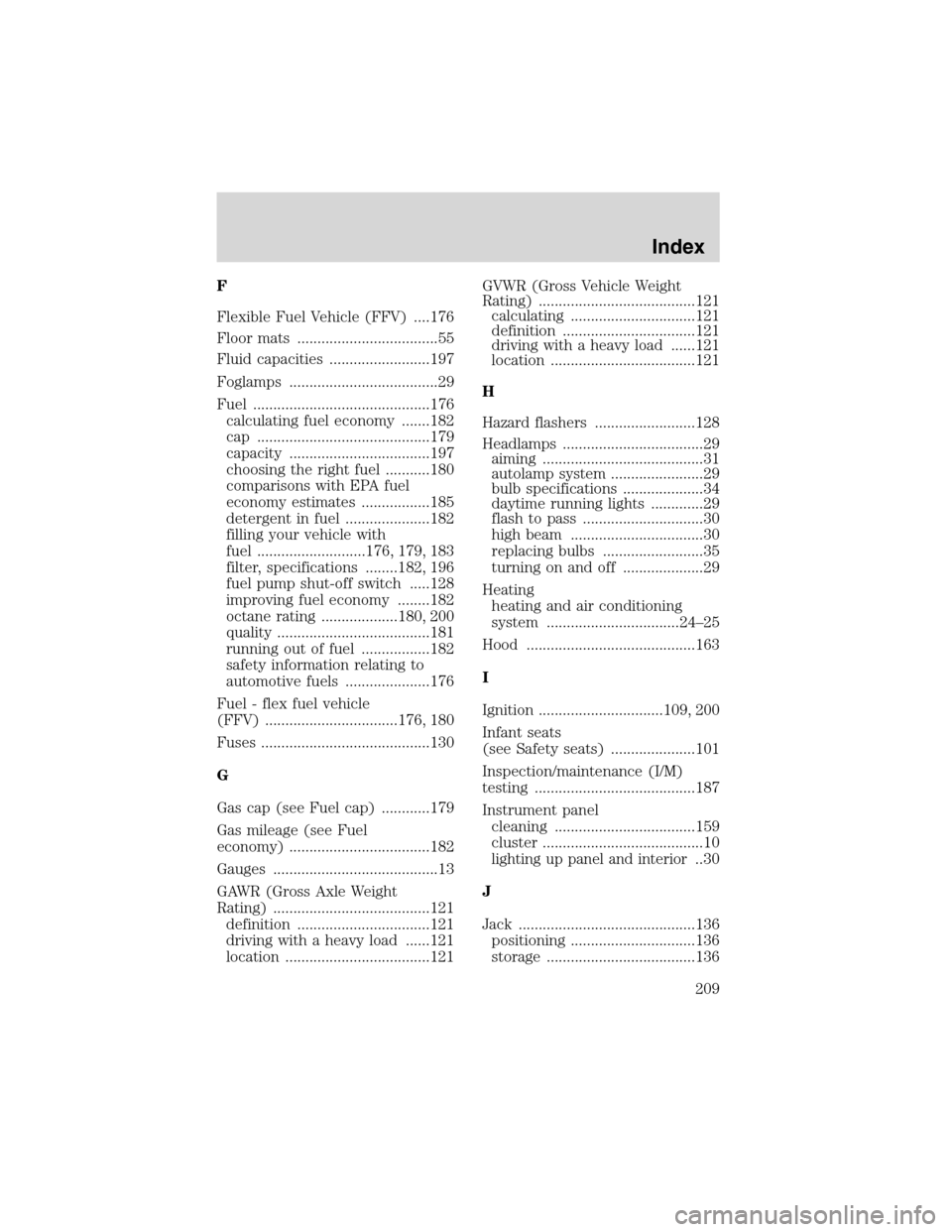
F
Flexible Fuel Vehicle (FFV) ....176
Floor mats ...................................55
Fluid capacities .........................197
Foglamps .....................................29
Fuel ............................................176
calculating fuel economy .......182
cap ...........................................179
capacity ...................................197
choosing the right fuel ...........180
comparisons with EPA fuel
economy estimates .................185
detergent in fuel .....................182
filling your vehicle with
fuel ...........................176, 179, 183
filter, specifications ........182, 196
fuel pump shut-off switch .....128
improving fuel economy ........182
octane rating ...................180, 200
quality ......................................181
running out of fuel .................182
safety information relating to
automotive fuels .....................176
Fuel - flex fuel vehicle
(FFV) .................................176, 180
Fuses ..........................................130
G
Gas cap (see Fuel cap) ............179
Gas mileage (see Fuel
economy) ...................................182
Gauges .........................................13
GAWR (Gross Axle Weight
Rating) .......................................121
definition .................................121
driving with a heavy load ......121
location ....................................121GVWR (Gross Vehicle Weight
Rating) .......................................121
calculating ...............................121
definition .................................121
driving with a heavy load ......121
location ....................................121
H
Hazard flashers .........................128
Headlamps ...................................29
aiming ........................................31
autolamp system .......................29
bulb specifications ....................34
daytime running lights .............29
flash to pass ..............................30
high beam .................................30
replacing bulbs .........................35
turning on and off ....................29
Heating
heating and air conditioning
system .................................24–25
Hood ..........................................163
I
Ignition ...............................109, 200
Infant seats
(see Safety seats) .....................101
Inspection/maintenance (I/M)
testing ........................................187
Instrument panel
cleaning ...................................159
cluster ........................................10
lighting up panel and interior..30
J
Jack ............................................136
positioning ...............................136
storage .....................................136
Index
209