climate control Mercury Villager 2000 s User Guide
[x] Cancel search | Manufacturer: MERCURY, Model Year: 2000, Model line: Villager, Model: Mercury Villager 2000Pages: 256, PDF Size: 2.21 MB
Page 37 of 256
Do not place objects on top of the instrument panel, as these
objects may become projectiles in a collision or sudden stop.
Rear passenger air conditioning system Ð EATC systems
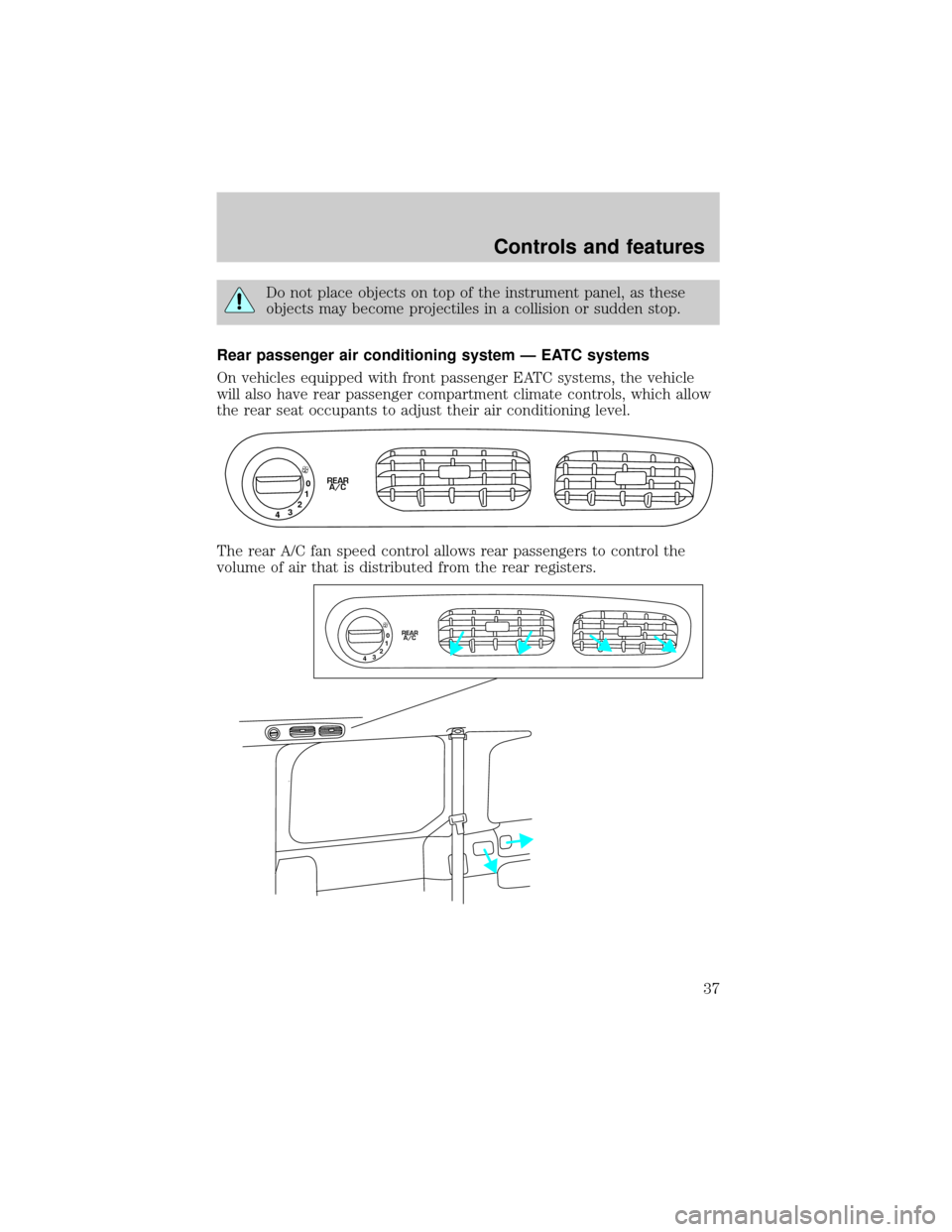
On vehicles equipped with front passenger EATC systems, the vehicle
will also have rear passenger compartment climate controls, which allow
the rear seat occupants to adjust their air conditioning level.
The rear A/C fan speed control allows rear passengers to control the
volume of air that is distributed from the rear registers.
0
1
2
3
4REAR
A/C
0
1
2
3
4REAR
A/C
Controls and features
37
Page 38 of 256
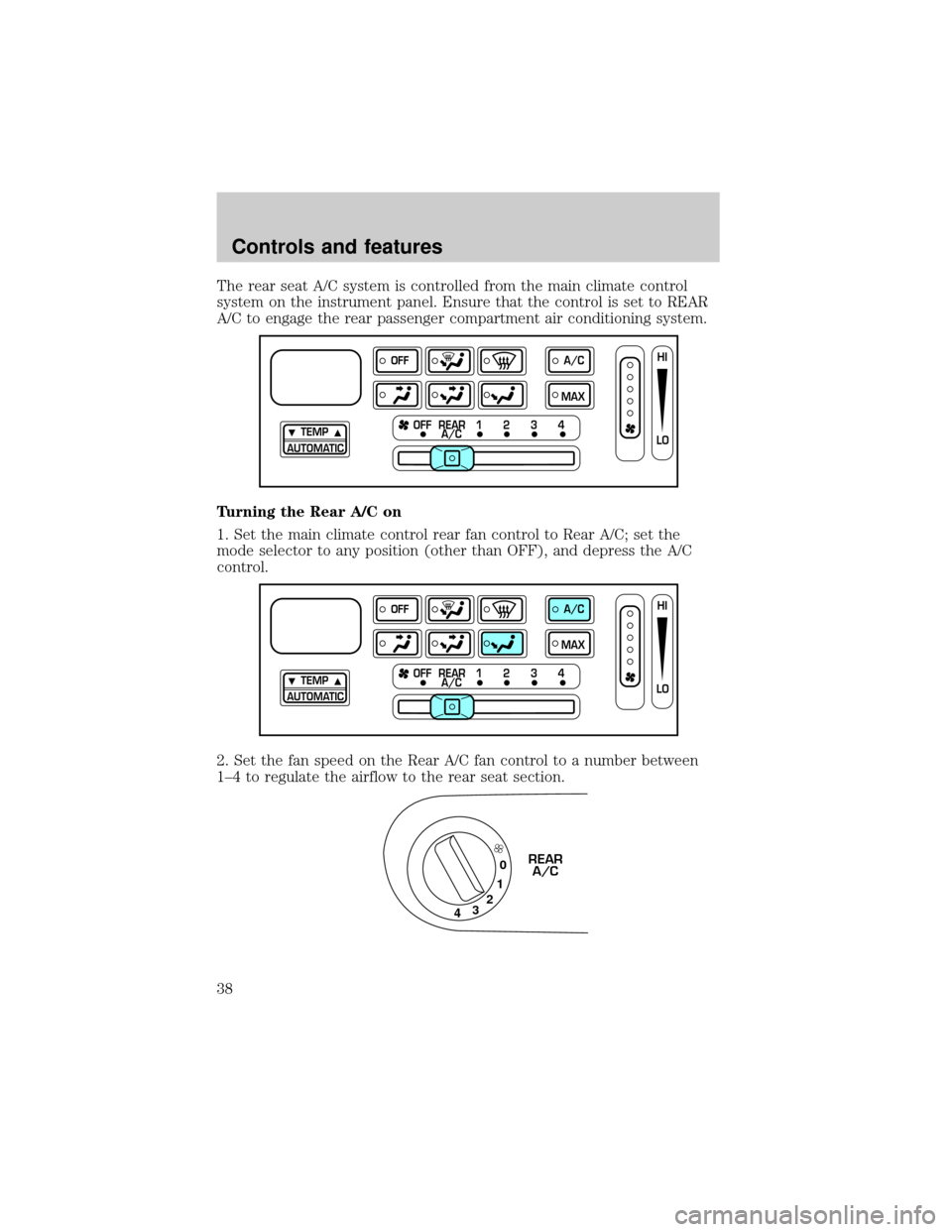
The rear seat A/C system is controlled from the main climate control
system on the instrument panel. Ensure that the control is set to REAR
A/C to engage the rear passenger compartment air conditioning system.
Turning the Rear A/C on
1. Set the main climate control rear fan control to Rear A/C; set the
mode selector to any position (other than OFF), and depress the A/C
control.
2. Set the fan speed on the Rear A/C fan control to a number between
1±4 to regulate the airflow to the rear seat section.
TEMP
AUTOMATICOFF REAR 1 2 3 4
OFFA/C
A/CMAXHI
LO
TEMP
AUTOMATICOFF REAR 1 2 3 4
OFFA/C
A/CMAXHI
LO
10
2
3
4
REAR
A/C
Controls and features
38
Page 39 of 256
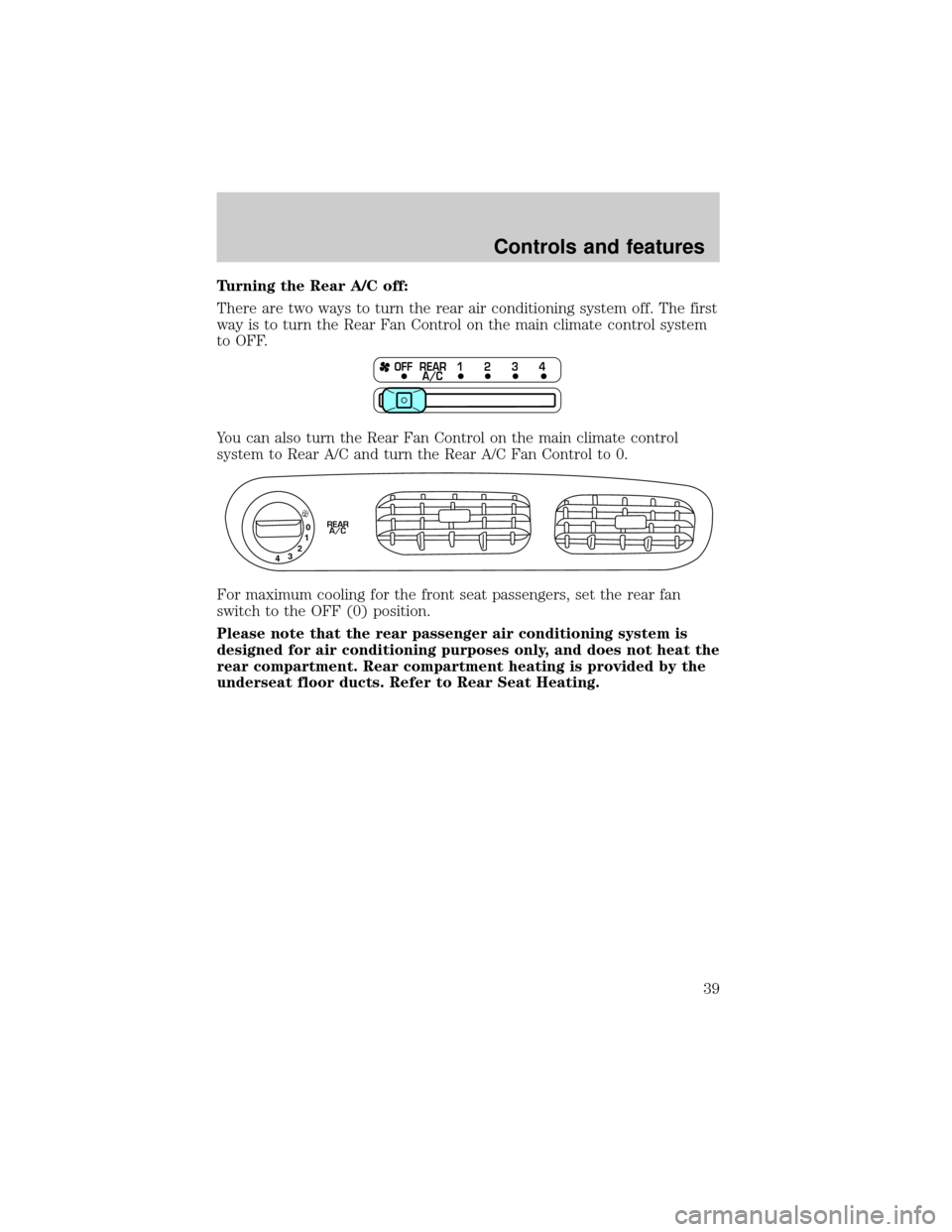
Turning the Rear A/C off:
There are two ways to turn the rear air conditioning system off. The first
way is to turn the Rear Fan Control on the main climate control system
to OFF.
You can also turn the Rear Fan Control on the main climate control
system to Rear A/C and turn the Rear A/C Fan Control to 0.
For maximum cooling for the front seat passengers, set the rear fan
switch to the OFF (0) position.
Please note that the rear passenger air conditioning system is
designed for air conditioning purposes only, and does not heat the
rear compartment. Rear compartment heating is provided by the
underseat floor ducts. Refer to Rear Seat Heating.
OFF REAR 1 2 3 4
A/C
0
1
2
3
4REAR
A/C
Controls and features
39
Page 171 of 256
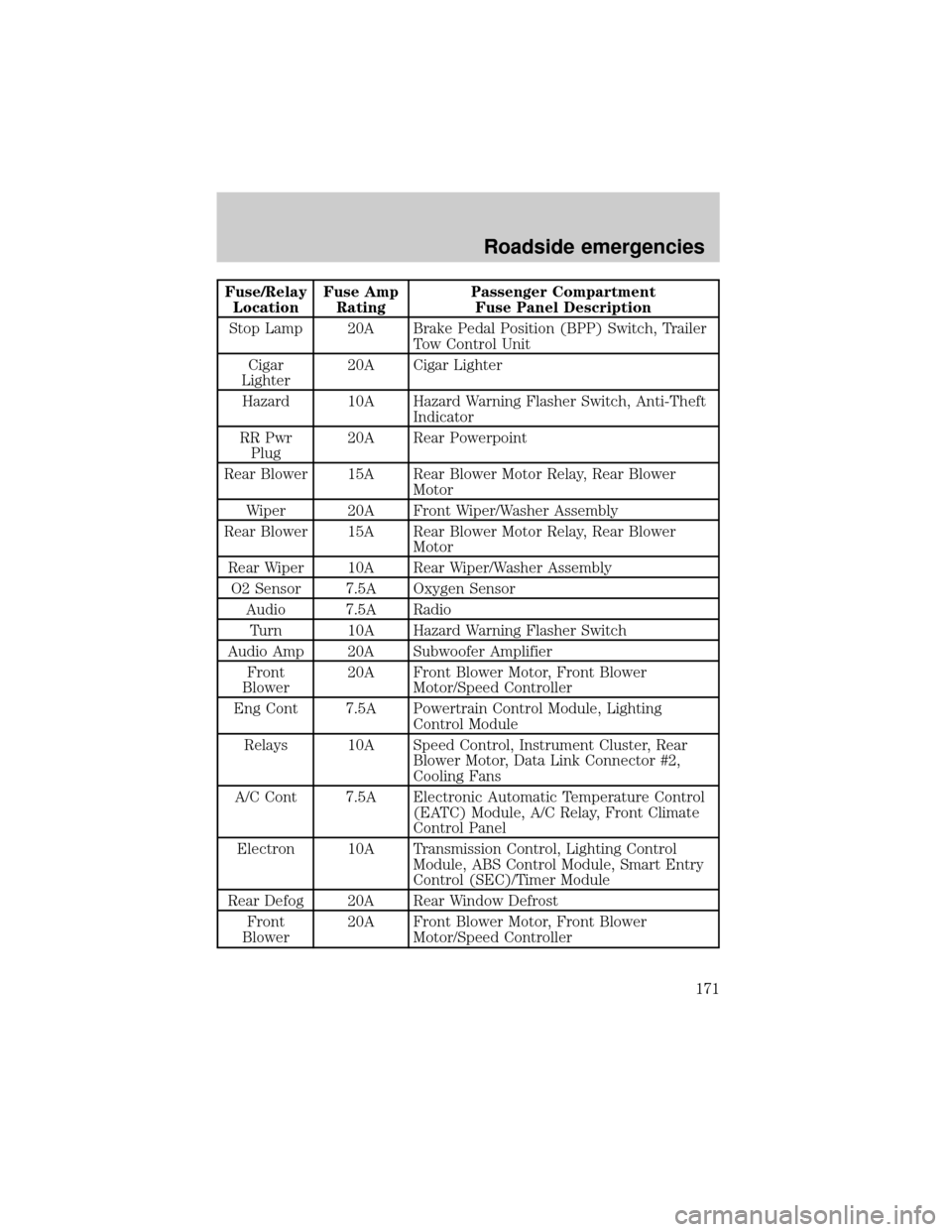
Fuse/Relay
LocationFuse Amp
RatingPassenger Compartment
Fuse Panel Description
Stop Lamp 20A Brake Pedal Position (BPP) Switch, Trailer
Tow Control Unit
Cigar
Lighter20A Cigar Lighter
Hazard 10A Hazard Warning Flasher Switch, Anti-Theft
Indicator
RR Pwr
Plug20A Rear Powerpoint
Rear Blower 15A Rear Blower Motor Relay, Rear Blower
Motor
Wiper 20A Front Wiper/Washer Assembly
Rear Blower 15A Rear Blower Motor Relay, Rear Blower
Motor
Rear Wiper 10A Rear Wiper/Washer Assembly
O2 Sensor 7.5A Oxygen Sensor
Audio 7.5A Radio
Turn 10A Hazard Warning Flasher Switch
Audio Amp 20A Subwoofer Amplifier
Front
Blower20A Front Blower Motor, Front Blower
Motor/Speed Controller
Eng Cont 7.5A Powertrain Control Module, Lighting
Control Module
Relays 10A Speed Control, Instrument Cluster, Rear
Blower Motor, Data Link Connector #2,
Cooling Fans
A/C Cont 7.5A Electronic Automatic Temperature Control
(EATC) Module, A/C Relay, Front Climate
Control Panel
Electron 10A Transmission Control, Lighting Control
Module, ABS Control Module, Smart Entry
Control (SEC)/Timer Module
Rear Defog 20A Rear Window Defrost
Front
Blower20A Front Blower Motor, Front Blower
Motor/Speed Controller
Roadside emergencies
171
Page 204 of 256
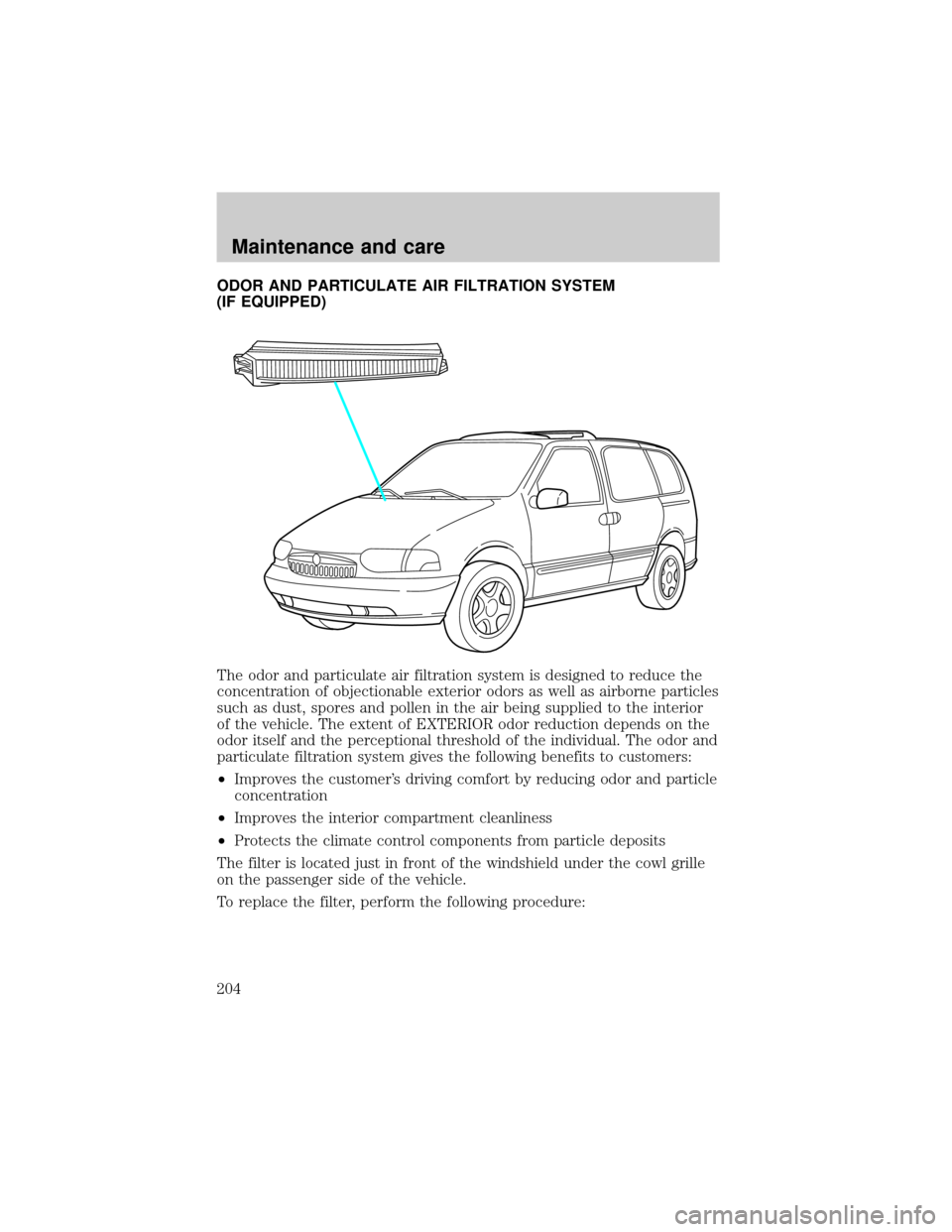
ODOR AND PARTICULATE AIR FILTRATION SYSTEM
(IF EQUIPPED)
The odor and particulate air filtration system is designed to reduce the
concentration of objectionable exterior odors as well as airborne particles
such as dust, spores and pollen in the air being supplied to the interior
of the vehicle. The extent of EXTERIOR odor reduction depends on the
odor itself and the perceptional threshold of the individual. The odor and
particulate filtration system gives the following benefits to customers:
²Improves the customer's driving comfort by reducing odor and particle
concentration
²Improves the interior compartment cleanliness
²Protects the climate control components from particle deposits
The filter is located just in front of the windshield under the cowl grille
on the passenger side of the vehicle.
To replace the filter, perform the following procedure:
Maintenance and care
204
Page 209 of 256

These Tire Quality Grades are determined by standards that the United
States Department of Transportation has set.
Tire Quality Grades apply to new pneumatic tires for use on passenger
cars. They do not apply to deep tread, winter-type snow tires,
space-saver or temporary use spare tires, tires with nominal rim
diameters of 10 to 12 inches or limited production tires as defined in
Title 49 Code of Federal Regulations Part 575.104(c)(2).
U.S. Department of Transportation-Tire quality grades:The U.S.
Department of Transportation requires Ford to give you the following
information about tire grades exactly as the government has written it.
Treadwear
The treadwear grade is a comparative rating based on the wear rate of
the tire when tested under controlled conditions on a specified
government test course. For example, a tire graded 150 would wear one
and one-half (1 1/2) times as well on the government course as a tire
graded 100. The relative performance of tires depends upon the actual
conditions of their use, however, and may depart significantly from the
norm due to variations in driving habits, service practices, and
differences in road characteristics and climate.
Traction AA A B C
The traction grades, from highest to lowest are AA, A, B, and C. Those
grades represent the tire's ability to stop on wet pavement as measured
under controlled conditions on specified government test surfaces of
asphalt and concrete. A tire marked C may have poor traction
performance.
The traction grade assigned to this tire is based on
straight-ahead braking traction tests, and does not include
acceleration, cornering, hydroplaning or peak traction characteristics.
Temperature A B C
The temperature grades are A (the highest), B, and C, representing the
tire's resistance to the generation of heat and its ability to dissipate heat
when tested under controlled conditions on a specified indoor laboratory
test wheel. Sustained high temperature can cause the material of the tire
to degenerate and reduce tire life, and excessive temperature can lead to
sudden tire failure. The grade C corresponds to a level of performance
Maintenance and care
209
Page 212 of 256
Failure to follow these precautions may adversely affect the
handling of the vehicle and make it easier for the driver to lose
control and roll over.
Tires that are larger or smaller than your vehicle's original tires may also
affect the accuracy of your speedometer.
SNOW TIRES AND CHAINS
Snow tires must be the same size and grade as the tires you
currently have on your vehicle.
The tires on your vehicle have all weather treads to provide traction in
rain and snow. However, in some climates, you may need to use snow
tires and chains. If you need to use chains, it is recommended that steel
wheels (of the same size and specifications) be used as chains may chip
aluminum wheels.
Follow these guidelines when using snow tires and chains:
²Use only SAE Class S chains.
²Install chains securely, verifying that the chains do not touch any
wiring, brake lines or fuel lines.
²Drive cautiously. If you hear the chains rub or bang against your
vehicle, stop and re-tighten the chains. If this does not work, remove
the chains to prevent damage to your vehicle.
²If possible, avoid fully loading your vehicle.
²Remove the tire chains when they are no longer needed. Do not use
tire chains on dry roads.
²The suspension insulation and bumpers will help prevent vehicle
damage. Do not remove these components from your vehicle when
using snow tires and chains.
WHAT YOU SHOULD KNOW ABOUT AUTOMOTIVE FUELS
Important safety precautions
Do not overfill the fuel tank. The pressure in an overfilled tank
may cause leakage and lead to fuel spray and fire.
Maintenance and care
212
Page 251 of 256

Accessory delay ..........................91
Air bag supplemental
restraint system .................132,133
and child safety seats ............134
description ..............................133
disposal ....................................137
driver air bag ..........................135
indicator light ......................8,136
operation .................................135
passenger air bag ...................135
Air cleaner filter .........200,201,233
Air conditioning ..........................22
automatic temperature
control system ..........................29
Air filter, cabin ..........................204
Antifreeze
(see Engine coolant) ................194
Anti-lock brake system
(see Brakes) .......................152,153
Anti-theft system ......................105
arming the system ..................105
disarming a
triggered system .....................107
disarming an untriggered
system .....................................107
Audio system (see Radio) .........40
Automatic transaxle .................155
driving with .............................156
fluid, adding ............................198
fluid, checking ........................198
fluid, refill capacities ..............233
fluid, specification ..................235
Auxiliary power point .................81
Axle
lubricant specifications ..........234
Battery .......................................201
acid, treating emergencies .....201
charging system warning light ..8
jumping a disabled battery ....180
maintenance-free ....................201
replacement, specifications ...233
servicing ..................................201Brakes ........................................152
anti-lock ............................152,153
anti-lock brake system
(ABS) warning light ..........10,153
brake warning light ....................9
fluid, checking and adding ....192
fluid, refill capacities ..............233
fluid, specifications ..........234,235
lubricant specifications ...234,235
parking ....................................153
shift interlock ..........................155
Break-in period .............................3
Capacities for refilling fluids ....233
Cargo cover ...............................110
Cargo net ............................109,110
CD changer .................................77
Certification Label ....................237
Child safety restraints ..............137
child safety belts ....................137
Child safety seats ......................138
in front seat ............................140
in rear seat .......................140,142
tether anchorage hardware ...144
Cleaning your vehicle ...............227
built-in child seat ...................232
engine compartment ..............229
exterior .............................228,229
exterior lamps .........................229
instrument panel ....................231
instrument panel lens ............231
interior ..............................231,232
mirrors .....................................229
plastic parts ............................229
safety belts ..............................232
washing ....................................227
waxing .....................................228
wheels ......................................228
windows ..................................231
wiper blades ............................230
woodtone trim ........................231
Climate control (see Air
conditioning or Heating) ............22
Index
251