Page 68 MINI COOPER 2005 Owner's Manual
[x] Cancel search | Manufacturer: MINI, Model Year: 2005, Model line: COOPER, Model: MINI COOPER 2005Pages: 165, PDF Size: 4.64 MB
Page 49 of 165

47
OVERVIEW REPAIRS OPERATIONCONTROLS DATA INDEX
MIRRORS
VEHICLE MEMORY
Interior rearview mirror To reduce glare from vehicles behind you
when you are driving at night:Turn the knob.Illuminated vanity mirror From ignition key position
1:
1. Fold down the sun visor2. Fold the cover panel upwards.Sun visorsCan be swung sideways.An additional sun visor is provided on the
driver's side to better protect the driver
from being blinded.
Interior mirror, automatic dimming* While the vehicle is being driven forward,
these mirrors dim light through an infi
-
nitely variable range depending on the
light's incidence. Two photocells in the
interior rearview mirror serve this purpose.
One is positioned on the underside of the
mirror frame, while the other is slightly off
-
set on the back of the mirror.In order for the photocells to work opti
-
mally, keep them clean and do not cover
the area between the interior rearview mir
-
ror and the windshield. Do not place stick
-
ers or toll tags on the windshield in front of
the mirror.
How the system functionsNo doubt you have often reflected on how
great it would be if you could configure
your vehicle's various adjustment settings
to meet your own personal requirements.
In developing this vehicle, the manufac
-
turer of the MINI has incorporated a num
-
ber of options which can be programmed
specifically for your vehicle. What the system can doYour MINI Dealer can provide you with
details on the capabilities of the Vehicle
Memory system.Examples for Vehicle Memory:>Automatic locking if none of the vehicle
doors are opened, refer to page
26
>Automatic locking after starting to drive,
refer to page
28
>Selective central locking system, refer to
pages
26, 27
>Convenience operation, refer to
pages
26, 27
>'Follow-me-home' lamps, refer to
page
57
>Daytime driving lamps, refer to page
58
>Speed-dependent windshield wipers,
refer to page
60
ProCarManuals.com
Page 50 of 165

48
VEHICLE MEMORY
TRANSPORTING CHILDREN SAFELY
>Setting units for outside temperature
and fuel consumption display, refer to
page
66
>Setting units for display of temperatures
specified for automatic climate control
system, refer to page
80
>Volume control PDC, refer to page
74
>Acoustic alarm for starting PDC activa
-
tion, refer to page
74.
This symbol alerts you to Vehicle Memory functions in the Owner's
Manual.
ate slightly differently from the descrip
-
tions used in this Owner's Manual. If you
decide to sell your vehicle one day, please
remember to have the memory functions
reset to their default configuration.<
The proper place for childrenChildren should always sit in the rear:Accident research shows that the safest
place for children in a vehicle is in the rear
seat.Older children should be tightly secured
with a safety belt, after they have out
-
grown a booster seat that is appropriate for
their age, height and weight.
A child sitting in the rear seat and not properly restrained may place his or
her head on or near the airbag, if so
equipped. For example, a child – even
though belted in – may fall asleep with his
or her head against the side airbag. It may
be difficult for a driver to ensure that chil
-
dren in the rear seat will remain properly
positioned at all times and do not place
their heads on or near the side airbag.
Therefore, we recommend that the rear
side airbags, if provided, be deactivated if
you plan to transport children in the rear
seat.
years of age and
children less than 5
ft / 150
cm tall
should always ride in the rear and the
restraint systems should be secured with
the vehicle's safety belts.
system that has first been properly
restrained. We strongly urge you to care
-
fully read and comply with the instructions
for installation and use provided by the
child-restraint's manufacturer whenever
you use such a device.All rear seating positions in your vehicle
meet the recommendations of SAE
J1819,
an industry-recommended practice for
securing child-restraint systems in motor
vehicles.
Exception for the front passenger seat
Should it one day be necessary to use a child-restraint system on the front
passenger seat, the airbags on the front
passenger side must be deactivated. Other
-
wise, there is a significant risk of injury to
children if the airbags deploy, even if they
are seated in a child-restraint system. Have
the front passenger airbags permanently
deactivated only by your MINI Dealer or a
workshop that has specially trained per
-
sonnel working in accordance with the
specifications of the MINI manufacturer.<
ProCarManuals.com
Page 55 of 165

53
OVERVIEW REPAIRS OPERATIONCONTROLS DATA INDEX
PARKING BRAKE
MANUAL TRANSMISSION
The parking brake is designed primarily to prevent the vehicle from rolling when it is
parked. It operates against the rear wheels.To engageLever automatically locks in position.
The indicator lamp in the instrument clus
-
ter lights up from ignition key position
2,
refer to page
17.
To release1. Pull up slightly2. Press the button3. Push the lever downwards.
If, in exceptional circumstances, it should be necessary to engage the
parking brake while the vehicle is in
motion, do not pull the lever with excessive
pressure. Keep your thumb pressed against
the release button while carefully pulling
the lever up to apply moderate pressure.
Excessive pressure can lead to overbraking
and loss of traction, i.e. fishtailing, at the
rear axle. The brake lamps do not come on
when the parking brake is engaged.<
To avoid corrosion and one-sided braking, apply the parking brake
lightly from time to time when coasting to
a standstill, for instance at a traffic light,
provided that it is safe to do so.<
6-speed transmission*
When changing gear in the 5th/6th gear plane, press the gearshift lever
to the right to prevent inadvertently shift
-
ing to a gear of the
3rd/4th gear plane.<
ProCarManuals.com
Page 56 of 165

54
MANUAL TRANSMISSION
CONTINUOUSLY VARIABLE AUTOMATIC TRANSMISSION (CVT)
*
Reverse gearBefore selecting reverse gear, ensure the
vehicle is stationary; then, fully depress the
clutch pedal and pause briefly before mov
-
ing the gearshift lever into position.5-speed transmission: Press the gearshift lever to the right and to
the back.6-speed transmission: Press the gearshift lever towards the left.
Thereby overcome the slight resistance and
press forward.As you do this, the backup lamps will come
on automatically when the ignition key is
in position
2.
Do not hold the vehicle in place on slopes by slipping or 'riding' the
clutch. Use the parking brake instead. Oth
-
erwise, a high degree of clutch wear could
result.<
In addition to the fully automatic mode,
you can shift gears manually using Step
-
tronic, refer to page
55.
Selector lever positionsP R N D M/S
+ –
Range selection Inadvertent engaging of certain selector
lever positions is prevented by a lock.Press the button on the front side of the
selector lever knob. The lock is released.
While the vehicle is stationary, and before shifting out of P or N, press the
brake pedal in order to disengage the selec
-
tor lever lock mechanism, shiftlock.
If the engine speed is too high when the
vehicle is at a standstill, the selector lever is
also blocked to protect the transmission.
Hold the brake pedal down until starting
off. Otherwise the vehicle will 'creep' when
a drive position is engaged.<
To prevent the vehicle from starting off on its own, always move the
ProCarManuals.com
Page 58 of 165
56
CONTINUOUSLY VARIABLE AUTOMATIC TRANSMISSION (CVT)
*
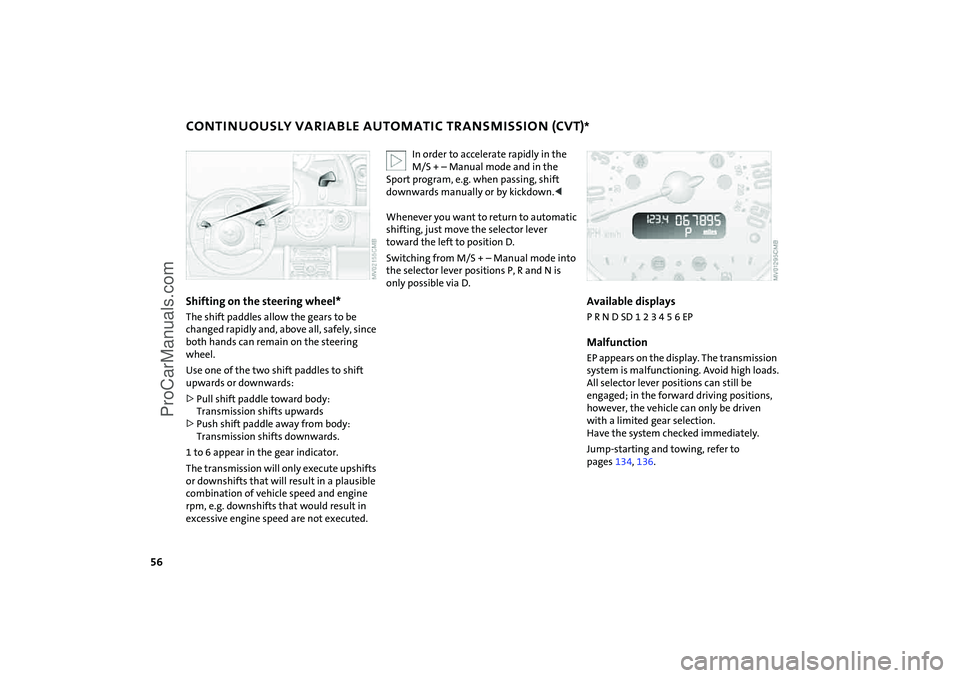
Shifting on the steering wheel* The shift paddles allow the gears to be
changed rapidly and, above all, safely, since
both hands can remain on the steering
wheel.Use one of the two shift paddles to shift
upwards or downwards:>Pull shift paddle toward body:
Transmission shifts upwards>Push shift paddle away from body:
Transmission shifts downwards.1 to 6 appear in the gear indicator.
The transmission will only execute upshifts
or downshifts that will result in a plausible
combination of vehicle speed and engine
rpm, e.g. downshifts that would result in
excessive engine speed are not executed.
In order to accelerate rapidly in the M/S
+ – Manual mode and in the
Sport program, e.g. when passing, shift
downwards manually or by kickdown.<
Whenever you want to return to automatic
shifting, just move the selector lever
toward the left to position D.Switching from M/S
+ – Manual mode into
the selector lever positions P, R and N is
only possible via D.
Available displaysP R N D SD 1 2 3 4 5 6 EPMalfunctionEP appears on the display. The transmission
system is malfunctioning. Avoid high loads.
All selector lever positions can still be
engaged; in the forward driving positions,
however, the vehicle can only be driven
with a limited gear selection.
Have the system checked immediately.Jump-starting and towing, refer to
pages
134
, 136
.
ProCarManuals.com
Page 62 of 165

60
WASHER/WIPER SYSTEMwindshield wipers are automatically con
-
trolled depending on the amount of mois
-
ture, including snow, on the windshield. To activate the rain sensor:From ignition key position
1:
Lever in position 1.
The wipers move over the windshield once.To deactivate the rain sensor:Put lever in position
0.
Switch the rain sensor off when pass
-
ing through an automatic car wash.
Failure to do so could result in damage
caused by undesired wiper activation. <
Normal wiper speedWhen the vehicle is stationary, the wipers
switch automatically to intermittent wip
-
ing.
You can have this function activated/deactivated.<
Fast wiper speedWhen the vehicle is stationary, the wipers
switch automatically to normal wiper
speed.
You can have this function activated/deactivated. <
Cleaning windshield and headlamps * The system sprays washer fluid against the
windshield. The wipers are automatically
activated for a brief period.When the vehicle lighting is on, the head
-
lamps are also cleaned at appropriate inter
-
vals.
Do not use the washers if there is any danger that the fluid will freeze on
the windshield. For this reason, use an anti
-
freeze agent, refer to page
108
.
Do not use the washers when the reservoir
is empty, since this could cause damage to
the washing pump.
position
2.
Rear window wiper * 6 Intermittent operation:
Turn the cap to position
6.
The rear window wiper moves across the
window a number of times before
switching to interm ittent operationCleaning the rear window * 7 Intermittent operation:
Turn the cap to position
7 and hold in
place
8 In lever position
0:
Turn the cap to position
8 and hold in
place
ProCarManuals.com
Page 66 of 165
64
FUEL GAUGE
COOLANT TEMPERATURE GAUGE
In the navigation system
Please also comply with the instruc
-
tions in the previous section.<
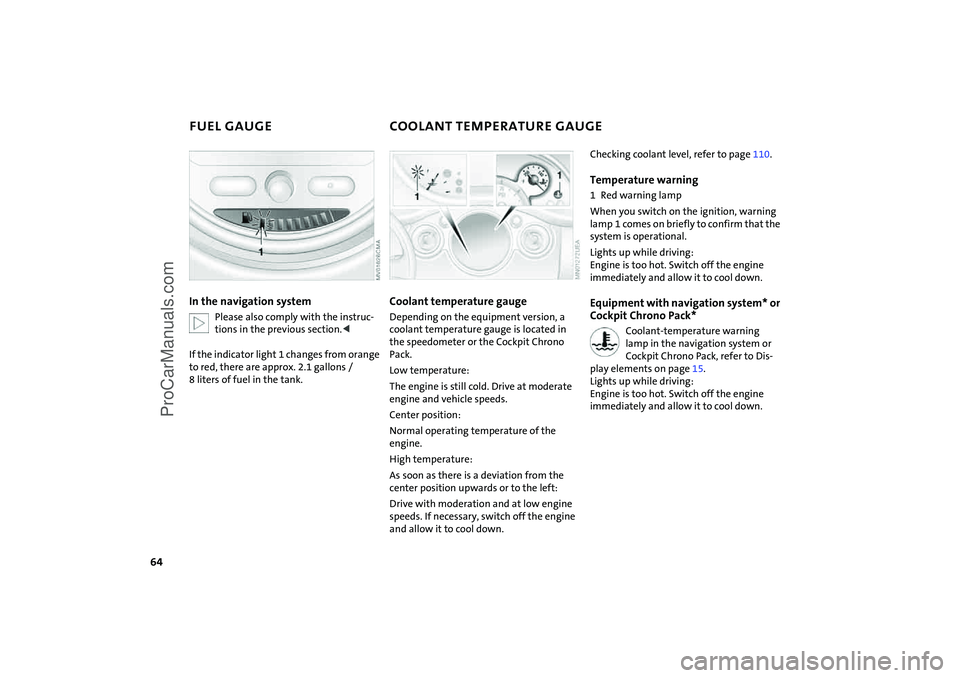
If the indicator light
1 changes from orange
to red, there are approx. 2.1
gallons
/
8
liters of fuel in the tank.
Coolant temperature gaugeDepending on the equipment version, a
coolant temperature gauge is located in
the speedometer or the Cockpit Chrono
Pack.Low temperature:The engine is still cold. Drive at moderate
engine and vehicle speeds.Center position:Normal operating temperature of the
engine.High temperature:As soon as there is a deviation from the
center position upwards or to the left:Drive with moderation and at low engine
speeds. If necessary, switch off the engine
and allow it to cool down.
Checking coolant level, refer to page
110
.
Temperature warning 1 Red warning lampWhen you switch on the ignition, warning
lamp
1 comes on briefly to confirm that the
system is operational.
Lights up while driving:
Engine is too hot. Switch off the engine
immediately and allow it to cool down.Equipment with navigation system* or
Cockpit Chrono Pack*
Coolant-temperature warning lamp in the navigation system or
Cockpit Chrono Pack, refer to Dis
-
play elements on page
15.
Lights up while driving:
Engine is too hot. Switch off the engine
immediately and allow it to cool down.
ProCarManuals.com
Page 67 of 165

65
OVERVIEW REPAIRS OPERATIONCONTROLS DATA INDEX
TACHOMETER
SERVICE INTERVAL DISPLAY
Do not operate the engine with the needle in the red overspeed zone of the gauge.To protect the engine, the power is reduced
when you approach a certain engine speed
in this sector.
Remaining distance for serviceThe distance remaining before the next
scheduled service is displayed in miles
/
kilometers for a short period with the igni
-
tion key in position 1 or higher. The display
also indicates whether an engine oil service
and/or an inspection is due.
The onboard computer bases its calcula
-
tions of the remaining distance on your
driving style in the period immediately pre
-
ceding your data request. The remaining
distance display counts backwards in steps
of 35
miles / 50
km to the next service. A
flashing message and a minus sign in front
of the display that again begins counting
forwards mean that the service interval has
been exceeded.
Please schedule an appointment with your
MINI Dealer or a workshop that has spe
-
cially trained personnel working in accor
-
dance with the specifications of your MINI
manufacturer.For more information on the service inter
-
val display, refer to page
112
.
ProCarManuals.com
Page 70 of 165
68
ALL SEASON TRACTION CONTROL (ASC)
*
The conceptThis system optimizes driving stability and
traction, especially when just starting off,
when accelerating or when cornering. ASC recognizes the danger present in trac
-
tion loss and will increase driving stability
and traction by reducing the engine's out
-
put and, if necessary, by applying the
brakes to the front wheels. ASC is operational each time you start the
engine. It contains the following functions:>Antilock Brake System (ABS)>Cornering Brake Control (CBC)>Electronic Brake Force Distribution (EBD).
The laws of physics cannot be repealed, even with ASC. An appropri
-
ate driving style always remains the
responsibility of the driver. Avoid using the
additional safety margin provided by the
system as an excuse for taking unnecessary
risks.
Do not make any modifications to the ASC
system. Allow only authorized technicians
to perform service procedures on the
ASC.<
Indicator lamp
The indicator lamp will go out shortly after the ignition has been
switched on, refer to pages
17, 18
.
If the indicator lamp flashes:
ASC controls the drive and braking forces.The indicator lamp stays lit:
The system is defective or was turned off
using the button. Have the system checked
as soon as possible.
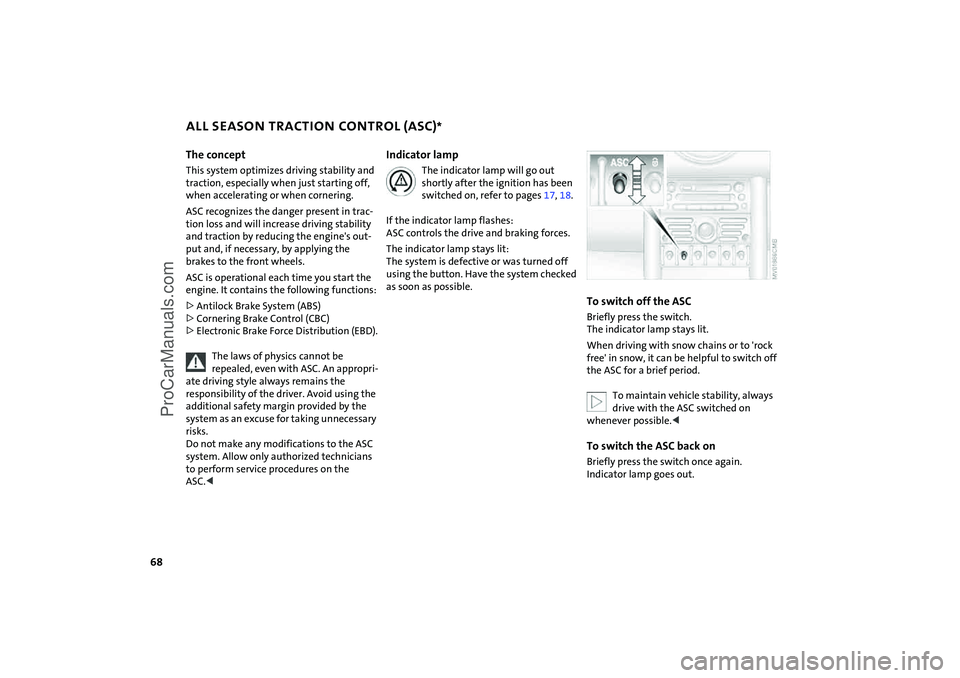
To switch off the ASCBriefly press the switch.
The indicator lamp stays lit.When driving with snow chains or to 'rock
free' in snow, it can be helpful to switch off
the ASC for a brief period.
To maintain vehicle stability, always drive with the ASC switched on
whenever possible.<
To switch the ASC back onBriefly press the switch once again.
Indicator lamp goes out.
ProCarManuals.com
Page 71 of 165
69
OVERVIEW REPAIRS OPERATIONCONTROLS DATA INDEX
DYNAMIC STABILITY CONTROL (DSC)
*
The conceptThis system optimizes driving stability and
traction, especially when just starting off,
when accelerating or when cornering. It
also maintains driving stability even in crit
-
ical driving situations.DSC recognizes unstable vehicle conditions,
such as understeering or oversteering, and,
as far as is possible within the laws of phys
-
ics, helps keep the vehicle on a steady
course by reducing the rpms and by brake
applications to the individual wheels.The DSC is operational every time you start
the engine. It contains the following func
-
tions:>All Season traction Control (ASC)>Antilock Brake System (ABS)>Cornering Brake Control (CBC)>Electronic Brake Force Distribution (EBD).
The laws of physics cannot be repealed, even with DSC. An appro
-
priate driving style always remains the
responsibility of the driver. Avoid using the
additional safety margin provided by the
system as an excuse for taking unnecessary
risks.
Do not make any modifications to the DSC
system. Allow only authorized technicians
to perform service procedures on the
DSC.
switched on, refer to pages
17, 18
.
If the indicator lamp flashes:
DSC controls the drive and braking forces. The indicator lamp stays lit:
The system is defective or was turned off
using the button. Have the system checked
as soon as possible.
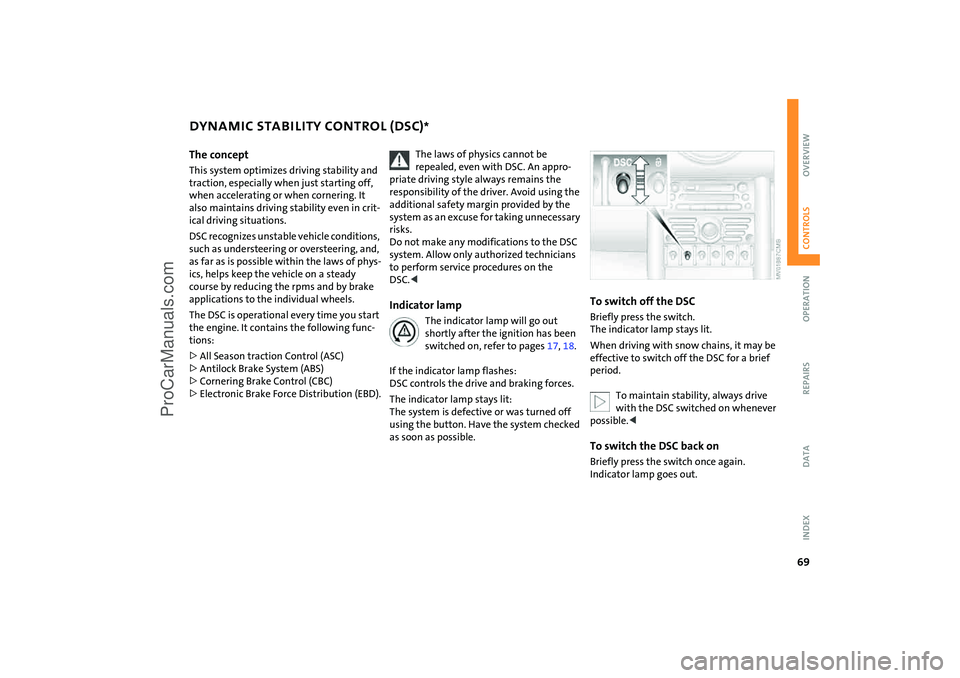
To switch off the DSCBriefly press the switch.
The indicator lamp stays lit.When driving with snow chains, it may be
effective to switch off the DSC for a brief
period.
To maintain stability, always drive with the DSC switched on whenever
possible.<
To switch the DSC back onBriefly press the switch once again.
Indicator lamp goes out.
ProCarManuals.com