inflation pressure MINI Hardtop 2 Door 2002 Owner's Manual
[x] Cancel search | Manufacturer: MINI, Model Year: 2002, Model line: Hardtop 2 Door, Model: MINI Hardtop 2 Door 2002Pages: 140, PDF Size: 1.63 MB
Page 5 of 140
3
OVERVIEW REPAIRS OPERATION CONTROLS DATA INDEX
Driving:
Ignition lock 42
Starting the engine 42
Switching off the engine 43
Parking brake 44
Manual transmission 45
Continuously Variable automatic
Transmission (CVT) 46
Parking lamps/Low beams 49
Indicator/Headlamp flasher 49
Instrument lighting 50
Fog lamps 50
Interior lamps 50
Light-emitting diodes 51
Washer/Wiper system 51
Cruise control 53
Everything under control:
Odometer 55
Tachometer 55
Fuel gauge 55
Coolant temperature gauge 56
Service Interval Display 57
Clock 57
Computer 58
Technology for safety and driving
convenience:
Automatic Stability Control plus Traction
(ASC+T) 60
Dynamic Stability Control (DSC) 61
Flat Tire Monitor 62
Park Distance Control (PDC) 63
Controlling the climate for pleasant
driving:
Air conditioner system 64
Automatic climate control 67
Interior conveniences:
Glove compartment 70
Ashtray/Beverage holder 70
Cigarette lighter 70
Loading and transporting cargo:
Luggage compartment cover 71
Foldable rear backrest 71
Loading cargo 72
Roof-mounted luggage rack 73
Care and maintenance
Special operating instructions:
Break-in procedures 76
General driving notes 76
Refueling 77
Fuel specifications 78
Antilock Brake System (ABS) 78
Brake system 79
Wheels and tires:
Tire inflation pressure 80
Tire condition 82
Tire replacement 83
Wheel and tire combinations 84
Winter tires 85
Snow chains 85
Page 18 of 140

16
INDICATOR AND WARNING LAMPS
Yellow: stop immediately
Flat Tire Monitor
l
Flashes: tire failure.
Reduce speed immediately and
stop the vehicle.
With safety (run-flat) tires:
Reduce vehicle speed carefully to under
50 mph (80 km/h).
In both cases, avoid hard brake applications
and steering maneuvers. Check the tire
inflation pressures.
Conduct in the event of a flat tire, see
pages 106, 110.
General information on the system, see
page 62
Red and yellow: continue to drive;
drive cautiously
Brake warning lamp together with
yellow indicator lamps for ABS, EBV
and ASC+T/DSC:
The control system ABS, EBV and
ASC+T/DSC has failed. Drive
cautiously and defensively. Avoid
full brake applications. Please have
the system checked by your MINI
center as soon as possible.
More information on pages 60, 61
Brake warning lamp together with
the yellow indicator warning lamps
ABS, EBV and ASC+T/DSC for Cana-
dian models.
Red: an important reminder
Brake warning lamp
with parking brake applied.
More information on the parking
brake on page 44
Parking brake lamp for Canadian
models.
Fasten safety belts
l
Depending on model, with acoustic
signal
*
. Lights up either for several
seconds or until the belt is engaged, de-
pending on version.
More information on page 35
Depending on the level of equipment,
the indicator lamp is in the vicinity of
the navigation system.
<
Airbags
l
Please have the system inspected
at your MINI center.
More information on pages 31, 37
Depending on the level of equipment,
the indicator lamp is in the vicinity of
the navigation system.
<
Hood/tailgate
Lights up when the hood and/or
tailgate are open.
More information on pages 27, 86
Page 64 of 140
62
FLAT TIRE MONITORThe conceptThe tire inflation pressure is determined
from the signals of the ABS sensors.
The system provides an alert whenever the
tire inflation pressure drops below the
pressure in any other tire. RequirementSo that the system can "familiarize" itself
with the correct inflation pressure, please
do the following:
1. Check the tire inflation pressure in all
tires
2. Compare them with the inflation pres-
sure table, see page 81, and adjust the
pressures if necessary
3. Initialize the system.
Check the tire inflation pressure
regularly and correct it if necessary,
see page 80.<
Flat tire
The indicator lamp in the instru-
ment cluster informs you by
flashing when the tire inflation
pressure of a tire drops in relation to any
other tire. In addition, an acoustic signal is
sounded.
>Vehicles with safety (run-flat) tires, see
notes on pages 110, 80, 84
>Vehicles with normal tires, see notes on
pages 106, 80.
The Flat Tire Monitor cannot alert you
to severe and sudden tire damage
caused by external factors. Another factor
which the Flat Tire Monitor does not recog-
nize is the balanced and very gradual pres-
sure loss that takes place in all tires over an
extended period of time.<
MalfunctionsAs long as there is still a malfunction, the
yellow indicator lamp on the instrument
cluster will stay lit up.
The indicator lamp also lights up in the
event of a system malfunction.
Please contact your MINI center in these
cases.
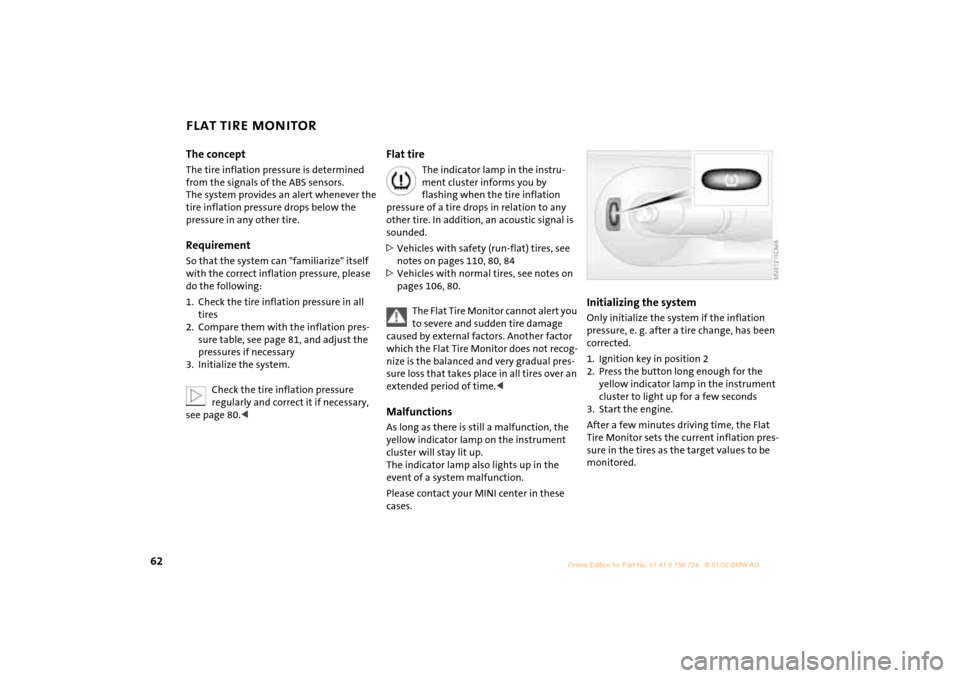
Initializing the systemOnly initialize the system if the inflation
pressure, e. g. after a tire change, has been
corrected.
1. Ignition key in position 2
2. Press the button long enough for the
yellow indicator lamp in the instrument
cluster to light up for a few seconds
3. Start the engine.
After a few minutes driving time, the Flat
Tire Monitor sets the current inflation pres-
sure in the tires as the target values to be
monitored.
Page 65 of 140

63
OVERVIEW REPAIRS OPERATIONCONTROLS DATA INDEX
FLAT TIRE MONITOR PARK DISTANCE CONTROL (PDC)*
Do not initialize the system when
snow chains are fitted. When driving
with snow chains, false alarms can occur or
pressure losses might not be detected.<
In the following situations false
alarms can also occur under certain
circumstances or the detection of inflation
pressure loss can be delayed:
>When driving on roads covered with
snow or on other slippery road surfaces
>A sporty driving style (slip at the driven
wheels, high lateral accelerations).<
The conceptThe PDC assists you when you back into a
parking space. A signal warns you of the
distance to an obstacle. To do this, four
ultrasonic sensors in the rear bumper
measure the distance to the nearest object.
The range for the sensors located at both
rear corners ends approx. 2 ft (60 cm)
behind the bumpers. The range for the two
middle sensors is slightly less than 5 ft
(1.5 meters).
The system starts to operate automatically
about one second after you select reverse
with the ignition key in position 2. PDC is
deactivated when you shift back out of
reverse. Acoustical signalsThe distance to the nearest object is indi-
cated by a tone sounding at various inter-
vals. As the distance between vehicle and
object decreases, the intervals between the
tones become shorter. A continuous tone
indicates the presence of an object less
than 9 in (20 cm) away.
The warning signal is canceled after
approx. three seconds if the distance to the
obstacle remains constant during this time
(if you are moving parallel to a wall, for
instance).System malfunctions will be indicated by
a continuous high-pitched tone when the
system is activated the first time. Please
have your MINI center resolve the problem.
Even with PDC, final responsibility for
estimating the distance between the
vehicle and any obstructions always
remains with the driver. Even when sensors
are involved, there is a blind spot in which
objects cannot be detected. Moreover, the
detection of obstructions can approach the
physical limits of ultrasonic measurement,
as occurs e. g. in the case of thin and
wedge-shaped objects.
Certain sources of sound, such as a loud
radio, could drown out the PDC signal
tone.<
Keep the sensors clean and free of ice
or snow in order to ensure that they
will continue to operate effectively.
Do not apply high pressure spray to the
sensors for a prolonged period of time.
Always maintain a distance of more than
4 in (10 cm).<
Page 82 of 140

80
TIRE INFLATION PRESSUREInformation for your safetyThe factory-approved radial tires are
matched to the vehicle and have been
selected to provide optimum safety and
driving comfort if used properly.
It is not merely the tire's service life, but
also driving comfort and Ð above all else Ð
driving safety that depend on the condition
of the tires and the maintenance of the
specified tire pressure.
Incorrect inflation pressure is a frequent
cause of tire damage. It also significantly
influences the roadholding ability of your
MINI.
Check tire inflation pressures regularly
Ð at least every two weeks and before
beginning a longer trip. Failure to observe
these precautions can result in incorrect tire
pressures, which cause instable handling
response as well as tire damage, and can
ultimately lead to an accident.
Also check the inflation pressure on the
space-saver spare tire.
brands recommended by the manufacturer,
which your MINI center can provide for you.
Inflation pressures are on a sticker attached
to the B-pillar and visible with the driver's
door open.Checking tire inflation pressuresAll pressures are specified in the standard
units of pressure for your country (bar, psi,
kilopascal), and apply to cold tires (tires at
ambient temperature).
Vehicles with Flat Tire Monitor:
After correcting the tire inflation pressure,
reinitialize the Flat Tire Monitor, see
page 62.
Checking the inflation pressure on the
space-saver spare tire*There is a valve extension accessible from
the outside on the bumper for checking the
inflation pressure.Safety (run-flat) tires* Safety tires are an optional extra consisting
of self-contained tires and special rims. The
tire reinforcement ensures that the tire
retains residual safety in the event of pres-
sure drop and driving remains possible to a
restricted degree. The vehicle is equipped
with a Flat Tire Monitor which indicates a
flat-tire.
More information, see pages 62, 110.
Page 83 of 140

81
OVERVIEW REPAIRSOPERATIONCONTROLS DATA INDEX
TIRE INFLATION PRESSUREModel Tires
Pressures specified in bar (kPa/psi)
MINI COOPER175/65 R 15 2.1 (210/30) 2.1 (210/30) 2.4 (240/35) 2.4 (240/35)
195/55 R 16
205/45 R 172.1 (210/30) 2.1 (210/30) 2.4 (240/35 2.4 (240/35
175/60 R 16
All winter tires2.3 (230/33) 2.3 (230/33) 2.6 (260/38) 2.6 (260/38)
Space-saver spare tire 4.2 (420/61) 4.2 (420/61) 4.2 (420/61) 4.2 (420/61)
MINI COOPER S195/55 R 16 2.1 (210/30) 2.1 (210/30) 2.4 (240/35) 2.4 (240/35)
205/45 R 17
195/55 R 16 M+S
205/45 R 17 M+S2.3 (230/33) 2.3 (230/33) 2.6 (260/38) 2.6 (260/38)
175/60 R 16 M+S 2.5 (250/36) 2.5 (250/36) 2.8 (280/41) 2.8 (280/41)
In the case of all-season tires, the tire inflation pressure for summer tires applies.
This data only applies to tires approved and/or recommended by the manufacturer, about which your MINI center will be glad to
provide information.
Page 87 of 140

85
OVERVIEW REPAIRSOPERATIONCONTROLS DATA INDEX
WINTER TIRESSNOW CHAINS
*
Choosing the right tire
The manufacturer recommends winter
tires (M+S radial tires) for driving in adverse
winter road conditions. While so-called all-
season tires (M+S designation) provide
better winter traction than summer tires
with the load ratings S, T, H, V, W, they do
not achieve the performance of winter
tires.
In the interest of safe tracking and steering
response, install winter tires made by the
same manufacturer having the same tread
configuration on all four wheels.
Before purchasing winter tires, check
whether your MINI is fitted with safety
tires. You will recognize safety tires by a
circular symbol containing the letters RSC
on the side of the tire, see page 110. In this
case, use only safety tires, as in the event of
a flat tire there is no space-saver spare tire.
Only winter tires recommended by the
manufacturer of your MINI should be
fitted. Any MINI center will be glad to
advise you on the selection of the right
winter tires for the relevant operating
conditions.
Observing speeds
Never exceed the maximum speed
for which the tires are rated.
Unprofessional attempts by laymen to
service tires can lead to damage and acci-
dents.
Have this work performed by skilled profes-
sionals only. Your MINI center will be glad
to assist you with both their expertise and
the proper equipment for your vehicle.<
Tire condition, tire inflation pressure
Once the tire wears to below 0.16 in
(4 mm), winter tires display a percep-
tible decrease in their ability to cope with
winter driving conditions, and should be
replaced in the interest of safety.<
Comply with the specified tire inflation
pressures and be sure to have the wheel
and tire assemblies balanced every time
you change the tires.
The use of narrow-link snow chains is
permitted in pairs only and only on
the front wheels with the following tires:
175/65 R 15
175/60 R 16
When fitting, comply with the manufac-
turer's instructions.<
With chains, do not exceed a speed
of 30 mph (50 km/h).<
After fitting the snow chains, do not
activate the Flat Tire Monitor.
When driving with snow chains, it can be
helpful to switch off the ASC+T or DSC for
a brief period, see pages 60, 61.<
Page 111 of 140
109
OVERVIEW REPAIRSOPERATION CONTROLS DATA INDEX
CHANGING TIRES Ð MINI WITH SPACE-SAVER SPARE TIRE
*
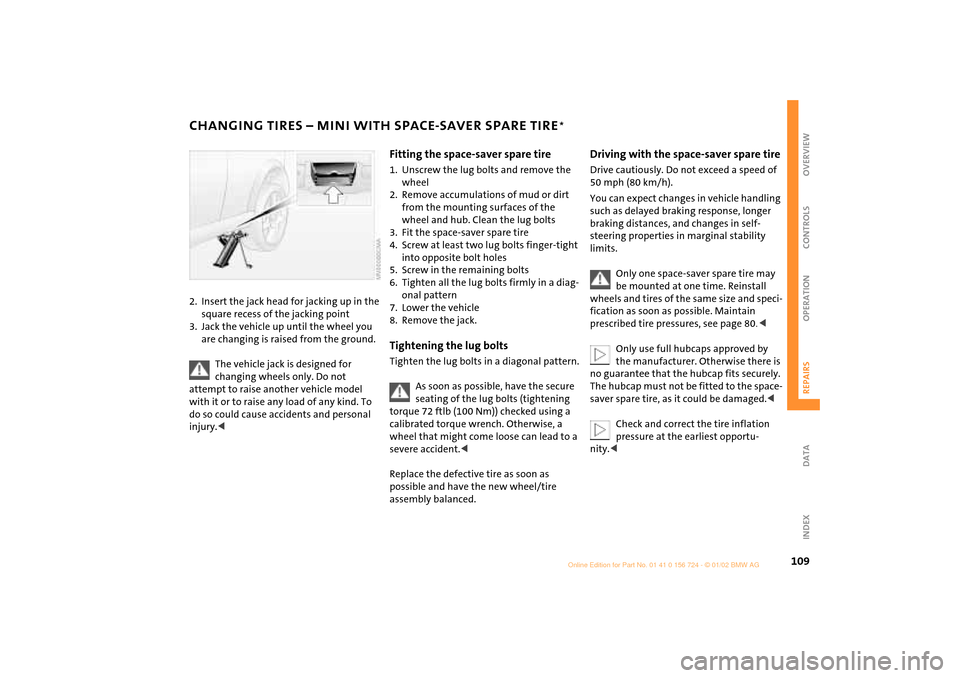
2. Insert the jack head for jacking up in the
square recess of the jacking point
3. Jack the vehicle up until the wheel you
are changing is raised from the ground.
The vehicle jack is designed for
changing wheels only. Do not
attempt to raise another vehicle model
with it or to raise any load of any kind. To
do so could cause accidents and personal
injury.<
Fitting the space-saver spare tire1. Unscrew the lug bolts and remove the
wheel
2. Remove accumulations of mud or dirt
from the mounting surfaces of the
wheel and hub. Clean the lug bolts
3. Fit the space-saver spare tire
4. Screw at least two lug bolts finger-tight
into opposite bolt holes
5. Screw in the remaining bolts
6. Tighten all the lug bolts firmly in a diag-
onal pattern
7. Lower the vehicle
8. Remove the jack.Tightening the lug boltsTighten the lug bolts in a diagonal pattern.
As soon as possible, have the secure
seating of the lug bolts (tightening
torque 72 ftlb (100 Nm)) checked using a
calibrated torque wrench. Otherwise, a
wheel that might come loose can lead to a
severe accident.<
Replace the defective tire as soon as
possible and have the new wheel/tire
assembly balanced.
Driving with the space-saver spare tireDrive cautiously. Do not exceed a speed of
50 mph (80 km/h).
You can expect changes in vehicle handling
such as delayed braking response, longer
braking distances, and changes in self-
steering properties in marginal stability
limits.
Only one space-saver spare tire may
be mounted at one time. Reinstall
wheels and tires of the same size and speci-
fication as soon as possible. Maintain
prescribed tire pressures, see page 80.<
Only use full hubcaps approved by
the manufacturer. Otherwise there is
no guarantee that the hubcap fits securely.
The hubcap must not be fitted to the space-
saver spare tire, as it could be damaged.<
Check and correct the tire inflation
pressure at the earliest opportu-
nity.<
Page 112 of 140

110
FLAT TIRE Ð SAFETY (RUN-FLAT) TIRES
*
You will recognize safety tires by a circular
symbol containing the letters RSC on the
side of the tire.
Safety tires consist of self-contained tires
and special rims. The tire reinforcement
ensures that the tire retains some residual
safety in the event of pressure drop and
driving remains possible to a restricted
degree.
The reinforcement on the flanks of
the safety tires means that it is
usually not possible to detect an air loss
from outside.<
Flat tire The yellow indicator lamp in the instru-
ment cluster lights up to indicate a flat tire.
In addition, a gong sounds, see
pages 17, 62.
1. Reduce vehicle speed carefully to under
50 mph (80 km/h), avoiding hard brake
applications and steering maneuvers
2. Do not exceed a speed of 50 mph
(80 km/h)
3. Identify damaged tires; check tire infla-
tion pressures on all four wheels at the
next opportunity, see page 80
4. Correct the tire inflation pressure if you
wish to continue your journey and this is
permitted, see next column
5. Have damaged tires changed by your
MINI center, see page 84.
Your MINI center has the information
needed for working with safety tires
and is equipped with the necessary special
tools. They provide advice if you wish to
replace the tires on your MINI or wish to
re-equip from summer to winter tires Ð or
vice versa, see also pages 80, 84, 85.<
For safety reasons, do not have a
damaged safety tire repaired.<
Continuing driving with a damaged
tireDriving can continue under certain condi-
tions with safety tires, depending on the
vehicle load and the severity of the tire
damage, at a maximum speed of 50 mph
(80 km/h).
You can determine the possible mileage for
continued driving on the basis of the
following general indications:
>Tire inflation pressure 0 bar (0 psi):
approx. 95 miles (150 km)
>Tire inflation pressure 0.5 bar Ð 1 bar
(7.2 psi Ð 14.5 psi): approx. 300 miles
(500 km)
>Tire inflation pressure greater than 1 bar
(14.5 psi): approx. 600 miles (1,000 km).
Page 135 of 140
EVERYTHING FROM A TO Z
133
OVERVIEW REPAIRS OPERATION CONTROLS DATA INDEX
Recirculation of air 65,
68
Reclining seat 31
Refueling 77
Remaining distance for
service 57
Remote control 23
battery 22
battery changing 22
initialization 22
Removing mist,
windows 66,
69
Removing window mist
air conditioner system 66
automatic climate
control 69
Replacement key 22
Reporting safety defects 9
Restraint system 38
Reverse gear 45, 47
Rod antenna 94
Roller sun blind, rear window
blind 30
Rubber parts 95
Run-flat tire, see Safety
tires 80,
84,
85,
110
S
Safety belts 16,
31,
35,
95
adjusting 35
Safety lock buttons 26
Safety tires 80,
84,
110
winter tires 84, 85
Screwdriver 100
Seats 31
Securing cargo 72
Selector lever shiftlock 42,
46
Service and Warranty Booklet
(US models)/Warranty and
Service Guide Booklet
(Canadian models) 93
Service Interval Display 57, 93
Shiftlock 46
Side airbags 37
Side turn signal indicators
bulb replacement 102
Sitting 31
Sliding/tilt sunroof 29
convenience feature 25
safety function 30
Smoker's equipment
package 70
Snow chains 85
Space-saver spare tire
changing tires 106 Spare key 22
Spark plugs 124
Speed 120
Speeds 85
Split rear backrest 71
Spray jets 52
Standing lamps 49
bulb replacement 102
Starting 42
problems 43,
113,
114,
115
with a discharged
battery 113,
114
Steering lock 42
Storage, tires 84
Sun visors 36
Switches 12
Switching off, engine 43
Symbols 6
T
Tachometer 55
Tail lamps
bulb replacement 103
Tailgate 16,
27
manual unlocking 27
Tank capacity 77
Tank content, filling
capacities 123 Technical data 120
Technical modifications 96
Temperature
automatic climate
control 68
heating and climate
control 65
tires 83
Temperature display 59
engine coolant 56
Temperature layering 66,
69
Temperatures, high 77
The right tires 84
Third brake lamp
bulb replacement 104
Tire change
tire change set 106
Tire changes between axles 84
Tire failure 16
safety tires 110
space-saver spare tire 106
Tire inflation pressure 80, 85
Tires 80
all-season tires 85
break-in 76
changing 106
condition 82,
85
damage 82