service MINI Hardtop 2 Door 2006 User Guide
[x] Cancel search | Manufacturer: MINI, Model Year: 2006, Model line: Hardtop 2 Door, Model: MINI Hardtop 2 Door 2006Pages: 168, PDF Size: 2.22 MB
Page 77 of 168

75
OVERVIEW REPAIRS OPERATIONCONTROLS DATA INDEX
AIRBAGS
The following airbags are located under the
marked covers:
MINI
1 Side airbags in the backrests
2 Head airbags
3 Front airbags
MINI Convertible
1 Side/head airbags in the backrests
3 Front airbags
Protective effect
Comply with the instructions on
page42, or the occupants' personal
safety will be diminished.<
The front airbags supplement the safety
belts by providing additional protection for
the driver and front passenger in the event
of a frontal collision in which the protec-
tion afforded by the belts alone may no
longer be sufficient. When needed, the
head and side airbags help to furnish pro-
tection in the event of side impact. Each of
the side airbags is designed to help support
the seat occupant's upper body. The corre-
sponding side/head airbag in the MINI Con-
vertible or the head airbag in the MINI sup-
ports the head.
The airbags are designed to not be trig-
gered in certain types of collisions, e.g. in
minor accidents or rear impacts.
For information on the ideal seating posi-
tion, refer to page42.
Do not apply adhesive materials to
the cover panels of the airbags, cover
them or modify them in any other way. Do
not fit covers, cushions or other items to
the front seats that have not been specially
approved for seats with integrated side air-
bags. Do not hang clothing, e. g. jackets,
over the backrests.
Do not attempt to remove the airbag
restraint system from the vehicle. Do not
touch the individual components directly after the system has been triggered; other-
wise there is a danger of burns. In the event
of malfunctions, deactivation or deploy-
ment of the airbag restraint system, have
the system checked, repaired or disassem-
bled only by a MINI Dealer or a workshop
with specially trained personnel working in
accordance with the specifications of the
MINI manufacturer and having the neces-
sary permits for handling explosive devices.
Unprofessional attempts to service the sys-
tem could lead to failure in an emergency
or undesired airbag activation, either of
which could result in personal injury.<
Warning notices and information regard-
ing airbags can also be found on the sun
visors.
Automatic deactivation of the front
passenger airbags
An analysis of the impression in the front
passenger seat cushion determines
whether and how the seat is occupied. The
system correspondingly activates or deacti-
vates the front and side airbags for the
front passenger.
The indicator lamp above the interior
rearview mirror shows the current
status of the front passenger airbags, deac-
Page 97 of 168

OVERVIEW
CONTROLS
OPERATION, CARE, MAINTENANCE
OWNER SERVICE PROCEDURES
INDEX TECHNICAL DATA
95
OVERVIEW REPAIRSOPERATIONCONTROLS DATA INDEX
Operation
Page 98 of 168
96
BREAK-IN PROCEDURES GENERAL DRIVING NOTES
Moving parts need to be given some time
until they can interact smoothly with one
another. To ensure that your vehicle pro-
vides maximum economy throughout a
long service life, we request that you com-
ply with the following information:
Engine
Comply with the local speed limits.
Up to 1,250 miles/2,000 km:
Drive at varying engine and road speeds,
but do not exceed the following:
4,500 rpm or
95 mph / 150 km/h.
Absolutely avoid putting the accelerator in
full-throttle or kickdown position.
After 1,250 miles/2,000 km:
Engine and road speeds can be gradually
increased.
Tires
Due to technical factors associated with
their manufacture, tires do not achieve
their full traction potential until after an
initial break-in period. Therefore drive care-
fully during the first 200 miles/300 km.
Brake system
Approx. 300 miles/500 km must be driven
before the brake pads and rotors achieve
the optimum pad-surface and wear pat-
terns required for trouble-free operation
and an extended service life.
Clutch
Roughly 300 miles/500 km must be driven
before the clutch starts to operate at opti-
mum efficiency. Remember to engage the
clutch carefully during this initial period.
After a part replacement
You should again comply with these break-
in procedures if parts mentioned above
have to be replaced later in the vehicle's
life.
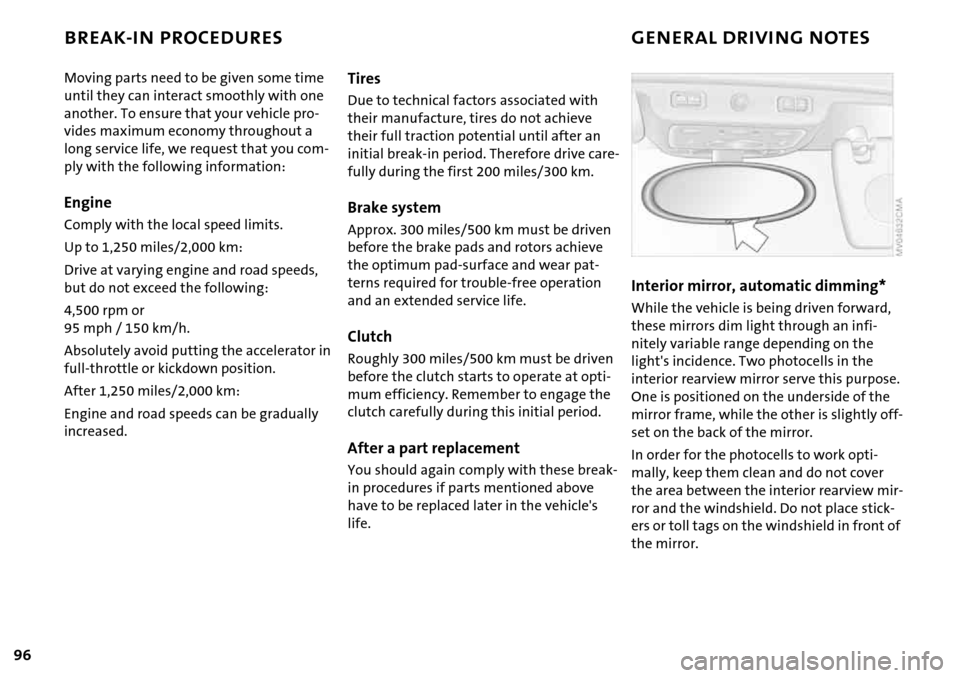
Interior mirror, automatic dimming*
While the vehicle is being driven forward,
these mirrors dim light through an infi-
nitely variable range depending on the
light's incidence. Two photocells in the
interior rearview mirror serve this purpose.
One is positioned on the underside of the
mirror frame, while the other is slightly off-
set on the back of the mirror.
In order for the photocells to work opti-
mally, keep them clean and do not cover
the area between the interior rearview mir-
ror and the windshield. Do not place stick-
ers or toll tags on the windshield in front of
the mirror.
Page 101 of 168
99
OVERVIEW REPAIRSOPERATIONCONTROLS DATA INDEX
REFUELING
Always switch off the engine before
refueling; otherwise no fuel can be
added to the tank and the SERVICE ENGINE
SOON lamp may come on.<
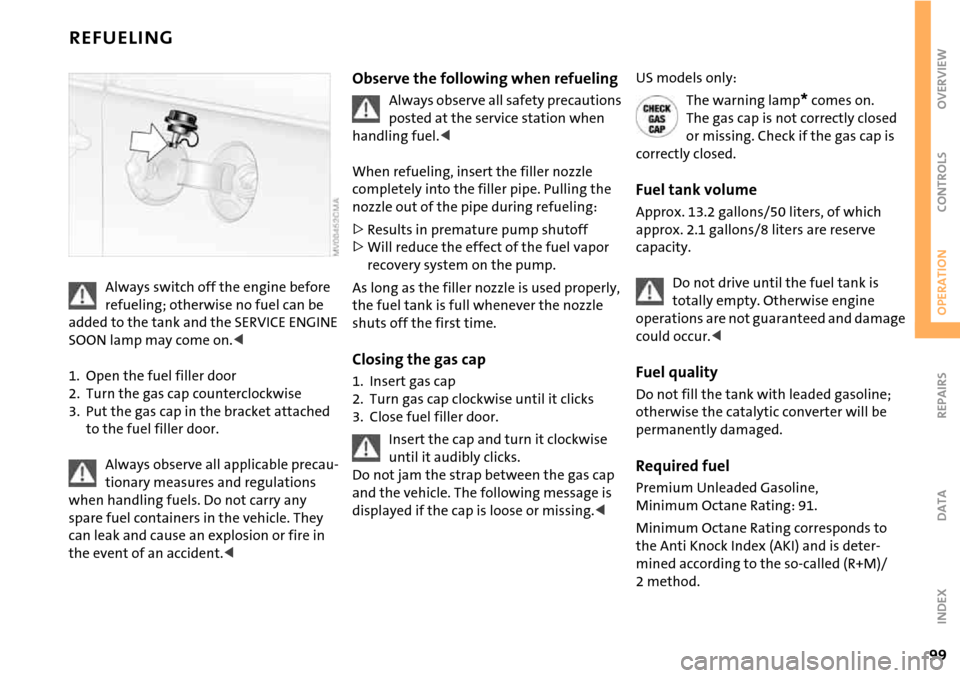
1. Open the fuel filler door
2. Turn the gas cap counterclockwise
3. Put the gas cap in the bracket attached
to the fuel filler door.
Always observe all applicable precau-
tionary measures and regulations
when handling fuels. Do not carry any
spare fuel containers in the vehicle. They
can leak and cause an explosion or fire in
the event of an accident.<
Observe the following when refueling
Always observe all safety precautions
posted at the service station when
handling fuel.<
When refueling, insert the filler nozzle
completely into the filler pipe. Pulling the
nozzle out of the pipe during refueling:
>Results in premature pump shutoff
>Will reduce the effect of the fuel vapor
recovery system on the pump.
As long as the filler nozzle is used properly,
the fuel tank is full whenever the nozzle
shuts off the first time.
Closing the gas cap
1. Insert gas cap
2. Turn gas cap clockwise until it clicks
3. Close fuel filler door.
Insert the cap and turn it clockwise
until it audibly clicks.
Do not jam the strap between the gas cap
and the vehicle. The following message is
displayed if the cap is loose or missing.<
US models only:
The warning lamp
* comes on.
The gas cap is not correctly closed
or missing. Check if the gas cap is
correctly closed.
Fuel tank volume
Approx. 13.2 gallons/50 liters, of which
approx. 2.1 gallons/8 liters are reserve
capacity.
Do not drive until the fuel tank is
totally empty. Otherwise engine
operations are not guaranteed and damage
could occur.<
Fuel quality
Do not fill the tank with leaded gasoline;
otherwise the catalytic converter will be
permanently damaged.
Required fuel
Premium Unleaded Gasoline,
Minimum Octane Rating: 91.
Minimum Octane Rating corresponds to
the Anti Knock Index (AKI) and is deter-
mined according to the so-called (R+M)/
2method.
Page 103 of 168
101
OVERVIEW REPAIRSOPERATIONCONTROLS DATA INDEX
TIRE INFLATION PRESSURE
Information for your safety
It is not merely the tire's service life, but
also driving safety and driving comfort that
depend on the condition of the tires and
the maintenance of the specified tire pres-
sure.
Checking tire inflation pressures
Check the tire inflation pressures only on
cold tires. This means after driving a maxi-
mum of 1.25 miles/2 km or when the vehi-
cle has been parked for at least 2 hours.
Warm tires have higher pressures.
Check tire inflation pressures regu-
larly and correct them if necessary,
including the space-saver spare tire: at
least twice a month and before long jour-
neys. Otherwise, incorrect tire pressures
can cause driving instability or tire damage,
ultimately resulting in accidents. Do not
drive with deflated, i.e. flat, tires except if
Run Flat tires are fitted. A flat tire greatly
impairs steering and braking response, and
can lead to complete loss of control over
the vehicle.<
After correcting the tire inflation
pressure, reinitialize the Flat Tire
Monitor, refer to page73.<
Tire inflation pressures for original
tires
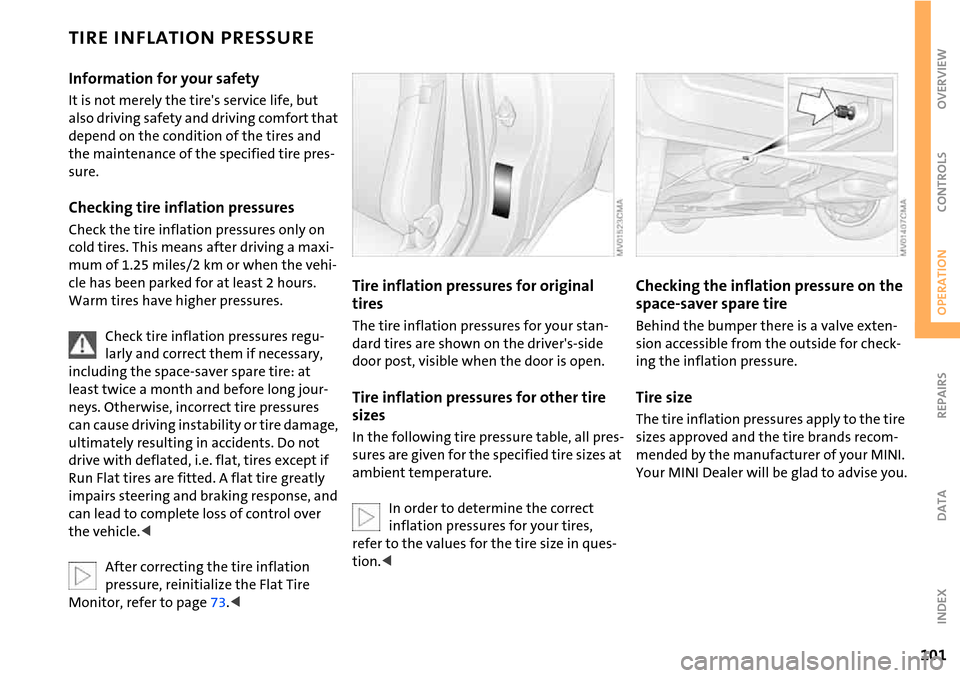
The tire inflation pressures for your stan-
dard tires are shown on the driver's-side
door post, visible when the door is open.
Tire inflation pressures for other tire
sizes
In the following tire pressure table, all pres-
sures are given for the specified tire sizes at
ambient temperature.
In order to determine the correct
inflation pressures for your tires,
refer to the values for the tire size in ques-
tion.<
Checking the inflation pressure on the
space-saver spare tire
Behind the bumper there is a valve exten-
sion accessible from the outside for check-
ing the inflation pressure.
Tire size
The tire inflation pressures apply to the tire
sizes approved and the tire brands recom-
mended by the manufacturer of your MINI.
Your MINI Dealer will be glad to advise you.
Page 107 of 168

105
OVERVIEW REPAIRSOPERATIONCONTROLS DATA INDEX
TIRE CODING
Knowing the tire code on the tire's sidewall
makes it easier for you to choose and iden-
tify the correct tires.
Tire size
e.g. 205/45 R 17 84 V
Nominal width in mm
Cross-sectional
ratio in %
Radial belt construction
Rim diameter in inches
Load index,
not on ZR tires
Speed code letter,
in front of the R on ZR tires
Speed code letters:
Q = up to 100 mph / 160 km/h
T = up to 118 mph / 190 km/h
H = up to 131 mph / 210 km/h
V = up to 150 mph / 240 km/h
W= up to 167 mph / 270 km/h
Tire Identification Number
Tires with DOT codes meet the guidelines
of the US Department of Transportation.DOT code:
e.g. DOT xxxx xxx 3505
Manufacturer's code
for tire make
Tire size and
tire version
Tire age
Tire age
The date on which the tire was manufac-
tured is indicated by the code on the side-
wall:
DOT...3505 indicates that the tire was man-
ufactured in Week 35 of the year 2005.
The manufacturer of your MINI recom-
mends replacing all tires after 6 years at
the latest, even if a tire service life of
10 years is possible.
Uniform Tire Quality Grading
Quality grades can be found where applica-
ble on the tire sidewall between tread
shoulder and maximum section width.
For example:
Treadwear 200 Traction AA
Temperature A
DOT quality grades
Tread wear
Traction AA A B C
Temperature A B C
All passenger car tires must conform
to Federal Safety Requirements in
addition to these grades.<
Tread wear
The tread wear grade is a comparative rat-
ing based on the wear rate of the tire when
tested under controlled conditions on a
specified government test course.
For example, a tire graded 150 would wear
one and one-half, 1γ, times as well on the
government course as a tire graded 100.
The relative performance of tires depends
upon the actual conditions of their use,
however, and may depart significantly
from the norm due to variations in driving
habits, service practices and differences in
road characteristics and climate.
Page 113 of 168

111
OVERVIEW REPAIRSOPERATIONCONTROLS DATA INDEX
BONNET
Do not attempt to service your vehi-
cle if you do not have the required
technical background. If you are not famil-
iar with the regulations to be observed,
have the necessary work on your vehicle
carried out only by a MINI Dealer or a work-
shop that has specially trained personnel
working in accordance with the specifica-
tions of the MINI manufacturer.
Work that is improperly carried out could
result in consequential damage and pose
safety hazards.<
To unlock
Pull the lever in the right door area beneath
the instrument panel.
To open
1. Reach under the bonnet
2. Pull the release lever
3. Open the bonnet.
To close
Allow the bonnet to fall from a height of
approx. 1 ft/30 cm.
Make sure that the closing range of
the bonnet is unobstructed, other-
wise personal injury could result.
If it is determined that the bonnet is not
completely closed while driving, stop
immediately and close it securely, also refer
to page17.<
Page 117 of 168

115
OVERVIEW REPAIRSOPERATIONCONTROLS DATA INDEX
ENGINE OIL COOLANT
Approved engine oils
The quality of the engine oil selected has
critical significance for the operation and
service life of an engine. Based on exten-
sive testing, the manufacturer of your MINI
approves only certain grades of engine oil.
Only use High Performance Synthetic Oil
approved by the manufacturer of your
MINI.
If MINI High Performance Synthetic Oil is
not available, you can add small quantities
of another synthetic oil in between oil
changes. Only use oils with a specification
of API SH or higher.
If you have any further questions
regarding MINI High Performance
Synthetic Oil or approved synthetic oils,
your MINI Dealer will be glad to advise
you.<
Do not use any oil additives, as they
could cause engine damage under
some circumstances.<
Viscosity grades
Viscosity is a measure of an oil's flow rating
and is classified into SAE grades.
The correct SAE grade for your MINI is
determined by the climatic conditions of
the region in which you normally drive your
MINI.
Approved oils feature the SAE grades
5W-40 and 5W-30.<
These oils can be used for driving at all out-
side temperatures.Do not open the cooling system when
the engine is hot. Escaping coolant
can cause burns.<
Coolant consists of water and a coolant
additive. Not all commercially available
additives are suitable for your MINI. Your
MINI Dealer knows which additives are
suitable and will be glad to advise you.
Only use suitable additives, other-
wise the engine can be damaged. The
additives are hazardous to your health.<
Comply with the applicable environ-
mental laws regulating the disposal
of coolant additives.<
Page 120 of 168

118
MINI MAINTENANCE SYSTEM
The MINI maintenance system helps main-
tain your vehicle's road safety and opera-
tional safety.
Please bear in mind that regular mainte-
nance is not only necessary for the safety of
your vehicle, but also plays a significant
role in maintaining the resale value of the
vehicle.
Service interval display
While conventional systems specify main-
tenance according to fixed distances
driven, the MINI Maintenance System takes
account of the operating conditions of the
vehicle, for distances can be driven in many
different ways:
60,000 miles/100,000 km short distance
operation can not be equated with
60,000 miles/100,000 km long distance
operation from a maintenance standpoint.
The condition-based MINI Maintenance
System includes the Engine Oil Service and
Inspections I and II.
Determining the maintenance intervals
according to the actual use of the vehicle
covers every kind of operating situation.
People who drive very little, i.e. much less
than 6,000 miles/10,000 km per year,
should have the engine oil changed at least
every 2 years since oil deteriorates over
time, regardless of use.
For more information on the service inter-
val display, refer to page68.
Service and Warranty Information
Booklet for US models, Warranty and
Service Guide Booklet for Canadian
models
For additional information on maintenance
intervals and procedures, please refer to
the Service and Warranty Information
Booklet for US models or the Warranty and
Service Guide Booklet for Canadian models.
As a precaution against rust, it is advisable
to have the body checked for damage from
rocks or gravel at the same time, depending
upon operating conditions.
The manufacturer of your MINI rec-
ommends having maintenance and
repair work carried out only by a MINI
Dealer or a workshop that has specially
trained personnel working in accordance
with the specifications of the MINI manu-
facturer.
Make sure that maintenance work is con-
firmed with an entry in the Service and
Warranty Information Booklet for
US models or the Warranty and Service
Guide Booklet for Canadian models. These
entries are your proof that the vehicle has
received regular maintenance.<
Page 123 of 168

121
OVERVIEW REPAIRSOPERATIONCONTROLS DATA INDEX
CARING FOR YOUR VEHICLE
ner, heavy-duty grease remover, fuel or
similar
>Wood paneling
*:
Please clean wood paneling and other
wood parts only with a damp cloth. Dry
off with a soft cloth
>Safety belts:
Only clean using mild soap, leaving the
belts fitted.
Do not dry clean, as the fabric can be
destroyed.
Always roll up safety belts only when
dry.
Dirty safety belts prevent unrolling and
thus negatively affect safety
>Floor carpets and floor mats
*:
If heavily soiled, clean using interior
cleaner. Floor mats can be removed to
allow the interior to be cleaned
>Wiper blades:
Clean with soapy water. Replace wiper
blades twice a year, before and after the
cold season. This is particularly impor-
tant on vehicles fitted with a rain sensor.
Caring for leather* and imitation
leather
The leather and imitation leather used by
the manufacturer of your MINI are high
quality products processed using state-of-
the-art methods and will retain their qual-ity level for many years if cared for prop-
erly.
Regular cleaning and care are necessary, as
dust and road dirt scratch in pores and
creases and lead to heavy wear as well as
premature brittleness of the leather and
imitation leather surface.
This is why you should use a cloth or vac-
uum cleaner to remove dust on a regular
basis.
Since dirt and oil slowly destroy the protec-
tive layer of the leather and imitation
leather, a treatment with a leather care
product is necessary twice a year. This pre-
serves the quality of the leather and pre-
vents electrostatic charging.
Cleaning agents can contain hazard-
ous or health-damaging substances.
For this reason, always observe the warn-
ings on the package. For interior cleaning,
always open the doors or windows of the
vehicle.
Do not use any products that are not
intended for cleaning the vehicle.
vertible top largely depend on the proper
care and operation of the convertible top.
You should therefore observe the following
notes in particular:
>Whenever possible, park your vehicle in
the shade to protect it from intense sun-
light
>Do not fold the convertible top when it is
wet, dirty or frozen; otherwise water
marks, moisture stains and chafing could
result
>If the vehicle is parked in an enclosed
area for a longer period of time, make
sure that there is sufficient ventilation
>Remove bird droppings immediately
because they have corrosive properties.
Never use spot removers, paint thin-
ner, solvents, cleaning fuel or similar
since these products can destroy the rubber
seals and cause leaks.<