battery MITSUBISHI 3000GT 1991 Service Manual
[x] Cancel search | Manufacturer: MITSUBISHI, Model Year: 1991, Model line: 3000GT, Model: MITSUBISHI 3000GT 1991Pages: 1146, PDF Size: 76.68 MB
Page 1072 of 1146
52B-62Air Bag ModuleSUPPLEMENTAL RESTRAINT SYSTEM (SRS) - and Clock Spring
AIR BAG MODULE AND CLOCK SPRINGM52PDCA
Caution1. Never attempt to disassemble or repair the
air bag module or clock spring.
If faulty, replace it.
2. Do not drop the air bag module or clock
spring or allow contact with water, grease or
oil.Replace it if a dent, crack, deformation or
rust are detected.
3.The air bag module should be stored on a flat
surface and placed so that the pad surface isfacing upward.
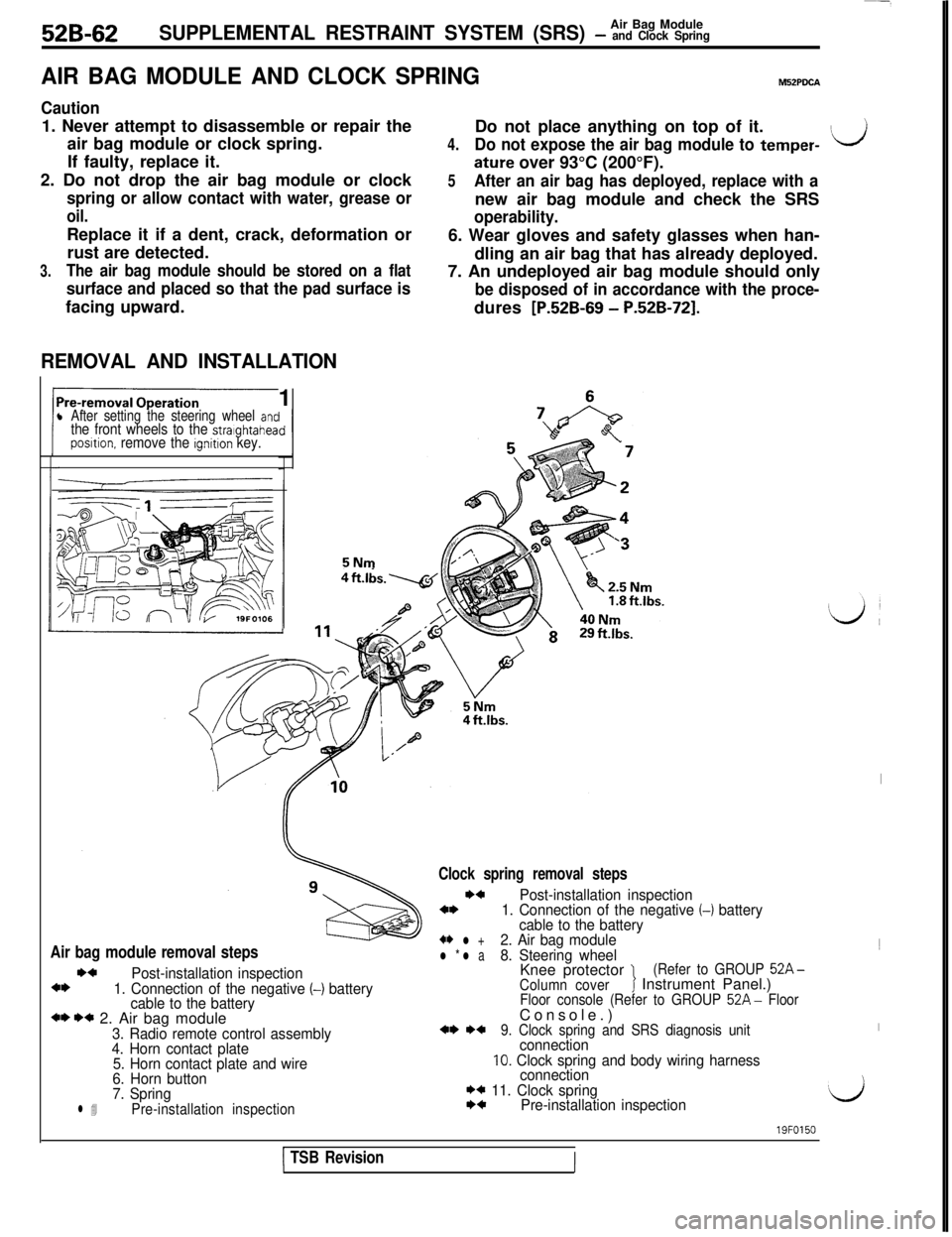
REMOVAL AND INSTALLATION1
l After setting the steering wheel antthe front wheels to the stralghtaheaposltion. remove the ignition key.5NmDo not place anything on top of it.
4.Do not expose the air bag module to temper-ILJ
ature over 93°C (200°F).
5After an air bag has deployed, replace with anew air bag module and check the SRS
operability.6. Wear gloves and safety glasses when han-
dling an air bag that has already deployed.
7. An undeployed air bag module should only
be disposed of in accordance with the proce-dures
[P.52B-69 - P.52B-721.
Air bag module removal stepsI)4
Post-installation inspection4*1. Connection of the negative (-1 battery
cable to the battery
*I) I)* 2. Air bag module3. Radio remote control assembly
4. Horn contact plate
5. Horn contact plate and wire
6. Horn button
7. Spring
l 4Pre-installation inspection
Clock spring removal steps
I)4Post-installation inspection4*1. Connection of the negative (-1 battery
cable to the battery
+* l +2. Air bag modulel * l a8. Steering wheelKnee protector 1(Refer to GROUP 52A-
Column coverJ Instrument Panel.)Floor console (Refer to GROUP 52A- FloorConsole.)
*I) *+9. Clock spring and SRS diagnosis unitconnection10. Clock spring and body wiring harness
connection
I)* 11. Clock springI)4Pre-installation inspection
I1
I
‘d
1 TSB Revision
19FO150
III
Page 1073 of 1146
Air Bag ModuleSUPPLEMENTAL RESTRAINT SYSTEM (SRS) - and Clock Spring526-6319FOlll
3
SERVICE POINTS OF REMOVAL1. DISCONNECTION OF THE NEGATIVE (-) BATTERY
CABLE FROM THE BATTERYTurn the ignition key to the “LOCK” position, disconnect
the negative battery cable and tape the terminal.
Caution
Wait at least 30 seconds after disconnecting the battery
cable before doing any further work. The SRS system is
designed to retain enough voltage to deploy the air bagfor a short time even after the battery has been
disconnected, so serious injury may result from unin-
tended air bag deployment if work is done on the SRSsystem immediately after the battery cable is discon-
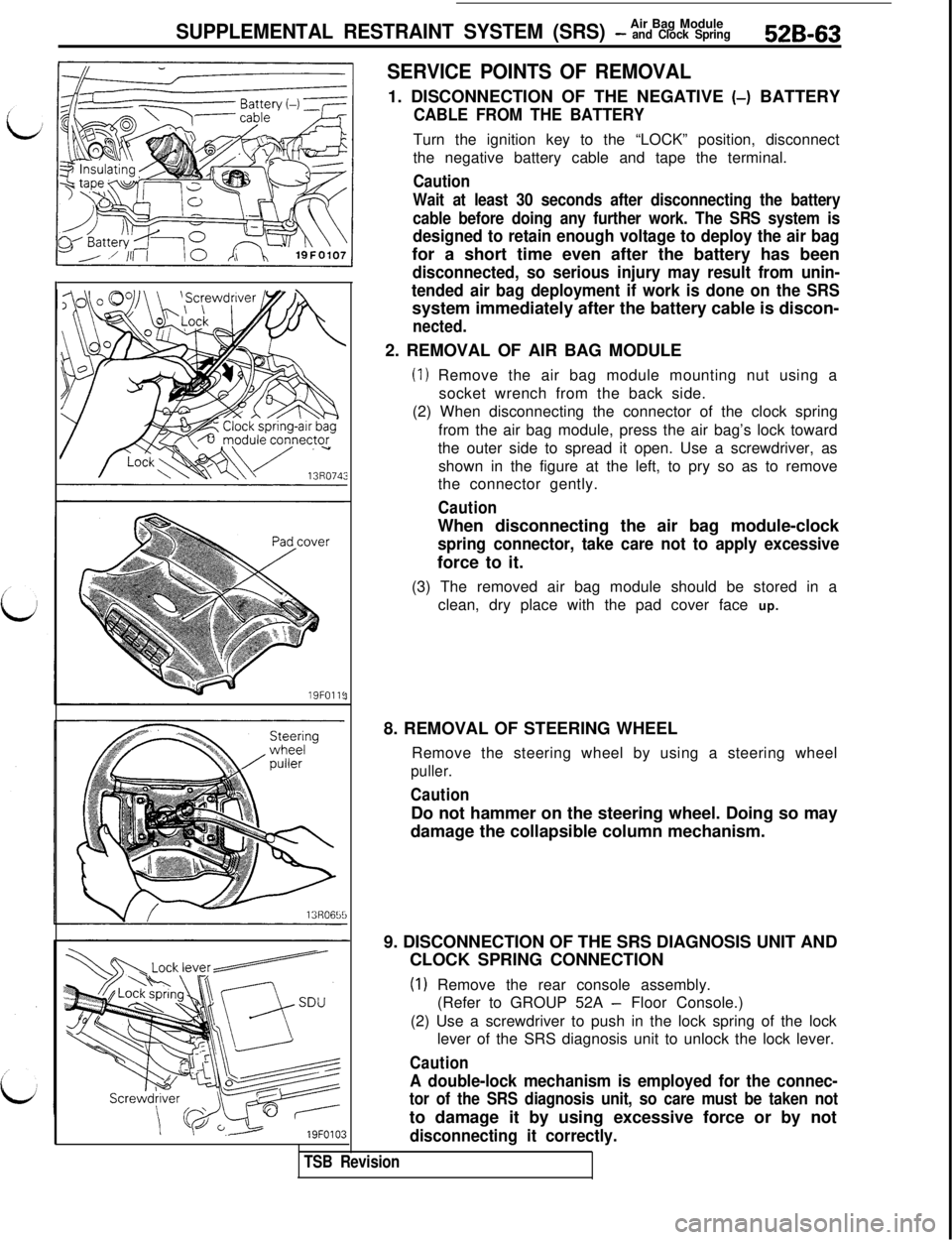
nected.2. REMOVAL OF AIR BAG MODULE
(1) Remove the air bag module mounting nut using a
socket wrench from the back side.
(2) When disconnecting the connector of the clock spring
from the air bag module, press the air bag’s lock toward
the outer side to spread it open. Use a screwdriver, as
shown in the figure at the left, to pry so as to remove
the connector gently.
CautionWhen disconnecting the air bag module-clock
spring connector, take care not to apply excessiveforce to it.
(3) The removed air bag module should be stored in a
clean, dry place with the pad cover face up.
8. REMOVAL OF STEERING WHEEL
Remove the steering wheel by using a steering wheel
puller.
CautionDo not hammer on the steering wheel. Doing so may
damage the collapsible column mechanism.
9. DISCONNECTION OF THE SRS DIAGNOSIS UNIT AND
CLOCK SPRING CONNECTION
(1) Remove the rear console assembly.
(Refer to GROUP 52A
- Floor Console.)
(2) Use a screwdriver to push in the lock spring of the lock
lever of the SRS diagnosis unit to unlock the lock lever.
Caution
A double-lock mechanism is employed for the connec-
tor of the SRS diagnosis unit, so care must be taken notto damage it by using excessive force or by not
disconnecting it correctly.
TSB Revision
Page 1077 of 1146
Air Bag Module
SUPPLEMENTAL RESTRAINT SYSTEM (SRS) - and Clock Spring52B-67Multi-use Testkr
ROM pack
(MB991 341)(MB991 359)
Diagnosis/
service
data
oumutGround
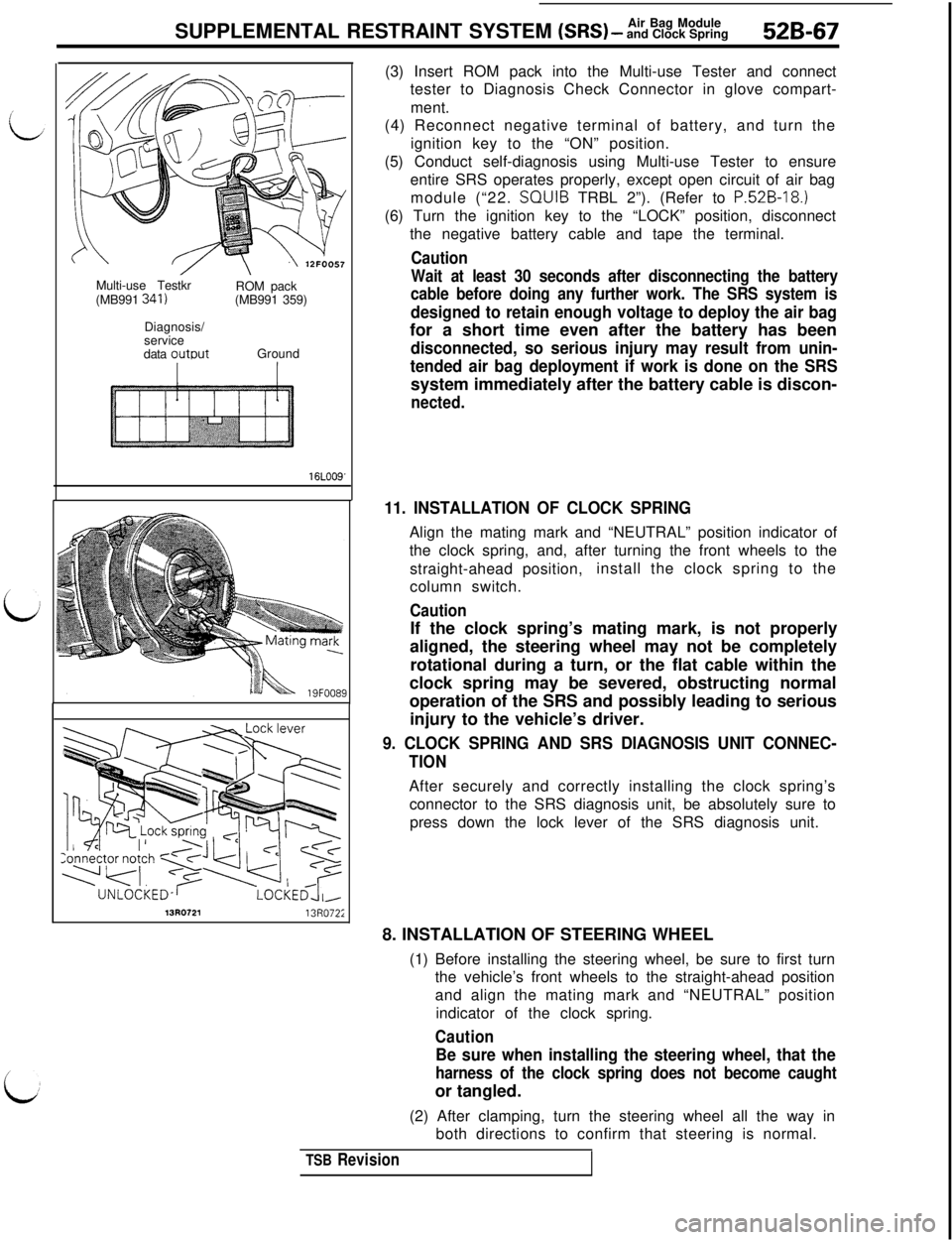
16LOO9'(3) Insert ROM pack into the Multi-use Tester and connect
tester to Diagnosis Check Connector in glove compart-
ment.
(4) Reconnect negative terminal of battery, and turn the
ignition key to the “ON” position.
(5) Conduct self-diagnosis using Multi-use Tester to ensure
entire SRS operates properly, except open circuit of air bag
module (“22. SQUIB TRBL 2”). (Refer to
P.52B-18.)(6) Turn the ignition key to the “LOCK” position, disconnect
the negative battery cable and tape the terminal.
Caution
Wait at least 30 seconds after disconnecting the battery
cable before doing any further work. The SRS system is
designed to retain enough voltage to deploy the air bagfor a short time even after the battery has been
disconnected, so serious injury may result from unin-
tended air bag deployment if work is done on the SRSsystem immediately after the battery cable is discon-
nected.
11. INSTALLATION OF CLOCK SPRINGAlign the mating mark and “NEUTRAL” position indicator of
the clock spring, and, after turning the front wheels to the
straight-ahead position,install the clock spring to the
column switch.
CautionIf the clock spring’s mating mark, is not properly
aligned, the steering wheel may not be completely
rotational during a turn, or the flat cable within the
clock spring may be severed, obstructing normal
operation of the SRS and possibly leading to serious
injury to the vehicle’s driver.
9. CLOCK SPRING AND SRS DIAGNOSIS UNIT CONNEC-
TIONAfter securely and correctly installing the clock spring’s
connector to the SRS diagnosis unit, be absolutely sure to
press down the lock lever of the SRS diagnosis unit.
13R072113R072;8. INSTALLATION OF STEERING WHEEL
(1) Before installing the steering wheel, be sure to first turn
the vehicle’s front wheels to the straight-ahead position
and align the mating mark and “NEUTRAL” position
indicator of the clock spring.
Caution
Be sure when installing the steering wheel, that the
harness of the clock spring does not become caughtor tangled.
(2) After clamping, turn the steering wheel all the way in
both directions to confirm that steering is normal.
TSB Revision
Page 1078 of 1146
52B-68SUPPLEMENTAL RESTRAINT SYSTEM (SRS) - %%%$kgSRS warning
light
/------ r--l
I
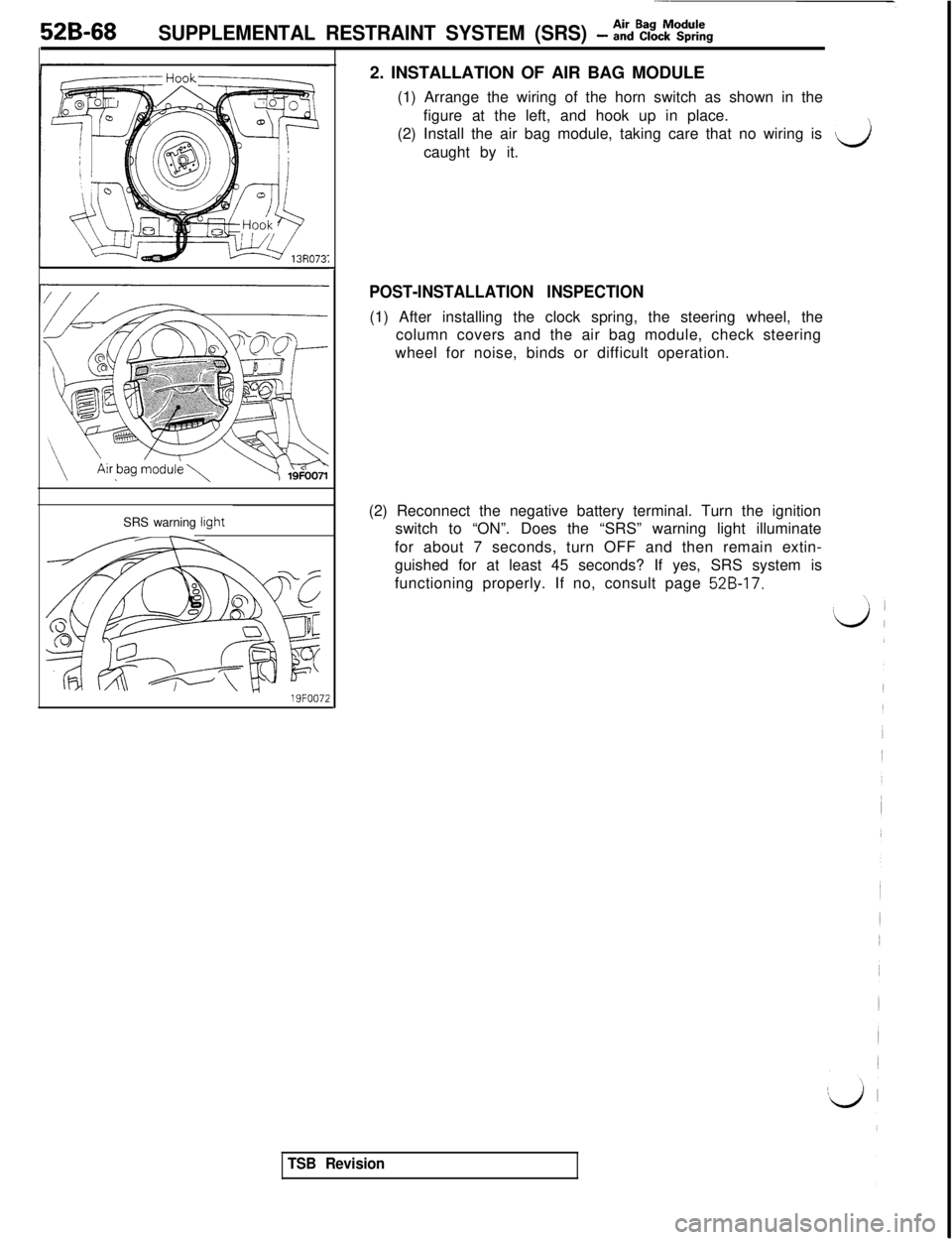
19FOO722. INSTALLATION OF AIR BAG MODULE
(1) Arrange the wiring of the horn switch as shown in the
figure at the left, and hook up in place.
(2) Install the air bag module, taking care that no wiring is
vicaught by it.
POST-INSTALLATION INSPECTION(1) After installing the clock spring, the steering wheel, the
column covers and the air bag module, check steering
wheel for noise, binds or difficult operation.
(2) Reconnect the negative battery terminal. Turn the ignition
switch to “ON”. Does the “SRS” warning light illuminate
for about 7 seconds, turn OFF and then remain extin-
guished for at least 45 seconds? If yes, SRS system is
functioning properly. If no, consult page
52B-17.
TSB Revision
Page 1079 of 1146
SUPPLEMENTAL RESTRAINT SYSTEM (SRS) - ~&%,MprOodcUures 52B-69
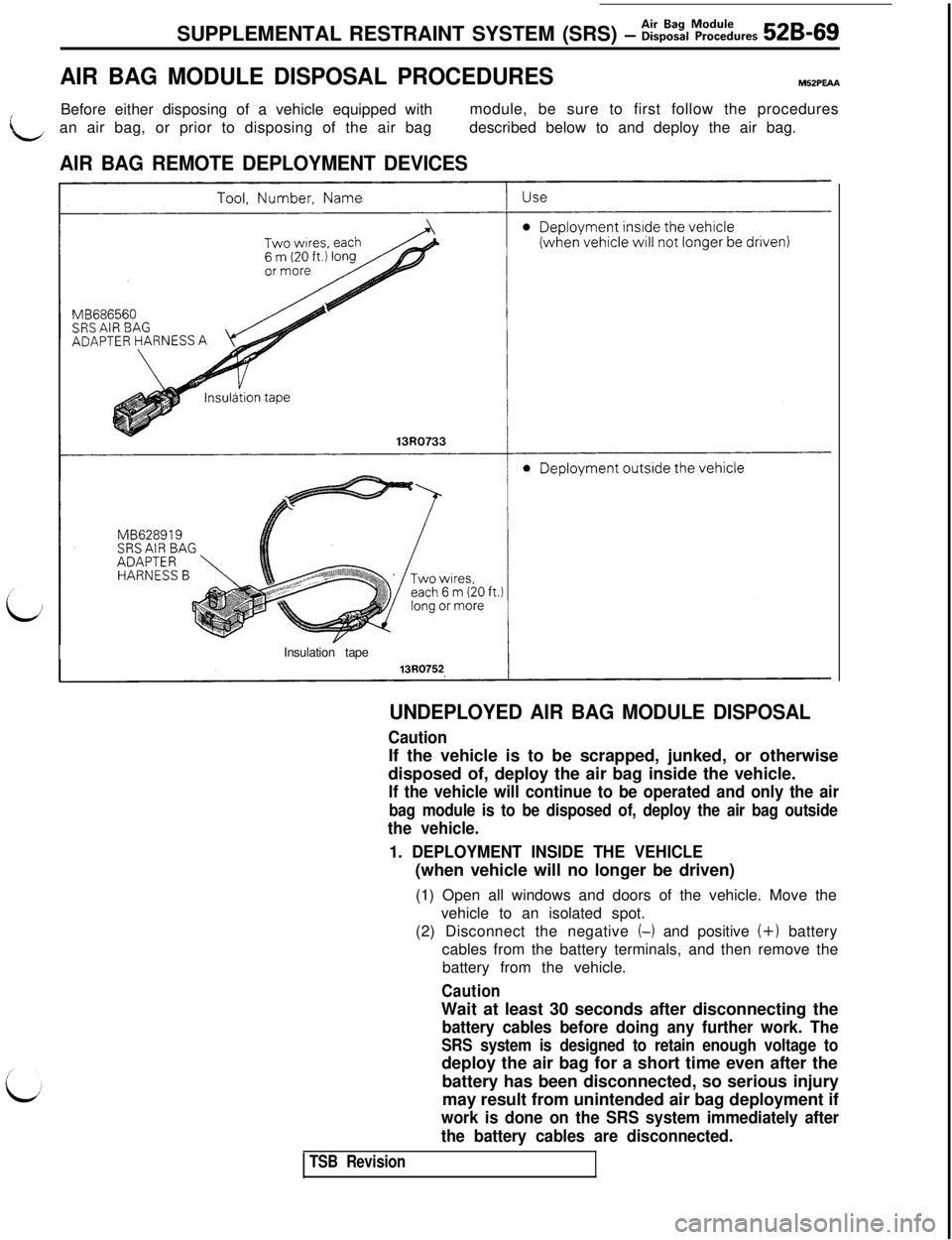
AIR BAG MODULE DISPOSAL PROCEDURESM52PmA
LBefore either disposing of a vehicle equipped withmodule, be sure to first follow the procedures
an air bag, or prior to disposing of the air bagdescribed below to and deploy the air bag.
AIR BAG REMOTE DEPLOYMENT DEVICESInsulation tape
UNDEPLOYED AIR BAG MODULE DISPOSAL
CautionIf the vehicle is to be scrapped, junked, or otherwise
disposed of, deploy the air bag inside the vehicle.
If the vehicle will continue to be operated and only the air
bag module is to be disposed of, deploy the air bag outside
the vehicle.
1. DEPLOYMENT INSIDE THE VEHICLE(when vehicle will no longer be driven)
(1) Open all windows and doors of the vehicle. Move the
vehicle to an isolated spot.
(2) Disconnect the negative
(4 and positive (i-1 battery
cables from the battery terminals, and then remove the
battery from the vehicle.
CautionWait at least 30 seconds after disconnecting the
battery cables before doing any further work. The
SRS system is designed to retain enough voltage todeploy the air bag for a short time even after the
battery has been disconnected, so serious injury
may result from unintended air bag deployment if
work is done on the SRS system immediately after
the battery cables are disconnected.
TSB Revision
Page 1081 of 1146
idAir Bag Module
SUPPLEMENTAL RESTRAINT SYSTEM (SRS)
- Disposal Procedures 52B-71
2.
19FO119Two wires
ConytionInsulation tape
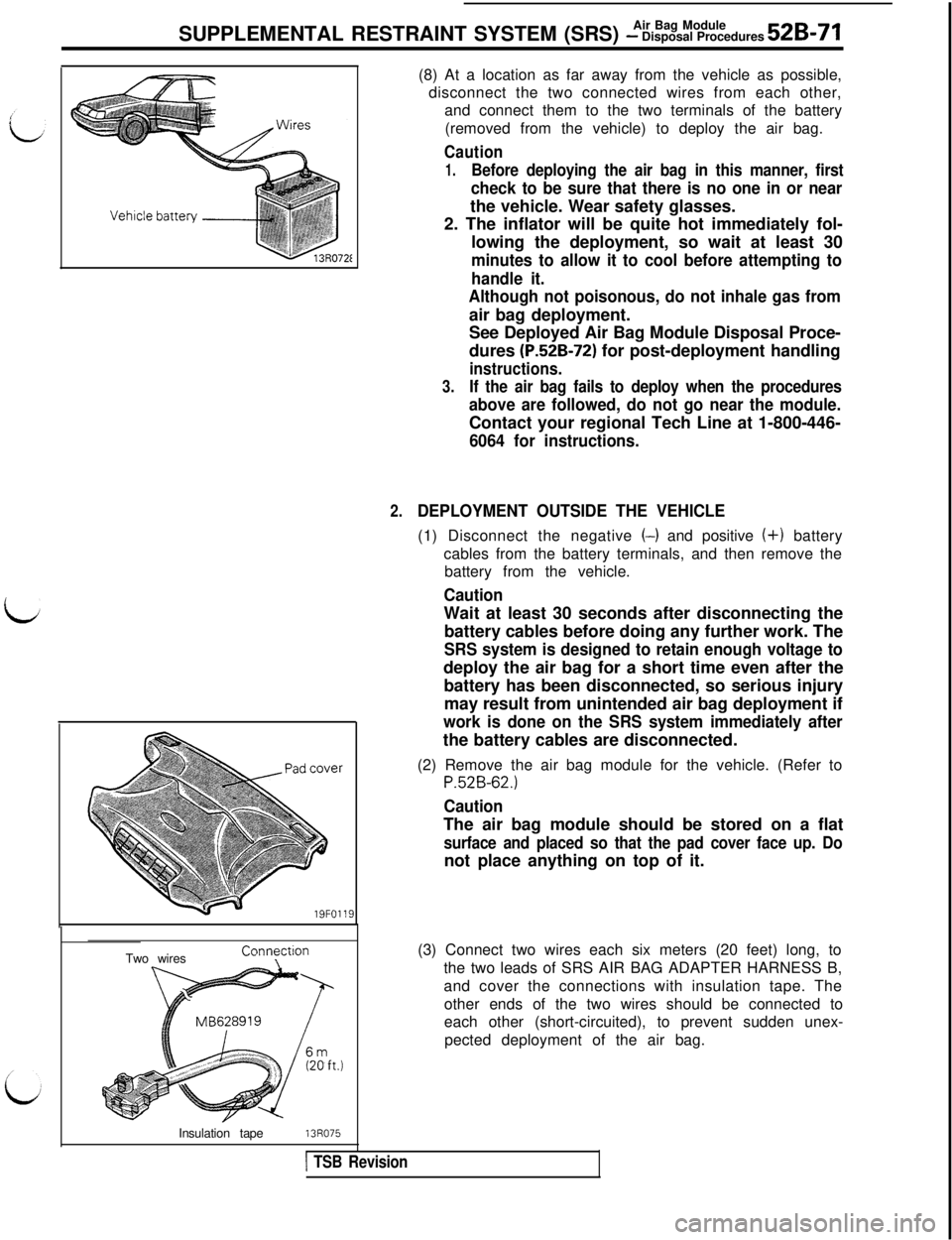
13~075(8) At a location as far away from the vehicle as possible,
disconnect the two connected wires from each other,
and connect them to the two terminals of the battery
(removed from the vehicle) to deploy the air bag.
Caution
1.Before deploying the air bag in this manner, first
check to be sure that there is no one in or nearthe vehicle. Wear safety glasses.
2. The inflator will be quite hot immediately fol-
lowing the deployment, so wait at least 30
minutes to allow it to cool before attempting to
handle it.
Although not poisonous, do not inhale gas fromair bag deployment.
See Deployed Air Bag Module Disposal Proce-
dures
(P.52B-72) for post-deployment handling
instructions.
3.If the air bag fails to deploy when the procedures
above are followed, do not go near the module.Contact your regional Tech Line at 1-800-446-
6064 for instructions.
DEPLOYMENT OUTSIDE THE VEHICLE(1) Disconnect the negative
(4 and positive (+) battery
cables from the battery terminals, and then remove the
battery from the vehicle.
CautionWait at least 30 seconds after disconnecting the
battery cables before doing any further work. The
SRS system is designed to retain enough voltage todeploy the air bag for a short time even after the
battery has been disconnected, so serious injury
may result from unintended air bag deployment if
work is done on the SRS system immediately afterthe battery cables are disconnected.
(2) Remove the air bag module for the vehicle. (Refer toP.528-62.)
CautionThe air bag module should be stored on a flat
surface and placed so that the pad cover face up. Donot place anything on top of it.
(3) Connect two wires each six meters (20 feet) long, to
the two leads of SRS AIR BAG ADAPTER HARNESS B,
and cover the connections with insulation tape. The
other ends of the two wires should be connected to
each other (short-circuited), to prevent sudden unex-
pected deployment of the air bag.
1 TSB Revision
Page 1082 of 1146
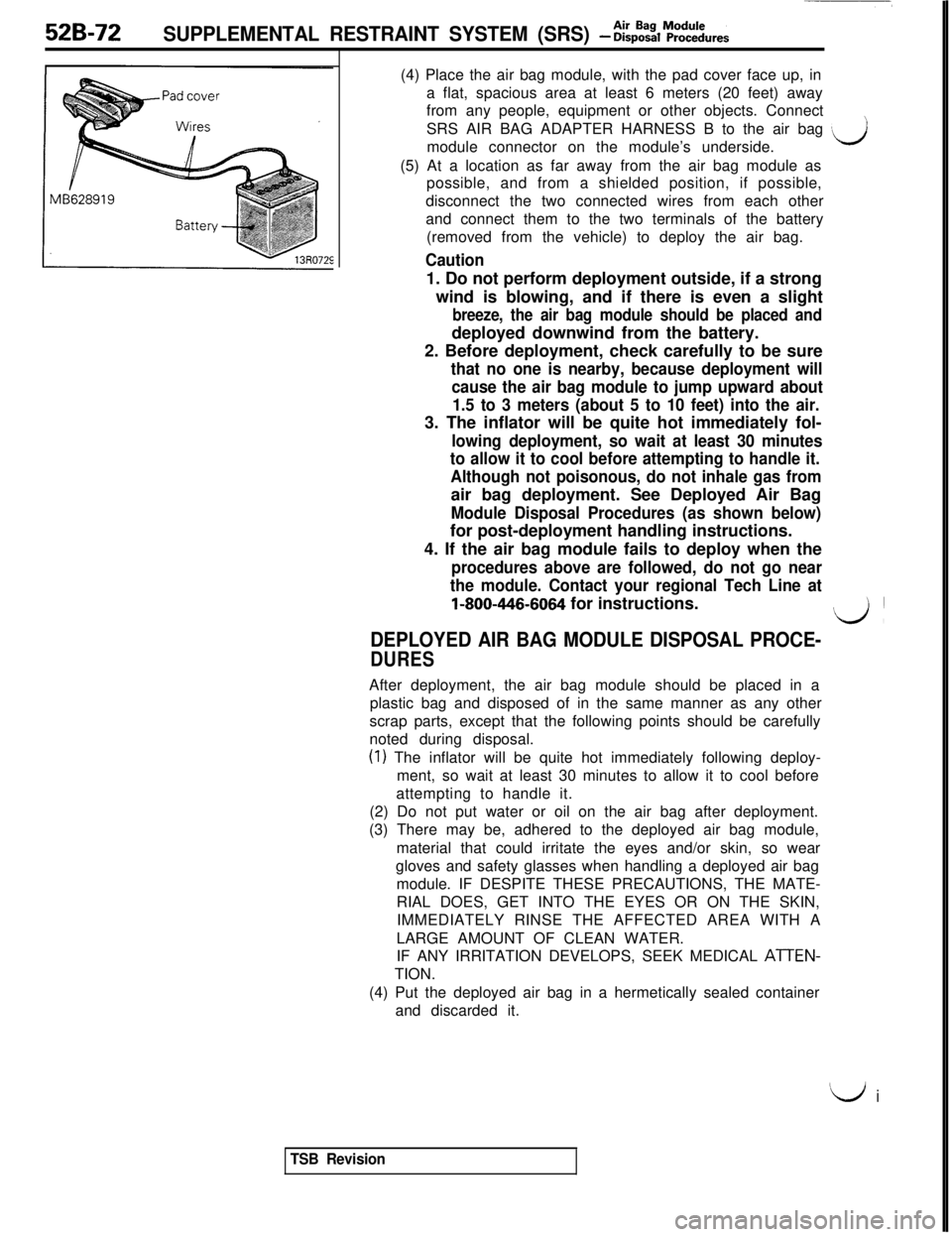
52B-72SUPPLEMENTAL RESTRAINT SYSTEM (SRS) - &%~~~~~ures(4) Place the air bag module, with the pad cover face up, in
a flat, spacious area at least 6 meters (20 feet) away
from any people, equipment or other objects. Connect
SRS AIR BAG ADAPTER HARNESS B to the air bag
mdmodule connector on the module’s underside.
(5) At a location as far away from the air bag module as
possible, and from a shielded position, if possible,
disconnect the two connected wires from each other
and connect them to the two terminals of the battery
(removed from the vehicle) to deploy the air bag.
Caution1. Do not perform deployment outside, if a strong
wind is blowing, and if there is even a slight
breeze, the air bag module should be placed anddeployed downwind from the battery.
2. Before deployment, check carefully to be sure
that no one is nearby, because deployment will
cause the air bag module to jump upward about
1.5 to 3 meters (about 5 to 10 feet) into the air.3. The inflator will be quite hot immediately fol-
lowing deployment, so wait at least 30 minutes
to allow it to cool before attempting to handle it.
Although not poisonous, do not inhale gas fromair bag deployment. See Deployed Air Bag
Module Disposal Procedures (as shown below)for post-deployment handling instructions.
4. If the air bag module fails to deploy when the
procedures above are followed, do not go near
the module. Contact your regional Tech Line at
l-800-446-6064 for instructions.\J’
DEPLOYED AIR BAG MODULE DISPOSAL PROCE-
DURESAfter deployment, the air bag module should be placed in a
plastic bag and disposed of in the same manner as any other
scrap parts, except that the following points should be carefully
noted during disposal.
(1) The inflator will be quite hot immediately following deploy-
ment, so wait at least 30 minutes to allow it to cool before
attempting to handle it.
(2) Do not put water or oil on the air bag after deployment.
(3) There may be, adhered to the deployed air bag module,
material that could irritate the eyes and/or skin, so wear
gloves and safety glasses when handling a deployed air bag
module. IF DESPITE THESE PRECAUTIONS, THE MATE-
RIAL DOES, GET INTO THE EYES OR ON THE SKIN,
IMMEDIATELY RINSE THE AFFECTED AREA WITH A
LARGE AMOUNT OF CLEAN WATER.
IF ANY IRRITATION DEVELOPS, SEEK MEDICAL
A-I-TEN-TION.
(4) Put the deployed air bag in a hermetically sealed container
and discarded it.
‘LJ i
TSB Revision
Page 1089 of 1146
L
2OFOO85HEATERS AND MANUAL AIR CONDITIONER
- Trqubleshooting55-7
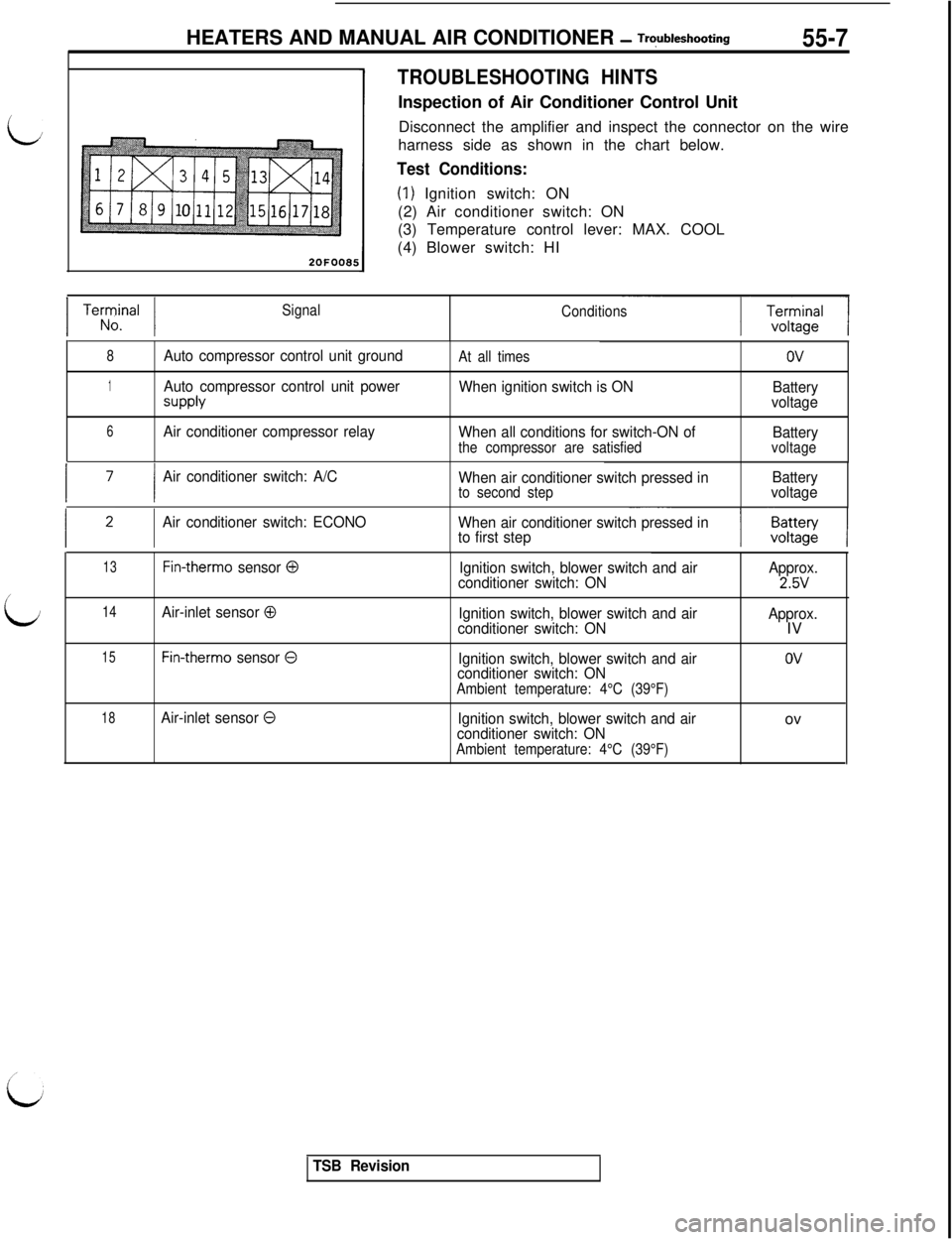
TROUBLESHOOTING HINTSInspection of Air Conditioner Control Unit
Disconnect the amplifier and inspect the connector on the wire
harness side as shown in the chart below.
Test Conditions:
(1) Ignition switch: ON
(2) Air conditioner switch: ON
(3) Temperature control lever: MAX. COOL
(4) Blower switch: HI
1 Terrrnal 1Signal
Conditions
8Auto compressor control unit groundAt all timesov
1Auto compressor control unit power
SUPPlY
When ignition switch is ON
Battery
voltage
6Air conditioner compressor relay
When all conditions for switch-ON of
Battery
the compressor are satisfiedvoltage
I ’I
Air conditioner switch: A/C
When air conditioner switch pressed inBattery
to second stepvoltage
Air conditioner switch: ECONO
When air conditioner switch pressed in
to first step
13Fin-therm0 sensor 0Ignition switch, blower switch and airApprox.
conditioner switch: ON2.5V/
LJ14Air-inlet sensor 0Ignition switch, blower switch and air
conditioner switch: ONApprox.IV
15Fin-therm0 sensor 0Ignition switch, blower switch and air
conditioner switch: ON
Ambient temperature: 4°C (39°F)
OV
18Air-inlet sensor 0Ignition switch, blower switch and air
conditioner switch: ON
Ambient temperature: 4°C (39°F)ov
TSB Revision
Page 1092 of 1146
55-10 HEATERS AND MANUAL AIR CONDITIONER -Service Adjustment Procedures
OFF-----__-__1210235 2,1002,700
(30) (33)(299) (384)
Pressure Fil
2OPOOlL
SERVICE ADJUSTMENT PROCEDURES
M55FEAU
TEST PROCEDURESSIGHT GLASS REFRIGERANT LEVEL TEST
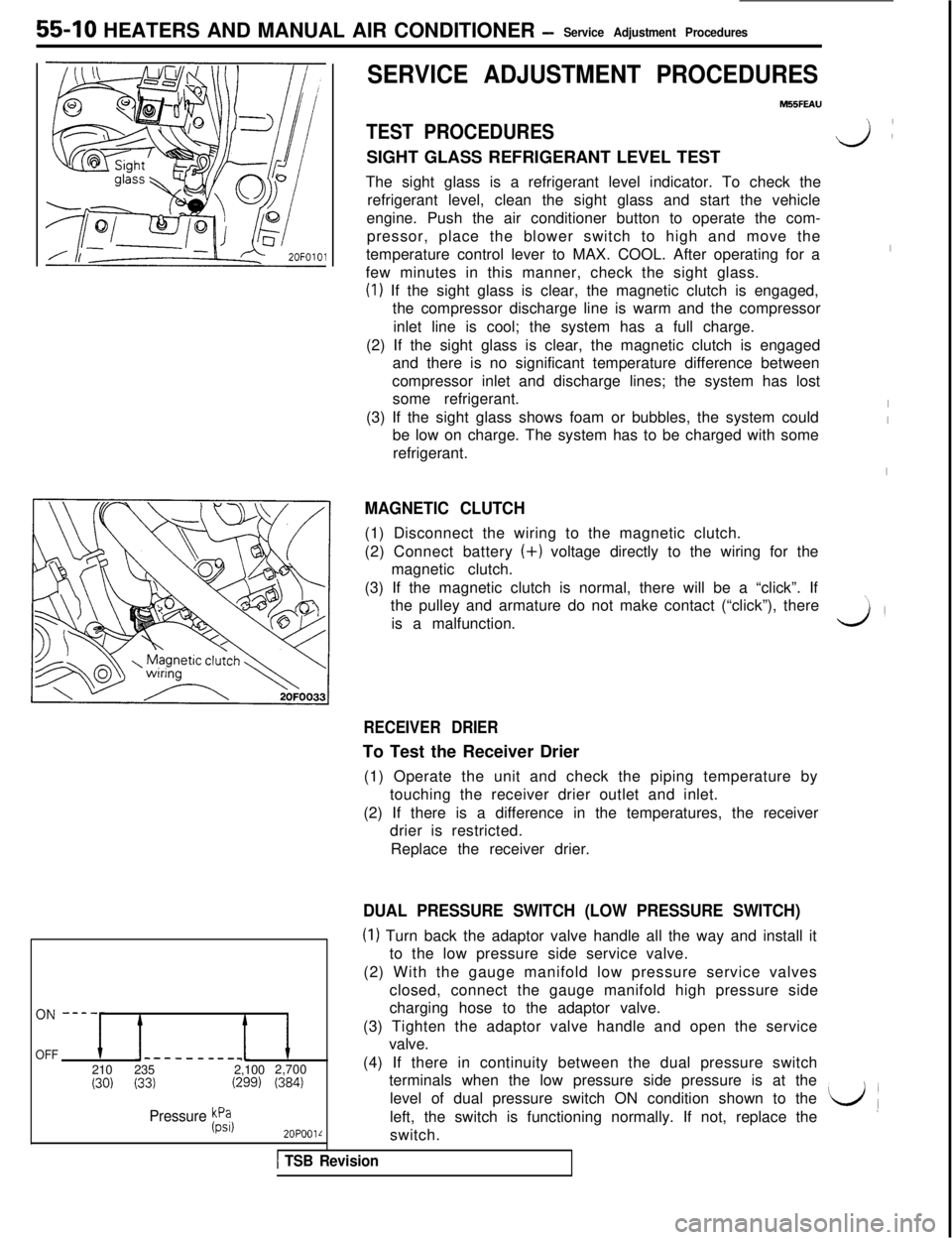
The sight glass is a refrigerant level indicator. To check the
refrigerant level, clean the sight glass and start the vehicle
engine. Push the air conditioner button to operate the com-
pressor, place the blower switch to high and move the
temperature control lever to MAX. COOL. After operating for a
few minutes in this manner, check the sight glass.
(I) If the sight glass is clear, the magnetic clutch is engaged,
the compressor discharge line is warm and the compressor
inlet line is cool; the system has a full charge.
(2) If the sight glass is clear, the magnetic clutch is engaged
and there is no significant temperature difference between
compressor inlet and discharge lines; the system has lost
some refrigerant.
(3) If the sight glass shows foam or bubbles, the system could
be low on charge. The system has to be charged with some
refrigerant.
MAGNETIC CLUTCH(1) Disconnect the wiring to the magnetic clutch.
(2) Connect battery (+) voltage directly to the wiring for the
magnetic clutch.
(3) If the magnetic clutch is normal, there will be a “click”. If
the pulley and armature do not make contact (“click”), there
is a malfunction.
v):
I
I
I
I
\,
3’
RECEIVER DRIERTo Test the Receiver Drier
(1) Operate the unit and check the piping temperature by
touching the receiver drier outlet and inlet.
(2) If there is a difference in the temperatures, the receiver
drier is restricted.
Replace the receiver drier.
DUAL PRESSURE SWITCH (LOW PRESSURE SWITCH)
(I) Turn back the adaptor valve handle all the way and install it
to the low pressure side service valve.
(2) With the gauge manifold low pressure service valves
closed, connect the gauge manifold high pressure side
charging hose to the adaptor valve.
(3) Tighten the adaptor valve handle and open the service
valve.
(4) If there in continuity between the dual pressure switch
terminals when the low pressure side pressure is at the
level of dual pressure switch ON condition shown to the
left, the switch is functioning normally. If not, replace the
L/(switch.
1 TSB Revision
Page 1106 of 1146
55-24
IHEATERS AND MANUAL AIR CONDITIONER
- Blower Assembly
INSPECTIONM55KCAMl Check for bending or abnormal deflection of the rotating
Ishaft of the blower motor assembly.
l Check for cracking or deterioration of the packing.
l Check for damage to the fan.
d’l Check for damage to the blower case.
l Check the operation of the inside/outside air-selection
damper, and for damage.
16LO28C
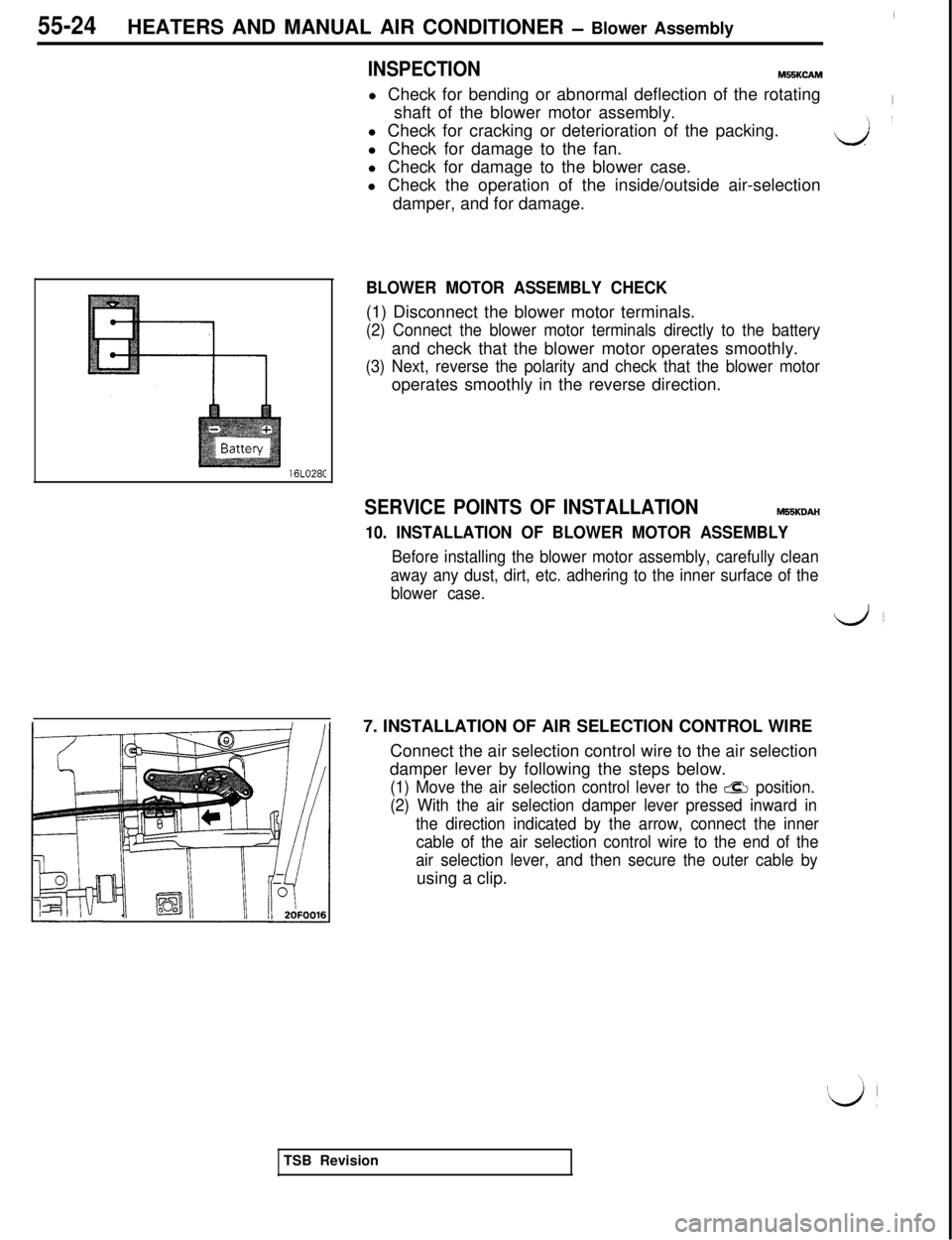
BLOWER MOTOR ASSEMBLY CHECK(1) Disconnect the blower motor terminals.
(2) Connect the blower motor terminals directly to the batteryand check that the blower motor operates smoothly.
(3) Next, reverse the polarity and check that the blower motoroperates smoothly in the reverse direction.
SERVICE POINTS OF INSTALLATIONM55KDAH
10. INSTALLATION OF BLOWER MOTOR ASSEMBLY
Before installing the blower motor assembly, carefully clean
away any dust, dirt, etc. adhering to the inner surface of the
blower case.7. INSTALLATION OF AIR SELECTION CONTROL WIRE
Connect the air selection control wire to the air selection
damper lever by following the steps below.
(1) Move the air selection control lever to the CQ position.
(2) With the air selection damper lever pressed inward in
the direction indicated by the arrow, connect the inner
cable of the air selection control wire to the end of the
air selection lever, and then secure the outer cable byusing a clip.
TSB Revision