battery MITSUBISHI 3000GT 1991 Service Manual
[x] Cancel search | Manufacturer: MITSUBISHI, Model Year: 1991, Model line: 3000GT, Model: MITSUBISHI 3000GT 1991Pages: 1146, PDF Size: 76.68 MB
Page 19 of 1146
GENERAL - Precautions before Service0045
c
mm (in.)so005
PRECAUTIONS BEFORE SERWCEMOOOAAOSERVICING ELECTRICAL SYSTEM
1. Note the following before proceeding with work on the
electrical system.
Note that the following must never be done:
Unauthorized modifications of any electrical device or
wiring, because such modifications might lead to a vehicle
malfunction, over-capacity or short-circuit that could result
in a fire in the vehicle.
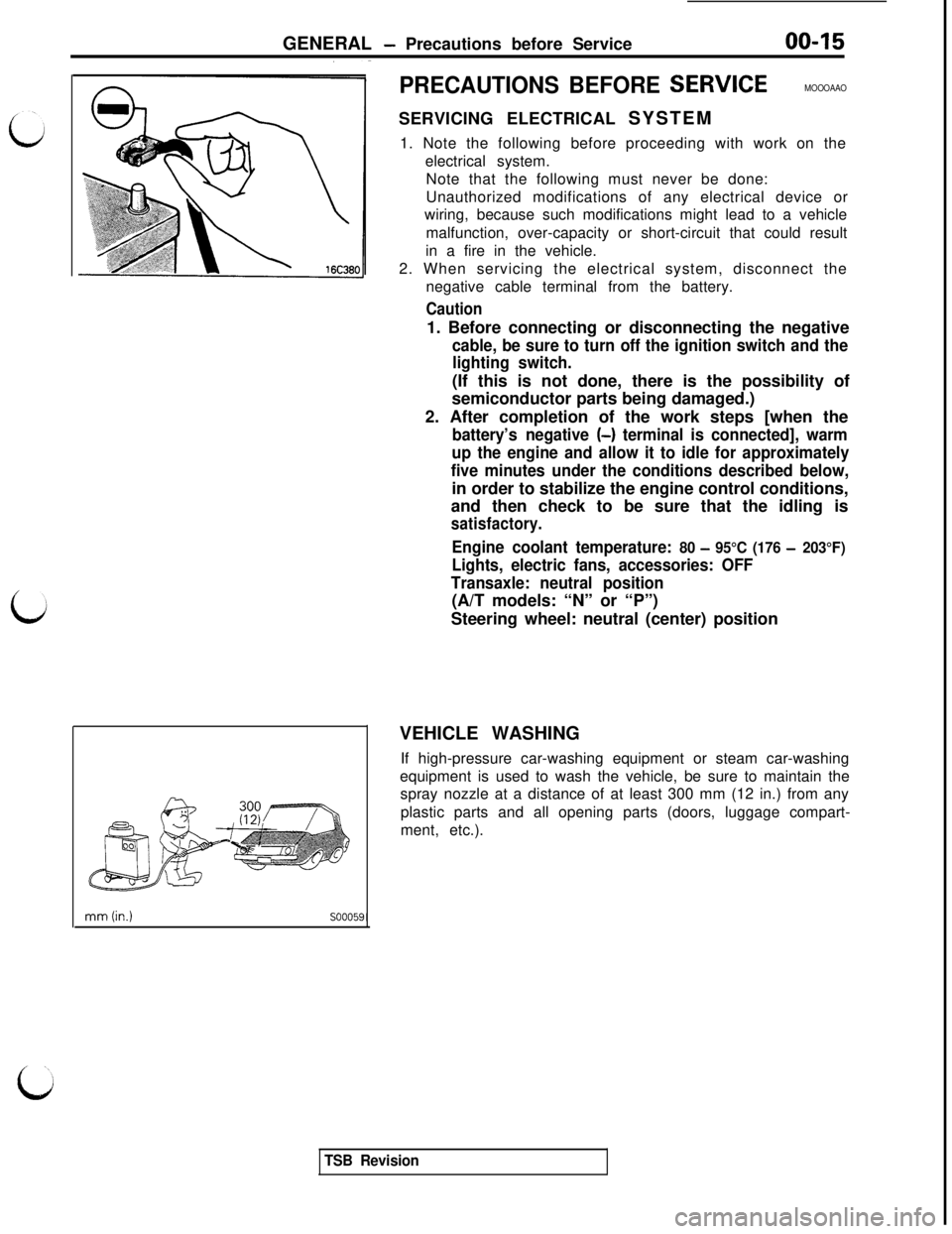
2. When servicing the electrical system, disconnect the
negative cable terminal from the battery.
Caution1. Before connecting or disconnecting the negative
cable, be sure to turn off the ignition switch and the
lighting switch.(If this is not done, there is the possibility of
semiconductor parts being damaged.)
2. After completion of the work steps [when the
battery’s negative (-) terminal is connected], warm
up the engine and allow it to idle for approximately
five minutes under the conditions described below,in order to stabilize the engine control conditions,
and then check to be sure that the idling is
satisfactory.
Engine coolant temperature: 80 - 95°C (176 - 203°F)
Lights, electric fans, accessories: OFF
Transaxle: neutral position(A/T models: “N” or “P”)
Steering wheel: neutral (center) position
VEHICLE WASHING
If high-pressure car-washing equipment or steam car-washing
equipment is used to wash the vehicle, be sure to maintain the
spray nozzle at a distance of at least 300 mm (12 in.) from any
plastic parts and all opening parts (doors, luggage compart-
ment, etc.).
c
TSB Revision
Page 65 of 1146
ENGINE - Service Adjustment Procedures11-15COMPRESSION PRESSURE CHECKMllFFAK
(1) Before checking compression, ensure that engine oil, the
starter motor, and battery are all in normal operating
condition.
(2) Start the engine and wait until engine coolant temperature
has risen to 80
- 95°C (176 - 205°F).
(3) Remove the all spark plugs.
(4) Crank the engine to remove any foreign objects in the
cylinders.
CautionCover the spark plug holes with shop towel, etc., in
order to keep expelled foreign objects from flying out,and keep away from the holes. When measuring
compression with water, oil, or fuel having entered the
cylinder through a crack, etc., these will come flying out
of the spark plug hole hot and fast, so be sure to take
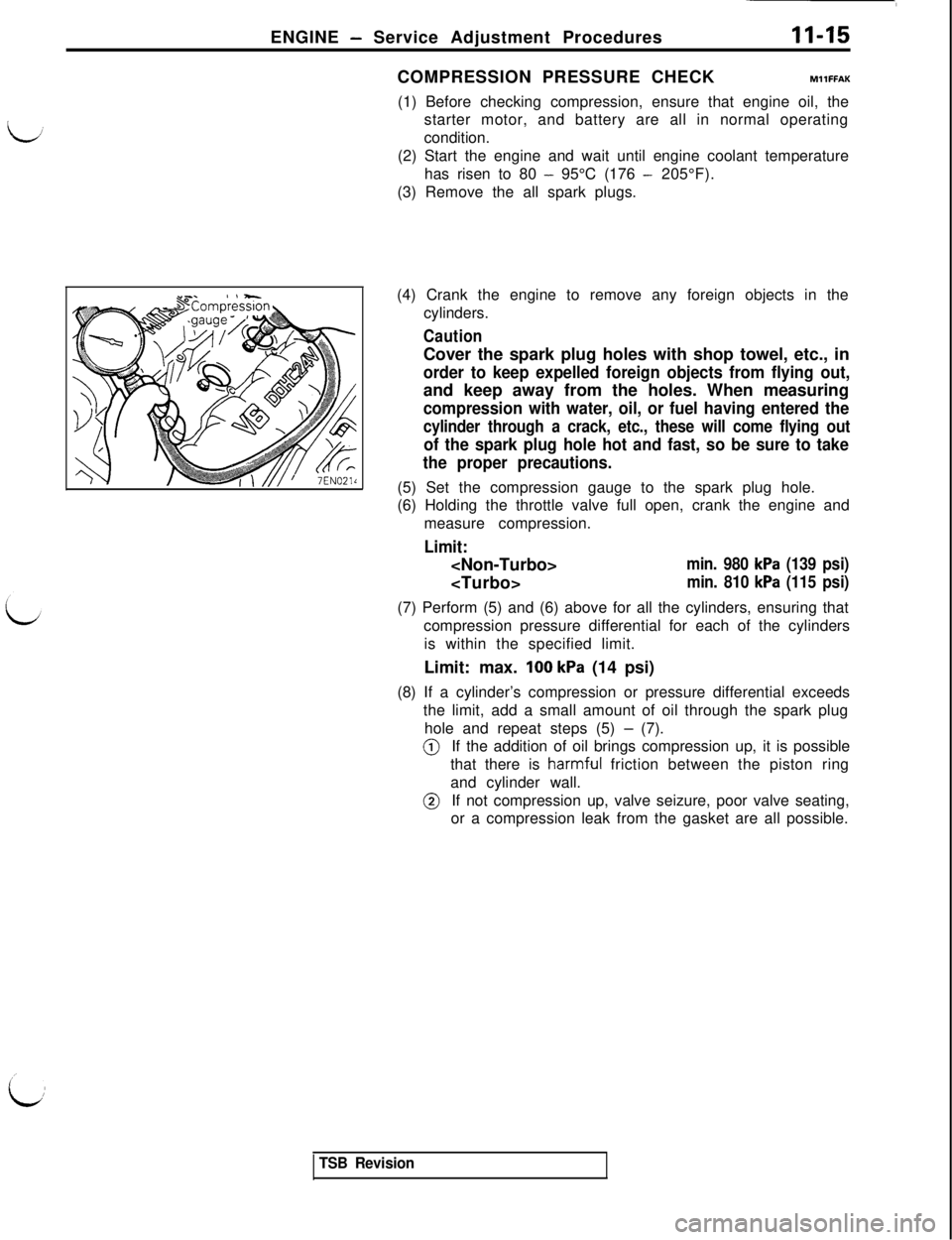
the proper precautions.(5) Set the compression gauge to the spark plug hole.
(6) Holding the throttle valve full open, crank the engine and
measure compression.
Limit:
min. 980 kPa (139 psi)
min. 810 kPa (115 psi)(7) Perform (5) and (6) above for all the cylinders, ensuring that
compression pressure differential for each of the cylinders
is within the specified limit.
Limit: max.
100 kPa (14 psi)
(8) If a cylinder’s compression or pressure differential exceeds
the limit, add a small amount of oil through the spark plug
hole and repeat steps (5)
- (7).@If the addition of oil brings compression up, it is possible
that there is
harmf,uI friction between the piston ring
and cylinder wall.@If not compression up, valve seizure, poor valve seating,
or a compression leak from the gasket are all possible.
TSB Revision
Page 118 of 1146

13-12FUEL SYSTEM - Troubleshooting
MALFUNCTION INDICATOR LIGHT INSPECTION
(1) Check that when the ignition switch is turned on, the lightilluminates for about 5 seconds and then goes out.
(2) If the light does not illuminate, check for open circuit in
dharness, blown fuse and blown bulb.
SELF-DIAGNOSIS
The engine control unit monitors the input/output signals (some
signals at all times and the others under specified conditions) ofthe engine control unit.
When it is noticed that an irregularity has continued for a
specified time or longer from when the irregular signal is
initially monitored, passing a certain number, the engine controlunit judges that an irregularity has occurred, memorizes the
malfunction code, and outputs the signal to the self-diagnosis
output terminal.
There are 21 diagnosis items, including the normal state, andthe diagnosis results can be read out with a voltmeter or
multi-use tester.Moreover, since memorization of the malfunction codes is
backed up directly by the battery, the diagnosis results are
memorized even if the ignition key is turned off. The malfunc-
tion codes will, however, be erased when the battery terminalor the engine control unit connector is disconnected.
The malfunction code can also be erased by turning on the
ignition switch and sending the malfunction code erase signalfrom the multi-use tester to the engine control unit.
CautionIf the sensor connector is disconnected with the ignition
_ _switch turned on, the malfunction code is memorized. Ind
this case, send the malfunction code erase signal from themulti-use tester to the engine control unit or disconnect
the battery terminal
(-) for 10 seconds or more, and the
diagnosis memory will be erased.
The 21 diagnosis items are provided as follows, and if plural
items are activated, they are all indicated sequentially from the
smallest code number.
CautionThe malfunction code for the ignition timing adjustment
signal is output when the line of the ignition timing
adjustment terminal is shorted to ground. Therefore, the
malfunction code is also output when the ignition timing
adjustment terminal is grounded to adjust the ignition
timing, but this does not show any abnormality.
TSB Revision
Page 121 of 1146
FUEL SYSTEM - Troubleshooting13-15READ OUT OF MALFUNCTION CODE
Precautions for Operation
(1) When battery voltage is low, no detection of failure is
possible. Be sure to check the battery for voltage and otherconditions before starting the test.
(2) Diagnosis item is erased if the battery or the engine controlunit connector is disconnected. Do not disconnect the
battery before the diagnosis result is completely read.
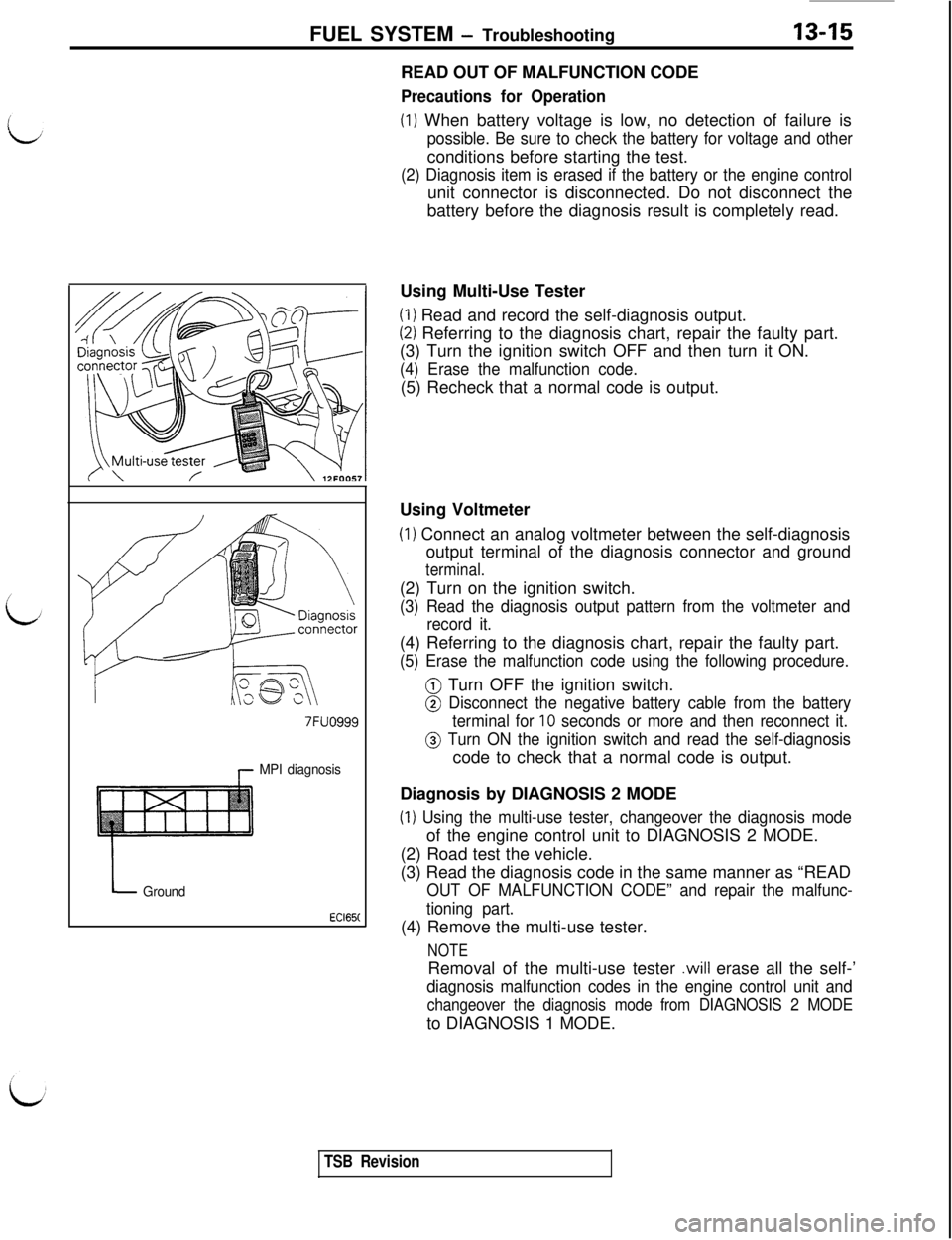
Using Multi-Use Tester
(I) Read and record the self-diagnosis output.
(2) Referring to the diagnosis chart, repair the faulty part.
(3) Turn the ignition switch OFF and then turn it ON.
(4) Erase the malfunction code.(5) Recheck that a normal code is output.
7FUO999
r MPI diagnosis
L Ground
EC165(Using Voltmeter(I) Connect an analog voltmeter between the self-diagnosis
output terminal of the diagnosis connector and ground
terminal.(2) Turn on the ignition switch.
(3) Read the diagnosis output pattern from the voltmeter and
record it.(4) Referring to the diagnosis chart, repair the faulty part.
(5) Erase the malfunction code using the following procedure.
@ Turn OFF the ignition switch.
@ Disconnect the negative battery cable from the battery
terminal for
10 seconds or more and then reconnect it.
@ Turn ON the ignition switch and read the self-diagnosiscode to check that a normal code is output.
Diagnosis by DIAGNOSIS 2 MODE
(1) Using the multi-use tester, changeover the diagnosis modeof the engine control unit to DIAGNOSIS 2 MODE.
(2) Road test the vehicle.
(3) Read the diagnosis code in the same manner as “READ
OUT OF MALFUNCTION CODE” and repair the malfunc-
tioning part.(4) Remove the multi-use tester.
NOTERemoval of the multi-use tester
.will erase all the self-’
diagnosis malfunction codes in the engine control unit and
changeover the diagnosis mode from DIAGNOSIS 2 MODEto DIAGNOSIS 1 MODE.
TSB Revision
Page 130 of 1146
13-24FUEL SYSTEM - ‘Troubleshootinn
FUSIBLE LINK@BATTERY%
--T-- -J/Bqa1
B;&CATED
;ER
0
1
15A
c-71
I-
jLEl3za
12345675 s *01112* , 1616
w
15A
I t
IOA
-1l-
C-83 m 7
pTEiEsq&is
1
6
Efi;;l
p!i!Ezq;
3 A-67
I
71,-----
AIRmFLOWSENSOR' i?
EN:
- ,lOI\
---------
OFF-*ON__O/ \I
1
cte"4 "5"0%
%D
dN INGlc
CLYYIJ
EN
33
-I
ENGINE
CONTROL
RELAY
c-44
\,
3"7
T!c
4:?3[II
1-;125 +2a 108 &1852-5
X35-AC-R0503-NY
EaaTSB Revision
Page 139 of 1146
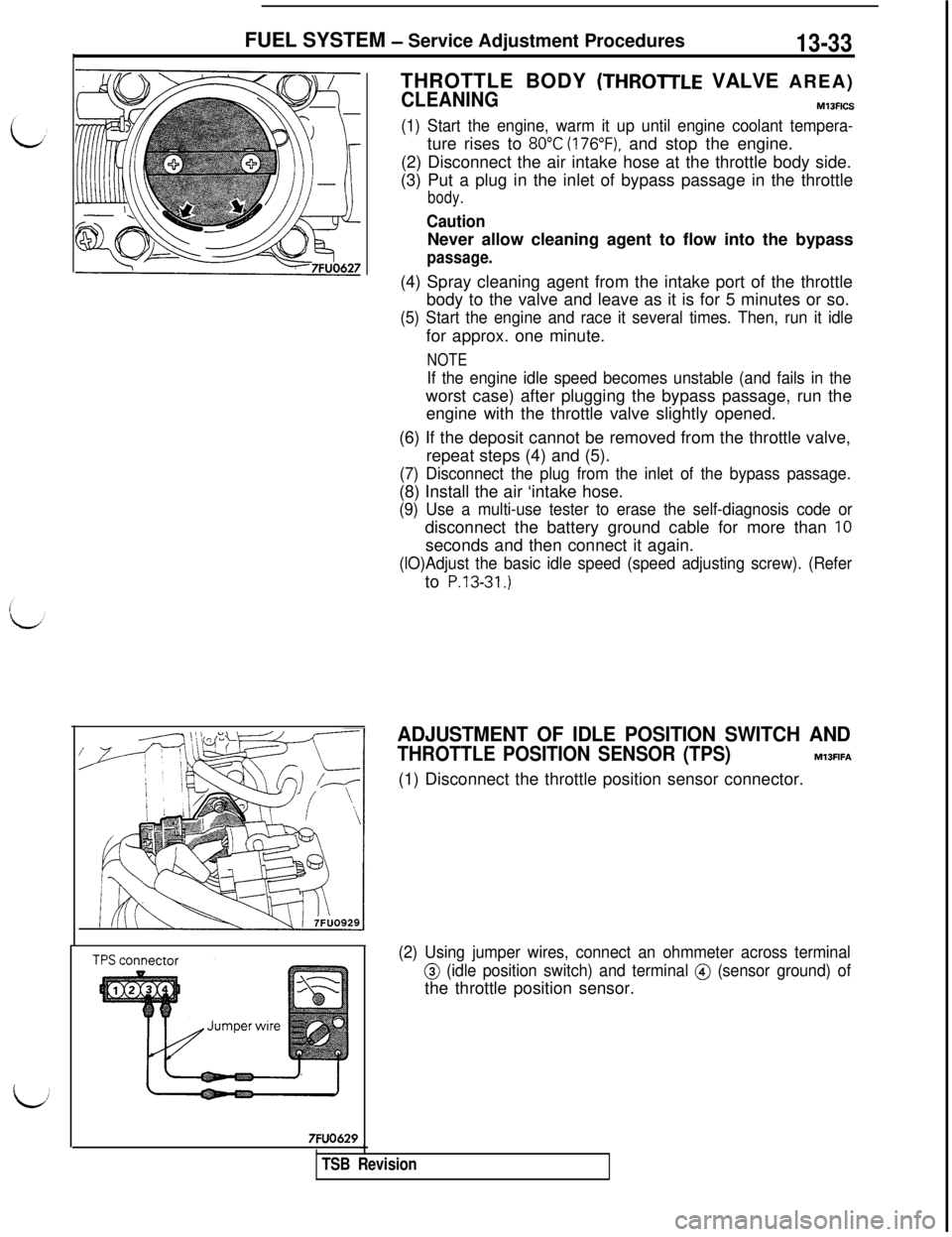
FUEL SYSTEM - Service Adjustment Procedures13-33THROTTLE BODY
(THROTrLE VALVE AREA)
CLEANINGM13FICS
(1) Start the engine, warm it up until engine coolant tempera-ture rises to
80°C (176”F), and stop the engine.
(2) Disconnect the air intake hose at the throttle body side.
(3) Put a plug in the inlet of bypass passage in the throttle
body.
CautionNever allow cleaning agent to flow into the bypass
passage.(4) Spray cleaning agent from the intake port of the throttle
body to the valve and leave as it is for 5 minutes or so.
(5) Start the engine and race it several times. Then, run it idlefor approx. one minute.
NOTE
If the engine idle speed becomes unstable (and fails in theworst case) after plugging the bypass passage, run the
engine with the throttle valve slightly opened.
(6) If the deposit cannot be removed from the throttle valve,
repeat steps (4) and (5).
(7) Disconnect the plug from the inlet of the bypass passage.(8) Install the air ‘intake hose.
(9) Use a multi-use tester to erase the self-diagnosis code ordisconnect the battery ground cable for more than
IOseconds and then connect it again.
(lO)Adjust the basic idle speed (speed adjusting screw). (Referto
P.13-31.)
7FUO629
ADJUSTMENT OF IDLE POSITION SWITCH AND
THROTTLE POSITION SENSOR (TPS)M13FIFA(1) Disconnect the throttle position sensor connector.
(2) Using jumper wires, connect an ohmmeter across terminal
@ (idle position switch) and terminal @ (sensor ground) ofthe throttle position sensor.
TSB Revision
Page 147 of 1146
FUEL SYSTEM - On-vehicle Inspection of MPI Components13-41
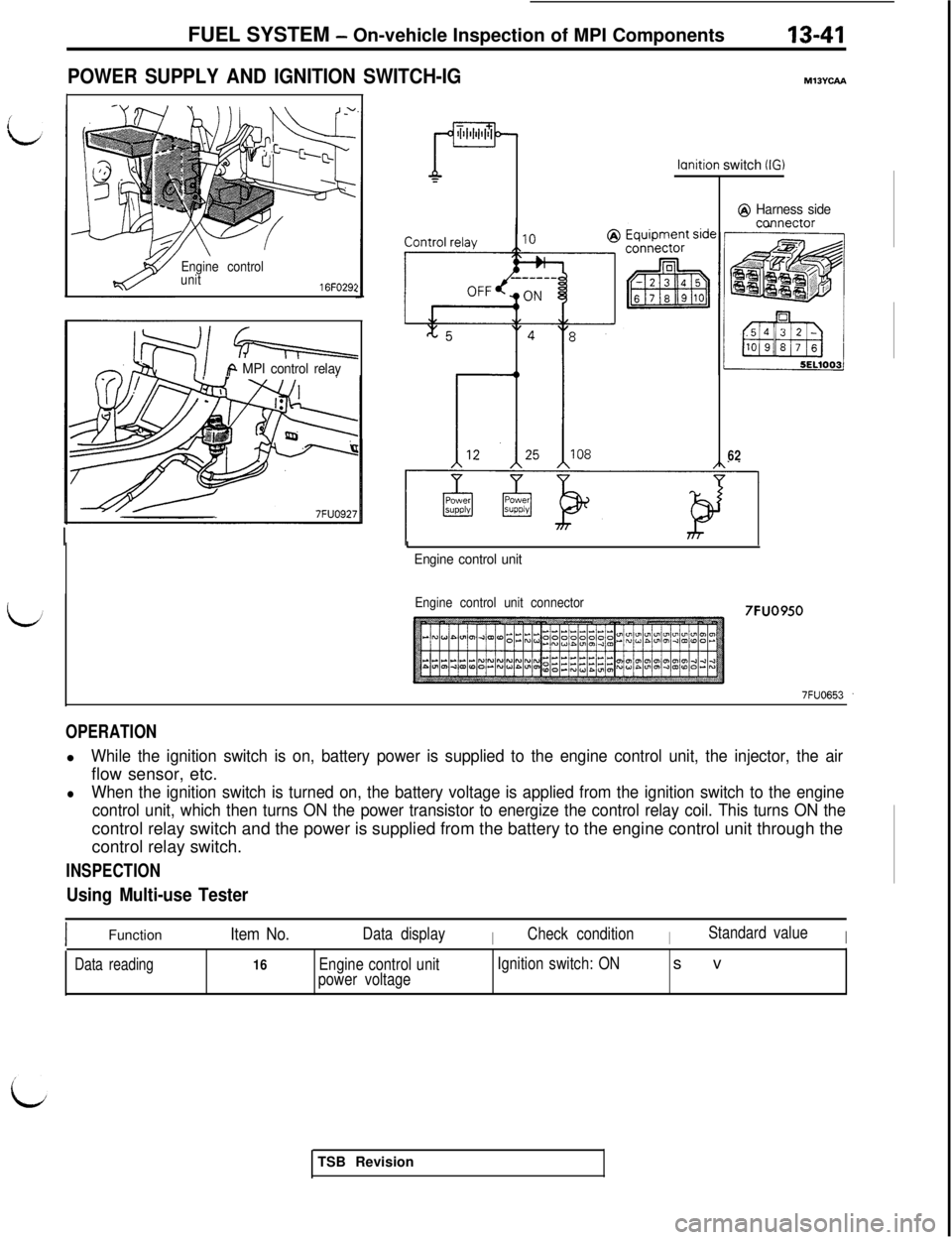
POWER SUPPLY AND IGNITION SWITCH-IG
Engine control
unit
16FO29:
Q-i=++=
iA MPI control relay
ml3Yuu
lcmition switch (IG)
@ Harness sideccmnector
62
I
Engine control unit
Engine control unit connector7FUO950
OPERATIONl
While the ignition switch is on, battery power is supplied to the engine control unit, the injector, the airflow sensor, etc.
lWhen the ignition switch is turned on, the battery voltage is applied from the ignition switch to the engine
control unit, which then turns ON the power transistor to energize the control relay coil. This turns ON thecontrol relay switch and the power is supplied from the battery to the engine control unit through the
control relay switch.
INSPECTION
Using Multi-use Tester
IFunctionItem No.Data displayICheck conditionIStandard valueI
Data reading16Engine control unit
power voltageIgnition switch: ONsv
TSB Revision
Page 148 of 1146
IS-42FUEL SYSTEM - On-vehicle Inspection of MPI Components
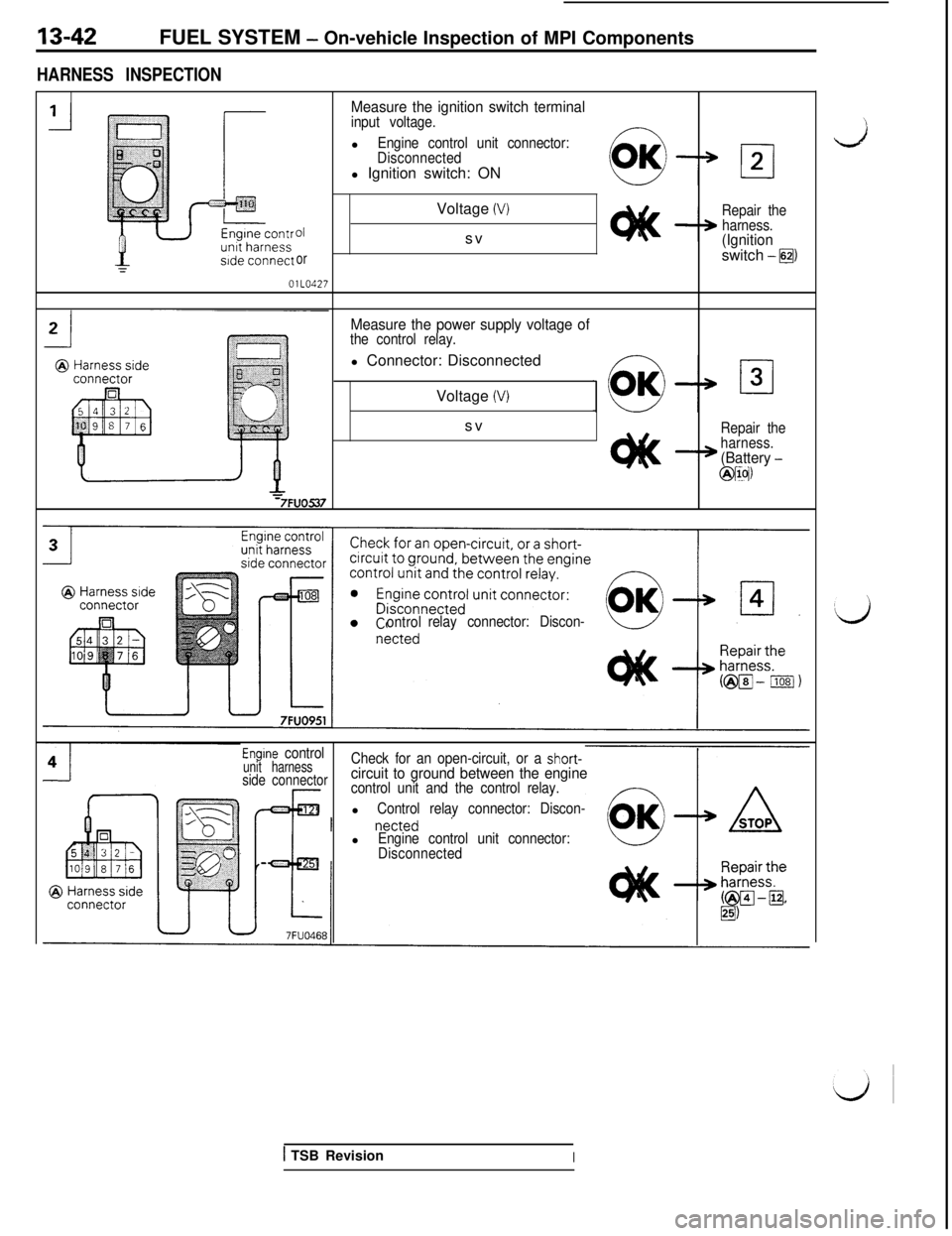
HARNESS INSPECTION
Measure the ignition switch terminalinput voltage.l
Engine control unit connector:
Disconnectedl Ignition switch: ON
01
orOlLO427Voltage
(V)svRepair the
harness.
(Ignitionswitch -@I
Measure the power supply voltage ofthe control relay.l Connector: Disconnected
Voltage
(V)sv
Repair the
harness.
(Battery -
@IIN
ontrolrelay connector: Discon-
Engine controlunit harnessCheck for an open-circuit, or a short-
side connectorcircuit to ground between the enginecontrol unit and the control relay.l
Control relay connector: Discon-l
Engine control unit connector:
Disconnected
1 TSB RevisionI
Page 149 of 1146
FUEL SYSTEM - On-vehicle Inspection of MPI Components13-43OlLO521
01 LO220
011022:
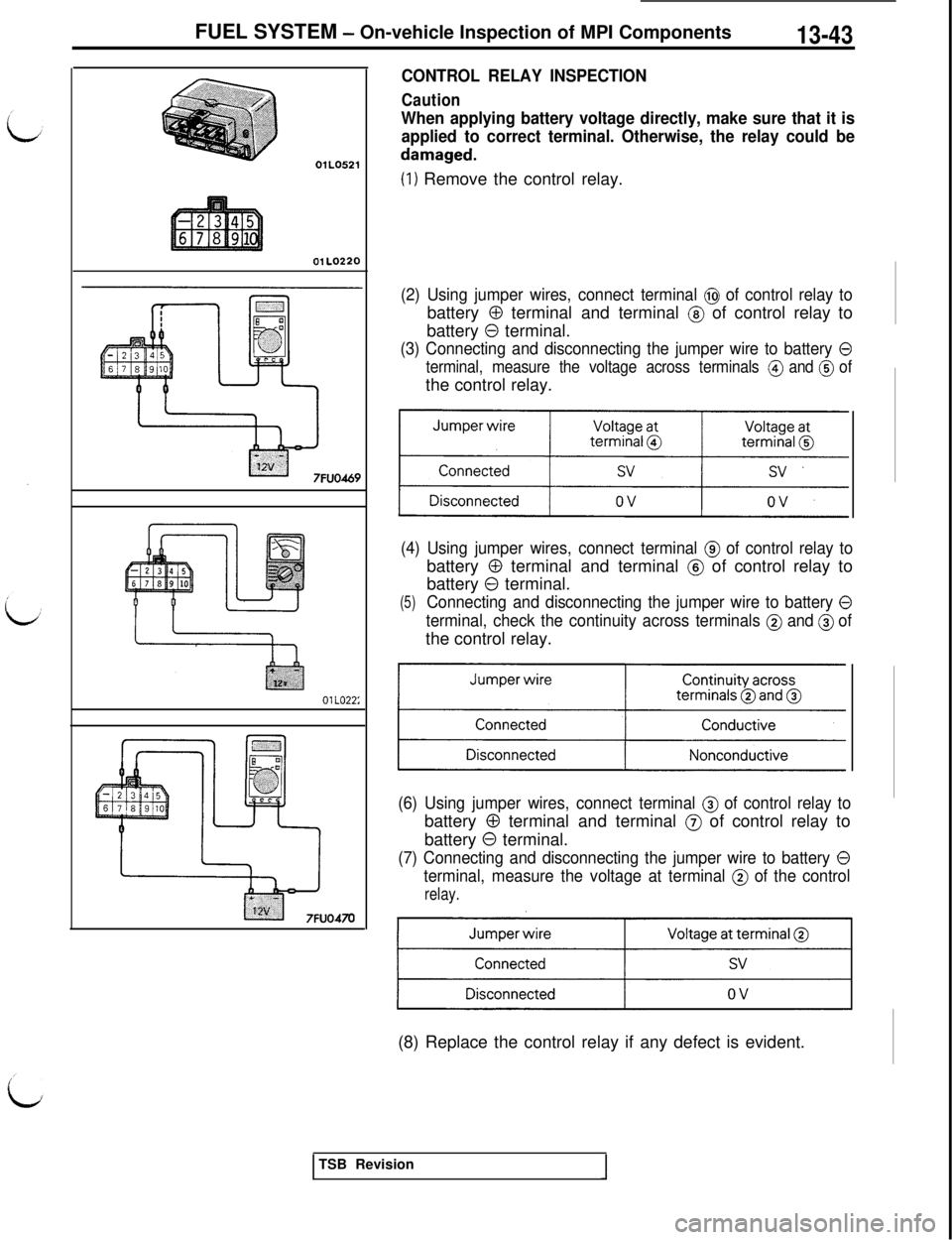
CONTROL RELAY INSPECTION
Caution
When applying battery voltage directly, make sure that it is
applied to correct terminal. Otherwise, the relay could be
damaged.
(1) Remove the control relay.
(2) Using jumper wires, connect terminal @ of control relay tobattery
0 terminal and terminal @ of control relay to
battery
0 terminal.
(3) Connecting and disconnecting the jumper wire to battery 0
terminal, measure the voltage across terminals @ and @ ofthe control relay.
(4) Using jumper wires, connect terminal @ of control relay tobattery
0 terminal and terminal @ of control relay to
battery
0 terminal.
(5)Connecting and disconnecting the jumper wire to battery 0
terminal, check the continuity across terminals @ and @ ofthe control relay.
(6) Using jumper wires, connect terminal @ of control relay tobattery
0 terminal and terminal @ of control relay to
battery
0 terminal.
(7) Connecting and disconnecting the jumper wire to battery 0
terminal, measure the voltage at terminal @ of the control
relay.(8) Replace the control relay if any defect is evident.
TSB Revision
Page 151 of 1146
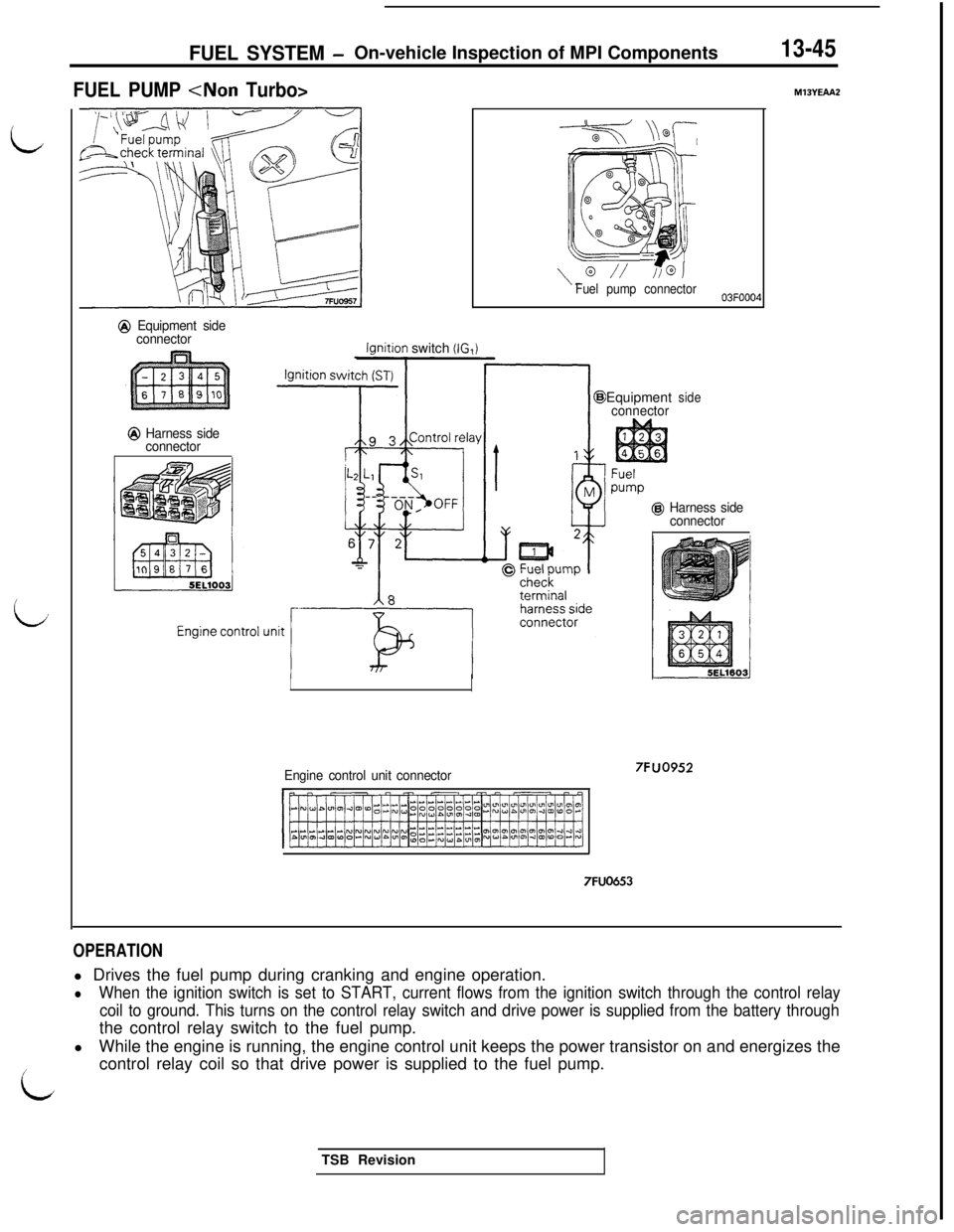
FUEL SYSTEM -On-vehicle Inspection of MPI Components13-45
FUEL PUMP
@ Equipment side
connector
@ Harness side
connector
lqnition switch (IG,i
LL--- /A&
\“// //@JFuel pump connector
Engine control unit connectorEquipment
connectorside
@ Harness side
connector
7FUO653
7FUO952
M13YEAA2
OPERATIONl Drives the fuel pump during cranking and engine operation.
lWhen the ignition switch is set to START, current flows from the ignition switch through the control relay
coil to ground. This turns on the control relay switch and drive power is supplied from the battery throughthe control relay switch to the fuel pump.
lWhile the engine is running, the engine control unit keeps the power transistor on and energizes the
icontrol relay coil so that drive power is supplied to the fuel pump.
LTSB Revision