instrument panel MITSUBISHI 3000GT 1991 User Guide
[x] Cancel search | Manufacturer: MITSUBISHI, Model Year: 1991, Model line: 3000GT, Model: MITSUBISHI 3000GT 1991Pages: 1146, PDF Size: 76.68 MB
Page 923 of 1146
L
/
idBODY
- Power Window
REMOVAL AND INSTALLATION42-51
Cll Door Wlndow Glass Adjustment
18FO205
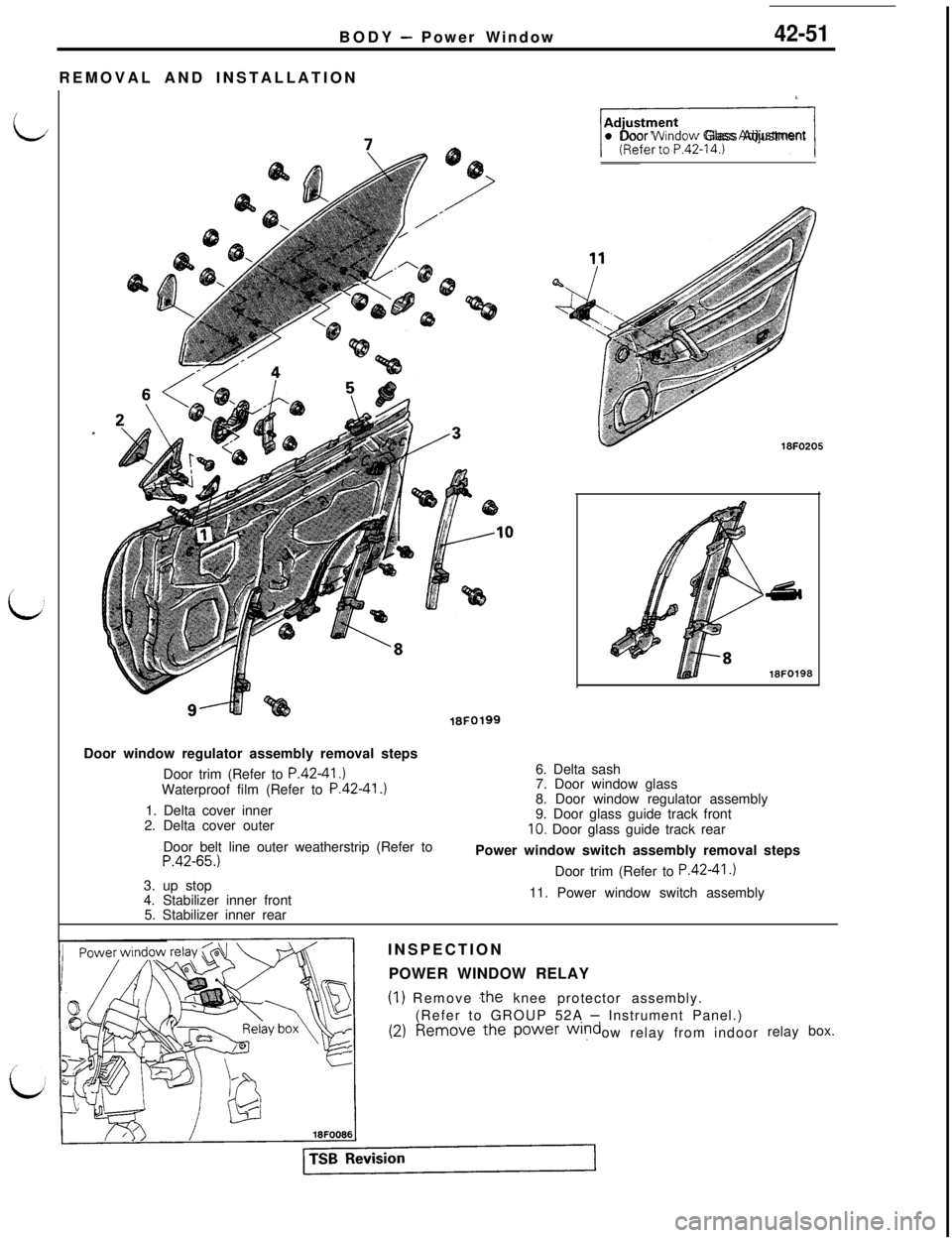
18FO198Door window regulator assembly removal steps
Door trim (Refer to
P.4241.)Waterproof film (Refer to P.42-41.)1. Delta cover inner
2. Delta cover outer
18FO1996. Delta sash
7. Door window glass
8. Door window regulator assembly
9. Door glass guide track front
10. Door glass guide track rear
Door belt line outer weatherstrip (Refer to
P.42-65.)3. up stop
4. Stabilizer inner frontPower window switch assembly removal steps
Door trim (Refer to P.42-41.)11. Power window switch assembly
5. Stabilizer inner rear
INSPECTION
POWER WINDOW RELAY
(1) Remove .the knee protector assembly.
(Refer to GROUP 52A
- Instrument Panel.)
ow relay from indoorrelaybox.
Page 935 of 1146
BODY - Central Door Lockina Svstem42-63
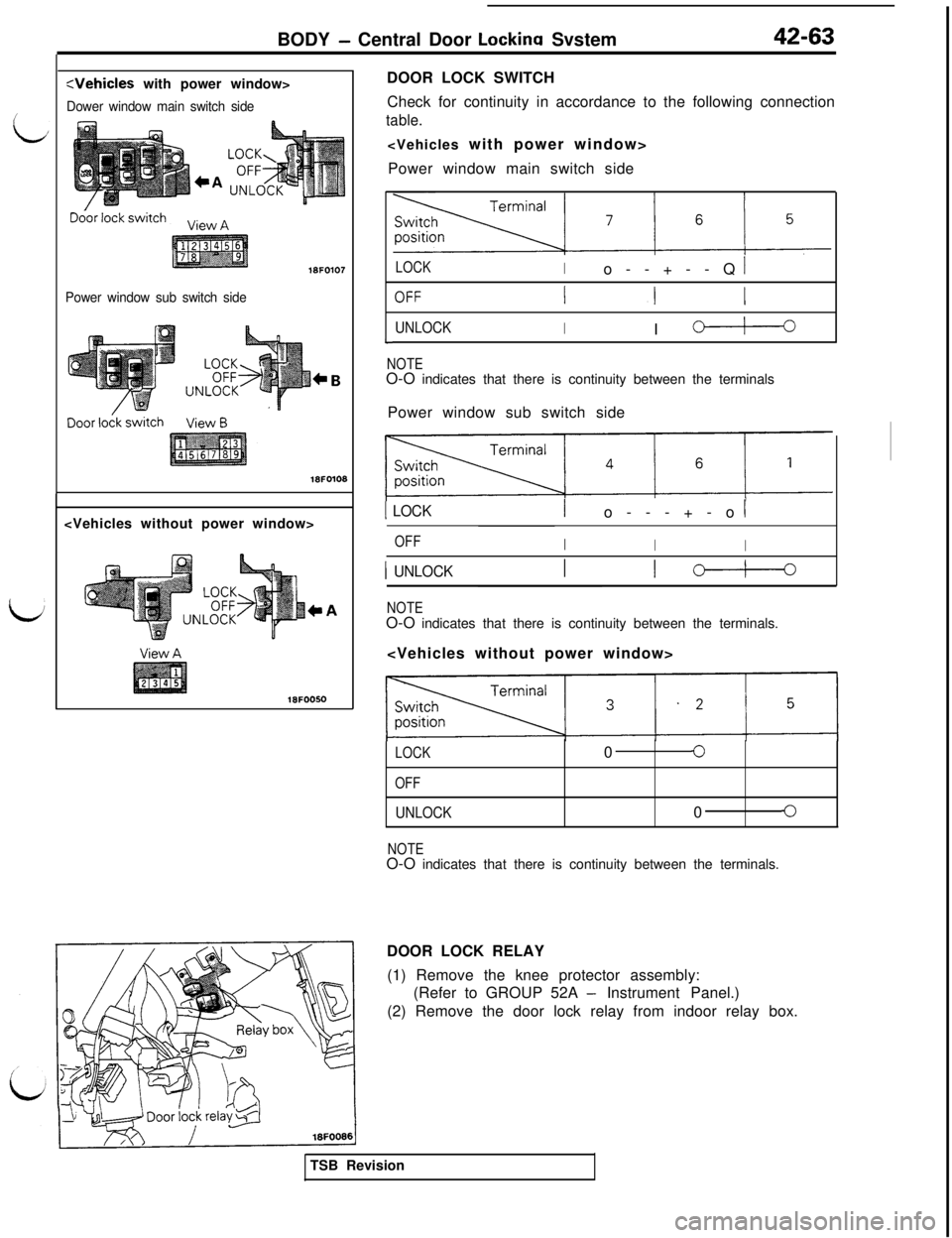
:Vehicles with power window>
Dower window main switch side
Power window sub switch side
18FO107
Check for continuity in accordance to the following connection
table.
Power window main switch side
LOCKIo--+--Q I
UNLOCKII c-+---oL
NOTEO-O indicates that there is continuity between the terminals
Power window sub switch side
1 LOCKIo---+-o I
OFFII
I
1 UNLOCKI c--+--
NOTEO-O indicates that there is continuity between the terminals.
LOCK00
OFF
UNLOCK00
NOTEO-O indicates that there is continuity between the terminals.
DOOR LOCK RELAY
(1) Remove the knee protector assembly:
(Refer to GROUP 52A
- Instrument Panel.)
(2) Remove the door lock relay from indoor relay box.
TSB Revision
Page 971 of 1146
EXTERIOR - Windshield Wiper and Washer51-33
L
lj
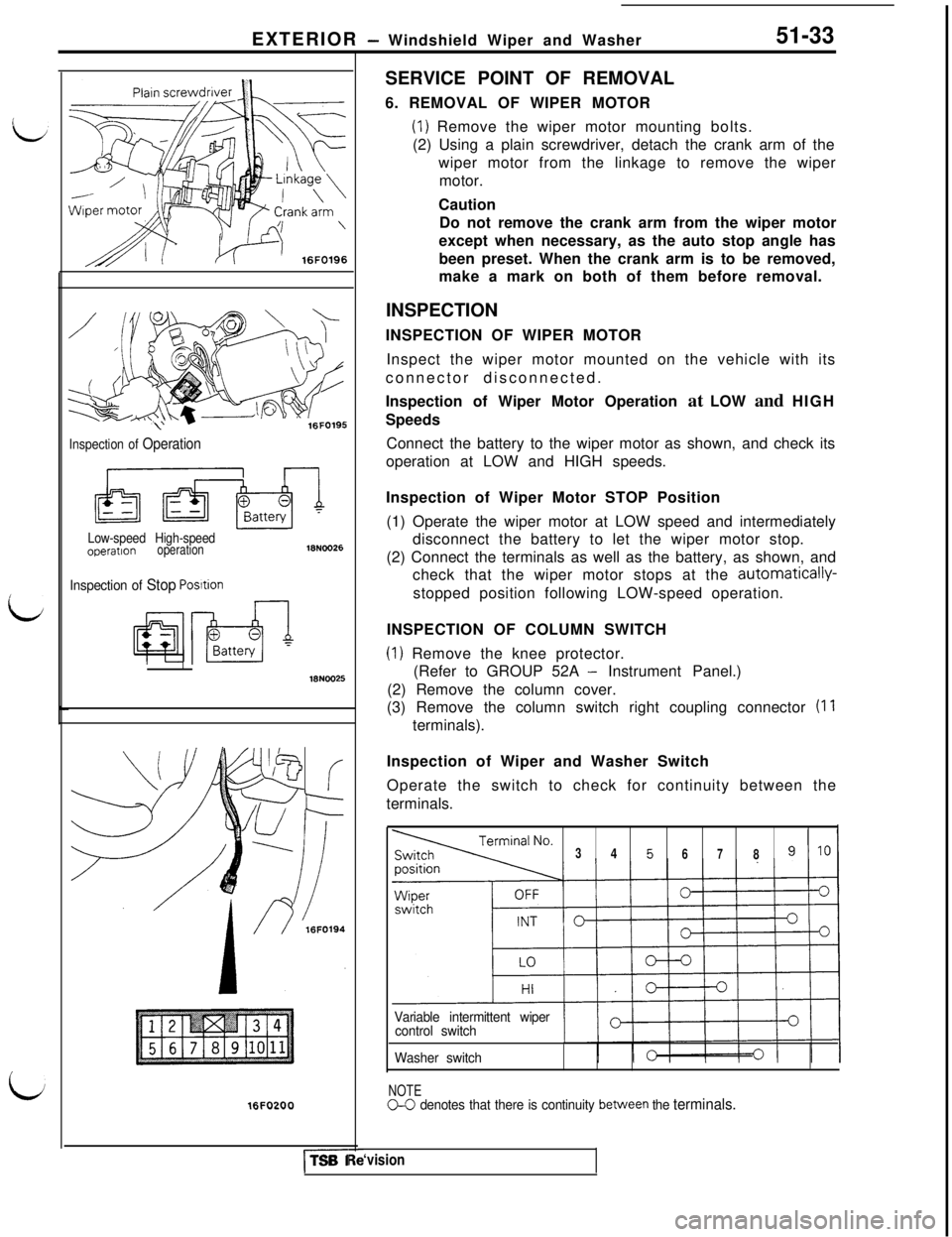
Inspection of Operation
Low-speed High-speedoperationoperation1610026
Inspection of Stop Posltion
n
16NOO25
16FO200
ITSB ISERVICE POINT OF REMOVAL
6. REMOVAL OF WIPER MOTOR
(1) Remove the wiper motor mounting bolts.
(2) Using a plain screwdriver, detach the crank arm of the
wiper motor from the linkage to remove the wiper
motor.
Caution
Do not remove the crank arm from the wiper motor
except when necessary, as the auto stop angle has
been preset. When the crank arm is to be removed,
make a mark on both of them before removal.
INSPECTION
INSPECTION OF WIPER MOTOR
Inspect the wiper motor mounted on the vehicle with its
connector disconnected.
Inspection of Wiper Motor Operation at LOW and HIGH
Speeds
Connect the battery to the wiper motor as shown, and check its
operation at LOW and HIGH speeds.
Inspection of Wiper Motor STOP Position
(1) Operate the wiper motor at LOW speed and intermediately
disconnect the battery to let the wiper motor stop.
(2) Connect the terminals as well as the battery, as shown, and
check that the wiper motor stops at the automatically-
stopped position following LOW-speed operation.
INSPECTION OF COLUMN SWITCH
(1) Remove the knee protector.
(Refer to GROUP 52A
- Instrument Panel.)
(2) Remove the column cover.
(3) Remove the column switch right coupling connector
(11terminals).
Inspection of Wiper and Washer Switch
Operate the switch to check for continuity between the
terminals.
345678
Variable intermittent wiper
control switch
Washer switch
NOTEC-0 denotes that there is continuity between the terminals.
‘vision
Page 976 of 1146
51-38EXTERIOR - Door Mirror
DOOR MIRRORREMOVAL AND INSTALLATION~MSlGAAR
I18FO166
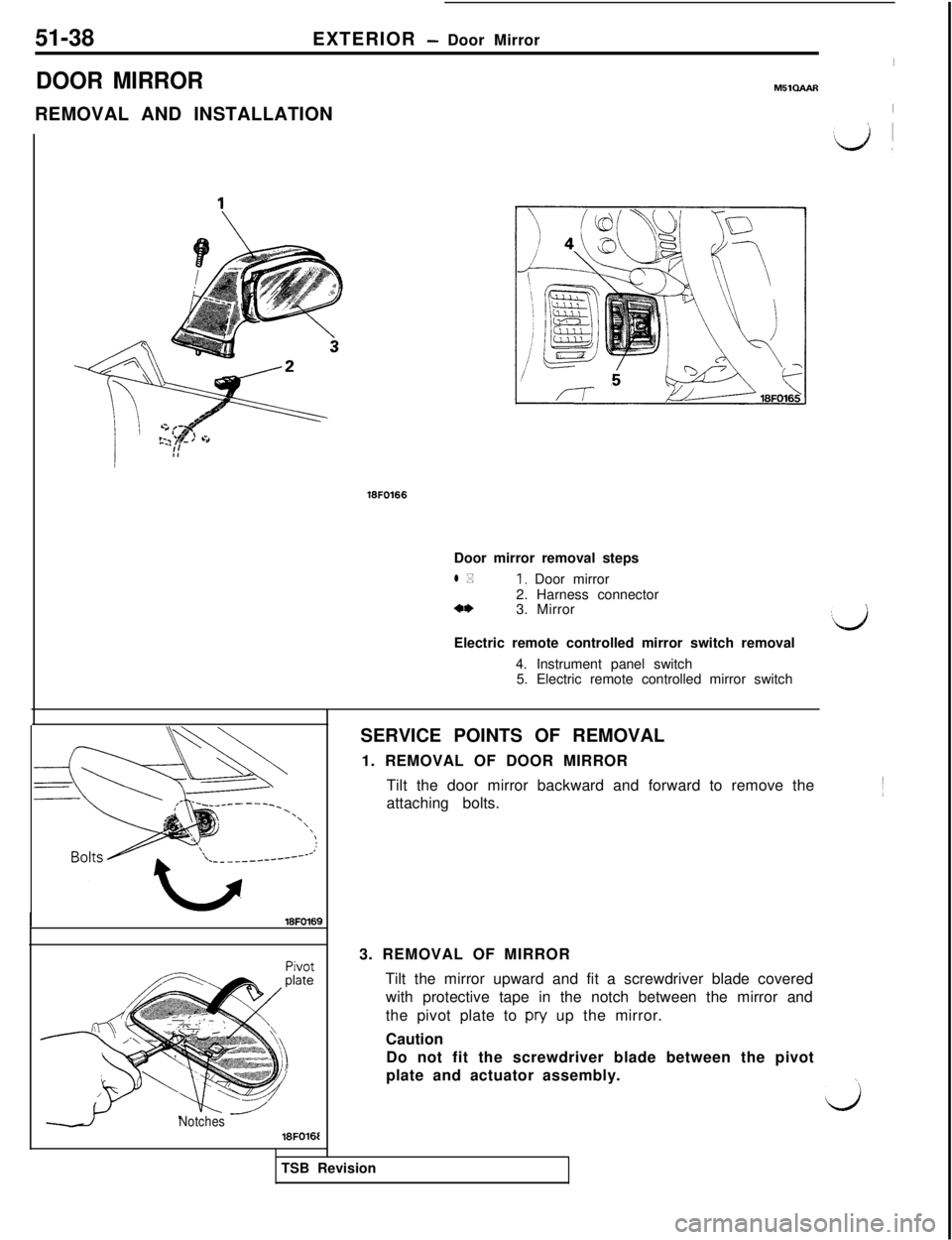
Door mirror removal steps
l *I. Door mirror
2. Harness connector
a*3. Mirror
Electric remote controlled mirror switch removal
4. Instrument panel switch
5. Electric remote controlled mirror switch
Pivnt
NotchesSERVICE POINTS OF REMOVAL
1. REMOVAL OF DOOR MIRROR
Tilt the door mirror backward and forward to remove the
attaching bolts.
3. REMOVAL OF MIRROR
Tilt the mirror upward and fit a screwdriver blade covered
with protective tape in the notch between the mirror and
the pivot plate to pry up the mirror.
Caution
Do not fit the screwdriver blade between the pivot
plate and actuator assembly.
\
LjTSB Revision
Page 979 of 1146
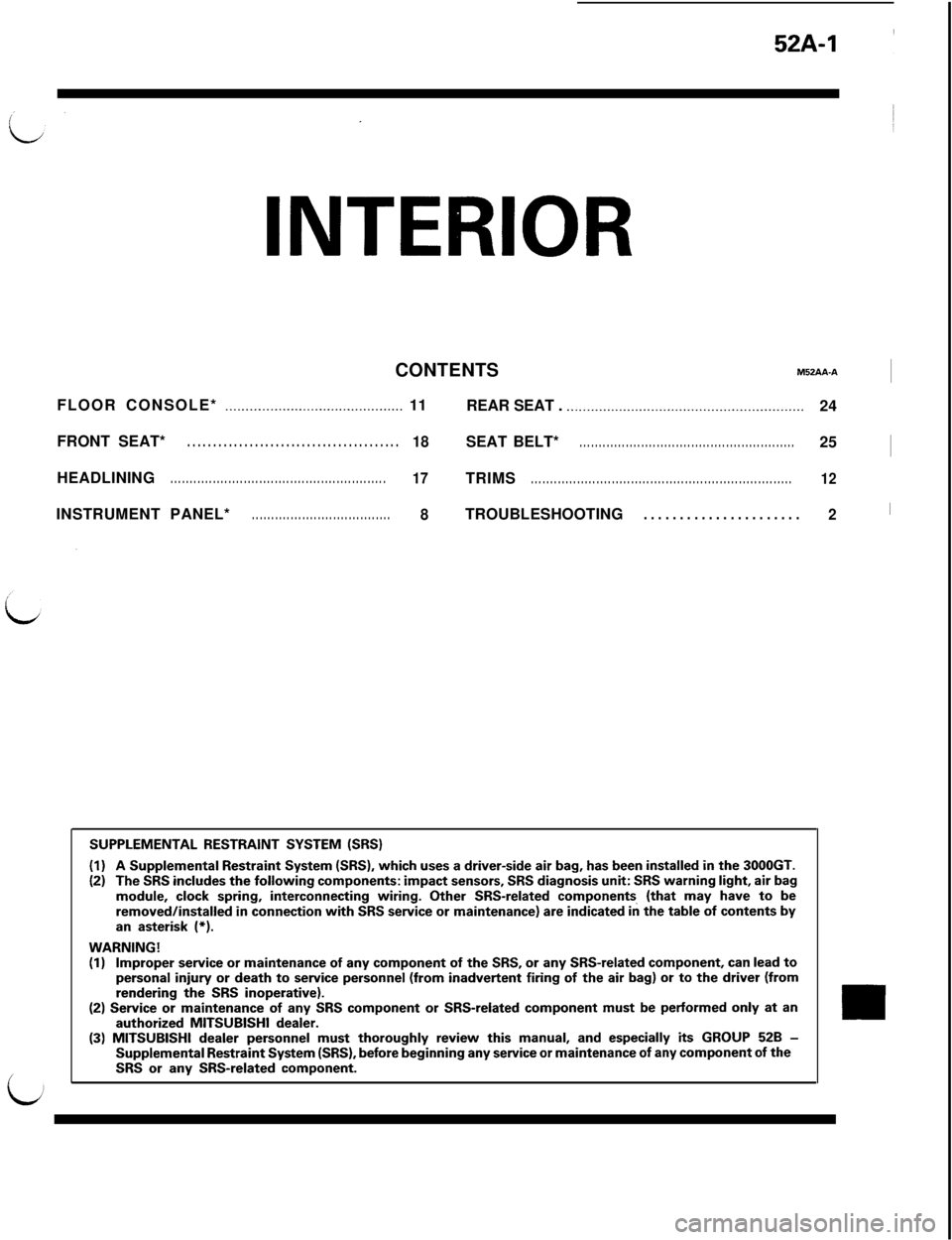
INTERIORCONTENTSNWAA-A~
FLOOR CONSOLE*
____....._.........__._..._......_..._...... 11
REAR SEAT . .._._____..______....____.._.._._..___.._._____.....___....24
FRONT SEAT*
. . . . . . . . . . . . . . . . . . . . . . . . . . . . . . . . . . . . . . . . .18SEAT BELT*. . . . . . . . . . . . . . . . . . . . . . . . . . . . . . . . . . . . . . . . . . . . . . . . . . . . . . . .25IHEADLINING
. . . . . . . . . . . . . . . . . . . . . . . . . . . . . . . . . . . . . . . . . . . . . . . . . . . . . . . .17TRIMS. . . . . . . . . . . . . . . . . . . . . . . . . . . . . . . . . . . . . . . . . . . . . . . . . . . . . . . . . . . . . . . . . . . .12INSTRUMENT PANEL*
. . . . . . . . . . . . . . . . . . . . . . . . . . . . . . . . . . . .8TROUBLESHOOTING. . . . . . . . . . . . . . . . . . . . . .
i
SUPPLEMENTAL RESTRAINT SYSTEM (SRS)
(1)A Supplemental Restraint System (SRS), which uses a driver-side air bag, has been installed in the 3000GT.(2)The SRS includes the following components: impact sensors, SRS diagnosis unit: SRS warning light, air bagmodule, clock spring, interconnecting wiring. Other SRS-related components, (that may have to beremoved/installed in connection with SRS service or maintenance) are indicated in the table of contents byan asterisk (*).
WARNING!(I)Improper service or maintenance of any component of the SRS, or any SRS-related component, can lead topersonal injury or death to service personnel (from inadvertent firing of the air bag) or to the driver (fromrendering the SRS inoperative).(2) Service or maintenance of any SRS component or SRS-related component must be performed only at anauthorized MITSUBISHI dealer.(3) MITSUBISHI dealer personnel must thoroughly review this manual, and especially its GROUP 52B -Supplemental Restraint System (SRS), before beginning any service or maintenance of any component of theSRS or any SRS-related component.
2I
Page 986 of 1146
52A-8INTERIOR - Instrument Panel
INSTRUMENT PANELM52UAAT
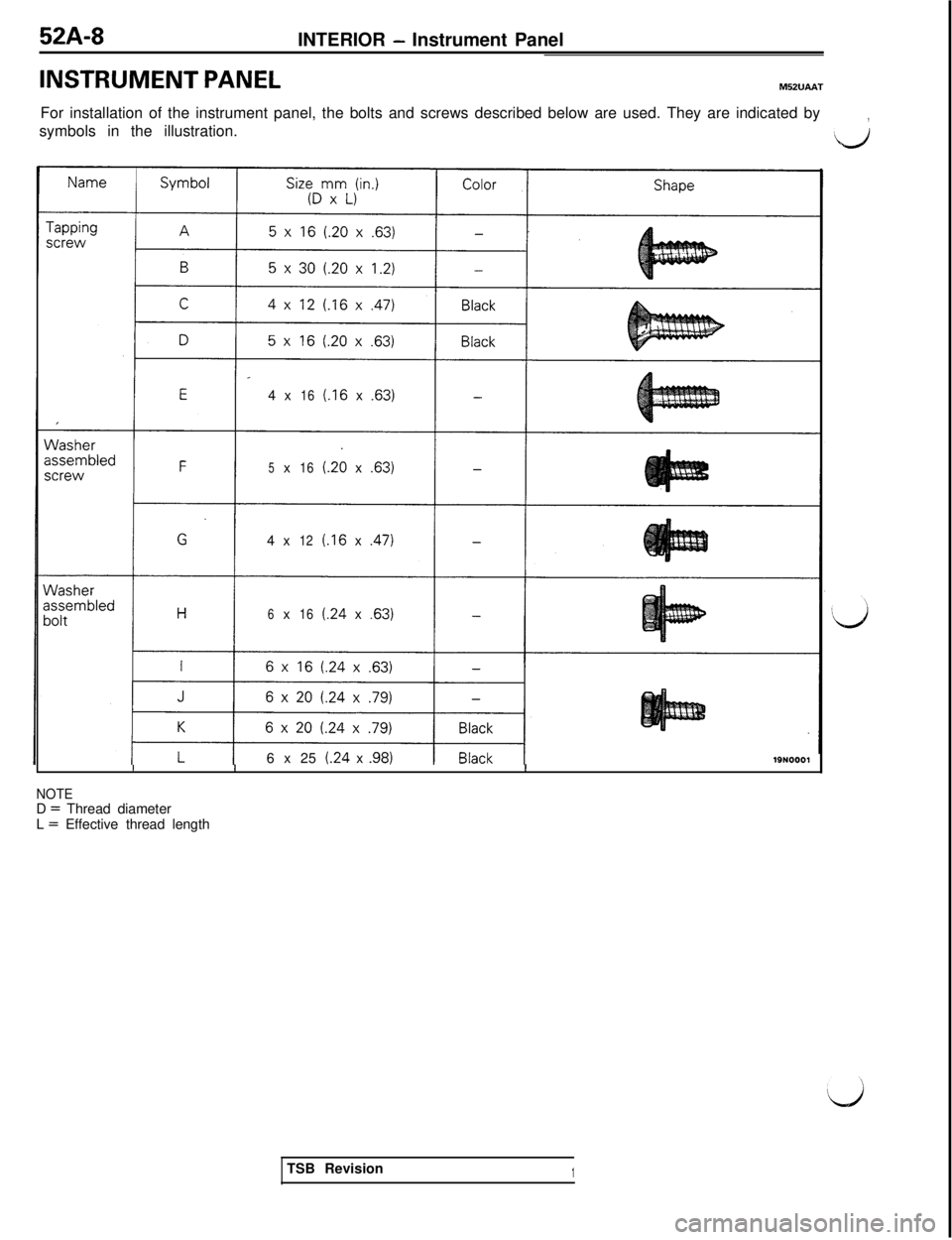
For installation of the instrument panel, the bolts and screws described below are used. They are indicated by
symbols in the illustration.
,4x
16(.I6x.63)
5x16(.20x.63)4x
12(.I6x.47)
6x16(.24x.63)
II6 x 25 (.24 x .98)19N0001I
NOTED = Thread diameter
L = Effective thread length
TSB Revision
1
Page 987 of 1146
INTERIOR - Instrument Panel52A-9
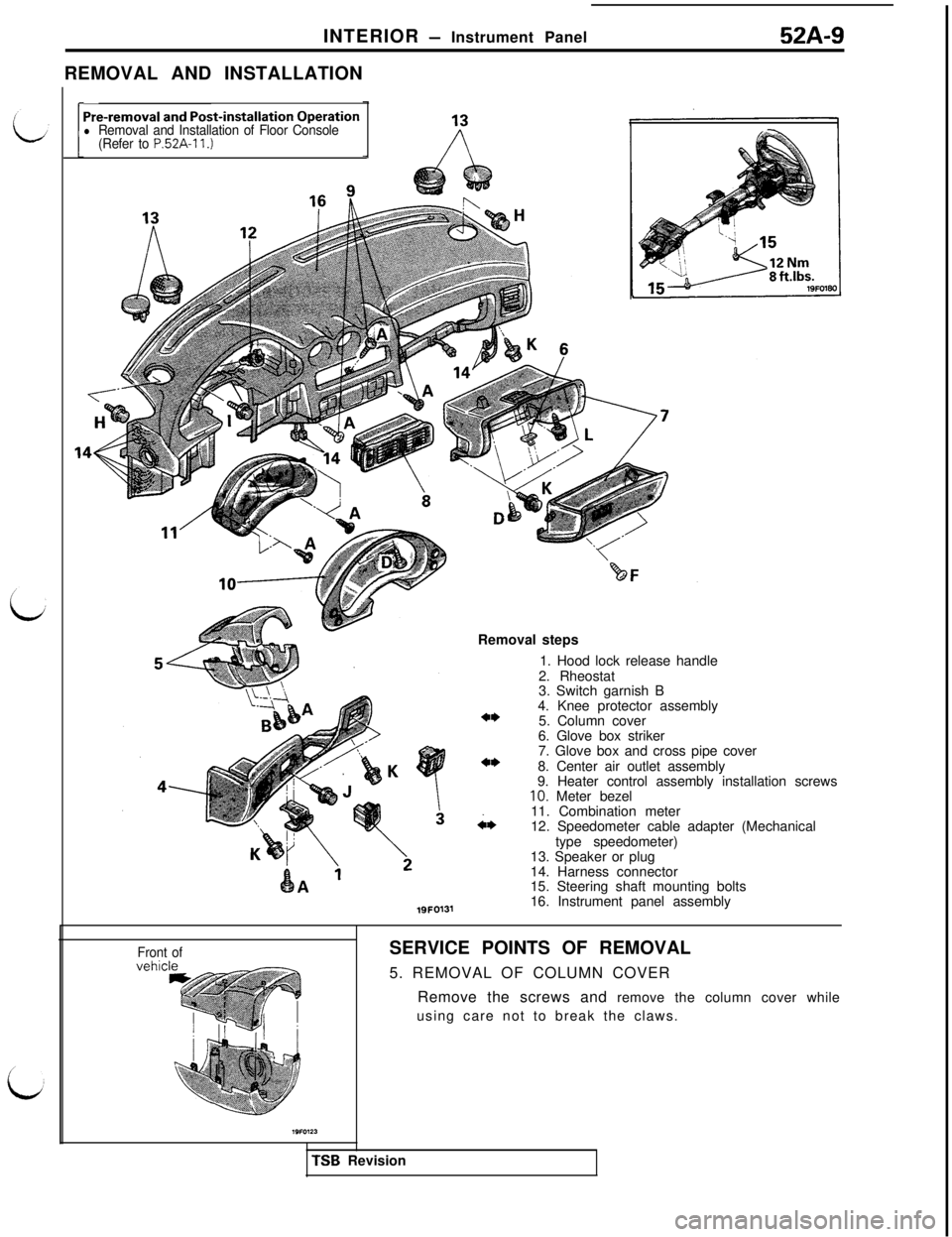
REMOVAL AND INSTALLATION
Pre-removal and Post-installation Operationl Removal and Installation of Floor Console
(Refer to P.52A-11.)
19FO131Removal steps
1. Hood lock release handle
2. Rheostat
3. Switch garnish B
4. Knee protector assembly
5. Column cover
6. Glove box striker
7. Glove box and cross pipe cover
8. Center air outlet assembly
9. Heater control assembly installation screws
10. Meter bezel
i*11. Combination meter
12. Speedometer cable adapter (Mechanical
type speedometer)
13. Speaker or plug
14. Harness connector
15. Steering shaft mounting bolts
16. Instrument panel assembly
Front ofSERVICE POINTS OF REMOVAL
5. REMOVAL OF COLUMN COVER
Remove the screws and remove the column cover while
using care not to break the claws.TSB Revision
Page 988 of 1146
52A-10
INTERIOR - Instrument Panel
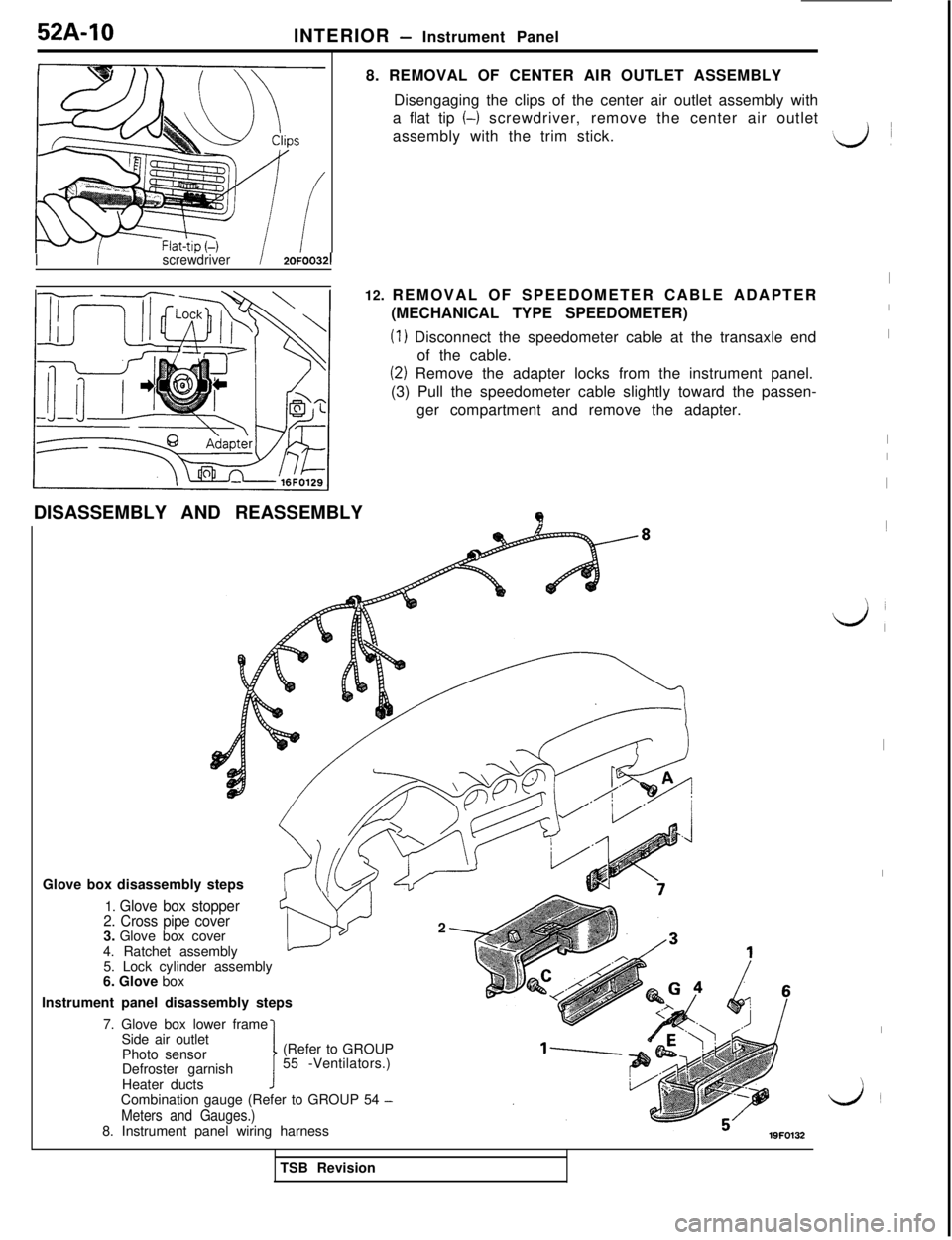
8. REMOVAL OF CENTER AIR OUTLET ASSEMBLY
Disengaging the clips of the center air outlet assembly with
a flat tip
(-1 screwdriver, remove the center air outlet
assembly with the trim stick.
IIscrewdriver/ 2OFOO321
12. REMOVAL OF SPEEDOMETER CABLE ADAPTER
(MECHANICAL TYPE SPEEDOMETER)
(1) Disconnect the speedometer cable at the transaxle end
of the cable.
(2) Remove the adapter locks from the instrument panel.
(3) Pull the speedometer cable slightly toward the passen-
ger compartment and remove the adapter.
DISASSEMBLY AND REASSEMBLY
QGlove box disassembly steps
1. Glove box stopper
2. Cross pipe cover3. Glove box cover
- w2
4. Ratchet assembly
5. Lock cylinder assembly
6. Glove box
Instrument panel disassembly steps
7. Glove box lower frame
Side air outlet
Photo sensor
Defroster garnish
Heater ducts1(Refer to GROUP
55 -Ventilators.)
Combination gauge (Refer to GROUP 54
-
Meters and Gauges.)8. Instrument panel wiring harness
19FO132
I
I
I
I
I
I1
d’
I
I
I
L&iTSB Revision
Page 990 of 1146
52A-12INTERIOR - Trims
19POO70
4Trim
19POO80
hornm
in.)
19POO8,
Pin
Trim
19POO8219POO80TRIMS
IM52UCW
TRIM CLIP REMOVAL/INSTALLATION
PROCE-DURES
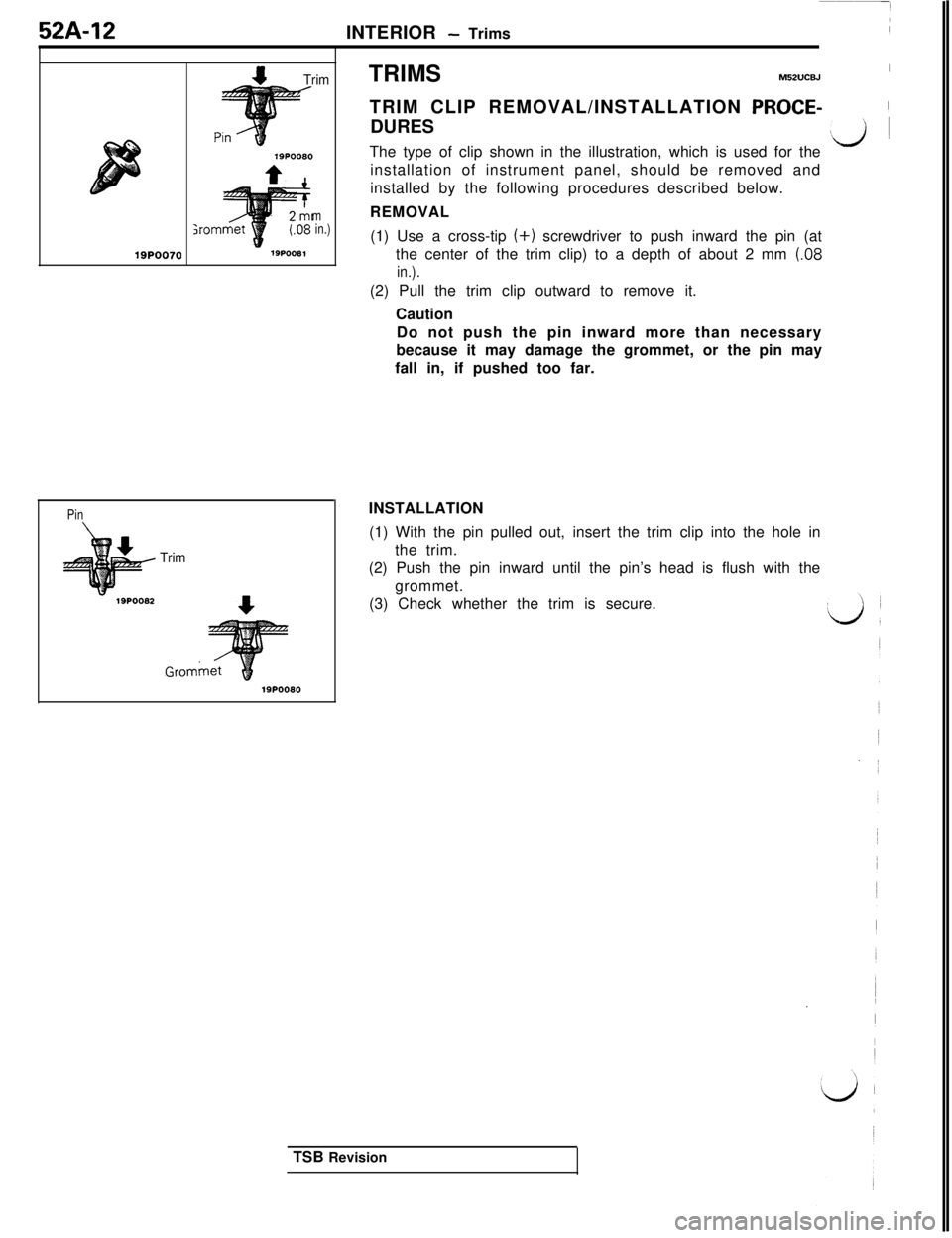
The type of clip shown in the illustration, which is used for the
Eli ~
installation of instrument panel, should be removed and
installed by the following procedures described below.
REMOVAL
(1) Use a cross-tip (+) screwdriver to push inward the pin (at
the center of the trim clip) to a depth of about 2 mm
(.08
in.).(2) Pull the trim clip outward to remove it.
Caution
Do not push the pin inward more than necessary
because it may damage the grommet, or the pin may
fall in, if pushed too far.
INSTALLATION
(1) With the pin pulled out, insert the trim clip into the hole in
the trim.
(2) Push the pin inward until the pin’s head is flush with the
grommet.
(3) Check whether the trim is secure.
TSB Revision
Page 1012 of 1146
52B-2SUPPLEMENTAL RESTRAINT SYSTEM (SRS) - General informationGENERAL INFORMATION
INTRODUCTIONThe Supplemental Restraint System (SRS) is de-
signed to supplement the driver’s seat belt to help
reduce the risk or severity of injury to the driver by
activating and deploying a driver’s-side air bag in
certain frontal collisions.
The SRS consists of: left front and right front impact
sensors located, one each, on the right and left front
upper frame lowers; an air bag module located in
the center of the steering wheel, which contains the
folded air bag and an inflator unit; the SRS diagnosis
unit located under the rear console assembly, which
monitors the system, and which contains a safing
impact sensor; an SRS warning light located on the
instrument panel, which indicates the operational
status of the SRS; a clock spring interconnection
located within the steering column; system wiring
and wiring connectors; and a knee bolster located
SRS warning light
M52BAAFunder the steering column.
The SRS is designed so that the air bag will deploy
when the safing sensor, plus either or both of the
left front and right front impact sensors simul-
taneously activate while the ignition switches
“ON”.
That is designed to occur in frontal or near-frontal
impacts of moderate to severe force.
Only authorized service personnel should do work
on or around the SRS components. Those service
personnel should read this manual carefully before
starting any such work. Extreme care must be used
whenservicing the SRS, to avoid injury to the
service personnel (by inadvertent deployment of the
air bag) or the driver (by rendering the SRS inopera-
tive).
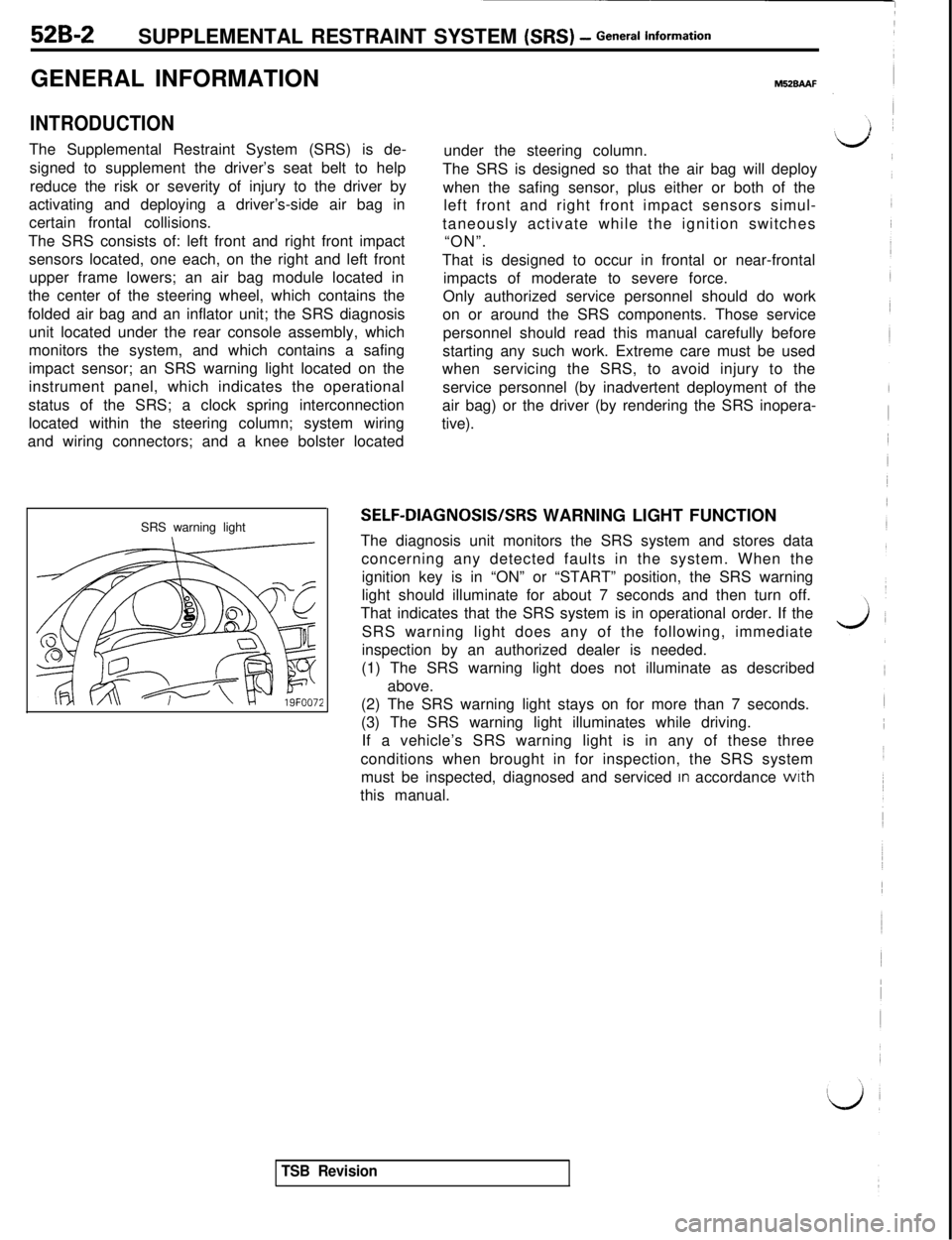
SELF-DIAGNOSIS/SRS WARNING LIGHT FUNCTION
The diagnosis unit monitors the SRS system and stores data
concerning any detected faults in the system. When the
ignition key is in “ON” or “START” position, the SRS warning
light should illuminate for about 7 seconds and then turn off.
That indicates that the SRS system is in operational order. If the
SRS warning light does any of the following, immediate
inspection by an authorized dealer is needed.
(1) The SRS warning light does not illuminate as described
above.
(2) The SRS warning light stays on for more than 7 seconds.
(3) The SRS warning light illuminates while driving.
If a vehicle’s SRS warning light is in any of these three
conditions when brought in for inspection, the SRS system
must be inspected, diagnosed and serviced
In accordance wrth
this manual.
TSB Revision