instrument panel MITSUBISHI 3000GT 1991 Owner's Manual
[x] Cancel search | Manufacturer: MITSUBISHI, Model Year: 1991, Model line: 3000GT, Model: MITSUBISHI 3000GT 1991Pages: 1146, PDF Size: 76.68 MB
Page 1018 of 1146
52B-8SUPPLEMENTAL RESTRAINT SYSTEM (SRS) - General Information
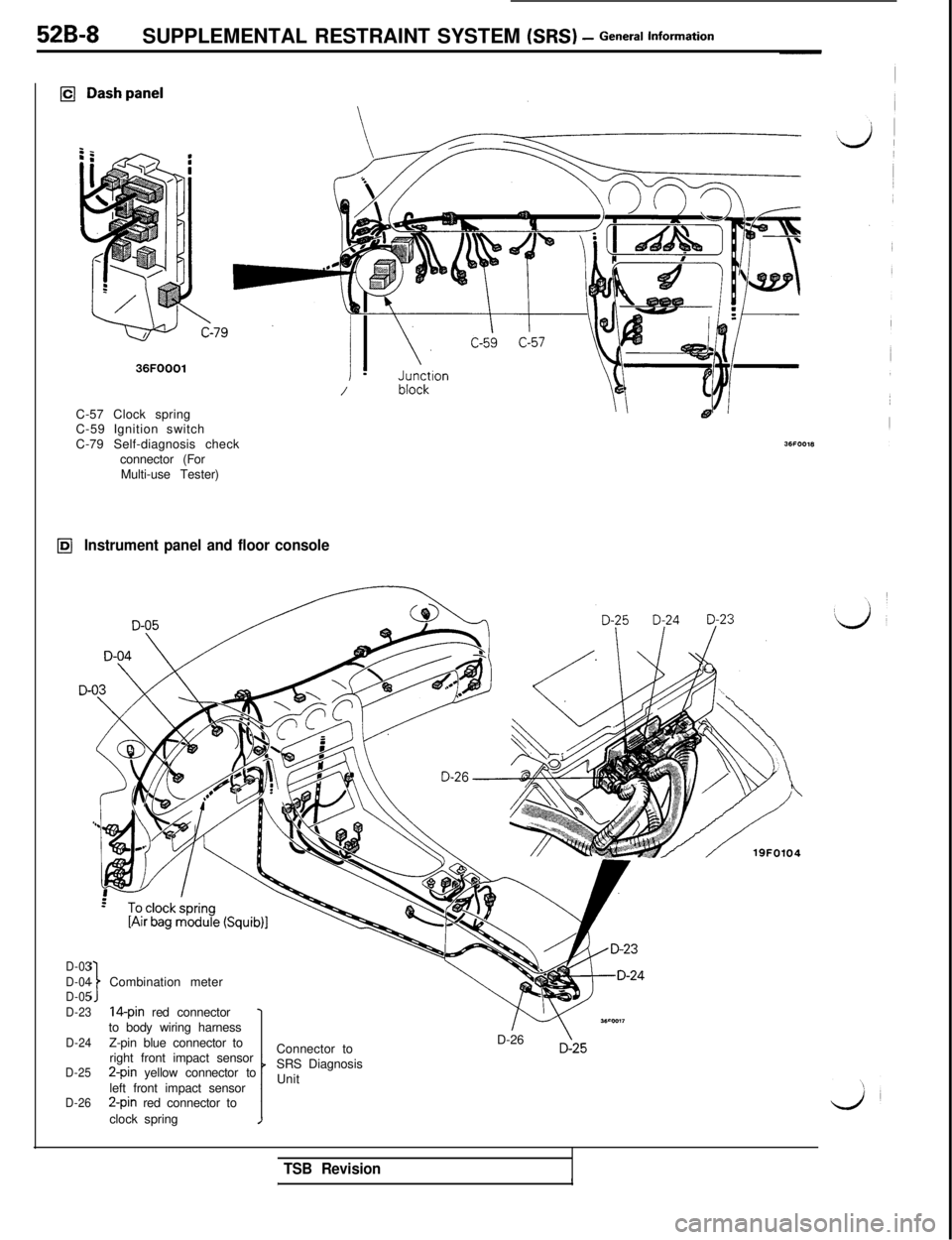
36FOOOlJ/C-57 Clock spring
C-59 Ignition switch
C-79 Self-diagnosis check
connector (For
Multi-use Tester)
IbJInstrument panel and floor console
D-
D-03
D-04Combination meter
D-05
D-2314-pin red connector
to body wiring harness
D-24Z-pin blue connector to
right front impact sensor
D-252-pin yellow connector to
left front impact sensor
D-262-pin red connector to
clock springConnector to
SRS Diagnosis
UnitD-26225
TSB Revision,1
Page 1024 of 1146
.52B-14 SUPPLEMENTAL RESTRAINT SYSTEM (SRS) - SRS Service Precautions
SRS SERVICE PRECAUTIONSMBZPBAA
1.In order to avoid injury to yourself or others from3.accidental deployment of the air bag during SRSNever Attempt to Repair the Following Com-servicing, read and carefully follow all the
pre-
ponents:dcautions and procedures described in this
manu-l Front Impact Sensors
al.l SRS Diagnosis Unit (SDU)
2.Do not use any electrical test equipment on orl Clock Spring
near SRS components, except those specifiedl Air Bag Module
on
P.52B-16.If any of those components are diagnosed as
Never use an analogue ohmmeter.faulty, they should only be replaced, in accord-
ance with the INDIVIDUAL COMPONENT SER-
VICE procedures in this manual, starting at page
[52B-561.
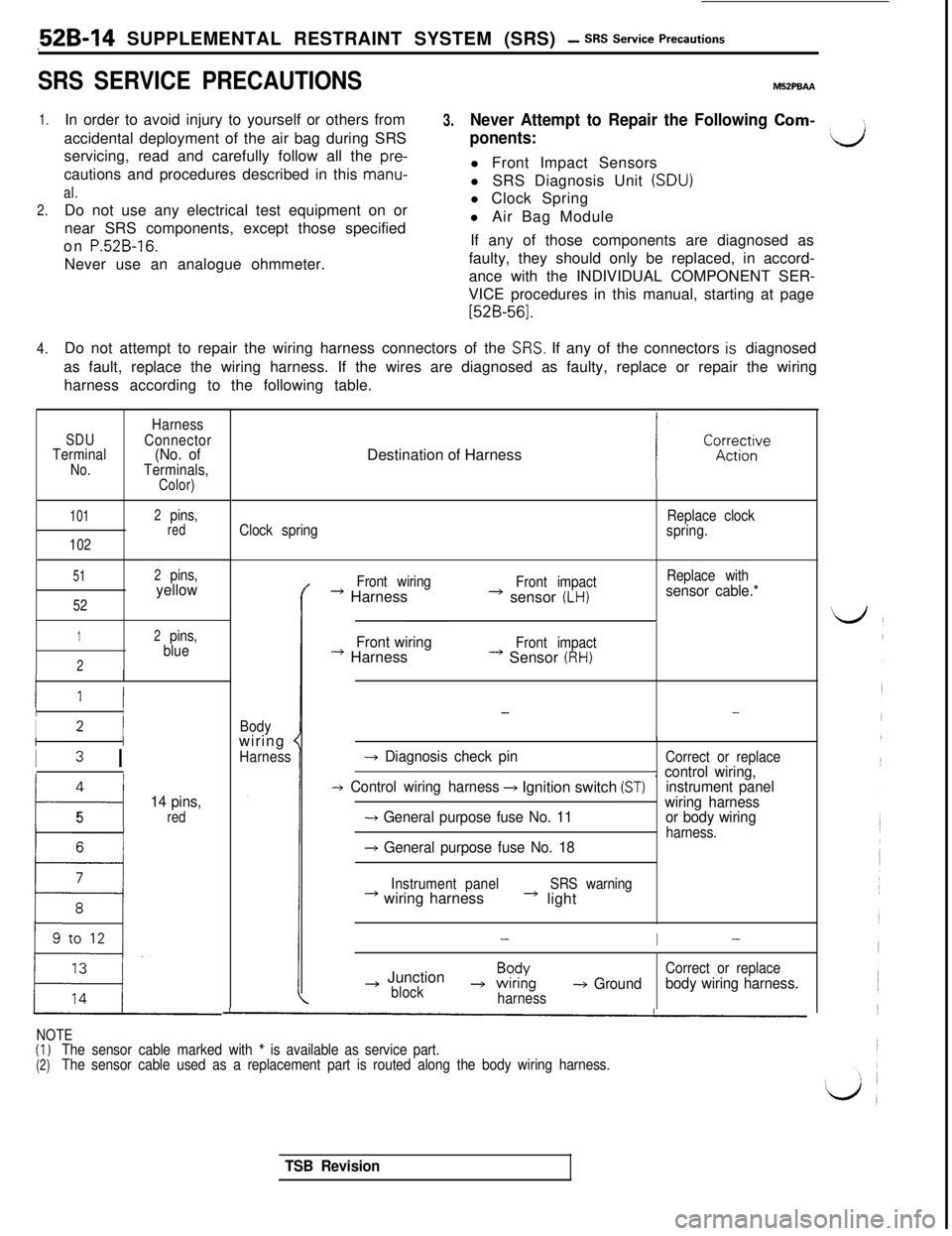
4.Do not attempt to repair the wiring harness connectors of the
SRS. If any of the connectors is diagnosed
as fault, replace the wiring harness. If the wires are diagnosed as faulty, replace or repair the wiring
harness according to the following table.
SDUTerminalNo.
Harness
Connector
(No. ofTerminals,Color)
101
102
2pins,red
51
52
2pins,yellow
12pins,
blue
2
II
II
I2 IIi
I3 I
4
t---i
14 pins,
5red
16 t
LDestination of Harness
Clock springReplace clock
spring.
Bodywiring
*
HarnessFront wiring
* HarnessFront impact+ sensor (LH)
Replace withsensor cable.*
Front wiring
--) HarnessFront impact* Sensor (RH)
--
-+ Diagnosis check pinCorrect or replace
-+ Control wiring harness+ Ignition switch (ST). control wiring,
instrument panel
-+ General purpose fuse No. 11wiring harness
or body wiringharness.+ General purpose fuse No. 18
Instrument panel+ wiring harnessSRS warning* light
-I-
~ JunctionBpdYCorrect or replace
block-+ wrnng-+ Groundharnessbody wiring harness.
NOTE(I)
(2)The sensor cable marked with * is available as service part.
The sensor cable used as a replacement part is routed along the body wiring harness.
TSB Revision
Page 1062 of 1146
52B-52 SUPPLEMENTAL RESTRAINT SYSTEM fSRSI - ~Z-%~~~~aK&%kTo air bagmodule
To SRS dragnosls unit
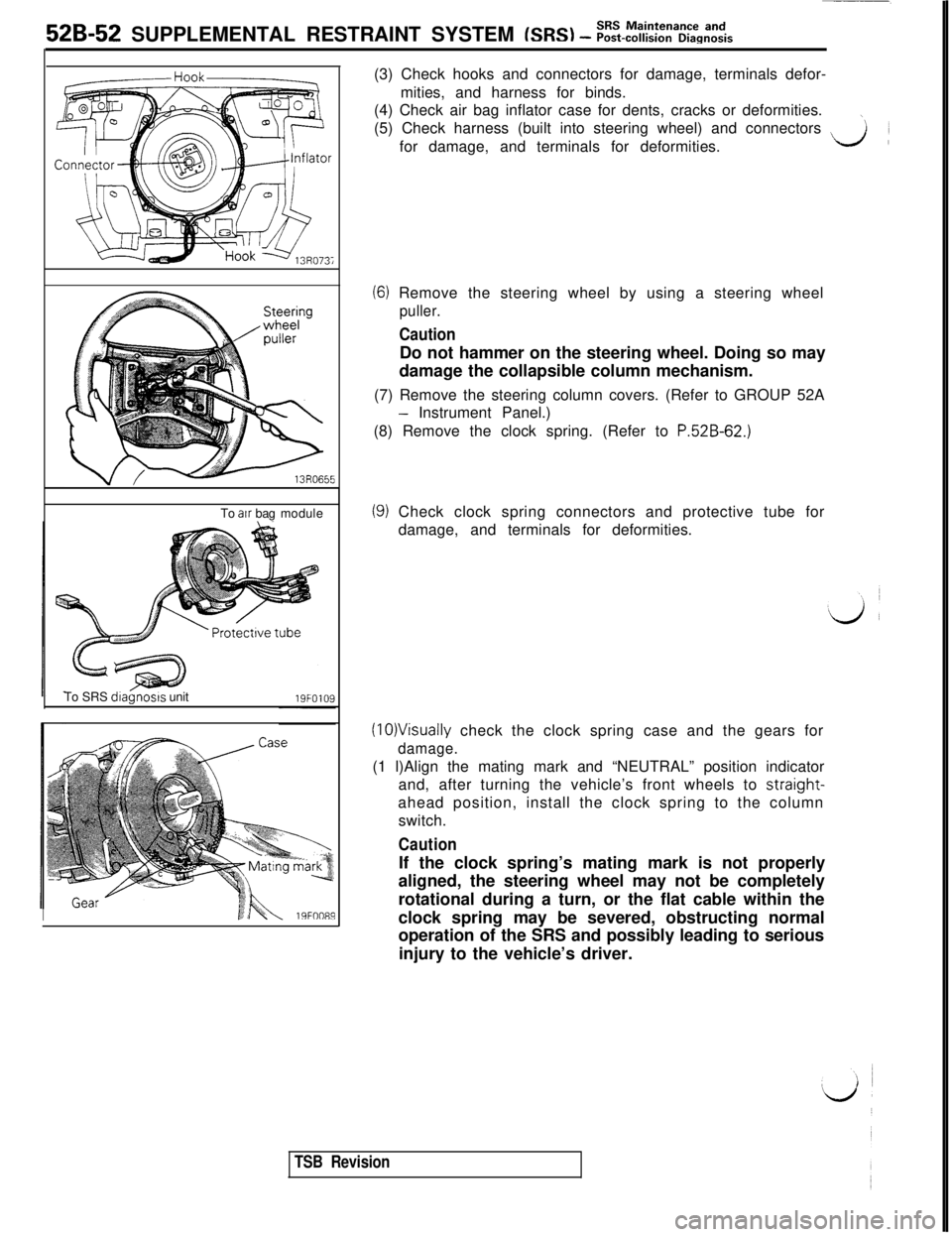
I19FOO89(3) Check hooks and connectors for damage, terminals defor-
mities, and harness for binds.
(4) Check air bag inflator case for dents, cracks or deformities.
\(5) Check harness (built into steering wheel) and connectors
~for damage, and terminals for deformities.LA
(6) Remove the steering wheel by using a steering wheel
puller.
CautionDo not hammer on the steering wheel. Doing so may
damage the collapsible column mechanism.
(7) Remove the steering column covers. (Refer to GROUP 52A
- Instrument Panel.)
(8) Remove the clock spring. (Refer to
P.52B-62.)
(9) Check clock spring connectors and protective tube for
damage, and terminals for deformities.
(10)Visually check the clock spring case and the gears for
damage.(1 l)Align the mating mark and “NEUTRAL” position indicator
and, after turning the vehicle’s front wheels to straight-
ahead position, install the clock spring to the column
switch.
CautionIf the clock spring’s mating mark is not properly
aligned, the steering wheel may not be completely
rotational during a turn, or the flat cable within the
clock spring may be severed, obstructing normal
operation of the SRS and possibly leading to serious
injury to the vehicle’s driver.
TSB Revision
Page 1072 of 1146
52B-62Air Bag ModuleSUPPLEMENTAL RESTRAINT SYSTEM (SRS) - and Clock Spring
AIR BAG MODULE AND CLOCK SPRINGM52PDCA
Caution1. Never attempt to disassemble or repair the
air bag module or clock spring.
If faulty, replace it.
2. Do not drop the air bag module or clock
spring or allow contact with water, grease or
oil.Replace it if a dent, crack, deformation or
rust are detected.
3.The air bag module should be stored on a flat
surface and placed so that the pad surface isfacing upward.
REMOVAL AND INSTALLATION1
l After setting the steering wheel antthe front wheels to the stralghtaheaposltion. remove the ignition key.5NmDo not place anything on top of it.
4.Do not expose the air bag module to temper-ILJ
ature over 93°C (200°F).
5After an air bag has deployed, replace with anew air bag module and check the SRS
operability.6. Wear gloves and safety glasses when han-
dling an air bag that has already deployed.
7. An undeployed air bag module should only
be disposed of in accordance with the proce-dures
[P.52B-69 - P.52B-721.
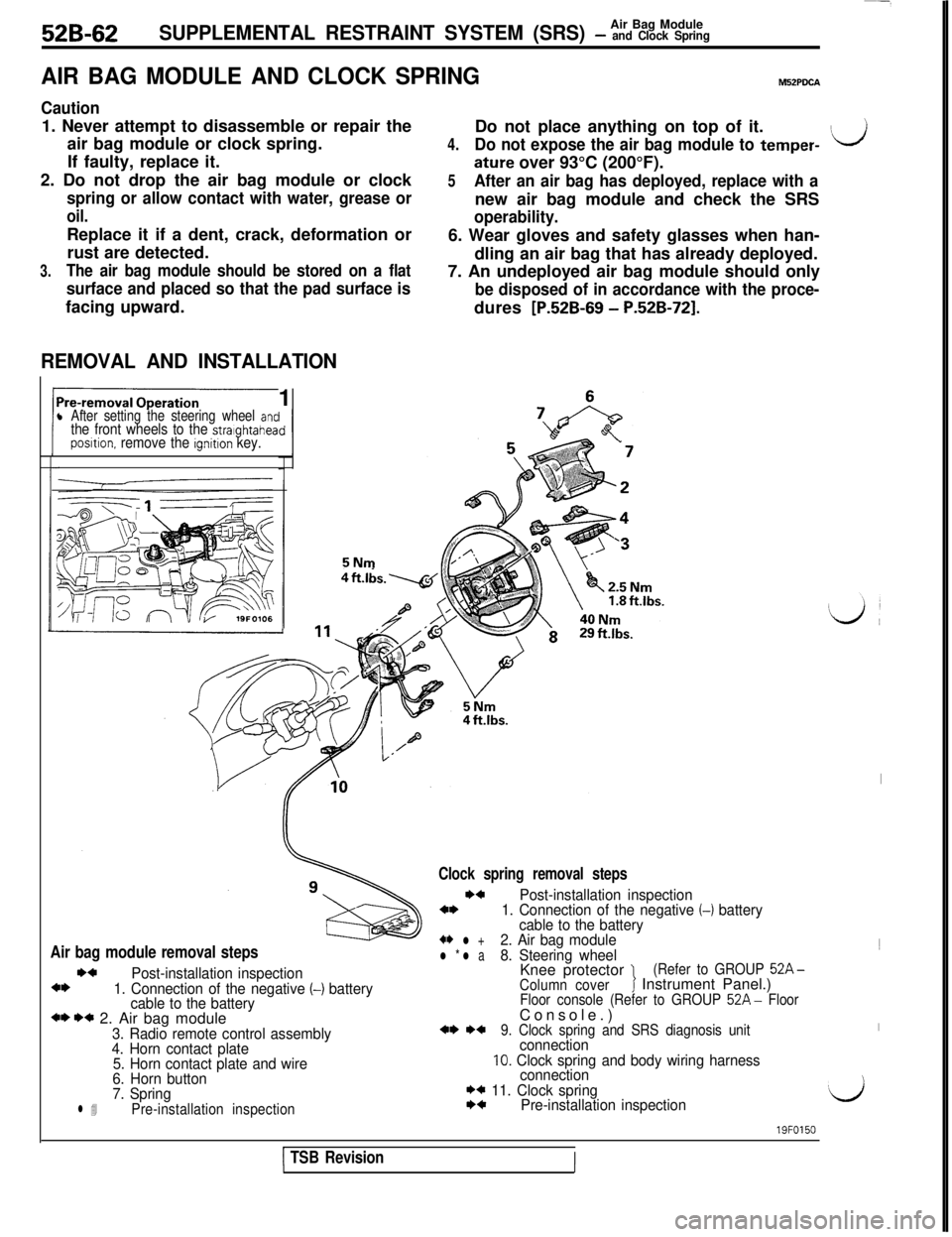
Air bag module removal stepsI)4
Post-installation inspection4*1. Connection of the negative (-1 battery
cable to the battery
*I) I)* 2. Air bag module3. Radio remote control assembly
4. Horn contact plate
5. Horn contact plate and wire
6. Horn button
7. Spring
l 4Pre-installation inspection
Clock spring removal steps
I)4Post-installation inspection4*1. Connection of the negative (-1 battery
cable to the battery
+* l +2. Air bag modulel * l a8. Steering wheelKnee protector 1(Refer to GROUP 52A-
Column coverJ Instrument Panel.)Floor console (Refer to GROUP 52A- FloorConsole.)
*I) *+9. Clock spring and SRS diagnosis unitconnection10. Clock spring and body wiring harness
connection
I)* 11. Clock springI)4Pre-installation inspection
I1
I
‘d
1 TSB Revision
19FO150
III
Page 1083 of 1146
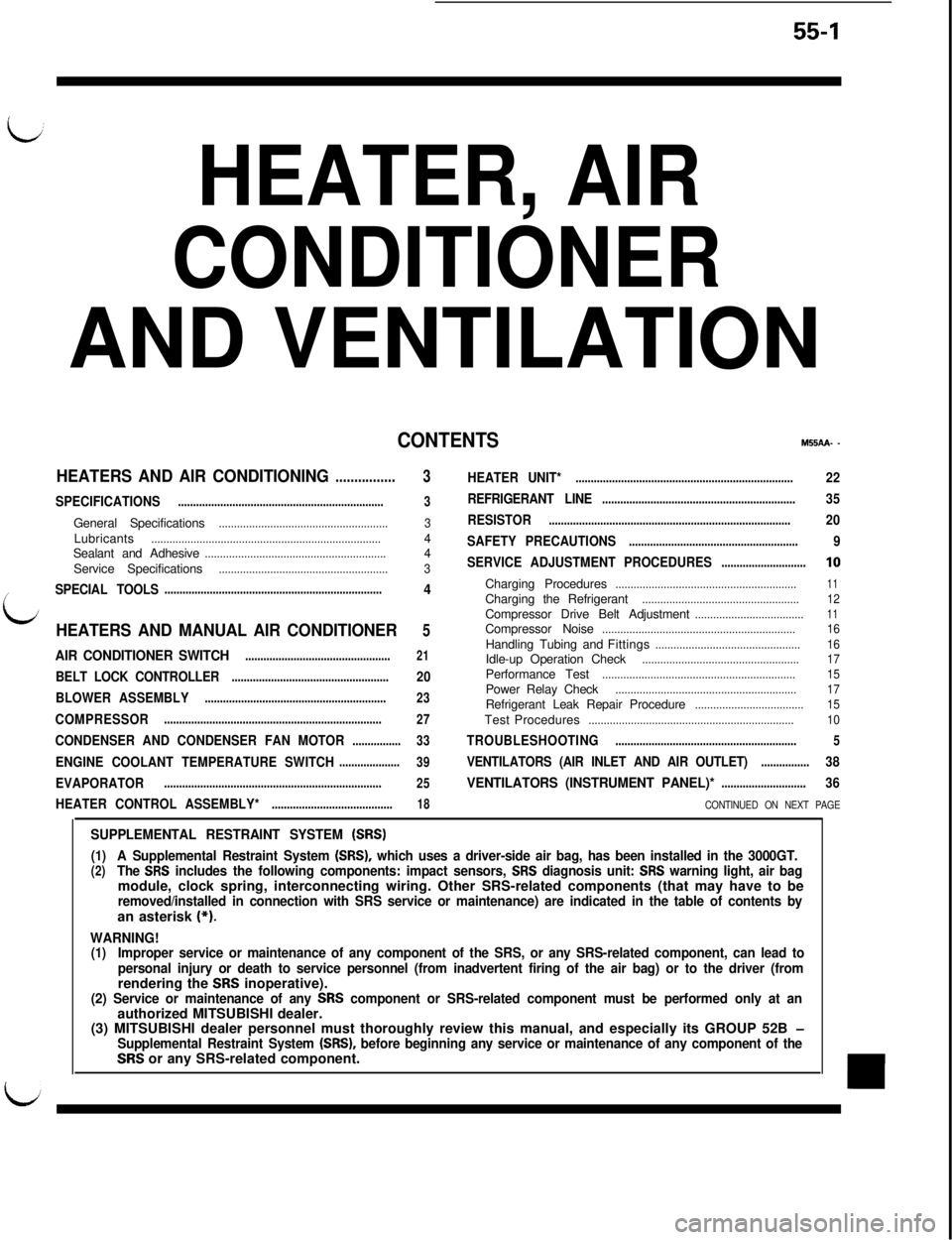
55-1
HEATER, AIR
CONDITIONER
AND VENTILATION
CONTENTSM55AA- -
HEATERS AND AIR CONDITIONING................3HEATER UNIT*........................................................................22
SPECIFICATIONS
....................................................................3REFRIGERANT LINE................................................................35General Specifications
........................................................3RESISTOR................................................................................20Lubricants
............................................................................4SAFETY PRECAUTIONS........................................................9Sealant and Adhesive............................................................4
Service Specifications3SERVICE ADJUSTMENT PROCEDURES............................10........................................................
SPECIAL TOOLS4Charging Procedures............................................................11
i
........................................................................Charging the Refrigerant....................................................12Compressor Drive Belt Adjustment....................................11
HEATERS AND MANUAL AIR CONDITIONER5Compressor Noise................................................................16
................................................16
AIR CONDITIONER SWITCH................................................21Handling Tubing andFittings
Idle-up Operation Check....................................................17
BELT LOCK CONTROLLER20Performance Test................................................................15....................................................
BLOWER ASSEMBLYPower Relay Check............................................................17............................................................23Refrigerant Leak Repair Procedure....................................15COMPRESSOR........................................................................
27TestProcedures....................................................................10
CONDENSER AND CONDENSER FAN MOTOR................33TROUBLESHOOTING............................................................5
ENGINE COOLANT TEMPERATURE SWITCH....................
39VENTILATORS (AIR INLET AND AIR OUTLET)................38
EVAPORATOR
........................................................................
25VENTILATORS (INSTRUMENT PANEL)*............................36
HEATER CONTROL ASSEMBLY*
........................................18CONTINUED ON NEXT PAGE
SUPPLEMENTAL RESTRAINT SYSTEM (SRS)
(1)A Supplemental Restraint System (SRS), which uses a driver-side air bag, has been installed in the 3000GT.(2)The SRS includes the following components: impact sensors, SRS diagnosis unit: SRS warning light, air bagmodule, clock spring, interconnecting wiring. Other SRS-related components (that may have to be
removed/installed in connection with SRS service or maintenance) are indicated in the table of contents byan asterisk (*).
WARNING!(1)Improper service or maintenance of any component of the SRS, or any SRS-related component, can lead to
personal injury or death to service personnel (from inadvertent firing of the air bag) or to the driver (fromrendering the
SRS inoperative).(2) Service or maintenance of any SRS component or SRS-related component must be performed only at anauthorized MITSUBISHI dealer.
(3) MITSUBISHI dealer personnel must thoroughly review this manual, and especially its GROUP 52B
-Supplemental Restraint System (SRS), before beginning any service or maintenance of any component of theSRS or any SRS-related component.
Page 1104 of 1146
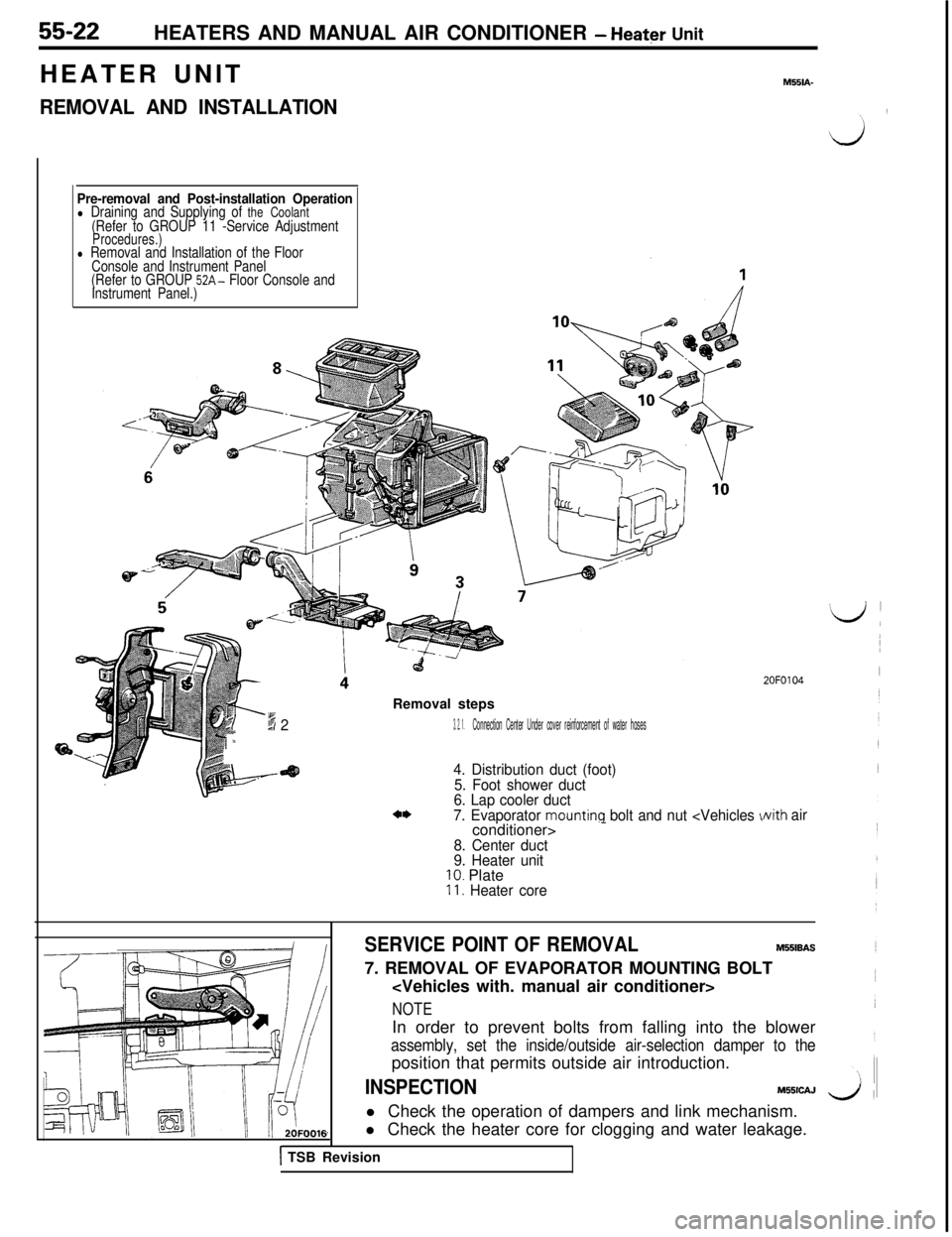
55-22HEATERS AND MANUAL AIR CONDITIONER - Heater Unit
HEATER UNIT
REMOVAL AND INSTALLATION
M551A-
Pre-removal and Post-installation Operationl Draining and Supplying of the Coolant(Refer to GROUP 11 -Service AdjustmentProcedures.)l Removal and Installation of the Floor
Console and Instrument Panel
(Refer to GROUP
52A- Floor Console and
Instrument Panel.)Removal steps
-6 dx23. 2. 1.Connection Center Under cover reinforcement of water hoses
4. Distribution duct (foot)
5. Foot shower duct
6. Lap cooler duct
7. Evaporator
mounting bolt and nut
8. Center duct
9. Heater unit
10. Plate11. Heater core
2OFO104
Nith air
SERVICE POINT OF REMOVALM551BAS7. REMOVAL OF EVAPORATOR MOUNTING BOLT
NOTEIn order to prevent bolts from falling into the blower
assembly, set the inside/outside air-selection damper to theposition that permits outside air introduction.
INSPECTIONM55lCAJ
l Check the operation of dampers and link mechanism.
l Check the heater core for clogging and water leakage.
1 TSB Revision
Page 1118 of 1146
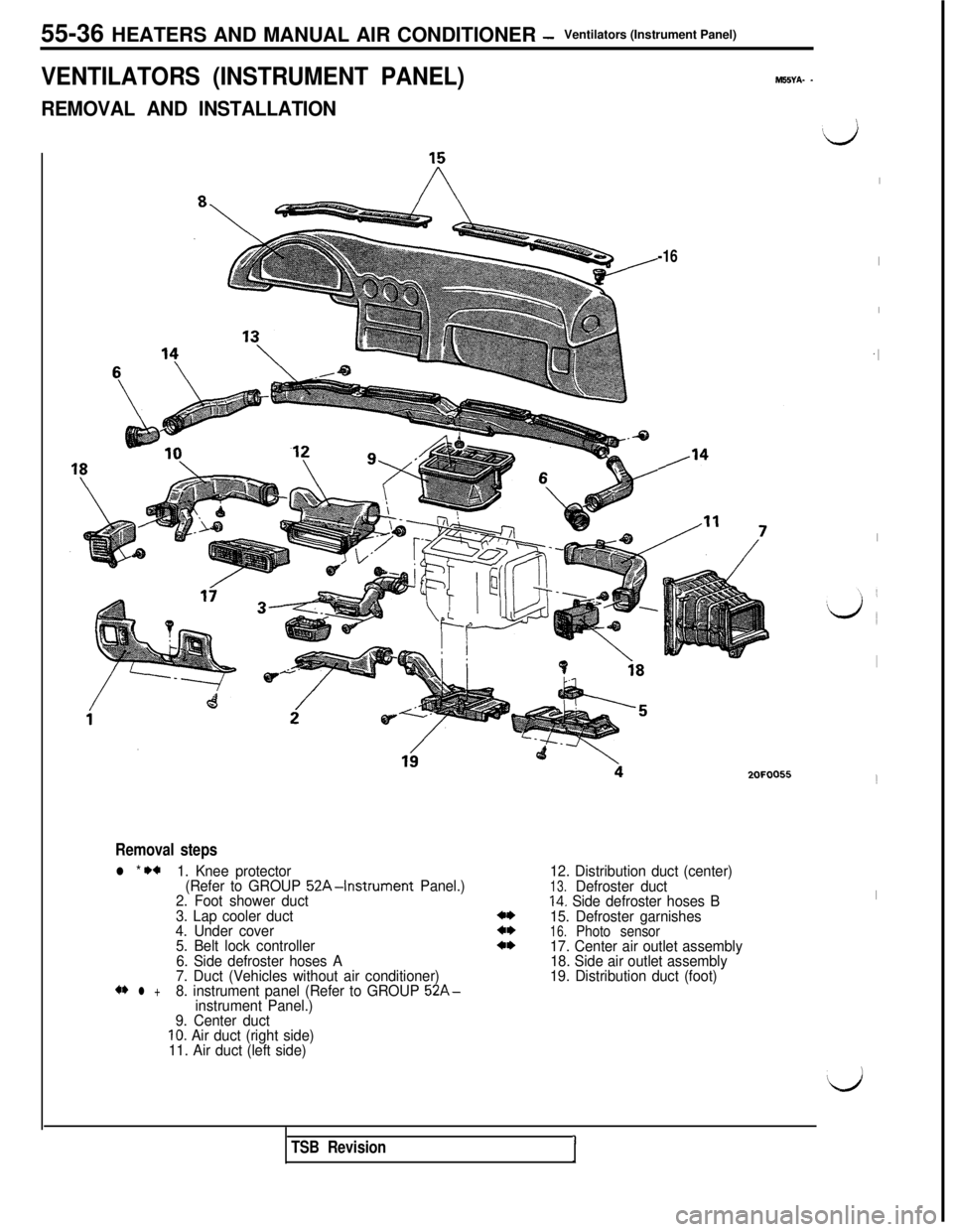
55-36 HEATERS AND MANUAL AIR CONDITIONER -Ventilators (Instrument Panel)
VENTILATORS (INSTRUMENT PANEL)M55YA- -
REMOVAL AND INSTALLATION
-16
/‘4
Removal steps
l * +a1. Knee protector
(Refer to GROUP 52A-Instrument Panel.)
2. Foot shower duct
3. Lap cooler duct
4. Under cover
5. Belt lock controller
6. Side defroster hoses A
7. Duct (Vehicles without air conditioner)
** l +8. instrument panel (Refer to GROUP 52A-instrument Panel.)
9. Center duct
10. Air duct (right side)
11. Air duct (left side)12. Distribution duct (center)
13.Defroster duct14. Side defroster hoses B
15. Defroster garnishes
16.Photo sensor17. Center air outlet assembly
18. Side air outlet assembly
19. Distribution duct (foot)2OFOO55
Ij
I
I
I
.I
I
I
!
I
‘d
TSB RevisionI
Page 1119 of 1146
HEATERS AND MANUAL AIR CONDITIONER -Ventilators (Instrument Panel) 55-37
/ 2OFOO321
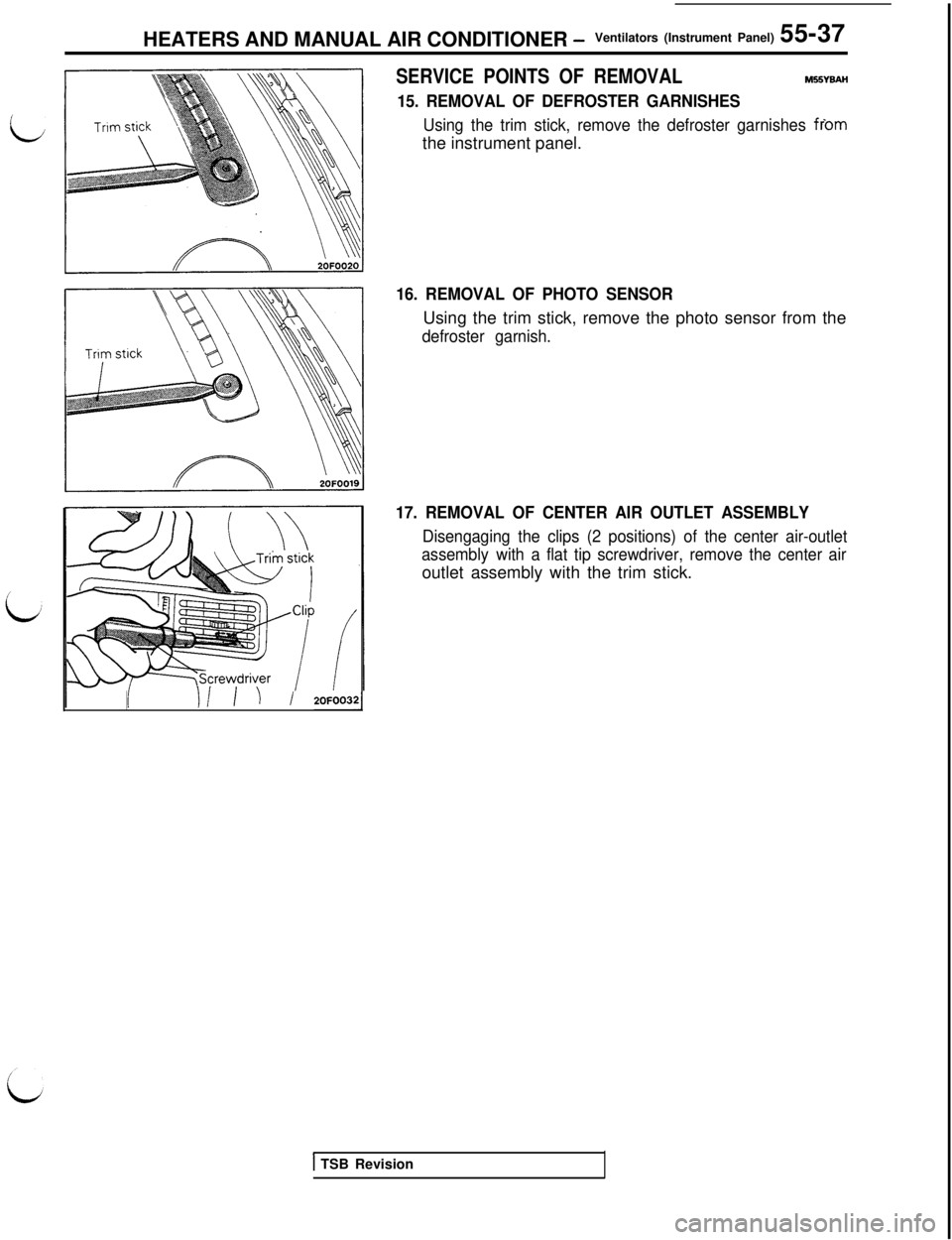
SERVICE POINTS OF REMOVALM55YBAH
15. REMOVAL OF DEFROSTER GARNISHES
Using the trim stick, remove the defroster garnishes fromthe instrument panel.
16. REMOVAL OF PHOTO SENSORUsing the trim stick, remove the photo sensor from the
defroster garnish.
17. REMOVAL OF CENTER AIR OUTLET ASSEMBLY
Disengaging the clips (2 positions) of the center air-outlet
assembly with a flat tip screwdriver, remove the center airoutlet assembly with the trim stick.
1 TSB Revision
Page 1135 of 1146
FULL AUTO AIR CONDITIONER - Troubleshootina55-53r
---.__------
2OFOO8:
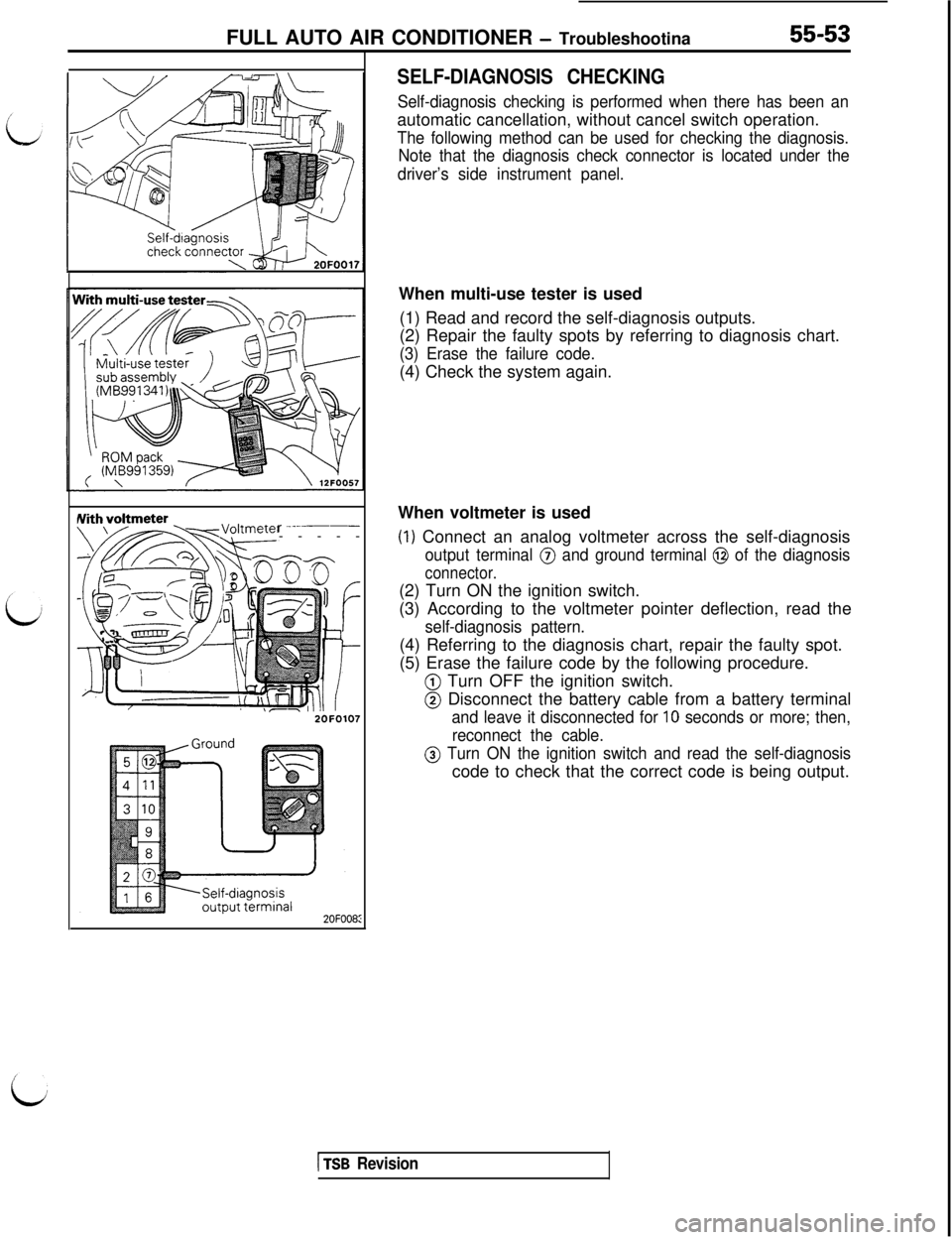
SELF-DIAGNOSIS CHECKING
Self-diagnosis checking is performed when there has been anautomatic cancellation, without cancel switch operation.
The following method can be used for checking the diagnosis.
Note that the diagnosis check connector is located under the
driver’s side instrument panel.When multi-use tester is used
(1) Read and record the self-diagnosis outputs.
(2) Repair the faulty spots by referring to diagnosis chart.
(3) Erase the failure code.(4) Check the system again.
When voltmeter is used
(1) Connect an analog voltmeter across the self-diagnosis
output terminal @ and ground terminal @ of the diagnosis
connector.(2) Turn ON the ignition switch.
(3) According to the voltmeter pointer deflection, read the
self-diagnosis pattern.(4) Referring to the diagnosis chart, repair the faulty spot.
(5) Erase the failure code by the following procedure.
@ Turn OFF the ignition switch.
@ Disconnect the battery cable from a battery terminal
and leave it disconnected for 10 seconds or more; then,
reconnect the cable.
@ Turn ON the ignition switch and read the self-diagnosiscode to check that the correct code is being output.
1 TSB Revision