oil MITSUBISHI 3000GT 1991 Service Manual
[x] Cancel search | Manufacturer: MITSUBISHI, Model Year: 1991, Model line: 3000GT, Model: MITSUBISHI 3000GT 1991Pages: 1146, PDF Size: 76.68 MB
Page 875 of 1146
BODY - SDecifications
L
)
L
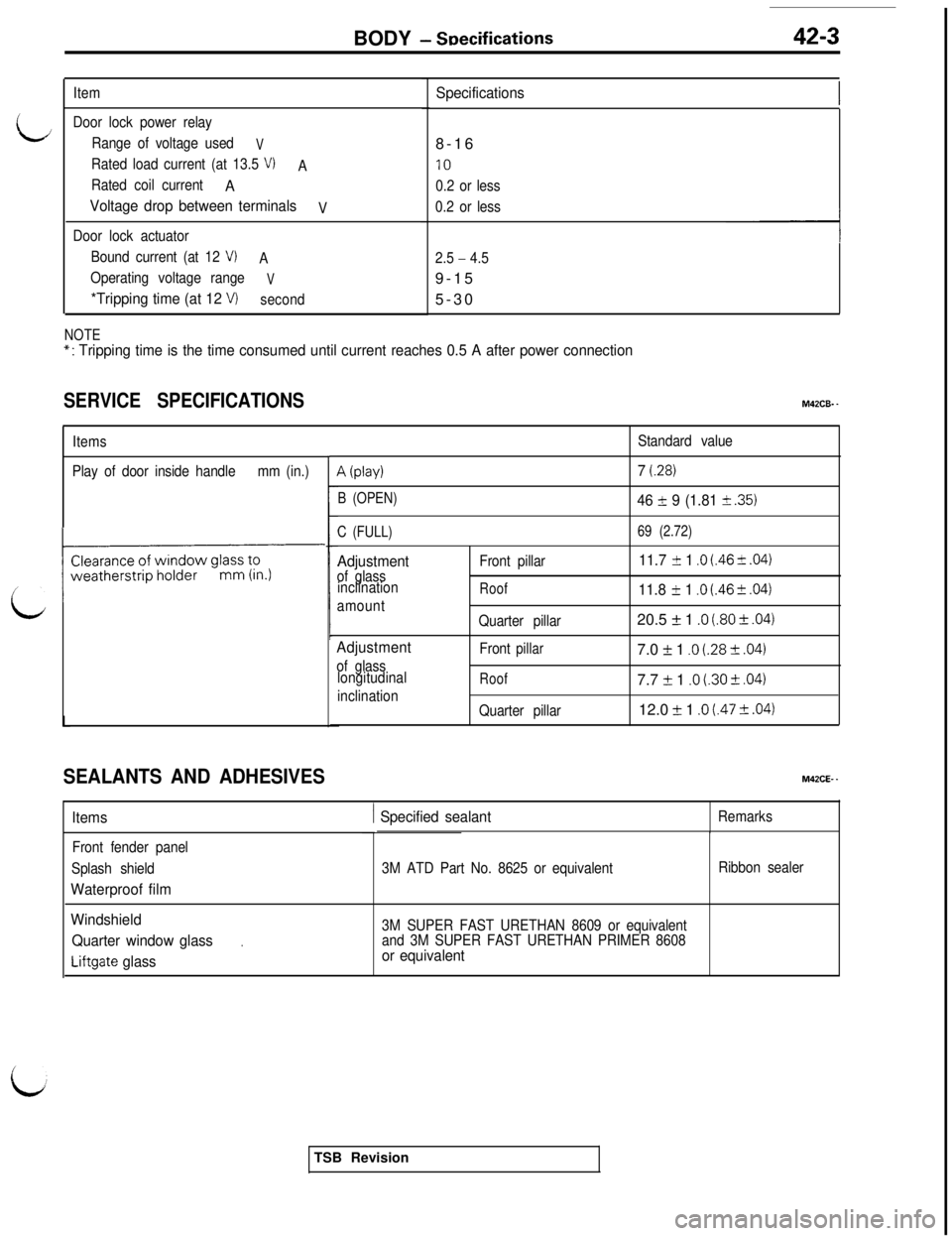
Item
Door lock power relay
Range of voltage used
V
Rated load current (at 13.5 VIA
Rated coil current
A
Voltage drop between terminals
V
Door lock actuator
Bound current (at 12
V)A
Operating voltage range
V
*Tripping time (at 12 VIsecond
Specifications8-16
IO
0.2 or less
0.2 or less
2.5
- 4.59-15
5-30
NOTE*: Tripping time is the time consumed until current reaches 0.5 A after power connection
SERVICE SPECIFICATIONSM42CB. -
ItemsStandard value
Play of door inside handlemm (in.)
A (play)
B (OPEN)
C (FULL)
Adjustmentof glass
inclination
amountFront pillarRoof
7 (.28)
46 f 9 (1.81 31 .35)
69 (2.72)
11.7 I!I 1 .O (.46 ?I .04)
11.8 f 1 .O (.46 + ,041L
SEALANTS AND ADHESIVES
Adjustment
of glass
longitudinal
inclinationQuarter pillar
Front
pillar
Roof
Quarter pillar20.5
f 1 .O (.80 f .04)7.0
i 1 .O (.28 -+ ,0417.7
If: 1 .o i.30 5 ,04112.0
f 1 .o I.47 + .04)
M42CE- -
Items1 Specified sealantRemarks
Front fender panel
Splash shield
Waterproof film
3M ATD Part No. 8625 or equivalentRibbon sealer
Windshield3M SUPER FAST URETHAN 8609 or equivalentQuarter window glass.and 3M SUPER FAST URETHAN PRIMER 8608
Liftgate glassor equivalentTSB Revision
Page 948 of 1146
51-10EXTERIOR - Service Adjustment Procedures
68FOO51
Multl-use tester
,SERVICE ADJUSTMENT PROCEDURES
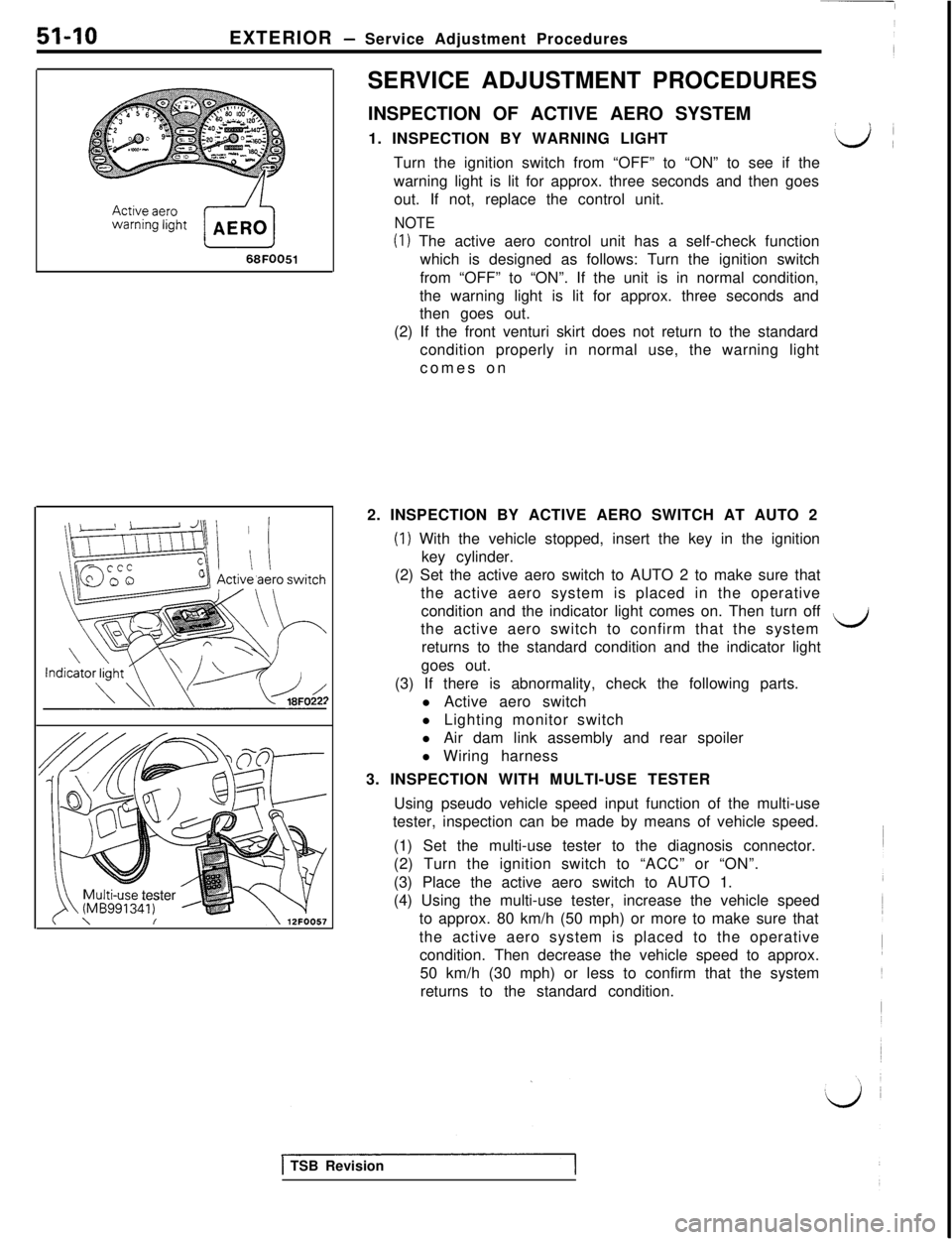
INSPECTION OF ACTIVE AERO SYSTEM
1. INSPECTION BY WARNING LIGHT
d!Turn the ignition switch from “OFF” to “ON” to see if the
warning light is lit for approx. three seconds and then goes
out. If not, replace the control unit.
NOTE
(1) The active aero control unit has a self-check function
which is designed as follows: Turn the ignition switch
from “OFF” to “ON”. If the unit is in normal condition,
the warning light is lit for approx. three seconds and
then goes out.
(2) If the front venturi skirt does not return to the standard
condition properly in normal use, the warning light
comes on
2. INSPECTION BY ACTIVE AERO SWITCH AT AUTO 2
(1) With the vehicle stopped, insert the key in the ignition
key cylinder.
(2) Set the active aero switch to AUTO 2 to make sure that
the active aero system is placed in the operative
condition and the indicator light comes on. Then turn off
the active aero switch to confirm that the system
LCJreturns to the standard condition and the indicator light
goes out.
(3) If there is abnormality, check the following parts.
l Active aero switch
l Lighting monitor switch
l Air dam link assembly and rear spoiler
l Wiring harness
3. INSPECTION WITH MULTI-USE TESTER
Using pseudo vehicle speed input function of the multi-use
tester, inspection can be made by means of vehicle speed.
(1) Set the multi-use tester to the diagnosis connector.
(2) Turn the ignition switch to “ACC” or “ON”.
(3) Place the active aero switch to AUTO 1.
(4) Using the multi-use tester, increase the vehicle speed
to approx. 80 km/h (50 mph) or more to make sure that
the active aero system is placed to the operative
condition. Then decrease the vehicle speed to approx.
50 km/h (30 mph) or less to confirm that the system
returns to the standard condition.
1 TSB Revision
Page 958 of 1146
51-20EXTERIOR - Aero Parts
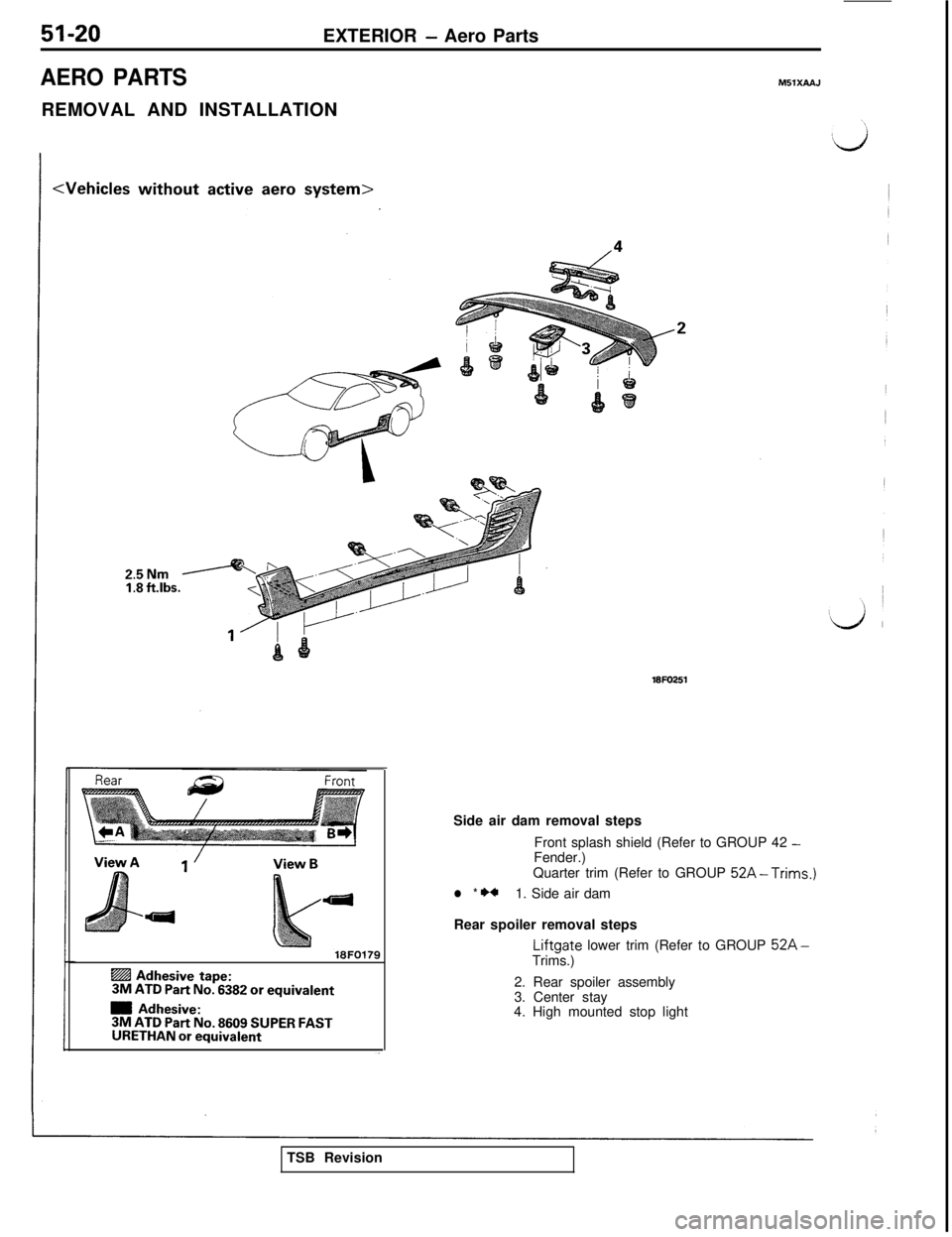
AERO PARTSM5lXAA.J
REMOVAL AND INSTALLATION
25NmI:8 ft.lbs.
18FO179
@ Adhesive tape:3M ATD Part No. 6382 or equivalent
m Adhesive:3M ATD Part No. 8609 SUPER FASTURETHAN or equivalent
18FO251Side air dam removal steps
Front splash shield (Refer to GROUP 42
-Fender.)
Quarter trim (Refer to GROUP
52A-Trims.)
l * **1. Side air dam
Rear spoiler removal steps
Liftgate lower trim (Refer to GROUP 52A-Trims.)
2. Rear spoiler assembly
3. Center stay
4. High mounted stop light
TSB Revision
Page 959 of 1146
EXTERIOR - Aero Parts51-21
8
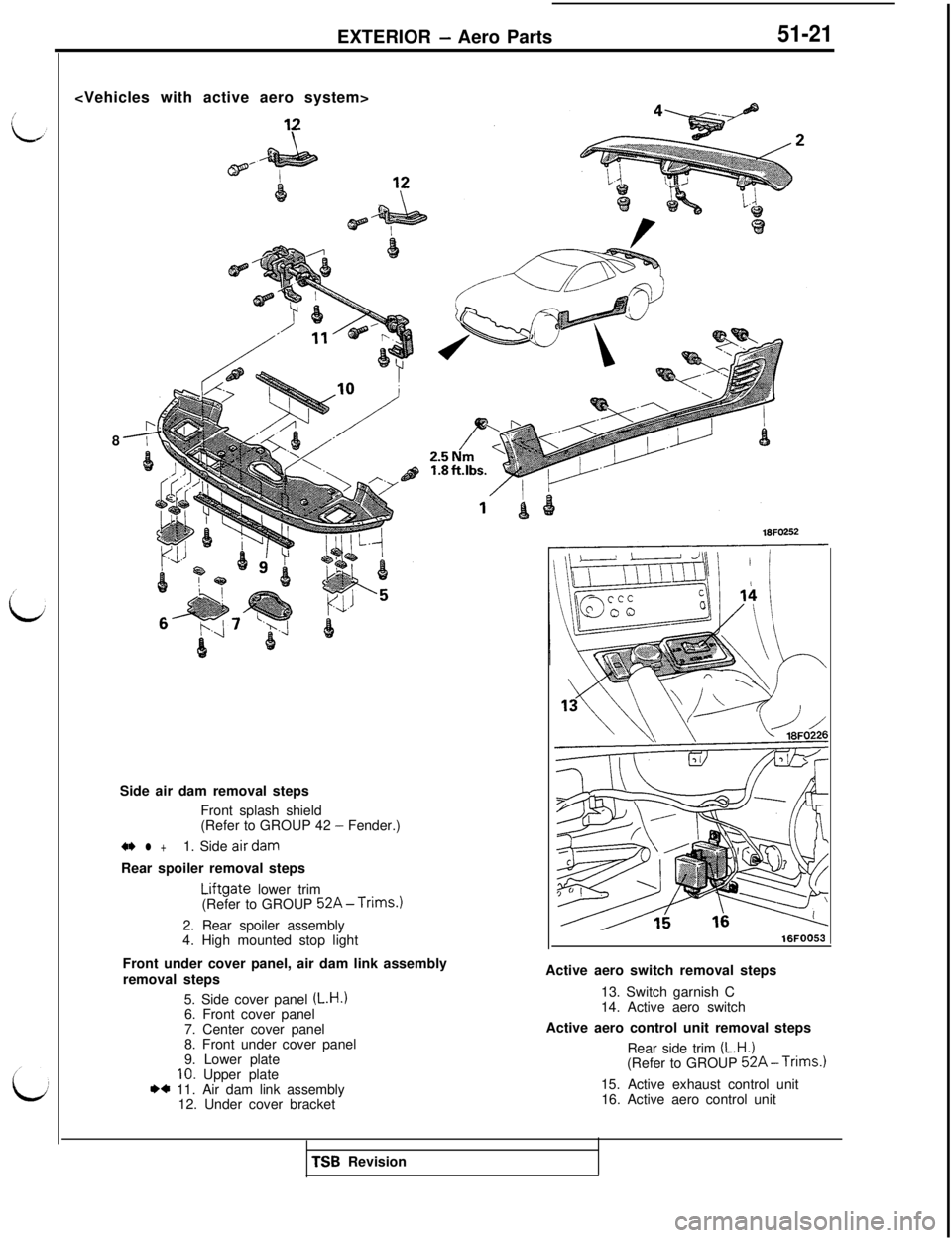
Side air dam removal steps
Front splash shield
(Refer to GROUP 42
- Fender.)
+I) l +1. Side airdamRear spoiler removal steps
Liftgate lower trim
(Refer to GROUP 52A-Trims.)2. Rear spoiler assembly
4. High mounted stop light
Front under cover panel, air dam link assembly
removal steps
5. Side cover panel
(L.H.)6. Front cover panel
7. Center cover panel
8. Front under cover panel
9. Lower plate
10. Upper plateI)* 11. Air dam link assembly
12. Under cover bracket
16FO252
16FOO53Active aero switch removal steps
13. Switch garnish C
14. Active aero switch
Active aero control unit removal steps
Rear side trim
(L.H.)(Refer to GROUP 52A-Trims.)15. Active exhaust control unit
16. Active aero control unitTSB Revision
Page 960 of 1146
51-22
EXTERIOR - Aero Parts
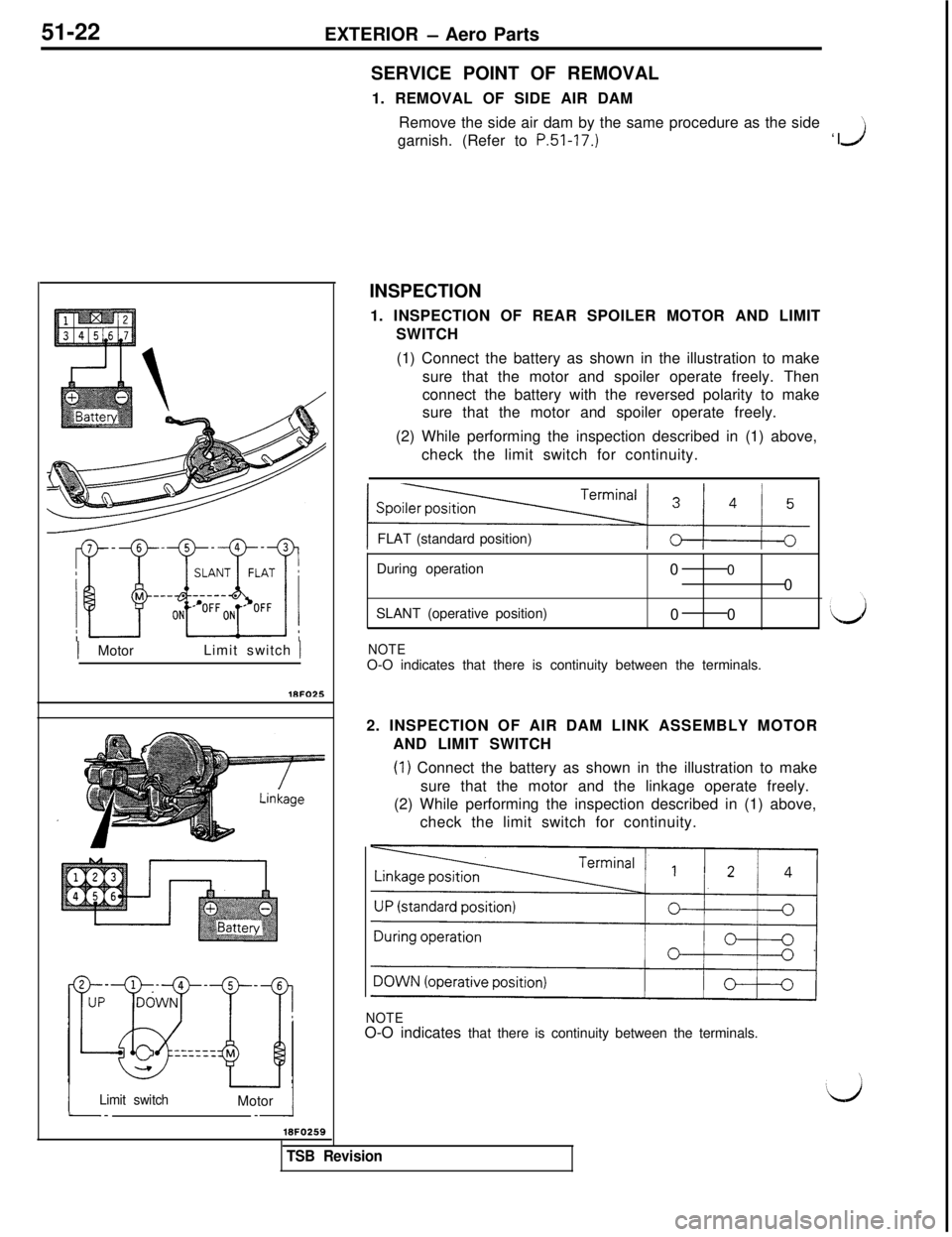
1 MotorLimit switch )
iLimit switch--Motor /_I
18FO259SERVICE POINT OF REMOVAL
1. REMOVAL OF SIDE AIR DAM
Remove the side air dam by the same procedure as the side
’garnish. (Refer to P.51-17.)‘IJINSPECTION
1. INSPECTION OF REAR SPOILER MOTOR AND LIMIT
SWITCH
(1) Connect the battery as shown in the illustration to make
sure that the motor and spoiler operate freely. Then
connect the battery with the reversed polarity to make
sure that the motor and spoiler operate freely.
(2) While performing the inspection described in (1) above,
check the limit switch for continuity.
FLAT (standard position)
During operation
00
0
SLANT (operative position)
00
NOTEO-O indicates that there is continuity between the terminals.
2. INSPECTION OF AIR DAM LINK ASSEMBLY MOTOR
AND LIMIT SWITCH
(1) Connect the battery as shown in the illustration to make
sure that the motor and the linkage operate freely.
(2) While performing the inspection described in (1) above,
check the limit switch for continuity.
NOTEO-O indicates that there is continuity between the terminals.
TSB Revision
Page 1072 of 1146
52B-62Air Bag ModuleSUPPLEMENTAL RESTRAINT SYSTEM (SRS) - and Clock Spring
AIR BAG MODULE AND CLOCK SPRINGM52PDCA
Caution1. Never attempt to disassemble or repair the
air bag module or clock spring.
If faulty, replace it.
2. Do not drop the air bag module or clock
spring or allow contact with water, grease or
oil.Replace it if a dent, crack, deformation or
rust are detected.
3.The air bag module should be stored on a flat
surface and placed so that the pad surface isfacing upward.
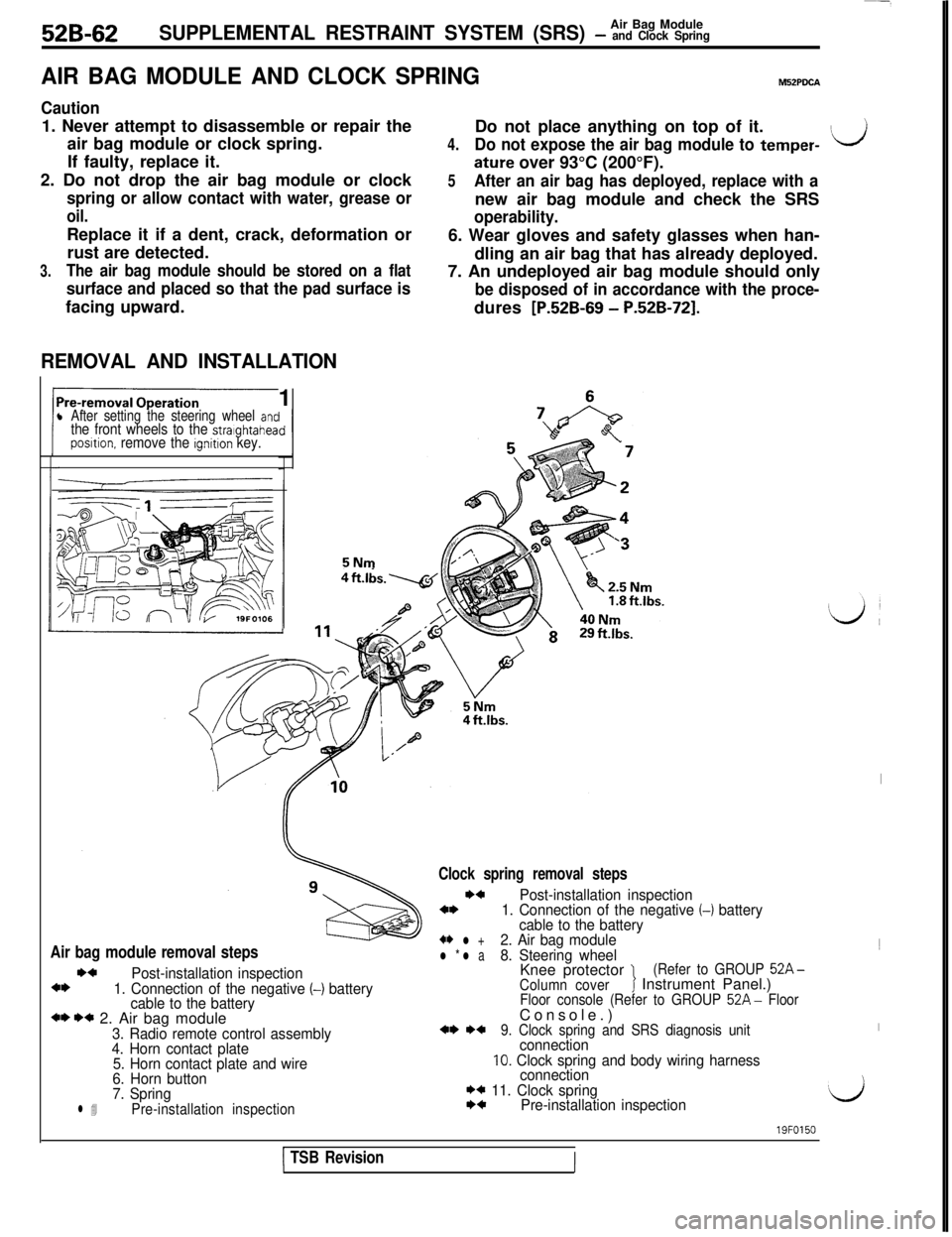
REMOVAL AND INSTALLATION1
l After setting the steering wheel antthe front wheels to the stralghtaheaposltion. remove the ignition key.5NmDo not place anything on top of it.
4.Do not expose the air bag module to temper-ILJ
ature over 93°C (200°F).
5After an air bag has deployed, replace with anew air bag module and check the SRS
operability.6. Wear gloves and safety glasses when han-
dling an air bag that has already deployed.
7. An undeployed air bag module should only
be disposed of in accordance with the proce-dures
[P.52B-69 - P.52B-721.
Air bag module removal stepsI)4
Post-installation inspection4*1. Connection of the negative (-1 battery
cable to the battery
*I) I)* 2. Air bag module3. Radio remote control assembly
4. Horn contact plate
5. Horn contact plate and wire
6. Horn button
7. Spring
l 4Pre-installation inspection
Clock spring removal steps
I)4Post-installation inspection4*1. Connection of the negative (-1 battery
cable to the battery
+* l +2. Air bag modulel * l a8. Steering wheelKnee protector 1(Refer to GROUP 52A-
Column coverJ Instrument Panel.)Floor console (Refer to GROUP 52A- FloorConsole.)
*I) *+9. Clock spring and SRS diagnosis unitconnection10. Clock spring and body wiring harness
connection
I)* 11. Clock springI)4Pre-installation inspection
I1
I
‘d
1 TSB Revision
19FO150
III
Page 1082 of 1146
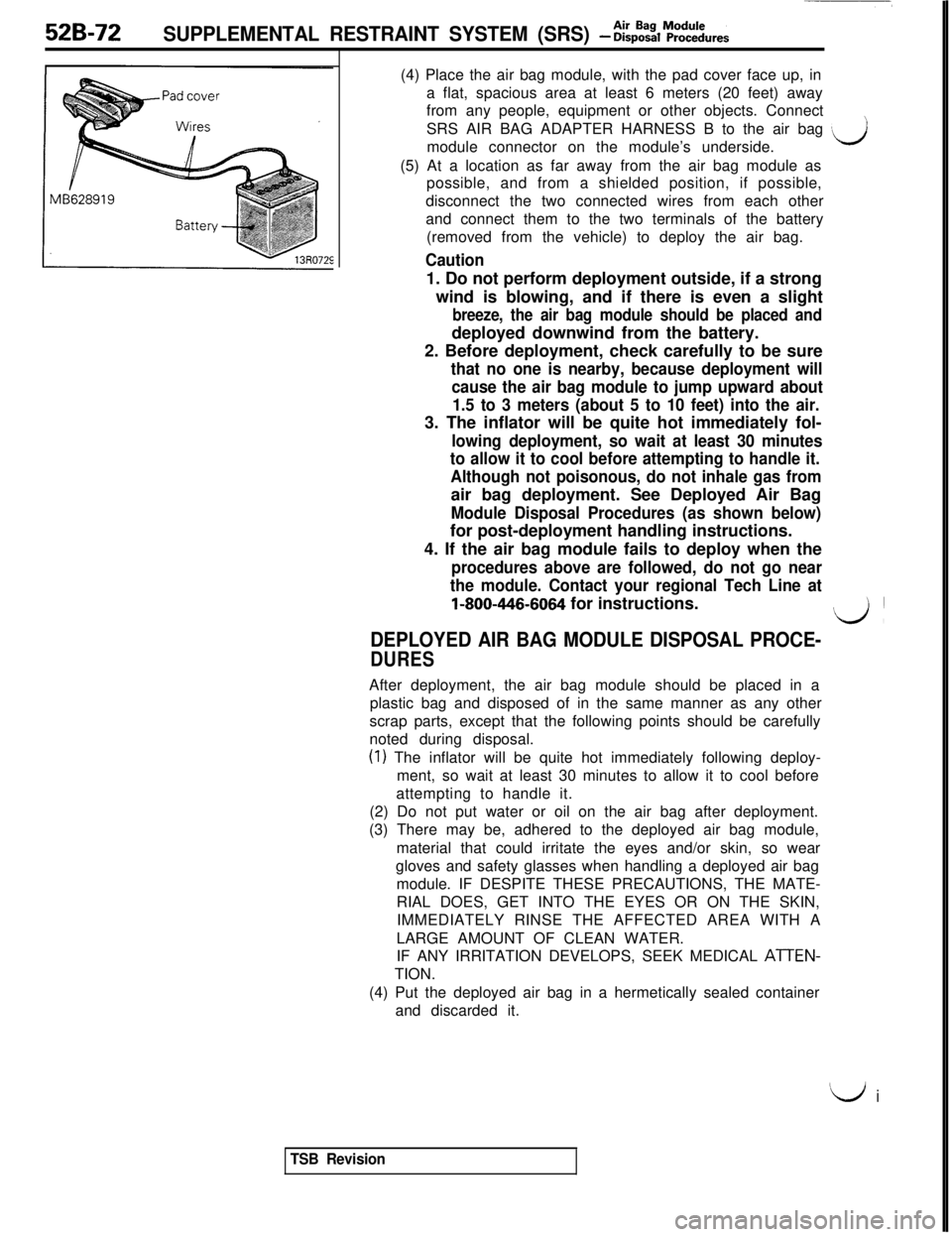
52B-72SUPPLEMENTAL RESTRAINT SYSTEM (SRS) - &%~~~~~ures(4) Place the air bag module, with the pad cover face up, in
a flat, spacious area at least 6 meters (20 feet) away
from any people, equipment or other objects. Connect
SRS AIR BAG ADAPTER HARNESS B to the air bag
mdmodule connector on the module’s underside.
(5) At a location as far away from the air bag module as
possible, and from a shielded position, if possible,
disconnect the two connected wires from each other
and connect them to the two terminals of the battery
(removed from the vehicle) to deploy the air bag.
Caution1. Do not perform deployment outside, if a strong
wind is blowing, and if there is even a slight
breeze, the air bag module should be placed anddeployed downwind from the battery.
2. Before deployment, check carefully to be sure
that no one is nearby, because deployment will
cause the air bag module to jump upward about
1.5 to 3 meters (about 5 to 10 feet) into the air.3. The inflator will be quite hot immediately fol-
lowing deployment, so wait at least 30 minutes
to allow it to cool before attempting to handle it.
Although not poisonous, do not inhale gas fromair bag deployment. See Deployed Air Bag
Module Disposal Procedures (as shown below)for post-deployment handling instructions.
4. If the air bag module fails to deploy when the
procedures above are followed, do not go near
the module. Contact your regional Tech Line at
l-800-446-6064 for instructions.\J’
DEPLOYED AIR BAG MODULE DISPOSAL PROCE-
DURESAfter deployment, the air bag module should be placed in a
plastic bag and disposed of in the same manner as any other
scrap parts, except that the following points should be carefully
noted during disposal.
(1) The inflator will be quite hot immediately following deploy-
ment, so wait at least 30 minutes to allow it to cool before
attempting to handle it.
(2) Do not put water or oil on the air bag after deployment.
(3) There may be, adhered to the deployed air bag module,
material that could irritate the eyes and/or skin, so wear
gloves and safety glasses when handling a deployed air bag
module. IF DESPITE THESE PRECAUTIONS, THE MATE-
RIAL DOES, GET INTO THE EYES OR ON THE SKIN,
IMMEDIATELY RINSE THE AFFECTED AREA WITH A
LARGE AMOUNT OF CLEAN WATER.
IF ANY IRRITATION DEVELOPS, SEEK MEDICAL
A-I-TEN-TION.
(4) Put the deployed air bag in a hermetically sealed container
and discarded it.
‘LJ i
TSB Revision
Page 1091 of 1146
HEATERS AND MANUAL AIR CONDITIONER - safety Pre=utm55-9
SAFETY PRECAUTIONSR-12 refrigerant is a chlorofluoro-carbon
(CFC) that
can contribute to the depletion of the ozone layer in
the upper atmosphere.
Ozone filters out harmful radiation from the sun.
To assist in protecting the ozone layer, Mitsubishi
Motor Sales of America recommends that a R-12
refrigerant recycling device that meets SAE stan-
dard
J1991 be used.
Contact an automotive service equipment supplier
for refrigerant recycling equipment that is available
in your area.
The refrigerant used in all air conditioner is R-l 2. It is
transparent and colorless in both the liquid and
vapor state. Since it has a boiling point of
-29.8”C(-21.7”F), at atmospheric pressure, it will be a vapor
at all normal temperatures and pressures. The vapor
is heavier than air, non-flammable, and nonexplo-
sive. It is nonpoisonous except when it is in direct
contact with open flame. It is noncorrosive except
when combined with water. The following precau-
tions must be observed when handling R-12.
CautionWear safety goggles when servicing the refri-
geration system.R-12 evaporates so rapidly at normal atmospheric
pressures and temperatures that it tends to freeze
anything it contacts. For this reason, extreme care
must be taken to prevent any liquid refrigerant from
contacting the skin and especially the eyes. Always
wear safety goggles when servicing the refrigera-
tion part of the air conditioning system. Keep a
bottle of sterile mineral oil handy when working on
the refrigeration system. Should any liquid re-
frigerant get into the eyes, use a few drops of
mineral oil to wash them out. R-12 is rapidly
absorbed by the oil. Next splash the eyes with
plenty of cold water. Call your doctor immediately
even though irritation has ceased after treatment.
CautionDo not heat R-12 above 52°C
(125.6”F).
M55PAAFIn most instances, moderate heat is required to
bring the pressure of the refrigerant in its container
above the pressure of the system when charging or
adding refrigerant. A bucket or large pan of hot
water not over 52°C
(125.6”F) is all the heat required
for this purpose. Do not heat the refrigerant contain-
er with a blow torch or any other means that would
raise temperature and pressure above this tempera-
ture. Do not weld or steam clean on or near the
system components or refrigerant lines.
Caution
Keep R-12 containers upright when charging the
system.When metering R-12 into the refrigeration system,
keep the supply tank or cans in an upright position. If
the refrigerant container is on its side or upside
down, liquid refrigerant will enter the system and
damage the compressor.
CautionAlways work in a well-ventilated room.
Good ventilation is vital in the working area.
Although R-12 vapor is normally nonpoisonous,
contact with an open flame can cause the vapor to
become very poisonous. A poisonous gas is pro-
duced when using the flame-type leak detector.
Avoid inhaling the fumes from the leak detector.
CautionDo not allow liquid refrigerant to touch bright
metal.Refrigerant will tarnish bright metal and chrome
surfaces, and in combination with moisture can
severely corrode all metal surfaces.
1 TSB Revision
Page 1096 of 1146
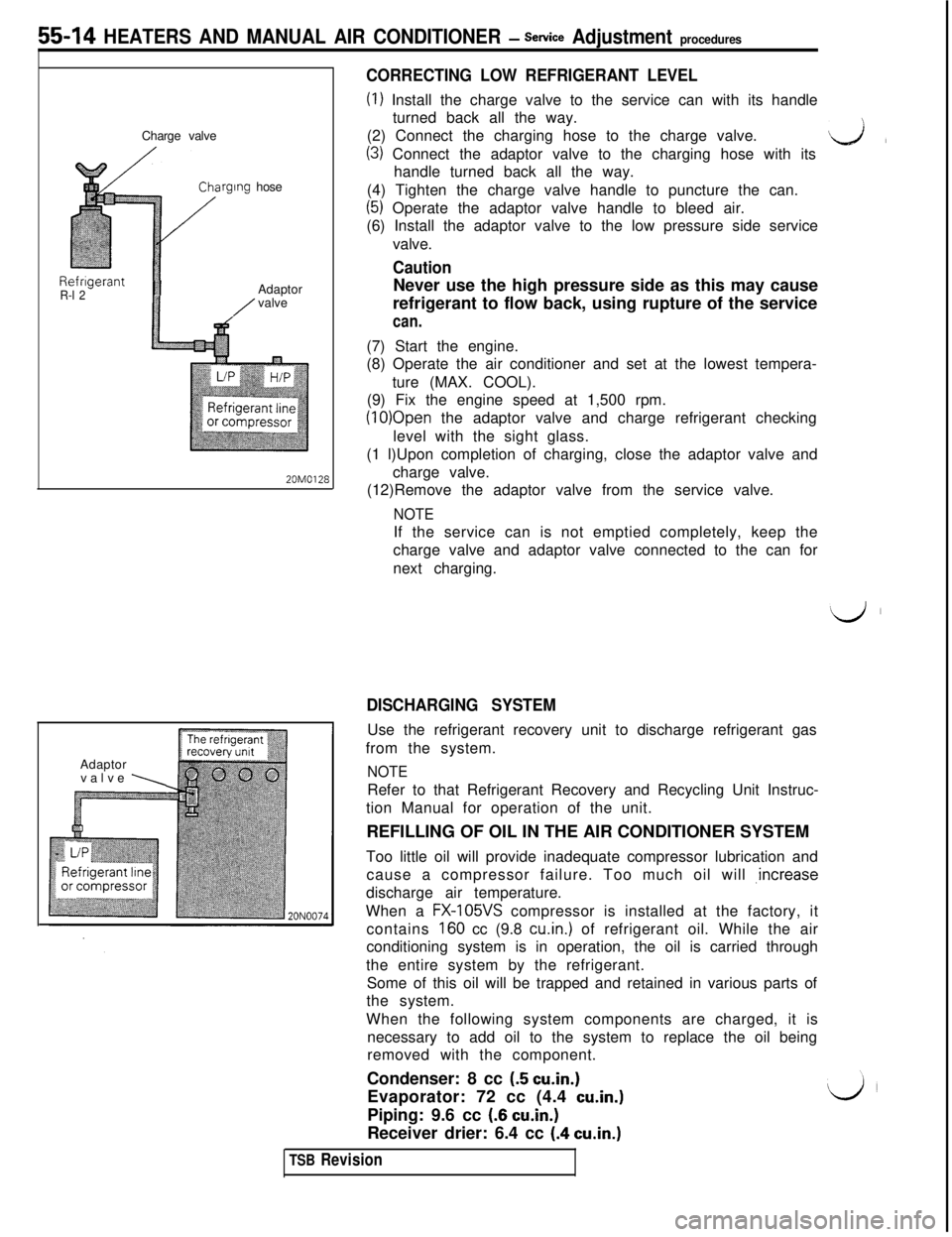
CautionRefrigerantR-l 2iAdaptorNever use the high pressure side as this may cause
/valve
refrigerant to flow back, using rupture of the servicecan.(7) Start the engine. Charge valvergmg hose
55-14 HEATERS AND MANUAL AIR CONDITIONER - Service Adjustment procedures
CORRECTING LOW REFRIGERANT LEVEL
(I) Install the charge valve to the service can with its handle
turned back all the way.
(2) Connect the charging hose to the charge valve.
(3) Connect the adaptor valve to the charging hose with itsL&lhandle turned back all the way.
(4) Tighten the charge valve handle to puncture the can.
(5) Operate the adaptor valve handle to bleed air.
(6) Install the adaptor valve to the low pressure side service
valve.
(8) Operate the air conditioner and set at the lowest tempera-
ture (MAX. COOL).
(9) Fix the engine speed at 1,500 rpm.
(10)Open the adaptor valve and charge refrigerant checking
level with the sight glass.
(1 l)Upon completion of charging, close the adaptor valve and
20M0128charge valve.
(12)Remove the adaptor valve from the service valve.
NOTEIf the service can is not emptied completely, keep the
charge valve and adaptor valve connected to the can for
next charging.
Adaptor
valve
\
DISCHARGING SYSTEMUse the refrigerant recovery unit to discharge refrigerant gas
from the system.
NOTERefer to that Refrigerant Recovery and Recycling Unit Instruc-
tion Manual for operation of the unit.
REFILLING OF OIL IN THE AIR CONDITIONER SYSTEM
Too little oil will provide inadequate compressor lubrication and
cause a compressor failure. Too much oil will ,increase
discharge air temperature.
When a
FX-105VS compressor is installed at the factory, it
contains
160 cc (9.8 cu.in.) of refrigerant oil. While the air
conditioning system is in operation, the oil is carried through
the entire system by the refrigerant.
Some of this oil will be trapped and retained in various parts of
the system.
When the following system components are charged, it is
necessary to add oil to the system to replace the oil being
removed with the component.
Condenser: 8 cc
(5 cu.in.)Evaporator: 72 cc (4.4
cu.in.)Piping: 9.6 cc
(6 cu.in.)Receiver drier: 6.4 cc
(.4 cu.in.)
TSB Revision
Page 1099 of 1146
HEATERS AND MANUAL AIR CbNDlTlONER -Service Adjustment Procedures 55 17
ADJUSTMENT PROCEDURES(1) Select a quiet area for testing. Duplicate conditions as much
as possible. Switch compressor on and off several times to
clearly identify compressor noise.
To duplicate high ambient conditions (high head pressure),
restrict air flow through condenser. Install manifold gauge
set to make sure discharge pressure doesn’t exceed 2,070
kPa (300 psi).
(2) Tighten all compressor mounting bolts, clutch mounting
bolt, and compressor drive belt. Check to assure clutch coil
is tight (no rotation or wobble).
(3) Check refrigerant hoses for rubbing or interference that can
cause unusual noises.
(4) Check refrigerant charge. (See “Charging System”.)
(5) Recheck compressor noise as in Step 1.
(6) If noise still exists, loosen compressor mounting bolts and
retorque. Repeat Step 1.
(7) If noise continues, replace compressor and repeat Step 1.
POWER RELAY CHECKMBBFNAK(1) Remove the radiator fan motor relays (HI) and (LO) from the
relay box on the right of the engine compartment.
(2) Remove the radiator fan motor relay (air conditioner),
condenser fan motor relays (HI) and (LO), and
air-conditioner compressor relay from the relay box on the left
of the engine compartment.
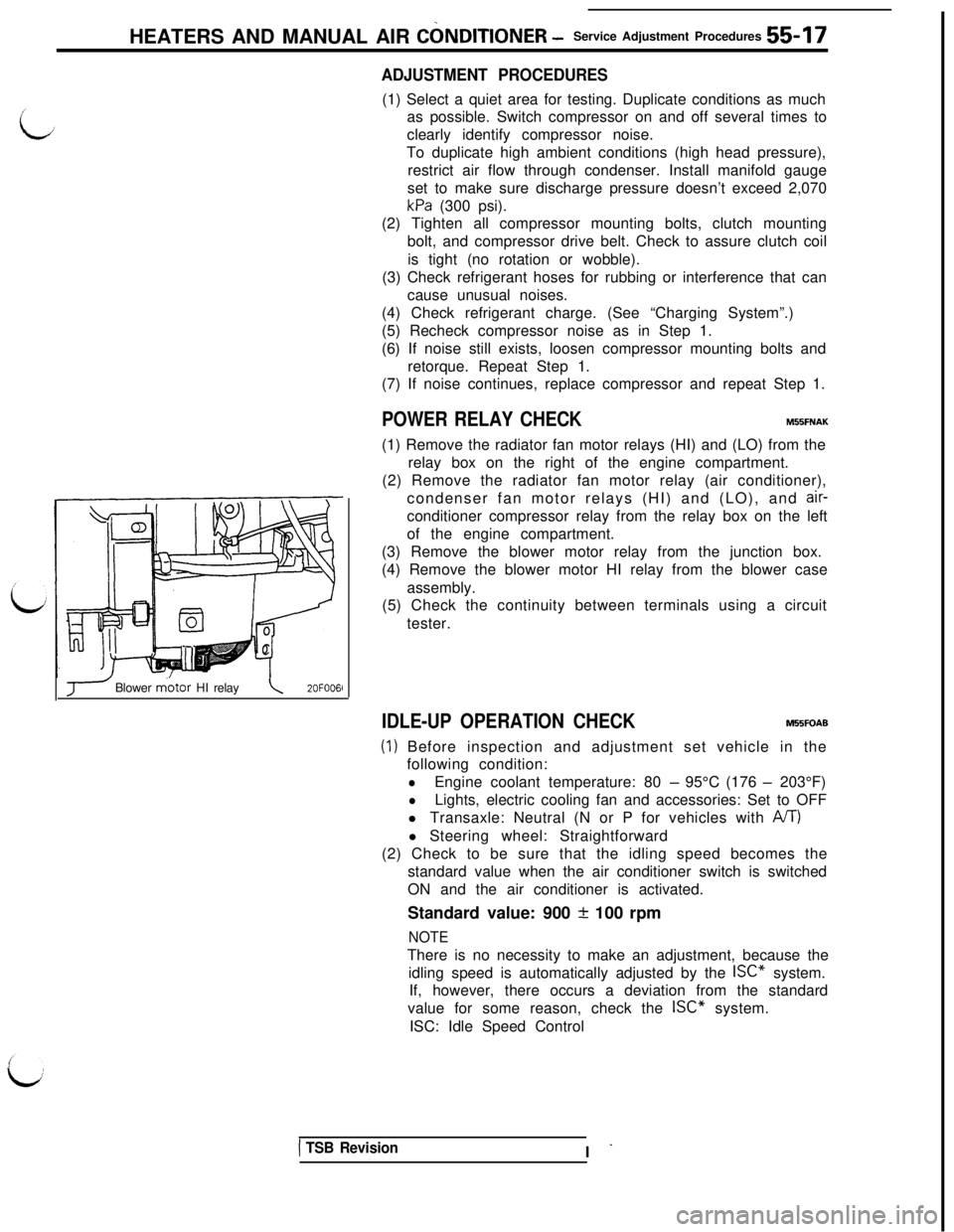
(3) Remove the blower motor relay from the junction box.
(4) Remove the blower motor HI relay from the blower case
assembly.
(5) Check the continuity between terminals using a circuit
tester.
J Blower m.otor HI relay\2OFOO6l
IDLE-UP OPERATION CHECKM55FOAB
(1) Before inspection and adjustment set vehicle in the
following condition:
lEngine coolant temperature: 80 - 95°C (176 - 203°F)
lLights, electric cooling fan and accessories: Set to OFF
l Transaxle: Neutral (N or P for vehicles with
A/T)l Steering wheel: Straightforward
(2) Check to be sure that the idling speed becomes the
standard value when the air conditioner switch is switched
ON and the air conditioner is activated.
Standard value: 900
+ 100 rpm
NOTEThere is no necessity to make an adjustment, because the
idling speed is automatically adjusted by the ISC” system.
If, however, there occurs a deviation from the standard
value for some reason, check the ISC” system.
ISC: Idle Speed Control
1 TSB RevisionI -