brake MITSUBISHI 3000GT 1991 Owner's Manual
[x] Cancel search | Manufacturer: MITSUBISHI, Model Year: 1991, Model line: 3000GT, Model: MITSUBISHI 3000GT 1991Pages: 1146, PDF Size: 76.68 MB
Page 286 of 1146
 Switc")
13-180CRUISE CONTROL SYSTEM - Service Adjustment Procedures.
4
ET: ON
07FOOl;Control switch
\E: ON
t
07FOOliControl switch
\
SET: ON
07FOOlControl switch
\
07FOOl
CRUISE CONTROL SETTING CHECK(1) Switch ON the main switch.
(2) Drive at the desired speed within the range of approximate-
ly 40
- 145 km/h (25 - 90 mph).
(3) Operate the control switch downward. (SET switch: ON)
(4) Check to be sure that the speed is the desired constant
speed when the switch is released, and also check to be
sure that the CRUISE indicator light (within the combination
meter) illuminates.
NOTEIf the vehicle speed decreases to approximately 15 km/h (9
mph) below the set speed, because of climbing a hill for
example, the cruise control will be cancelled.
SPEED-INCREASE SETTING CHECK(1) Set to the desired speed.
(2) Operate the control switch upward. (RESUME switch: ON)
(3) Check to be sure that acceleration continues while the
switch is hold, and that when it is released the constant.
speed at the time when it was released becomes the
driving speed.
NOTEEven if, during acceleration, the vehicle speed reaches or
exceeds the high limit [approximately 145 km/h (90 mph)],
acceleration will continue, however, when the switch is
released, the set speed (“memorized speed”) will become
the high limit of the vehicle speed.
SPEED REDUCTION SETTING CHECK(1) Set to the desired speed.
(2) Operate the control switch downward. (SET switch: ON)
(3) Check to be sure that deceleration continues while the
switch is held, and that when it is released the constant
speed at the time when it was released becomes the
driving speed.
NOTEWhen the vehicle speed reaches the low limit [approx-
imately 40 km/h (25 mph)] during deceleration, the cruise
control will be cancelled.
CRUISE CONTROL CANCELLATION AND SET SPEED RE-
SUME CHECK(1) Set cruise control.
(2) In the cruising condition of the cruise control mode, check
that when any of the following operations are performed,
the normal drive mode is restored and
,the vehicle coasts
smoothly.@ Move the control switch toward you. (CANCEL switch:@ Depress the brake pedal.@ Depress the clutch pedal.
TSB Revision
Page 289 of 1146
CRUISE CONTROL SYSTEM - Service Adjustment Procedures13-183
onoo5J16LO285
141014;
TFA0359
16FO13LResistance
3--1Okl2
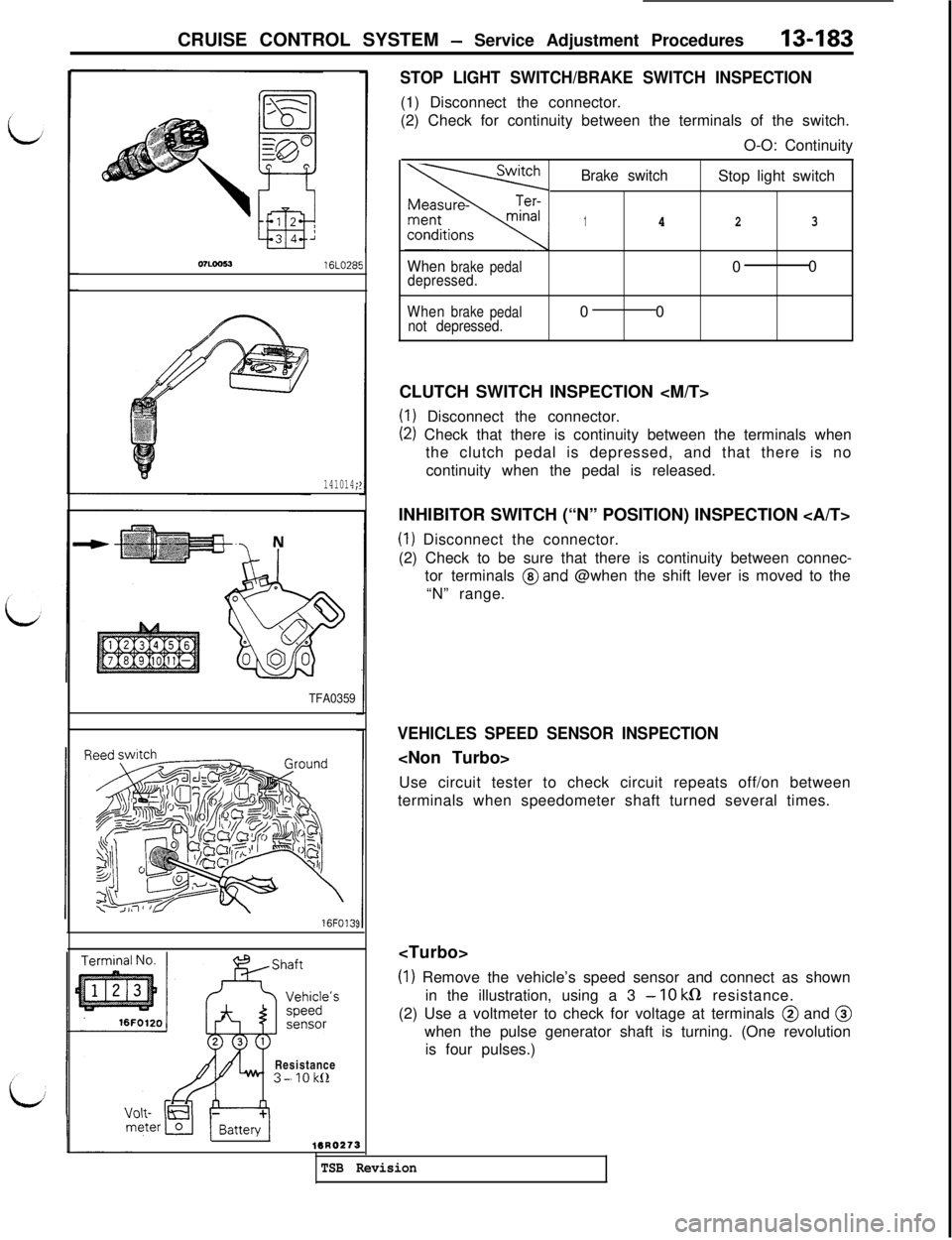
STOP LIGHT SWITCH/BRAKE SWITCH INSPECTION(1) Disconnect the connector.
(2) Check for continuity between the terminals of the switch.
O-O: Continuity
Brake switchStop light switch
1423
Whenbrakepedal00depressed.
When
brake
pedal00not depressed.CLUTCH SWITCH INSPECTION
(I) Disconnect the connector.
(2) Check that there is continuity between the terminals when
the clutch pedal is depressed, and that there is no
continuity when the pedal is released.
INHIBITOR SWITCH (“N” POSITION) INSPECTION
(1) Disconnect the connector.
(2) Check to be sure that there is continuity between connec-
tor terminals
@and @when the shift lever is moved to the
“N” range.
VEHICLES SPEED SENSOR INSPECTION
Use circuit tester to check circuit repeats off/on between
terminals when speedometer shaft turned several times.
(1) Remove the vehicle’s speed sensor and connect as shown
in the illustration, using a 3
- 10 kQ resistance.
(2) Use a voltmeter to check for voltage at terminals @ and @
when the pulse generator shaft is turning. (One revolution
is four pulses.)
16R0273
TSB Revision
Page 323 of 1146
INTAKE AND EXHAUST - Air Intake Plenum
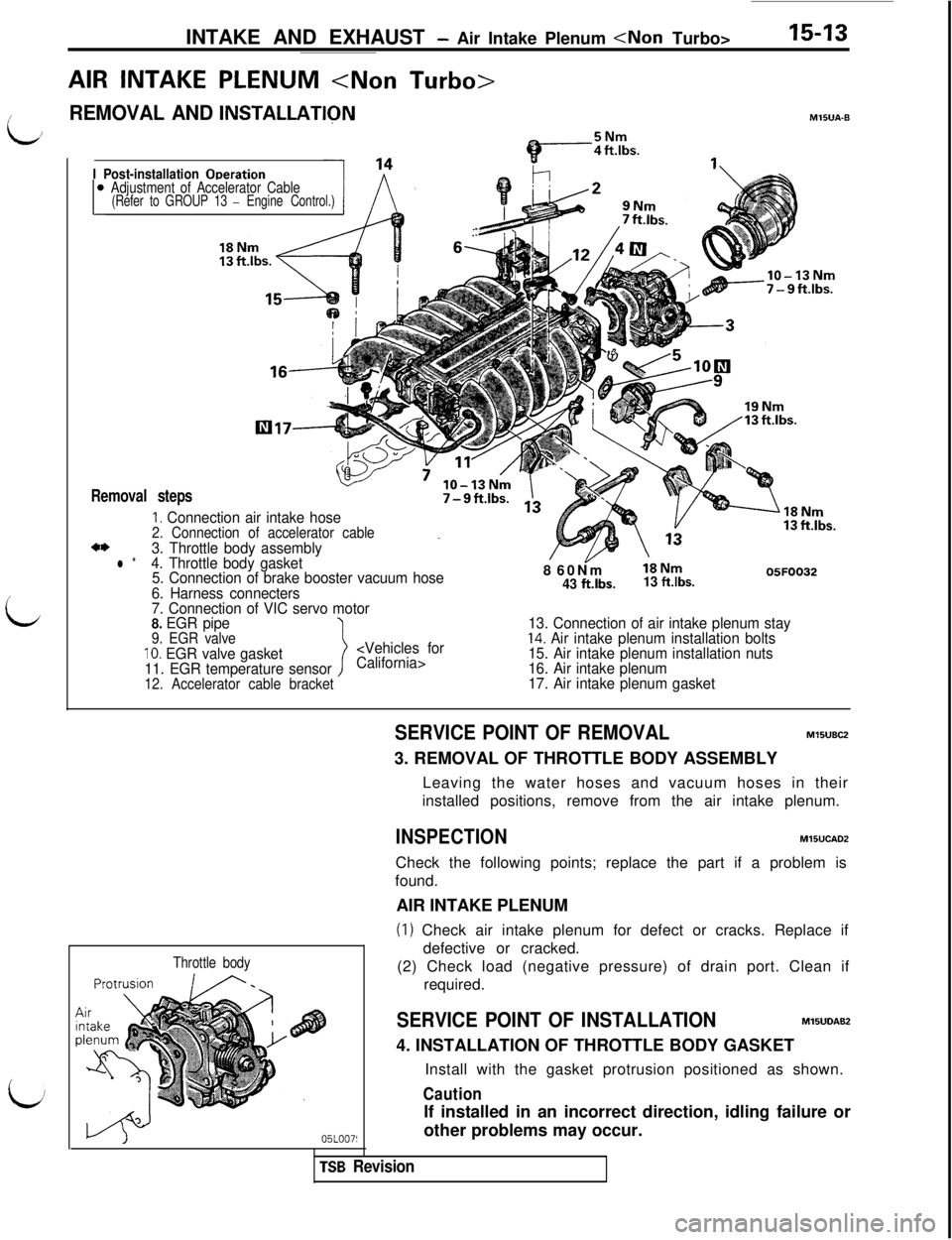
AIR INTAKE PLENUM
/REMOVAL AND INSTALLATIQNMlWA-B
L/
i
I Post-installation ODeration
Adjustment of Accelerator Cable
(Refer to GROUP 13 - Engine Control.)
Removal steps7-9ft.lbs.
I. Connection air intake hose2. Connection of accelerator cable_*I)3. Throttle body assemblyl *4. Throttle body gasket
5. Connection of brake booster vacuum hose
6. Harness connecters8 60Nm;6Nm05FOO32
43 ft.lbs.13 ft.lbs.
7. Connection of VIC servo motor
8. EGR pipe
9. EGR valve
11. EGR temperature sensor
12. Accelerator cable bracket
13. Connection of air intake plenum stay14. Air intake plenum installation bolts
15. Air intake plenum installation nuts
16. Air intake plenum
17. Air intake plenum gasket
Throttle body
SERVICE POINT OF REMOVALM15UBC23. REMOVAL OF THROTTLE BODY ASSEMBLY
Leaving the water hoses and vacuum hoses in their
installed positions, remove from the air intake plenum.
INSPECTIONM15UCAD2
Check the following points; replace the part if a problem is
found.
AIR INTAKE PLENUM
(1) Check air intake plenum for defect or cracks. Replace if
defective or cracked.
(2) Check load (negative pressure) of drain port. Clean if
required.
SERVICE POINT OF INSTALLATIONMl5UDAB2
4. INSTALLATION OF THROTTLE BODY GASKET
Install with the gasket protrusion positioned as shown.
CautionIf installed in an incorrect direction, idling failure or
other problems may occur.
TSB Revision
Page 324 of 1146
15-14INTAKE AND EXHAUST - Air Intake Plenum
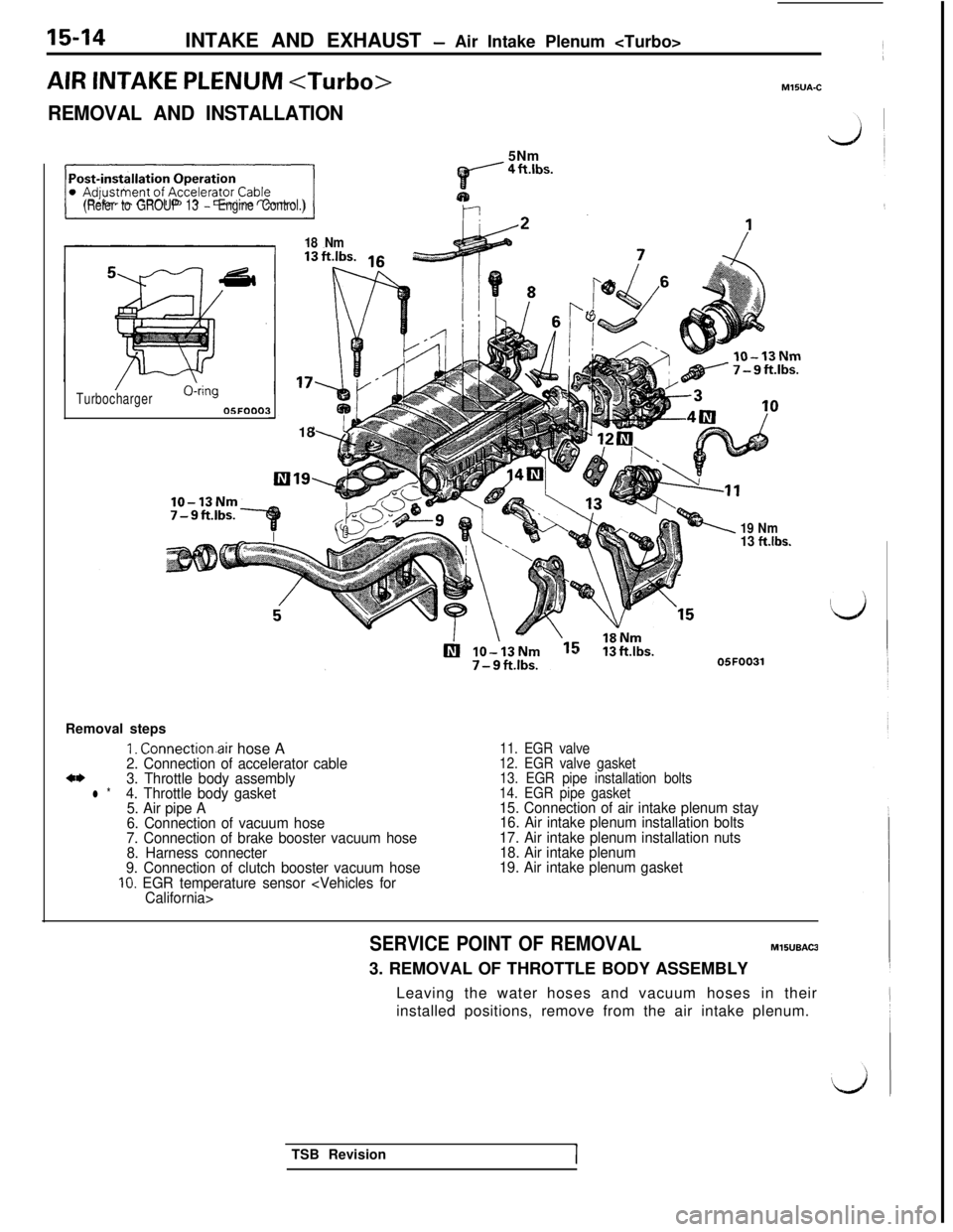
AIR INTAKE PLENUM
REMOVAL AND INSTALLATION
(Refer to GROUP 13 - Engine Control.)
/TurbochargerO&gOSFOOOS5Nm
L
18 Nm18
19 Nm13 ft.lbs.
-05FOO31Removal steps
I. Connection.air hose A2. Connection of accelerator cablea*3. Throttle body assemblyl *4. Throttle body gasket
5. Air pipe A
6. Connection of vacuum hose
7. Connection of brake booster vacuum hose
8. Harness connecter
9. Connection of clutch booster vacuum hose
10. EGR temperature sensor
11. EGR valve
12. EGR valve gasket
13. EGR pipe installation bolts
14. EGR pipe gasket
15. Connection of air intake plenum stay
16. Air intake plenum installation bolts
17. Air intake plenum installation nuts
18. Air intake plenum
19. Air intake plenum gasket
SERVICE POINT OF REMOVALM15UBAU3. REMOVAL OF THROTTLE BODY ASSEMBLY
Leaving the water hoses and vacuum hoses in their
installed positions, remove from the air intake plenum.
TSB Revision
Page 366 of 1146
21-8CLUTCH - Clutch Pedal
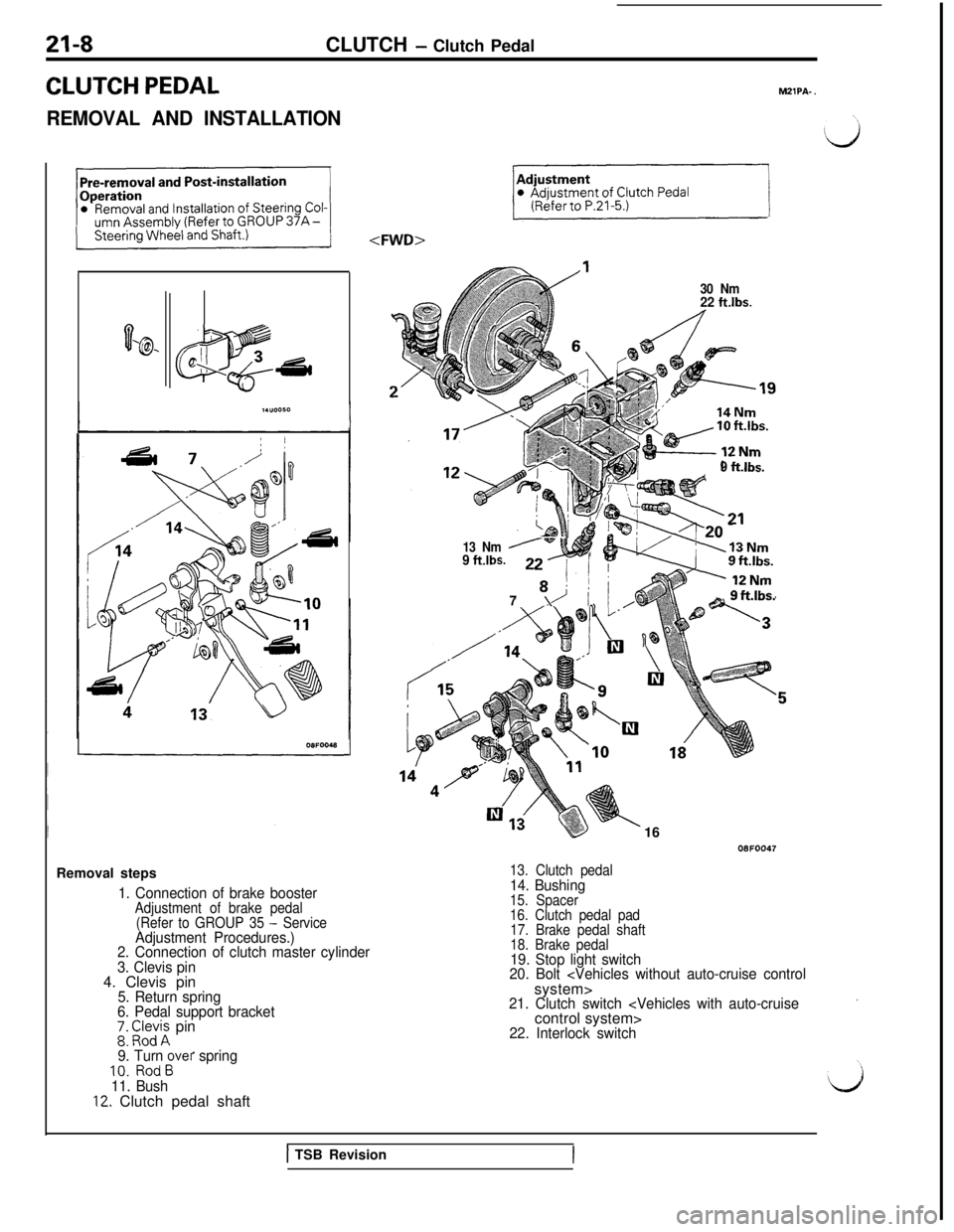
CLUTCH PEDAL
REMOVAL AND INSTALLATIONMZlPA-
.
0‘@- D.,
a
;
IGsdRemoval steps
1. Connection of brake boosterAdjustment of brake pedal
(Refer to GROUP 35 - ServiceAdjustment Procedures.)
2. Connection of clutch master cylinder
3. Clevis pin4. Clevis pin
5. Return spring
6. Pedal support bracket
;: EIe;i; pin
9. Turn over spring10. RodB
11. Bush
12. Clutch pedal shaft
30 Nm22 ftlbs.
9 ft.lbs.
13 Nm
9 ft.lbs.Gw+,
8 !!
79 I_a 9ft.lbs.
k1608FOO47
13. Clutch pedal14. Bushing15. Spacer
16. Clutch pedal pad
17. Brake pedal shaft
18. Brake pedal
19. Stop light switch
20. Bolt
21. Clutch switch
22. Interlock switch
1 TSB Revision
Page 367 of 1146
IICLUTCH - Clutch Pedal
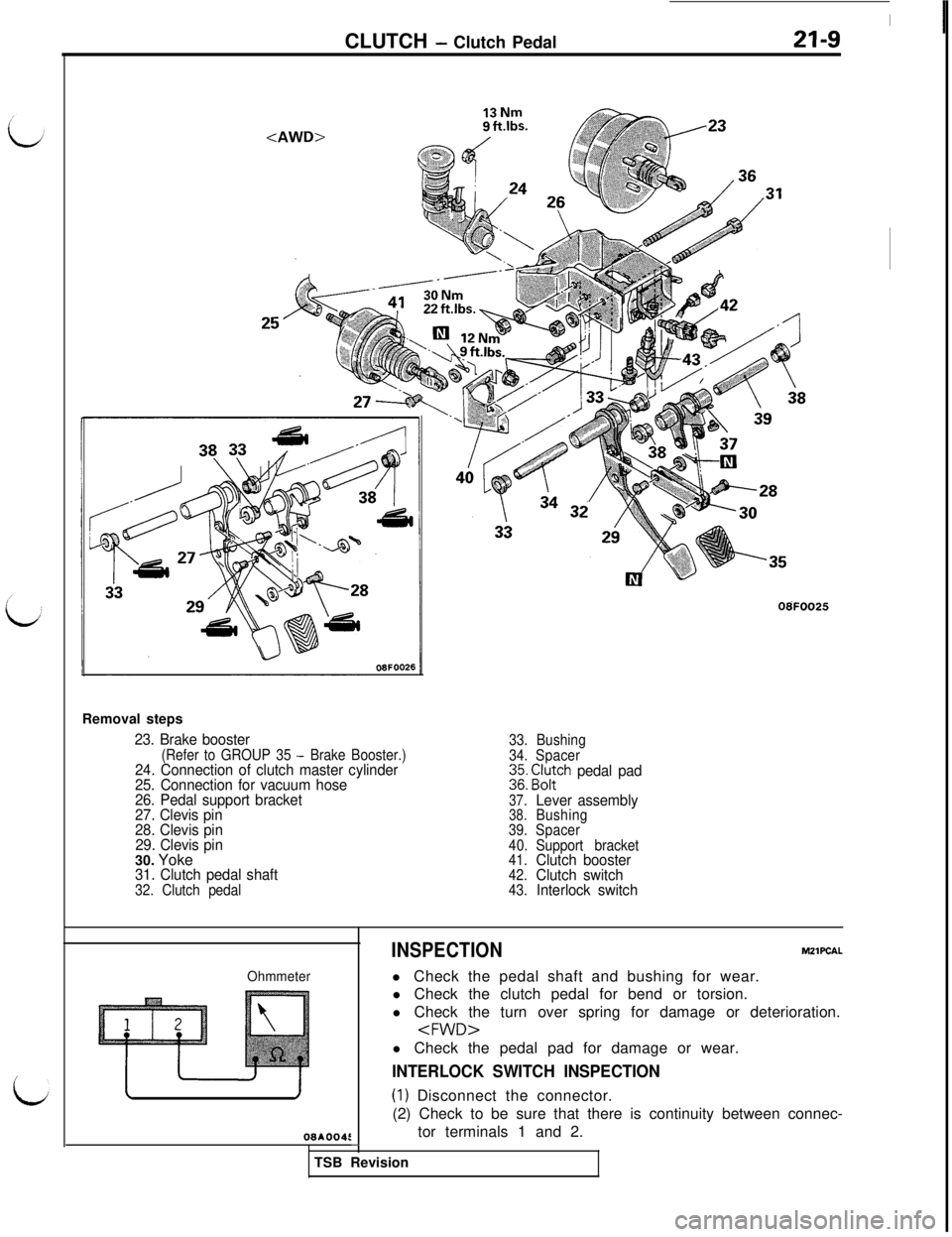
23. Brake booster(Refer to GROUP 35 - Brake Booster.)24. Connection of clutch master cylinder
25. Connection for vacuum hose
26. Pedal support bracket
27. Clevis pin
28. Clevis pin
29. Clevis pin30. Yoke
31. Clutch pedal shaft32. Clutch pedal08FOO25
33.Bushing
34.Spacer
$ E$ch pedal pad
37.Lever assembly38.Bushing
39.Spacer
40.Support bracket
41.
Clutch booster42.Clutch switch43.Interlock switch
Ohmmeter
08AOO4L
INSPECTIONMZlPCAL
l Check the pedal shaft and bushing for wear.
l Check the clutch pedal for bend or torsion.
l Check the turn over spring for damage or deterioration.
INTERLOCK SWITCH INSPECTION
(1) Disconnect the connector.
(2) Check to be sure that there is continuity between connec-
tor terminals 1 and 2.
-TSB Revision
Page 368 of 1146
a-10CLUTCH - Clutch Control
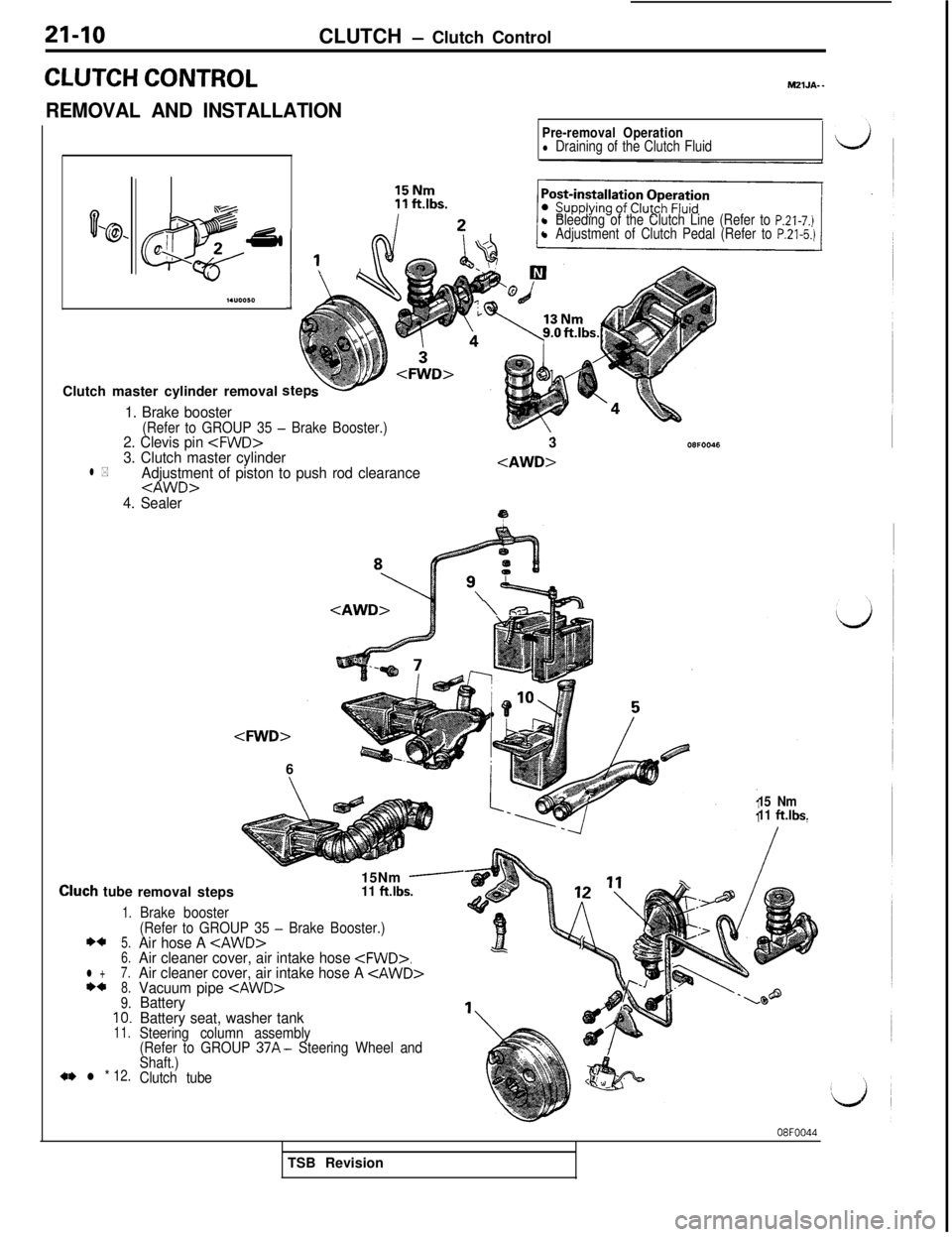
CLUTCH CONTROL
REMOVAL AND INSTALLATIONMZlJA-
-
03% J 2’ti
m
I.“0050I
Pre-removal Operationl Draining of the Clutch Fluid
l Bleeding of the Clutch Line (Refer to P.21-7.)l Adjustment of Clutch Pedal (Refer to P.21-5.)Clutch master cylinder removalstep
1. Brake booster(Refer to GROUP 35 - Brake Booster.)2. Clevis pin
4. Sealer3
9
Cluch tube
1.
**5.
6.
l +7.**8.9.IO.11.
a* l * 12.
removal steps
Brake booster15Nm
-11 ft.lbs.
(Refer to GROUP 35
- Brake Booster.)Air hose A
Battery seat, washer tank
Steering column assembly
(Refer to GROUP 37A- Steering Wheel and
Shaft.)
Clutch tube15 Nm
11
ft.lbs.
08FOO44TSB Revision
Page 371 of 1146
CLUTCH - Clutch Control21-13
14UOO6514U006t14GOO50
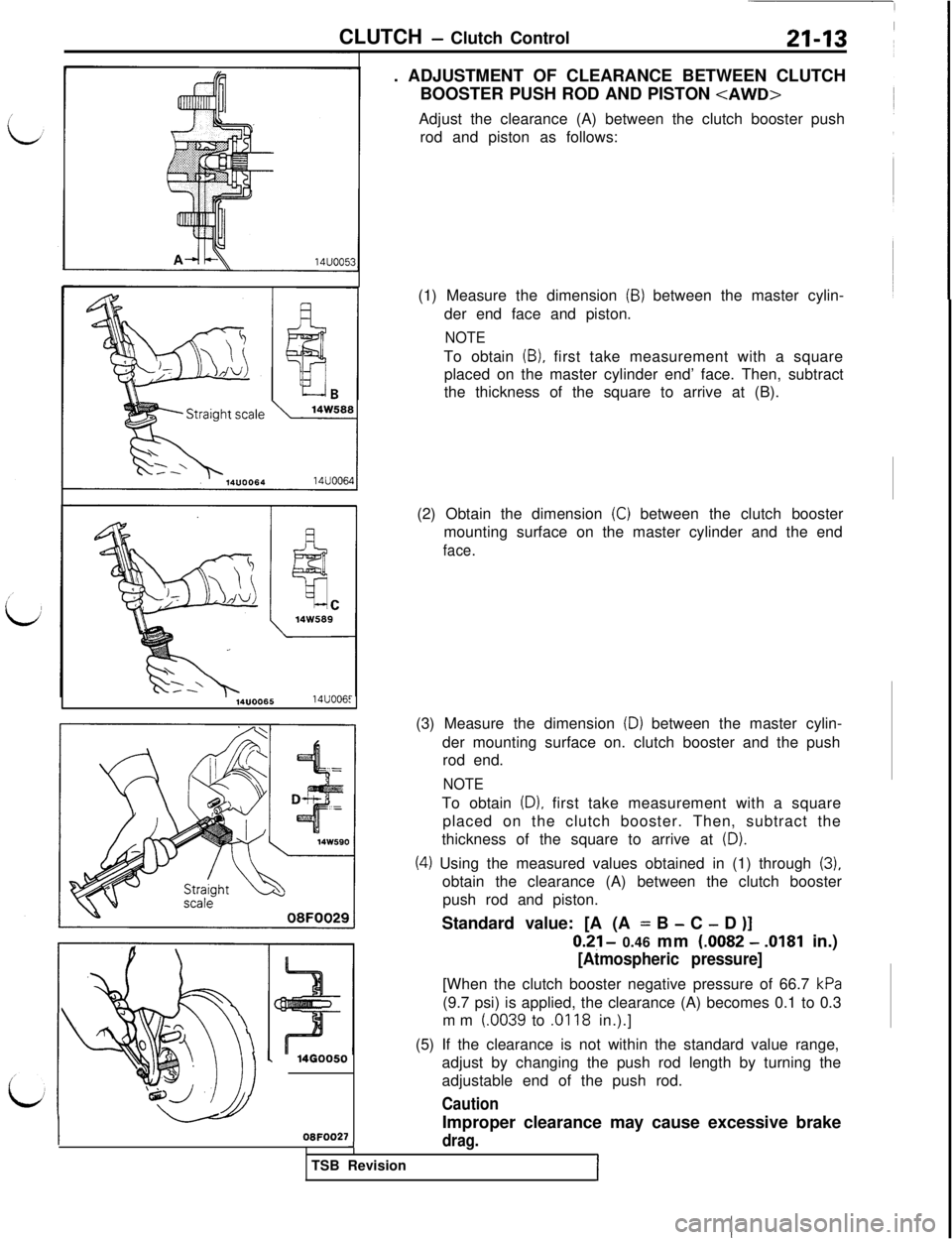
08FOO27. ADJUSTMENT OF CLEARANCE BETWEEN CLUTCH
BOOSTER PUSH ROD AND PISTON
rod and piston as follows:
(1) Measure the dimension
(B) between the master cylin-
der end face and piston.
NOTETo obtain
(B), first take measurement with a square
placed on the master cylinder end’ face. Then, subtract
the thickness of the square to arrive at (B).
(2) Obtain the dimension
(C) between the clutch booster
mounting surface on the master cylinder and the end
face.(3) Measure the dimension
(D) between the master cylin-
der mounting surface on. clutch booster and the push
rod end.
NOTETo obtain
(D). first take measurement with a square
placed on the clutch booster. Then, subtract the
thickness of the square to arrive at
(D).
(4) Using the measured values obtained in (1) through (3).obtain the clearance (A) between the clutch booster
push rod and piston.
Standard value: [A (A = B
- C - D )]
0.2j - 0.46 mm (.0082 - .0181 in.)
[Atmospheric pressure][When the clutch booster negative pressure of 66.7
kPa(9.7 psi) is applied, the clearance (A) becomes 0.1 to 0.3
mm
(.0039 to .0118 in.).]
(5) If the clearance is not within the standard value range,
adjust by changing the push rod length by turning the
adjustable end of the push rod.
CautionImproper clearance may cause excessive brake
drag.JTSB Revision
I
Page 373 of 1146
CLUTCH - Clutch Release Cylinder21-15
CLUTCH RELEASE CYLINDER
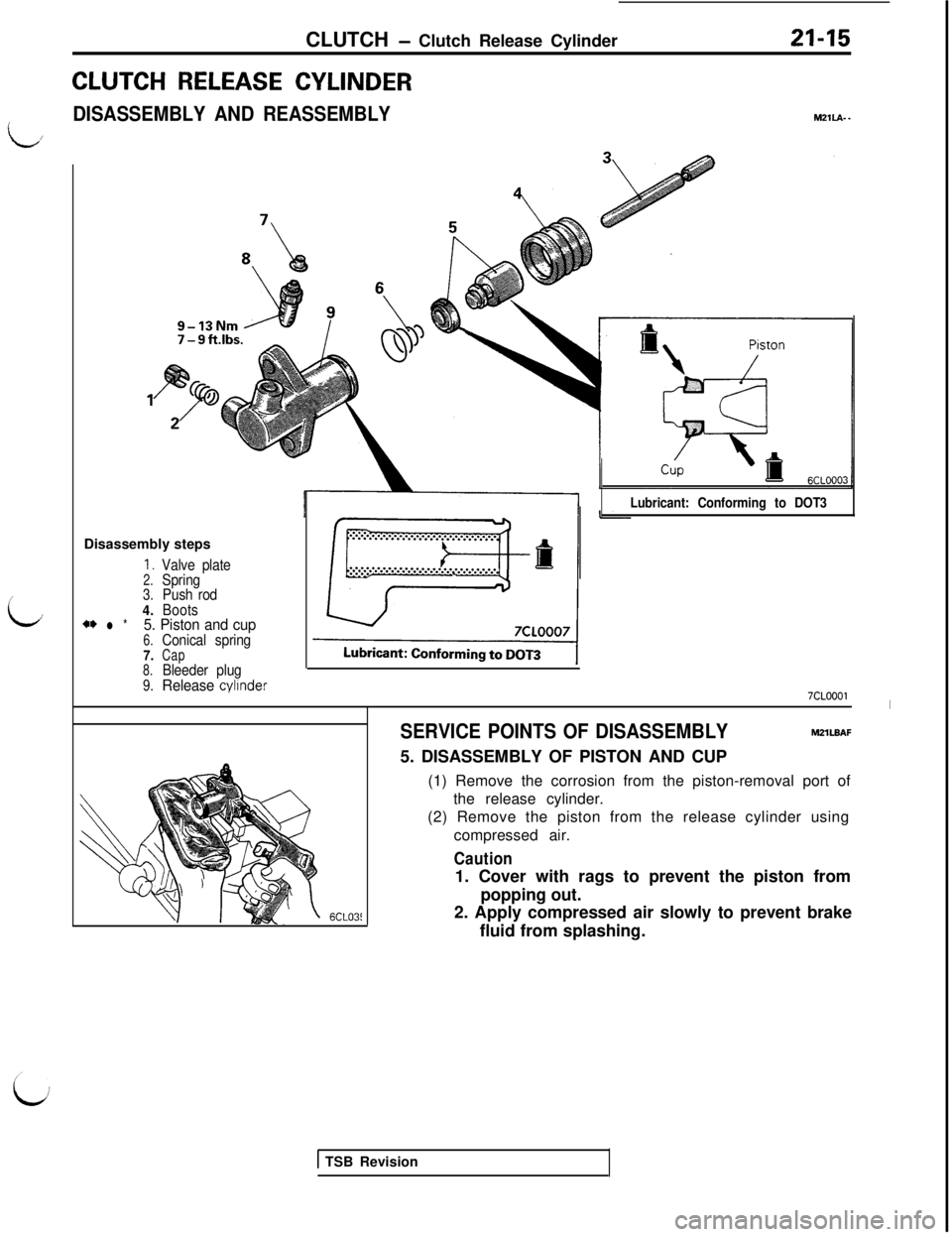
DISASSEMBLY AND REASSEMBLY
L.4/
/
iJ
Lubricant: Conforming to DOT3Disassembly steps
1.Valve plate2.Spring3.Push rod4.Boots*I) l *5. Piston and cup6.Conical spring
7.Cap
8.Bleeder plug9.Release cylinder7CLOOOl
6CLO3!
SERVICE POINTS OF DISASSEMBLYM2lLBAF5. DISASSEMBLY OF PISTON AND CUP
(1) Remove the corrosion from the piston-removal port of
the release cylinder.
(2) Remove the piston from the release cylinder using
compressed air.
Caution1. Cover with rags to prevent the piston from
popping out.
2. Apply compressed air slowly to prevent brake
fluid from splashing.
1 TSB Revision
Page 374 of 1146
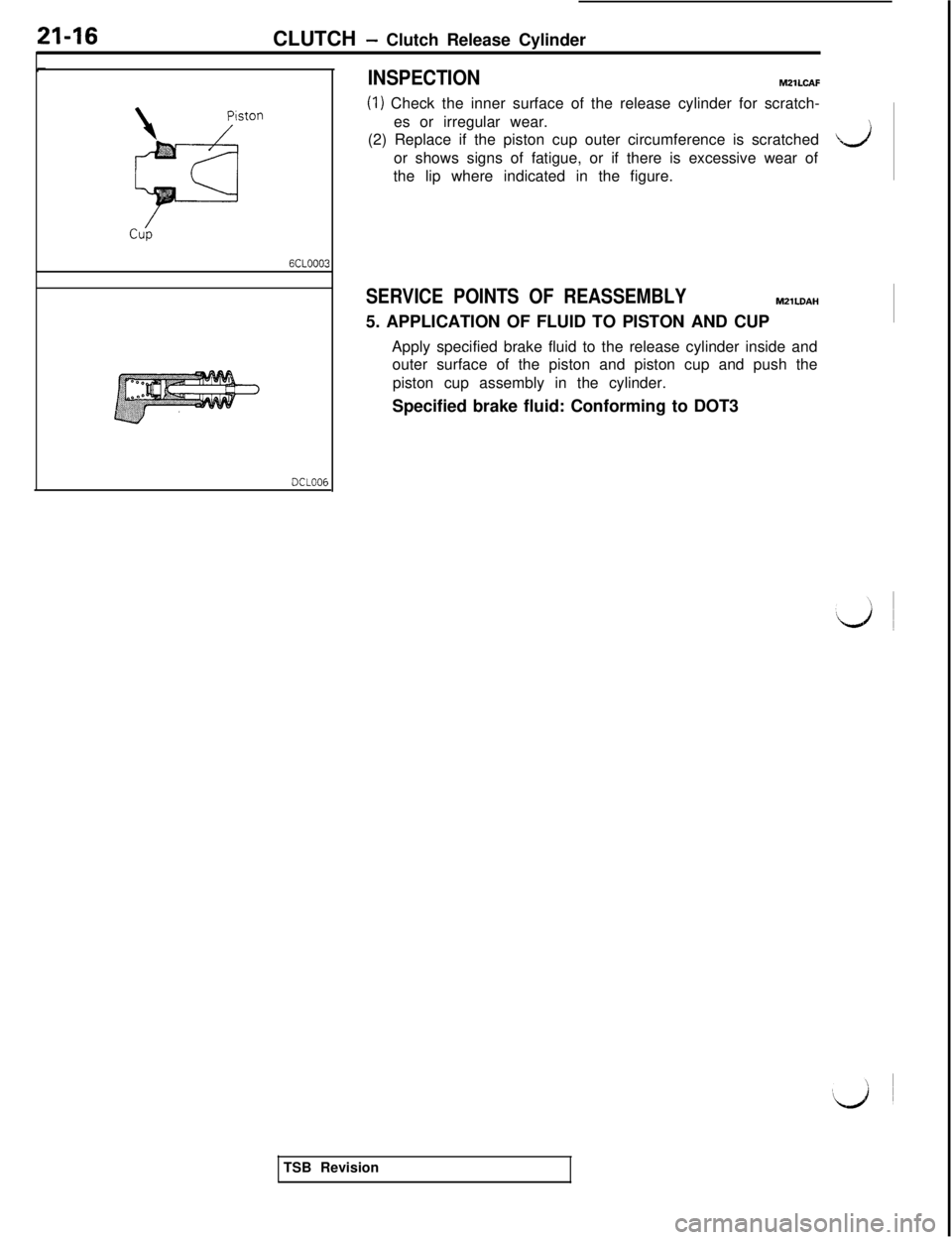
21-16CLUTCH - Clutch Release Cylinder
6CLOOO3
DCLOOE,
INSPECTIONM21LCAF
(1) Check the inner surface of the release cylinder for scratch-
es or irregular wear.
(2) Replace if the piston cup outer circumference is scratched
LIor shows signs of fatigue, or if there is excessive wear of
the lip where indicated in the figure.
SERVICE POINTS OF REASSEMBLYMZlLDAH
5. APPLICATION OF FLUID TO PISTON AND CUP
Apply specified brake fluid to the release cylinder inside and
outer surface of the piston and piston cup and push the
piston cup assembly in the cylinder.
Specified brake fluid: Conforming to DOT3
TSB Revision