service indicator MITSUBISHI 3000GT 1991 Owner's Manual
[x] Cancel search | Manufacturer: MITSUBISHI, Model Year: 1991, Model line: 3000GT, Model: MITSUBISHI 3000GT 1991Pages: 1146, PDF Size: 76.68 MB
Page 805 of 1146
SERVICE BRAKES - Rear Disc Brake35-83
:FWD>
27 Nm20 ft.lbs.
6
Illi ’I13
-
11"?"L
pi,
d $A,, :;y,
44 4% w403.57
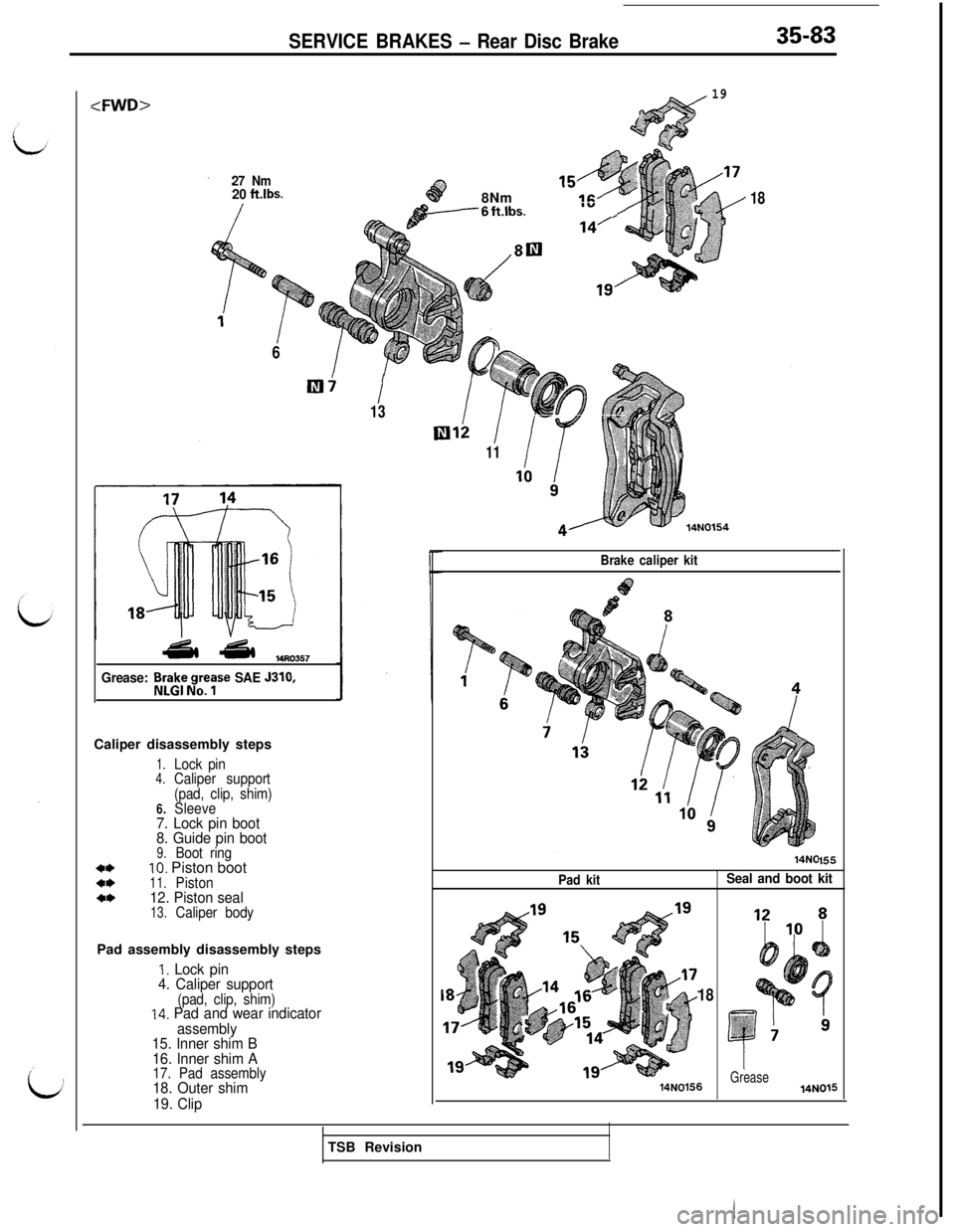
Grease: Br3rt;ty SAE J310,Caliper disassembly steps
1.Lock pin4.Caliper support
(pad, clip, shim)
6.Sleeve7. Lock pin boot
8. Guide pin boot
9.Boot ring*I)10. Piston boot*I)11.Piston*+12. Piston seal13.Caliper bodyPad assembly disassembly steps
1. Lock pin
4. Caliper support
(pad, clip, shim)14. Pad and wear indicator
assembly
15. Inner shim B
16. Inner shim A
17. Pad assembly18. Outer shim
19. Clip
w
19".*:a;*4~. ,/'.*"+:-r
48Nm&&----6ft.lbs.18I”,
Brake caliper kit
Pad kit
155
Seal and boot kit
18
14N0156Grease14N015TSB Revision
Page 807 of 1146
SERVICE BRAKES - Rear Disc Brake35-85
i
id14N0131
i
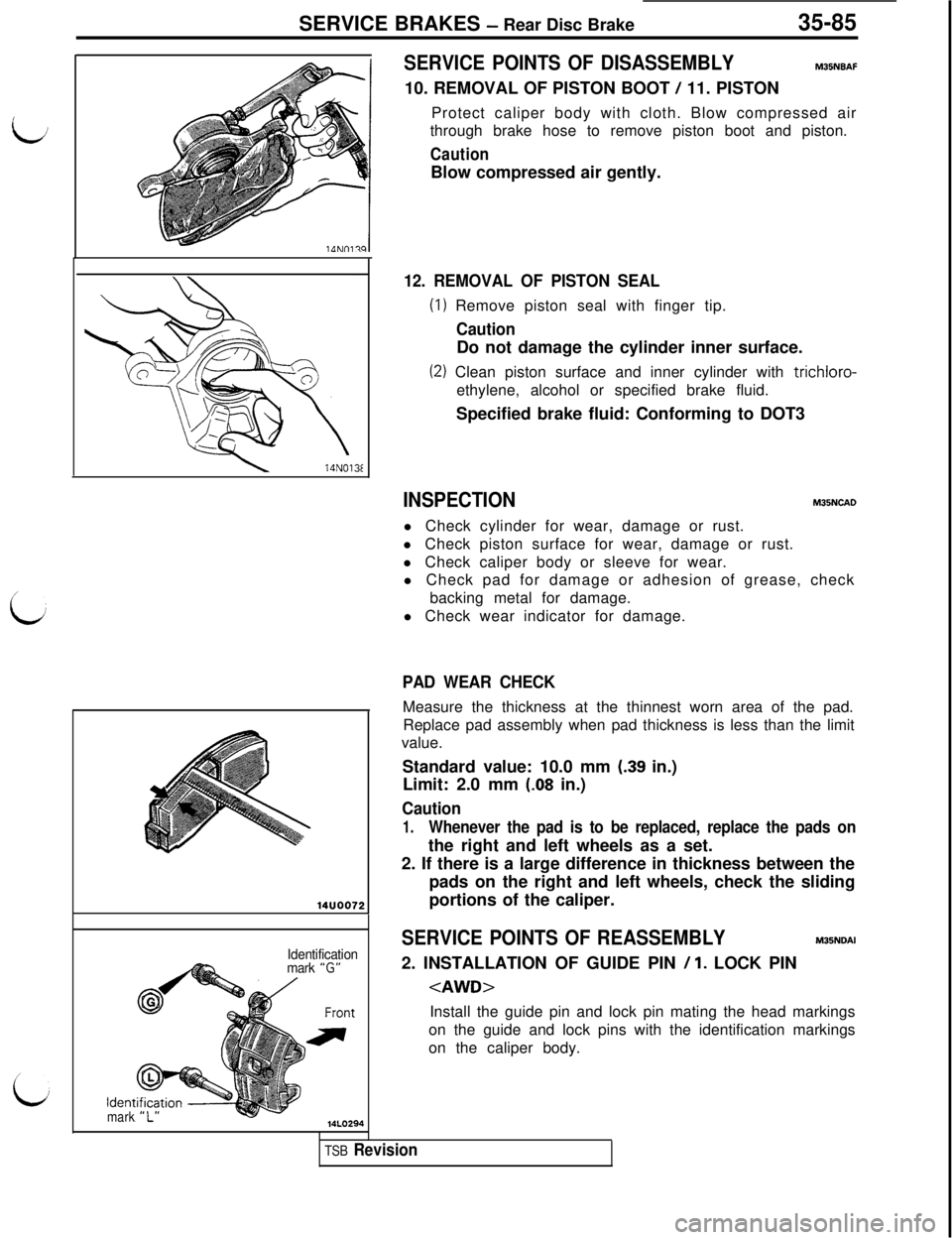
SERVICE POINTS OF DISASSEMBLYM35NBAF10. REMOVAL OF PISTON BOOT
/ 11. PISTON
Protect caliper body with cloth. Blow compressed air
through brake hose to remove piston boot and piston.
CautionBlow compressed air gently.
12. REMOVAL OF PISTON SEAL
(I) Remove piston seal with finger tip.
CautionDo not damage the cylinder inner surface.
(2) Clean piston surface and inner cylinder with trichloro-
ethylene, alcohol or specified brake fluid.
Specified brake fluid: Conforming to DOT3
INSPECTIONM35NCAOl Check cylinder for wear, damage or rust.
l Check piston surface for wear, damage or rust.
l Check caliper body or sleeve for wear.
l Check pad for damage or adhesion of grease, check
backing metal for damage.
l Check wear indicator for damage.
PAD WEAR CHECKMeasure the thickness at the thinnest worn area of the pad.
Replace pad assembly when pad thickness is less than the limit
value.
Standard value: 10.0 mm
(39 in.)
Limit: 2.0 mm
(.08 in.)
Caution
1.Whenever the pad is to be replaced, replace the pads onthe right and left wheels as a set.
2. If there is a large difference in thickness between the
pads on the right and left wheels, check the sliding
portions of the caliper.
Identification
mark “G”
ldentmark
SERVICE POINTS OF REASSEMBLYM35NOAI2. INSTALLATION OF GUIDE PIN
/ 1. LOCK PIN
on the guide and lock pins with the identification markings
on the caliper body.
TSB Revision
Page 948 of 1146
51-10EXTERIOR - Service Adjustment Procedures
68FOO51
Multl-use tester
,SERVICE ADJUSTMENT PROCEDURES
INSPECTION OF ACTIVE AERO SYSTEM
1. INSPECTION BY WARNING LIGHT
d!Turn the ignition switch from “OFF” to “ON” to see if the
warning light is lit for approx. three seconds and then goes
out. If not, replace the control unit.
NOTE
(1) The active aero control unit has a self-check function
which is designed as follows: Turn the ignition switch
from “OFF” to “ON”. If the unit is in normal condition,
the warning light is lit for approx. three seconds and
then goes out.
(2) If the front venturi skirt does not return to the standard
condition properly in normal use, the warning light
comes on
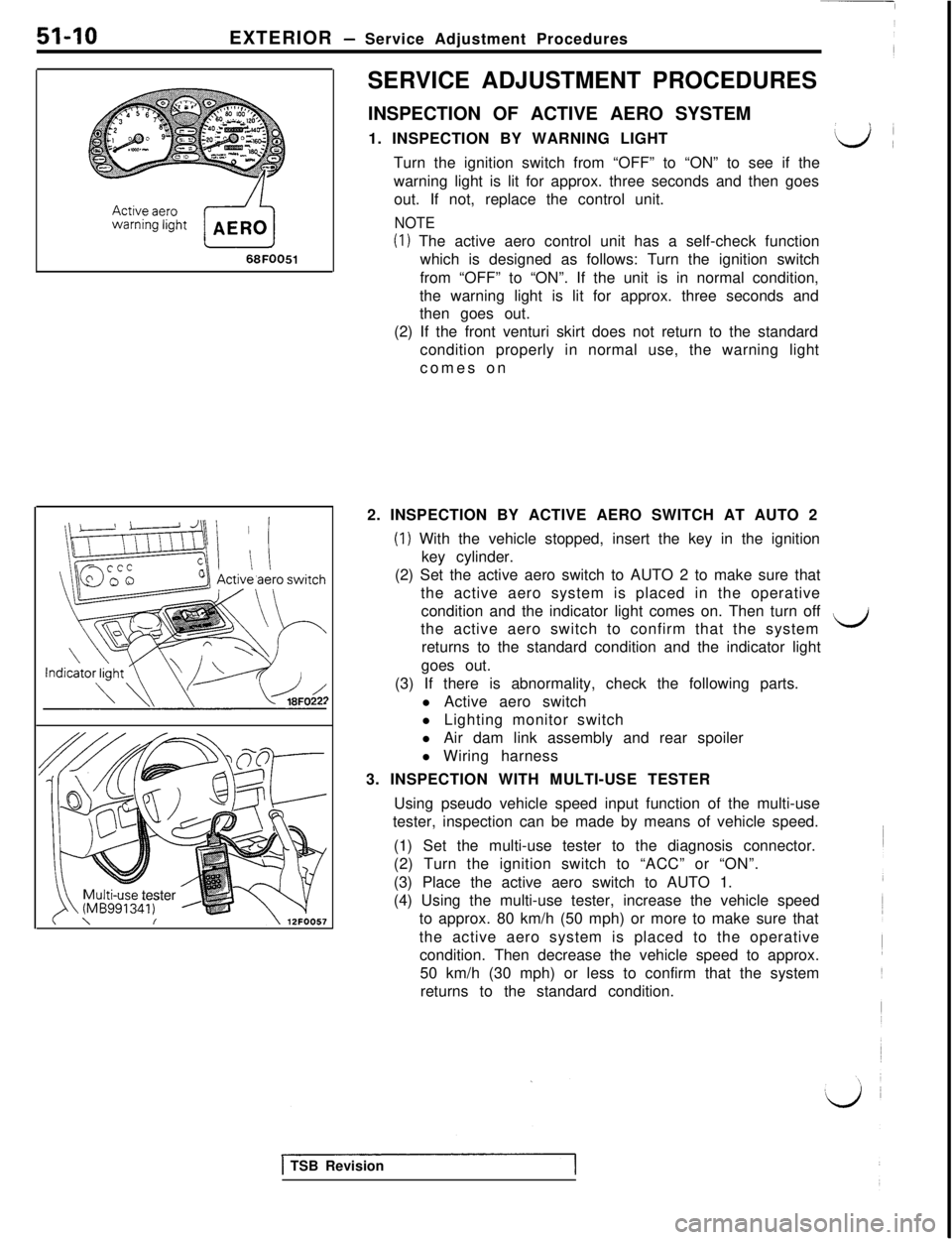
2. INSPECTION BY ACTIVE AERO SWITCH AT AUTO 2
(1) With the vehicle stopped, insert the key in the ignition
key cylinder.
(2) Set the active aero switch to AUTO 2 to make sure that
the active aero system is placed in the operative
condition and the indicator light comes on. Then turn off
the active aero switch to confirm that the system
LCJreturns to the standard condition and the indicator light
goes out.
(3) If there is abnormality, check the following parts.
l Active aero switch
l Lighting monitor switch
l Air dam link assembly and rear spoiler
l Wiring harness
3. INSPECTION WITH MULTI-USE TESTER
Using pseudo vehicle speed input function of the multi-use
tester, inspection can be made by means of vehicle speed.
(1) Set the multi-use tester to the diagnosis connector.
(2) Turn the ignition switch to “ACC” or “ON”.
(3) Place the active aero switch to AUTO 1.
(4) Using the multi-use tester, increase the vehicle speed
to approx. 80 km/h (50 mph) or more to make sure that
the active aero system is placed to the operative
condition. Then decrease the vehicle speed to approx.
50 km/h (30 mph) or less to confirm that the system
returns to the standard condition.
1 TSB Revision
Page 1077 of 1146
Air Bag Module
SUPPLEMENTAL RESTRAINT SYSTEM (SRS) - and Clock Spring52B-67Multi-use Testkr
ROM pack
(MB991 341)(MB991 359)
Diagnosis/
service
data
oumutGround
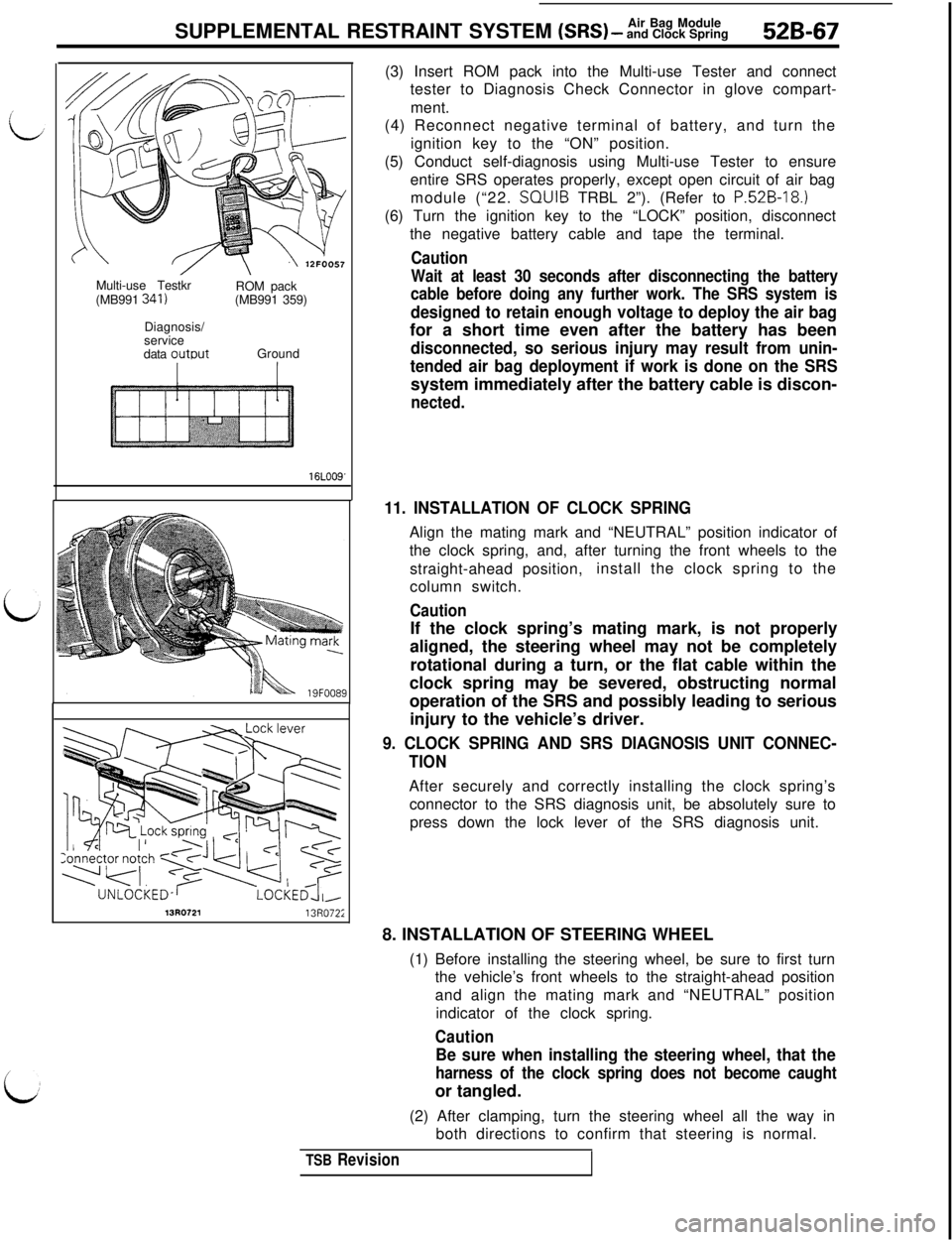
16LOO9'(3) Insert ROM pack into the Multi-use Tester and connect
tester to Diagnosis Check Connector in glove compart-
ment.
(4) Reconnect negative terminal of battery, and turn the
ignition key to the “ON” position.
(5) Conduct self-diagnosis using Multi-use Tester to ensure
entire SRS operates properly, except open circuit of air bag
module (“22. SQUIB TRBL 2”). (Refer to
P.52B-18.)(6) Turn the ignition key to the “LOCK” position, disconnect
the negative battery cable and tape the terminal.
Caution
Wait at least 30 seconds after disconnecting the battery
cable before doing any further work. The SRS system is
designed to retain enough voltage to deploy the air bagfor a short time even after the battery has been
disconnected, so serious injury may result from unin-
tended air bag deployment if work is done on the SRSsystem immediately after the battery cable is discon-
nected.
11. INSTALLATION OF CLOCK SPRINGAlign the mating mark and “NEUTRAL” position indicator of
the clock spring, and, after turning the front wheels to the
straight-ahead position,install the clock spring to the
column switch.
CautionIf the clock spring’s mating mark, is not properly
aligned, the steering wheel may not be completely
rotational during a turn, or the flat cable within the
clock spring may be severed, obstructing normal
operation of the SRS and possibly leading to serious
injury to the vehicle’s driver.
9. CLOCK SPRING AND SRS DIAGNOSIS UNIT CONNEC-
TIONAfter securely and correctly installing the clock spring’s
connector to the SRS diagnosis unit, be absolutely sure to
press down the lock lever of the SRS diagnosis unit.
13R072113R072;8. INSTALLATION OF STEERING WHEEL
(1) Before installing the steering wheel, be sure to first turn
the vehicle’s front wheels to the straight-ahead position
and align the mating mark and “NEUTRAL” position
indicator of the clock spring.
Caution
Be sure when installing the steering wheel, that the
harness of the clock spring does not become caughtor tangled.
(2) After clamping, turn the steering wheel all the way in
both directions to confirm that steering is normal.
TSB Revision
Page 1092 of 1146
55-10 HEATERS AND MANUAL AIR CONDITIONER -Service Adjustment Procedures
OFF-----__-__1210235 2,1002,700
(30) (33)(299) (384)
Pressure Fil
2OPOOlL
SERVICE ADJUSTMENT PROCEDURES
M55FEAU
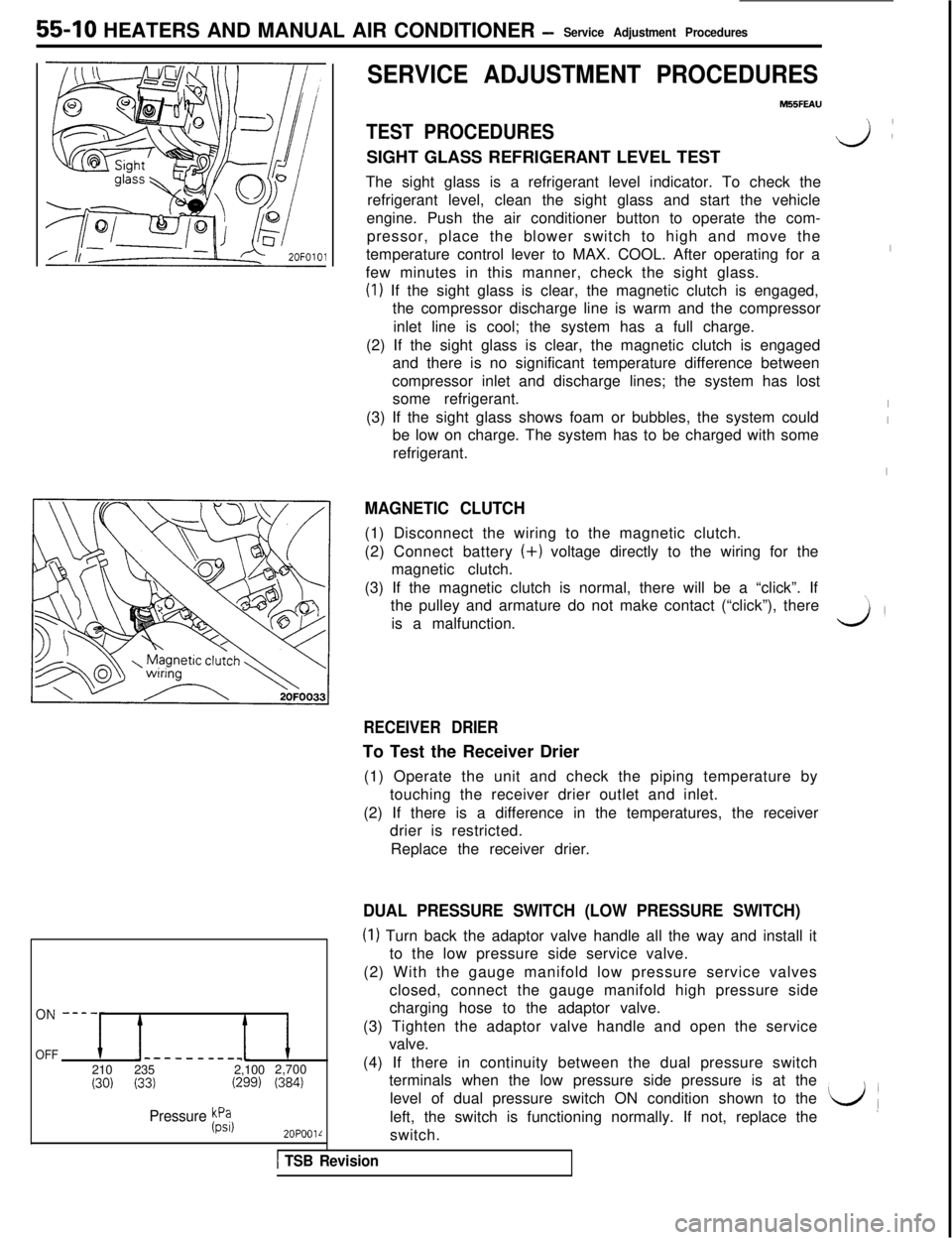
TEST PROCEDURESSIGHT GLASS REFRIGERANT LEVEL TEST
The sight glass is a refrigerant level indicator. To check the
refrigerant level, clean the sight glass and start the vehicle
engine. Push the air conditioner button to operate the com-
pressor, place the blower switch to high and move the
temperature control lever to MAX. COOL. After operating for a
few minutes in this manner, check the sight glass.
(I) If the sight glass is clear, the magnetic clutch is engaged,
the compressor discharge line is warm and the compressor
inlet line is cool; the system has a full charge.
(2) If the sight glass is clear, the magnetic clutch is engaged
and there is no significant temperature difference between
compressor inlet and discharge lines; the system has lost
some refrigerant.
(3) If the sight glass shows foam or bubbles, the system could
be low on charge. The system has to be charged with some
refrigerant.
MAGNETIC CLUTCH(1) Disconnect the wiring to the magnetic clutch.
(2) Connect battery (+) voltage directly to the wiring for the
magnetic clutch.
(3) If the magnetic clutch is normal, there will be a “click”. If
the pulley and armature do not make contact (“click”), there
is a malfunction.
v):
I
I
I
I
\,
3’
RECEIVER DRIERTo Test the Receiver Drier
(1) Operate the unit and check the piping temperature by
touching the receiver drier outlet and inlet.
(2) If there is a difference in the temperatures, the receiver
drier is restricted.
Replace the receiver drier.
DUAL PRESSURE SWITCH (LOW PRESSURE SWITCH)
(I) Turn back the adaptor valve handle all the way and install it
to the low pressure side service valve.
(2) With the gauge manifold low pressure service valves
closed, connect the gauge manifold high pressure side
charging hose to the adaptor valve.
(3) Tighten the adaptor valve handle and open the service
valve.
(4) If there in continuity between the dual pressure switch
terminals when the low pressure side pressure is at the
level of dual pressure switch ON condition shown to the
left, the switch is functioning normally. If not, replace the
L/(switch.
1 TSB Revision