air bleeding MITSUBISHI 3000GT 1991 Service Manual
[x] Cancel search | Manufacturer: MITSUBISHI, Model Year: 1991, Model line: 3000GT, Model: MITSUBISHI 3000GT 1991Pages: 1146, PDF Size: 76.68 MB
Page 368 of 1146
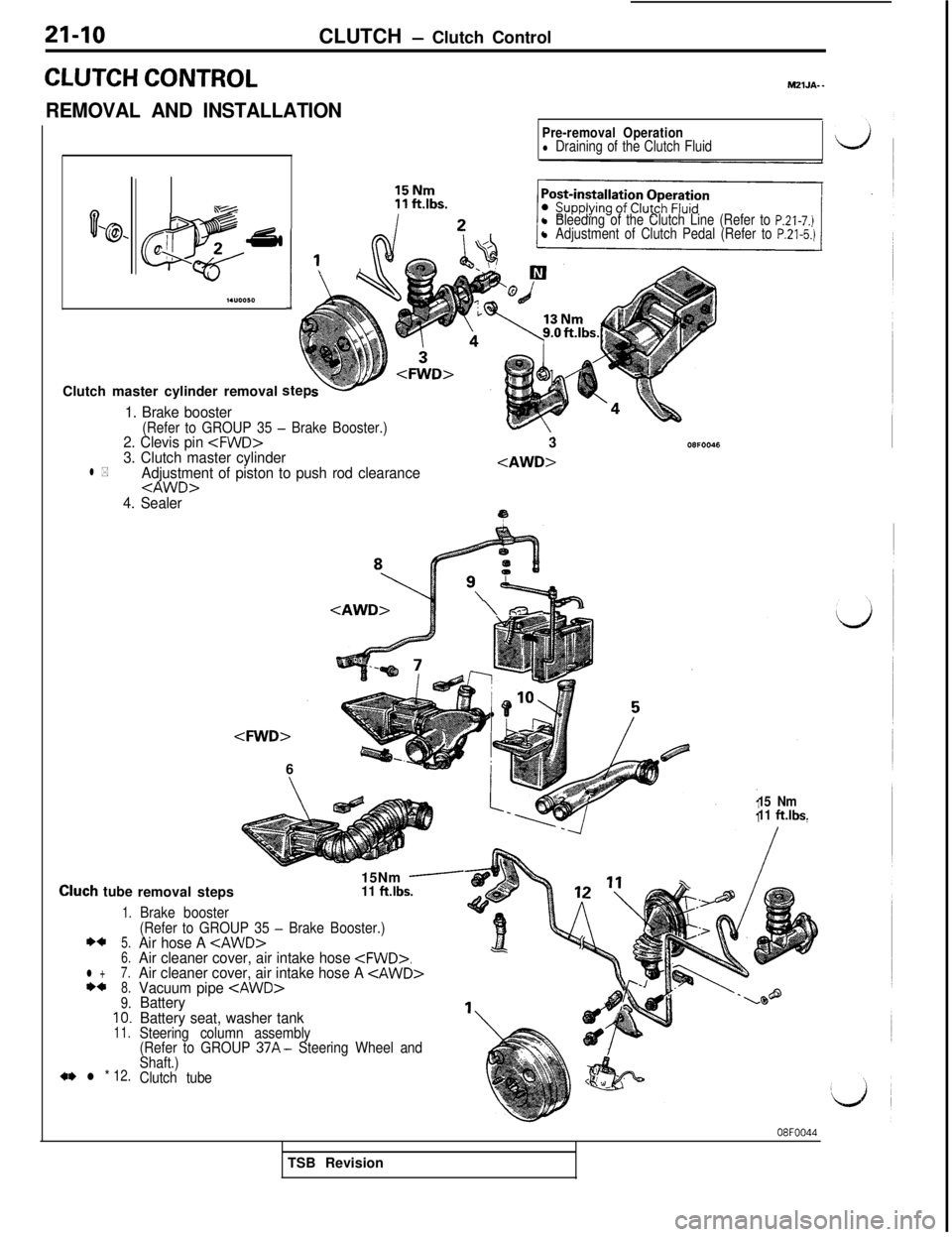
a-10CLUTCH - Clutch Control
CLUTCH CONTROL
REMOVAL AND INSTALLATIONMZlJA-
-
03% J 2’ti
m
I.“0050I
Pre-removal Operationl Draining of the Clutch Fluid
l Bleeding of the Clutch Line (Refer to P.21-7.)l Adjustment of Clutch Pedal (Refer to P.21-5.)Clutch master cylinder removalstep
1. Brake booster(Refer to GROUP 35 - Brake Booster.)2. Clevis pin
4. Sealer3
9
Cluch tube
1.
**5.
6.
l +7.**8.9.IO.11.
a* l * 12.
removal steps
Brake booster15Nm
-11 ft.lbs.
(Refer to GROUP 35
- Brake Booster.)Air hose A
Battery seat, washer tank
Steering column assembly
(Refer to GROUP 37A- Steering Wheel and
Shaft.)
Clutch tube15 Nm
11
ft.lbs.
08FOO44TSB Revision
Page 648 of 1146
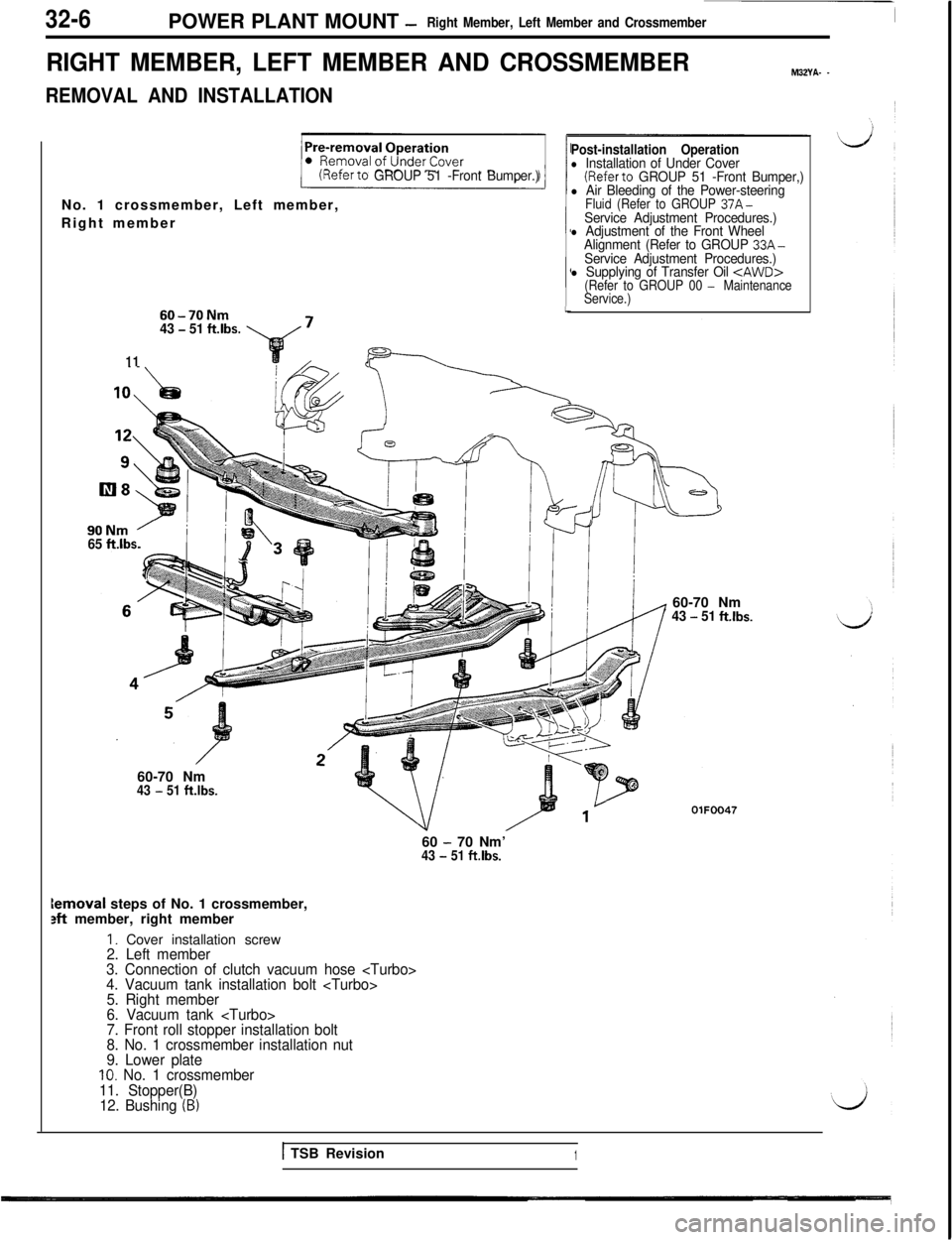
32-6POWER PLANT MOUNT -Right Member, Left Member and Crossmember
RIGHT MEMBER, LEFT MEMBER AND CROSSMEMBER
I
M32YA- _
REMOVAL AND INSTALLATION
(Referto GROUP 51 -Front Bumper.)No. 1 crossmember, Left member,
Right member
60-70Nm43 - 51 ft.lbs.
11
F=----lL90Nm
’65 ft.lbs.
/I
Post-installation Operationl Installation of Under Cover(Referto GROUP 51 -Front Bumper,)l Air Bleeding of the Power-steeringFluid (Refer to GROUP 37A-Service Adjustment Procedures.)l Adjustment of the Front Wheel
Alignment (Refer to GROUP 33A-Service Adjustment Procedures.)l Supplying of Transfer Oil
Service.)60-70 Nm
43 - 51 ft.lbs.60-70 Nm
43 - 51 ftlbs.
/aa lVOiFOO4760
- 70 Nm’43 - 51 ft.lbs.lemoval steps of No. 1 crossmember,
M member, right member
I. Cover installation screw2. Left member
3. Connection of clutch vacuum hose
4. Vacuum tank installation bolt
5. Right member
6. Vacuum tank
7. Front roll stopper installation bolt
8. No. 1 crossmember installation nut
9. Lower plate
10. No. 1 crossmember
11. Stopper(B)
12. Bushing
(B)
1 TSB Revision1
Page 723 of 1146
L,
SERVICE
BRAKES
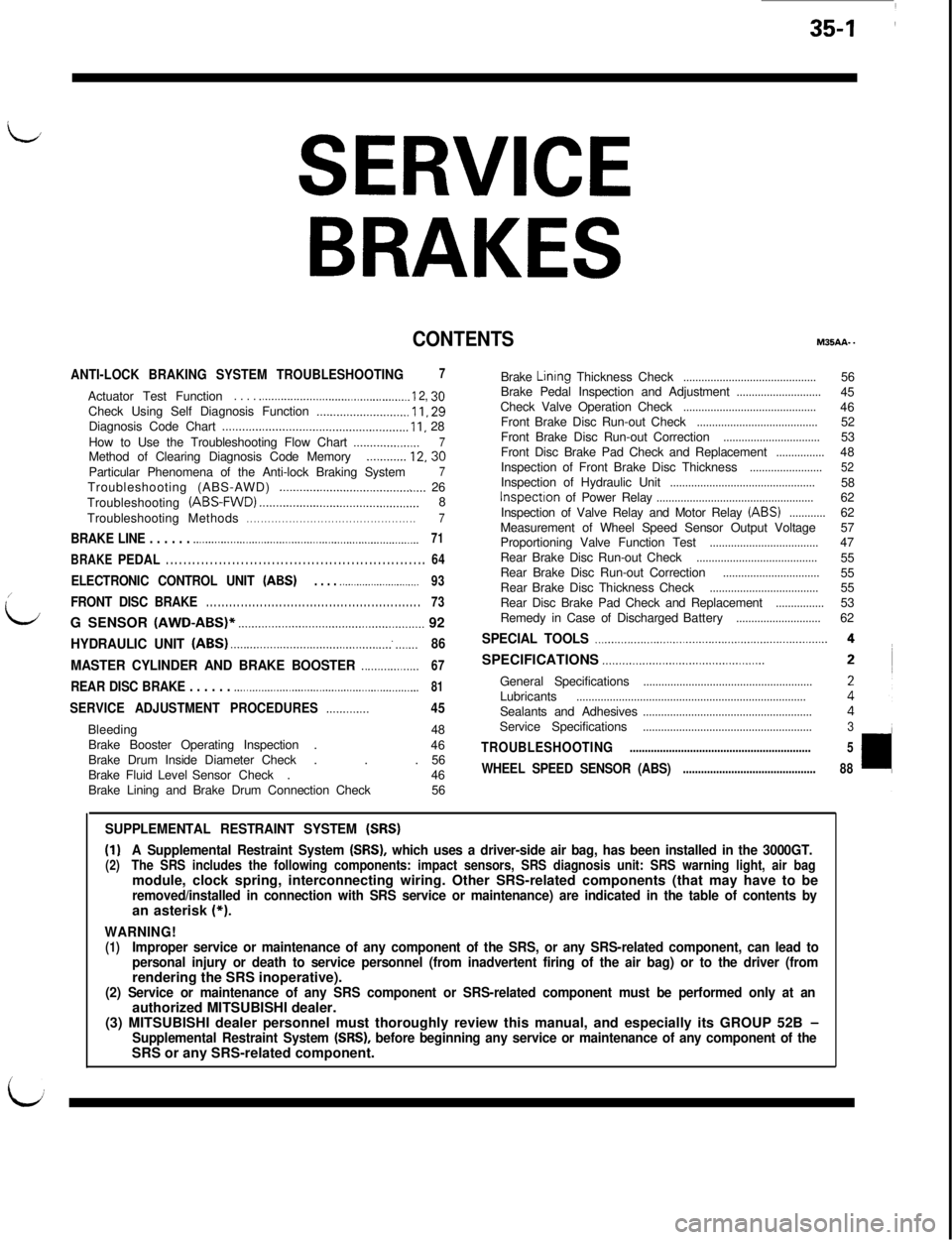
CONTENTSM35AA..
ANTI-LOCK BRAKING SYSTEM TROUBLESHOOTING7Actuator Test Function
. . . . ..___..._____.__................................ I 2, 36Check Using Self Diagnosis Function __._.....,_._.._____........ 11, 28
Diagnosis Code Chart ..,,........,......_..................................,. 1 I, 28
How to Use the Troubleshooting Flow Chart
_____.___......._._.7Method of Clearing Diagnosis Code Memory._.,._...... 12, 30
Particular Phenomena of the Anti-lock Braking System
7Troubleshooting (ABS-AWD) ._______._.._...........................,... 26
Troubleshooting (ABS-FWD) ______.._._........_...........,.....,.....,....8
TroubleshootingMethods. . . . . . . . . . . . . . . . . . . . . . . . . . . . . . . . . . . . . . . . . . . . . . . .7
BRAKE LINE . . . . . . .._.......................................................................71
BRAKEPEDAL. . . . . . . . . . . . . . . . . . . . . . . . . . . . . . . . . . . . . . . . . . . . . . . . . . . . . . . . . . .64
ELECTRONIC CONTROL UNIT (ABS). . . . .._._..___..__._............93/
L
FRONT DISC BRAKE. . . . . . . . . . . . . . . . . . . . . . . . . . . . . . . . . . . . . . . . . . . . . . . . . . . . . . . .73G SENSOR (AWD-ABS)’
____.____.___.__._._.................,,......,.....,.... 92
HYDRAULIC UNIT (ABS) .___.._._._._.______.............,...,,..........~ .,_____86
MASTER CYLINDER AND BRAKE BOOSTER ..__.._____.._____67SPECIFICATIONS ._....._.___.....................................
REAR DISC BRAKE . . . . . . .._..._._.___................................................81
SERVICE ADJUSTMENT PROCEDURES..___........45Bleeding48
Brake Booster Operating Inspection.
46
Brake Drum Inside Diameter Check. . .56
BrakeFluidLevelSensor Check.46
Brake Lining and Brake Drum Connection Check56Brake
Linrng Thickness Check............................................Brake Pedal Inspection and Adjustment............................Check Valve Operation Check............................................Front Brake Disc Run-out Check........................................Front Brake Disc Run-out Correction................................Front Disc Brake Pad Check and Replacement................Inspection of Front Brake Disc Thickness........................Inspection of Hydraulic Unit................................................Inspectton of Power Relay....................................................Inspection of Valve Relay and Motor Relay (ABS)............Measurement of Wheel Speed Sensor Output Voltage
Proportioning Valve Function Test
....................................Rear Brake Disc Run-out Check........................................Rear Brake Disc Run-out Correction................................Rear Brake Disc Thickness Check....................................Rear Disc Brake Pad Check and Replacement................Remedy in Case of DischargedBattery............................56
45
46
52
53
48
5258
62
62
57
47
55
55
55
53
62
SPECIAL TOOLS ..__.......___..........................................................General Specifications
........................................................Lubricants............................................................................Sealants and Adhesives........................................................Service Specifications........................................................3
TROUBLESHOOTING............................................................5
WHEEL SPEED SENSOR (ABS)............................................88
SUPPLEMENTAL RESTRAINT SYSTEM (SRS)
(1)A Supplemental Restraint System (SRS), which uses a driver-side air bag, has been installed in the 3000GT.(2)The SRS includes the following components: impact sensors, SRS diagnosis unit: SRS warning light, air bagmodule, clock spring, interconnecting wiring. Other SRS-related components (that may have to be
removed/installed in connection with SRS service or maintenance) are indicated in the table of contents byan asterisk (*).
WARNING!(1)Improper service or maintenance of any component of the SRS, or any SRS-related component, can lead to
personal injury or death to service personnel (from inadvertent firing of the air bag) or to the driver (fromrendering the SRS inoperative).
(2) Service or maintenance of any SRS component or SRS-related component must be performed only at anauthorized MITSUBISHI dealer.
(3) MITSUBISHI dealer personnel must thoroughly review this manual, and especially its GROUP 52B
-Supplemental Restraint System (SRS), before beginning any service or maintenance of any component of theSRS or any SRS-related component.
i
Page 829 of 1146
37A-1
STEERING
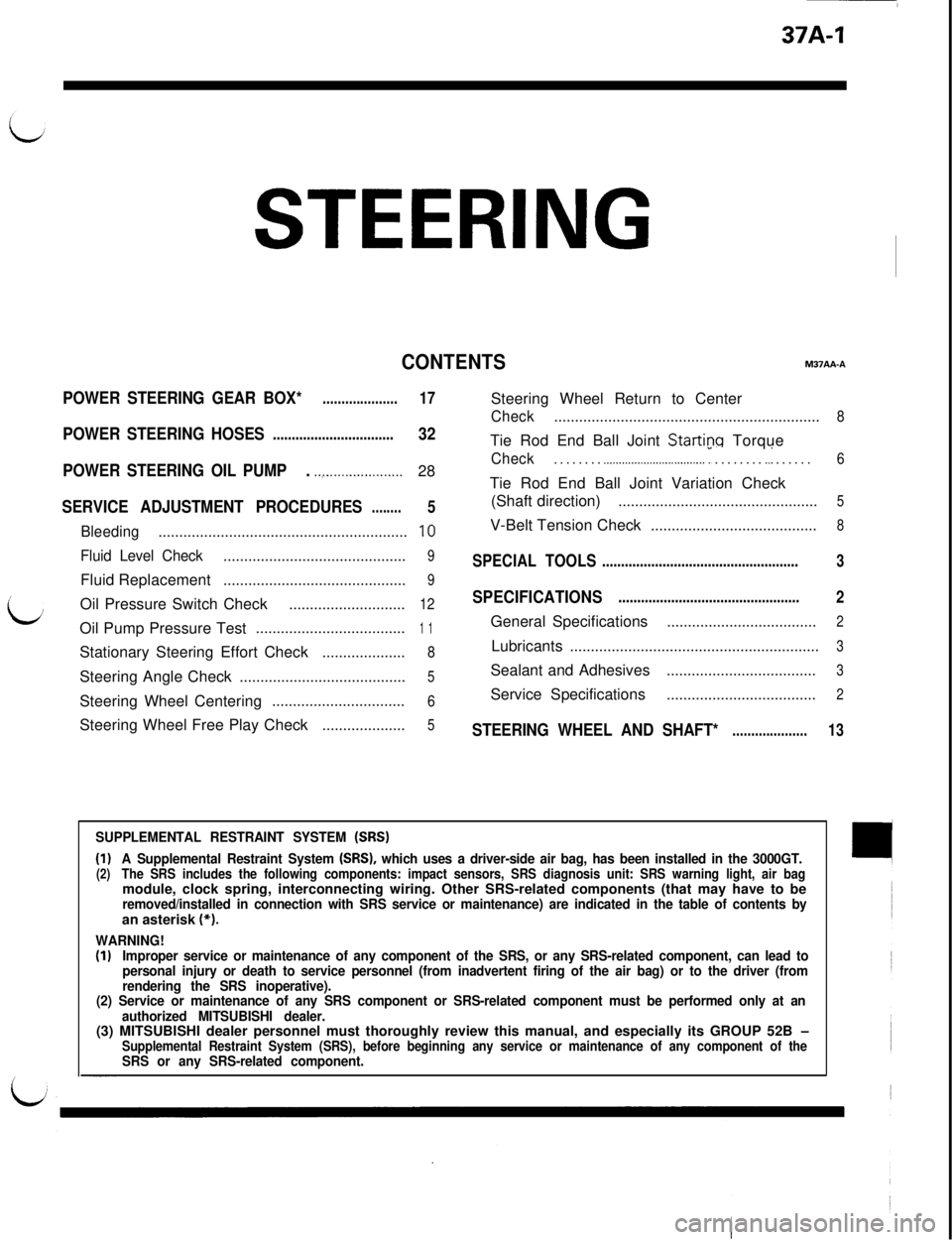
CONTENTSM37AA-A
POWER STEERING GEAR BOX*....................17Steering Wheel Return to Center
Check................................................................8
POWER STEERING HOSES................................32Tie Rod End Ball Joint Startinq Torque
POWER STEERING OIL PUMP. .._....................28Check. . . . . . . . .._.............................. r . . . . . . . . ..I . . . . . .6Tie Rod End Ball Joint Variation Check
SERVICE ADJUSTMENT PROCEDURES5(Shaft direction)................................................5........
Bleeding............................................................10V-Belt Tension Check........................................8
Fluid Level Check............................................9SPECIAL TOOLS....................................................3Fluid Replacement
............................................9
/
bOil Pressure Switch Check
SPECIFICATIONS2............................12................................................Oil Pump Pressure Test
....................................1 1General Specifications....................................2Stationary Steering Effort Check
....................8Lubricants............................................................3Steering Angle Check
5Sealant and Adhesives....................................3........................................Steering Wheel Centering
6Service Specifications....................................2................................Steering Wheel Free Play Check
....................5STEERING WHEEL AND SHAFT*....................13
SUPPLEMENTAL RESTRAINT SYSTEM (SRS)
(1)A Supplemental Restraint System (SRS), which uses a driver-side air bag, has been installed in the 3000GT.(2)The SRS includes the following components: impact sensors, SRS diagnosis unit: SRS warning light, air bagmodule, clock spring, interconnecting wiring. Other SRS-related components (that may have to be
removed/installed in connection with SRS service or maintenance) are indicated in the table of contents byan asterisk (*).
WARNING!(I)Improper service or maintenance of any component of the SRS, or any SRS-related component, can lead to
personal injury or death to service personnel (from inadvertent firing of the air bag) or to the driver (from
rendering the SRS inoperative).
(2) Service or maintenance of any SRS component or SRS-related component must be performed only at an
authorized MITSUBISHI dealer.(3) MITSUBISHI dealer personnel must thoroughly review this manual, and especially its GROUP 52B
-Supplemental Restraint System (SRS), before beginning any service or maintenance of any component of theSRS or any SRS-related component.
Page 837 of 1146
STEERING - Service Adjustment Procedures37A-9
LL:13N002E
FluId f[uctuatlon
While
engineWhile engme
runningstopped13uo13:
Return ho
Vinyl hose13AO142
j
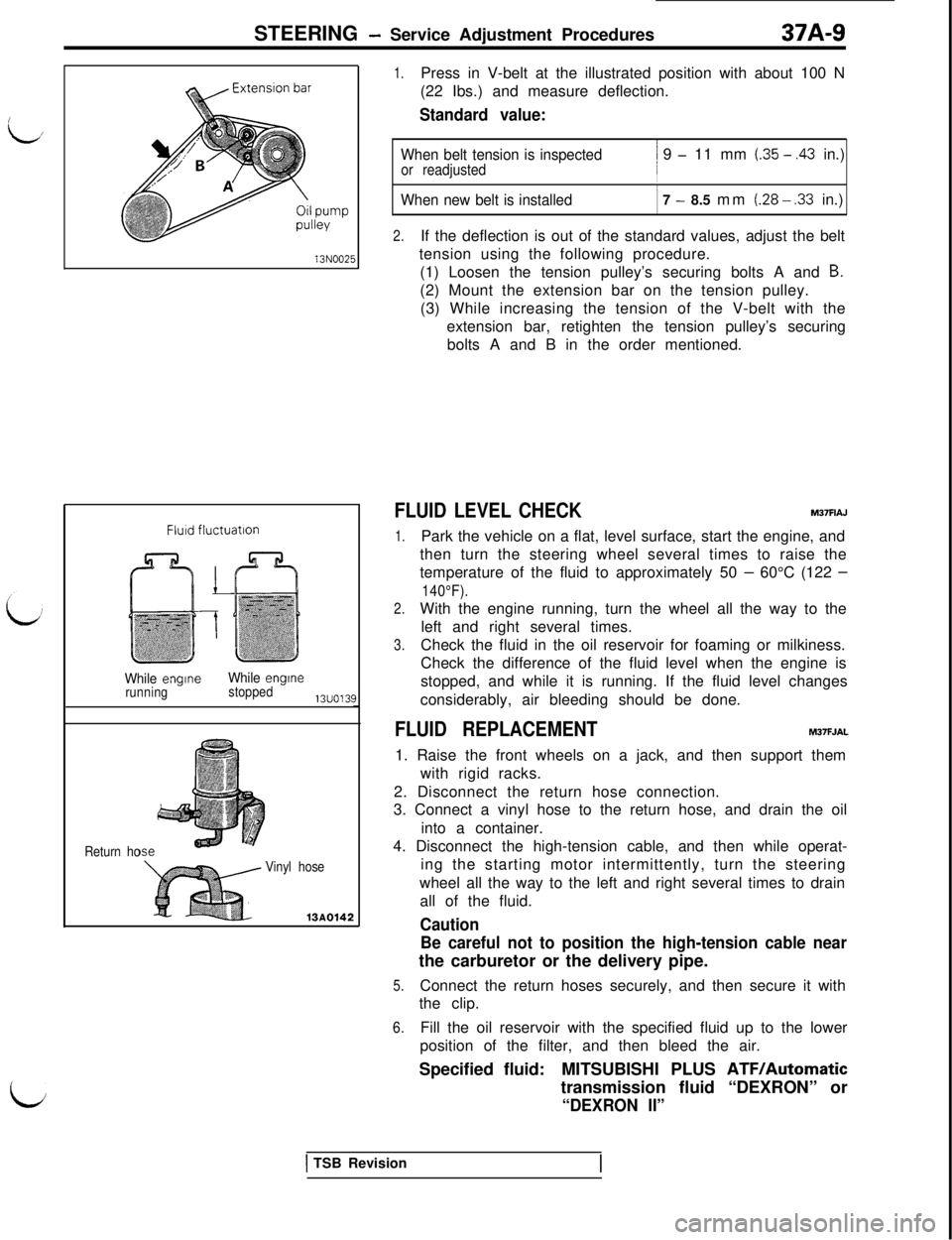
1.Press in V-belt at the illustrated position with about 100 N
(22 Ibs.) and measure deflection.
Standard value:
When belt tension is inspectedor readjusted
When new belt is installed
/ 9 - 11 mm (.35 - .43 in.)
I
’ 7 - 8.5 mm (.28 - .33 in.)
2.If the deflection is out of the standard values, adjust the belt
tension using the following procedure.
(1) Loosen the tension pulley’s securing bolts A and
B.(2) Mount the extension bar on the tension pulley.
(3) While increasing the tension of the V-belt with the
extension bar, retighten the tension pulley’s securing
bolts A and B in the order mentioned.
FLUID LEVEL CHECKM37FlAJ
1.Park the vehicle on a flat, level surface, start the engine, and
then turn the steering wheel several times to raise the
temperature of the fluid to approximately 50
- 60°C (122 -
140°F).
2.With the engine running, turn the wheel all the way to the
left and right several times.
3.Check the fluid in the oil reservoir for foaming or milkiness.
Check the difference of the fluid level when the engine is
stopped, and while it is running. If the fluid level changes
considerably, air bleeding should be done.
FLUID REPLACEMENTM37FJAL1. Raise the front wheels on a jack, and then support them
with rigid racks.
2. Disconnect the return hose connection.
3. Connect a vinyl hose to the return hose, and drain the oil
into a container.
4. Disconnect the high-tension cable, and then while operat-
ing the starting motor intermittently, turn the steering
wheel all the way to the left and right several times to drain
all of the fluid.
Caution
Be careful not to position the high-tension cable nearthe carburetor or the delivery pipe.
5.Connect the return hoses securely, and then secure it with
the clip.
6.Fill the oil reservoir with the specified fluid up to the lower
position of the filter, and then bleed the air.
Specified fluid:MITSUBISHI PLUS ATF/Automatic
transmission fluid “DEXRON” or
“DEXRON II”
1 TSB Revision
Page 838 of 1146
37A-10STEERING - Service Adjustment Procedures
BLEEDINGM37FKAl
1.Jack up the front wheels and support them by using a floor
stand.
2. Manually turn the oil pump pulley a few times.
3. Turn the steering wheel all the way to the left and to the
right several times.
4. Disconnect the high-tension cable, and then, while operat-
ing the starting motor intermittently, turn the steering
wheel all the way to the left and right several times (for 15
to 20 seconds).
Caution1. During air bleeding, replenish the fluid supply so
that the level never falls below the lower position ofthe filter.
2. If air bleeding is done while engine is running, the
air will be broken up and absorbed into the fluid; besure to do the bleeding only while cranking.
5. Connect the ignition cable, and then start the engine
(idling).
6.Turn the steering wheel to the left and right until there are
no air bubbles in the oil reservoir.
7.Confirm that the fluid is not milky, and that the level is up to
the specified position on the level gauge.
8. Confirm that there is very little change in the fluid level
when the steering wheel is turned left and right.
Fluid level change:wlthln 5 mm 1.2 in.)I
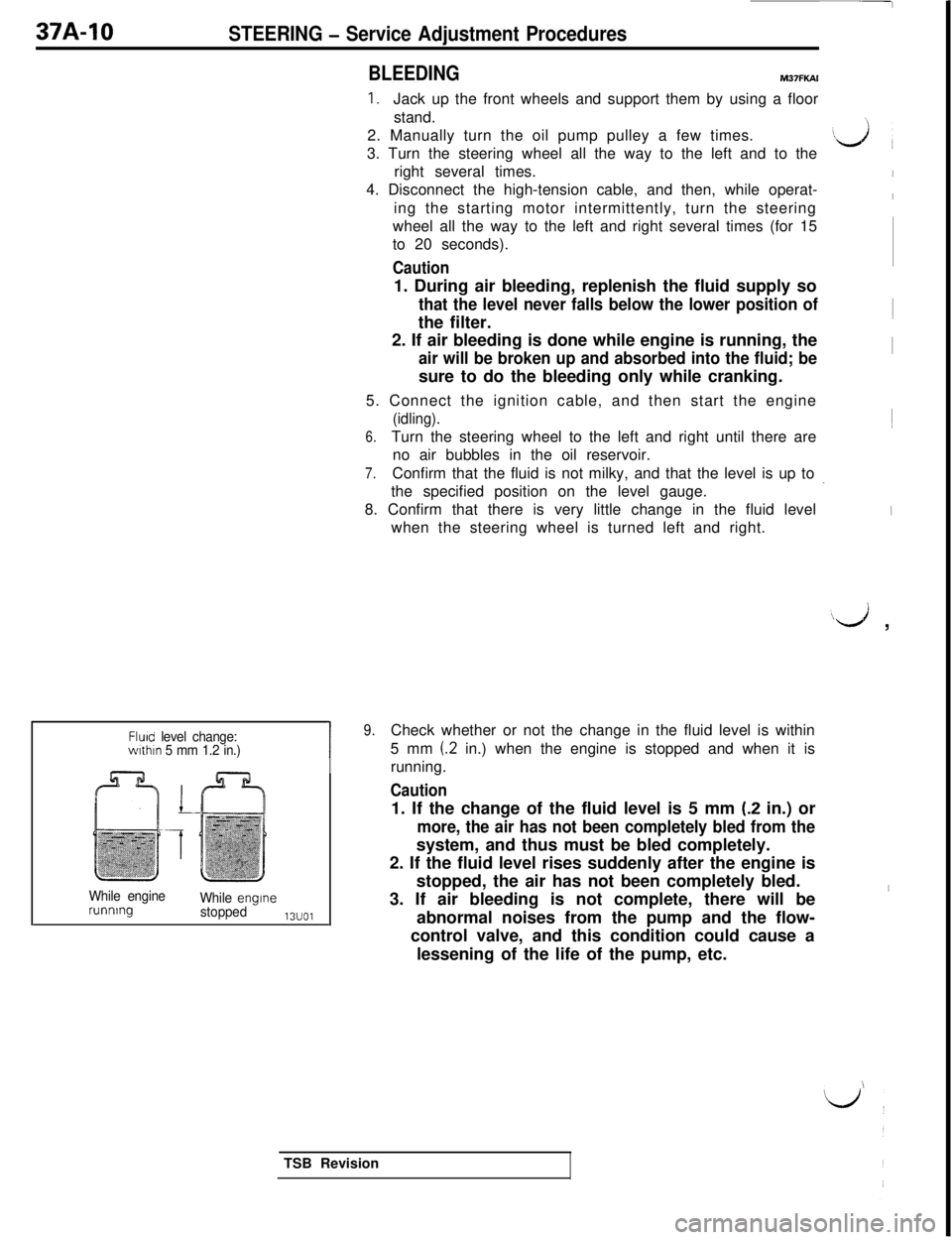
9.Check whether or not the change in the fluid level is within
5 mm
(.2 in.) when the engine is stopped and when it is
Irunning.
Caution
While enginerunningWhile enginestopped13UOl1. If the change of the fluid level is 5 mm
I.2 in.) or
more, the air has not been completely bled from thesystem, and thus must be bled completely.
2. If the fluid level rises suddenly after the engine is
stopped, the air has not been completely bled.
3. If air bleeding is not complete, there will be
abnormal noises from the pump and the flow-
control valve, and this condition could cause a
lessening of the life of the pump, etc.
LJ
I
I~
I~
I
LJ ,
I
\TSB Revision
Page 864 of 1146
37B44-WHEEL STEERING SYSTEM (4WS) -Service Adjustment ProceduresSERVICE ADJUSTMENT PROCEDURES
M37FKAH
BLEEDING,LJ(1) Bleed air from power steering system (Refer to GROUP
37A
- Service Adjustment Procedures.)
(2) Lift up the vehicle.
(3) Start the engine and let it idle.
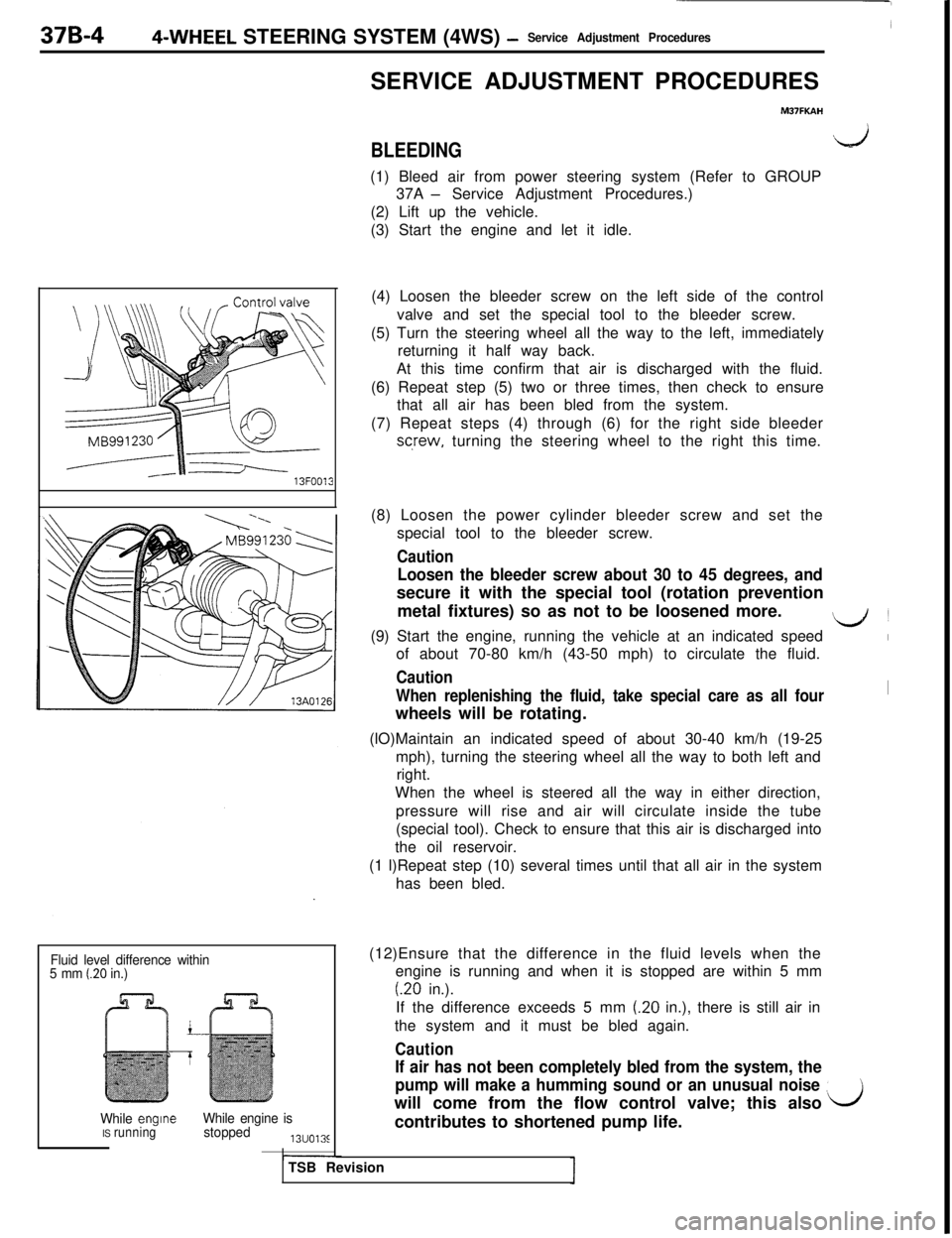
(4) Loosen the bleeder screw on the left side of the control
valve and set the special tool to the bleeder screw.
(5) Turn the steering wheel all the way to the left, immediately
returning it half way back.
At this time confirm that air is discharged with the fluid.
(6) Repeat step (5) two or three times, then check to ensure
that all air has been bled from the system.
(7) Repeat steps (4) through (6) for the right side bleeder
sc,rew, turning the steering wheel to the right this time.
(8) Loosen the power cylinder bleeder screw and set the
special tool to the bleeder screw.
Caution
Loosen the bleeder screw about 30 to 45 degrees, andsecure it with the special tool (rotation prevention
metal fixtures) so as not to be loosened more.
(9) Start the engine, running the vehicle at an indicated speed
I/l1Iof about 70-80 km/h (43-50 mph) to circulate the fluid.
-13FOO13
Caution
When replenishing the fluid, take special care as all fourIwheels will be rotating.
Fluid level difference within
5 mm (.20 in.)
While
engineWhile engine isIS runningstopped13lJO13~(lO)Maintain an indicated speed of about 30-40 km/h (19-25
mph), turning the steering wheel all the way to both left and
right.
When the wheel is steered all the way in either direction,
pressure will rise and air will circulate inside the tube
(special tool). Check to ensure that this air is discharged into
the oil reservoir.
(1 l)Repeat step (10) several times until that all air in the system
has been bled.
(12)Ensure that the difference in the fluid levels when the
engine is running and when it is stopped are within 5 mm(.20 in.).
If the difference exceeds 5 mm
(.20 in.), there is still air in
the system and it must be bled again.
Caution
If air has not been completely bled from the system, the
pump will make a humming sound or an unusual noise ,,
will come from the flow control valve; this also
dcontributes to shortened pump life.
TSB Revision