brake light MITSUBISHI 3000GT 1991 Workshop Manual
[x] Cancel search | Manufacturer: MITSUBISHI, Model Year: 1991, Model line: 3000GT, Model: MITSUBISHI 3000GT 1991Pages: 1146, PDF Size: 76.68 MB
Page 768 of 1146
35-46SERVICE BRAKES - Service Adjustment Procedures
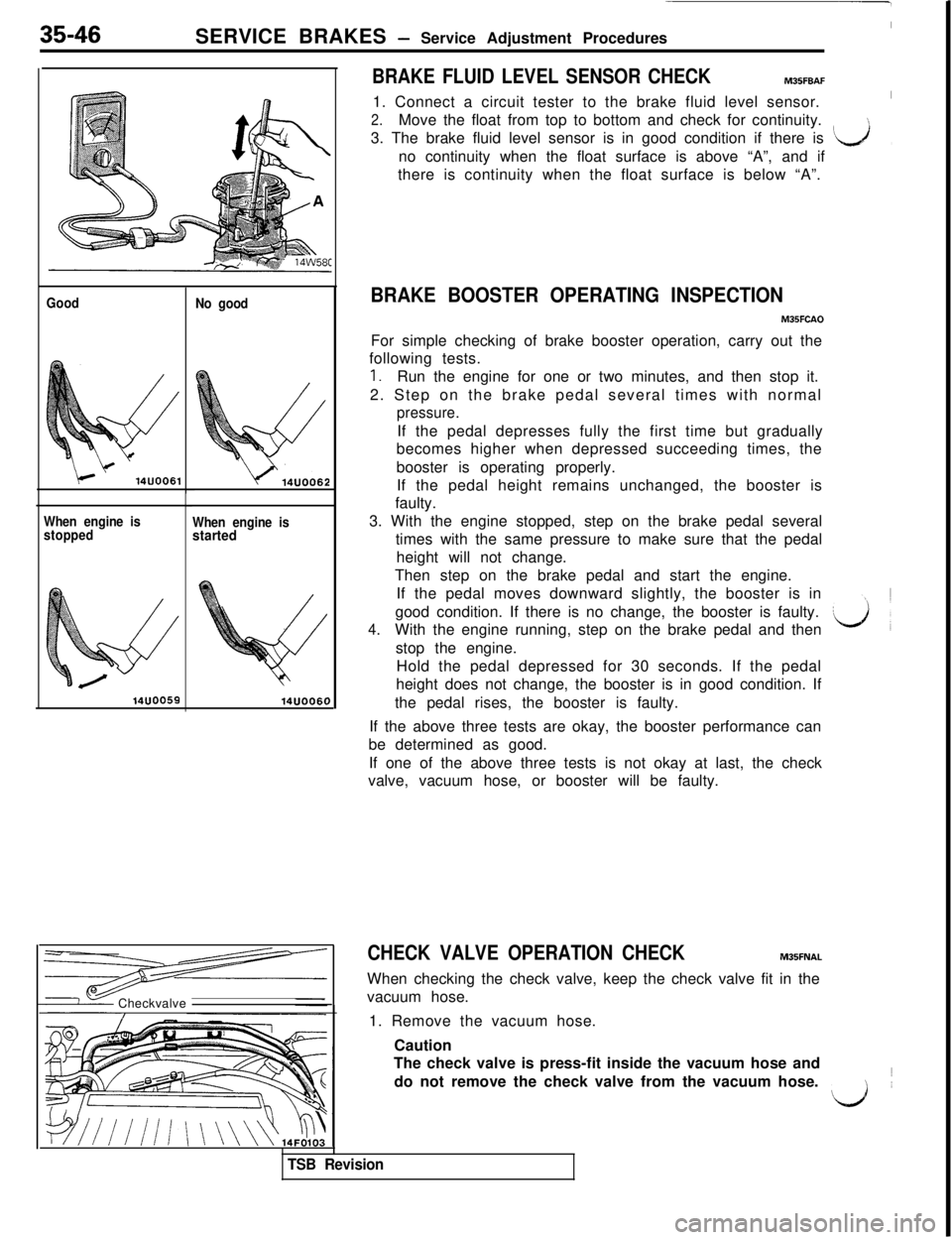
BRAKE FLUID LEVEL SENSOR CHECK
I
MBSFBAF
Good
k‘14UOO61
When engine is
stoppedNo good
When engine isstarted
14UOO6C)Checkvalve/1. Connect a circuit tester to the brake fluid level sensor.
I
2.Move the float from top to bottom and check for continuity.
3. The brake fluid level sensor is in good condition if there is
‘k&Jno continuity when the float surface is above “A”, and if,there is continuity when the float surface is below “A”.
BRAKE BOOSTER OPERATING INSPECTION
M35FCAOFor simple checking of brake booster operation, carry out the
following tests.
1.Run the engine for one or two minutes, and then stop it.
2. Step on the brake pedal several times with normal
pressure.If the pedal depresses fully the first time but gradually
becomes higher when depressed succeeding times, the
booster is operating properly.
If the pedal height remains unchanged, the booster is
faulty.
3. With the engine stopped, step on the brake pedal several
times with the same pressure to make sure that the pedal
height will not change.
Then step on the brake pedal and start the engine.
If the pedal moves downward slightly, the booster is in
good condition. If there is no change, the booster is faulty.
4.With the engine running, step on the brake pedal and then
stop the engine.
Hold the pedal depressed for 30 seconds. If the pedal
height does not change, the booster is in good condition. If
the pedal rises, the booster is faulty.
If the above three tests are okay, the booster performance can
be determined as good.
If one of the above three tests is not okay at last, the check
valve, vacuum hose, or booster will be faulty.
CHECK VALVE OPERATION CHECKM35FNALWhen checking the check valve, keep the check valve fit in the
vacuum hose.
1. Remove the vacuum hose.
Caution
The check valve is press-fit inside the vacuum hose and
do not remove the check valve from the vacuum hose.1
d~
TSB Revision
Page 780 of 1146
35-58SERVICE BRAKES - Service Adjustment Procedures
POINTS IN WAVEFORM MEASUREMENT
Symptom
Too small or zero waveform
amplitudeProbable causes
Faulty wheel speed sensorRemedy
Replace sensor
Incorrect pole piece-to-rotor clearance
Adjust clearance
Waveform amplitude fluctuates
excessively (this is no problem ifAxle hub eccentric or with large runout
Replace hub
the minimum amplitude is
100 mV
or more)
Noisy or disturbed waveformOpen circuit in sensor
Open circuit in harness
Incorrectly mounted wheel speed sensor
Rotor with missing or damaged teethReplace sensor
Correct harness
Mount correctly
Replace rotor
NOTEThe wheel speed sensor cable moves following motion of the front or rear suspension. Therefore, it is likely that it has an
open circuit only when driving on rough roads and it functions normally on ordinary roads. It is, therefore, recommended
to observe sensor output voltage waveform also under special conditions, such as rough road driving,
(ME!991 377)12FOO5i
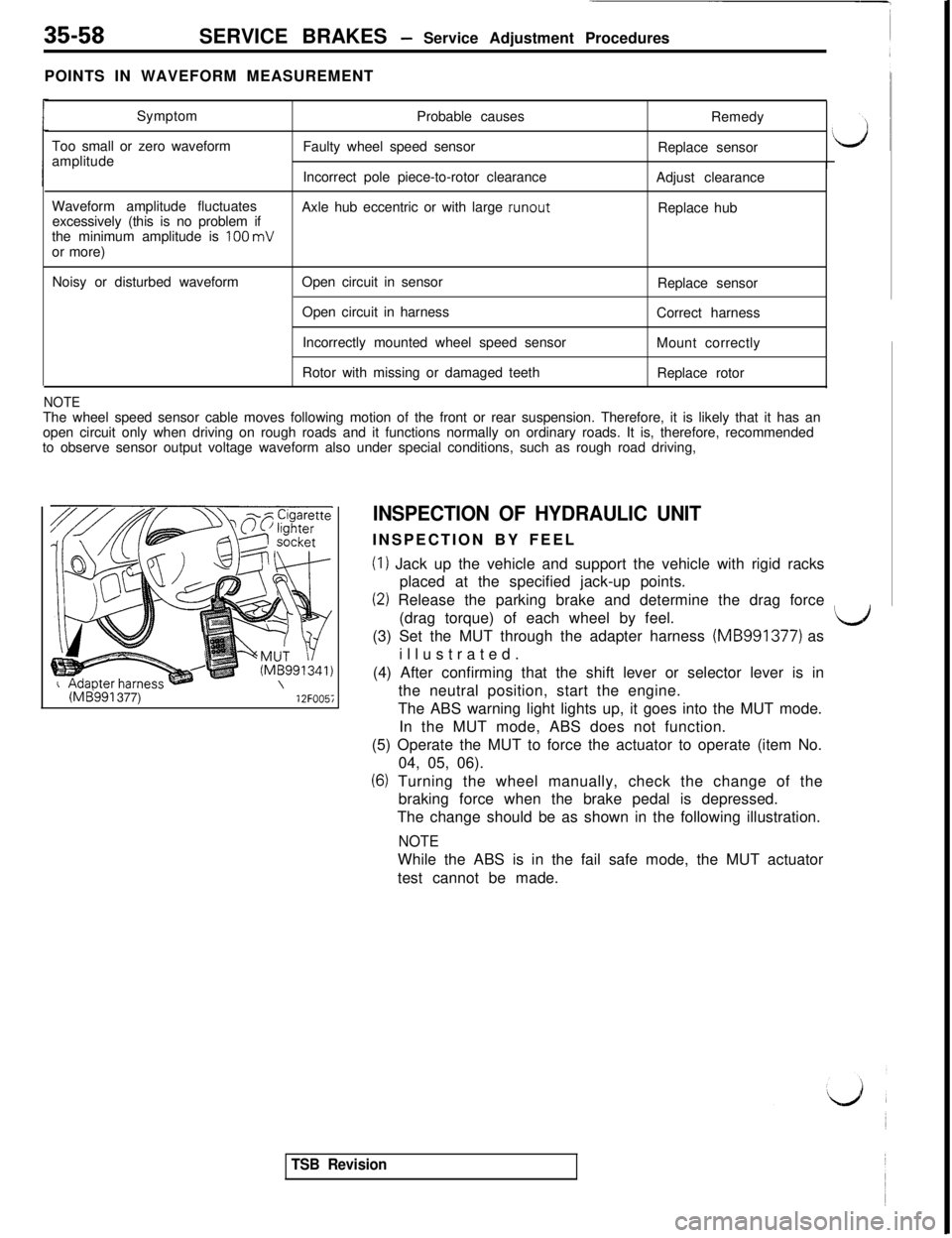
INSPECTION OF HYDRAULIC UNITINSPECTION BY FEEL
(I) Jack up the vehicle and support the vehicle with rigid racks
placed at the specified jack-up points.
(2) Release the parking brake and determine the drag force
(drag torque) of each wheel by feel.
LJ(3) Set the MUT through the adapter harness (MB991377) as
illustrated.
(4) After confirming that the shift lever or selector lever is in
the neutral position, start the engine.
The ABS warning light lights up, it goes into the MUT mode.
In the MUT mode, ABS does not function.
(5) Operate the MUT to force the actuator to operate (item No.
04, 05, 06).
(6) Turning the wheel manually, check the change of the
braking force when the brake pedal is depressed.
The change should be as shown in the following illustration.
NOTEWhile the ABS is in the fail safe mode, the MUT actuator
test cannot be made.
TSB Revision
Page 782 of 1146
35-60SERVICE BRAKES - Service Adjustment Procedures
INSPECTION BY USING BRAKE FORCE TESTER
NOTE
(1) The brake force tester roller and tire must be dry during the
test.
(2) When testing the front brakes, apply the parking brake and
when testing the rear brakes, apply chocks to the front
wheels to lock them.
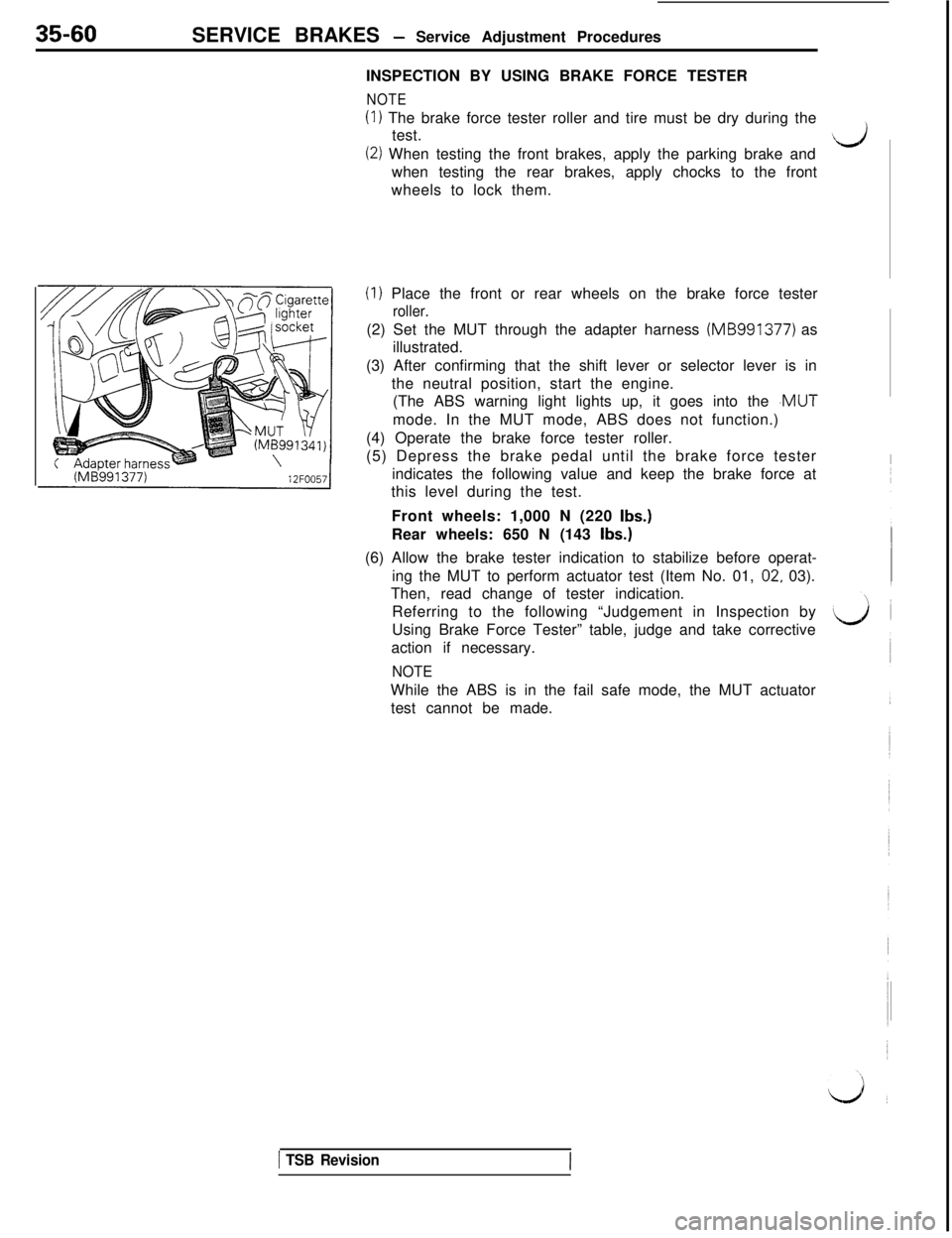
(I) Place the front or rear wheels on the brake force tester
roller.(2) Set the MUT through the adapter harness
(MB9913771 as
illustrated.
(3) After confirming that the shift lever or selector lever is in
the neutral position, start the engine.
(The ABS warning light lights up, it goes into the
-MUTmode. In the MUT mode, ABS does not function.)
(4) Operate the brake force tester roller.
(5) Depress the brake pedal until the brake force tester
indicates the following value and keep the brake force at
this level during the test.
Front wheels: 1,000 N (220
Ibs.)Rear wheels: 650 N (143
Ibs.)(6) Allow the brake tester indication to stabilize before operat-
ing the MUT to perform actuator test (Item No. 01,
02, 03).
Then, read change of tester indication.
Referring to the following “Judgement in Inspection by
Using Brake Force Tester” table, judge and take corrective
action if necessary.
NOTEWhile the ABS is in the fail safe mode, the MUT actuator
test cannot be made.
1 TSB Revision
Page 784 of 1146
When energized
Between terminals 4 and 5Continuity
When de-energized
Between terminals 4 and 5\i fl \\ 16FO264No continuity
Between terminals 1 and 3Continuity
16FO122L--J18FOCII
SERVICE BRAKES - Service Adjustment ProceduresI
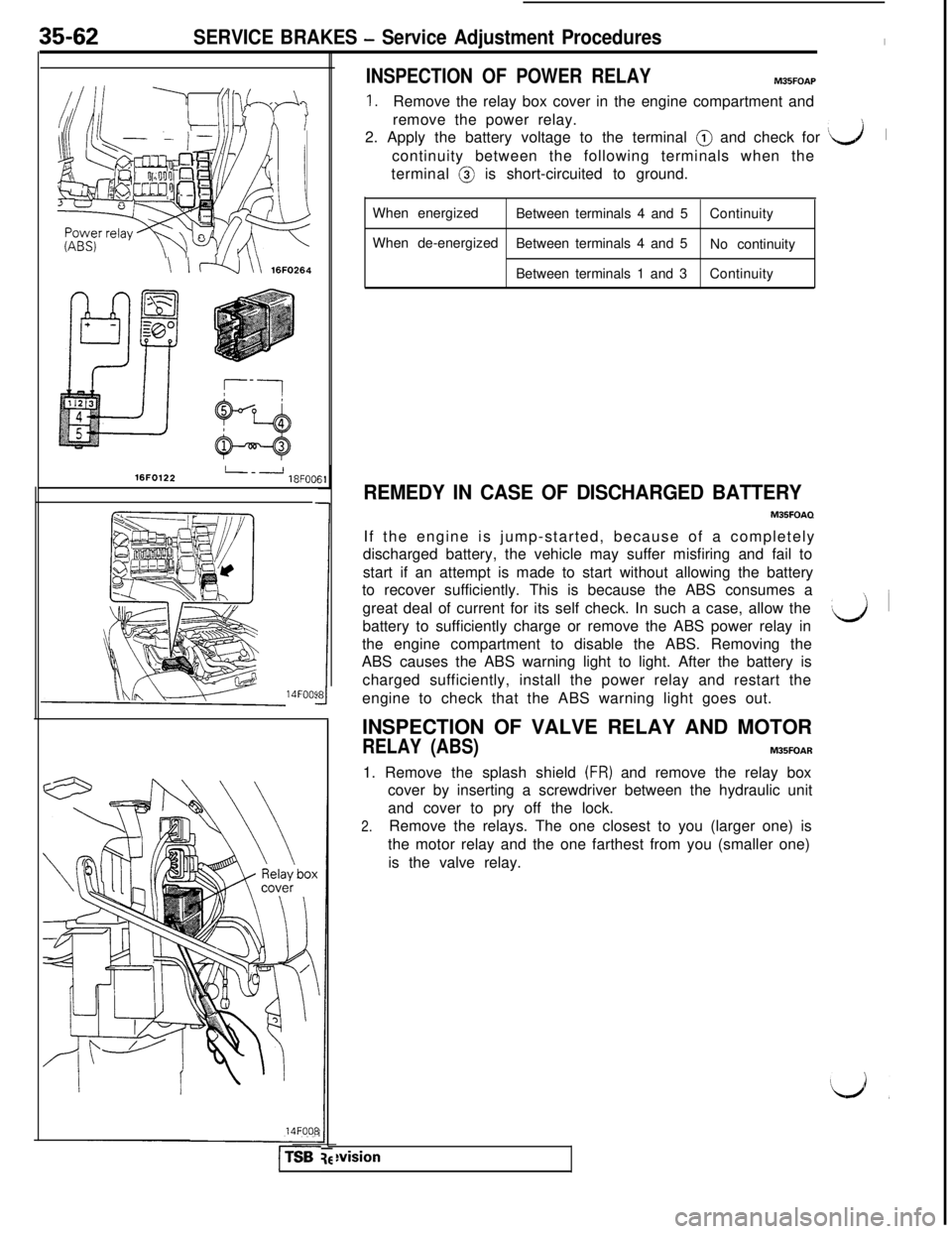
INSPECTION OF POWER RELAYM35FOAP
7
1.Remove the relay box cover in the engine compartment and
remove the power relay.
2. Apply the battery voltage to the terminal @ and check for
‘L-J1
continuity between the following terminals when the
terminal @ is short-circuited to ground.
35-62
14FOOS14FOO8
l-TSB
1
REMEDY IN CASE OF DISCHARGED BATTERY
M35FOAQIf the engine is jump-started, because of a completely
discharged battery, the vehicle may suffer misfiring and fail to
start if an attempt is made to start without allowing the battery
to recover sufficiently. This is because the ABS consumes a
great deal of current for its self check. In such a case, allow the
battery to sufficiently charge or remove the ABS power relay in
the engine compartment to disable the ABS. Removing the
ABS causes the ABS warning light to light. After the battery is
charged sufficiently, install the power relay and restart the
engine to check that the ABS warning light goes out.
INSPECTION OF VALVE RELAY AND MOTOR
RELAY (ABS)M35FOAR1. Remove the splash shield
(FR) and remove the relay box
cover by inserting a screwdriver between the hydraulic unit
and cover to pry off the lock.
2.Remove the relays. The one closest to you (larger one) is
the motor relay and the one farthest from you (smaller one)
is the valve relay.
‘d~ i
wision
Page 786 of 1146
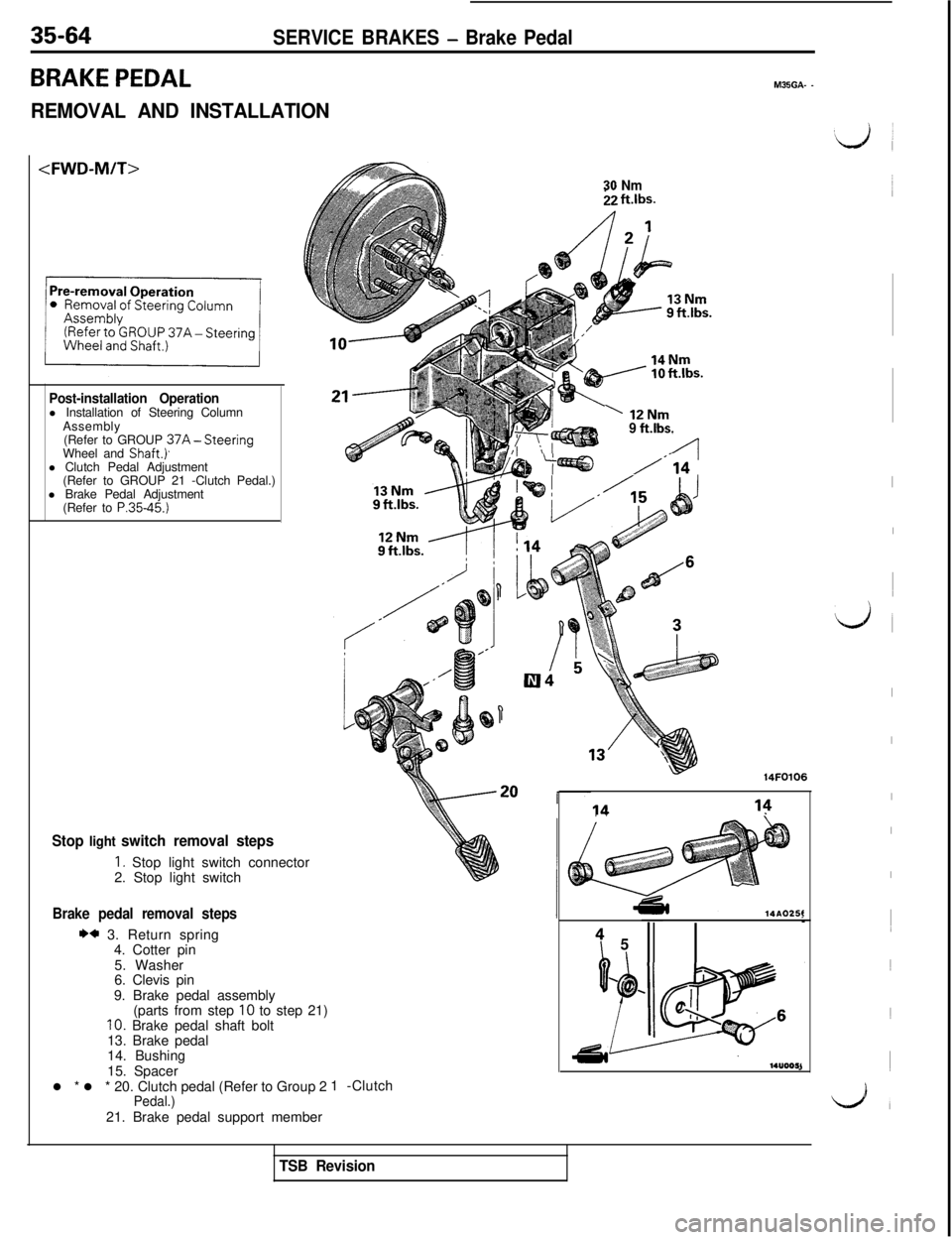
35-64SERVICE BRAKES - Brake Pedal
BRAKE PEDAL
REMOVAL AND INSTALLATIONM35GA-
-
Post-installation Operationl Installation of Steering Column
Assembly
(Refer to GROUP
37A-SteeringWheel and Shaft.)l Clutch Pedal Adjustment
(Refer to GROUP 21 -Clutch Pedal.)
l Brake Pedal Adjustment
(Refer to
P.3545.)
Stop light switch removal steps
I. Stop light switch connector
2. Stop light switch
Brake pedal removal steps
I)* 3. Return spring
4. Cotter pin
5. Washer
6. Clevis pin
9. Brake pedal assembly
(parts from step
10 to step 21)10. Brake pedal shaft bolt
13. Brake pedal
14. Bushing
15. Spacer
l * l * 20. Clutch pedal (Refer to Group 2
Pedal.)1 -Clutch
21. Brake pedal support member
30 Nmftlbs.
’ 12Nm9 ft.lbs.
c-iA.14
14FO10614
l?
14AO2564 5
%
,36il4”OOS,
. .
I
I~
d
I
I
I
I
I~11~
d,
TSB Revision
Page 787 of 1146
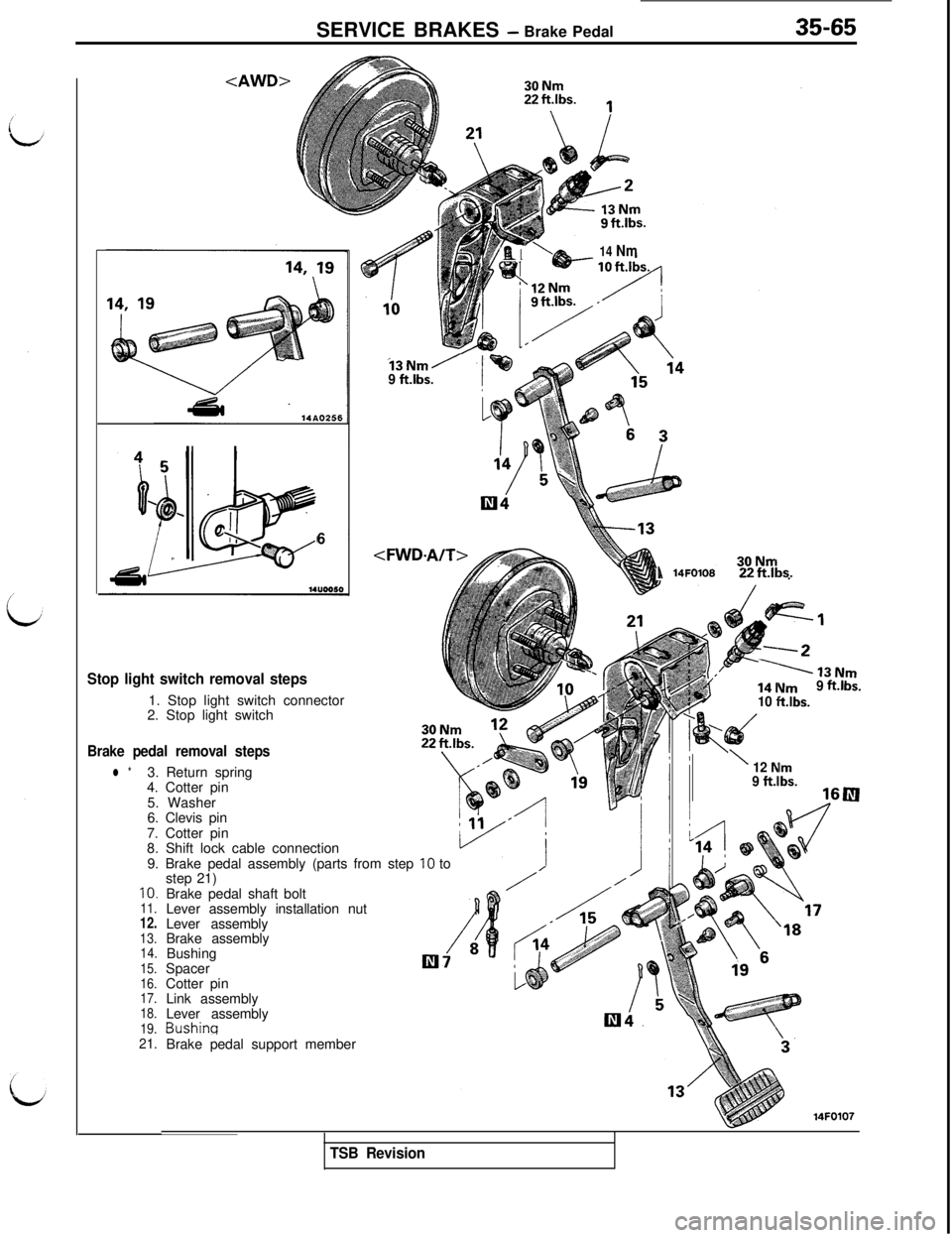
SERVICE BRAKES - Brake Pedal35-65
‘Ii14 Nm
i3Nmy9 ftlbs.
6
--2
-.113Nm14 Nm
9 ft.lbs.
10 klbs.
Stop light switch removal steps1. Stop light switch connector
2. Stop light switch
Brake pedal removal steps
l *3. Return spring
4. Cotter pin
5. Washer\12 Nlm9 ftllbs.6. Clevis pin
7. Cotter pin
8. Shift lock cable connection
9. Brake pedal assembly (parts from step
10 to
step 21)
/’/’10.
11.
12.13.
14.
15.
16.
17.
18.
19.
21.Brake pedal shaft bolt
Lever assembly installation nut
Lever assembly
Brake assembly
Bushing
Spacer
Cotter pin
Link assembly
Lever assemblyBushinq
Brake pedal support member
/
14FO107
TSB Revision
Page 788 of 1146
35-66SERVICE BRAKES - Brake Pedal
14LO142No continuity Continuity
4mm
(.I6 in.)14LO171
:Vehicles with cruise control>a
b14LO17C
Brake pedal
14FOO76
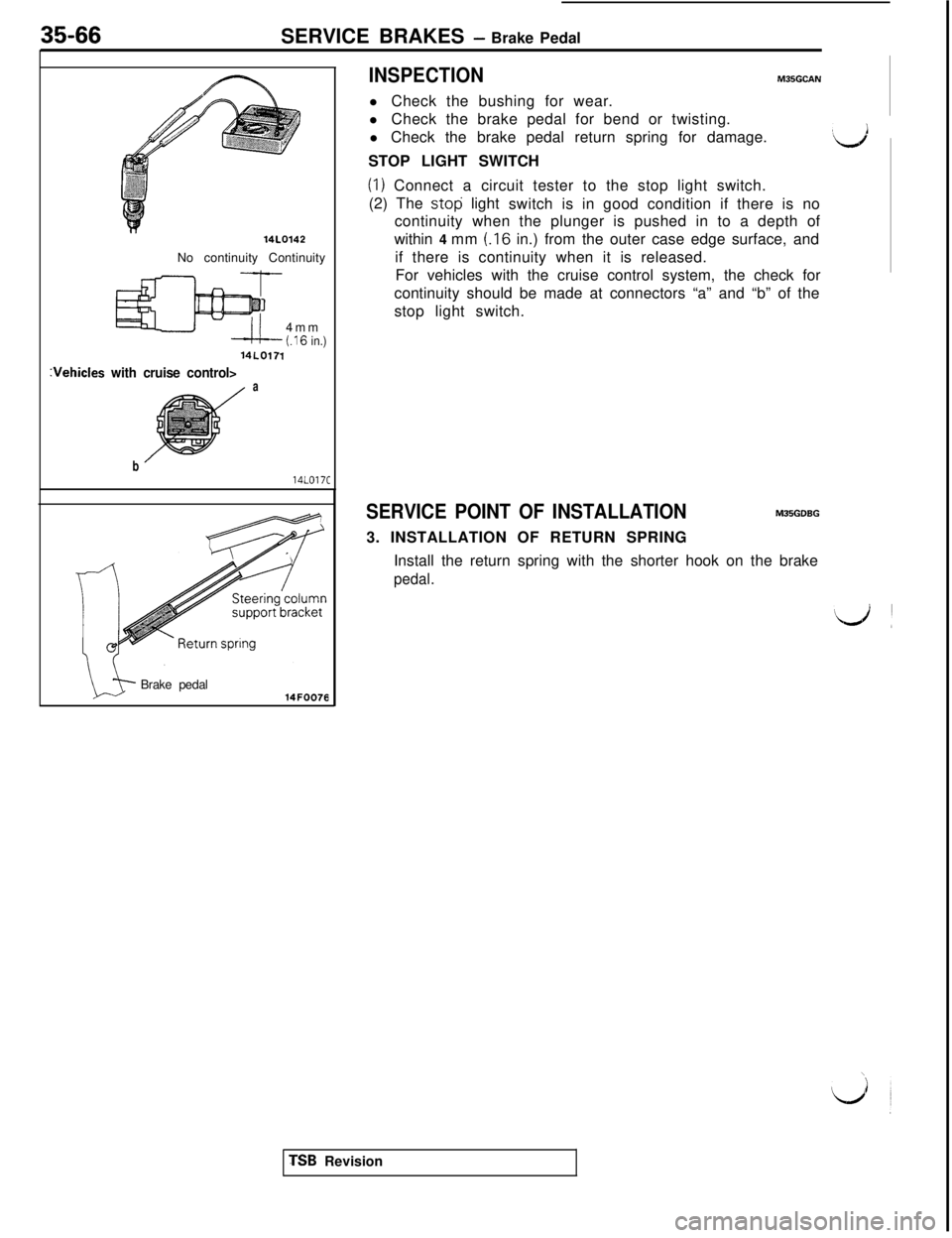
INSPECTIONM35GCANl Check the bushing for wear.
l Check the brake pedal for bend or twisting.
l Check the brake pedal return spring for damage.
‘LJ)STOP LIGHT SWITCH
(I) Connect a circuit tester to the stop light switch.
(2) The
stolj light
switch is in good condition if there is no
continuity when the plunger is pushed in to a depth of
within 4 mm
(.16 in.) from the outer case edge surface, and
if there is continuity when it is released.
For vehicles with the cruise control system, the check for
continuity should be made at connectors “a” and “b” of the
stop light switch.
SERVICE POINT OF INSTALLATIONM35GDBG3. INSTALLATION OF RETURN SPRING
Install the return spring with the shorter hook on the brake
pedal.
TSB Revision
Page 791 of 1146
SERVICE BRAKES - Master Cylinder and Brake Booster35-69light
scale14AO471
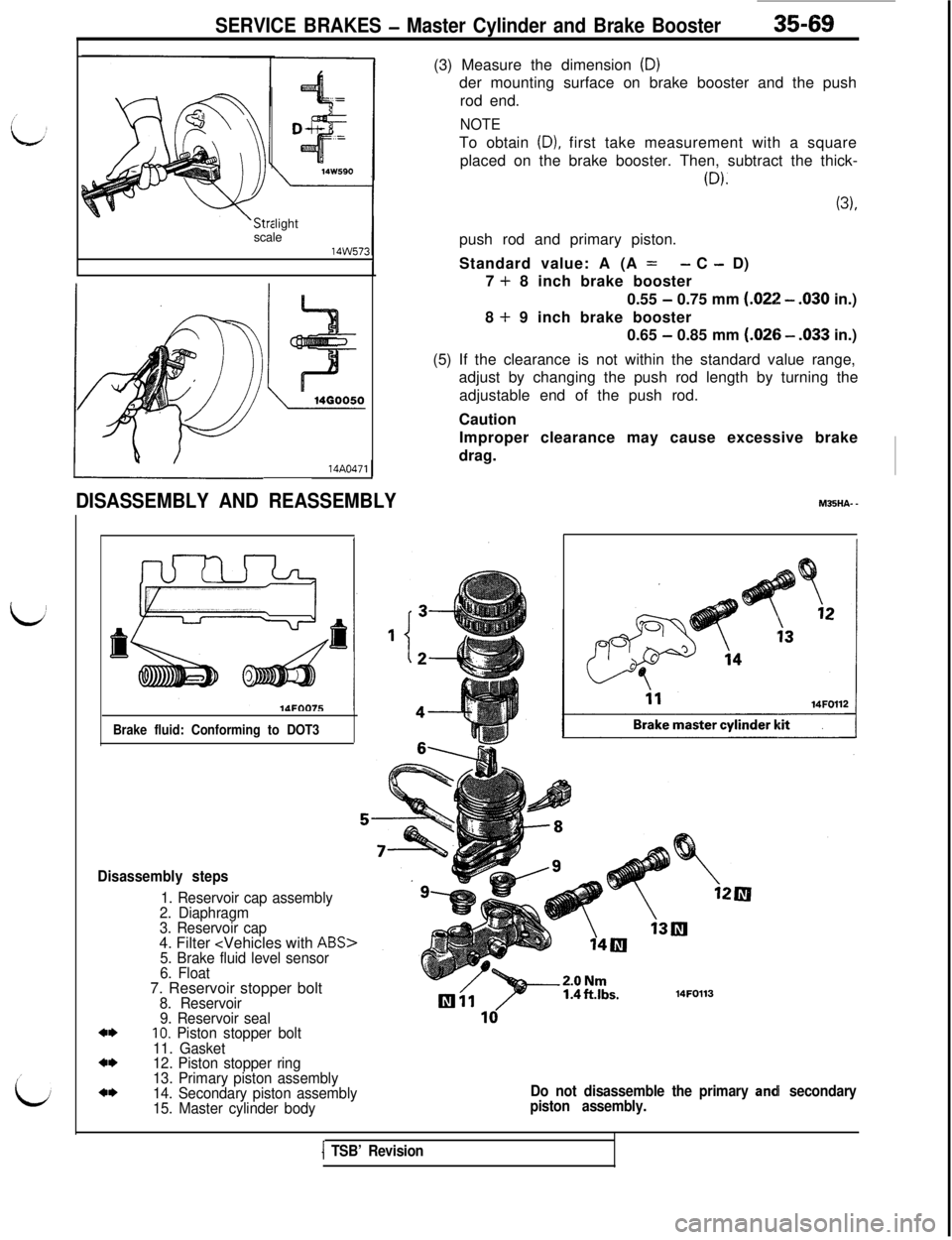
DISASSEMBLY AND REASSEMBLY
Brake fluid: Conforming to DOT3
Disassembly steps
1. Reservoir cap assembly
2. Diaphragm
3. Reservoir cap4. Filter
5. Brake fluid level sensor
6. Float7. Reservoir stopper bolt
8. Reservoir
9. Reservoir seal
*I)IO. Piston stopper bolt
11. Gasket
a*12. Piston stopper ring
13. Primary piston assembly
a*14. Secondary piston assembly
15. Master cylinder body(3) Measure the dimension
(D)der mounting surface on brake booster and the push
rod end.
NOTETo obtain
(D), first take measurement with a square
placed on the brake booster. Then, subtract the thick-
(D).
(3),push rod and primary piston.
Standard value: A (A
=- C - D)
7
+ 8 inch brake booster
0.55
- 0.75 mm (.022 - .030 in.)
8
+ 9 inch brake booster
0.65
- 0.85 mm (.026 - .033 in.)
(5) If the clearance is not within the standard value range,
adjust by changing the push rod length by turning the
adjustable end of the push rod.
Caution
Improper clearance may cause excessive brake
drag.M35HA-
-
14FOll3
Do not disassemble the primary ancH secondary
piston assembly.
1 TSB’ Revision
Page 817 of 1146
36-1
PARKING
BRAKES
CONTENTSM36AA-.
PARKINGBRAKE. . . . . . . . . . . . . . . . . . . . . . . . . . . . . . . . . . . . . . . . . . . . . . . .8SPECIAL TOOLS . .._.._.............................................
PARKING BRAKE LEVER AND PARKINGSPECIFICATIONS................................................
BRAKE CABLE*....................................................5General Specifications....................................
SERVICE ADJUSTMENT PROCEDURES4Lubricants....................................................................Parking Brake Lever Stroke Check4Sealants
andAdhesives....................................................Parking Brake Switch Check
............................4Service Specifications....................................
TROUBLESHOOTING........................................
i
SUPPLEMENTAL RESTRAINT SYSTEM (SRS)
(1)A Supplemental Restraint System (SRS), which uses a driver-side air bag, has been installed in the 3000GT.(2)The SRS includes the following components: impact sensors, SRS diagnosis unit: SRS warning light, air bagmodule, clock spring, interconnecting wiring. Other SRS-related components (that may have to be
removed/installed in connection with SRS service or maintenance) are indicated in the table of contents byan asterisk (*).
WARNING!(1)Improper service or maintenance of any component of the SRS, or any SRS-related component, can lead to
personal injury or death to service personnel (from inadvertent firing of the air bag) or to the driver (fromrendering the SRS inoperative).(2) Service or maintenance of any SRS component or SRS-related component must be performed only at an
authorized MITSUBISHI dealer.(3) MITSUBISHI dealer personnel must thoroughly review this manual, and especially its GROUP 52B
-Supplemental Restraint System (SRS), before beginning any service or maintenance of any component of theSRS or any SRS-related component.
u
I
Page 820 of 1146
36-4PARKING BRAKES - Service Adiustment Procedures
-
\Adjusting nut14u015:
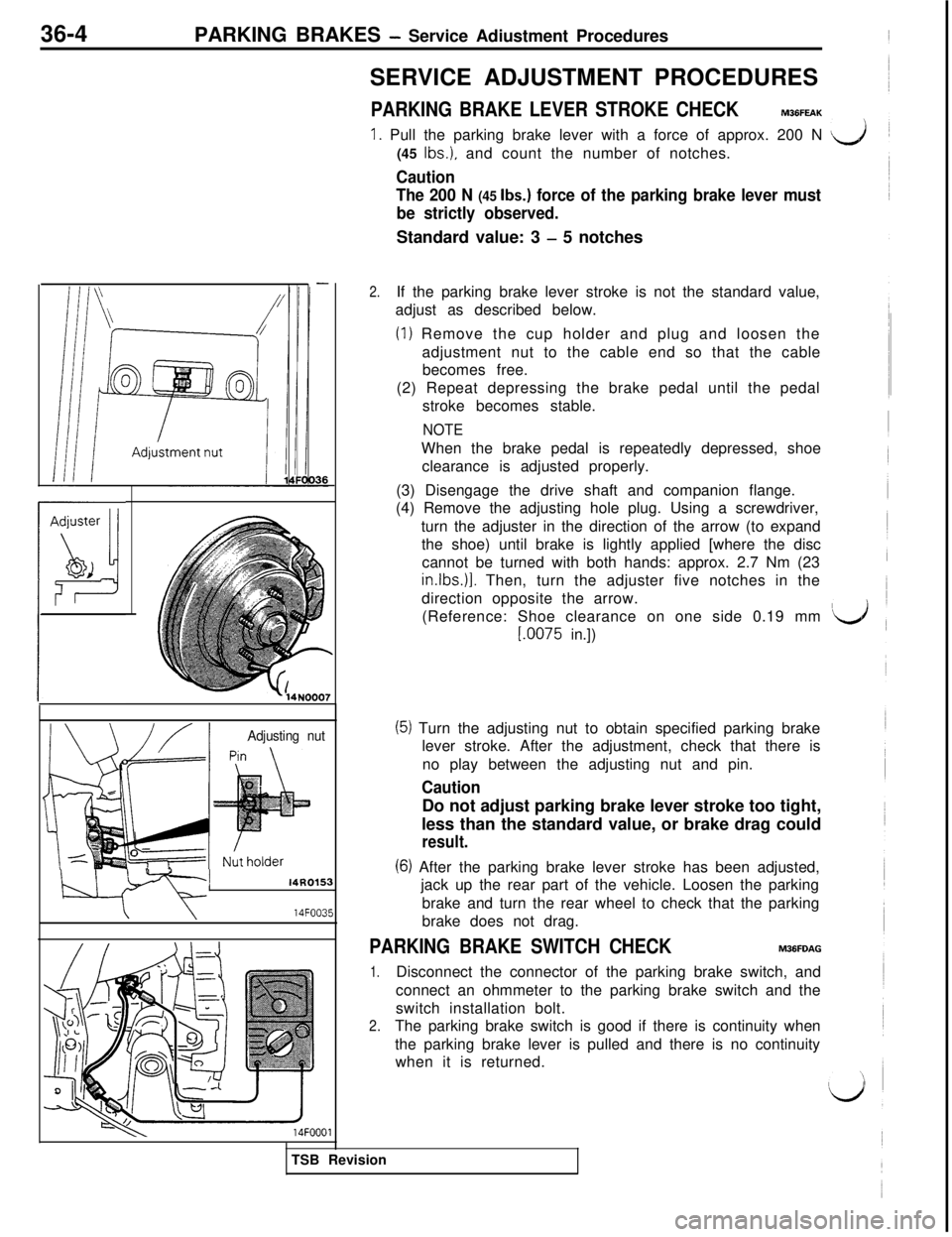
un' 14FOO3SERVICE ADJUSTMENT PROCEDURES
PARKING BRAKE LEVER STROKE CHECKM36FEAK
1. Pull the parking brake lever with a force of approx. 200 N d(45
Ibs.), and count the number of notches.
Caution
The 200 N
(45 Ibs.) force of the parking brake lever must
be strictly observed.Standard value: 3
- 5 notches
2.If the parking brake lever stroke is not the standard value,
adjust as described below.
(1) Remove the cup holder and plug and loosen the
adjustment nut to the cable end so that the cable
becomes free.
(2) Repeat depressing the brake pedal until the pedal
stroke becomes stable.
NOTEWhen the brake pedal is repeatedly depressed, shoe
clearance is adjusted properly.
(3) Disengage the drive shaft and companion flange.
(4) Remove the adjusting hole plug. Using a screwdriver,
turn the adjuster in the direction of the arrow (to expand
the shoe) until brake is lightly applied [where the disc
cannot be turned with both hands: approx. 2.7 Nm (23in.lbs.)]. Then, turn the adjuster five notches in the
direction opposite the arrow.
(Reference: Shoe clearance on one side 0.19 mm
‘d
I.0075 in.])
(6) After the parking brake lever stroke has been adjusted,
jack up the rear part of the vehicle. Loosen the parking
brake and turn the rear wheel to check that the parking
brake does not drag.
PARKING BRAKE SWITCH CHECKM36FDAG
1.Disconnect the connector of the parking brake switch, and
connect an ohmmeter to the parking brake switch and the
switch installation bolt.
2.The parking brake switch is good if there is continuity when
the parking brake lever is pulled and there is no continuity
when it is returned.
,(JTSB Revision
(51 Turn the adjusting nut to obtain specified parking brake
lever stroke. After the adjustment, check that there is
no play between the adjusting nut and pin.
CautionDo not adjust parking brake lever stroke too tight,
less than the standard value, or brake drag could
result.