air filter MITSUBISHI 3000GT 1991 Service Manual
[x] Cancel search | Manufacturer: MITSUBISHI, Model Year: 1991, Model line: 3000GT, Model: MITSUBISHI 3000GT 1991Pages: 1146, PDF Size: 76.68 MB
Page 5 of 1146
,
b
00-I
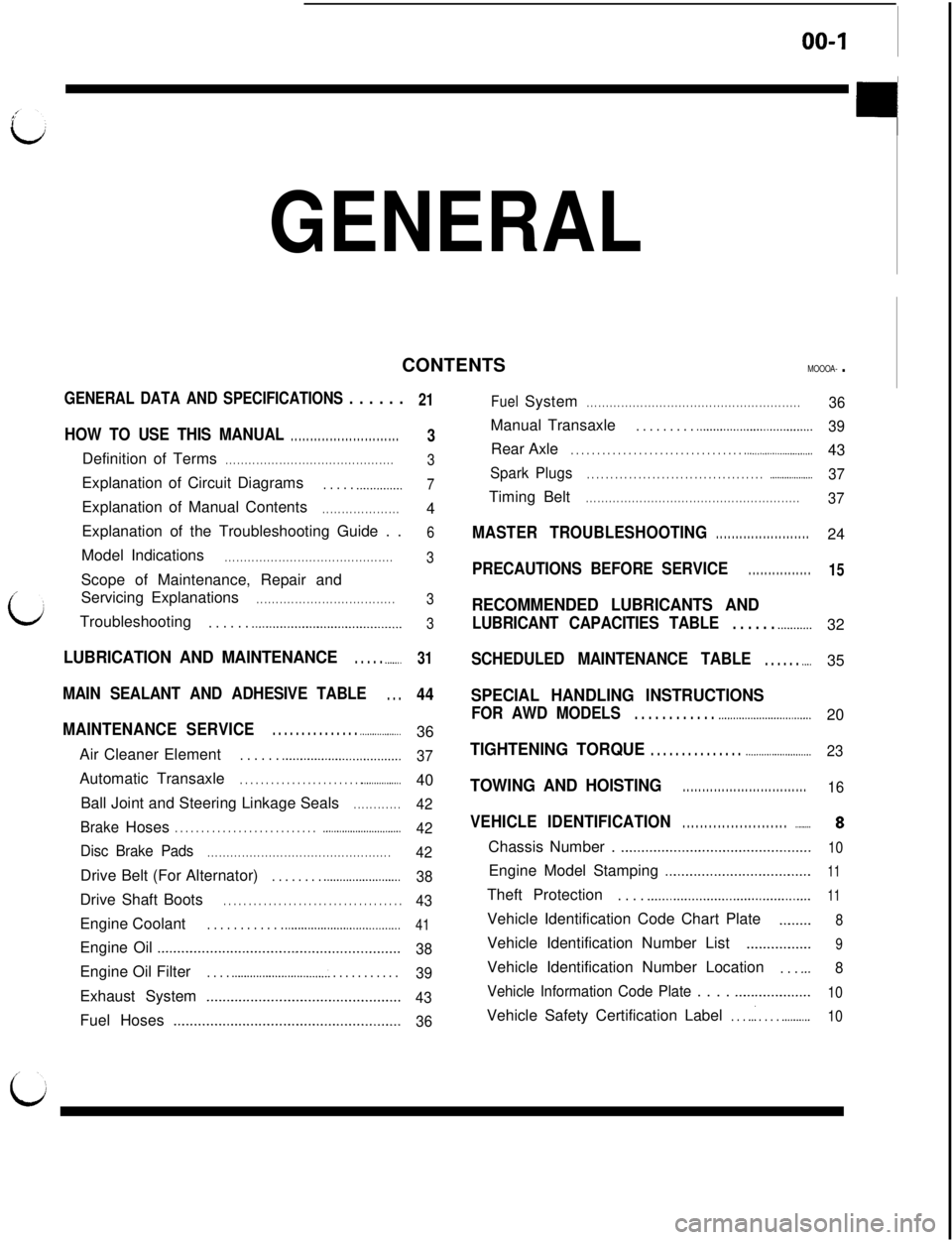
GENERALCONTENTS
MOOOA- .
GENERAL DATA AND SPECIFICATIONS . . . . . .21
HOW TO USE THIS MANUAL. . . . . . . . . . . . . . . . . . . . . . . . . . . .3Definition of Terms
. . . . . . . . . . . . . . . . . . . . . . . . . . . . . . . . . . . . . . . . . . . .3Explanation of Circuit Diagrams
. . . . . .._...........7Explanation of Manual Contents
. . . . . . . . . . . . . . . . . . . .4
Explanation of the Troubleshooting Guide . .
6ModelIndications
. . . . . . . . . . . . . . . . . . . . . . . . . . . . . . . . . . . . . . . . . . . .3Scope of Maintenance, Repair and
ServicingExplanations
. . . . . . . . . . . . . . . . . . . . . . . . . . . . . . . . . . . .3Troubleshooting
. . . . . . .._.......................................3
LUBRICATION AND MAINTENANCE. . . . . .._....31SCHEDULED MAINTENANCE TABLE. . . . . . .._.
MAIN SEALANT AND ADHESIVE TABLE. . .44
MAINTENANCE SERVICE
. . . . . . . . . . . . . . . .._......_.....__Air Cleaner Element
. . . . . . .._......._......_................Automatic Transaxle
. . . . . . . . . . . . . . . . . . . . . . . . .._......._.....Ball Joint and Steering Linkage Seals
. . . . . . . . . . . .
BrakeHoses. . . . . . . . . . . . . . . . . . . . . . . . . . . .._......._.._...._......._..
Disc Brake Pads. . . . . . . . . . . . . . . . . . . . . . . . . . . . . . . . . . . . . . . . . . . . . . . .Drive Belt (For Alternator)
. . . . . . . . .._.........._..........Drive Shaft Boots
. . . . . . . . . . . . . . . . . . . . . . . . . . . . . . . . . . . .Engine Coolant
. . . . . . . . . . . . ..__.._.............................Engine Oil
.._....__._.................................................Engine Oil Filter
. . . . .._._.......__.................. . . . . . . . . . . .Exhaust System
_....._......._.....__._............,...........Fuel Hoses
..__......__............................................36
3740
42
42
42
38
43
41
38
39
43
36
FuelSystem. . . . . . . . . . . . . . . . . . . . . . . . . . . . . . . . . . . . . . . . . . . . . . . . . . . . . . . .Manual Transaxle
. . . . . . . . . .._........................_.......Rear Axle
. . . . . . . . . . . . . . . . . . . . . . . . . . . . . . . . . . .._..._.._..____.._.......
SparkPlugs. . . . . . . . . . . . . . . . . . . . . . . . . . . . . . . . . . . . . . .._...............TimingBelt
. . . . . . . . . . . . . . . . . . . . . . . . . . . . . . . . . . . . . . . . . . . . . . . . . . . . . . . .
MASTER TROUBLESHOOTING. . . . . . . . . . . . . . . . . . . . . . . .
PRECAUTIONS BEFORE SERVICE. . . . . . . . . . . . . . . .
RECOMMENDED LUBRICANTS AND
LUBRICANT CAPACITIES TABLE. . . . . . .._........
SPECIAL HANDLING INSTRUCTIONS
FOR AWD MODELS. . . . . . . . . . . . .._...._........................
TIGHTENING TORQUE. . . . . . . . . . . . . . . ..__.....................
TOWING AND HOISTING. . . . . . . . . . . . . . . . . . . . . . . . . . . . . . . .
VEHICLE IDENTIFICATION. . . . . . . . . . . . . . . . . . . . . . . . .._.....Chassis Number .
.._............................................Engine Model Stamping
.._..........................._...._Theft Protection
. . . . .._.........................................Vehicle Identification Code Chart Plate
.._.....Vehicle Identification Number List
.._._....._..._.Vehicle Identification Number Location
. . . .._
Vehicle Information Code Plate . . . . .._._......_.......Vehicle Safety Certification Label
. . . ..I . . . . .._..._...
36
3943
37
3724
1532
35
20
23
16
8
10
11
11
8
9
8
10
10
Page 40 of 1146
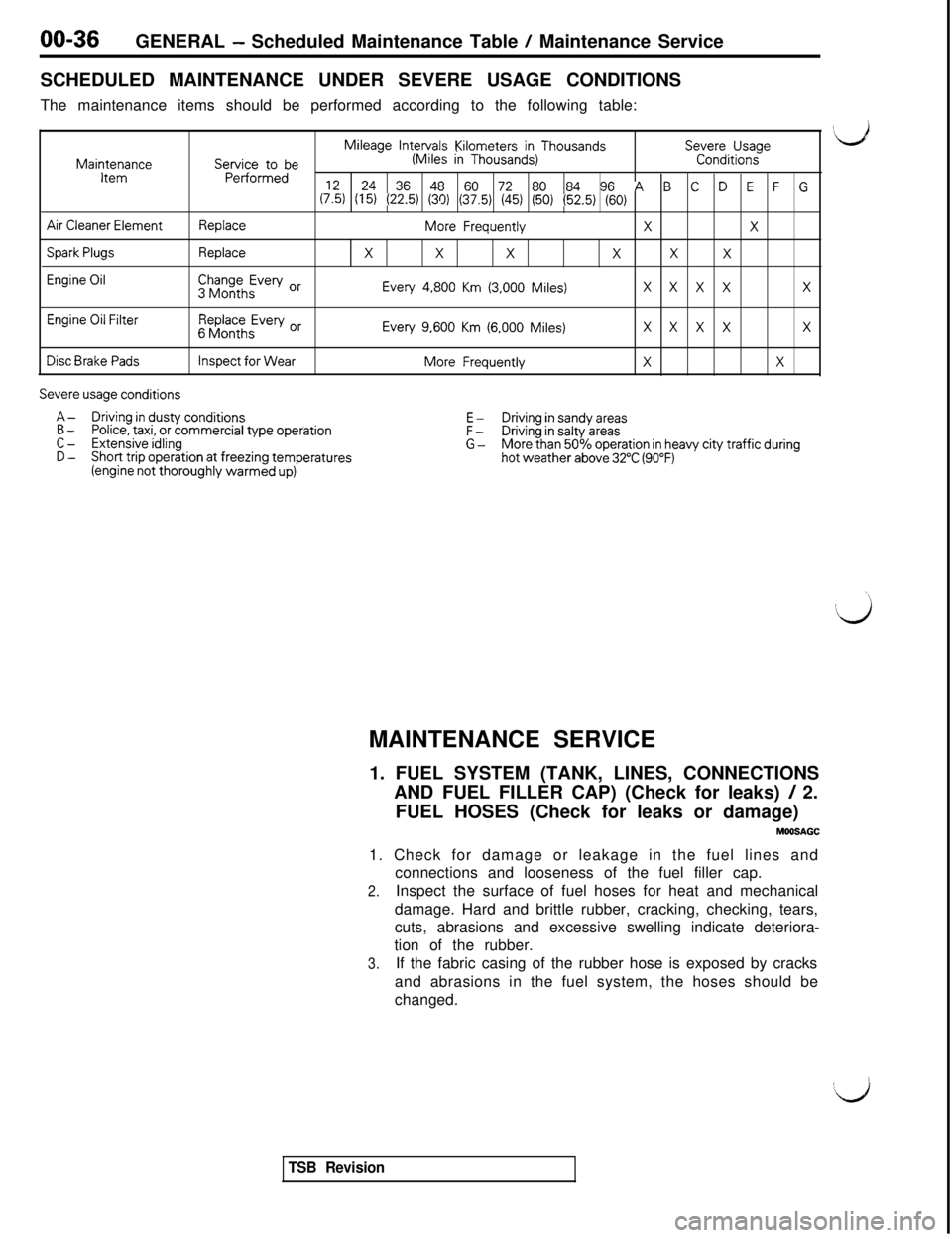
00-36GENERAL - Scheduled Maintenance Table / Maintenance Service
SCHEDULED MAINTENANCE UNDER SEVERE USAGE CONDITIONS
The maintenance items should be performed according to the following table:
Mileage Intervals Kilometers in ThousandsSevere Usage
MaintenanceService to be(Miles in Thousands)Conditions
itemPerformed
(6 (15) (22.5) (30) (37.5) (45) (50) (52.5) (60)24 36 48 60 72 80 84 96 A B C D E F G
Air Cleaner ElementReplaceMore FrequentlyXX
Spark PlugsReplaceXXXXXX
Engine OilChange Every Or3 MonthsEvery 4,800 Km (3,000 Miles)x x x xX
Engine Oil FilterReplace Every or6 MonthsEvery 9,600 Km (6.000 Miles)x x x xX
Disc Brake PadsInspect for WearMore FrequentlyXX
Severe usage conditions
A-Driving in dusty conditionsE -B -Police, taxi, or commercial type operationF -Driving in sandy areas
C -Extensive idlingG -Driving in salty areas
D -Short trip operation at freezing temperaturesMore than 50% operation in heavy city traffic during
(engine not thoroughly warmed up)hot weather above 32°C (90°F)MAINTENANCE SERVICE
1. FUEL SYSTEM (TANK, LINES, CONNECTIONS
AND FUEL FILLER CAP) (Check for leaks)
/ 2.
FUEL HOSES (Check for leaks or damage)MWShGC
1. Check for damage or leakage in the fuel lines and
connections and looseness of the fuel filler cap.
2.Inspect the surface of fuel hoses for heat and mechanical
damage. Hard and brittle rubber, cracking, checking, tears,
cuts, abrasions and excessive swelling indicate deteriora-
tion of the rubber.
3.If the fabric casing of the rubber hose is exposed by cracks
and abrasions in the fuel system, the hoses should be
changed.
TSB Revision
Page 41 of 1146
GENERAL - Maintenance Service00-37
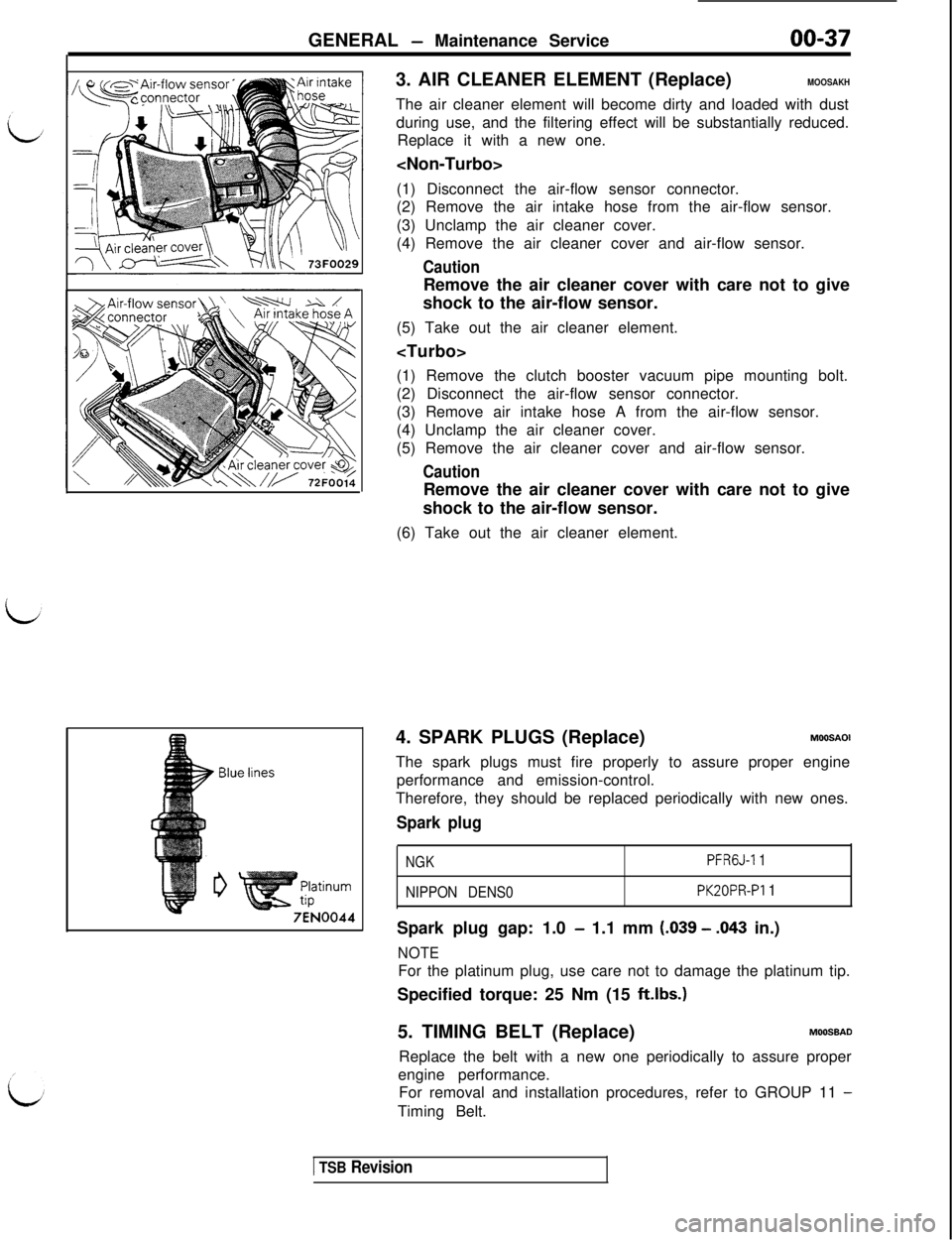
3. AIR CLEANER ELEMENT (Replace)
MOOSAKHThe air cleaner element will become dirty and loaded with dust
during use, and the filtering effect will be substantially reduced.
Replace it with a new one.
(1) Disconnect the air-flow sensor connector.
(2) Remove the air intake hose from the air-flow sensor.
(3) Unclamp the air cleaner cover.
(4) Remove the air cleaner cover and air-flow sensor.
CautionRemove the air cleaner cover with care not to give
shock to the air-flow sensor.
(5) Take out the air cleaner element.
(1) Remove the clutch booster vacuum pipe mounting bolt.
(2) Disconnect the air-flow sensor connector.
(3) Remove air intake hose A from the air-flow sensor.
(4) Unclamp the air cleaner cover.
(5) Remove the air cleaner cover and air-flow sensor.
CautionRemove the air cleaner cover with care not to give
shock to the air-flow sensor.
(6) Take out the air cleaner element.
4. SPARK PLUGS (Replace)
MOOSAOIThe spark plugs must fire properly to assure proper engine
performance and emission-control.
Therefore, they should be replaced periodically with new ones.
Spark plug
NGKPFRGJ-1 1
NIPPON DENS0
PK20PR-PI 1Spark plug gap: 1.0
- 1.1 mm LO39 - -043 in.)
NOTEFor the platinum plug, use care not to damage the platinum tip.
Specified torque: 25 Nm (15
ft.lbs.15. TIMING BELT (Replace)
MOOSBADReplace the belt with a new one periodically to assure proper
engine performance.
For removal and installation procedures, refer to GROUP 11
-Timing Belt.
1 TSB Revision
Page 42 of 1146
00-38GENERAL - Maintenance Service
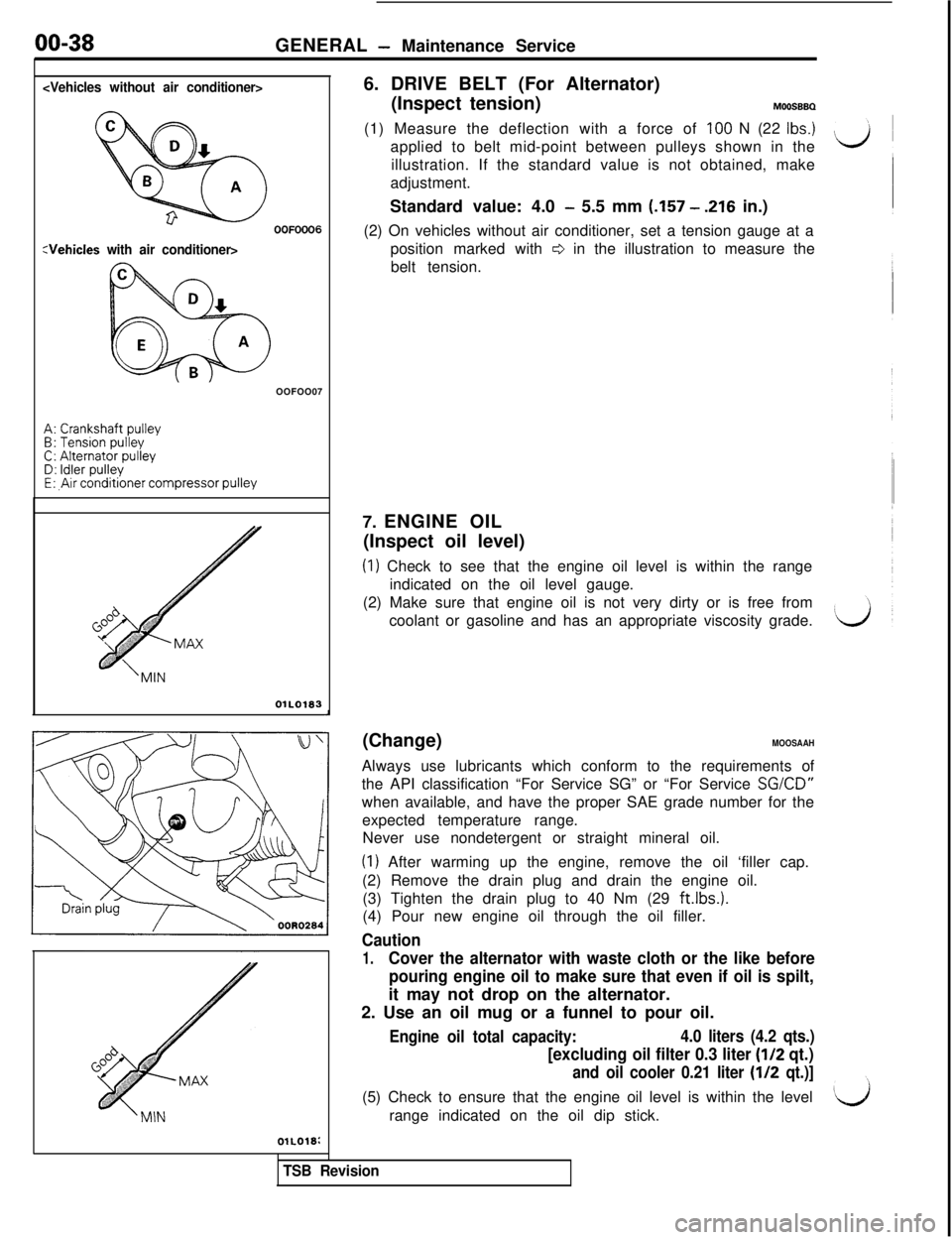
00F0006
:Vehicles with air conditioner>OOFOO07
A: Crankshaft pulleyB: Tension pulleyC: Alternator pulleyD: Idler pulleyE: ,Air conditioner compressor pulley
OlLO183
OlLO18:(Inspect tension)
MOOS88(1(1) Measure the deflection with a force of
100 N (22 Ibs.)applied to belt mid-point between pulleys shown in the
illustration. If the standard value is not obtained, make
adjustment.
Standard value: 4.0
- 5.5 mm (.157 - 216 in.)
(2) On vehicles without air conditioner, set a tension gauge at a
position marked with
r3 in the illustration to measure the
belt tension.
7. ENGINE OIL
(Inspect oil level)
(I) Check to see that the engine oil level is within the range
indicated on the oil level gauge.
(2) Make sure that engine oil is not very dirty or is free from
coolant or gasoline and has an appropriate viscosity grade.J
(Change)
MOOSAAHAlways use lubricants which conform to the requirements of
the API classification “For Service SG” or “For Service
SGKD”when available, and have the proper SAE grade number for the
expected temperature range.
Never use nondetergent or straight mineral oil.
(1) After warming up the engine, remove the oil ‘filler cap.
(2) Remove the drain plug and drain the engine oil.
(3) Tighten the drain plug to 40 Nm (29 ft.lbs.).
(4) Pour new engine oil through the oil filler.
Caution
1.Cover the alternator with waste cloth or the like before
pouring engine oil to make sure that even if oil is spilt,it may not drop on the alternator.
2. Use an oil mug or a funnel to pour oil.
Engine oil total capacity:4.0 liters (4.2 qts.)
[excluding oil filter 0.3 liter (l/2 qt.)
and oil cooler 0.21 liter (l/2 qt.)](5) Check to ensure that the engine oil level is within the level
range indicated on the oil dip stick.
TSB Revision
Page 60 of 1146

II-IOENGINE - Troubleshooting
TROUBLESHOOTINGmiwm
SymptomProbable cause
RemedyI,aJ
Compression too low) Cylinder head gasket blown1 Replace gasketI
Piston ring worn or damage
Piston or cylinder worn
Replace rings
Repair or replace piston and/or cylinder
block
Valve seat worn or damage
Repair or replace valve and/or seat ring
3il pressure drop
Engine oil level too lowCheck engine oil level
Oil pressure switch faulty
Oil filter clogged
Replace oil pressure switch
Install new filter
Oil pump gears or cover worn
Thin or diluted engine oilReplace gears and/or cover
Change engine oil to correct viscosity
1 Oil relief valve stuck (opened)) Repair relief valve
Excessive bearing clearance
Replace bearingsIbOil relief valve stuck (closed)
Incorrect lash adjusterRepair relief valve
Replace lash adjuster Oil pressure too high
Noisy valves
Thin or diluted engine oil (low oil pressure)Change engine oil
Valve stem or valve guide worn or damageReplace valve and/or guide
Connecting rod noise/
nain bearing noiseInsufficient oil supplyCheck engine oil level
Thin or diluted engine oilChange engine oil
Excessive bearing clearanceReplace bearings
Timing belt noise
Incorrect belt tensionAdjust belt tension
TSB Revision
Page 107 of 1146
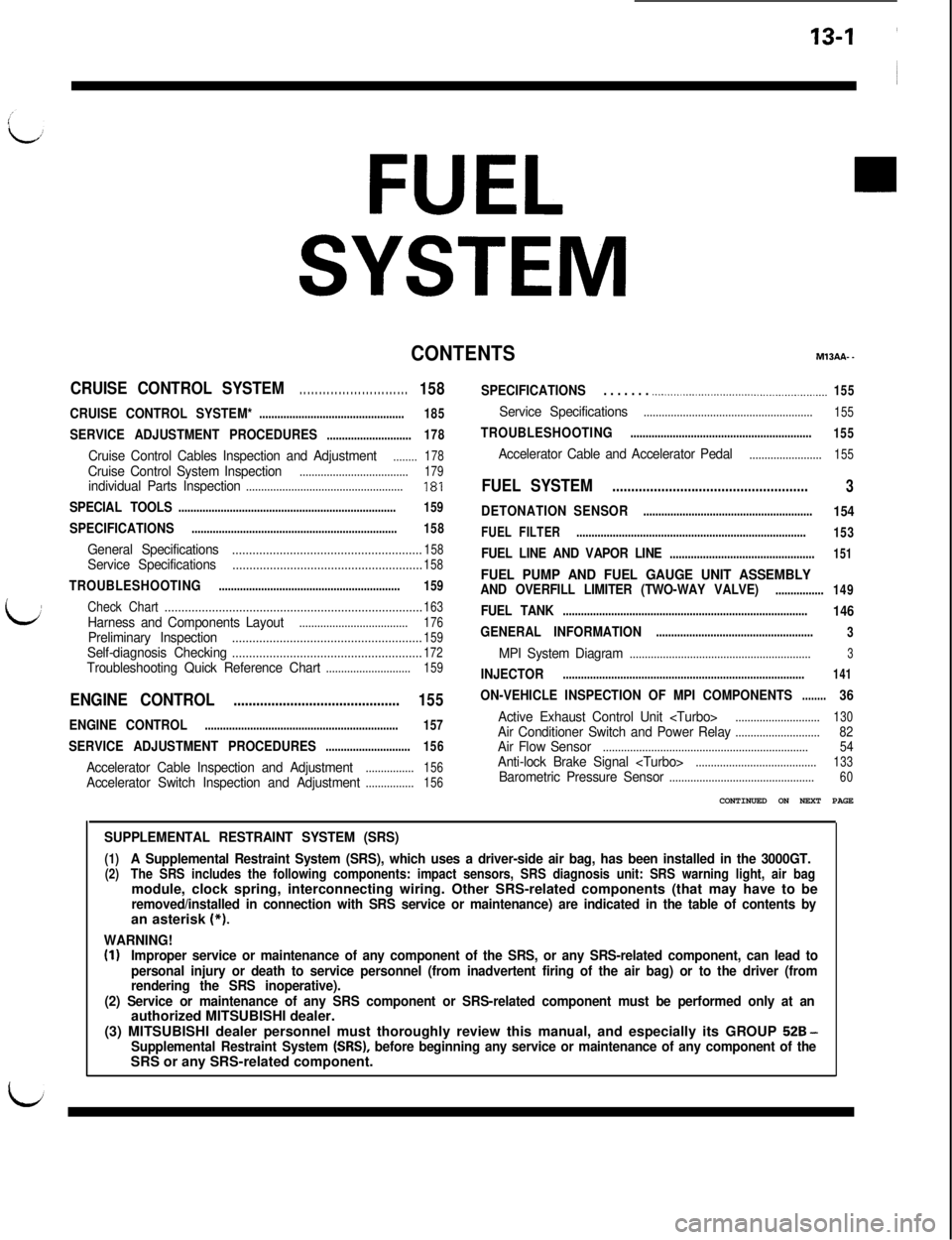
FUEL
SYSTEM
CONTENTSM13AA- _
CRUISE CONTROL SYSTEM. . . . . . . . . . . . . . . . . . . . . . . . . . . .158SPECIFICATIONS. . . . . . . .._._....................................................155
CRUISE CONTROL SYSTEM*................................................185
SERVICE ADJUSTMENT PROCEDURES............................178
Cruise Control Cables Inspection and Adjustment........178Cruise Control SystemInspection....................................179individual Parts Inspection....................................................181
SPECIAL TOOLS........................................................................159
SPECIFICATIONS....................................................................158
General Specifications........................................................158Service Specifications........................................................158
TROUBLESHOOTING............................................................159
Check Chart............................................................................163Harness and Components Layout....................................176Preliminary Inspection........................................................159Self-diagnosis Checking........................................................172Troubleshooting Quick Reference Chart............................159
ENGINE CONTROL............................................155
ENGINE CONTROL................................................................157
SERVICE ADJUSTMENT PROCEDURES............................156
Accelerator Cable Inspection and Adjustment................156Accelerator Switch Inspection and Adjustment................156
Service Specifications........................................................
155
TROUBLESHOOTING............................................................
155
Accelerator Cable and Accelerator Pedal........................155
FUEL SYSTEM....................................................3
DETONATION SENSOR........................................................154
FUEL FILTER............................................................................
153
FUEL LINE AND VAPOR LINE................................................151
FUEL PUMP AND FUEL GAUGE UNIT ASSEMBLYAND OVERFILL LIMITER (TWO-WAY VALVE)................149
FUEL TANK.................................................................................146
GENERAL INFORMATION
....................................................
3
MPI System Diagram............................................................3
INJECTOR................................................................................141
ON-VEHICLE INSPECTION OF MPI COMPONENTS........36
Active Exhaust Control Unit
SUPPLEMENTAL RESTRAINT SYSTEM (SRS)
(1)A Supplemental Restraint System (SRS), which uses a driver-side air bag, has been installed in the 3000GT.(2)The SRS includes the following components: impact sensors, SRS diagnosis unit: SRS warning light, air bagmodule, clock spring, interconnecting wiring. Other SRS-related components (that may have to be
removed/installed in connection with SRS service or maintenance) are indicated in the table of contents byan asterisk (*).
WARNING!(I)Improper service or maintenance of any component of the SRS, or any SRS-related component, can lead to
personal injury or death to service personnel (from inadvertent firing of the air bag) or to the driver (from
rendering the SRS inoperative).
(2) Service or maintenance of any SRS component or SRS-related component must be performed only at anauthorized MITSUBISHI dealer.
(3) MITSUBISHI dealer personnel must thoroughly review this manual, and especially its GROUP
528 -Supplemental Restraint System (SRS), before beginning any service or maintenance of any component of theSRS or any SRS-related component.
Page 112 of 1146
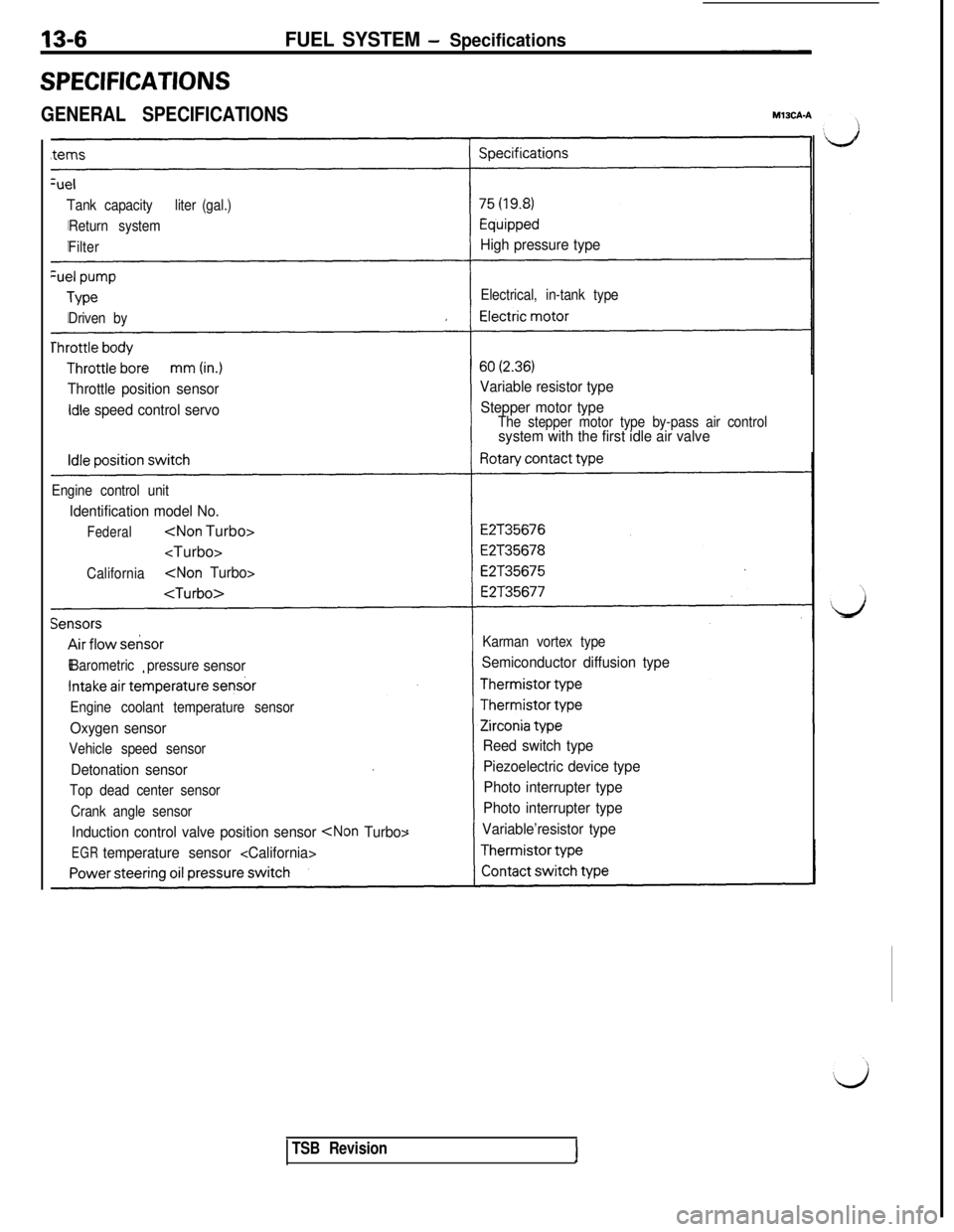
Tank capacityliter (gal.)
Return system
Filter
High pressure type
Electrical, in-tank type
Driven by
Throttle position sensor
idle speed control servoVariable resistor type
Stepper motor typeThe stepper motor type by-pass air controlsystem with the first idle air valve
Engine control unit
Identification model No.
Federal
California
Karman vortex type
Barometric pressure
sensorSemiconductor diffusion type
Engine coolant temperature sensor
Oxygen sensor
Vehicle speed sensor
Detonation sensor
Top dead center sensor
Crank angle sensor
Induction control valve position sensor
EGRtemperature sensor
Piezoelectric device type
Photo interrupter type
Photo interrupter type
Variable’resistor type
13-6FUEL SYSTEM - Specifications
SPECIFICATIONS
GENERAL SPECIFICATIONS
TSB Revision
Page 245 of 1146
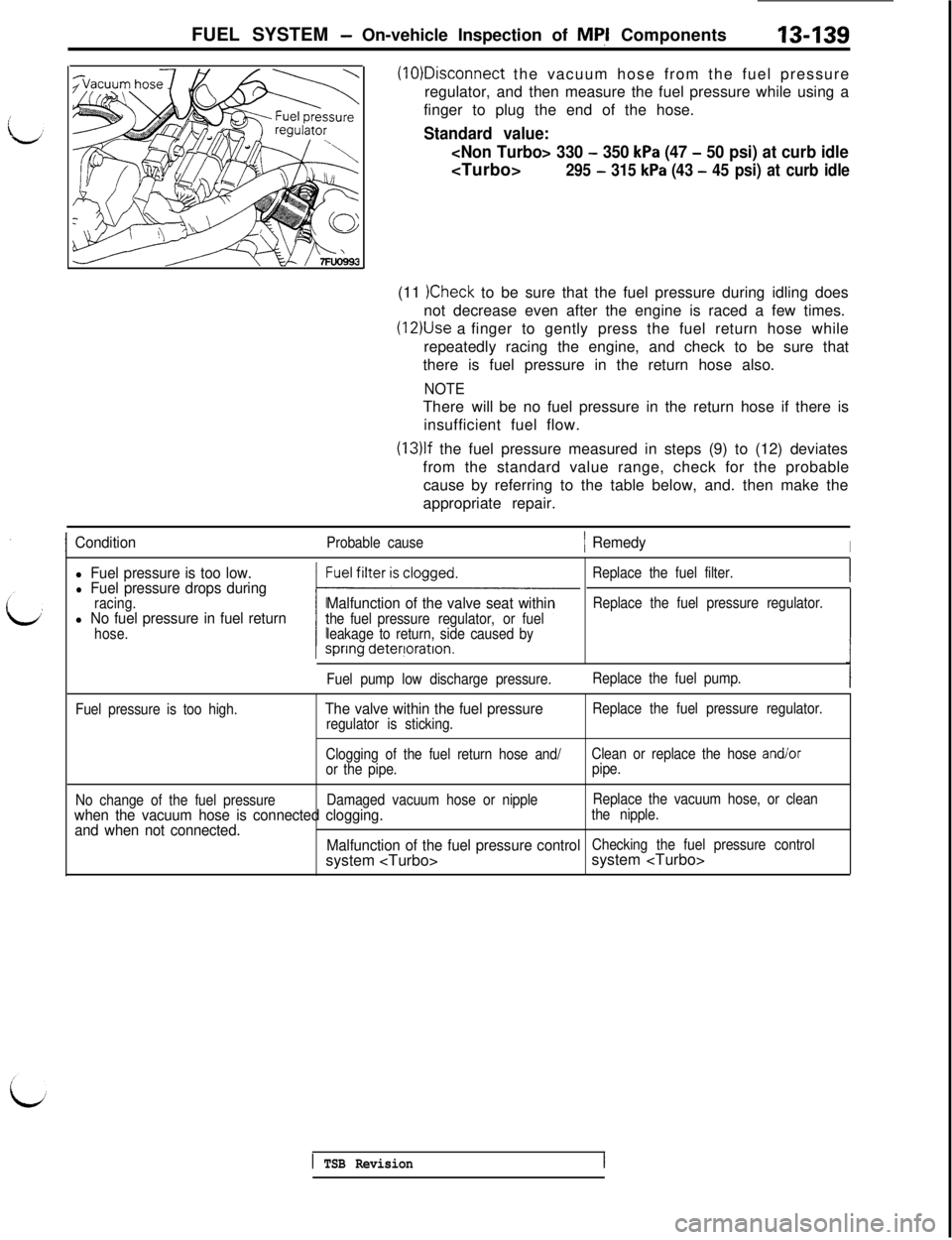
FUEL SYSTEM - On-vehicle Inspection of Mql Components13439(10)Disconnect the vacuum hose from the fuel pressure
regulator, and then measure the fuel pressure while using a
finger to plug the end of the hose.
Standard value:
- 350 kPa (47 - 50 psi) at curb idle
295 - 315 kPa (43 - 45 psi) at curb idle(11
)Check to be sure that the fuel pressure during idling does
not decrease even after the engine is raced a few times.
(12)Use a finger to gently press the fuel return hose while
repeatedly racing the engine, and check to be sure that
there is fuel pressure in the return hose also.
NOTEThere will be no fuel pressure in the return hose if there is
insufficient fuel flow.
(13)lf the fuel pressure measured in steps (9) to (12) deviates
from the standard value range, check for the probable
cause by referring to the table below, and. then make the
appropriate repair.
IConditionProbable cause1 RemedyI
l Fuel pressure is too low.l Fuel pressure drops duringracing.l No fuel pressure in fuel returnhose.
Malfunction of the valve seat withinthe fuel pressure regulator, or fuel
leakage to return, side caused byReplace the fuel filter.
Replace the fuel pressure regulator.
Fuel pump low discharge pressure.Replace the fuel pump.
Fuel pressure is too high.
The valve within the fuel pressureregulator is sticking.Replace the fuel pressure regulator.
Clogging of the fuel return hose and/Clean or replace the hose
and/oror the pipe.pipe.
No change of the fuel pressureDamaged vacuum hose or nippleReplace the vacuum hose, or clean
when the vacuum hose is connected clogging.the nipple.
and when not connected.
Malfunction of the fuel pressure controlChecking the fuel pressure controlsystem
1 TSB Revision
Page 492 of 1146
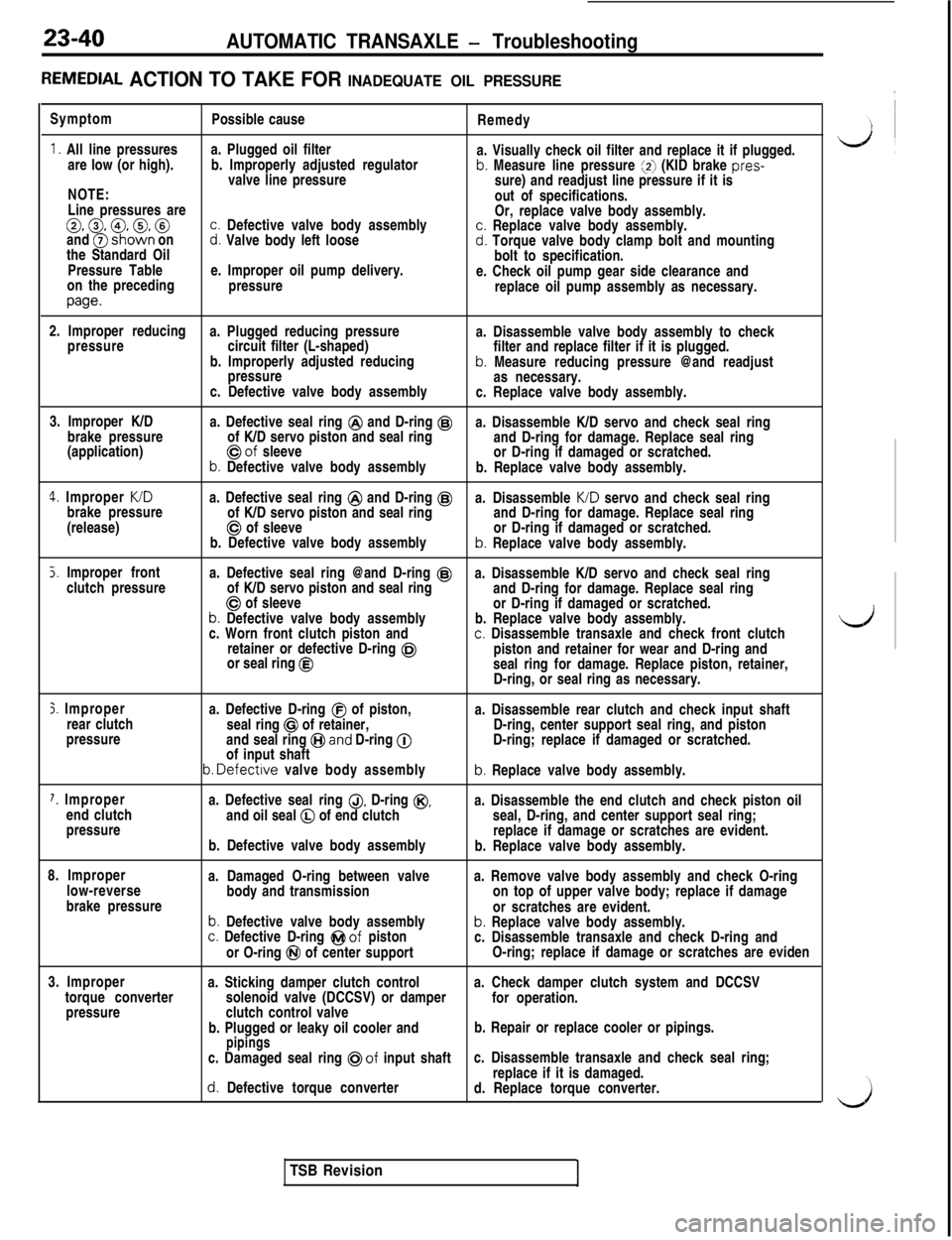
23-40AUTOMATIC TRANSAXLE - Troubleshooting
REMEDIAL ACTION TO TAKE FOR INADEQUATE OIL PRESSURESymptom
Possible cause
Remedy
1. All line pressuresa. Plugged oil filter
are low (or high).b. Improperly adjusted regulatora. Visually check oil filter and replace it if plugged.
valve line pressure
b. Measure line pressure (2) (KID brake pres-
NOTE:sure) and readjust line pressure if it is
Line pressures areout of specifications.
@.@.@).@.@and @shown onc. Defective valve body assemblyOr, replace valve body assembly.
the Standard Oil
Pressure Table
on the preceding
paw.
d. Valve body left loose
e. Improper oil pump delivery.
pressurec. Replace valve body assembly.d. Torque valve body clamp bolt and mounting
bolt to specification.
e. Check oil pump gear side clearance and
replace oil pump assembly as necessary.
2. Improper reducing
a. Plugged reducing pressure
a. Disassemble valve body assembly to check
pressurecircuit filter (L-shaped)
b. Improperly adjusted reducingfilter and replace filter if it is plugged.
b. Measure reducing pressure @and readjust
pressure
c. Defective valve body assemblyas necessary.
c. Replace valve body assembly.
3. Improper K/D
brake pressure
(application)a. Defective seal ring
@ and D-ring @of K/D servo piston and seal ringa. Disassemble K/D servo and check seal ring
@of sleeveand D-ring for damage. Replace seal ringb. Defective valve body assemblyor D-ring if damaged or scratched.
b. Replace valve body assembly.
4. Improper KIDbrake pressure
(release)
J. Improper front
clutch pressurea. Defective seal ring
@ and D-ring @of K/D servo piston and seal ringa. Disassemble KID servo and check seal ring
@ of sleeveand D-ring for damage. Replace seal ring
b. Defective valve body assemblyor D-ring if damaged or scratched.b. Replace valve body assembly.
a. Defective seal ring @and D-ring
@of K/D servo piston and seal ringa. Disassemble K/D servo and check seal ring
@ of sleeveand D-ring for damage. Replace seal ringb. Defective valve body assemblyor D-ring if damaged or scratched.
c. Worn front clutch piston andb. Replace valve body assembly.c. Disassemble transaxle and check front clutch
retainer or defective D-ring @or seal ring @piston and retainer for wear and D-ring and
seal ring for damage. Replace piston, retainer,
D-ring, or seal ring as necessary.
3. Improper
rear clutch
pressure
7. Improper
end clutch
pressurea. Defective D-ring
@ of piston,
seal ring @ of retainer,
and seal ring @and D-ring @of input shaft
b. Defectrve valve body assembly
a. Defective seal ring
0. D-ring 0,and oil seal (iJ of end clutch
b. Defective valve body assemblya. Disassemble rear clutch and check input shaft
D-ring, center support seal ring, and piston
D-ring; replace if damaged or scratched.
b. Replace valve body assembly.
a. Disassemble the end clutch and check piston oil
seal, D-ring, and center support seal ring;
replace if damage or scratches are evident.
b. Replace valve body assembly.
8. Improper
low-reverse
brake pressurea. Damaged O-ring between valve
body and transmission
b. Defective valve body assemblyc. Defective D-ring @of piston
or O-ring
@I of center supporta. Remove valve body assembly and check O-ring
on top of upper valve body; replace if damage
or scratches are evident.
b. Replace valve body assembly.
c. Disassemble transaxle and check D-ring and
O-ring; replace if damage or scratches are eviden
3. Improper
torque converter
pressurea. Sticking damper clutch controla. Check damper clutch system and DCCSV
solenoid valve (DCCSV) or damper
for operation.
clutch control valve
b. Plugged or leaky oil cooler and
pipingsb. Repair or replace cooler or pipings.
c. Damaged seal ring @of input shaftc. Disassemble transaxle and check seal ring;
d. Defective torque converterreplace if it is damaged.
d. Replace torque converter.
TSB Revision
d
‘\
d
Page 837 of 1146
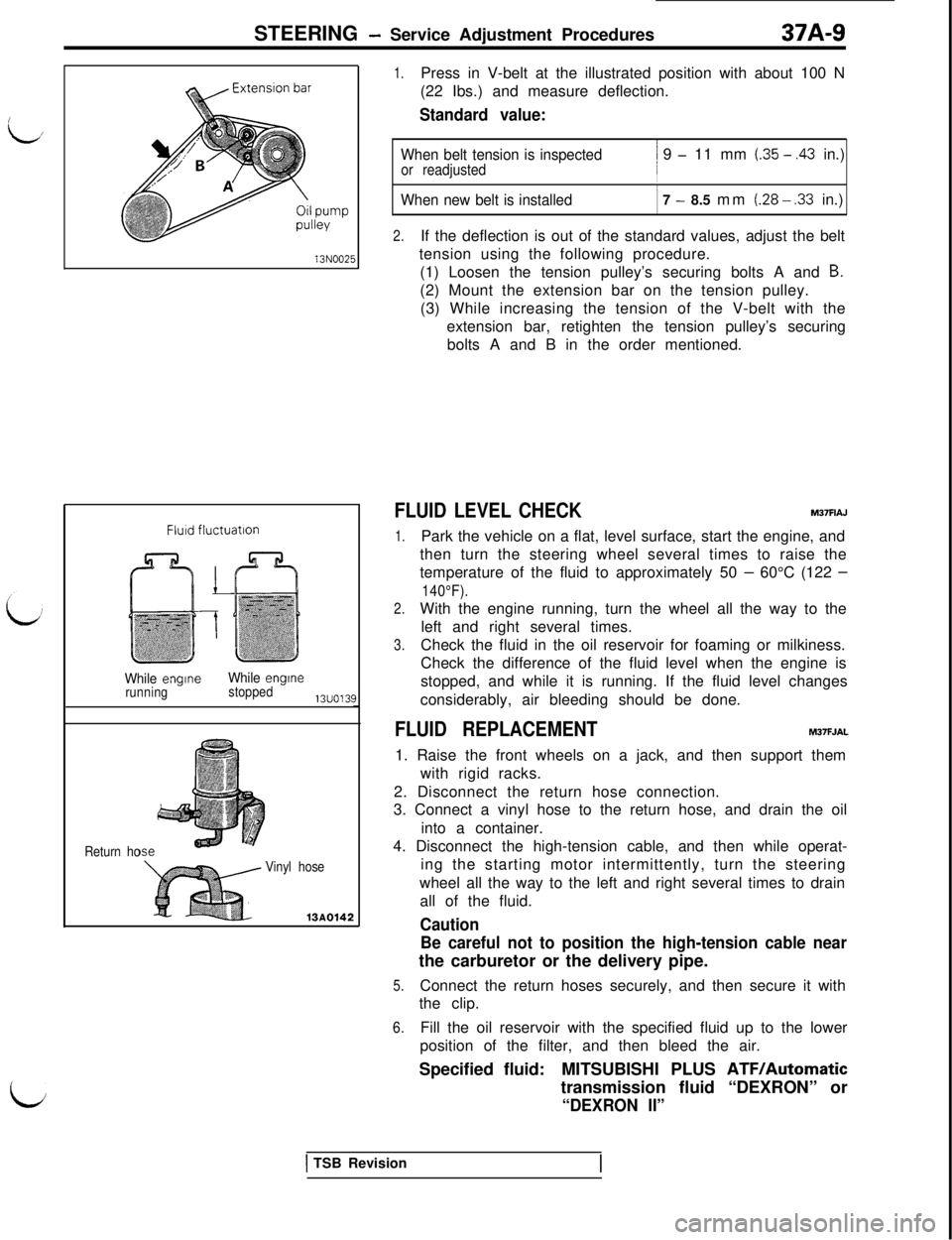
STEERING - Service Adjustment Procedures37A-9
LL:13N002E
FluId f[uctuatlon
While
engineWhile engme
runningstopped13uo13:
Return ho
Vinyl hose13AO142
j
1.Press in V-belt at the illustrated position with about 100 N
(22 Ibs.) and measure deflection.
Standard value:
When belt tension is inspectedor readjusted
When new belt is installed
/ 9 - 11 mm (.35 - .43 in.)
I
’ 7 - 8.5 mm (.28 - .33 in.)
2.If the deflection is out of the standard values, adjust the belt
tension using the following procedure.
(1) Loosen the tension pulley’s securing bolts A and
B.(2) Mount the extension bar on the tension pulley.
(3) While increasing the tension of the V-belt with the
extension bar, retighten the tension pulley’s securing
bolts A and B in the order mentioned.
FLUID LEVEL CHECKM37FlAJ
1.Park the vehicle on a flat, level surface, start the engine, and
then turn the steering wheel several times to raise the
temperature of the fluid to approximately 50
- 60°C (122 -
140°F).
2.With the engine running, turn the wheel all the way to the
left and right several times.
3.Check the fluid in the oil reservoir for foaming or milkiness.
Check the difference of the fluid level when the engine is
stopped, and while it is running. If the fluid level changes
considerably, air bleeding should be done.
FLUID REPLACEMENTM37FJAL1. Raise the front wheels on a jack, and then support them
with rigid racks.
2. Disconnect the return hose connection.
3. Connect a vinyl hose to the return hose, and drain the oil
into a container.
4. Disconnect the high-tension cable, and then while operat-
ing the starting motor intermittently, turn the steering
wheel all the way to the left and right several times to drain
all of the fluid.
Caution
Be careful not to position the high-tension cable nearthe carburetor or the delivery pipe.
5.Connect the return hoses securely, and then secure it with
the clip.
6.Fill the oil reservoir with the specified fluid up to the lower
position of the filter, and then bleed the air.
Specified fluid:MITSUBISHI PLUS ATF/Automatic
transmission fluid “DEXRON” or
“DEXRON II”
1 TSB Revision