towing MITSUBISHI 3000GT 1991 Service Manual
[x] Cancel search | Manufacturer: MITSUBISHI, Model Year: 1991, Model line: 3000GT, Model: MITSUBISHI 3000GT 1991Pages: 1146, PDF Size: 76.68 MB
Page 5 of 1146
,
b
00-I
GENERALCONTENTS
MOOOA- .
GENERAL DATA AND SPECIFICATIONS . . . . . .21
HOW TO USE THIS MANUAL. . . . . . . . . . . . . . . . . . . . . . . . . . . .3Definition of Terms
. . . . . . . . . . . . . . . . . . . . . . . . . . . . . . . . . . . . . . . . . . . .3Explanation of Circuit Diagrams
. . . . . .._...........7Explanation of Manual Contents
. . . . . . . . . . . . . . . . . . . .4
Explanation of the Troubleshooting Guide . .
6ModelIndications
. . . . . . . . . . . . . . . . . . . . . . . . . . . . . . . . . . . . . . . . . . . .3Scope of Maintenance, Repair and
ServicingExplanations
. . . . . . . . . . . . . . . . . . . . . . . . . . . . . . . . . . . .3Troubleshooting
. . . . . . .._.......................................3
LUBRICATION AND MAINTENANCE. . . . . .._....31SCHEDULED MAINTENANCE TABLE. . . . . . .._.
MAIN SEALANT AND ADHESIVE TABLE. . .44
MAINTENANCE SERVICE
. . . . . . . . . . . . . . . .._......_.....__Air Cleaner Element
. . . . . . .._......._......_................Automatic Transaxle
. . . . . . . . . . . . . . . . . . . . . . . . .._......._.....Ball Joint and Steering Linkage Seals
. . . . . . . . . . . .
BrakeHoses. . . . . . . . . . . . . . . . . . . . . . . . . . . .._......._.._...._......._..
Disc Brake Pads. . . . . . . . . . . . . . . . . . . . . . . . . . . . . . . . . . . . . . . . . . . . . . . .Drive Belt (For Alternator)
. . . . . . . . .._.........._..........Drive Shaft Boots
. . . . . . . . . . . . . . . . . . . . . . . . . . . . . . . . . . . .Engine Coolant
. . . . . . . . . . . . ..__.._.............................Engine Oil
.._....__._.................................................Engine Oil Filter
. . . . .._._.......__.................. . . . . . . . . . . .Exhaust System
_....._......._.....__._............,...........Fuel Hoses
..__......__............................................36
3740
42
42
42
38
43
41
38
39
43
36
FuelSystem. . . . . . . . . . . . . . . . . . . . . . . . . . . . . . . . . . . . . . . . . . . . . . . . . . . . . . . .Manual Transaxle
. . . . . . . . . .._........................_.......Rear Axle
. . . . . . . . . . . . . . . . . . . . . . . . . . . . . . . . . . .._..._.._..____.._.......
SparkPlugs. . . . . . . . . . . . . . . . . . . . . . . . . . . . . . . . . . . . . . .._...............TimingBelt
. . . . . . . . . . . . . . . . . . . . . . . . . . . . . . . . . . . . . . . . . . . . . . . . . . . . . . . .
MASTER TROUBLESHOOTING. . . . . . . . . . . . . . . . . . . . . . . .
PRECAUTIONS BEFORE SERVICE. . . . . . . . . . . . . . . .
RECOMMENDED LUBRICANTS AND
LUBRICANT CAPACITIES TABLE. . . . . . .._........
SPECIAL HANDLING INSTRUCTIONS
FOR AWD MODELS. . . . . . . . . . . . .._...._........................
TIGHTENING TORQUE. . . . . . . . . . . . . . . ..__.....................
TOWING AND HOISTING. . . . . . . . . . . . . . . . . . . . . . . . . . . . . . . .
VEHICLE IDENTIFICATION. . . . . . . . . . . . . . . . . . . . . . . . .._.....Chassis Number .
.._............................................Engine Model Stamping
.._..........................._...._Theft Protection
. . . . .._.........................................Vehicle Identification Code Chart Plate
.._.....Vehicle Identification Number List
.._._....._..._.Vehicle Identification Number Location
. . . .._
Vehicle Information Code Plate . . . . .._._......_.......Vehicle Safety Certification Label
. . . ..I . . . . .._..._...
36
3943
37
3724
1532
35
20
23
16
8
10
11
11
8
9
8
10
10
Page 20 of 1146
00-16GENERAL - Towina and Hoistina
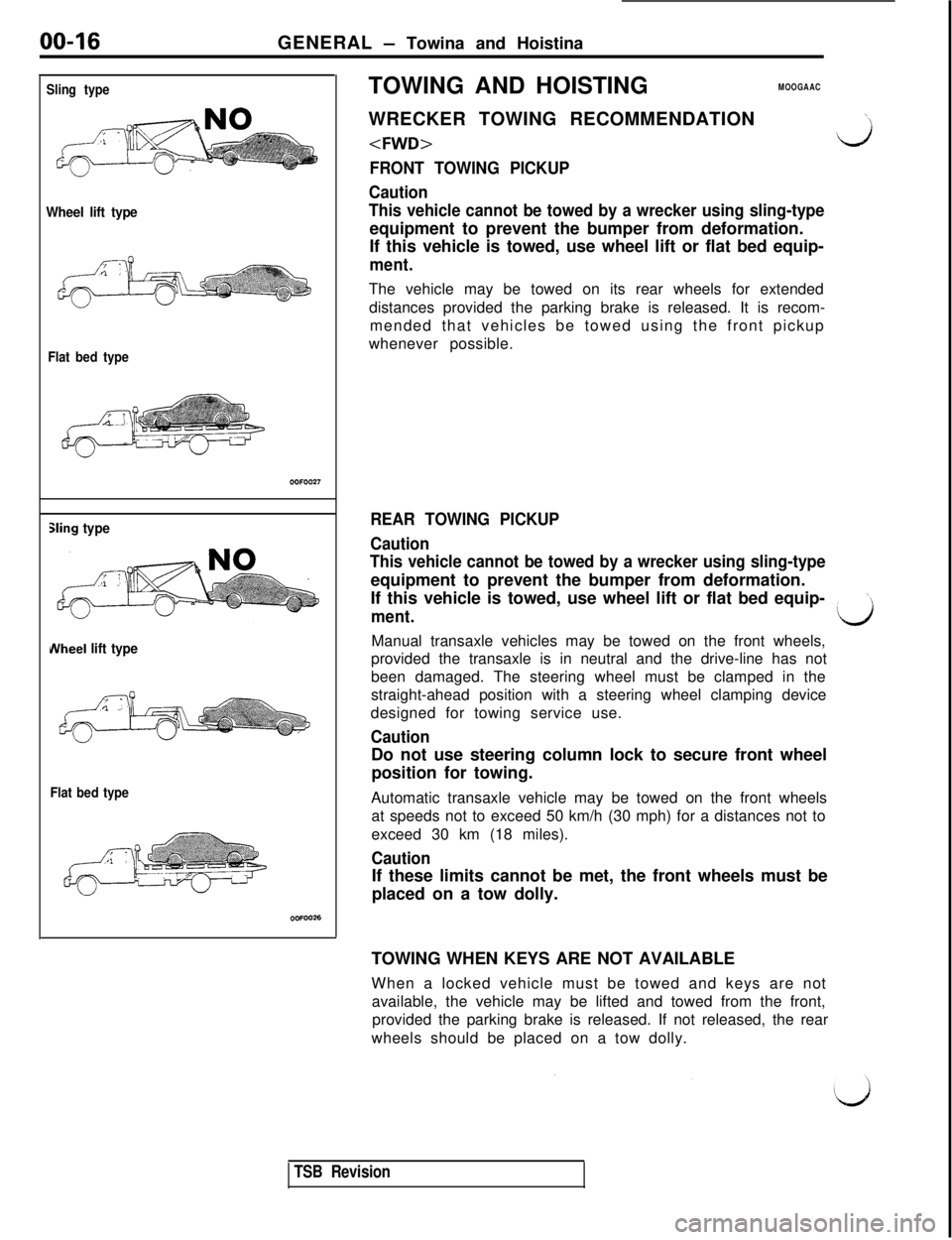
Sling type
Wheel lift type
Flat bed type
Sling type
Wheel lift type
Flat bed typeTOWING AND HOISTING
MOOGAACWRECKER TOWING RECOMMENDATION
FRONT TOWING PICKUP
Caution
\‘i
d
This vehicle cannot be towed by a wrecker using sling-typeequipment to prevent the bumper from deformation.
If this vehicle is towed, use wheel lift or flat bed equip-
ment.The vehicle may be towed on its rear wheels for extended
distances provided the parking brake is released. It is recom-
mended that vehicles be towed using the front pickup
whenever possible.
REAR TOWING PICKUP
Caution
This vehicle cannot be towed by a wrecker using sling-typeequipment to prevent the bumper from deformation.
If this vehicle is towed, use wheel lift or flat bed equip-
\
ment.‘L*3Manual transaxle vehicles may be towed on the front wheels,
provided the transaxle is in neutral and the drive-line has not
been damaged. The steering wheel must be clamped in the
straight-ahead position with a steering wheel clamping device
designed for towing service use.
CautionDo not use steering column lock to secure front wheel
position for towing.
Automatic transaxle vehicle may be towed on the front wheels
at speeds not to exceed 50 km/h (30 mph) for a distances not to
exceed 30 km (18 miles).
CautionIf these limits cannot be met, the front wheels must be
placed on a tow dolly.
TOWING WHEN KEYS ARE NOT AVAILABLE
When a locked vehicle must be towed and keys are not
available, the vehicle may be lifted and towed from the front,
provided the parking brake is released. If not released, the rear
wheels should be placed on a tow dolly.
TSB Revision
Page 21 of 1146
GENERAL - Towing and Hoisting
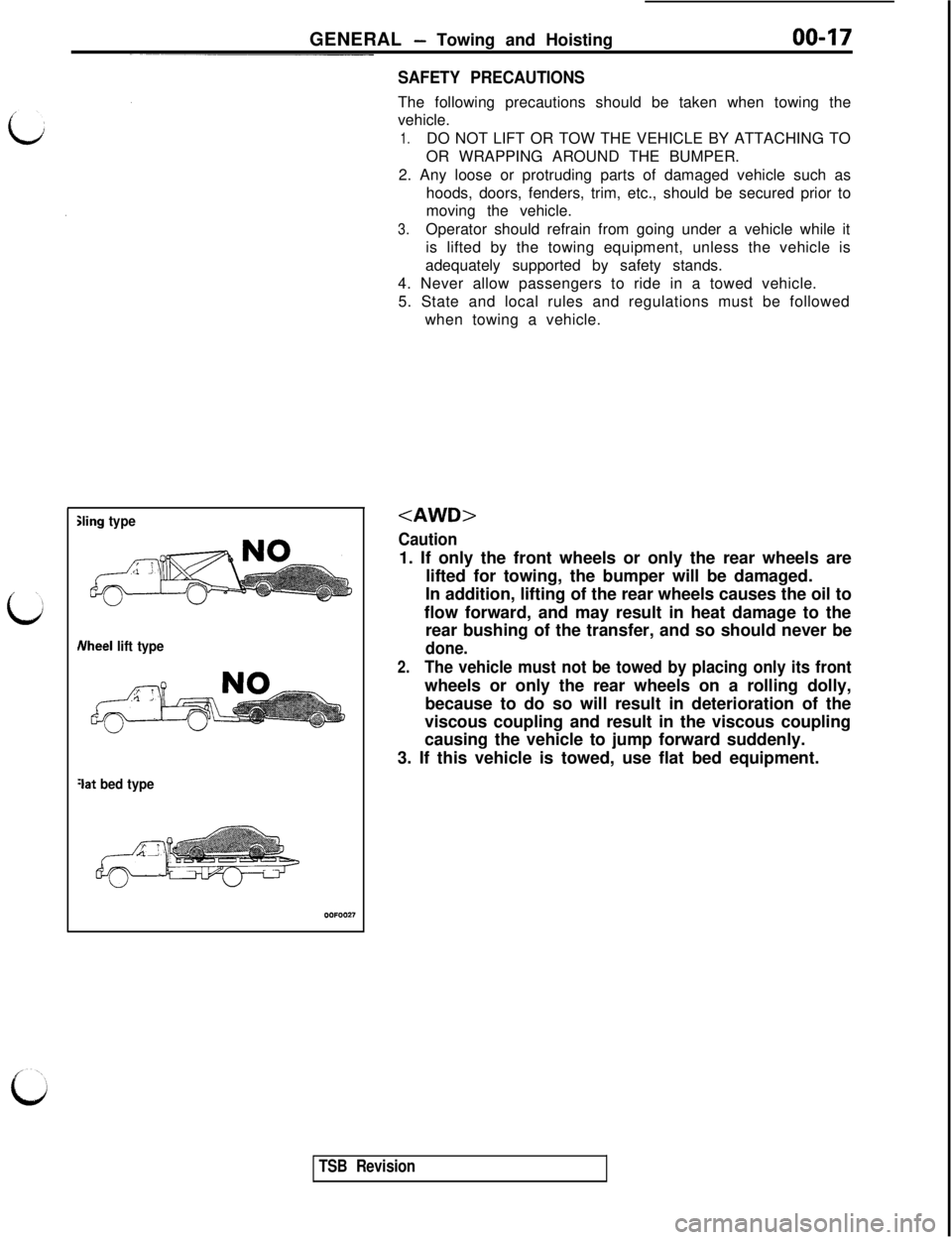
Sling type
Nheel lift type
3at bed type
SAFETY PRECAUTIONSThe following precautions should be taken when towing the
vehicle.
1.DO NOT LIFT OR TOW THE VEHICLE BY ATTACHING TO
OR WRAPPING AROUND THE BUMPER.
2. Any loose or protruding parts of damaged vehicle such as
hoods, doors, fenders, trim, etc., should be secured prior to
moving the vehicle.
3.Operator should refrain from going under a vehicle while it
is lifted by the towing equipment, unless the vehicle is
adequately supported by safety stands.
4. Never allow passengers to ride in a towed vehicle.
5. State and local rules and regulations must be followed
when towing a vehicle.
Caution1. If only the front wheels or only the rear wheels are
lifted for towing, the bumper will be damaged.
In addition, lifting of the rear wheels causes the oil to
flow forward, and may result in heat damage to the
rear bushing of the transfer, and so should never be
done.
2.The vehicle must not be towed by placing only its frontwheels or only the rear wheels on a rolling dolly,
because to do so will result in deterioration of the
viscous coupling and result in the viscous coupling
causing the vehicle to jump forward suddenly.
3. If this vehicle is towed, use flat bed equipment.
TSB Revision
Page 22 of 1146
00-18
GENERAL - Towing and Hoisting
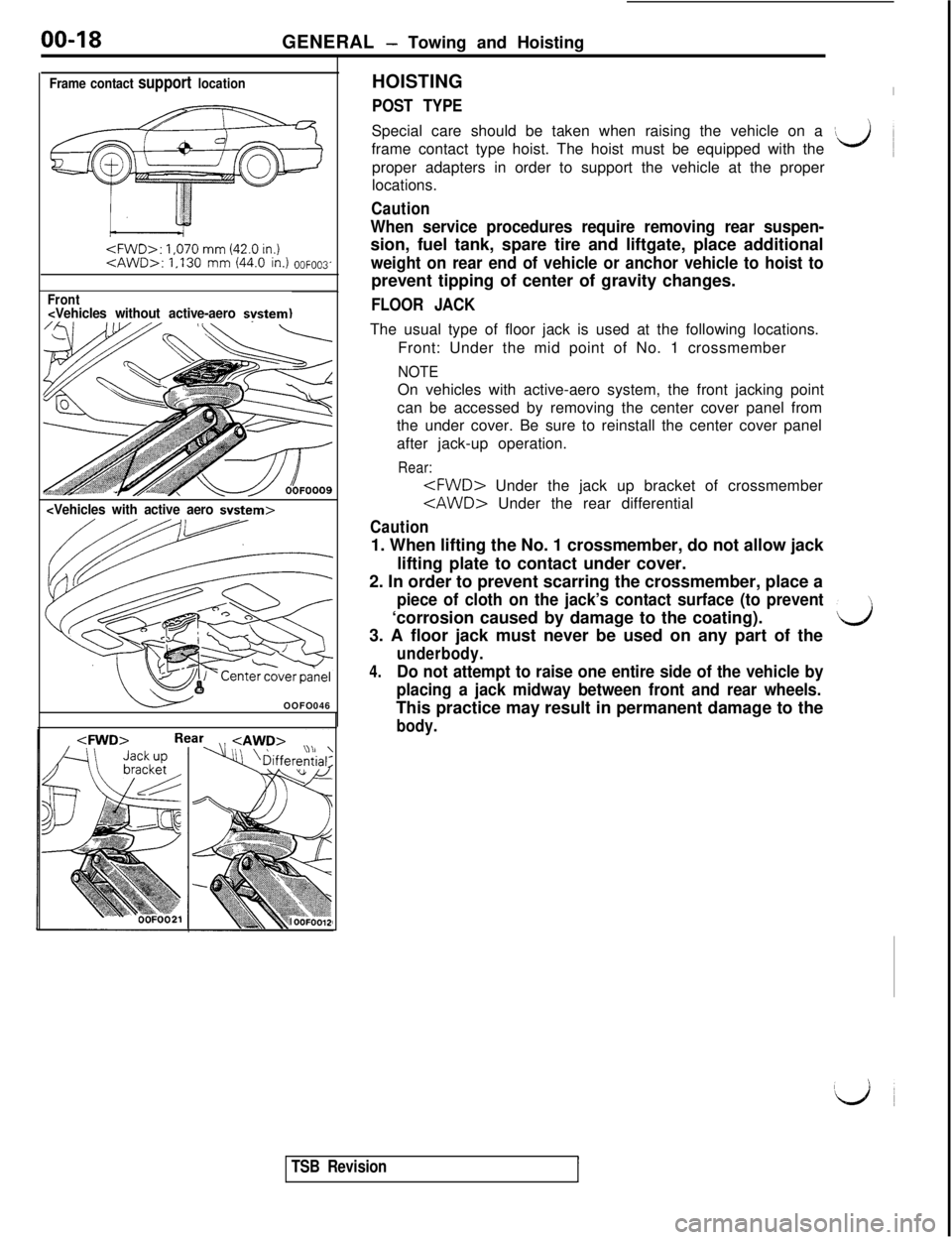
Frame contact support location
1,070 mm (42.0 in.)
Front
POST TYPESpecial care should be taken when raising the vehicle on a
\frame contact type hoist. The hoist must be equipped with theL)proper adapters in order to support the vehicle at the proper
locations.
Caution
When service procedures require removing rear suspen-sion, fuel tank, spare tire and liftgate, place additional
weight on rear end of vehicle or anchor vehicle to hoist toprevent tipping of center of gravity changes.
FLOOR JACKThe usual type of floor jack is used at the following locations.
Front: Under the mid point of No. 1 crossmember
NOTEOn vehicles with active-aero system, the front jacking point
can be accessed by removing the center cover panel from
the under cover. Be sure to reinstall the center cover panel
after jack-up operation.
Rear:
Caution1. When lifting the No. 1 crossmember, do not allow jack
lifting plate to contact under cover.
2. In order to prevent scarring the crossmember, place a
piece of cloth on the jack’s contact surface (to prevent‘corrosion caused by damage to the coating).
d3. A floor jack must never be used on any part of the
underbody.
4.Do not attempt to raise one entire side of the vehicle by
placing a jack midway between front and rear wheels.This practice may result in permanent damage to the
body.
TSB Revision
Page 23 of 1146
GENERAL - Towing and Hoisting
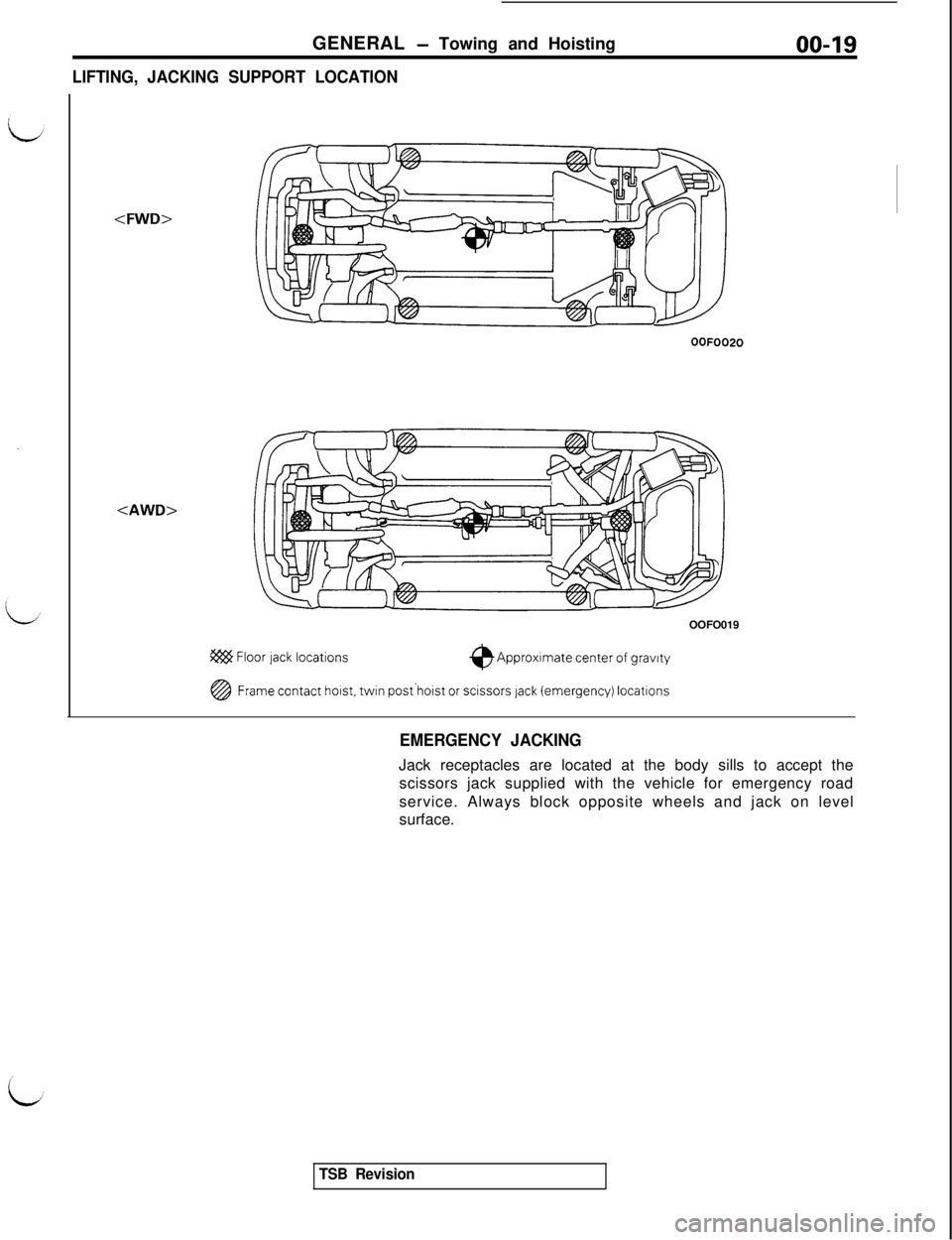
LIFTING, JACKING SUPPORT LOCATION00-19
OOFOO20OOFO019
@ Floor lack locations$Approximate center of gravrty
@Frame contact hoist. twin post‘hoist or scissors lack (emergency) locatlons
EMERGENCY JACKINGJack receptacles are located at the body sills to accept the
scissors jack supplied with the vehicle for emergency road
service. Always block opposite wheels and jack on level
surface.
TSB Revision