air condition MITSUBISHI 380 2005 Owners Manual
[x] Cancel search | Manufacturer: MITSUBISHI, Model Year: 2005, Model line: 380, Model: MITSUBISHI 380 2005Pages: 1500, PDF Size: 47.87 MB
Page 267 of 1500
SYMPTOM PROCEDURES
SIMPLIFIED WIRING SYSTEM (SWS)54B-267
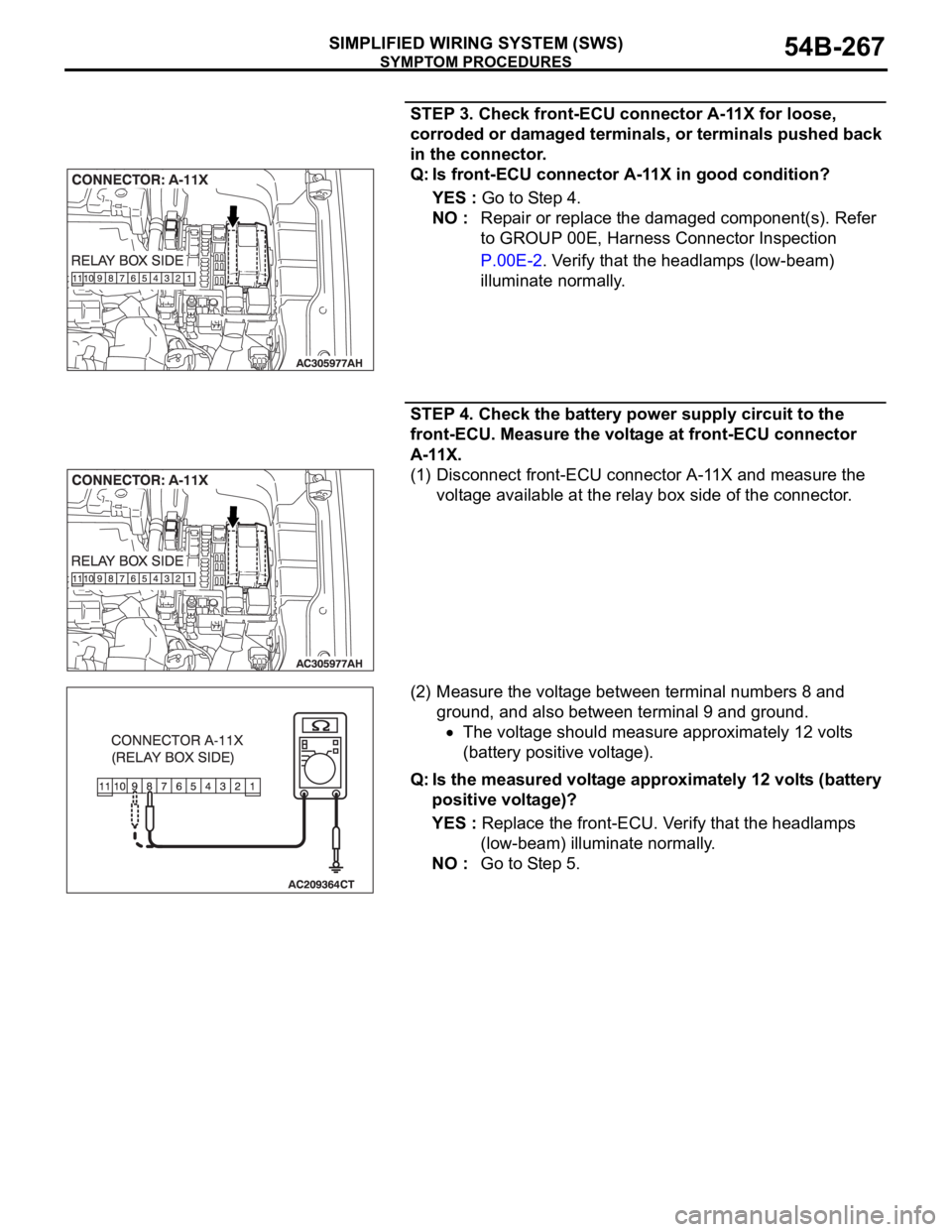
STEP 3. Check front-ECU connector A-11X for loose,
corroded or damaged terminals, or terminals pushed back
in the connector.
Q: Is front-ECU connector A-11X in good condition?
YES : Go to Step 4.
NO : Repair or replace the damaged component(s). Refer
to GROUP 00E, Harness Connector Inspection
P.00E-2. Verify that the headlamps (low-beam)
illuminate normally.
STEP 4. Check the battery power supply circuit to the
front-ECU. Measure the voltage at front-ECU connector
A-11X.
(1) Disconnect front-ECU connector A-11X and measure the
voltage available at the relay box side of the connector.
(2) Measure the voltage between terminal numbers 8 and
ground, and also between terminal 9 and ground.
The voltage should measure approximately 12 volts
(battery positive voltage).
Q: Is the measured voltage approximately 12 volts (battery
positive voltage)?
YES : Replace the front-ECU. Verify that the headlamps
(low-beam) illuminate normally.
NO : Go to Step 5.
Page 268 of 1500
SYMPTOM PROCEDURES
SIMPLIFIED WIRING SYSTEM (SWS)54B-268
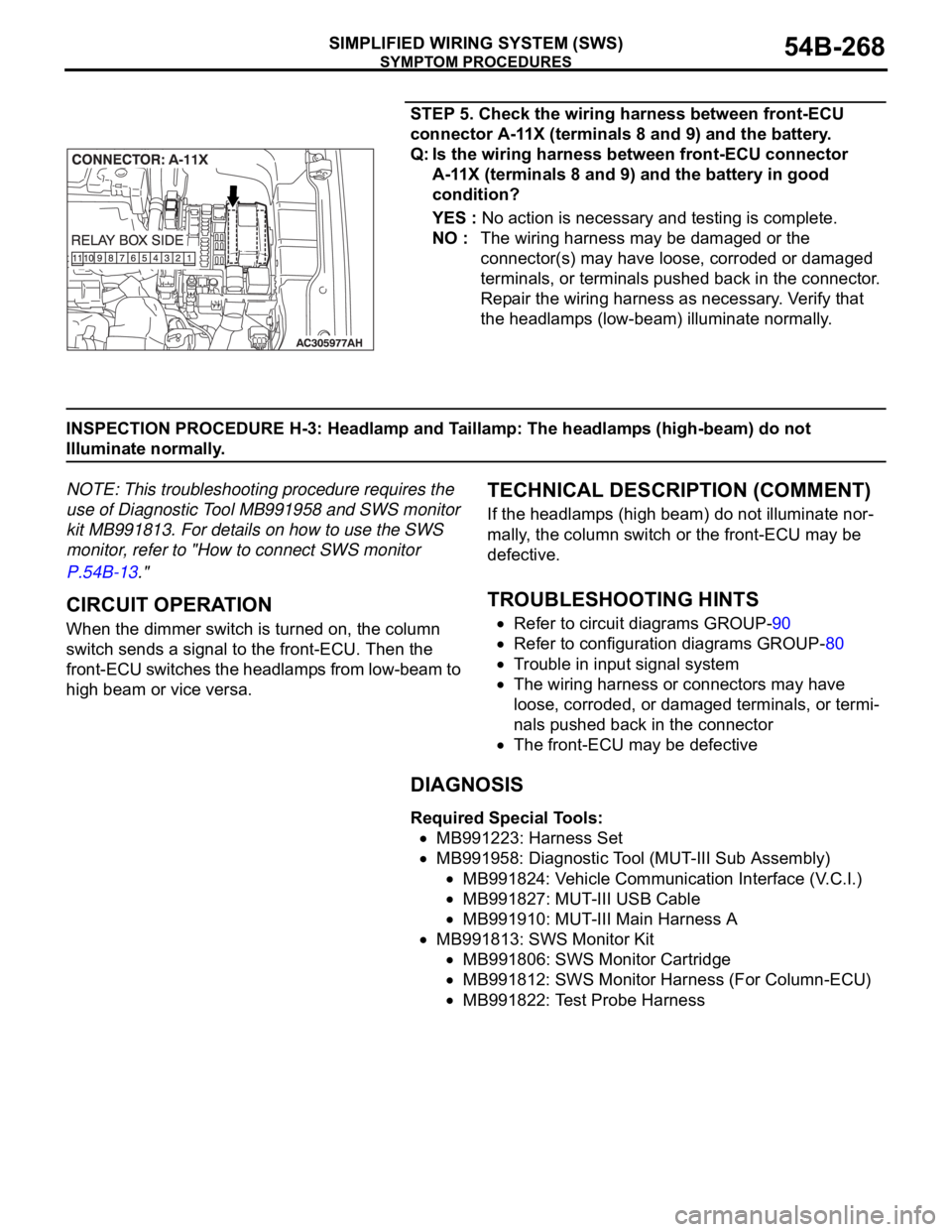
STEP 5. Check the wiring harness between front-ECU
connector A-11X (terminals 8 and 9) and the battery.
Q: Is the wiring harness between front-ECU connector
A-11X (terminals 8 and 9) and the battery in good
condition?
YES : No action is necessary and testing is complete.
NO : The wiring harness may be damaged or the
connector(s) may have loose, corroded or damaged
terminals, or terminals pushed back in the connector.
Repair the wiring harness as necessary. Verify that
the headlamps (low-beam) illuminate normally.
INSPECTION PROCEDURE H-3: Headlamp and Taillamp: The headlamps (high-beam) do not
Illuminate normally.
NOTE: This troubleshooting procedure requires the
use of Diagnostic Tool MB991958 and SWS monitor
kit MB991813. For details on how to use the SWS
monitor, refer to "How to connect SWS monitor
P.54B-13."
.
CIRCUIT OPERATION
When the dimmer switch is turned on, the column
switch sends a signal to the front-ECU. Then the
front-ECU switches the headlamps from low-beam to
high beam or vice versa.
.
TECHNICAL DESCRIPTION (COMMENT)
If the headlamps (high beam) do not illuminate nor-
mally, the column switch or the front-ECU may be
defective.
.
TROUBLESHOOTING HINTS
Refer to circuit diagrams GROUP-90
Refer to configuration diagrams GROUP-80
Trouble in input signal system
The wiring harness or connectors may have
loose, corroded, or damaged terminals, or termi-
nals pushed back in the connector
The front-ECU may be defective
DIAGNOSIS
Required Special Tools:
MB991223: Harness Set
MB991958: Diagnostic Tool (MUT-III Sub Assembly)
MB991824: Vehicle Communication Interface (V.C.I.)
MB991827: MUT-III USB Cable
MB991910: MUT-III Main Harness A
MB991813: SWS Monitor Kit
MB991806: SWS Monitor Cartridge
MB991812: SWS Monitor Harness (For Column-ECU)
MB991822: Test Probe Harness
Page 276 of 1500
SYMPTOM PROCEDURES
SIMPLIFIED WIRING SYSTEM (SWS)54B-276
DIAGNOSIS
Required Special Tool:
MB991223: Harness Set
STEP 1. Check the operation of each lamp.
Q: Which lamp does not illuminate?
front park lamp (LH), taillamp (LH), and licence plate
lamp : Go to Step 2.
front park lamp (RH), taillamp (RH) : Go to Step 4.
taillamp (LH) and licence plate lamp : Go to Step 6.
taillamp (LH) : Go to Step 8.
taillamp (RH) : Go to Step 13.
front park lamp (LH) : Go to Step 19.
front park lamp (RH) : Go to Step 25.
licence plate lamp : Go to Step 31.
All lamps : Refer to Inspection Procedure H-1 "The
taillamps do not illuminate normally P.54B-260."
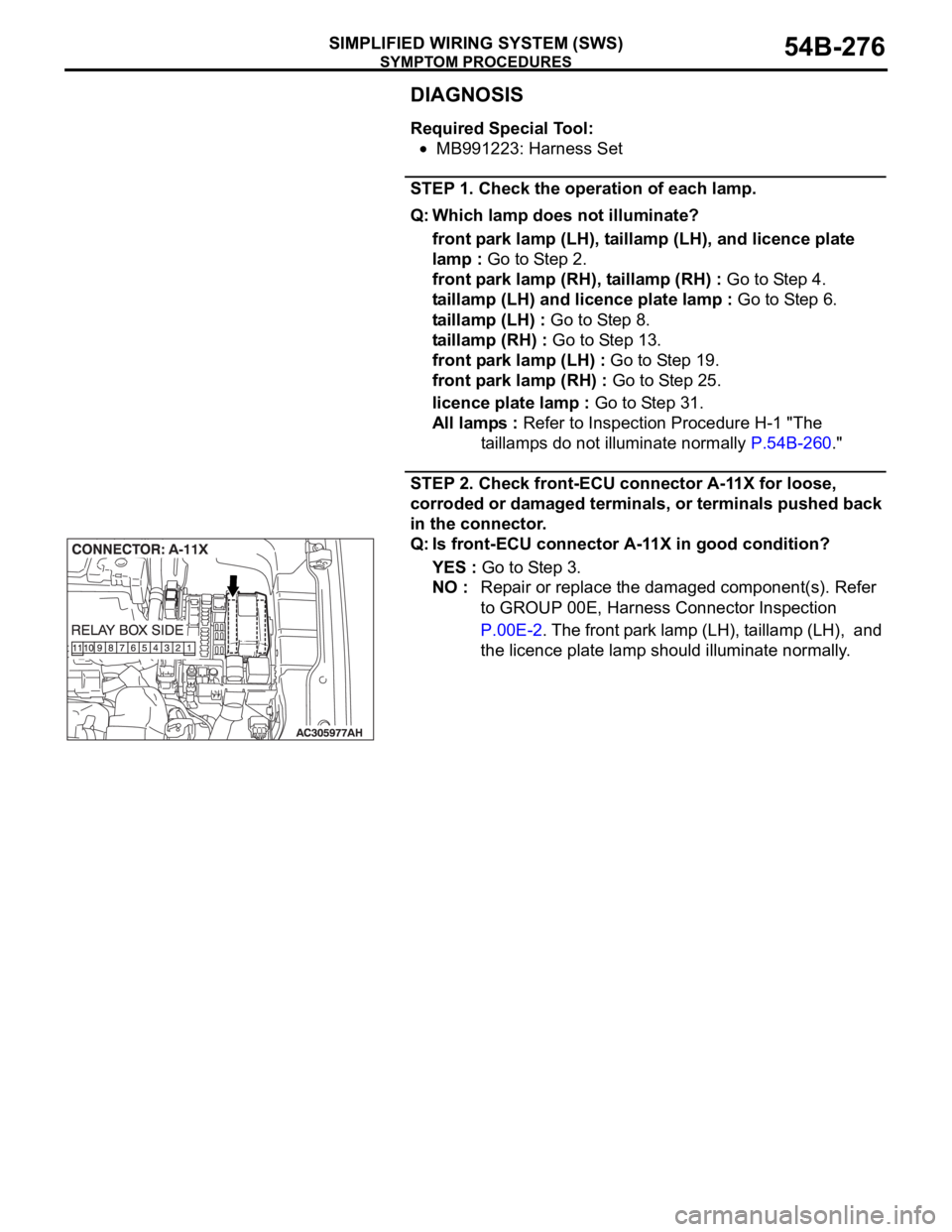
STEP 2. Check front-ECU connector A-11X for loose,
corroded or damaged terminals, or terminals pushed back
in the connector.
Q: Is front-ECU connector A-11X in good condition?
YES : Go to Step 3.
NO : Repair or replace the damaged component(s). Refer
to GROUP 00E, Harness Connector Inspection
P.00E-2. The front park lamp (LH), taillamp (LH), and
the licence plate lamp should illuminate normally.
Page 277 of 1500
SYMPTOM PROCEDURES
SIMPLIFIED WIRING SYSTEM (SWS)54B-277
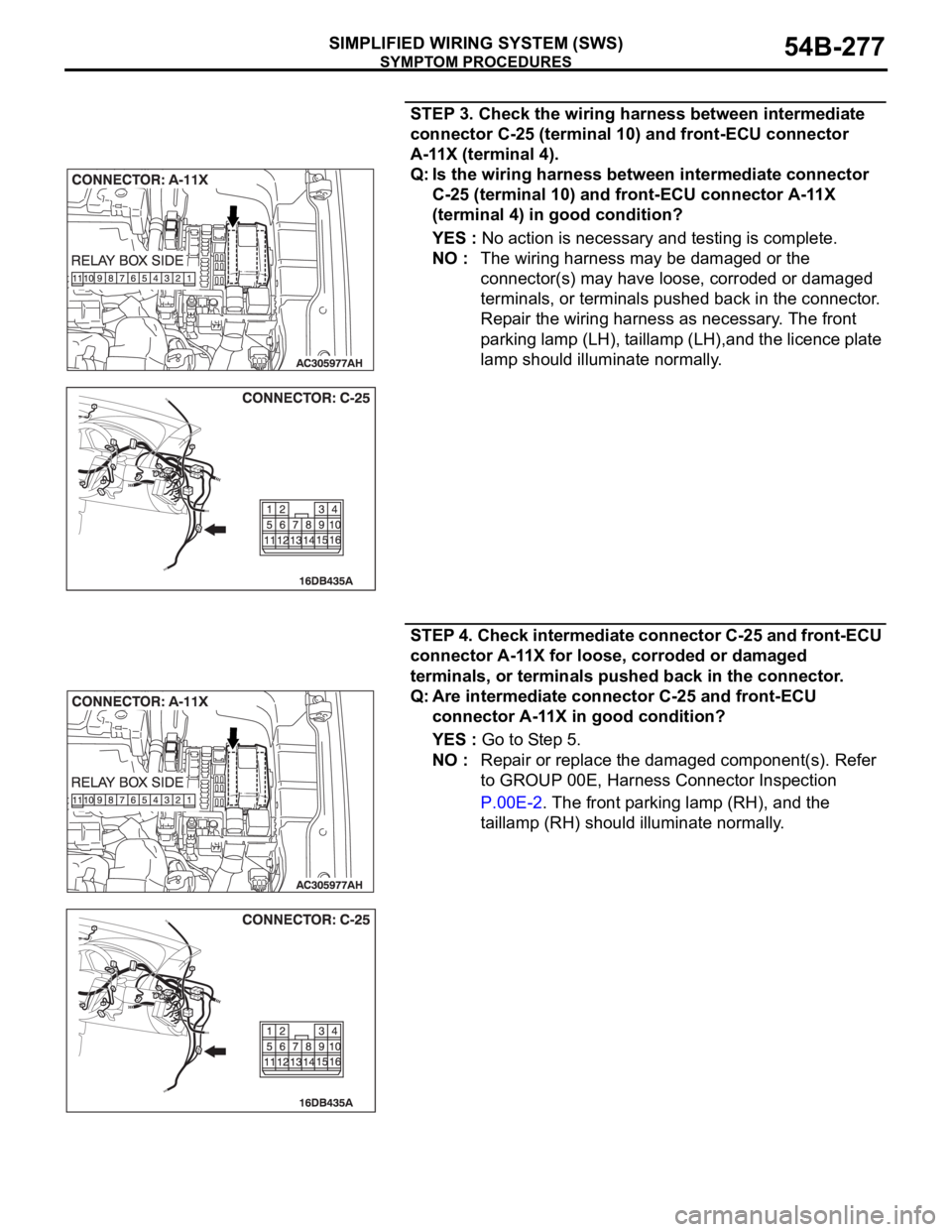
STEP 3. Check the wiring harness between intermediate
connector C-25 (terminal 10) and front-ECU connector
A-11X (terminal 4).
Q: Is the wiring harness between intermediate connector
C-25 (terminal 10) and front-ECU connector A-11X
(terminal 4) in good condition?
YES : No action is necessary and testing is complete.
NO : The wiring harness may be damaged or the
connector(s) may have loose, corroded or damaged
terminals, or terminals pushed back in the connector.
Repair the wiring harness as necessary. The front
parking lamp (LH), taillamp (LH),and the licence plate
lamp should illuminate normally.
STEP 4. Check intermediate connector C-25 and front-ECU
connector A-11X for loose, corroded or damaged
terminals, or terminals pushed back in the connector.
Q: Are intermediate connector C-25 and front-ECU
connector A-11X in good condition?
YES : Go to Step 5.
NO : Repair or replace the damaged component(s). Refer
to GROUP 00E, Harness Connector Inspection
P.00E-2. The front parking lamp (RH), and the
taillamp (RH) should illuminate normally.
Page 278 of 1500
SYMPTOM PROCEDURES
SIMPLIFIED WIRING SYSTEM (SWS)54B-278
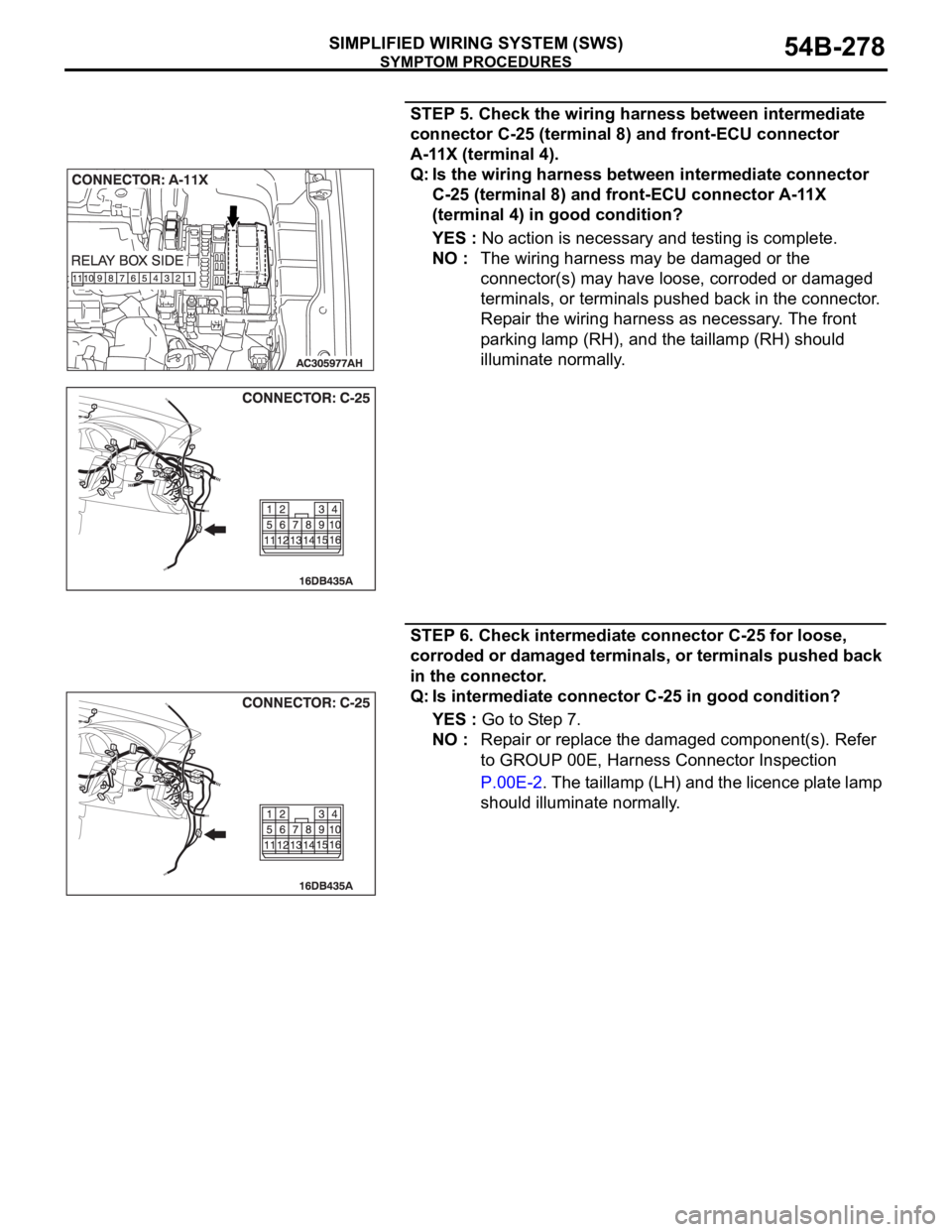
STEP 5. Check the wiring harness between intermediate
connector C-25 (terminal 8) and front-ECU connector
A-11X (terminal 4).
Q: Is the wiring harness between intermediate connector
C-25 (terminal 8) and front-ECU connector A-11X
(terminal 4) in good condition?
YES : No action is necessary and testing is complete.
NO : The wiring harness may be damaged or the
connector(s) may have loose, corroded or damaged
terminals, or terminals pushed back in the connector.
Repair the wiring harness as necessary. The front
parking lamp (RH), and the taillamp (RH) should
illuminate normally.
STEP 6. Check intermediate connector C-25 for loose,
corroded or damaged terminals, or terminals pushed back
in the connector.
Q: Is intermediate connector C-25 in good condition?
YES : Go to Step 7.
NO : Repair or replace the damaged component(s). Refer
to GROUP 00E, Harness Connector Inspection
P.00E-2. The taillamp (LH) and the licence plate lamp
should illuminate normally.
Page 279 of 1500
SYMPTOM PROCEDURES
SIMPLIFIED WIRING SYSTEM (SWS)54B-279
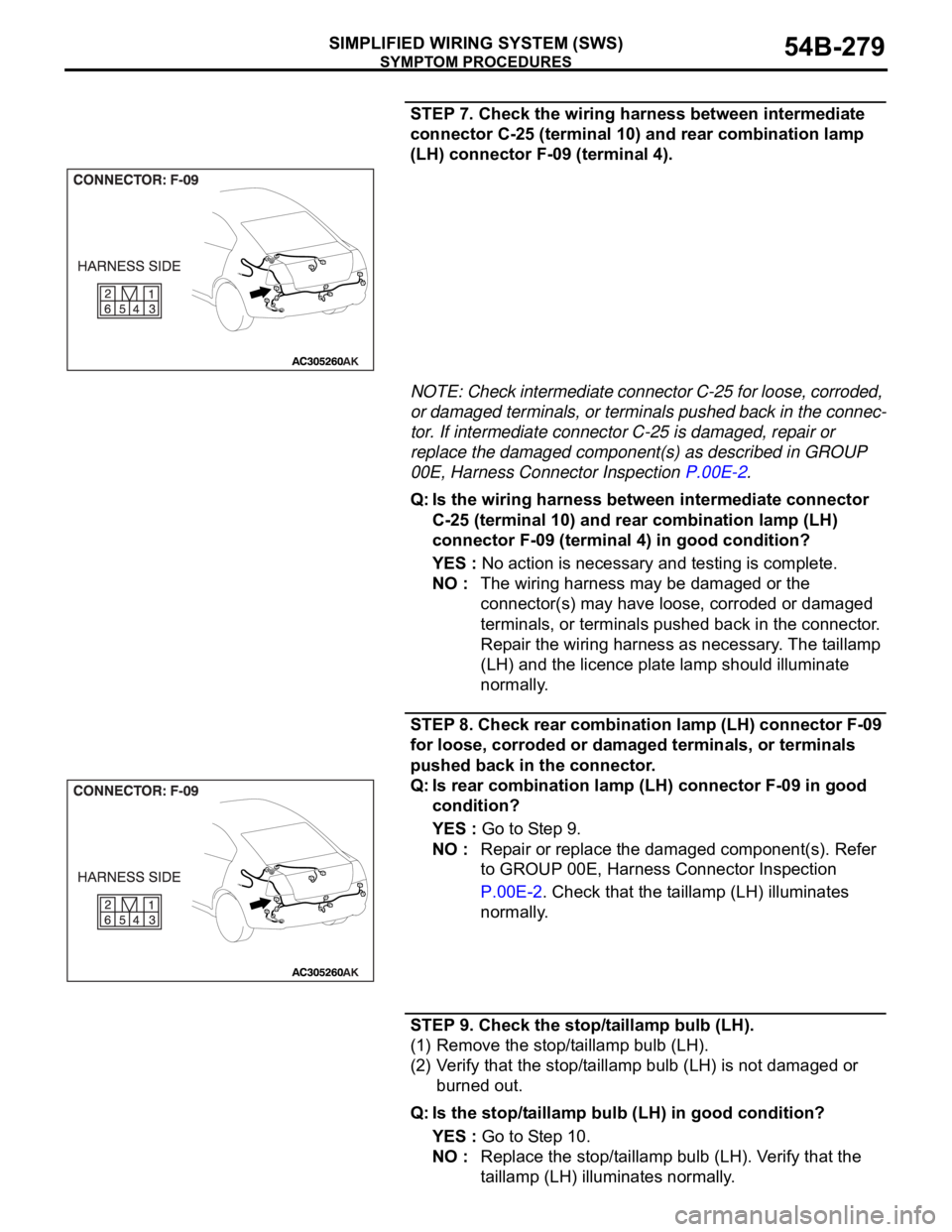
STEP 7. Check the wiring harness between intermediate
connector C-25 (terminal 10) and rear combination lamp
(LH) connector F-09 (terminal 4).
NOTE: Check intermediate connector C-25 for loose, corroded,
or damaged terminals, or terminals pushed back in the connec-
tor. If intermediate connector C-25 is damaged, repair or
replace the damaged component(s) as described in GROUP
00E, Harness Connector Inspection P.00E-2.
Q: Is the wiring harness between intermediate connector
C-25 (terminal 10) and rear combination lamp (LH)
connector F-09 (terminal 4) in good condition?
YES : No action is necessary and testing is complete.
NO : The wiring harness may be damaged or the
connector(s) may have loose, corroded or damaged
terminals, or terminals pushed back in the connector.
Repair the wiring harness as necessary. The taillamp
(LH) and the licence plate lamp should illuminate
normally.
STEP 8. Check rear combination lamp (LH) connector F-09
for loose, corroded or damaged terminals, or terminals
pushed back in the connector.
Q: Is rear combination lamp (LH) connector F-09 in good
condition?
YES : Go to Step 9.
NO : Repair or replace the damaged component(s). Refer
to GROUP 00E, Harness Connector Inspection
P.00E-2. Check that the taillamp (LH) illuminates
normally.
STEP 9. Check the stop/taillamp bulb (LH).
(1) Remove the stop/taillamp bulb (LH).
(2) Verify that the stop/taillamp bulb (LH) is not damaged or
burned out.
Q: Is the stop/taillamp bulb (LH) in good condition?
YES : Go to Step 10.
NO : Replace the stop/taillamp bulb (LH). Verify that the
taillamp (LH) illuminates normally.
Page 280 of 1500
SYMPTOM PROCEDURES
SIMPLIFIED WIRING SYSTEM (SWS)54B-280
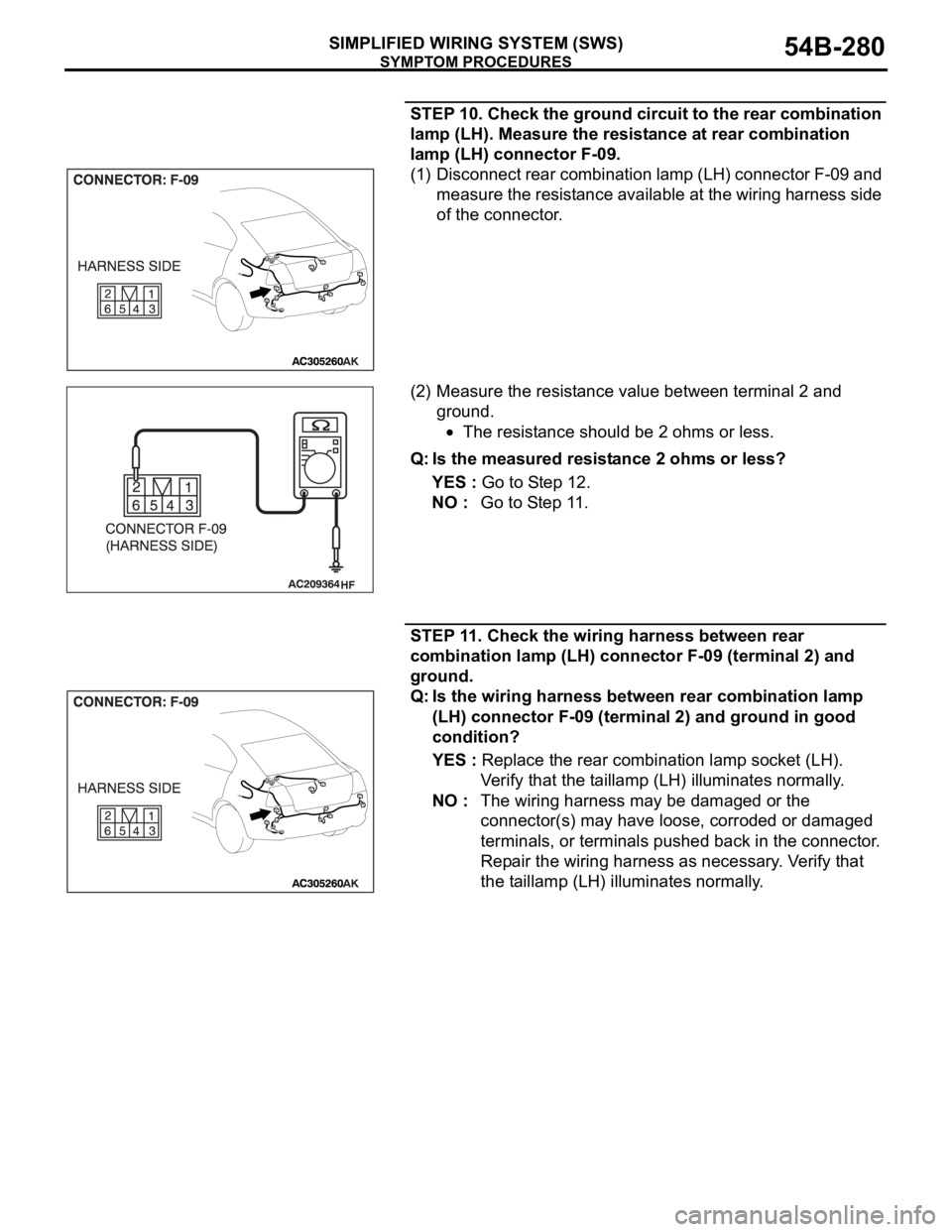
STEP 10. Check the ground circuit to the rear combination
lamp (LH). Measure the resistance at rear combination
lamp (LH) connector F-09.
(1) Disconnect rear combination lamp (LH) connector F-09 and
measure the resistance available at the wiring harness side
of the connector.
(2) Measure the resistance value between terminal 2 and
ground.
The resistance should be 2 ohms or less.
Q: Is the measured resistance 2 ohms or less?
YES : Go to Step 12.
NO : Go to Step 11.
STEP 11. Check the wiring harness between rear
combination lamp (LH) connector F-09 (terminal 2) and
ground.
Q: Is the wiring harness between rear combination lamp
(LH) connector F-09 (terminal 2) and ground in good
condition?
YES : Replace the rear combination lamp socket (LH).
Verify that the taillamp (LH) illuminates normally.
NO : The wiring harness may be damaged or the
connector(s) may have loose, corroded or damaged
terminals, or terminals pushed back in the connector.
Repair the wiring harness as necessary. Verify that
the taillamp (LH) illuminates normally.
Page 281 of 1500
SYMPTOM PROCEDURES
SIMPLIFIED WIRING SYSTEM (SWS)54B-281
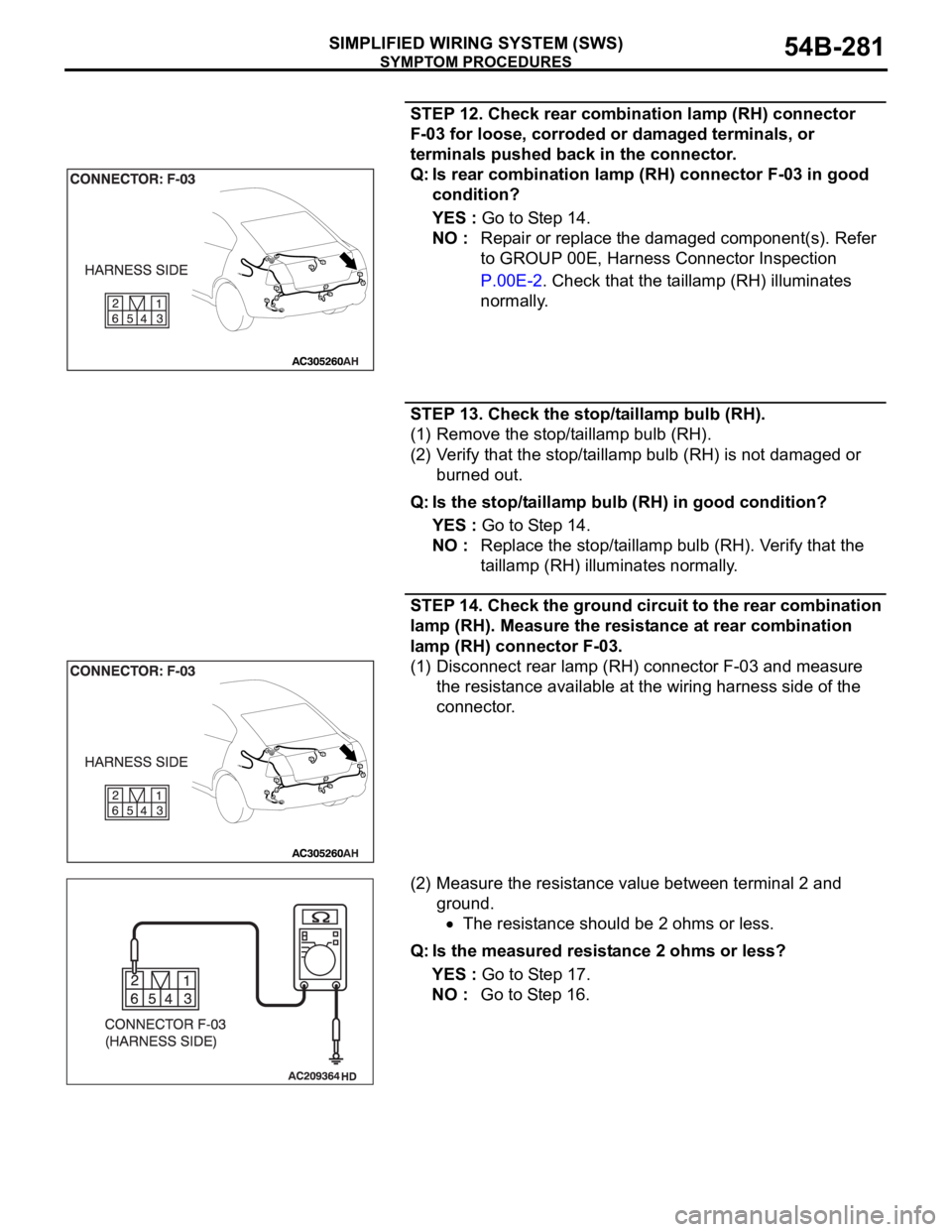
STEP 12. Check rear combination lamp (RH) connector
F-03 for loose, corroded or damaged terminals, or
terminals pushed back in the connector.
Q: Is rear combination lamp (RH) connector F-03 in good
condition?
YES : Go to Step 14.
NO : Repair or replace the damaged component(s). Refer
to GROUP 00E, Harness Connector Inspection
P.00E-2. Check that the taillamp (RH) illuminates
normally.
STEP 13. Check the stop/taillamp bulb (RH).
(1) Remove the stop/taillamp bulb (RH).
(2) Verify that the stop/taillamp bulb (RH) is not damaged or
burned out.
Q: Is the stop/taillamp bulb (RH) in good condition?
YES : Go to Step 14.
NO : Replace the stop/taillamp bulb (RH). Verify that the
taillamp (RH) illuminates normally.
STEP 14. Check the ground circuit to the rear combination
lamp (RH). Measure the resistance at rear combination
lamp (RH) connector F-03.
(1) Disconnect rear lamp (RH) connector F-03 and measure
the resistance available at the wiring harness side of the
connector.
(2) Measure the resistance value between terminal 2 and
ground.
The resistance should be 2 ohms or less.
Q: Is the measured resistance 2 ohms or less?
YES : Go to Step 17.
NO : Go to Step 16.
Page 282 of 1500
SYMPTOM PROCEDURES
SIMPLIFIED WIRING SYSTEM (SWS)54B-282
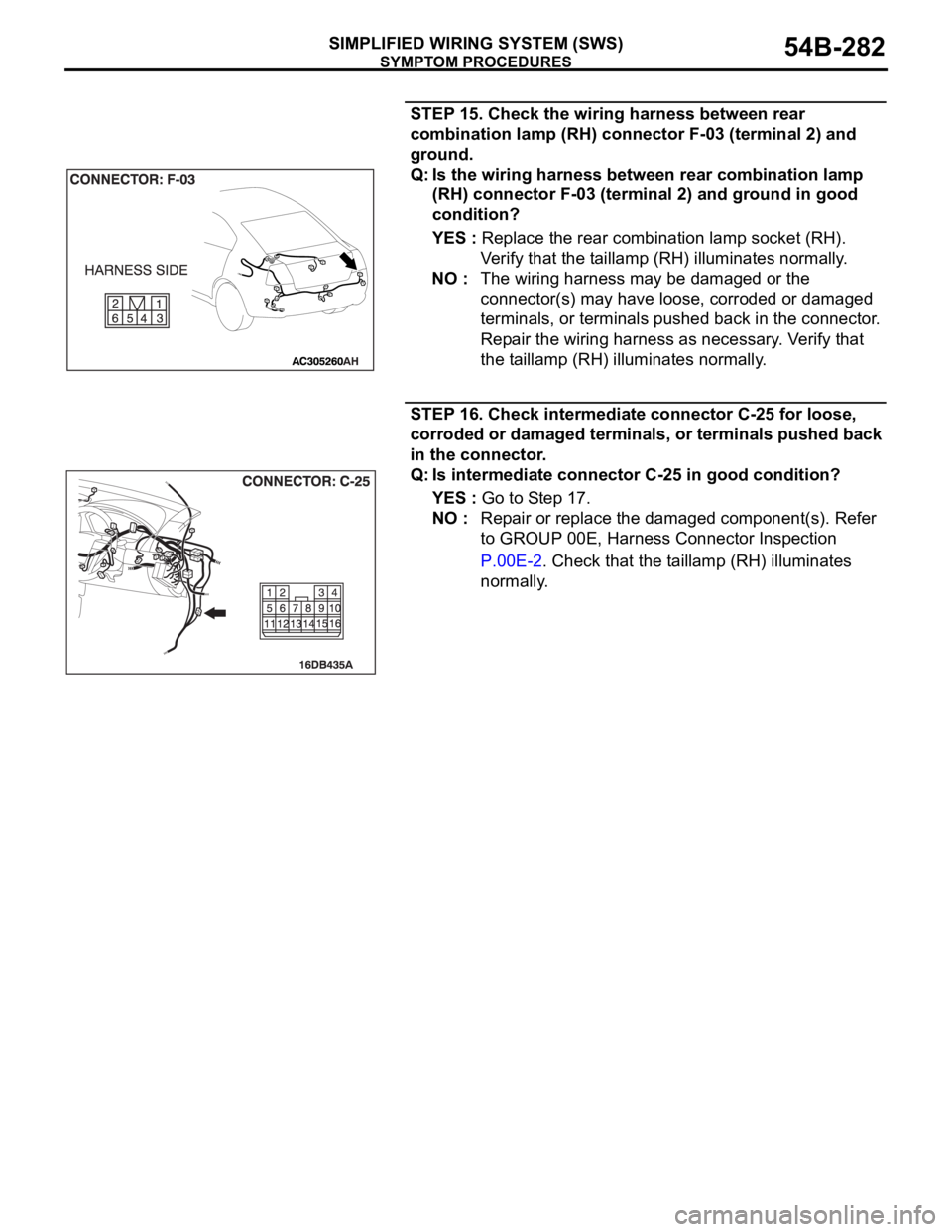
STEP 15. Check the wiring harness between rear
combination lamp (RH) connector F-03 (terminal 2) and
ground.
Q: Is the wiring harness between rear combination lamp
(RH) connector F-03 (terminal 2) and ground in good
condition?
YES : Replace the rear combination lamp socket (RH).
Verify that the taillamp (RH) illuminates normally.
NO : The wiring harness may be damaged or the
connector(s) may have loose, corroded or damaged
terminals, or terminals pushed back in the connector.
Repair the wiring harness as necessary. Verify that
the taillamp (RH) illuminates normally.
STEP 16. Check intermediate connector C-25 for loose,
corroded or damaged terminals, or terminals pushed back
in the connector.
Q: Is intermediate connector C-25 in good condition?
YES : Go to Step 17.
NO : Repair or replace the damaged component(s). Refer
to GROUP 00E, Harness Connector Inspection
P.00E-2. Check that the taillamp (RH) illuminates
normally.
Page 283 of 1500
SYMPTOM PROCEDURES
SIMPLIFIED WIRING SYSTEM (SWS)54B-283
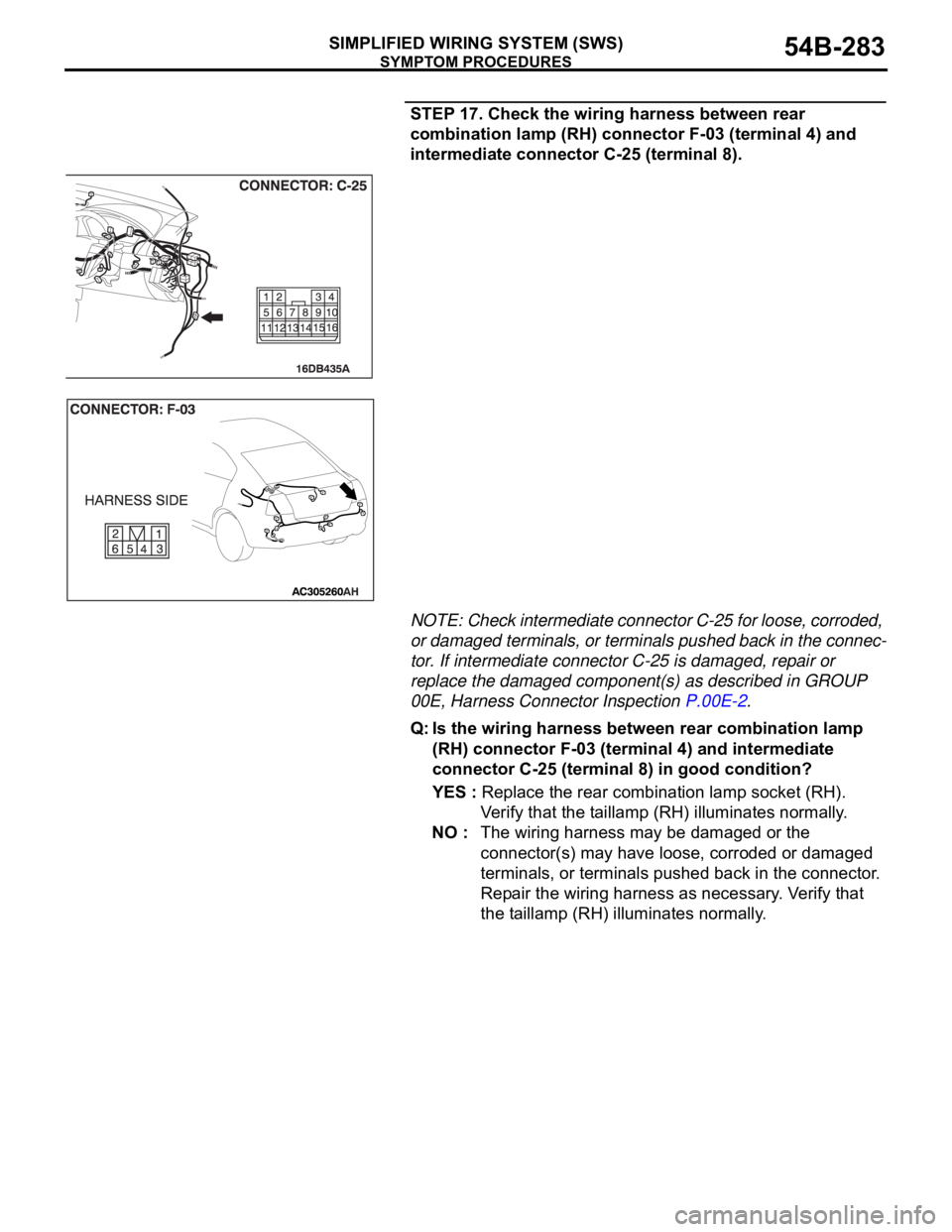
STEP 17. Check the wiring harness between rear
combination lamp (RH) connector F-03 (terminal 4) and
intermediate connector C-25 (terminal 8).
NOTE: Check intermediate connector C-25 for loose, corroded,
or damaged terminals, or terminals pushed back in the connec-
tor. If intermediate connector C-25 is damaged, repair or
replace the damaged component(s) as described in GROUP
00E, Harness Connector Inspection P.00E-2.
Q: Is the wiring harness between rear combination lamp
(RH) connector F-03 (terminal 4) and intermediate
connector C-25 (terminal 8) in good condition?
YES : Replace the rear combination lamp socket (RH).
Verify that the taillamp (RH) illuminates normally.
NO : The wiring harness may be damaged or the
connector(s) may have loose, corroded or damaged
terminals, or terminals pushed back in the connector.
Repair the wiring harness as necessary. Verify that
the taillamp (RH) illuminates normally.