clutch MITSUBISHI 380 2005 User Guide
[x] Cancel search | Manufacturer: MITSUBISHI, Model Year: 2005, Model line: 380, Model: MITSUBISHI 380 2005Pages: 1500, PDF Size: 47.87 MB
Page 783 of 1500
AUTO A/C DIAGNOSIS
HEATER, AIR CONDITIONING AND VENTILATION55-82
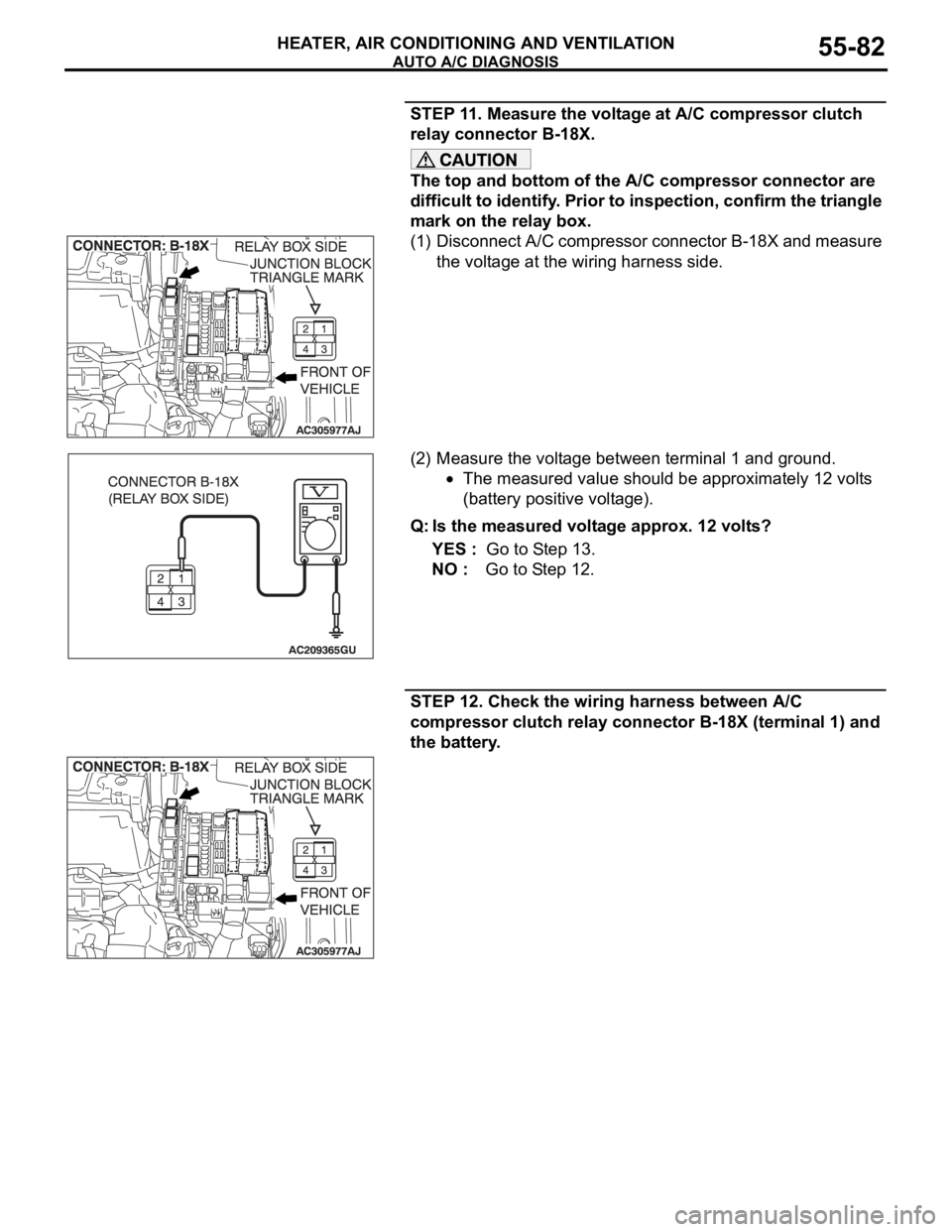
STEP 11. Measure the voltage at A/C compressor clutch
relay connector B-18X.
The top and bottom of the A/C compressor connector are
difficult to identify. Prior to inspection, confirm the triangle
mark on the relay box.
(1) Disconnect A/C compressor connector B-18X and measure
the voltage at the wiring harness side.
(2) Measure the voltage between terminal 1 and ground.
The measured value should be approximately 12 volts
(battery positive voltage).
Q: Is the measured voltage approx. 12 volts?
YES : Go to Step 13.
NO : Go to Step 12.
STEP 12. Check the wiring harness between A/C
compressor clutch relay connector B-18X (terminal 1) and
the battery.
Page 784 of 1500
AUTO A/C DIAGNOSIS
HEATER, AIR CONDITIONING AND VENTILATION55-83
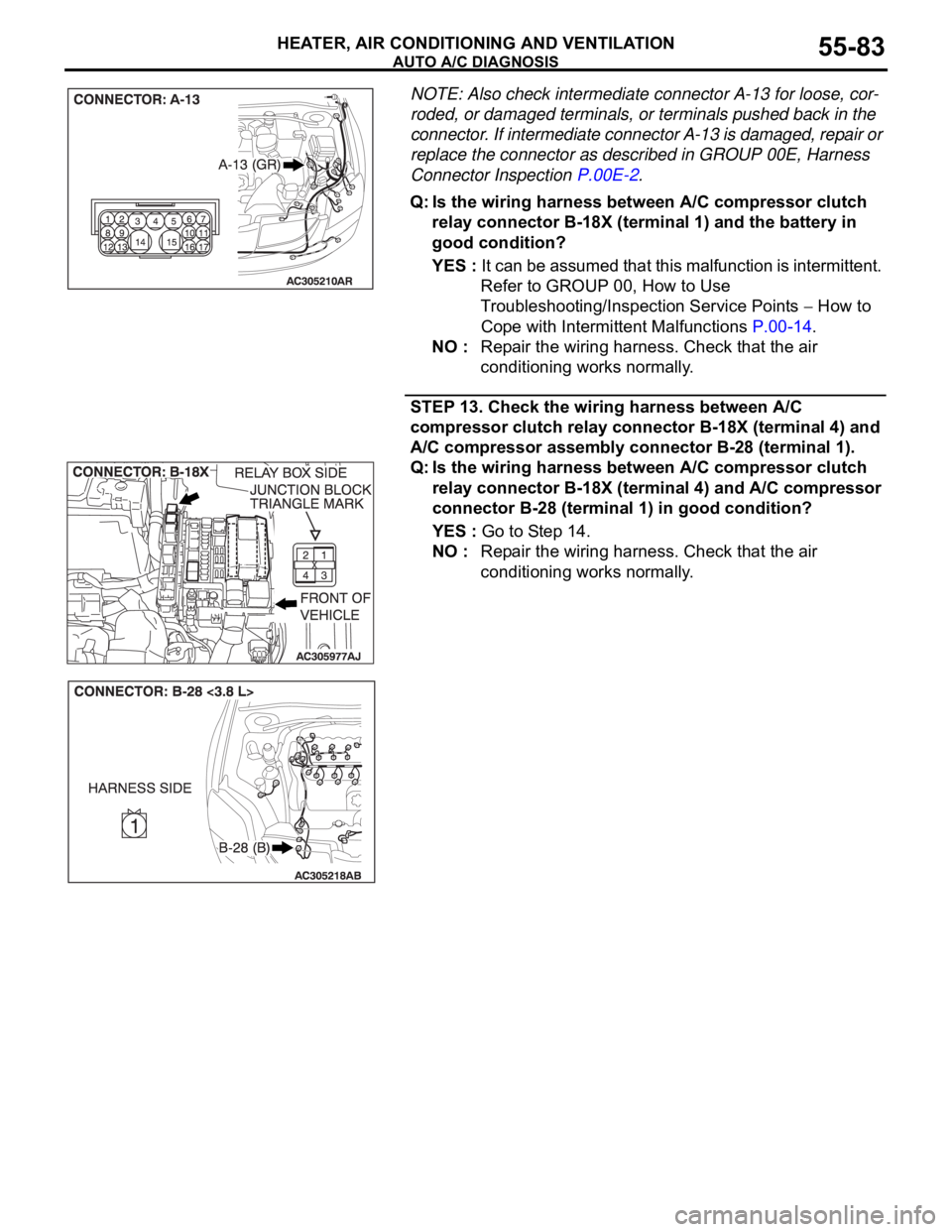
NOTE: Also check intermediate connector A-13 for loose, cor-
roded, or damaged terminals, or terminals pushed back in the
connector. If intermediate connector A-13 is damaged, repair or
replace the connector as described in GROUP 00E, Harness
Connector Inspection P.00E-2.
Q: Is the wiring harness between A/C compressor clutch
relay connector B-18X (terminal 1) and the battery in
good condition?
YES : It can be assumed that this malfunction is intermittent.
Refer to GROUP 00, How to Use
Troubleshooting/Inspection Service Points
How to
Cope with Intermittent Malfunctions P.00-14.
NO : Repair the wiring harness. Check that the air
conditioning works normally.
STEP 13. Check the wiring harness between A/C
compressor clutch relay connector B-18X (terminal 4) and
A/C compressor assembly connector B-28 (terminal 1).
Q: Is the wiring harness between A/C compressor clutch
relay connector B-18X (terminal 4) and A/C compressor
connector B-28 (terminal 1) in good condition?
YES : Go to Step 14.
NO : Repair the wiring harness. Check that the air
conditioning works normally.
Page 785 of 1500
AUTO A/C DIAGNOSIS
HEATER, AIR CONDITIONING AND VENTILATION55-84
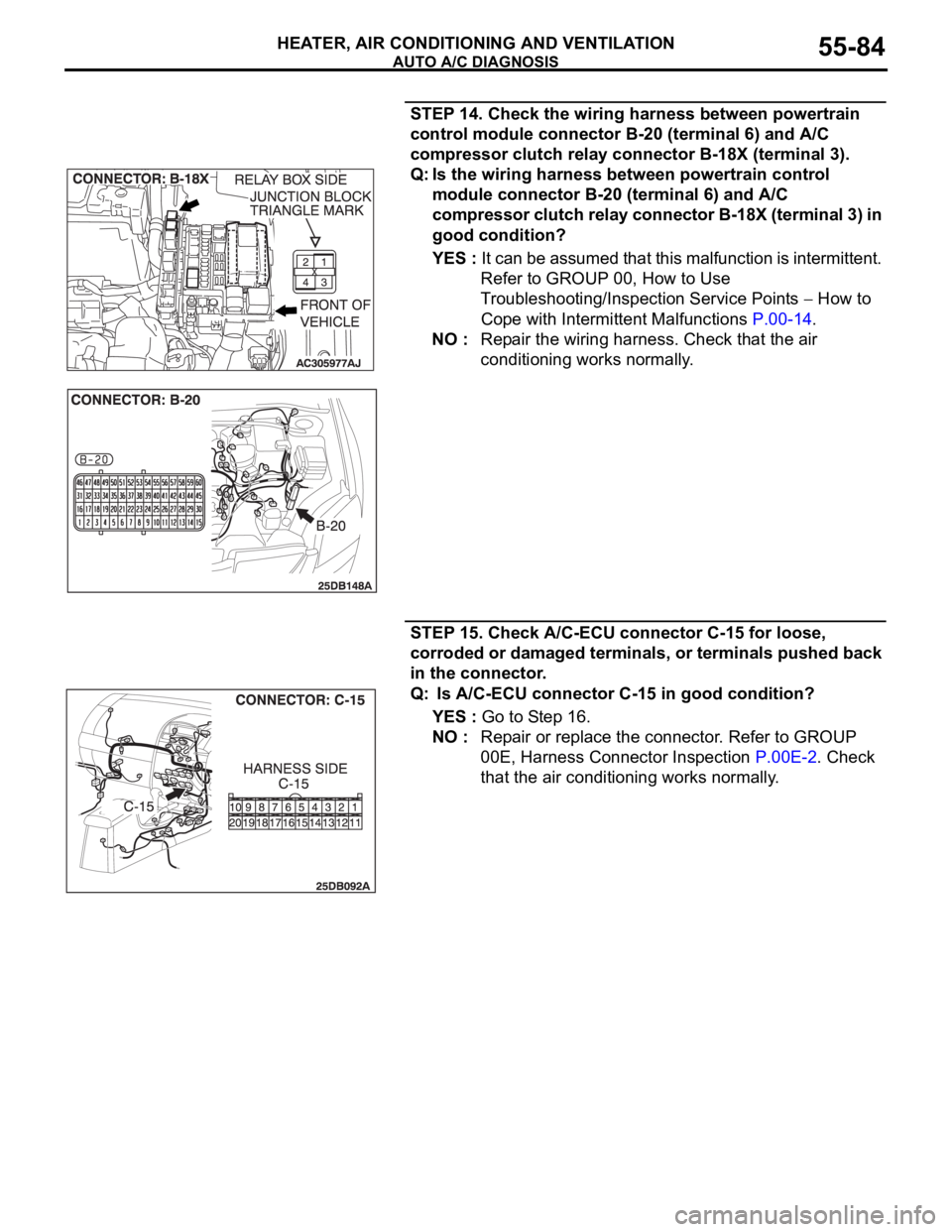
STEP 14. Check the wiring harness between powertrain
control module connector B-20 (terminal 6) and A/C
compressor clutch relay connector B-18X (terminal 3).
Q: Is the wiring harness between powertrain control
module connector B-20 (terminal 6) and A/C
compressor clutch relay connector B-18X (terminal 3) in
good condition?
YES : It can be assumed that this malfunction is intermittent.
Refer to GROUP 00, How to Use
Troubleshooting/Inspection Service Points
How to
Cope with Intermittent Malfunctions P.00-14.
NO : Repair the wiring harness. Check that the air
conditioning works normally.
STEP 15. Check A/C-ECU connector C-15 for loose,
corroded or damaged terminals, or terminals pushed back
in the connector.
Q: Is A/C-ECU connector C-15 in good condition?
YES : Go to Step 16.
NO : Repair or replace the connector. Refer to GROUP
00E, Harness Connector Inspection P.00E-2. Check
that the air conditioning works normally.
Page 787 of 1500
AUTO A/C DIAGNOSIS
HEATER, AIR CONDITIONING AND VENTILATION55-86
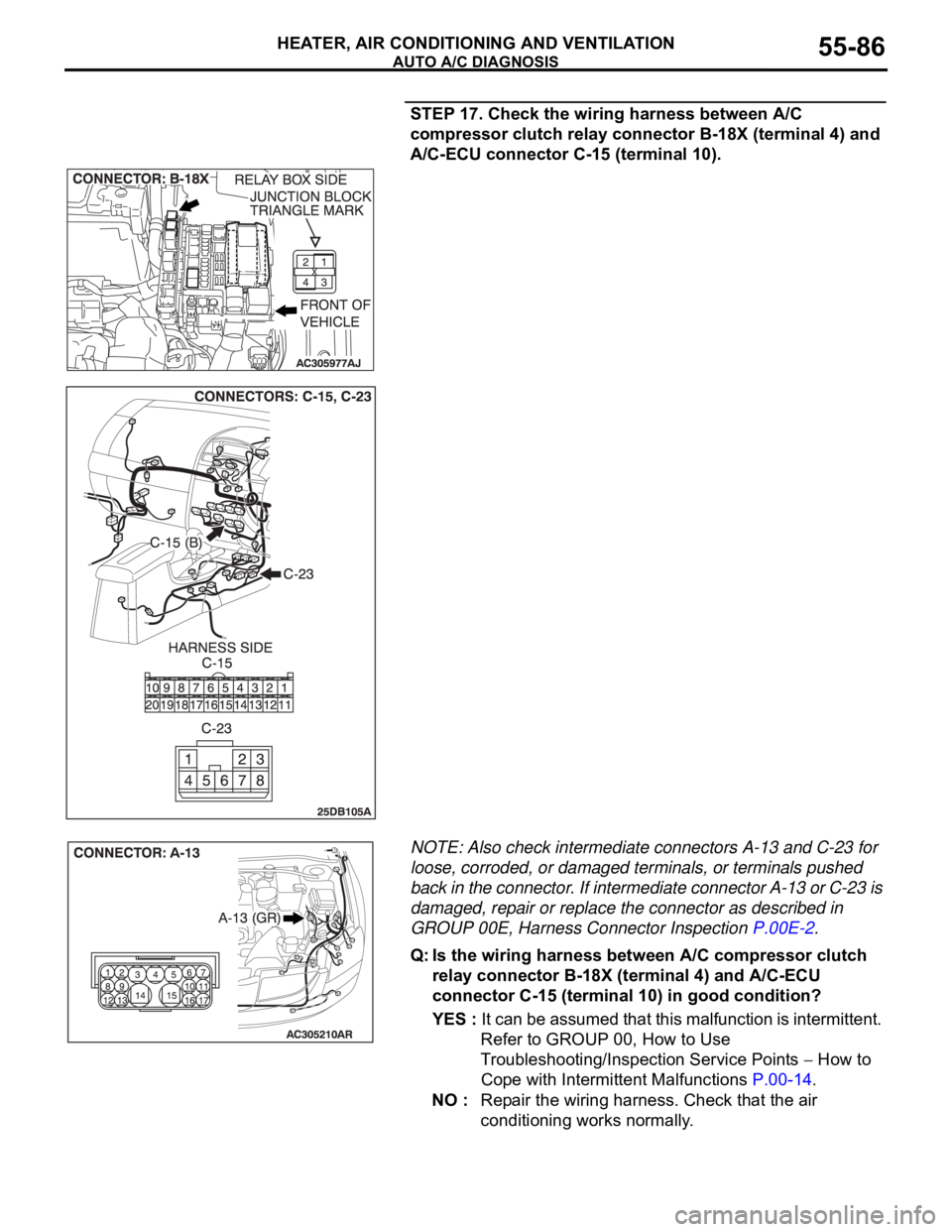
STEP 17. Check the wiring harness between A/C
compressor clutch relay connector B-18X (terminal 4) and
A/C-ECU connector C-15 (terminal 10).
NOTE: Also check intermediate connectors A-13 and C-23 for
loose, corroded, or damaged terminals, or terminals pushed
back in the connector. If intermediate connector A-13 or C-23 is
damaged, repair or replace the connector as described in
GROUP 00E, Harness Connector Inspection P.00E-2.
Q: Is the wiring harness between A/C compressor clutch
relay connector B-18X (terminal 4) and A/C-ECU
connector C-15 (terminal 10) in good condition?
YES : It can be assumed that this malfunction is intermittent.
Refer to GROUP 00, How to Use
Troubleshooting/Inspection Service Points
How to
Cope with Intermittent Malfunctions P.00-14.
NO : Repair the wiring harness. Check that the air
conditioning works normally.
Page 788 of 1500
AUTO A/C DIAGNOSIS
HEATER, AIR CONDITIONING AND VENTILATION55-87
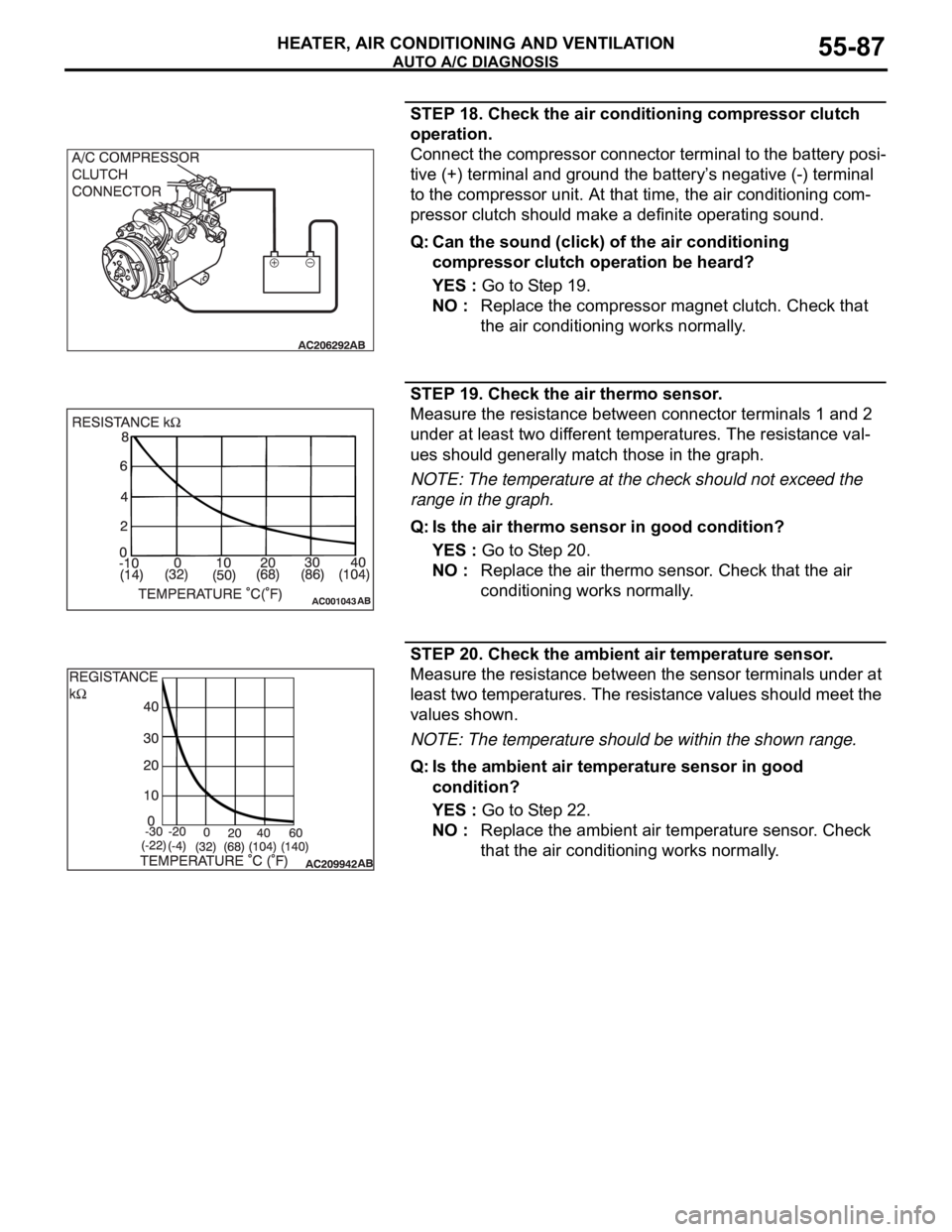
STEP 18. Check the air conditioning compressor clutch
operation.
Connect the compressor connector terminal to the battery posi-
tive (+) terminal and ground the battery’s negative (-) terminal
to the compressor unit. At that time, the air conditioning com-
pressor clutch should make a definite operating sound.
Q: Can the sound (click) of the air conditioning
compressor clutch operation be heard?
YES : Go to Step 19.
NO : Replace the compressor magnet clutch. Check that
the air conditioning works normally.
STEP 19. Check the air thermo sensor.
Measure the resistance between connector terminals 1 and 2
under at least two different temperatures. The resistance val-
ues should generally match those in the graph.
NOTE: The temperature at the check should not exceed the
range in the graph.
Q: Is the air thermo sensor in good condition?
YES : Go to Step 20.
NO : Replace the air thermo sensor. Check that the air
conditioning works normally.
STEP 20. Check the ambient air temperature sensor.
Measure the resistance between the sensor terminals under at
least two temperatures. The resistance values should meet the
values shown.
NOTE: The temperature should be within the shown range.
Q: Is the ambient air temperature sensor in good
condition?
YES : Go to Step 22.
NO : Replace the ambient air temperature sensor. Check
that the air conditioning works normally.
Page 836 of 1500

AUTO A/C DIAGNOSIS
HEATER, AIR CONDITIONING AND VENTILATION55-135
Temperature
setting23 Temperature setting
actualIgnition switch: ON The actual setting
corresponds with
diagnostic tool
display.
Vehicle speed 26 Actual vehicle speed Ignition switch: ON The vehicle speed
corresponds with
diagnostic tool
display.
A/C compressor
drive request27 Compressor clutch Engine: ON
Compressor:
ONDiagnostic tool
indication: "ON"
Compressor:
OFFDiagnostic tool
indication: "OFF"
Illumination 15 Display lighting Ignition switch: ON
Lights: ON
Diagnostic tool
indication: "ON"
Lights: OFF
Diagnostic tool
indication: "OFF"
Engine speed 23 Actual engine speed Engine: ON The engine speed
corresponds with
diagnostic tool
display.
In/out air select
switch state3 In/out air select
switch Ignition switch: ON In/out air
switch: ONDiagnostic tool
indication: "pressed"
In/out air
switch: OFFDiagnostic tool
indication: "release"
Rear defogger
relay72 Rear defogger relay Ignition switch: ON
Rear defogger:
ONDiagnostic tool
indication: "ON"
Rear defogger:
OFFDiagnostic tool
indication: "OFF" MUT-III
DIAGNOSTIC
TOOL DISPLAYITEM
NO.INSPECTION ITEM INSPECTION REQUIREMENT NORMAL VALUE
Page 842 of 1500
ON-VEHICLE SERVICE
HEATER, AIR CONDITIONING AND VENTILATION55-141
ON-VEHICLE SERVICE
REFRIGERANT LEVEL TESTM1552008400408
Use the refrigerant recovery station to remove all of the refrig-
erant, and then calculate the amount of the refrigerant and
charge it.
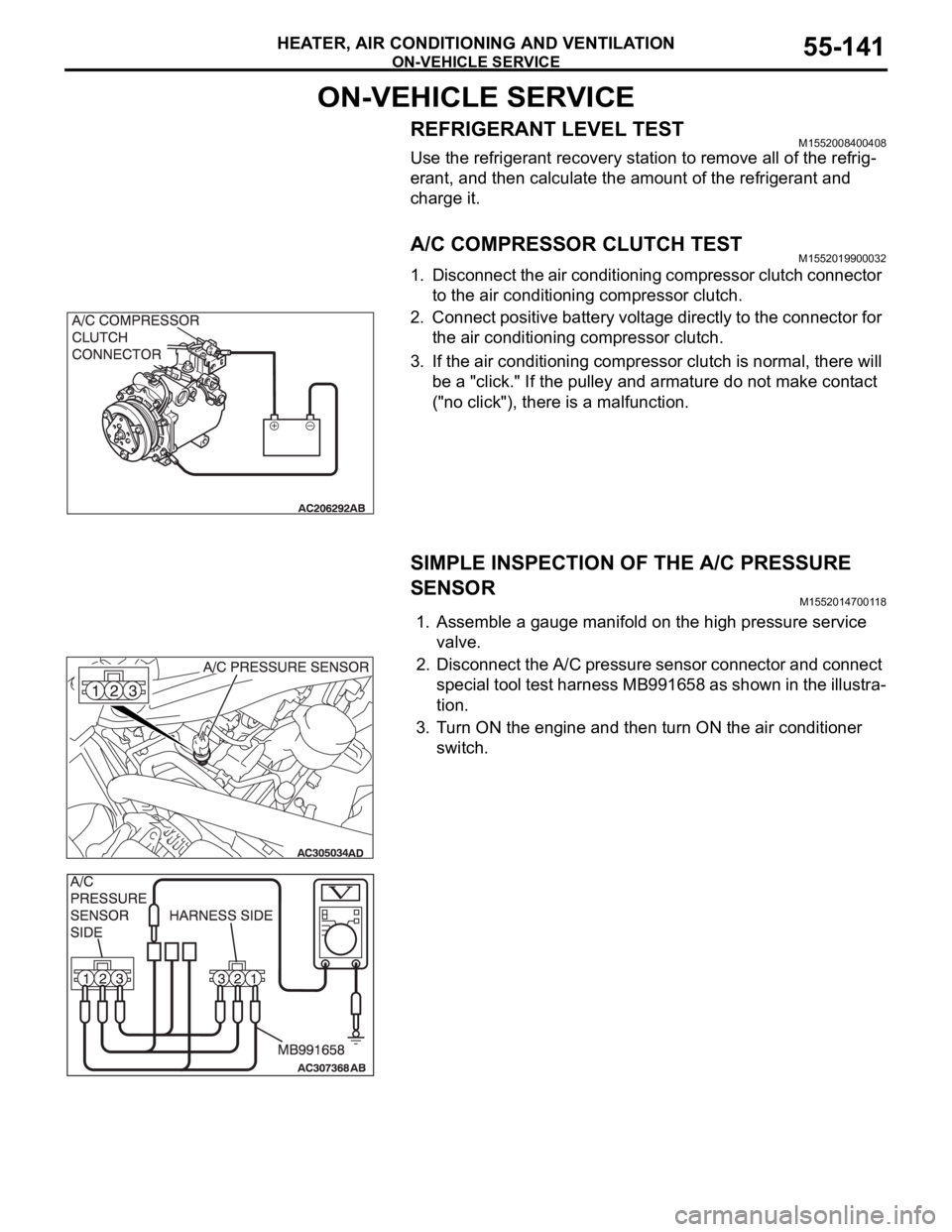
A/C COMPRESSOR CLUTCH TESTM1552019900032
1. Disconnect the air conditioning compressor clutch connector
to the air conditioning compressor clutch.
2. Connect positive battery voltage directly to the connector for
the air conditioning compressor clutch.
3. If the air conditioning compressor clutch is normal, there will
be a "click." If the pulley and armature do not make contact
("no click"), there is a malfunction.
SIMPLE INSPECTION OF THE A/C PRESSURE
SENSOR
M1552014700118
1. Assemble a gauge manifold on the high pressure service
valve.
2. Disconnect the A/C pressure sensor connector and connect
special tool test harness MB991658 as shown in the illustra-
tion.
3. Turn ON the engine and then turn ON the air conditioner
switch.
Page 844 of 1500
ON-VEHICLE SERVICE
HEATER, AIR CONDITIONING AND VENTILATION55-143
PERFORMANCE TEST M1552001400526
The vehicles to be tested should be parked out of direct sun-
light.
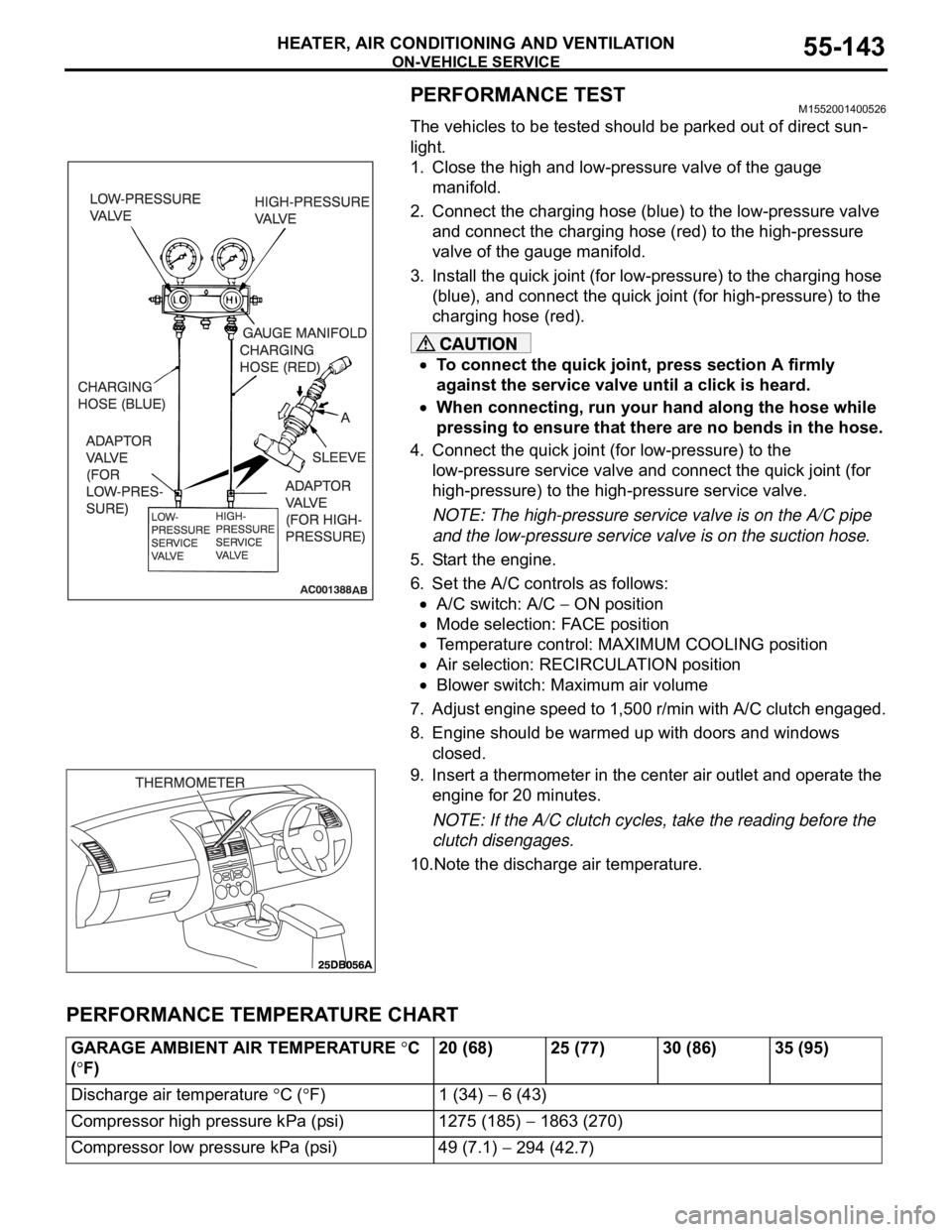
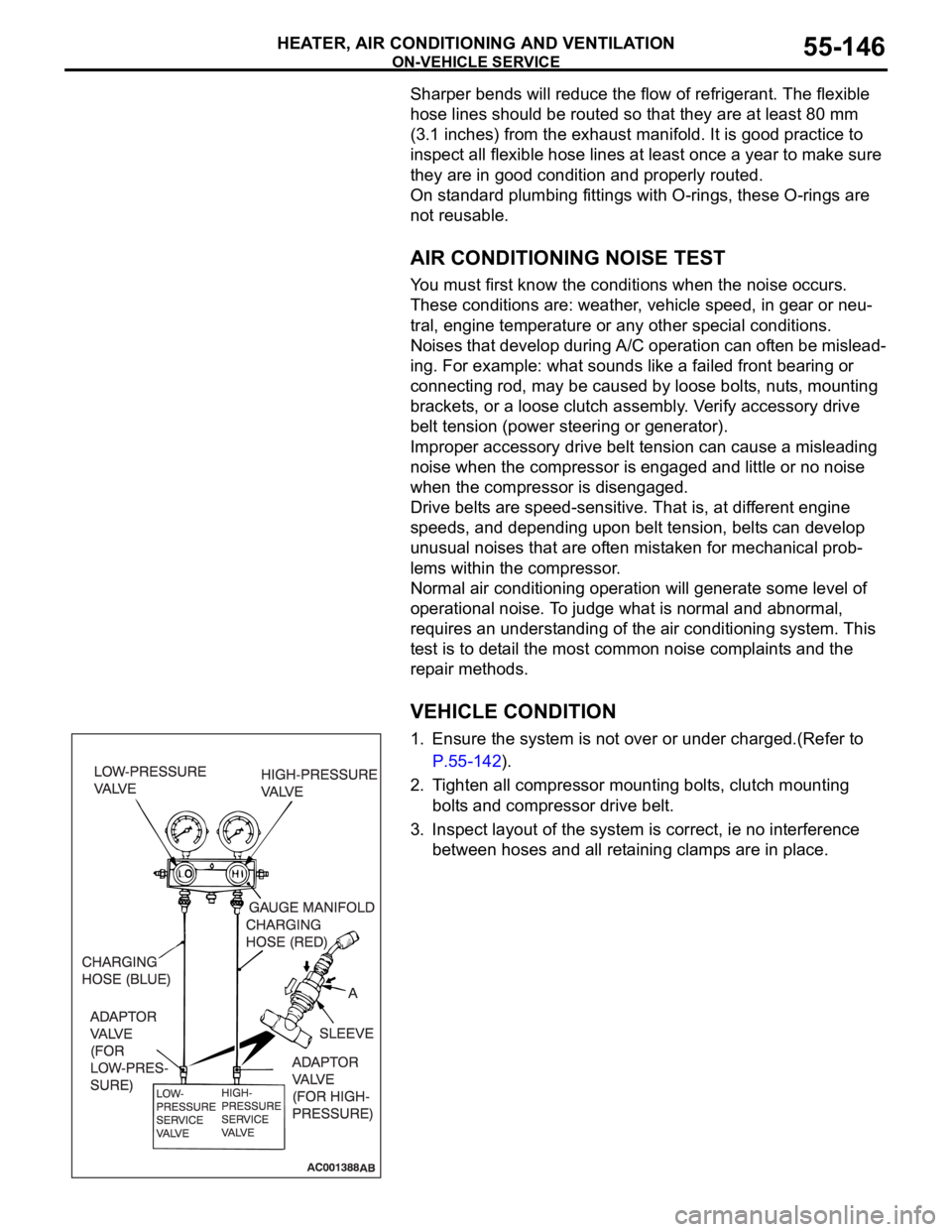
1. Close the high and low-pressure valve of the gauge
manifold.
2. Connect the charging hose (blue) to the low-pressure valve
and connect the charging hose (red) to the high-pressure
valve of the gauge manifold.
3. Install the quick joint (for low-pressure) to the charging hose
(blue), and connect the quick joint (for high-pressure) to the
charging hose (red).
To connect the quick joint, press section A firmly
against the service valve until a click is heard.
When connecting, run your hand along the hose while
pressing to ensure that there are no bends in the hose.
4. Connect the quick joint (for low-pressure) to the
low-pressure service valve and connect the quick joint (for
high-pressure) to the high-pressure service valve.
NOTE: The high-pressure service valve is on the A/C pipe
and the low-pressure service valve is on the suction hose.
5. Start the engine.
6. Set the A/C controls as follows:
A/C switch: A/C ON position
Mode selection: FACE position
Temperature control: MAXIMUM COOLING position
Air selection: RECIRCULATION position
Blower switch: Maximum air volume
7. Adjust engine speed to 1,500 r/min with A/C clutch engaged.
8. Engine should be warmed up with doors and windows
closed.
9. Insert a thermometer in the center air outlet and operate the
engine for 20 minutes.
NOTE: If the A/C clutch cycles, take the reading before the
clutch disengages.
10.Note the discharge air temperature.
PERFORMANCE TEMPERATURE CHART
GARAGE AMBIENT AIR TEMPERATURE C
(
F)20 (68) 25 (77) 30 (86) 35 (95)
Discharge air temperature
C (F) 1 (34) 6 (43)
Compressor high pressure kPa (psi) 1275 (185)
1863 (270)
Compressor low pressure kPa (psi) 49 (7.1)
294 (42.7)
Page 845 of 1500
ON-VEHICLE SERVICE
HEATER, AIR CONDITIONING AND VENTILATION55-144
REFRIGERANT LEAK INSPECTION PROCEDUREM1552001500299
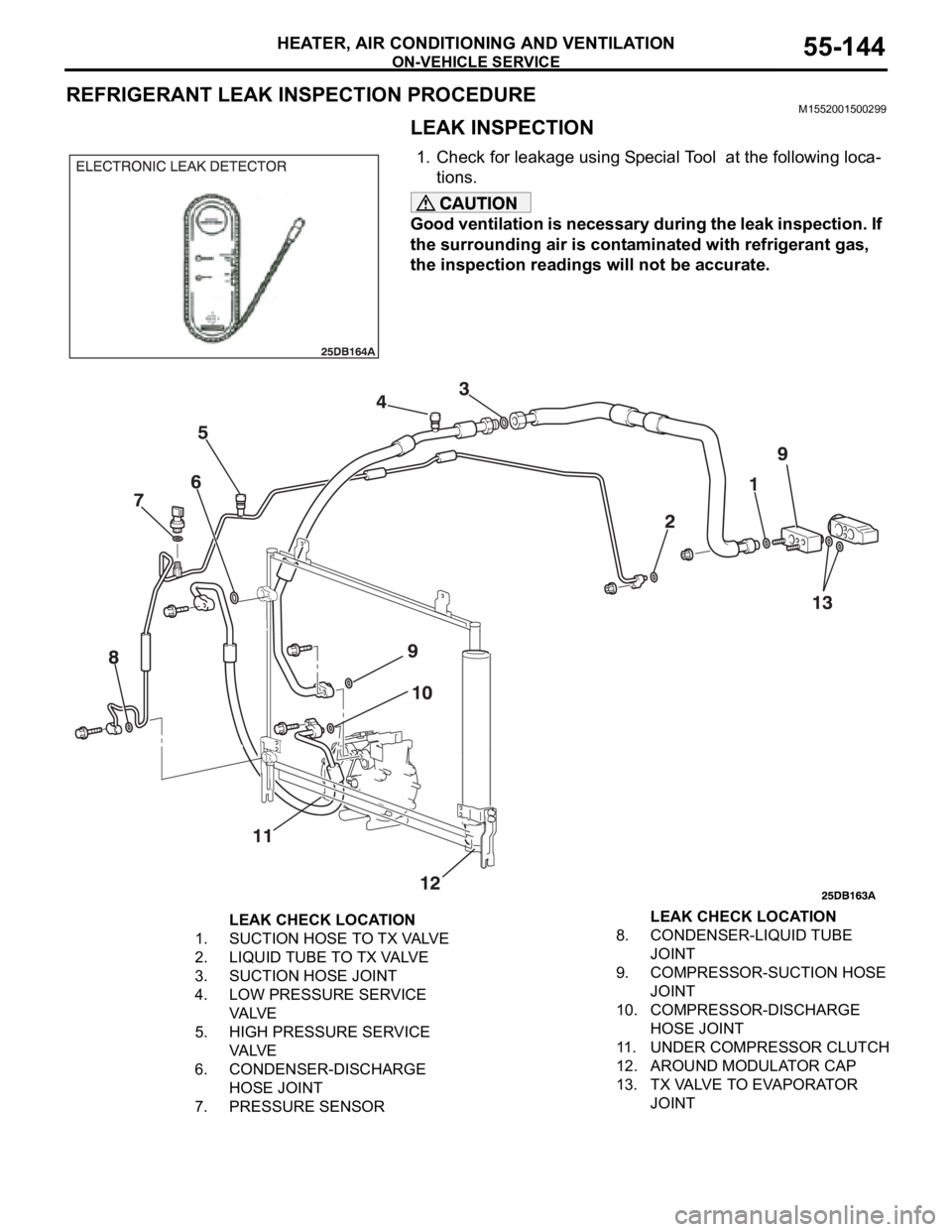
LEAK INSPECTION
1. Check for leakage using Special Tool at the following loca-
tions.
Good ventilation is necessary during the leak inspection. If
the surrounding air is contaminated with refrigerant gas,
the inspection readings will not be accurate.
LEAK CHECK LOCATION
1. SUCTION HOSE TO TX VALVE
2. LIQUID TUBE TO TX VALVE
3. SUCTION HOSE JOINT
4. LOW PRESSURE SERVICE
VA LV E
5. HIGH PRESSURE SERVICE
VA LV E
6. CONDENSER-DISCHARGE
HOSE JOINT
7. PRESSURE SENSOR8. CONDENSER-LIQUID TUBE
JOINT
9. COMPRESSOR-SUCTION HOSE
JOINT
10. COMPRESSOR-DISCHARGE
HOSE JOINT
11. UNDER COMPRESSOR CLUTCH
12. AROUND MODULATOR CAP
13. TX VALVE TO EVAPORATOR
JOINT LEAK CHECK LOCATION
Page 847 of 1500
ON-VEHICLE SERVICE
HEATER, AIR CONDITIONING AND VENTILATION55-146
Sharper bends will reduce the flow of refrigerant. The flexible
hose lines should be routed so that they are at least 80 mm
(3.1 inches) from the exhaust manifold. It is good practice to
inspect all flexible hose lines at least once a year to make sure
they are in good condition and properly routed.
On standard plumbing fittings with O-rings, these O-rings are
not reusable.
AIR CONDITIONING NOISE TEST
You must first know the conditions when the noise occurs.
These conditions are: weather, vehicle speed, in gear or neu-
tral, engine temperature or any other special conditions.
Noises that develop during A/C operation can often be mislead-
ing. For example: what sounds like a failed front bearing or
connecting rod, may be caused by loose bolts, nuts, mounting
brackets, or a loose clutch assembly. Verify accessory drive
belt tension (power steering or generator).
Improper accessory drive belt tension can cause a misleading
noise when the compressor is engaged and little or no noise
when the compressor is disengaged.
Drive belts are speed-sensitive. That is, at different engine
speeds, and depending upon belt tension, belts can develop
unusual noises that are often mistaken for mechanical prob-
lems within the compressor.
Normal air conditioning operation will generate some level of
operational noise. To judge what is normal and abnormal,
requires an understanding of the air conditioning system. This
test is to detail the most common noise complaints and the
repair methods.
VEHICLE CONDITION
1. Ensure the system is not over or under charged.(Refer to
P.55-142).
2. Tighten all compressor mounting bolts, clutch mounting
bolts and compressor drive belt.
3. Inspect layout of the system is correct, ie no interference
between hoses and all retaining clamps are in place.