clutch MITSUBISHI 380 2005 Owner's Manual
[x] Cancel search | Manufacturer: MITSUBISHI, Model Year: 2005, Model line: 380, Model: MITSUBISHI 380 2005Pages: 1500, PDF Size: 47.87 MB
Page 848 of 1500

ON-VEHICLE SERVICE
HEATER, AIR CONDITIONING AND VENTILATION55-147
TEST PROCEDURES
1. Select a quiet area for testing.
2. Duplicate problem (customer complaint) as much as
possible.
3. Judge if the noise is abnormal (ie. it is important to
understand the characteristics of the vehicle and its normal
state to judge what is abnormal) - Compare with similar
vehicle if necessary.
4. Detail what and how noise occurs.
5. Find the noise source and verify its transmission by isolating
the subject part from the vehicle.
6. Repair the problem.
7. Explain and report your findings.
DETAILS OF A/C NOISE
POSSIBLE CAUSES, CHECKS AND REPAIRS
NOISE DESCRIPTION WHEN IT OCCURS SOURCE OF NOISE
Rumbling (Bearing noise) With A/C On or Off Magnetic clutch, idler pulley
Clang-Clack noise When compressor is engaged Magnetic clutch operation
Squawking (Belt sliding noise) When compressor is engaged V-belt
Whistling or Whooping noise Immediately after the A/C is
engaged.Expansion valve
Hissing or swishing noise When A/C is engaged, but
decreases as flow is stable Refrigerant flow
Rattling (Internal compressor) When compressor is operating Compressor internal part
Wooing (Resonant noise) With A/C On, occurs at certain
speed.Resonance of accessories
Cooing (Discharge pulsation
noise)With A/C On or Off Resonating noise with the vehicle
body
NOISE DESCRIPTION POSSIBLE CAUSE CHECK REPAIR
Rumbling (Bearing
noise)Bearing damage in rotor Manual rotation of bearing Replace compressor
Rotor slipping on boss Wear on compressor boss
surfaceReplace compressor
Bearing damage in pulley Check alignment between
pulleysReplace compressor
Clang-Clack noise Hub to stator misaligned Wear on inner clutch face Replace compressor
Gap between clutch
surface is too largeCheck Air gap is within
specificationReplace compressor
Squawking (Belt sliding
noise)Oil/water between the belt
and rotor surfaceOil and water
contaminationClean
Low belt tension Belt tension Reset or Replace belt and
set tension to correct
specification
Whistling or Whooping
noiseVibration of expansion
valveExpansion valve Replace TX valve
Page 850 of 1500
ON-VEHICLE SERVICE
HEATER, AIR CONDITIONING AND VENTILATION55-149
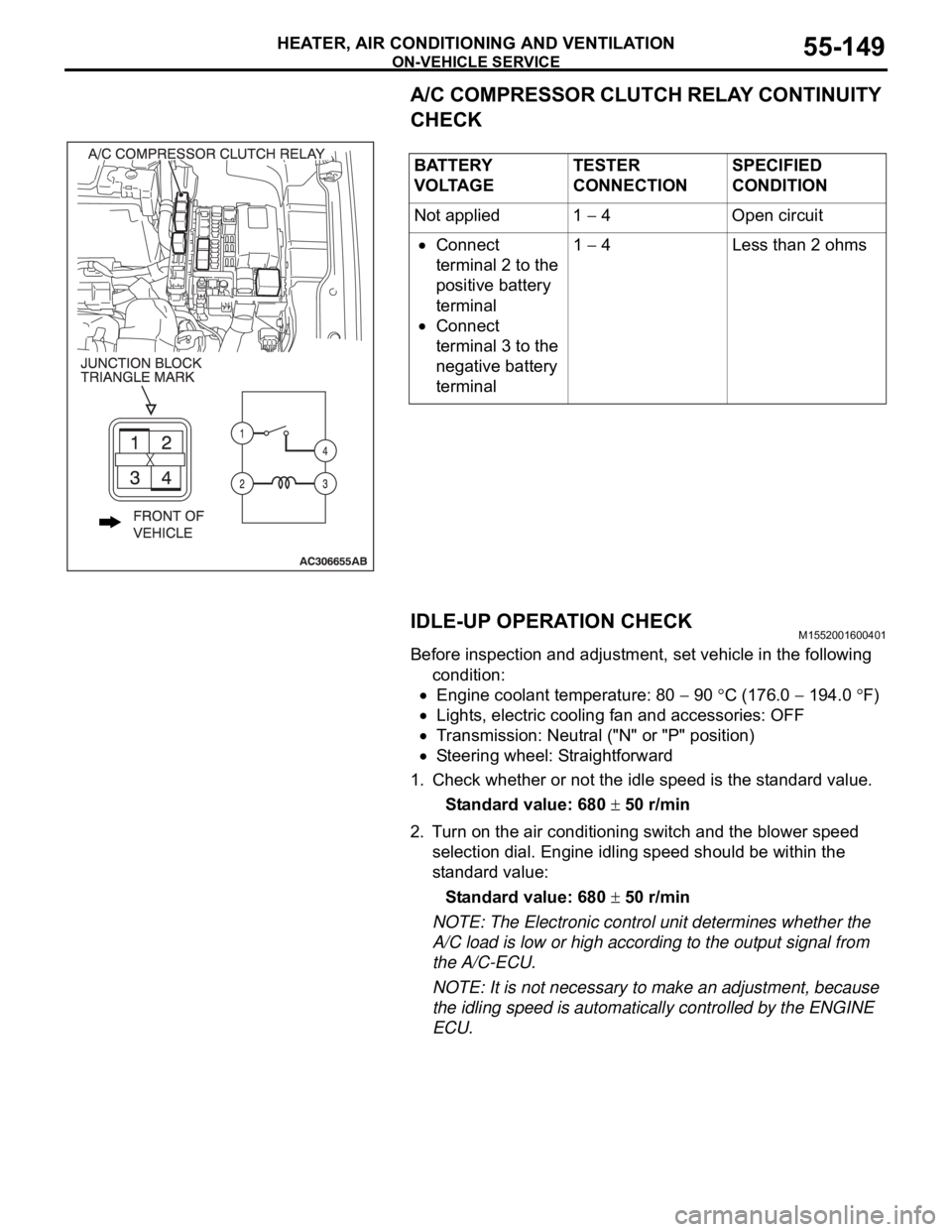
A/C COMPRESSOR CLUTCH RELAY CONTINUITY
CHECK
IDLE-UP OPERATION CHECK
M1552001600401
Before inspection and adjustment, set vehicle in the following
condition:
Engine coolant temperature: 80 90 C (176.0 194.0 F)
Lights, electric cooling fan and accessories: OFF
Transmission: Neutral ("N" or "P" position)
Steering wheel: Straightforward
1. Check whether or not the idle speed is the standard value.
Standard value: 680
50 r/min
2. Turn on the air conditioning switch and the blower speed
selection dial. Engine idling speed should be within the
standard value:
Standard value: 680
50 r/min
NOTE: The Electronic control unit determines whether the
A/C load is low or high according to the output signal from
the A/C-ECU.
NOTE: It is not necessary to make an adjustment, because
the idling speed is automatically controlled by the ENGINE
ECU. BATTERY
V O LTA G ETESTER
CONNECTIONSPECIFIED
CONDITION
Not applied 1
4 Open circuit
Connect
terminal 2 to the
positive battery
terminal
Connect
terminal 3 to the
negative battery
terminal1
4 Less than 2 ohms
Page 853 of 1500
HEATER UNIT, HEATER CORE, BLOWER ASSEMBLY AND EVAPORATOR UNIT
HEATER, AIR CONDITIONING AND VENTILATION55-152
REMOVAL SERVICE POINTS
.
<> SUCTION PIPE AND LIQUID PIPE DISCON-
NECTION
As the compressor oil and receiver are highly moisture
absorbent, use a non-porous material to plug the hose and
nipples.
To prevent the entry of dust or other foreign bodies, plug the
dismantled hose and the nipples of the expansion valves.
.
<> HEATER UNIT AND DECK
CROSSMEMBER ASSEMBLY REMOVAL
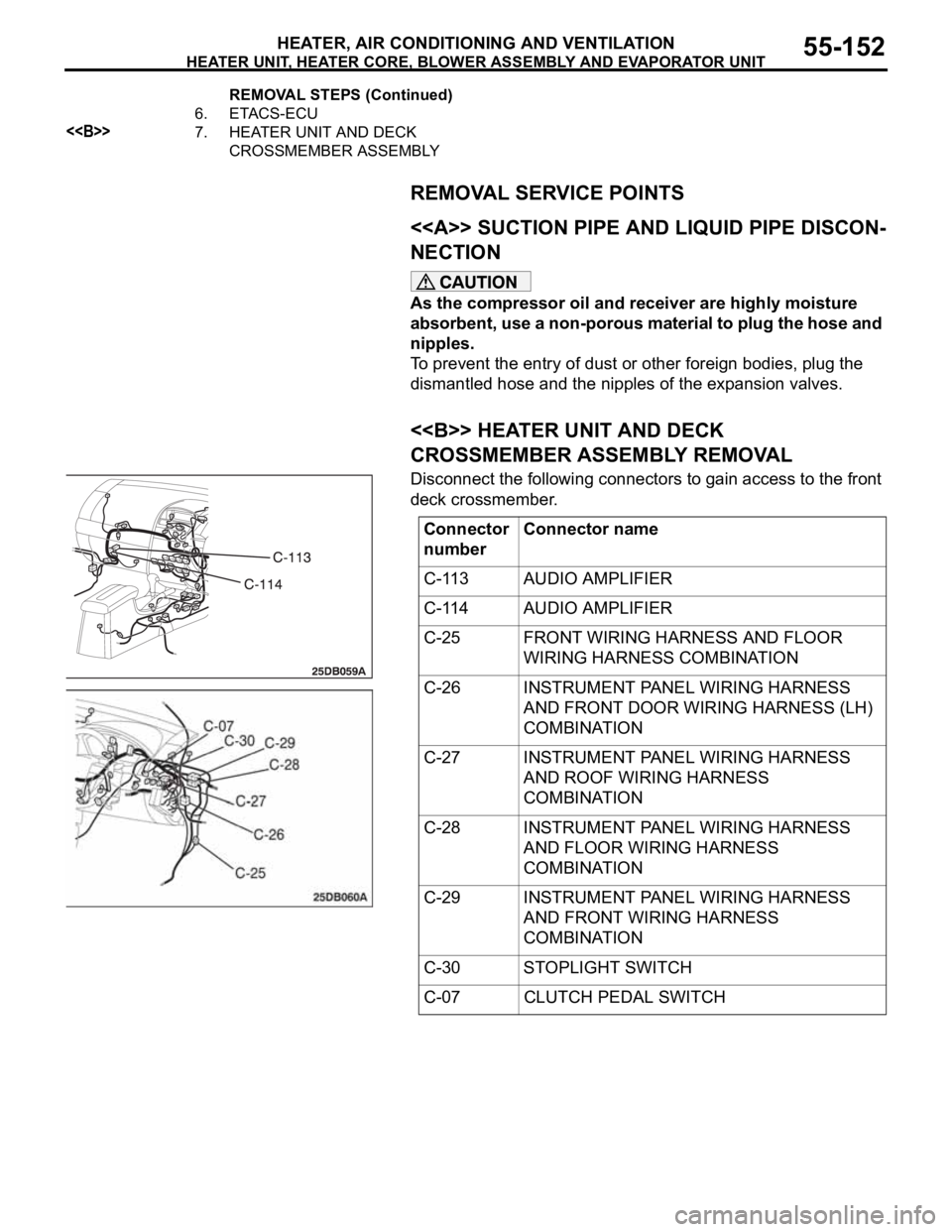
Disconnect the following connectors to gain access to the front
deck crossmember.
6. ETACS-ECU
<>7. HEATER UNIT AND DECK
CROSSMEMBER ASSEMBLY REMOVAL STEPS (Continued)
Connector
numberConnector name
C-113 AUDIO AMPLIFIER
C-114 AUDIO AMPLIFIER
C-25 FRONT WIRING HARNESS AND FLOOR
WIRING HARNESS COMBINATION
C-26 INSTRUMENT PANEL WIRING HARNESS
AND FRONT DOOR WIRING HARNESS (LH)
COMBINATION
C-27 INSTRUMENT PANEL WIRING HARNESS
AND ROOF WIRING HARNESS
COMBINATION
C-28 INSTRUMENT PANEL WIRING HARNESS
AND FLOOR WIRING HARNESS
COMBINATION
C-29 INSTRUMENT PANEL WIRING HARNESS
AND FRONT WIRING HARNESS
COMBINATION
C-30 STOPLIGHT SWITCH
C-07 CLUTCH PEDAL SWITCH
Page 867 of 1500
COMPRESSOR ASSEMBLY AND DRIVE BELT
HEATER, AIR CONDITIONING AND VENTILATION55-166
INSPECTIONM1552014301083
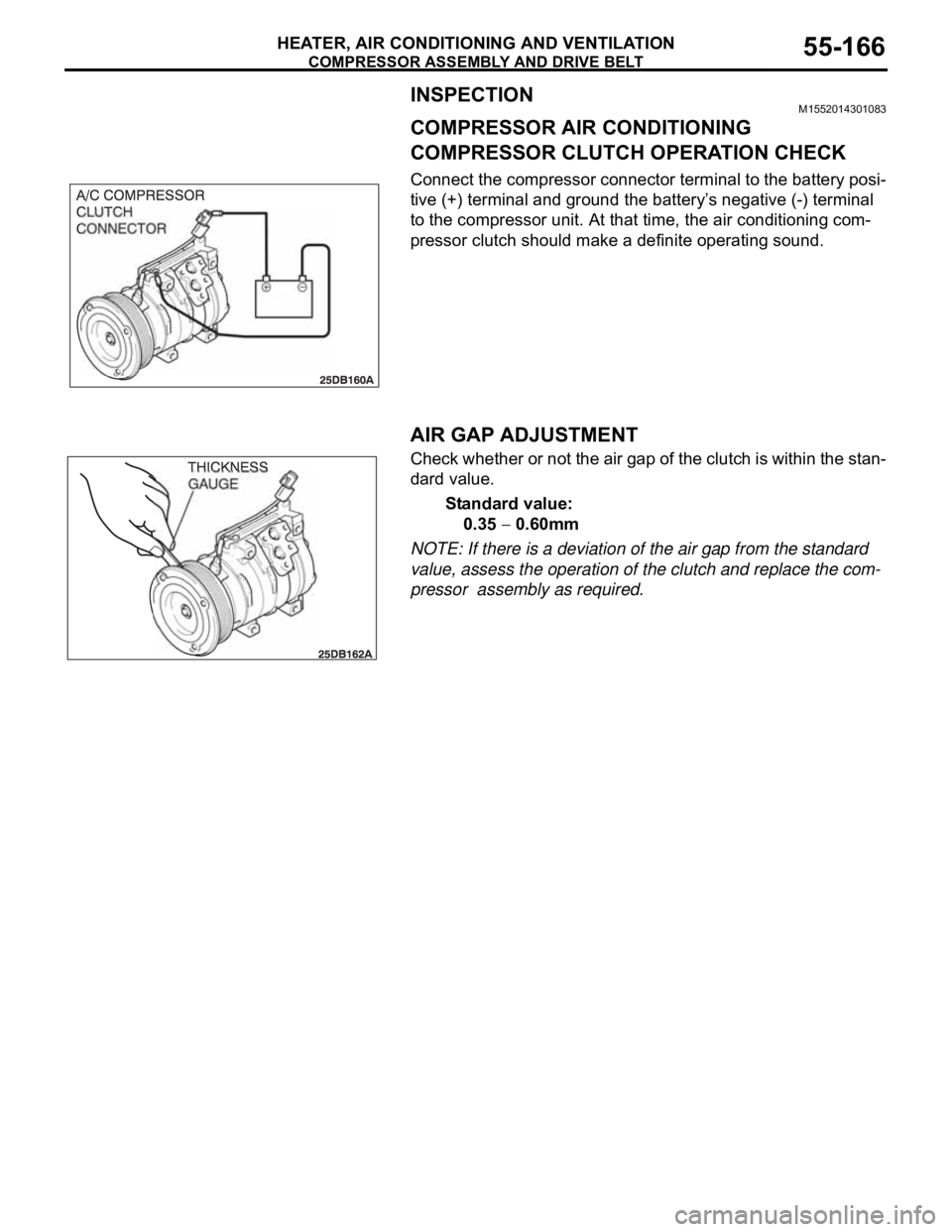
COMPRESSOR AIR CONDITIONING
COMPRESSOR CLUTCH OPERATION CHECK
Connect the compressor connector terminal to the battery posi-
tive (+) terminal and ground the battery’s negative (-) terminal
to the compressor unit. At that time, the air conditioning com-
pressor clutch should make a definite operating sound.
.
AIR GAP ADJUSTMENT
Check whether or not the air gap of the clutch is within the stan-
dard value.
Standard value:
0.35
0.60mm
NOTE: If there is a deviation of the air gap from the standard
value, assess the operation of the clutch and replace the com-
pressor assembly as required.
Page 879 of 1500

SPECIFICATIONS
HEATER, AIR CONDITIONING AND VENTILATION55-178
SPECIFICATIONS
FASTENER TIGHTENING SPECIFICATIONSM1552012100273
GENERAL SPECIFICATIONSM1552000200262
SERVICE SPECIFICATIONSM1552000300333
LUBRICANTSM1552000400329
ITEM SPECIFICATION
Liquid pipe mounting nut (heater unit side) 4.9
0.9 Nm (43 8 in-lb)
Liquid pipe mounting bolt (condenser side) 4.9
0.9 Nm (44 8 in-lb)
Suction flexible hose mounting nut (compressor side) 25
4 Nm (18 3 ft-lb)
Suction pipe mounting nut (heater unit side) 12
2 Nm (107 17 in-lb)
Suction pipe to suction hose union nut 32
2 Nm
Discharge flexible hose mounting bolt (compressor side) 25
4 Nm (18 3 ft-lb)
Discharge flexible hose mounting nut (condenser side) 12
2 Nm (107 17 in-lb)
ITEM MANUAL AIR CONDITIONING
Heater control Dial type
Air conditioning switch Push-button type
Compressor Type 10S17 (Swashplate type)
Displacement (cm
3)188
Refrigerant Type R134a (HFC-134a)
Amount (grams) 435
475
ITEM STANDARD VALUE
Idle speed r/min 680
50
Idle-up speed r/min 680
50
Air mix damper potentiometer resistance k
1.7 5.0
Air outlet changeover damper potentiometer resistance k
0.8 4.8
Air gap (air conditioning compressor clutch) mm (in) 0.3
0.5 (0.012 0.020)
ITEM SPECIFIED LUBRICANT QUANTITY(ml)
Each connection of refrigerant line ND Oil 8 As required
Compressor refrigerant unit lubricant (ml) ND Oil 8 140
Page 885 of 1500
RELAY
COMPONENT LOCATIONS70-6
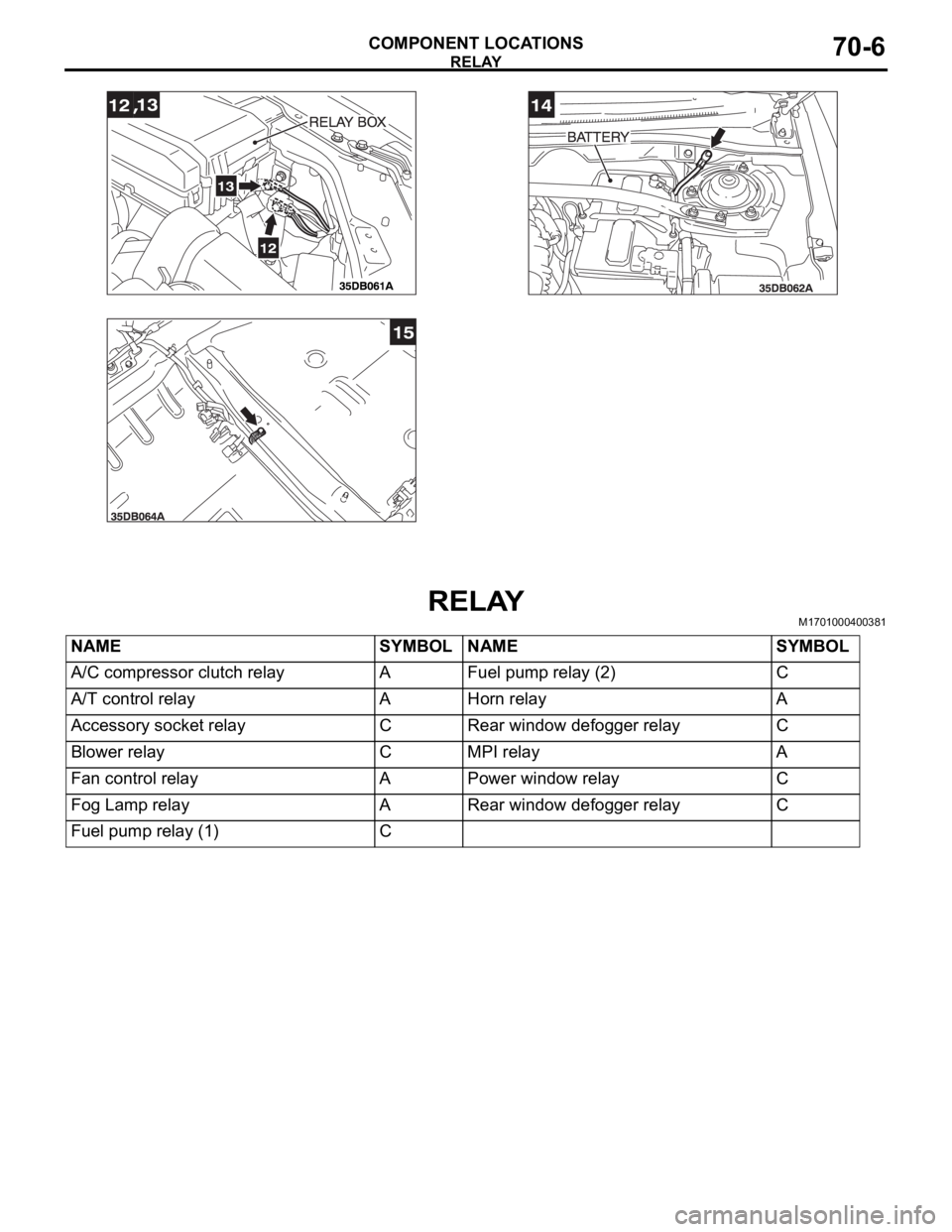
RELAYM1701000400381
NAME SYMBOL NAME SYMBOL
A/C compressor clutch relay A Fuel pump relay (2) C
A/T control relay A Horn relay A
Accessory socket relay C Rear window defogger relay C
Blower relay C MPI relay A
Fan control relay A Power window relay C
Fog Lamp relay A Rear window defogger relay C
Fuel pump relay (1) C
Page 997 of 1500
STARTING SYSTEM
ENGINE ELECTRICAL16-20
STARTING SYSTEM
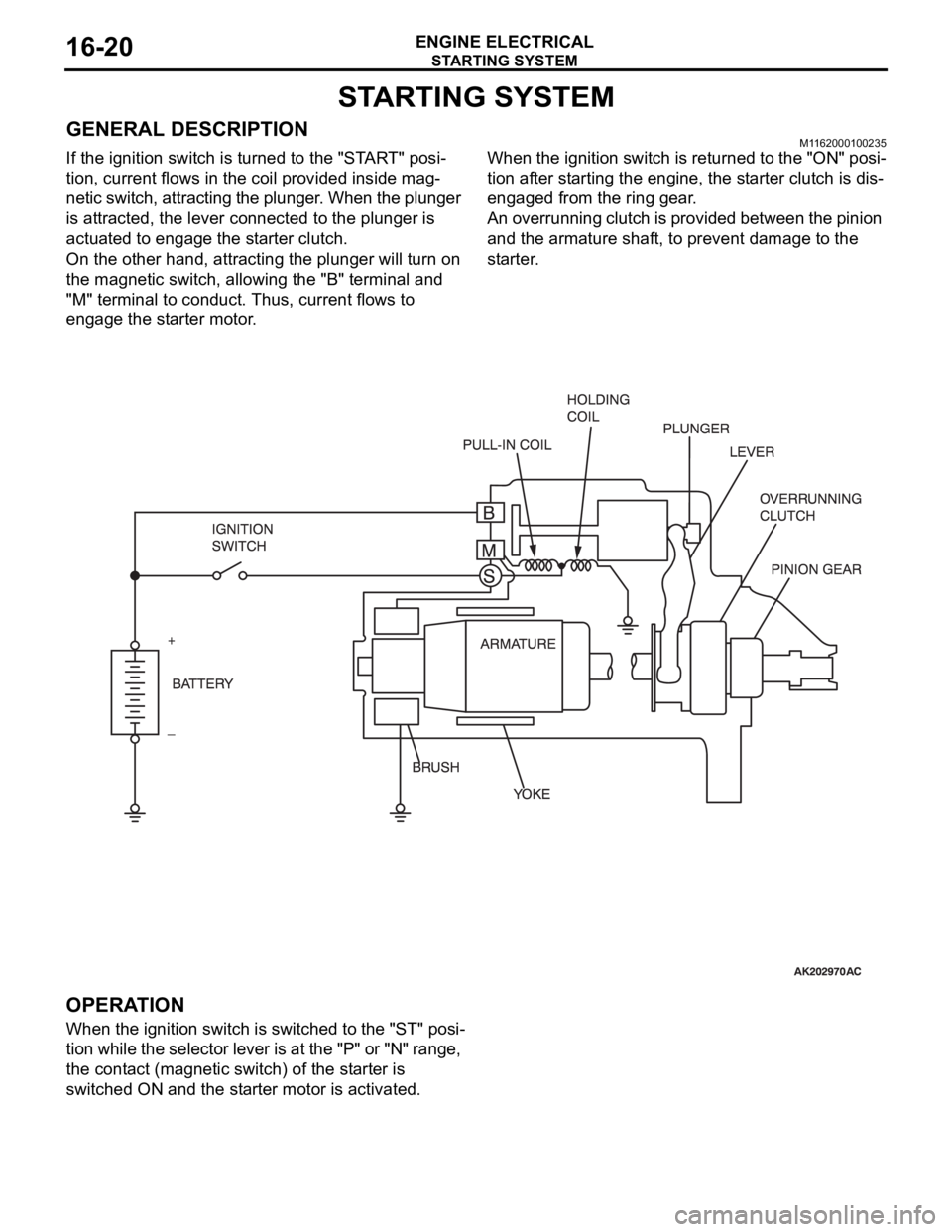
GENERAL DESCRIPTIONM1162000100235
If the ignition switch is turned to the "START" posi-
tion, current flows in the coil provided inside mag-
netic switch, attracting the plunger. When the plunger
is attracted, the lever connected to the plunger is
actuated to engage the starter clutch.
On the other hand, attracting the plunger will turn on
the magnetic switch, allowing the "B" terminal and
"M" terminal to conduct. Thus, current flows to
engage the starter motor.When the ignition switch is returned to the "ON" posi-
tion after starting the engine, the starter clutch is dis-
engaged from the ring gear.
An overrunning clutch is provided between the pinion
and the armature shaft, to prevent damage to the
starter.
OPERATION
When the ignition switch is switched to the "ST" posi-
tion while the selector lever is at the "P" or "N" range,
the contact (magnetic switch) of the starter is
switched ON and the starter motor is activated.
Page 1003 of 1500
STARTING SYSTEM
ENGINE ELECTRICAL16-26
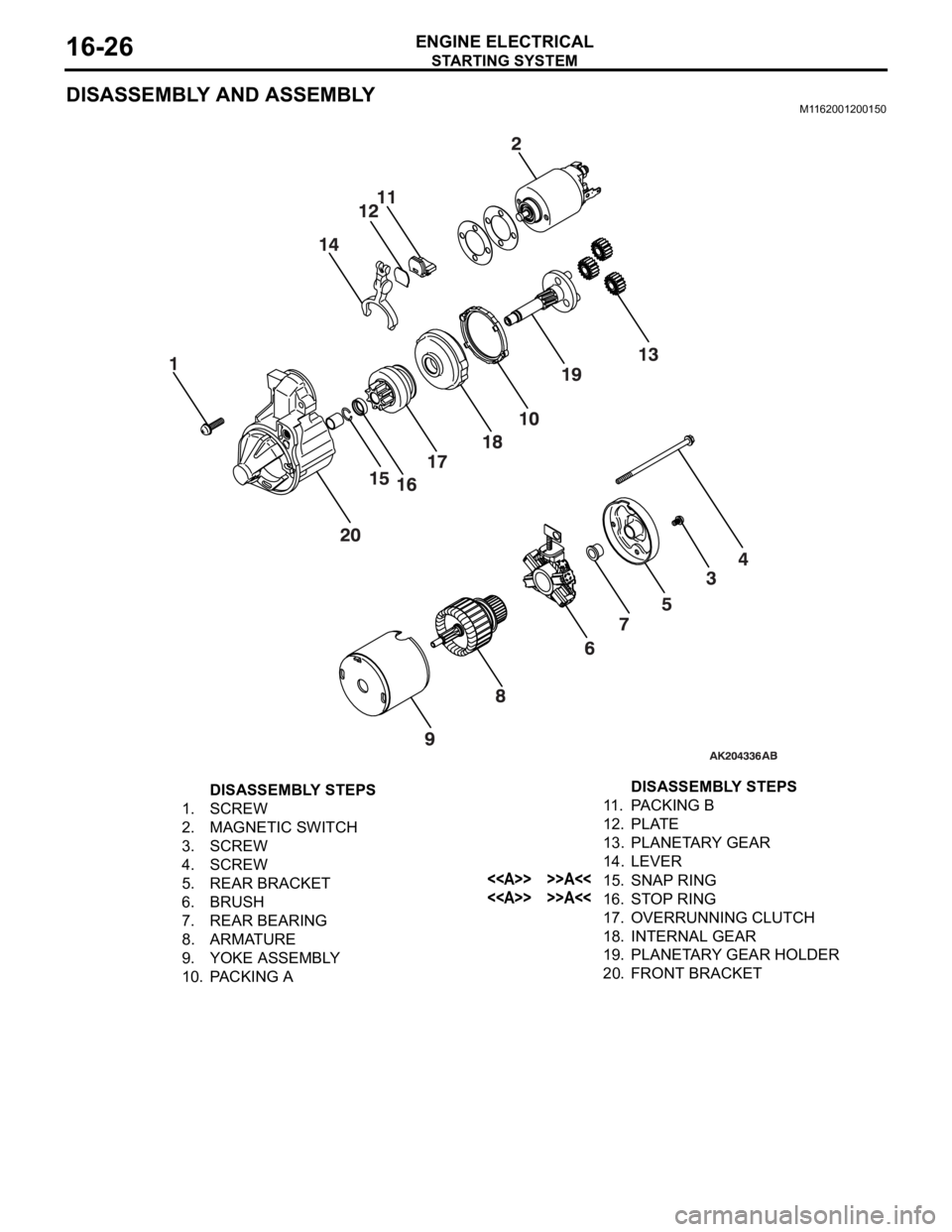
DISASSEMBLY AND ASSEMBLYM1162001200150
DISASSEMBLY STEPS
1. SCREW
2. MAGNETIC SWITCH
3. SCREW
4. SCREW
5. REAR BRACKET
6. BRUSH
7. REAR BEARING
8. ARMATURE
9. YOKE ASSEMBLY
10. PACKING A11 . PA C K I N G B
12. PLATE
13. PLANETARY GEAR
14. LEVER
<> >>A<<15. SNAP RING
<> >>A<<16. STOP RING
17. OVERRUNNING CLUTCH
18. INTERNAL GEAR
19. PLANETARY GEAR HOLDER
20. FRONT BRACKETDISASSEMBLY STEPS
Page 1004 of 1500
Page 1006 of 1500
STARTING SYSTEM
ENGINE ELECTRICAL16-29
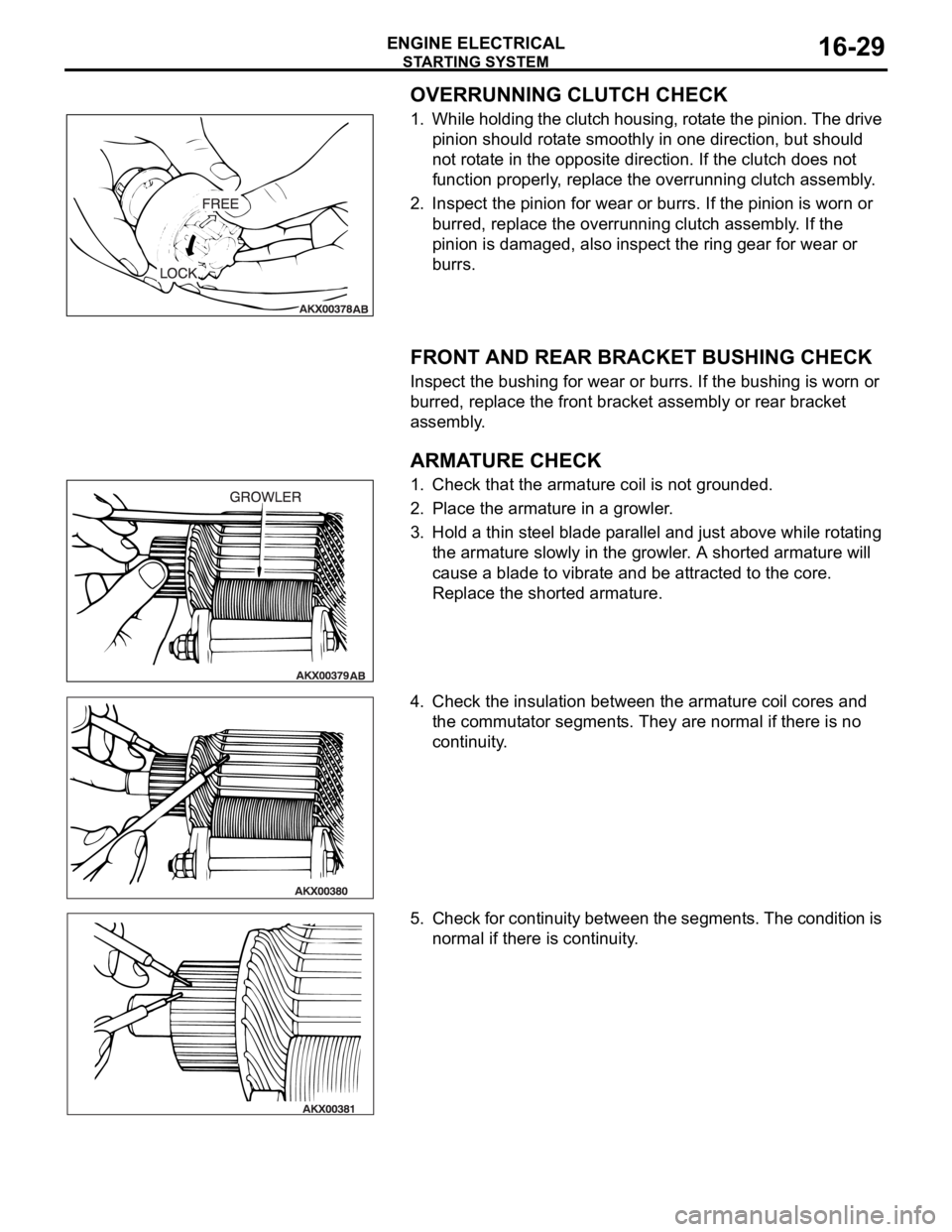
OVERRUNNING CLUTCH CHECK
1. While holding the clutch housing, rotate the pinion. The drive
pinion should rotate smoothly in one direction, but should
not rotate in the opposite direction. If the clutch does not
function properly, replace the overrunning clutch assembly.
2. Inspect the pinion for wear or burrs. If the pinion is worn or
burred, replace the overrunning clutch assembly. If the
pinion is damaged, also inspect the ring gear for wear or
burrs.
.
FRONT AND REAR BRACKET BUSHING CHECK
Inspect the bushing for wear or burrs. If the bushing is worn or
burred, replace the front bracket assembly or rear bracket
assembly.
.
ARMATURE CHECK
1. Check that the armature coil is not grounded.
2. Place the armature in a growler.
3. Hold a thin steel blade parallel and just above while rotating
the armature slowly in the growler. A shorted armature will
cause a blade to vibrate and be attracted to the core.
Replace the shorted armature.
4. Check the insulation between the armature coil cores and
the commutator segments. They are normal if there is no
continuity.
5. Check for continuity between the segments. The condition is
normal if there is continuity.