MAINTENANCE SERVICE
GENERAL00-55
The SRS may not activate if any of the above compo-
nents are not installed properly, which could result in
serious injury or death to the vehicle's driver and
front passenger.
11.Check the steering wheel for excessive free play.
Replace any part if it fails visual inspection (Refer to
GROUP 52B, Air Bag Module and Clock Spring P.52B-237).
FRONT SEATBACK ASSEMBLY WITH
SIDE-AIRBAG MODULE
If any improper part is found during the following
inspection, replace the front seatback assembly
with a new one.
Dispose of the old one according to the specified
procedure (Refer to GROUP 52B, Air Bag Module
Disposal Procedures P.52B-254).
Never attempt to measure the circuit resistance of
the air bag module (squib) even if you are using
the specified tester. If the circuit resistance is mea-
sured with a tester, accidental air bag deployment
will result in serious personal injury.
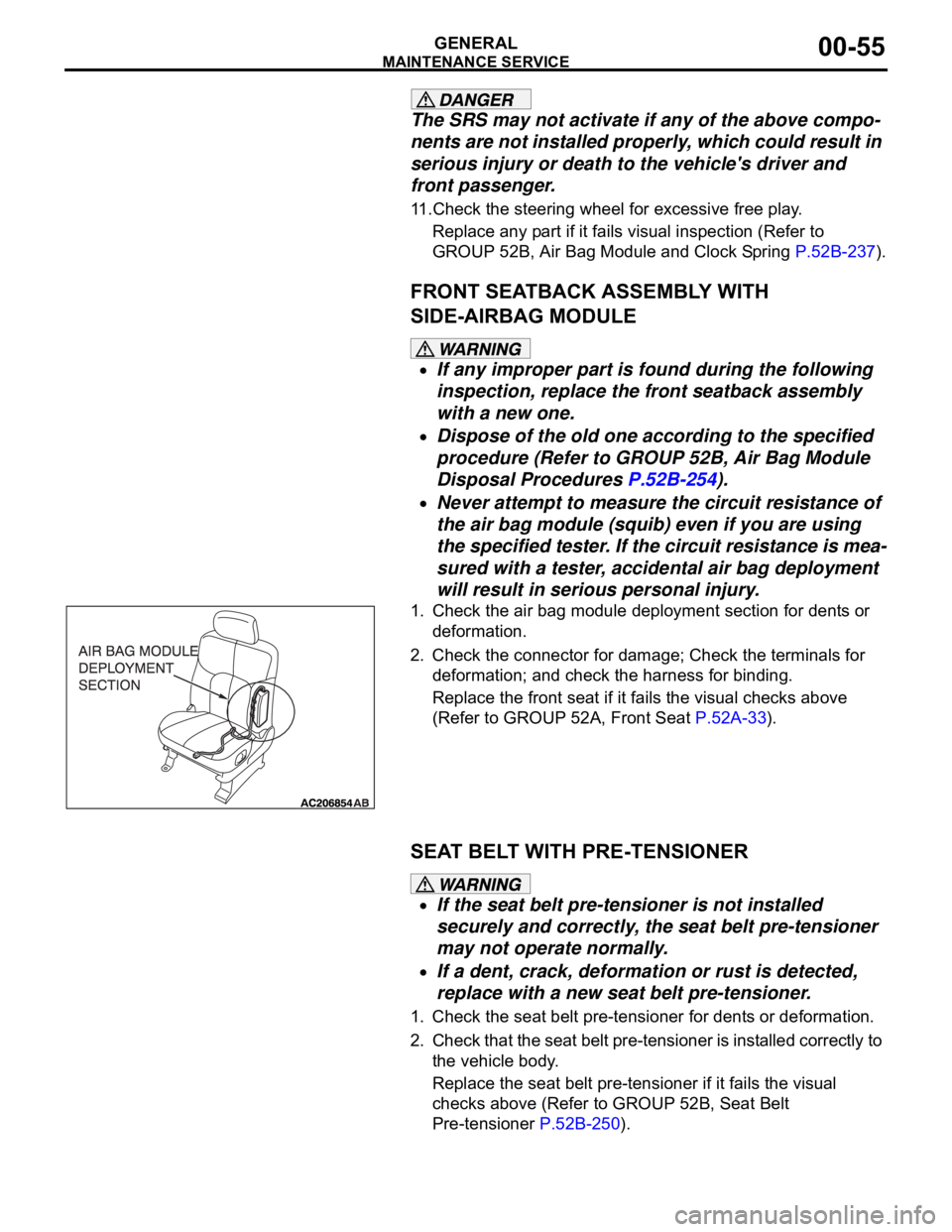
1. Check the air bag module deployment section for dents or
deformation.
2. Check the connector for damage; Check the terminals for
deformation; and check the harness for binding.
Replace the front seat if it fails the visual checks above
(Refer to GROUP 52A, Front Seat P.52A-33).
SEAT BELT WITH PRE-TENSIONER
If the seat belt pre-tensioner is not installed
securely and correctly, the seat belt pre-tensioner
may not operate normally.
If a dent, crack, deformation or rust is detected,
replace with a new seat belt pre-tensioner.
1. Check the seat belt pre-tensioner for dents or deformation.
2. Check that the seat belt pre-tensioner is installed correctly to
the vehicle body.
Replace the seat belt pre-tensioner if it fails the visual
checks above (Refer to GROUP 52B, Seat Belt
Pre-tensioner P.52B-250).
MAINTENANCE SERVICE
GENERAL00-56
WIRING HARNESS
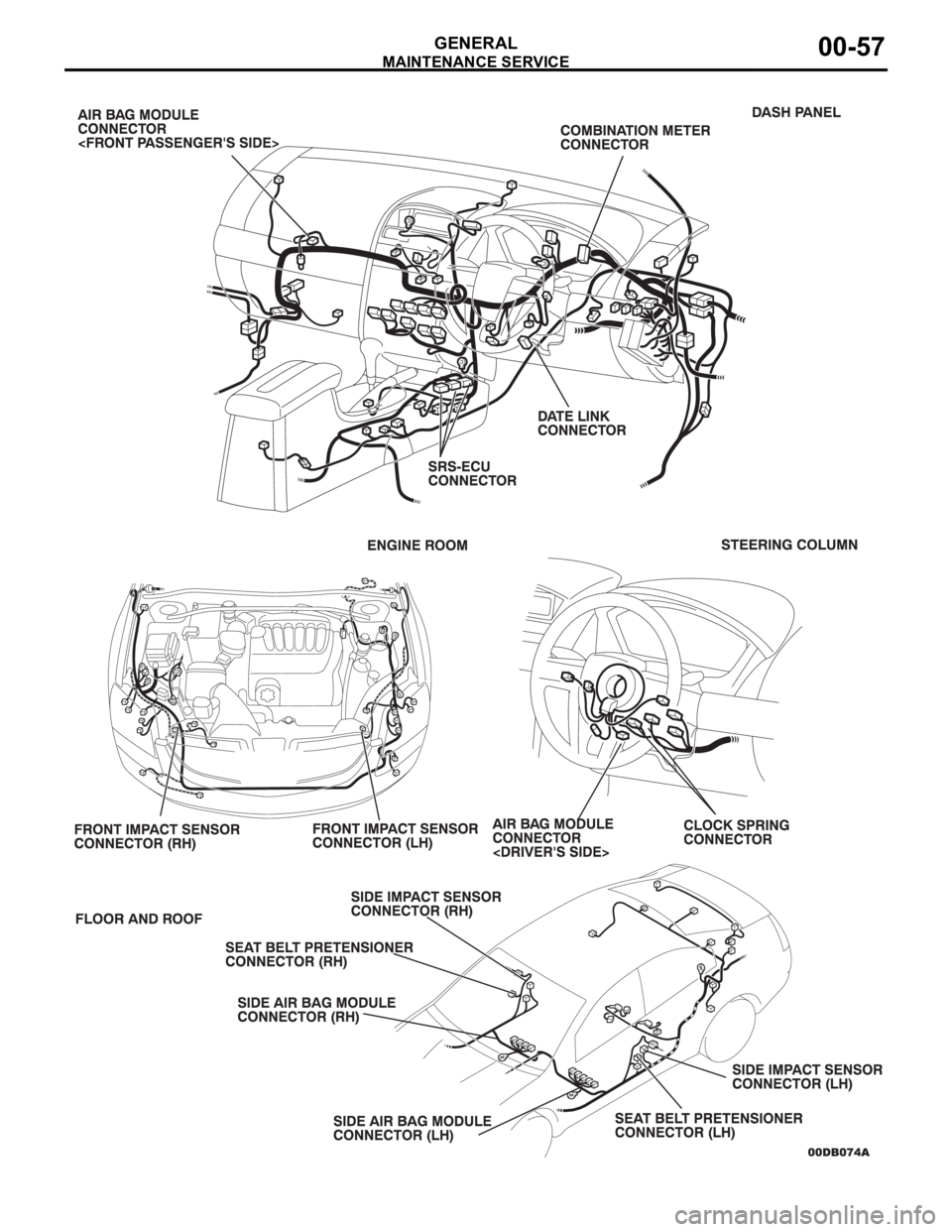
1. Check the connector for poor connection.
The SRS system may not operate if SRS harnesses or
connectors are damaged or improperly connected,
which could result in serious injury or death to the
vehicle's driver and front passenger.
2. Check the harness for binds, the connectors for damage,
and the terminals for deformation. Replace any connector or
harness that fails the visual inspection (Refer to GROUP
52B, SRS Precaution P.52B-16).
MAINTENANCE SERVICE
GENERAL00-58
20. TYRES (ROTATE)M1001008900303
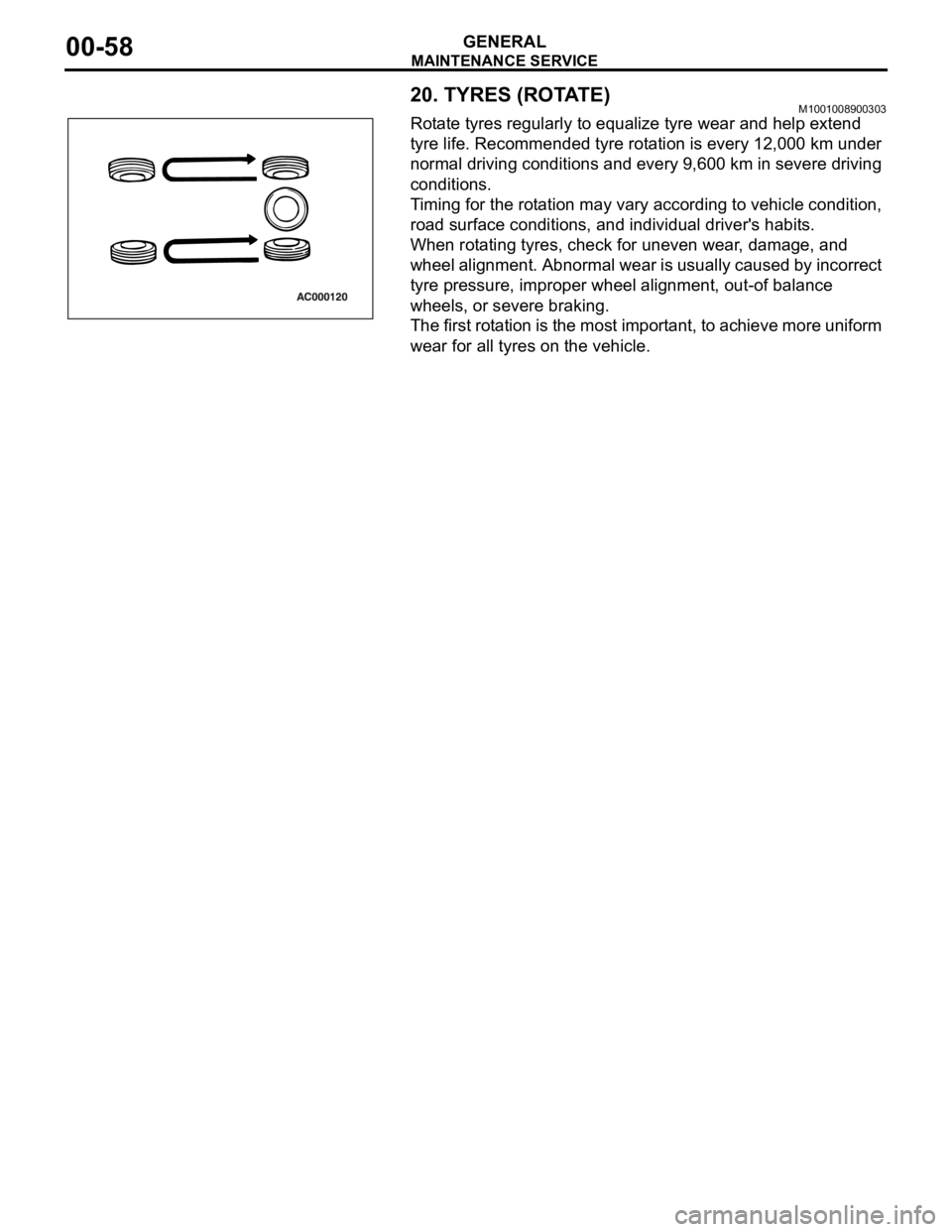
Rotate tyres regularly to equalize tyre wear and help extend
tyre life. Recommended tyre rotation is every 12,000 km under
normal driving conditions and every 9,600 km in severe driving
conditions.
Timing for the rotation may vary according to vehicle condition,
road surface conditions, and individual driver's habits.
When rotating tyres, check for uneven wear, damage, and
wheel alignment. Abnormal wear is usually caused by incorrect
tyre pressure, improper wheel alignment, out-of balance
wheels, or severe braking.
The first rotation is the most important, to achieve more uniform
wear for all tyres on the vehicle.