wiring MITSUBISHI 380 2005 Workshop Manual
[x] Cancel search | Manufacturer: MITSUBISHI, Model Year: 2005, Model line: 380, Model: MITSUBISHI 380 2005Pages: 1500, PDF Size: 47.87 MB
Page 907 of 1500
HOW TO DIAGNOSE
GENERAL
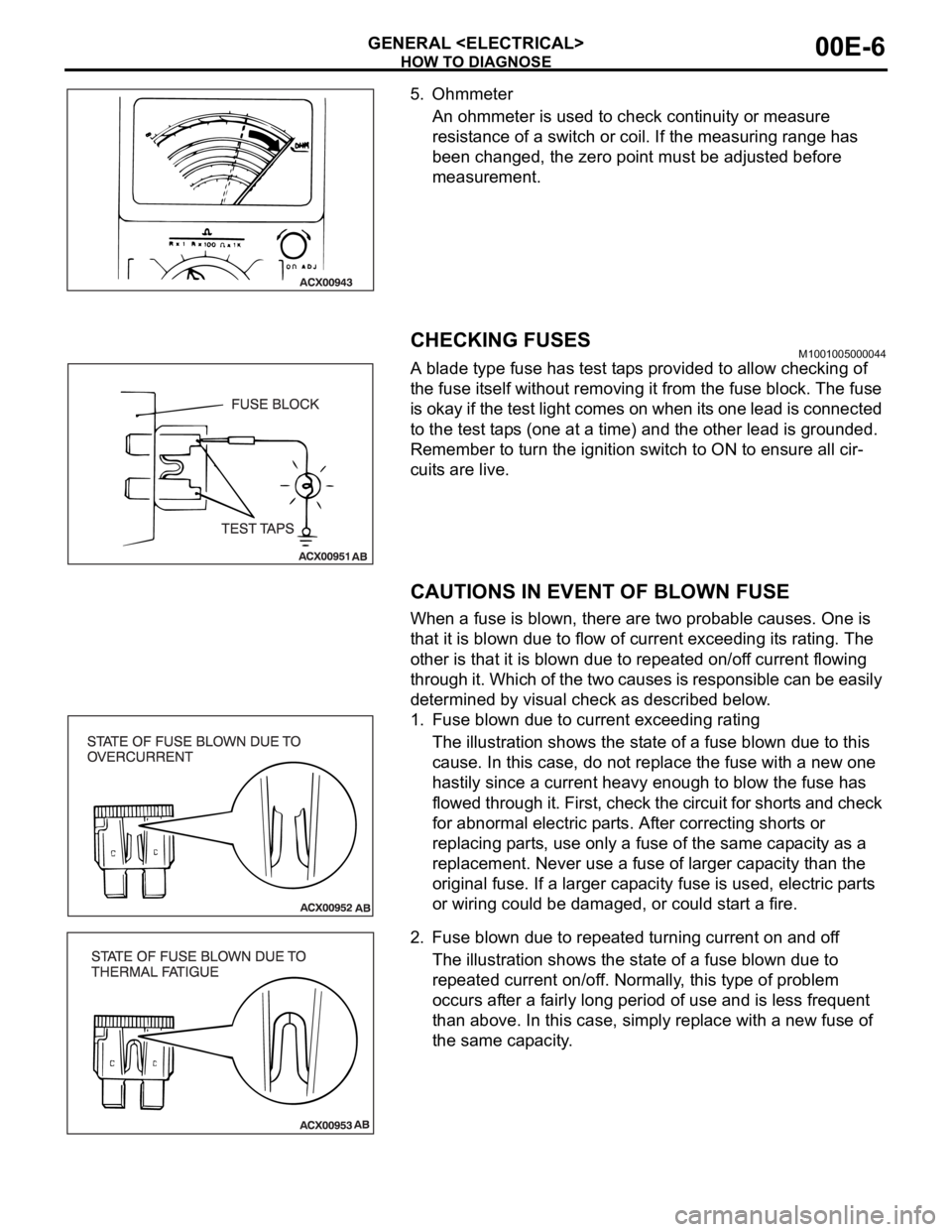
5. Ohmmeter
An ohmmeter is used to check continuity or measure
resistance of a switch or coil. If the measuring range has
been changed, the zero point must be adjusted before
measurement.
CHECKING FUSESM1001005000044
A blade type fuse has test taps provided to allow checking of
the fuse itself without removing it from the fuse block. The fuse
is okay if the test light comes on when its one lead is connected
to the test taps (one at a time) and the other lead is grounded.
Remember to turn the ignition switch to ON to ensure all cir-
cuits are live.
CAUTIONS IN EVENT OF BLOWN FUSE
When a fuse is blown, there are two probable causes. One is
that it is blown due to flow of current exceeding its rating. The
other is that it is blown due to repeated on/off current flowing
through it. Which of the two causes is responsible can be easily
determined by visual check as described below.
1. Fuse blown due to current exceeding rating
The illustration shows the state of a fuse blown due to this
cause. In this case, do not replace the fuse with a new one
hastily since a current heavy enough to blow the fuse has
flowed through it. First, check the circuit for shorts and check
for abnormal electric parts. After correcting shorts or
replacing parts, use only a fuse of the same capacity as a
replacement. Never use a fuse of larger capacity than the
original fuse. If a larger capacity fuse is used, electric parts
or wiring could be damaged, or could start a fire.
2. Fuse blown due to repeated turning current on and off
The illustration shows the state of a fuse blown due to
repeated current on/off. Normally, this type of problem
occurs after a fairly long period of use and is less frequent
than above. In this case, simply replace with a new fuse of
the same capacity.
Page 910 of 1500
HOW TO DIAGNOSE
GENERAL
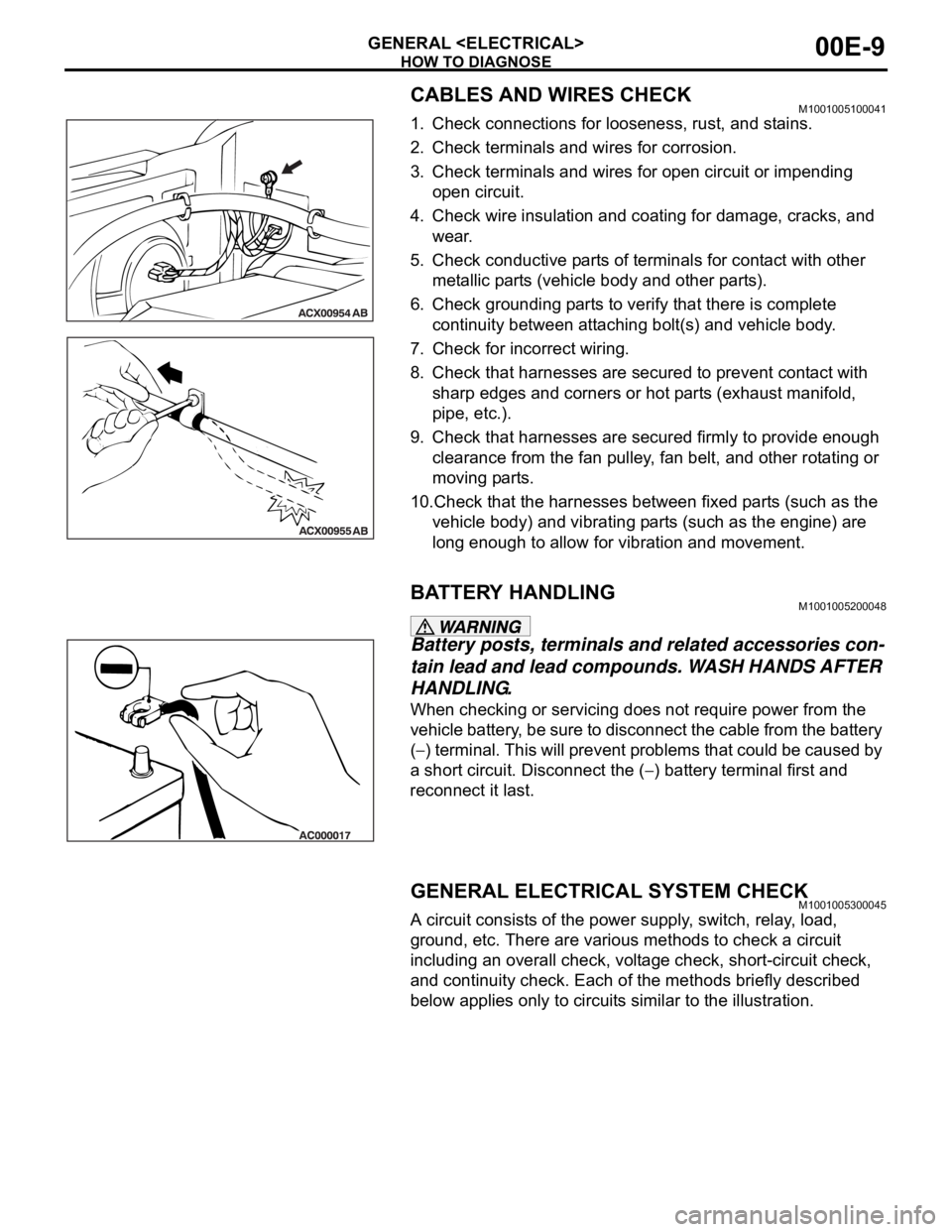
CABLES AND WIRES CHECKM1001005100041
1. Check connections for looseness, rust, and stains.
2. Check terminals and wires for corrosion.
3. Check terminals and wires for open circuit or impending
open circuit.
4. Check wire insulation and coating for damage, cracks, and
wear.
5. Check conductive parts of terminals for contact with other
metallic parts (vehicle body and other parts).
6. Check grounding parts to verify that there is complete
continuity between attaching bolt(s) and vehicle body.
7. Check for incorrect wiring.
8. Check that harnesses are secured to prevent contact with
sharp edges and corners or hot parts (exhaust manifold,
pipe, etc.).
9. Check that harnesses are secured firmly to provide enough
clearance from the fan pulley, fan belt, and other rotating or
moving parts.
10.Check that the harnesses between fixed parts (such as the
vehicle body) and vibrating parts (such as the engine) are
long enough to allow for vibration and movement.
BATTERY HANDLINGM1001005200048
Battery posts, terminals and related accessories con-
tain lead and lead compounds. WASH HANDS AFTER
HANDLING.
When checking or servicing does not require power from the
vehicle battery, be sure to disconnect the cable from the battery
(
) terminal. This will prevent problems that could be caused by
a short circuit. Disconnect the (
) battery terminal first and
reconnect it last.
GENERAL ELECTRICAL SYSTEM CHECKM1001005300045
A circuit consists of the power supply, switch, relay, load,
ground, etc. There are various methods to check a circuit
including an overall check, voltage check, short-circuit check,
and continuity check. Each of the methods briefly described
below applies only to circuits similar to the illustration.
Page 920 of 1500

ENGINE COOLING DIAGNOSIS
ENGINE COOLING14-5
INSPECTION PROCEDURE 3: Radiator Fan and Condenser Fan do not Operate
.
CIRCUIT OPERATION
The fan controller is powered from fusible link
No.2.
The engine-ECU uses input signals from the A/C
switch, the water temperature sensor unit and the
vehicle speed sensor
speed sensor to control the speed of the
radiator fan motor and the condenser fan motor.
The engine-ECU controls the fan controller to
activate the radiator fan motor and the condenser
fan motor.
.
TECHNICAL DESCRIPTION
The cause could be a malfunction of the fan con-
troller power supply or earth circuit.
If the communication line wiring harness between
the fan controller and the engine-ECU is
short-circuited to earth, the radiator fan motor
and the condenser fan motor will not rotate.
The cause could also be a malfunction of input
signal from the A/C switch, the water temperature
sensor unit and the vehicle speed sensor
or the output shaft speed sensor to the
engine-ECU.
The cause could also be a malfunction of the fan
controller or the engine-ECU.
.
TROUBLESHOOTING HINTS
Malfunction of fusible link No.2
Malfunction of fan control relay
Malfunction of cooling fan motor and fan control-
ler
Malfunction of engine-ECU.
Damaged wiring harness or connector
Refer to component locations GROUP-1
Refer to configuration diagrams GROUP-1
Refer to circuit diagrams GROUP-1
Page 921 of 1500
ENGINE COOLING DIAGNOSIS
ENGINE COOLING14-6
DIAGNOSIS
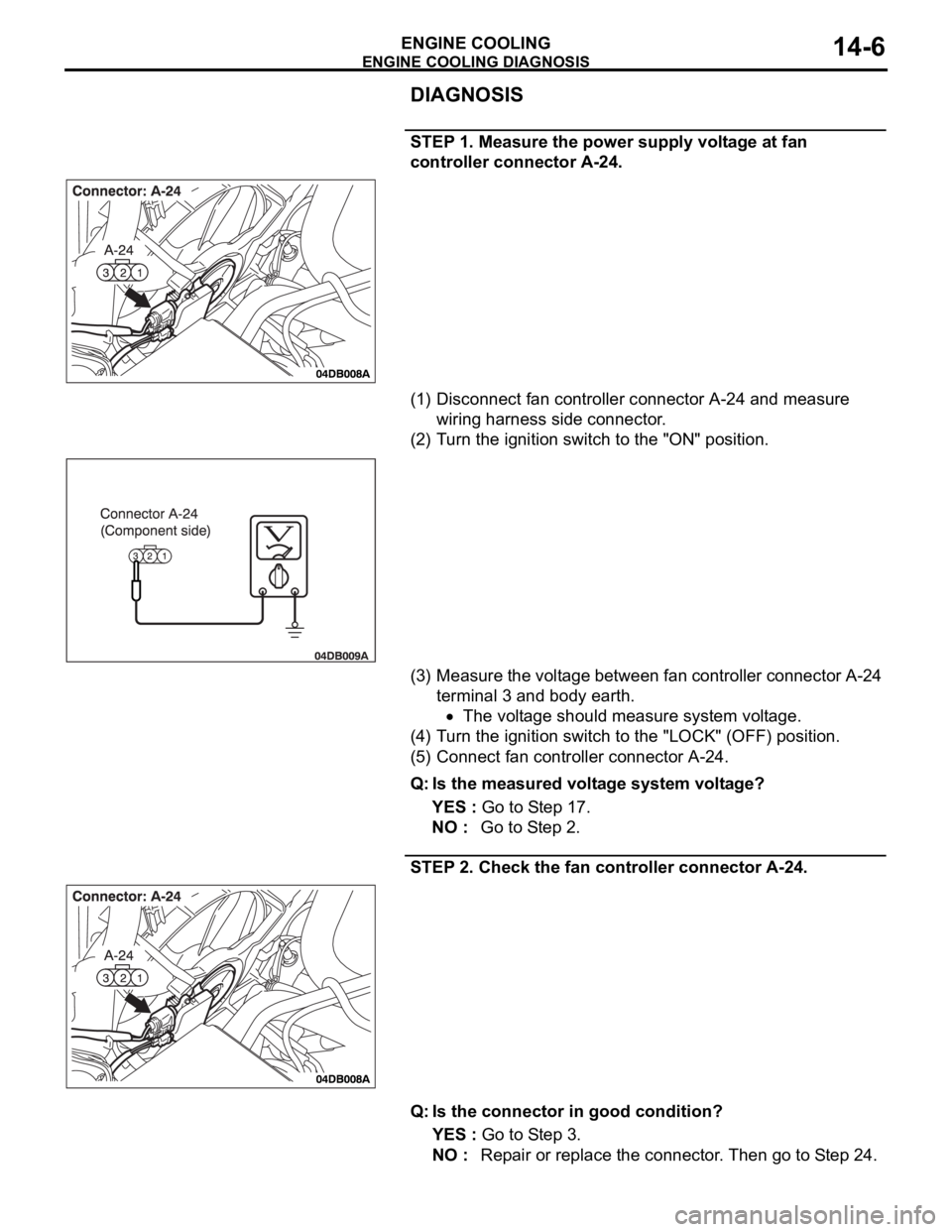
STEP 1. Measure the power supply voltage at fan
controller connector A-24.
(1) Disconnect fan controller connector A-24 and measure
wiring harness side connector.
(2) Turn the ignition switch to the "ON" position.
(3) Measure the voltage between fan controller connector A-24
terminal 3 and body earth.
The voltage should measure system voltage.
(4) Turn the ignition switch to the "LOCK" (OFF) position.
(5) Connect fan controller connector A-24.
Q: Is the measured voltage system voltage?
YES : Go to Step 17.
NO : Go to Step 2.
STEP 2. Check the fan controller connector A-24.
Q: Is the connector in good condition?
YES : Go to Step 3.
NO : Repair or replace the connector. Then go to Step 24.
Page 930 of 1500
ENGINE COOLING DIAGNOSIS
ENGINE COOLING14-15
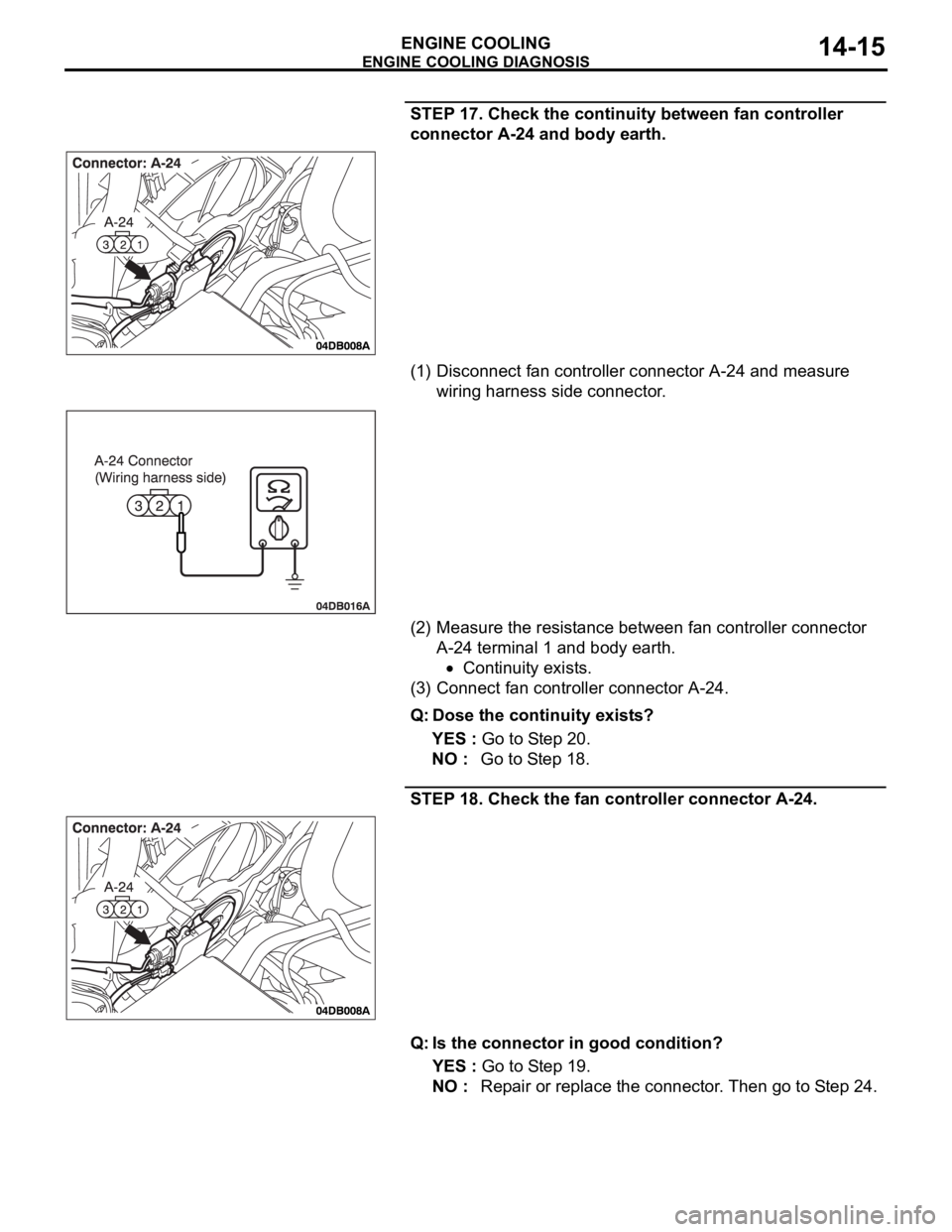
STEP 17. Check the continuity between fan controller
connector A-24 and body earth.
(1) Disconnect fan controller connector A-24 and measure
wiring harness side connector.
(2) Measure the resistance between fan controller connector
A-24 terminal 1 and body earth.
Continuity exists.
(3) Connect fan controller connector A-24.
Q: Dose the continuity exists?
YES : Go to Step 20.
NO : Go to Step 18.
STEP 18. Check the fan controller connector A-24.
Q: Is the connector in good condition?
YES : Go to Step 19.
NO : Repair or replace the connector. Then go to Step 24.
Page 935 of 1500
ENGINE COOLING DIAGNOSIS
ENGINE COOLING14-20
STEP 23. MUT-III self-diag code
Check if an MPI system self-diag code is set. (Refer to GROUP
13A - Trouble shooting 13A-5).
Q: Diagnosis code set?
YES : Inspection chart for diagnosis code (Refer to GROUP
13A - Trouble shooting 13A-17)
NO : Replace the engine-ECU (Refer to GROUP 13A,
Engine-ECU 13A-675 ). Then go to Step 24.
STEP 24. Check the symptoms.
Q: Does the radiator fan motor and the condenser fan
motor operate correctly?
YES : This symptom is complete.
NO : Return to Step 1.
INSPECTION PROCEDURE 4: Radiator Fan and Condenser Fan do not Change Speed or Stop
.
Radiator Fan and Condenser Fan Drive
Circuit
Refer to 5.
.
TECHNICAL DESCRIPTION
The cause could be a malfunction of the fan con-
troller power supply or earth circuit.
If the communication line wiring harness between
the fan controller and the engine-ECU is
short-circuited to earth, the radiator fan motor
and the condenser fan motor will not rotate.
The cause could also be a malfunction of input
signal from the A/C switch, the water temperature
sensor unit and the vehicle speed sensor
or the output shaft speed sensor to the
engine-ECU.
The cause could also be a malfunction of the fan
controller or the engine-ECU.
.
TROUBLESHOOTING HINTS
Malfunction of fusible link No.2
Malfunction of fan control relay
Malfunction of cooling fan motor
Malfunction of fan controller
Malfunction of engine-ECU
Damaged wiring harness or connector
DIAGNOSIS
STEP 1. Check the fan control relay.
Refer to 14-31.
Q: Is the fan control relay in good condition?
YES : Go to Step 2.
NO : Replace the fan control relay. Then go to Step 8.
Page 940 of 1500
ENGINE COOLING DIAGNOSIS
ENGINE COOLING14-25
STEP 7. MUT-III self-diag code
Check if an MPI system self-diag code is set. (Refer to GROUP
13A - Trouble shooting 13A-5)
Q: Diagnosis code set?
YES : Inspection chart for diagnosis code (Refer to GROUP
13A - Trouble shooting 13A-5)
NO : Replace the engine-ECU (Refer to GROUP 13A,
Engine-ECU 13A-675 ) Then go to Step 8 .
STEP 8. Check the symptoms.
Q: Does the radiator fan motor and the condenser fan
motor operate correctly?
YES : This symptom is complete.
NO : Return to Step 1.
INSPECTION PROCEDURE 5: Radiator Fan does not Operate
.
Radiator Fan and Condenser Fan Drive
Circuit
.
TECHNICAL DESCRIPTION
The cause could be a malfunction of the radiator fan
motor or an open circuit between the fan controller
and the radiator fan motor.
.
TROUBLESHOOTING HINTS
Malfunction of radiator fan motor
Malfunction of fan controller
Refer to component locations GROUP-1
Refer to configuration diagrams GROUP-1
Refer to circuit diagrams GROUP-1
DIAGNOSIS
Replace the radiator fan motor and fan controller assembly.
Q: Does the radiator fan operate correctly?
YES : There is no action to be taken?
NO : Repair the wiring harness between the fan controller
and the radiator fan motor.
INSPECTION PROCEDURE 6: Condenser Fan does not Operate
.
Radiator Fan and Condenser Fan Drive
Circuit
.
TECHNICAL DESCRIPTION
The cause could be a malfunction of the condenser
fan motor or fan controller.
.
TROUBLESHOOTING HINTS
Malfunction of condenser fan motor
Malfunction of fan controller
Refer to component locations GROUP-1
Refer to configuration diagrams GROUP-1
Refer to circuit diagrams GROUP-1
Page 950 of 1500
THERMOSTAT
ENGINE COOLING14-35
THERMOSTAT
REMOVAL AND INSTALLATIONM1141002400475
Pre-removal and Post-installation Operation
Engine Coolant Draining and Refilling (Refer to 27).
Engine Cover Removal and Installation (Refer to GROUP
11C, Engine Assembly 11A-14).
Engine Control Unit (ECU) Removal and Installation
(Refer to GROUP 00, General 00-7).
Air Cleaner Removal and Installation (Refer to GROUP
15, Air Cleaner 4).
Strut Tower Bar Removal and Installation (Refer to
GROUP 42, Strut Tower Bar 12).
Battery and Battery Tray Removal and Installation
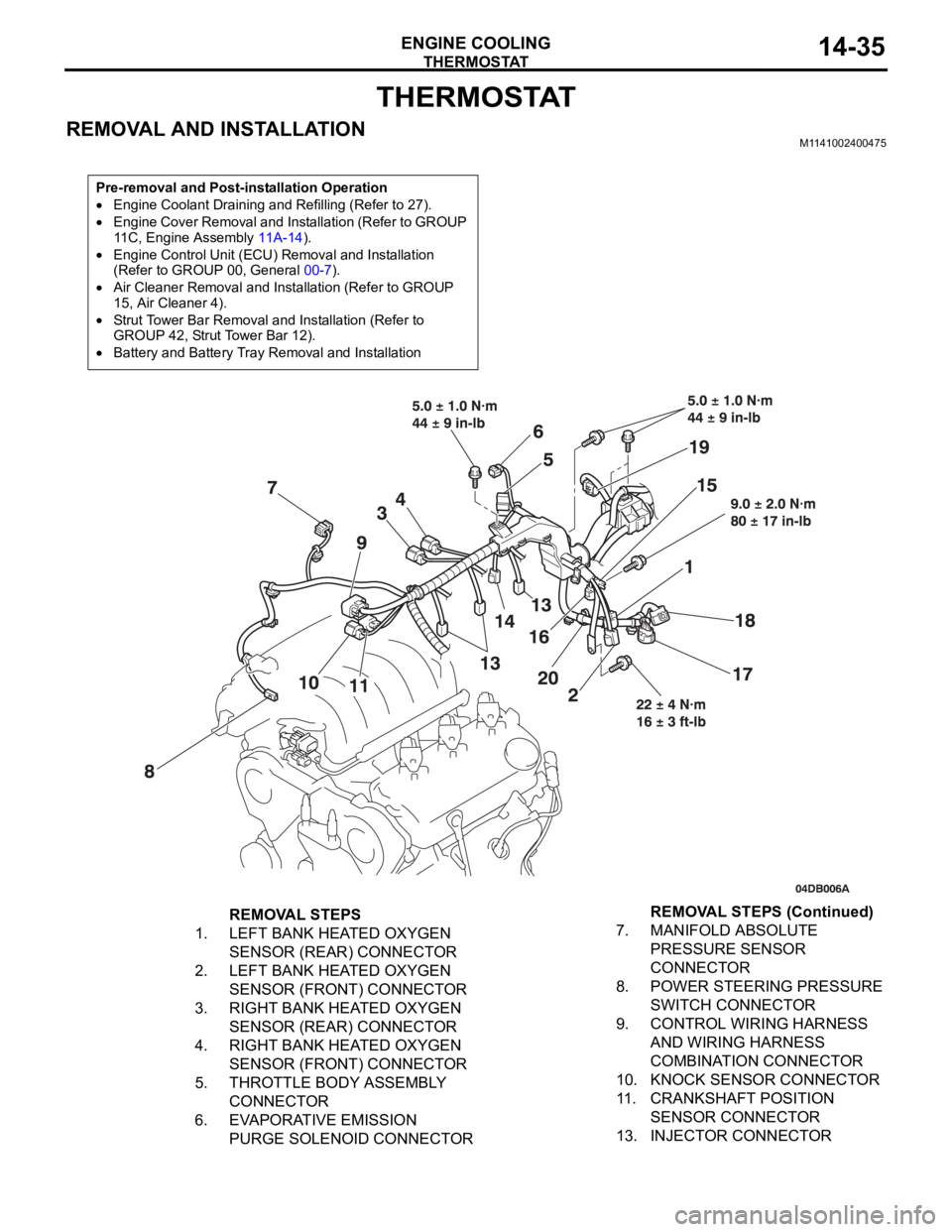
REMOVAL STEPS
1. LEFT BANK HEATED OXYGEN
SENSOR (REAR) CONNECTOR
2. LEFT BANK HEATED OXYGEN
SENSOR (FRONT) CONNECTOR
3. RIGHT BANK HEATED OXYGEN
SENSOR (REAR) CONNECTOR
4. RIGHT BANK HEATED OXYGEN
SENSOR (FRONT) CONNECTOR
5. THROTTLE BODY ASSEMBLY
CONNECTOR
6. EVAPORATIVE EMISSION
PURGE SOLENOID CONNECTOR7. MANIFOLD ABSOLUTE
PRESSURE SENSOR
CONNECTOR
8. POWER STEERING PRESSURE
SWITCH CONNECTOR
9. CONTROL WIRING HARNESS
AND WIRING HARNESS
COMBINATION CONNECTOR
10. KNOCK SENSOR CONNECTOR
11. CRANKSHAFT POSITION
SENSOR CONNECTOR
13. INJECTOR CONNECTORREMOVAL STEPS (Continued)
Page 965 of 1500
INTAKE MANIFOLD PLENUM
INTAKE AND EXHAUST15-6
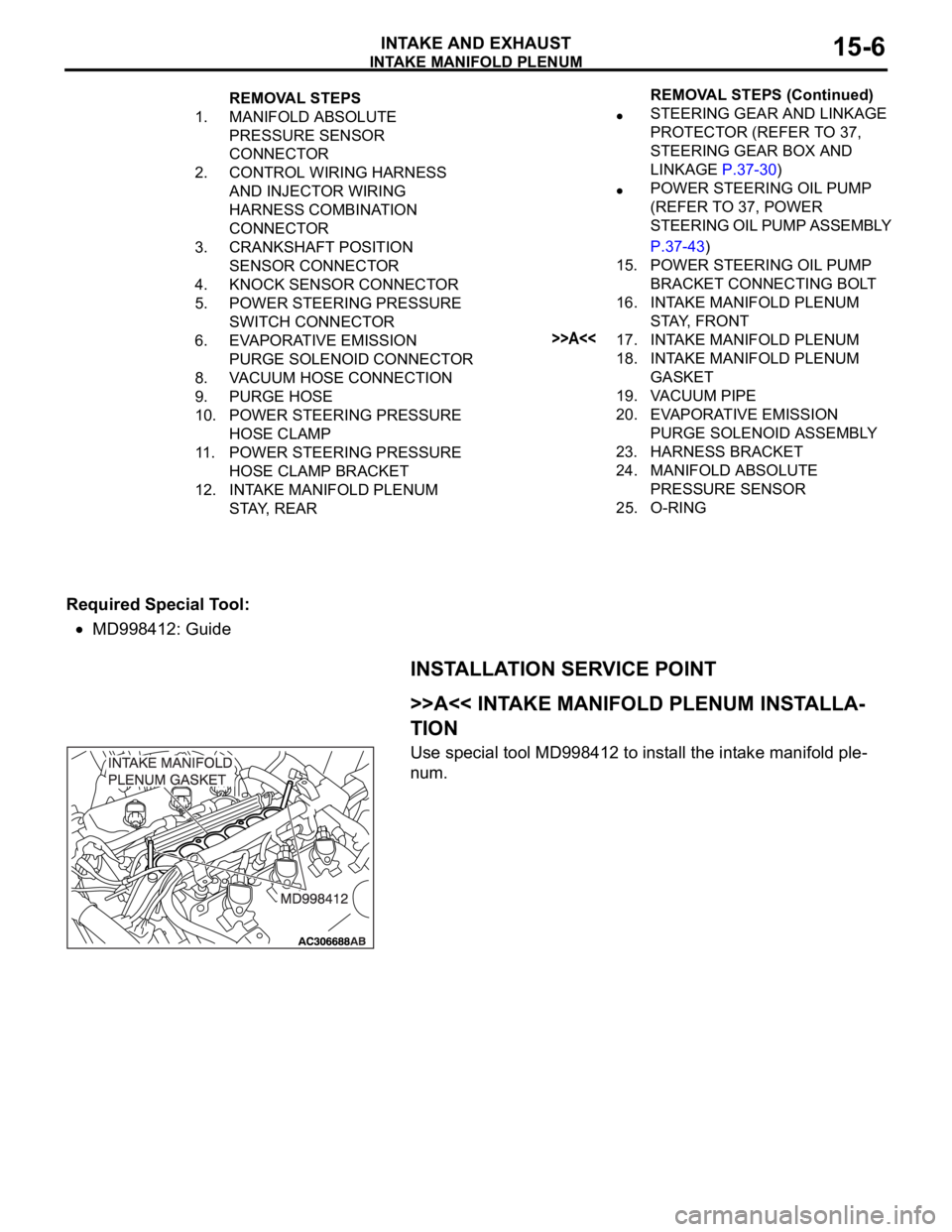
Required Special Tool:
MD998412: Guide
INSTALLATION SERVICE POINT
.
>>A<< INTAKE MANIFOLD PLENUM INSTALLA-
TION
Use special tool MD998412 to install the intake manifold ple-
num.
REMOVAL STEPS
1. MANIFOLD ABSOLUTE
PRESSURE SENSOR
CONNECTOR
2. CONTROL WIRING HARNESS
AND INJECTOR WIRING
HARNESS COMBINATION
CONNECTOR
3. CRANKSHAFT POSITION
SENSOR CONNECTOR
4. KNOCK SENSOR CONNECTOR
5. POWER STEERING PRESSURE
SWITCH CONNECTOR
6. EVAPORATIVE EMISSION
PURGE SOLENOID CONNECTOR
8. VACUUM HOSE CONNECTION
9. PURGE HOSE
10. POWER STEERING PRESSURE
HOSE CLAMP
11. POWER STEERING PRESSURE
HOSE CLAMP BRACKET
12. INTAKE MANIFOLD PLENUM
STAY, REARSTEERING GEAR AND LINKAGE
PROTECTOR (REFER TO 37,
STEERING GEAR BOX AND
LINKAGE P.37-30)
POWER STEERING OIL PUMP
(REFER TO 37, POWER
STEERING OIL PUMP ASSEMBLY
P.37-43)
15. POWER STEERING OIL PUMP
BRACKET CONNECTING BOLT
16. INTAKE MANIFOLD PLENUM
STAY, FRONT
>>A<<17. INTAKE MANIFOLD PLENUM
18. INTAKE MANIFOLD PLENUM
GASKET
19. VACUUM PIPE
20. EVAPORATIVE EMISSION
PURGE SOLENOID ASSEMBLY
23. HARNESS BRACKET
24. MANIFOLD ABSOLUTE
PRESSURE SENSOR
25. O-RINGREMOVAL STEPS (Continued)
Page 984 of 1500
CHARGING SYSTEM
ENGINE ELECTRICAL16-7
ON-VEHICLE SERVICE
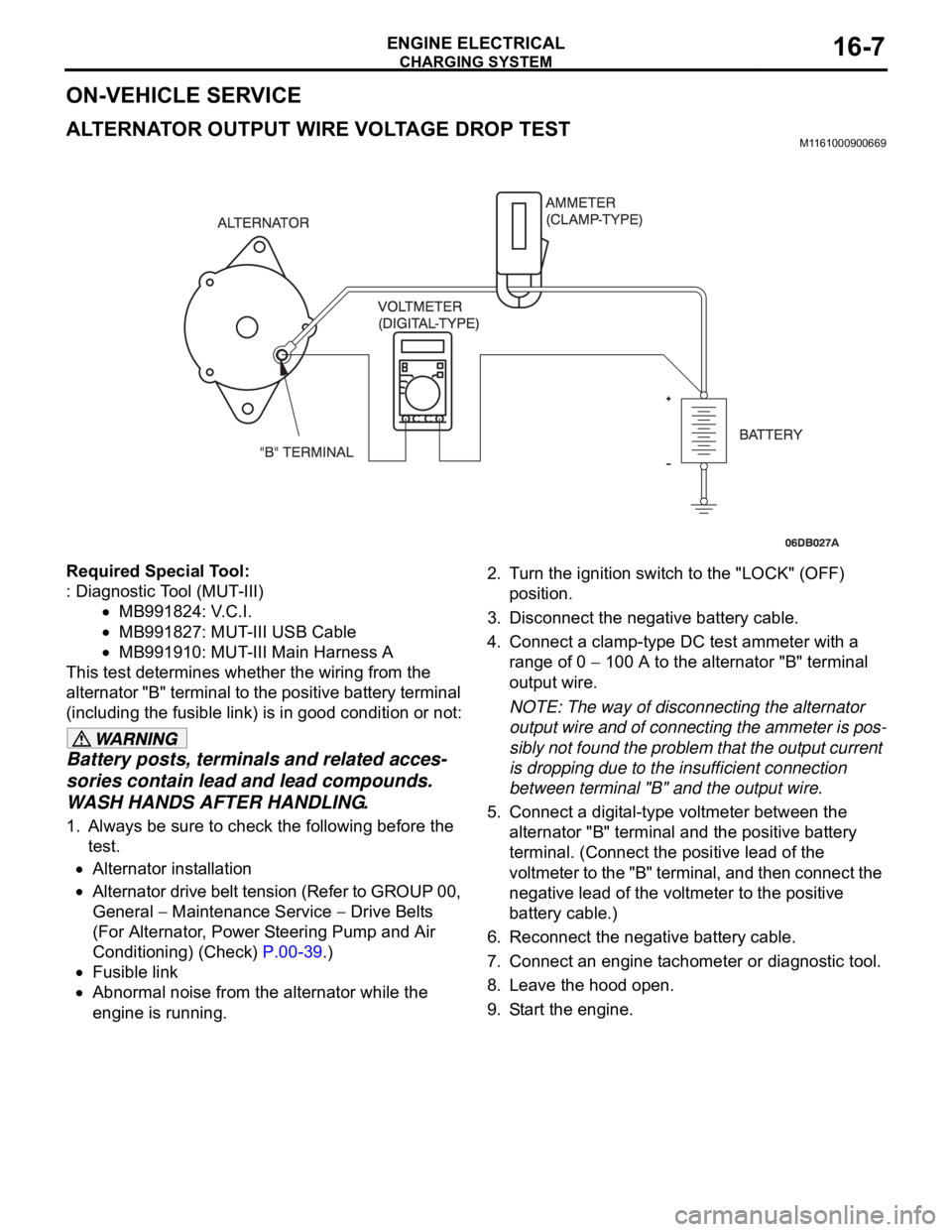
ALTERNATOR OUTPUT WIRE VOLTAGE DROP TESTM1161000900669
Required Special Tool:
: Diagnostic Tool (MUT-III)
MB991824: V.C.I.
MB991827: MUT-III USB Cable
MB991910: MUT-III Main Harness A
This test determines whether the wiring from the
alternator "B" terminal to the positive battery terminal
(including the fusible link) is in good condition or not:
Battery posts, terminals and related acces-
sories contain lead and lead compounds.
WASH HANDS AFTER HANDLING.
1. Always be sure to check the following before the
test.
Alternator installation
Alternator drive belt tension (Refer to GROUP 00,
General
Maintenance Service Drive Belts
(For Alternator, Power Steering Pump and Air
Conditioning) (Check) P.00-39.)
Fusible link
Abnormal noise from the alternator while the
engine is running.2. Turn the ignition switch to the "LOCK" (OFF)
position.
3. Disconnect the negative battery cable.
4. Connect a clamp-type DC test ammeter with a
range of 0
100 A to the alternator "B" terminal
output wire.
NOTE: The way of disconnecting the alternator
output wire and of connecting the ammeter is pos-
sibly not found the problem that the output current
is dropping due to the insufficient connection
between terminal "B" and the output wire.
5. Connect a digital-type voltmeter between the
alternator "B" terminal and the positive battery
terminal. (Connect the positive lead of the
voltmeter to the "B" terminal, and then connect the
negative lead of the voltmeter to the positive
battery cable.)
6. Reconnect the negative battery cable.
7. Connect an engine tachometer or diagnostic tool.
8. Leave the hood open.
9. Start the engine.