sensor MITSUBISHI 380 2005 Repair Manual
[x] Cancel search | Manufacturer: MITSUBISHI, Model Year: 2005, Model line: 380, Model: MITSUBISHI 380 2005Pages: 1500, PDF Size: 47.87 MB
Page 832 of 1500
AUTO A/C DIAGNOSIS
HEATER, AIR CONDITIONING AND VENTILATION55-131
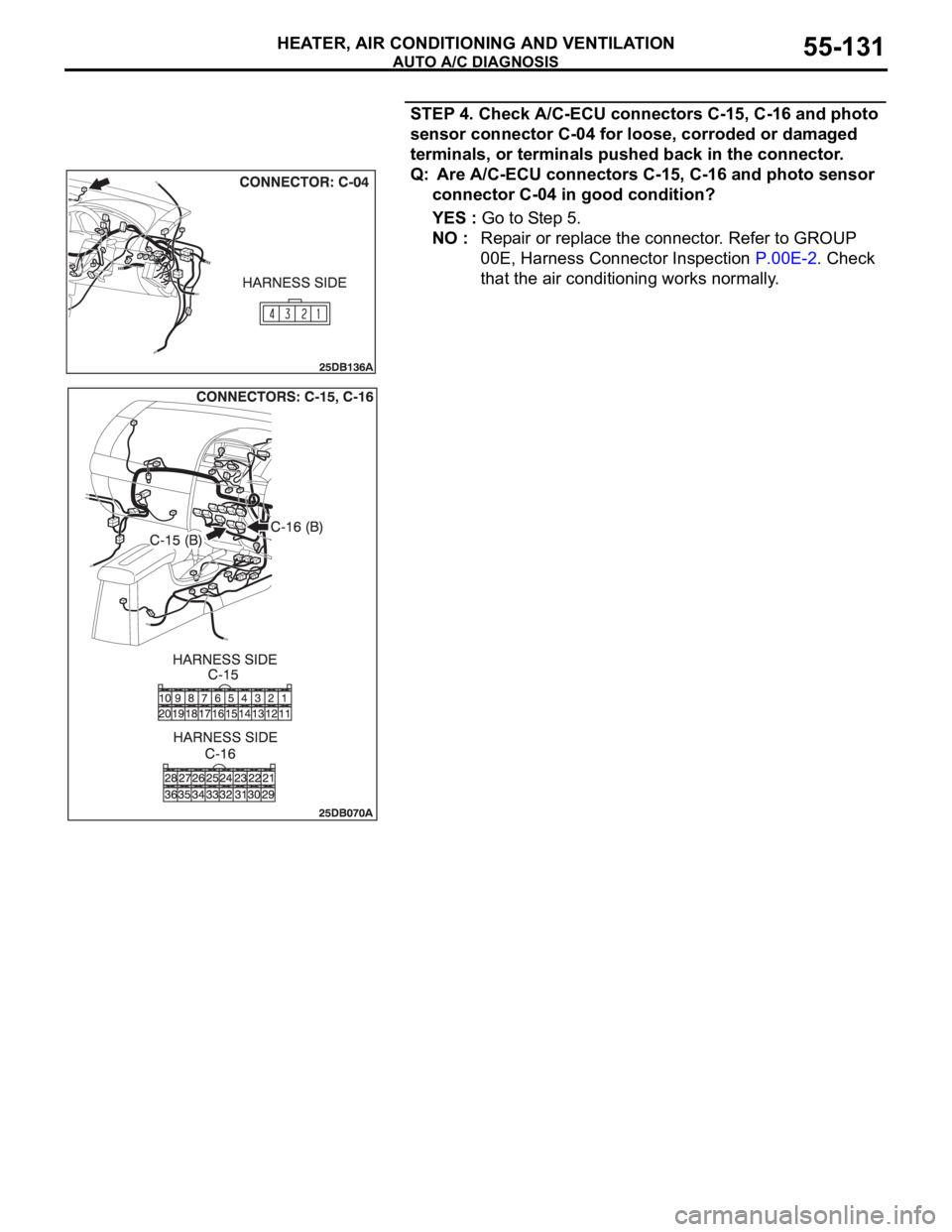
STEP 4. Check A/C-ECU connectors C-15, C-16 and photo
sensor connector C-04 for loose, corroded or damaged
terminals, or terminals pushed back in the connector.
Q: Are A/C-ECU connectors C-15, C-16 and photo sensor
connector C-04 in good condition?
YES : Go to Step 5.
NO : Repair or replace the connector. Refer to GROUP
00E, Harness Connector Inspection P.00E-2. Check
that the air conditioning works normally.
Page 833 of 1500
AUTO A/C DIAGNOSIS
HEATER, AIR CONDITIONING AND VENTILATION55-132
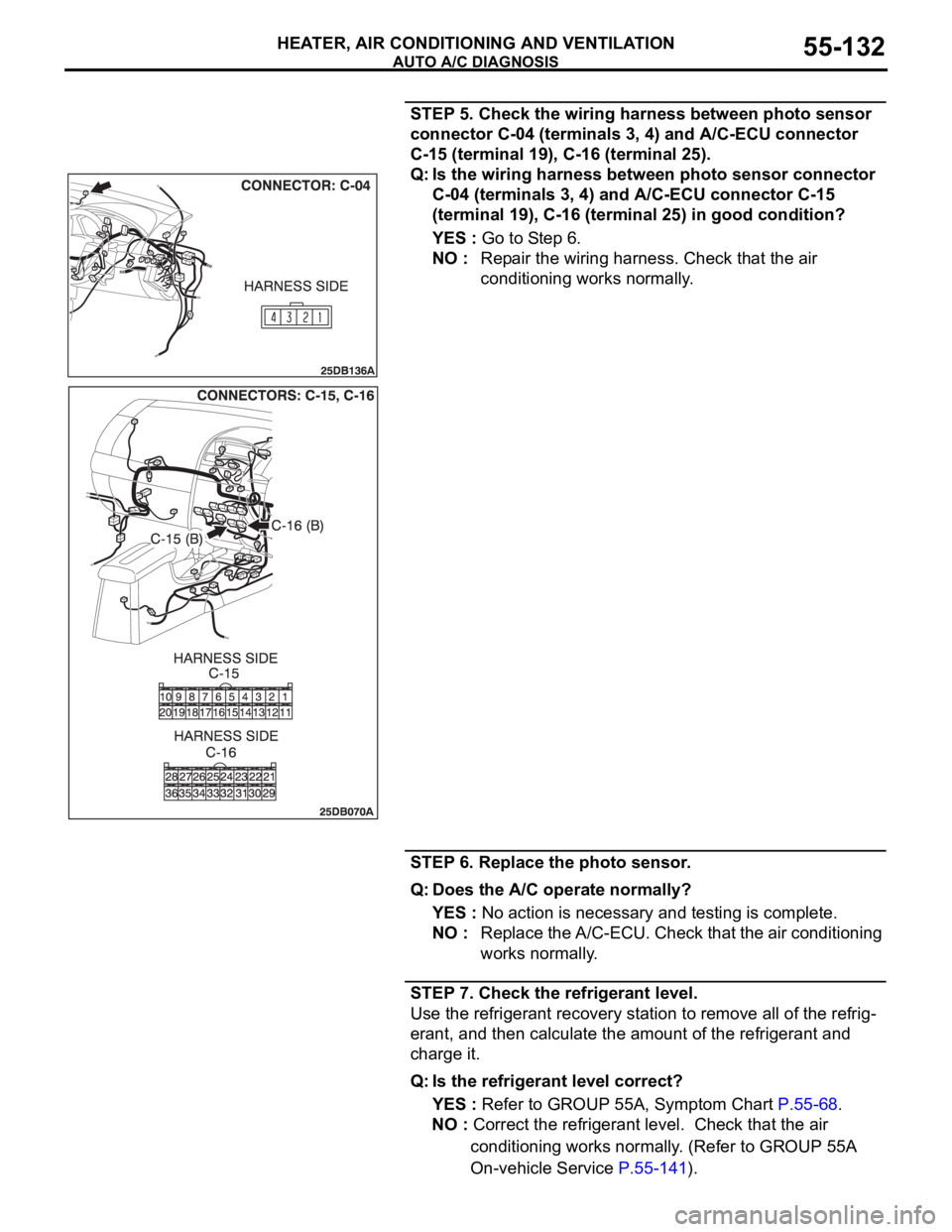
STEP 5. Check the wiring harness between photo sensor
connector C-04 (terminals 3, 4) and A/C-ECU connector
C-15 (terminal 19), C-16 (terminal 25).
Q: Is the wiring harness between photo sensor connector
C-04 (terminals 3, 4) and A/C-ECU connector C-15
(terminal 19), C-16 (terminal 25) in good condition?
YES : Go to Step 6.
NO : Repair the wiring harness. Check that the air
conditioning works normally.
STEP 6. Replace the photo sensor.
Q: Does the A/C operate normally?
YES : No action is necessary and testing is complete.
NO : Replace the A/C-ECU. Check that the air conditioning
works normally.
STEP 7. Check the refrigerant level.
Use the refrigerant recovery station to remove all of the refrig-
erant, and then calculate the amount of the refrigerant and
charge it.
Q: Is the refrigerant level correct?
YES : Refer to GROUP 55A, Symptom Chart P.55-68.
NO : Correct the refrigerant level. Check that the air
conditioning works normally. (Refer to GROUP 55A
On-vehicle Service P.55-141).
Page 834 of 1500

AUTO A/C DIAGNOSIS
HEATER, AIR CONDITIONING AND VENTILATION55-133
DATA LIST REFERENCE TABLEM1554005100136
MUT-III
DIAGNOSTIC
TOOL DISPLAYITEM
NO.INSPECTION ITEM INSPECTION REQUIREMENT NORMAL VALUE
Inside
temperature
sensor59 Interior temperature
sensorIgnition switch: ON Inside air
temperature and
temperature
displayed on the
diagnostic tool are
identical.
Outside
temperature
sensor58 Outside temperature
sensorIgnition switch: ON Outside air
temperature and
temperature
displayed on the
diagnostic tool are
identical.
Air thermo sensor 20 Air thermo sensor Ignition switch: ON The temperature
measured behind
the evaporator
matches the
displayed value on
the diagnostic tool
while the engine is
cold.
Pressure sensor 61 A/C pressure sensor Ignition switch: ON Measured refrigerant
pressure is nearly
equal to the value
shown on the
diagnostic tool
(MPa).
Water
temperature
sensor62 Engine coolant
temperature sensor
(Data received by
CAN
Communication)Ignition switch: ON Engine coolant
temperature and
temperature
displayed on the
diagnostic tool are
identical.
Photo sensor 67 Photo sensor Ignition switch: ON Amount of light is
proportional to
voltage displayed on
the diagnostic tool.
Air mix
potentiometer63 Air mixing damper
control motor
potentiometerIgnition switch: ON Damper
positionOpening degree (V)
MAX. HOT Approx. 5
MAX. COOL Approx. 0
Air mix
potentiometer
(Target)64 Target value for air
mixing damper
control motor
potentiometerIgnition switch: ON Damper
positionOpening degree (V)
MAX. HOT Approx. 5
MAX. COOL Approx. 0
Page 838 of 1500

AUTO A/C DIAGNOSIS
HEATER, AIR CONDITIONING AND VENTILATION55-137
CHECK AT A/C-ECU TERMINALM1552010300572
TERMINAL
NO.CHECK ITEM CHECKING REQUIREMENTS NORMAL CONDITION
1 Air mixing damper control motor When the air mix damper is
moved to the MAX. COOL
position. 10 V
When the air mix damper is
moved to the MAX. HOT
position. 0.5 V
2 Air mixing damper control motor When the air mix damper is
moved to the MAX. COOL
position. 0.5 V
When the air mix damper is
moved to the MAX. HOT
position. 10 V
3 Back-up power supply Always Battery positive voltage
4 Mode selection damper control
motor (DEF)When the damper is moved to
the FACE position. 0.5 V
When the damper is moved to
the DEF position. 10 V
5 Outside/inside air selection
damper control motor (outside)When the damper is moved to
the inside air recirculation
position.0.5 V
When the damper is moved to
the outside air induction
position.0 V (when the motor is
stopped)
6 Outside/inside air selection
damper control motor (inside)When the damper is moved to
the inside air recirculation
position.0 V (when the motor is
stopped)
When the damper is moved to
the outside air induction
position.0.5 V
8 Rear defogger relay Ignition switch: ON Battery positive voltage
9 Front blower relay Ignition switch: ON Battery positive voltage
10 A/C compressor relay A/C compressor relay: ON Battery positive voltage
11 Mode selection damper control
motor (FACE)When the damper is moved to
the FACE position. 10 V
When the damper is moved to
the DEF position. 0.5 V
12 A/C pressure sensor Ignition switch: ON 5 V
Page 839 of 1500

AUTO A/C DIAGNOSIS
HEATER, AIR CONDITIONING AND VENTILATION55-138
16 Potentiometer power supply Ignition switch: ON 5 V
17 Power transistor (BASE) When the blower speed
selection dial shows Maximum
air volume.1 V
18 Power transistor
(COLLECTOR)When the blower speed
selection dial shows Maximum
air volume.12.1 V
19 Photo sensor Ignition switch: ON 5 V
20 Sensors and potentiometers
groundAlways 0 V
21 Mode selection damper control
motor potentiometer inputWhen the damper is moved to
the FACE position. 4 V
22 Interior temperature sensor Ignition switch: ON 5 V
23 Ambient temperature sensor
inputWhen sensor temperature is
25
C (77F) [4 k]1.9 V
24 Air thermo sensor input When sensor temperature is
25
C (77F) [1.5 k]2.2 V
25 Photo sensor ground Ignition switch: ON 0 V
26 A/C pressure sensor at 2.6 MPa 3.9 V
27 Ground Always 0 V
28 Power supply to the ignition
switch (IG2)Ignition switch: ON Battery positive voltage
29 Air mixing damper control motor
potentiometer inputWhen the damper door is
moved to the MAX. HOT
position.1.4 V
30 Illumination ground Always 0 V
31 ILL power supply Lighting switch: ON Battery positive voltage
34 A/C pressure sensor ground Always 0 V
36 Power supply to the ignition
switch (ACC)Ignition switch: ON Battery positive voltage TERMINAL
NO.CHECK ITEM CHECKING REQUIREMENTS NORMAL CONDITION
Page 840 of 1500
SPECIAL TOOLS
HEATER, AIR CONDITIONING AND VENTILATION55-139
SPECIAL TOOLSM1552000600334
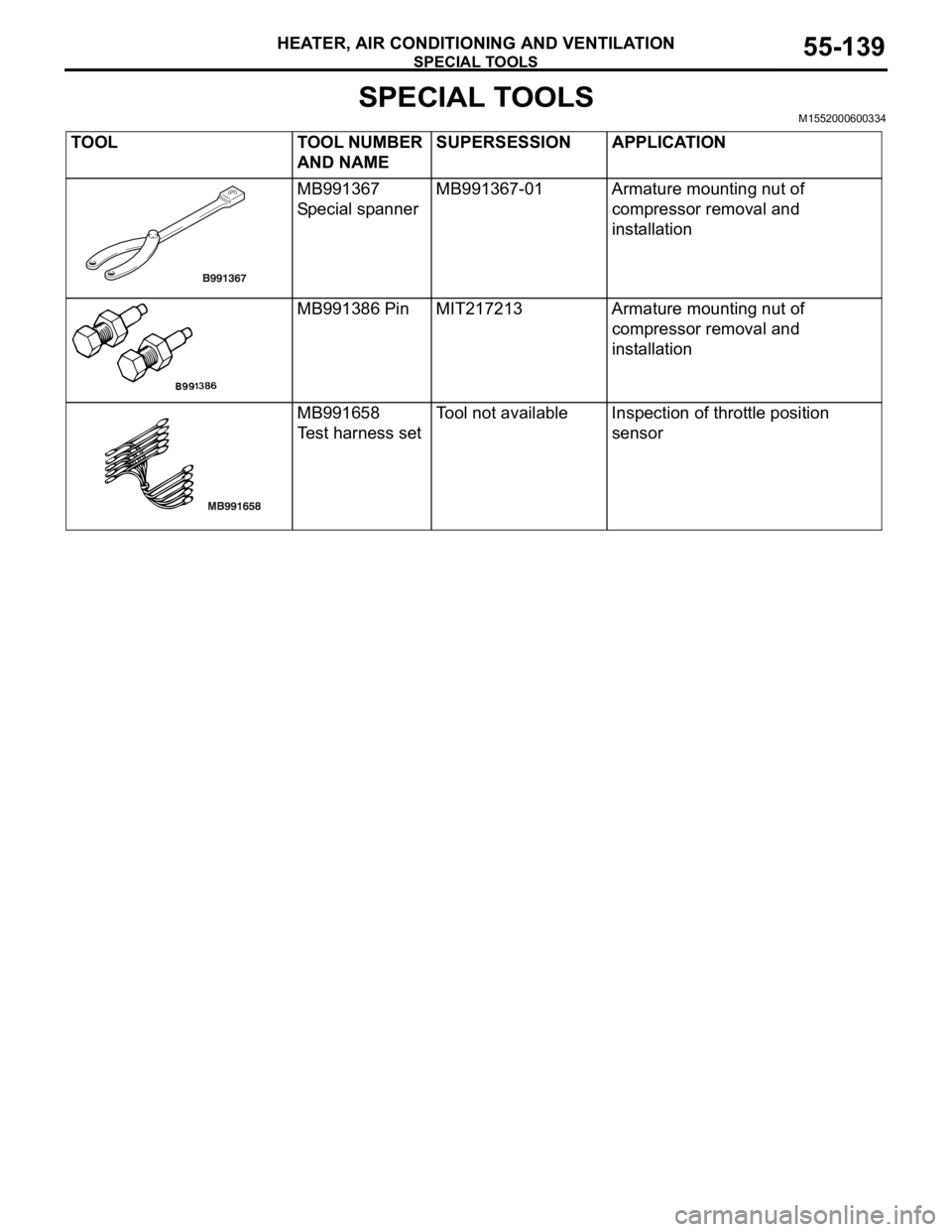
TOOL TOOL NUMBER
AND NAMESUPERSESSION APPLICATION
MB991367
Special spannerMB991367-01 Armature mounting nut of
compressor removal and
installation
MB991386 Pin MIT217213 Armature mounting nut of
compressor removal and
installation
MB991658
Test harness setTool not available Inspection of throttle position
sensor
Page 842 of 1500
ON-VEHICLE SERVICE
HEATER, AIR CONDITIONING AND VENTILATION55-141
ON-VEHICLE SERVICE
REFRIGERANT LEVEL TESTM1552008400408
Use the refrigerant recovery station to remove all of the refrig-
erant, and then calculate the amount of the refrigerant and
charge it.
A/C COMPRESSOR CLUTCH TESTM1552019900032
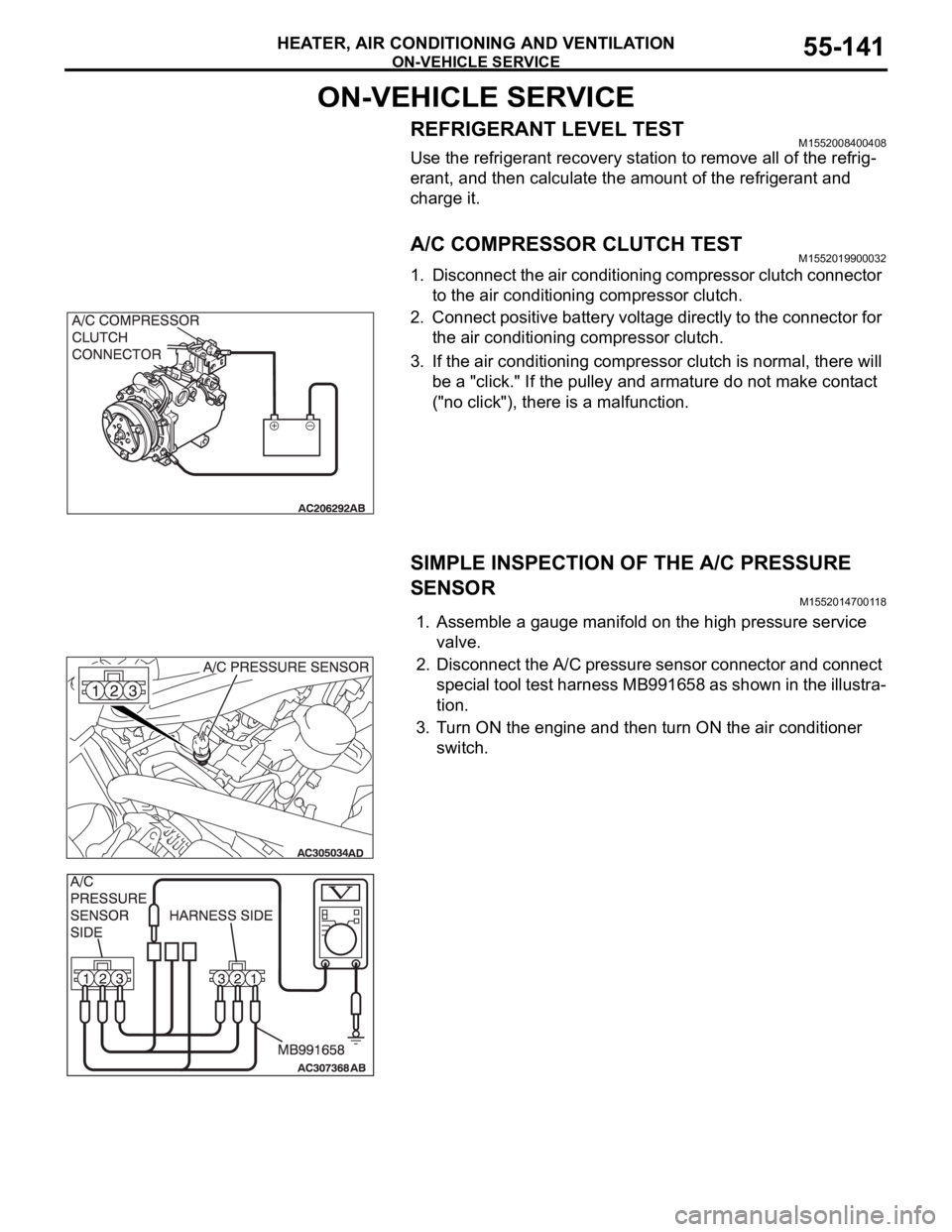
1. Disconnect the air conditioning compressor clutch connector
to the air conditioning compressor clutch.
2. Connect positive battery voltage directly to the connector for
the air conditioning compressor clutch.
3. If the air conditioning compressor clutch is normal, there will
be a "click." If the pulley and armature do not make contact
("no click"), there is a malfunction.
SIMPLE INSPECTION OF THE A/C PRESSURE
SENSOR
M1552014700118
1. Assemble a gauge manifold on the high pressure service
valve.
2. Disconnect the A/C pressure sensor connector and connect
special tool test harness MB991658 as shown in the illustra-
tion.
3. Turn ON the engine and then turn ON the air conditioner
switch.
Page 843 of 1500

ON-VEHICLE SERVICE
HEATER, AIR CONDITIONING AND VENTILATION55-142
4. At this time, check to see that the voltage of A/C pressure
sensor terminal No. 2 reflects the specifications of the fig-
ure.
NOTE: The allowance shall be defined as
5%.
COMPRESSOR DRIVE BELT ADJUSTMENTM1552001000357
Refer to GROUP 00, Maintenance Service Drive Belts
P.00-39.
CHARGING M1552001200403
Use the refrigerant recovery station to charge the refrigerant.
METHOD BY USING REFRIGERANT RECOVERY
AND RECYCLING UNIT
Using the refrigerant recovery and recycling unit, refill the
refrigerant.
NOTE: Refer to the Refrigerant Recovery and Recycling Unit’s
Instruction Manual for operation of the unit.
DISCHARGING SYSTEM
Use the refrigerant recovery unit to discharge refrigerant gas
from the system.
NOTE: Refer to the Refrigerant Recovery and Recycling Unit’s
Instruction Manual for operation of the unit.
REFILLING OF OIL IN THE A/C SYSTEM
Too little oil will provide inadequate compressor lubrication and
cause a compressor failure. Too much oil will increase dis-
charge air temperature.
When a compressor is installed at the factory, it contains 140
ml of refrigerant oil. While the A/C system is in operation, the oil
is carried through the entire system by the refrigerant. Some of
this oil will be trapped and retained in various parts of the sys-
tem.
When the following system components are changed, it is nec-
essary to add oil to the system to replace the oil being removed
with the component.
Compressor oil: ND Oil 8
Quantity:
Evaporator: 40 ml
Condenser: 40 ml
Page 845 of 1500
ON-VEHICLE SERVICE
HEATER, AIR CONDITIONING AND VENTILATION55-144
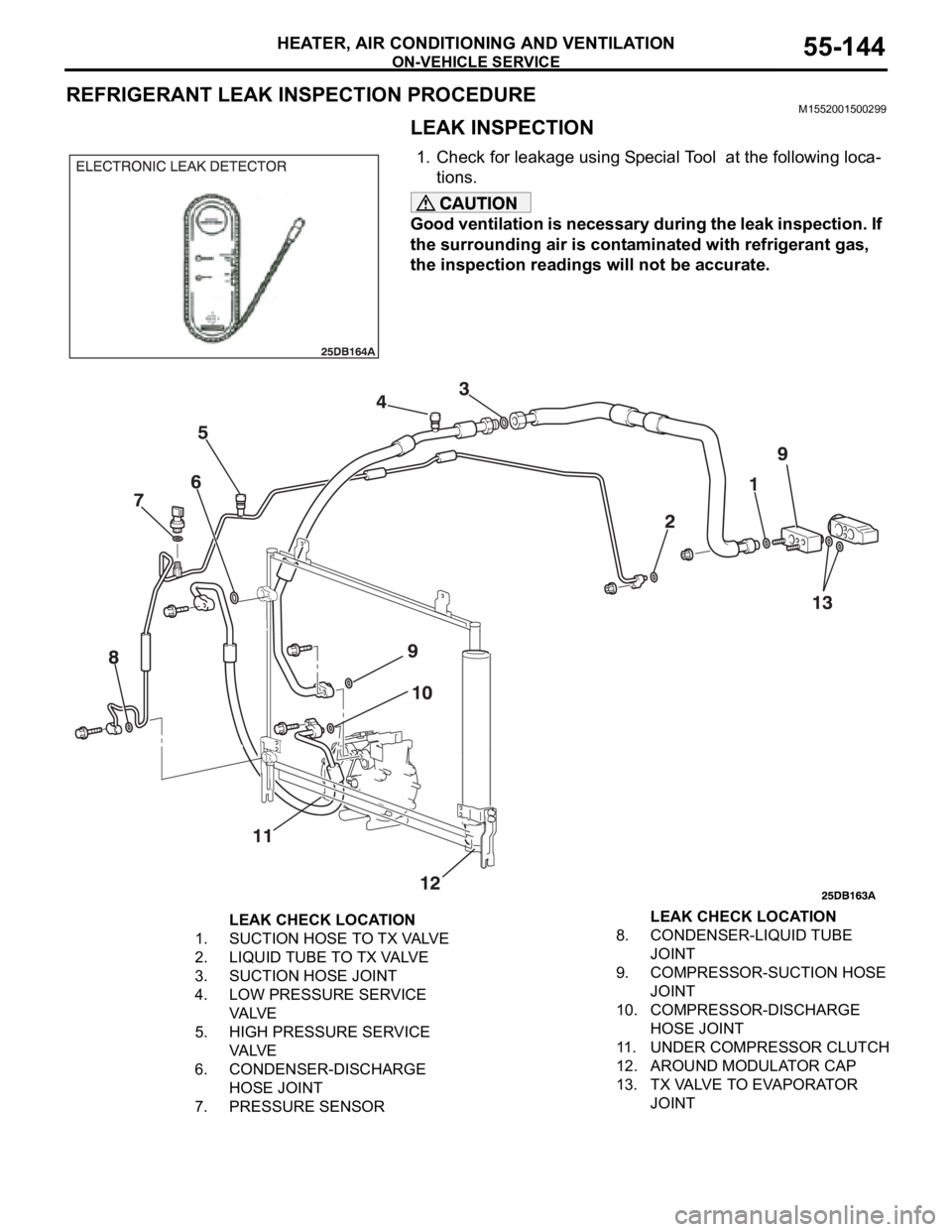
REFRIGERANT LEAK INSPECTION PROCEDUREM1552001500299
LEAK INSPECTION
1. Check for leakage using Special Tool at the following loca-
tions.
Good ventilation is necessary during the leak inspection. If
the surrounding air is contaminated with refrigerant gas,
the inspection readings will not be accurate.
LEAK CHECK LOCATION
1. SUCTION HOSE TO TX VALVE
2. LIQUID TUBE TO TX VALVE
3. SUCTION HOSE JOINT
4. LOW PRESSURE SERVICE
VA LV E
5. HIGH PRESSURE SERVICE
VA LV E
6. CONDENSER-DISCHARGE
HOSE JOINT
7. PRESSURE SENSOR8. CONDENSER-LIQUID TUBE
JOINT
9. COMPRESSOR-SUCTION HOSE
JOINT
10. COMPRESSOR-DISCHARGE
HOSE JOINT
11. UNDER COMPRESSOR CLUTCH
12. AROUND MODULATOR CAP
13. TX VALVE TO EVAPORATOR
JOINT LEAK CHECK LOCATION
Page 855 of 1500
HEATER UNIT, HEATER CORE, BLOWER ASSEMBLY AND EVAPORATOR UNIT
HEATER, AIR CONDITIONING AND VENTILATION55-154
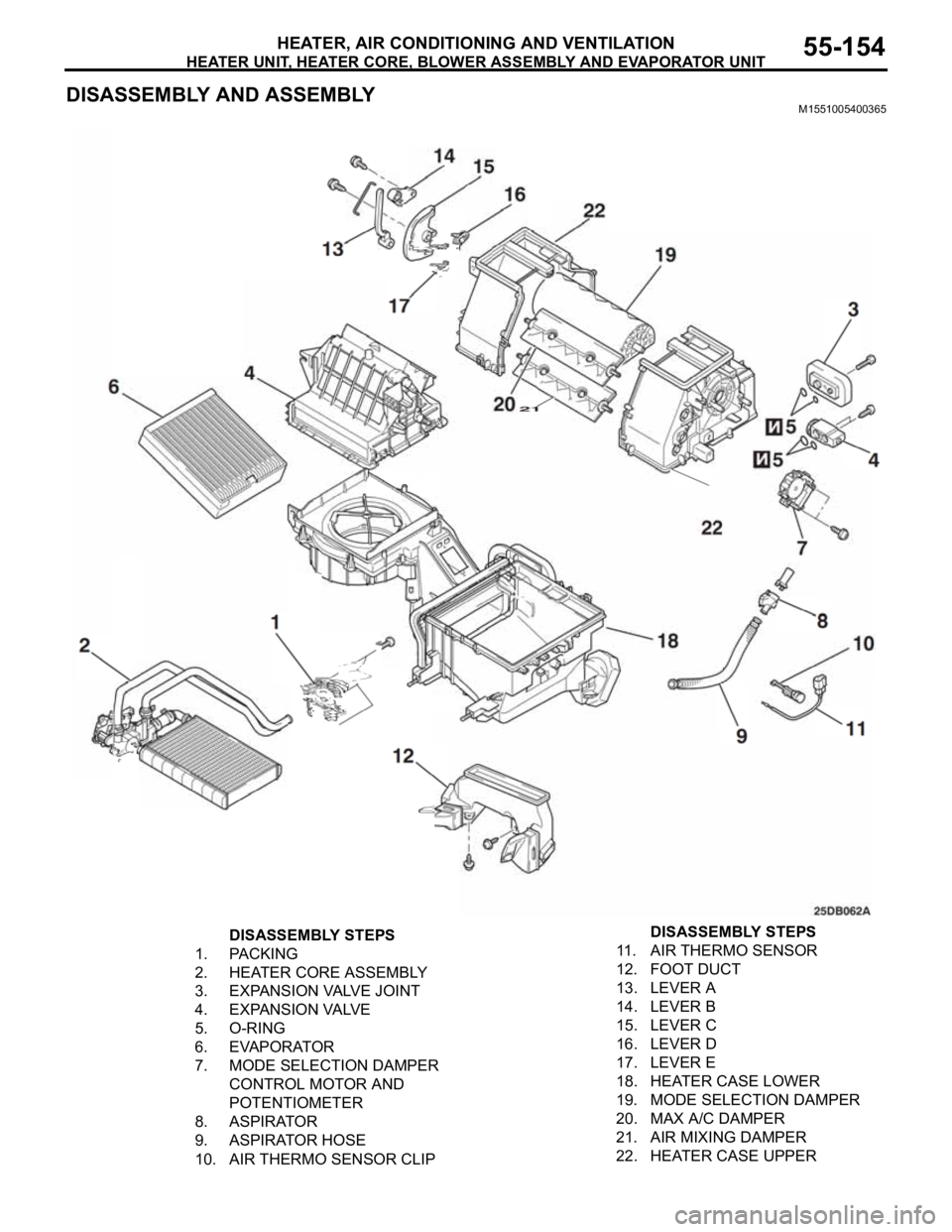
DISASSEMBLY AND ASSEMBLYM1551005400365
DISASSEMBLY STEPS
1. PACKING
2. HEATER CORE ASSEMBLY
3. EXPANSION VALVE JOINT
4. EXPANSION VALVE
5. O-RING
6. EVAPORATOR
7. MODE SELECTION DAMPER
CONTROL MOTOR AND
POTENTIOMETER
8. ASPIRATOR
9. ASPIRATOR HOSE
10. AIR THERMO SENSOR CLIP11. AIR THERMO SENSOR
12. FOOT DUCT
13. LEVER A
14. LEVER B
15. LEVER C
16. LEVER D
17. LEVER E
18. HEATER CASE LOWER
19. MODE SELECTION DAMPER
20. MAX A/C DAMPER
21. AIR MIXING DAMPER
22. HEATER CASE UPPERDISASSEMBLY STEPS