CD changer MITSUBISHI 380 2005 Workshop Manual
[x] Cancel search | Manufacturer: MITSUBISHI, Model Year: 2005, Model line: 380, Model: MITSUBISHI 380 2005Pages: 1500, PDF Size: 47.87 MB
Page 495 of 1500
INSTRUMENT PANEL ASSEMBLY
INTERIOR52A-6
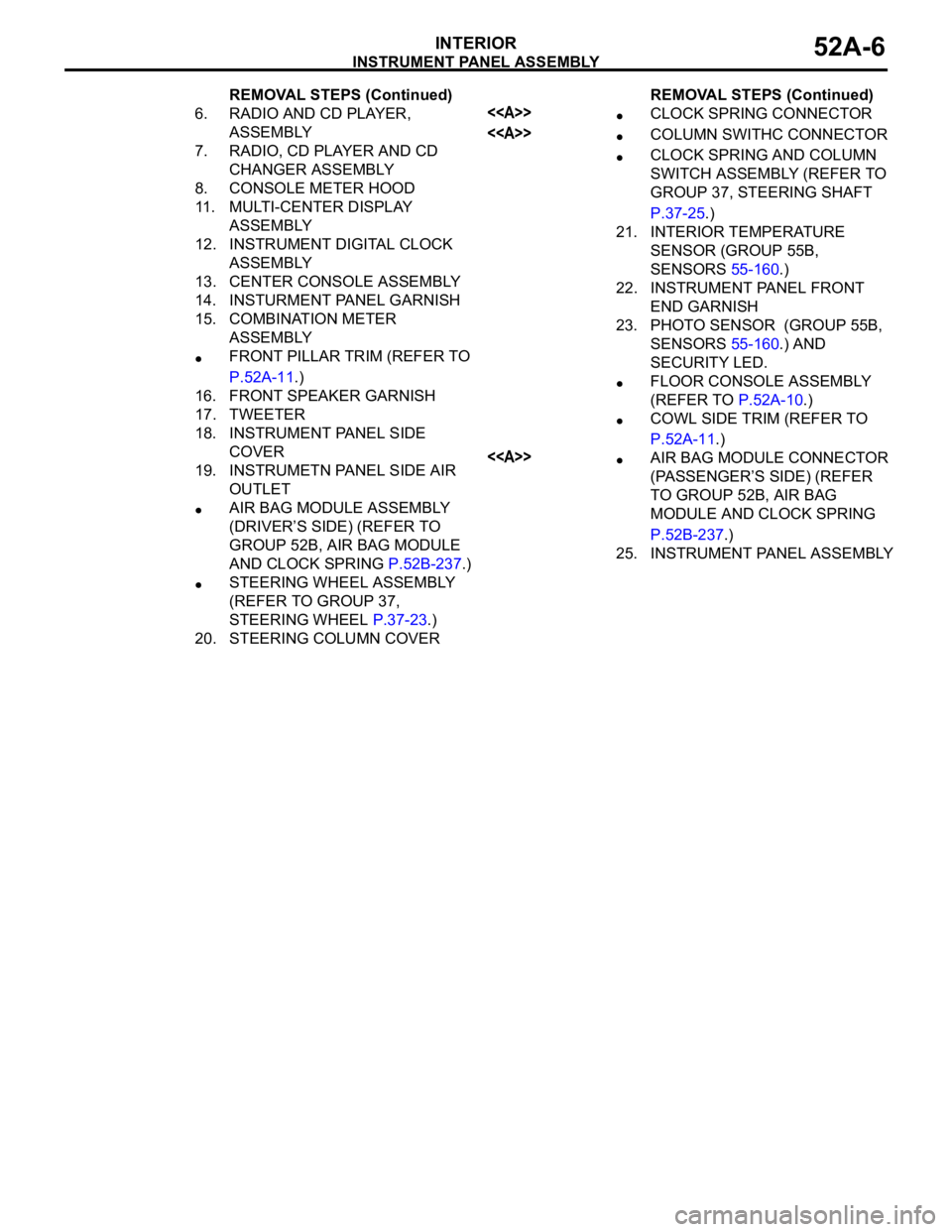
6. RADIO AND CD PLAYER,
ASSEMBLY
7. RADIO, CD PLAYER AND CD
CHANGER ASSEMBLY
8. CONSOLE METER HOOD
11. MULTI-CENTER DISPLAY
ASSEMBLY
12. INSTRUMENT DIGITAL CLOCK
ASSEMBLY
13. CENTER CONSOLE ASSEMBLY
14. INSTURMENT PANEL GARNISH
15. COMBINATION METER
ASSEMBLY
FRONT PILLAR TRIM (REFER TO
P.52A-11.)
16. FRONT SPEAKER GARNISH
17. TWEETER
18. INSTRUMENT PANEL SIDE
COVER
19. INSTRUMETN PANEL SIDE AIR
OUTLET
AIR BAG MODULE ASSEMBLY
(DRIVER’S SIDE) (REFER TO
GROUP 52B, AIR BAG MODULE
AND CLOCK SPRING P.52B-237.)
STEERING WHEEL ASSEMBLY
(REFER TO GROUP 37,
STEERING WHEEL P.37-23.)
20. STEERING COLUMN COVERREMOVAL STEPS (Continued)
<>CLOCK SPRING CONNECTOR
<>COLUMN SWITHC CONNECTOR
CLOCK SPRING AND COLUMN
SWITCH ASSEMBLY (REFER TO
GROUP 37, STEERING SHAFT
P.37-25.)
21. INTERIOR TEMPERATURE
SENSOR (GROUP 55B,
SENSORS 55-160.)
22. INSTRUMENT PANEL FRONT
END GARNISH
23. PHOTO SENSOR (GROUP 55B,
SENSORS 55-160.) AND
SECURITY LED.
FLOOR CONSOLE ASSEMBLY
(REFER TO P.52A-10.)
COWL SIDE TRIM (REFER TO
P.52A-11.)
<>AIR BAG MODULE CONNECTOR
(PASSENGER’S SIDE) (REFER
TO GROUP 52B, AIR BAG
MODULE AND CLOCK SPRING
P.52B-237.)
25. INSTRUMENT PANEL ASSEMBLYREMOVAL STEPS (Continued)
Page 561 of 1500
DASH PANEL
CONFIGURATION DIAGRAMS80-12
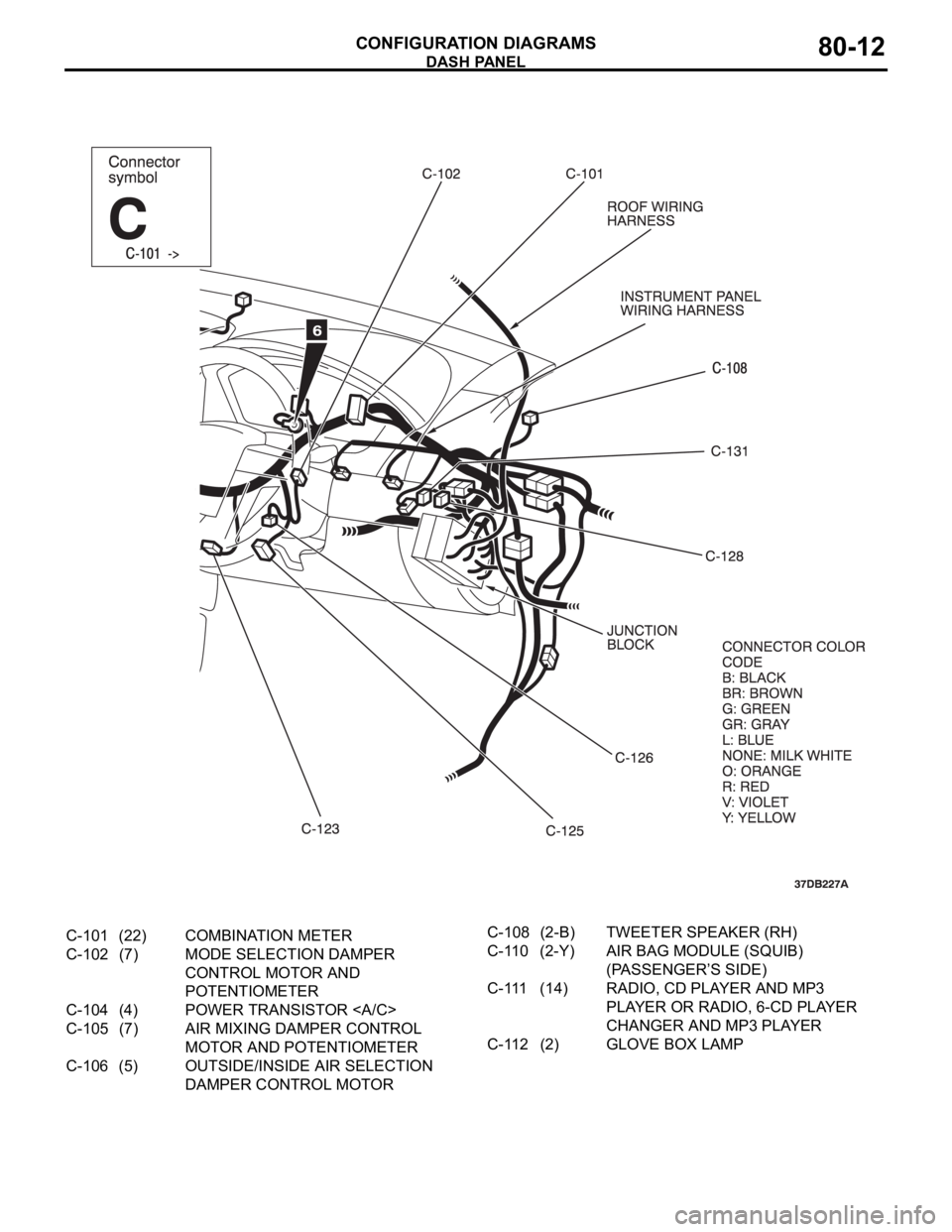
C-101 (22) COMBINATION METER
C-102 (7) MODE SELECTION DAMPER
CONTROL MOTOR AND
POTENTIOMETER
C-104 (4) POWER TRANSISTOR
C-105 (7) AIR MIXING DAMPER CONTROL
MOTOR AND POTENTIOMETER
C-106 (5) OUTSIDE/INSIDE AIR SELECTION
DAMPER CONTROL MOTORC-108 (2-B) TWEETER SPEAKER (RH)
C-110 (2-Y) AIR BAG MODULE (SQUIB)
(PASSENGER’S SIDE)
C-111 (14) RADIO, CD PLAYER AND MP3
PLAYER OR RADIO, 6-CD PLAYER
CHANGER AND MP3 PLAYER
C-112 (2) GLOVE BOX LAMP
Page 917 of 1500
GENERAL DESCRIPTION
ENGINE COOLING14-2
GENERAL DESCRIPTIONM1141000100401
The cooling system is designed to keep every
part of the engine at appropriate temperature in
whatever condition the engine may be operated.
The cooling method is of the water-cooled, pres-
sure forced circulation type in which the water
pump pressurizes coolant and circulates it
throughout the engine. If the coolant temperature exceeds the prescribed temperature, the thermo-
stat opens to circulate the coolant through the
radiator as well so that the heat absorbed by the
coolant may be radiated into the air. The water
pump is of the centrifugal type and is driven by
the drive belt from the crankshaft. The radiator is
the corrugated fin, down flow type.
SPECIAL TOOLM1141000600279
ENGINE COOLING DIAGNOSIS
INTRODUCTIONM1141005300347
The system cools the engine so that it does not over-
heat and maintains the engine at an optimum tem-
perature. The system components are the radiator,
water pump, thermostat, condenser and fan assem-
blies. Possible faults include low coolant, contamina-
tion, belt loosening and component damage.
TROUBLESHOOTING STRATEGYM1141005200340
Use these steps to plan your diagnostic strategy. If
you follow them carefully, you will be sure to find
most of the engine cooling faults.
1. Gather information from the customer.2. Verify that the condition described by the
customer exists.
3. Find and repair the malfunction by following the
SYMPTOM CHART.
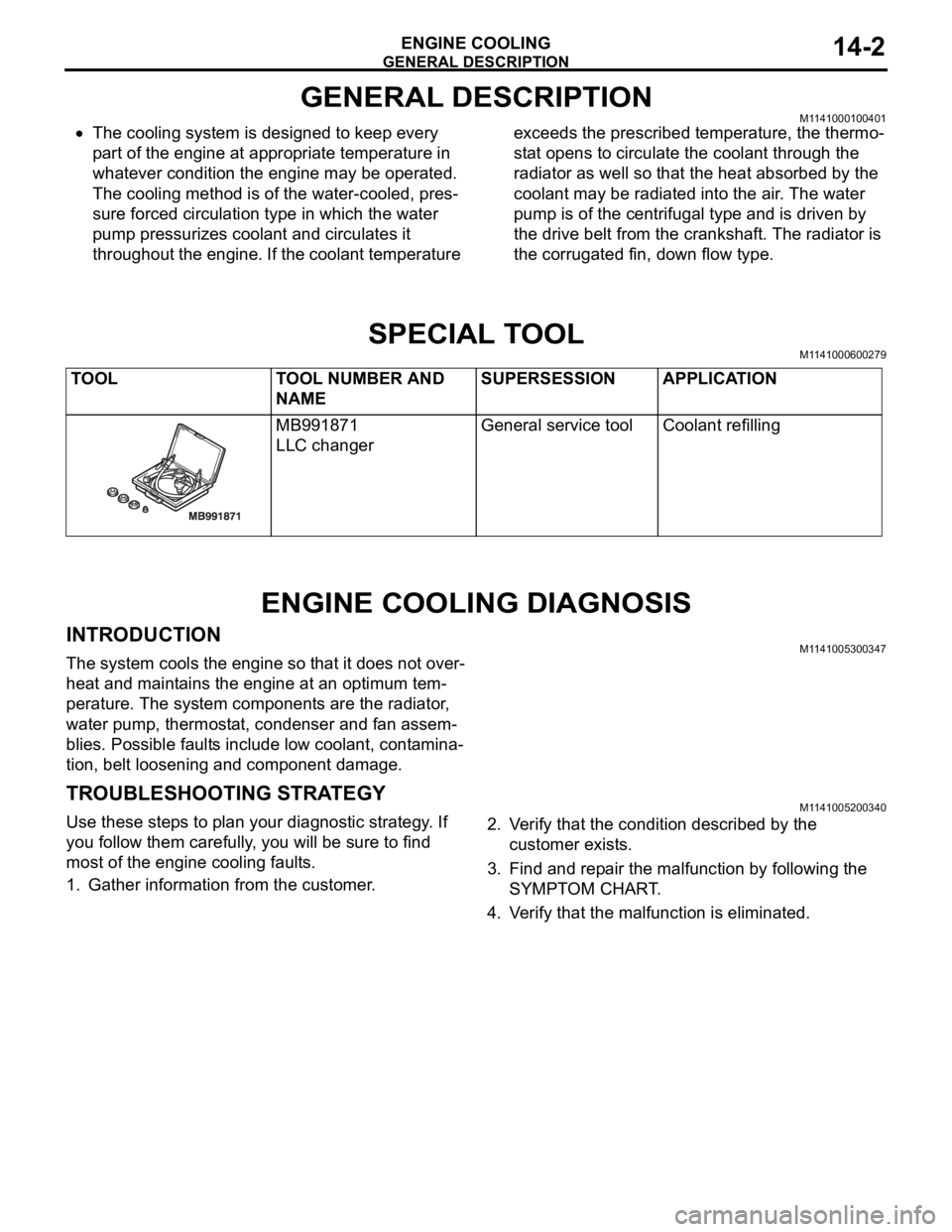
4. Verify that the malfunction is eliminated. TOOL TOOL NUMBER AND
NAMESUPERSESSION APPLICATION
MB991871
LLC changerGeneral service tool Coolant refilling