Relays MITSUBISHI 380 2005 Workshop Manual
[x] Cancel search | Manufacturer: MITSUBISHI, Model Year: 2005, Model line: 380, Model: MITSUBISHI 380 2005Pages: 1500, PDF Size: 47.87 MB
Page 705 of 1500

GENERAL DESCRIPTION
HEATER, AIR CONDITIONING AND VENTILATION55-4
OPERATION
.
CONDENSER FAN AND RADIATOR FAN
CONTROL
The ECU judges the required revolution speed of
radiator fan motor and condenser fan motor using
the input signals transmitted from A/C switch, output
shaft speed sensor and engine coolant temperature
sensor. The ECU activates the fan control relays to
drive the radiator fan motor and condenser fan
motor.
.
COMPRESSOR CONTROL
When operating the air conditioning switch
The air thermo sensor, which senses the temper-
ature of the air flowing out of the evaporator,
deactivates the compressor at 3
C (37.4F) or
below.
The dual pressure switch turns OFF when the
refrigerant pressure becomes excessively high or
low, thus protecting the compressor circuit (See
Table below).
When the air thermo sensor is activated, and the
ignition switch, blower switch, and air condition-
ing switch are ON, the A/C compressor clutch
relay is energized.
When operating the mode selection dial
The air conditioning will work when the mode
selection dial is set to the "Defroster" or
"Defroster/foot" position, or the temperature con-
trol dial is set to the "MAX A/C" position. In other
dial positions, when the air conditioning switch is
turned on, the air conditioning will work.
A/C Compressor Clutch Relay ON Conditions
Ignition switch (IG2) ONNOTE: A/C compressor clutch relay is
de-energized when any one switch, sensor
or control unit shown on the left turns off.
NOTE: The components marked by
*
communicate with the ECU. If the air thermo
sensor detects a temperature of 3
C
(37.4
F), the A/C-ECU will turn off the A/C
compressor clutch relay. Blower switch ON
Air conditioning switch, mode selection dial
defroster, defroster/foot position or temperature
control MAX A/CON
Air thermo sensor*
Pressure detected
by A/C pressure
sensor2940 kPa or less (If the
refrigerant pressure exceeds
2940 kPa, A/C compressor
clutch relay is not ON
condition until the refrigerant
pressure has been measured
up to 2350 kPa or less.)ON
190 kPa or more (If the
refrigerant pressure falls short
of 190 kPa, A/C compressor
clutch relay is not ON
condition until the refrigerant
pressure has been measured
up to 220 kPa or more.)
A/C compressor clutch relay driving transistor (within
ecu)ON
Page 902 of 1500
00E-1
GROUP 00E
GENERAL
CONTENTS
HARNESS CONNECTOR
INSPECTION . . . . . . . . . . . . . . . . . . .00E-2
HOW TO DIAGNOSE . . . . . . . . . . . . .00E-2
HOW TO DIAGNOSE . . . . . . . . . . . . . . . . . 00E-2
TROUBLESHOOTING STEPS . . . . . . . . . . 00E-3
INFORMATION FOR DIAGNOSIS . . . . . . . 00E-3
INSPECTION . . . . . . . . . . . . . . . . . . . . . . . 00E-4INSPECTION INSTRUMENTS . . . . . . . . . . 00E-5
CHECKING FUSES . . . . . . . . . . . . . . . . . . . 00E-6
CHECKING SWITCHES . . . . . . . . . . . . . . . 00E-7
CHECKING RELAYS . . . . . . . . . . . . . . . . . 00E-8
CABLES AND WIRES CHECK . . . . . . . . . . 00E-9
BATTERY HANDLING . . . . . . . . . . . . . . . . 00E-9
GENERAL ELECTRICAL SYSTEM CHECK00E-9
Page 909 of 1500
HOW TO DIAGNOSE
GENERAL
CHECKING RELAYSM1001004900152
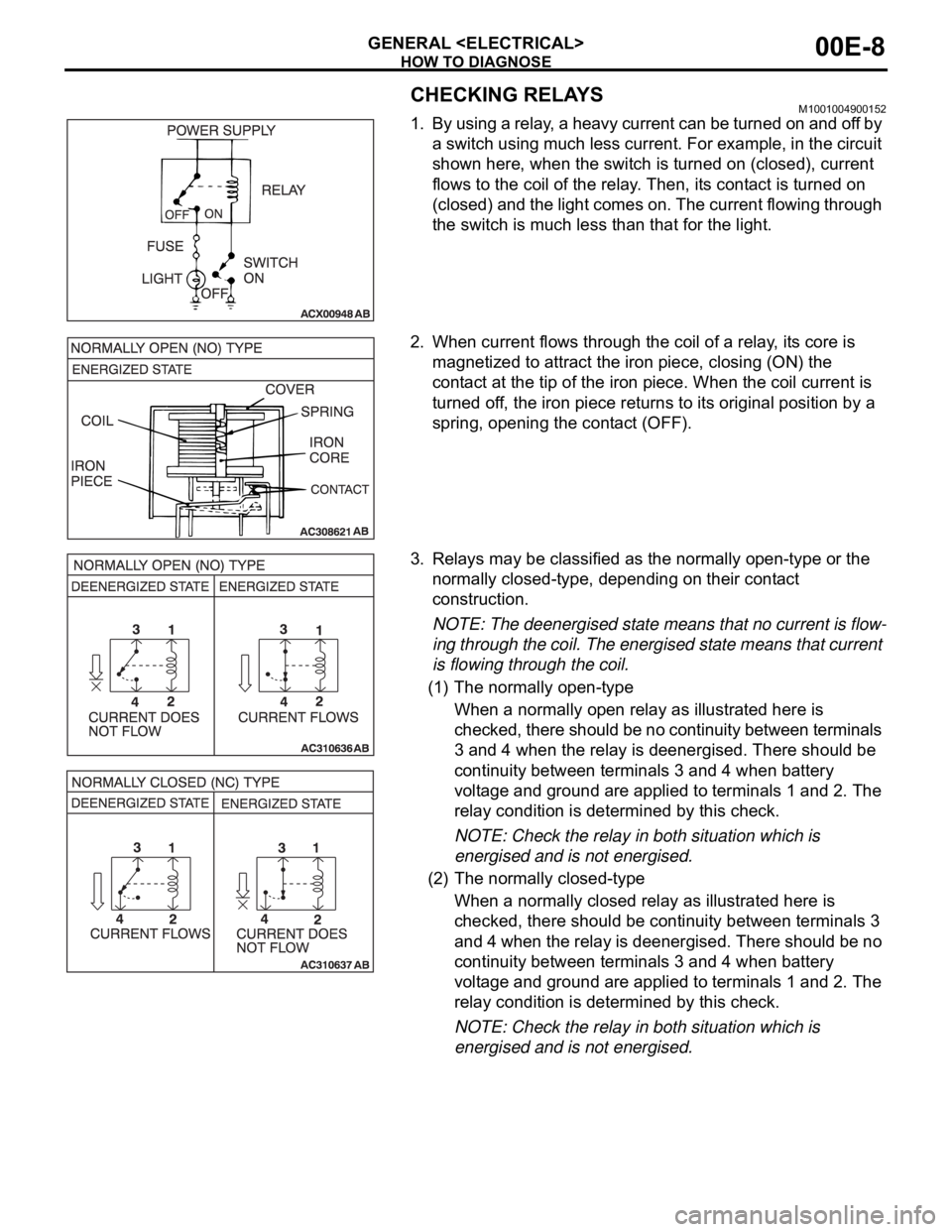
1. By using a relay, a heavy current can be turned on and off by
a switch using much less current. For example, in the circuit
shown here, when the switch is turned on (closed), current
flows to the coil of the relay. Then, its contact is turned on
(closed) and the light comes on. The current flowing through
the switch is much less than that for the light.
2. When current flows through the coil of a relay, its core is
magnetized to attract the iron piece, closing (ON) the
contact at the tip of the iron piece. When the coil current is
turned off, the iron piece returns to its original position by a
spring, opening the contact (OFF).
3. Relays may be classified as the normally open-type or the
normally closed-type, depending on their contact
construction.
NOTE: The deenergised state means that no current is flow-
ing through the coil. The energised state means that current
is flowing through the coil.
(1) The normally open-type
When a normally open relay as illustrated here is
checked, there should be no continuity between terminals
3 and 4 when the relay is deenergised. There should be
continuity between terminals 3 and 4 when battery
voltage and ground are applied to terminals 1 and 2. The
relay condition is determined by this check.
NOTE: Check the relay in both situation which is
energised and is not energised.
(2) The normally closed-type
When a normally closed relay as illustrated here is
checked, there should be continuity between terminals 3
and 4 when the relay is deenergised. There should be no
continuity between terminals 3 and 4 when battery
voltage and ground are applied to terminals 1 and 2. The
relay condition is determined by this check.
NOTE: Check the relay in both situation which is
energised and is not energised.