wheel MITSUBISHI ASX 2012 Owner's Manual (in English)
[x] Cancel search | Manufacturer: MITSUBISHI, Model Year: 2012, Model line: ASX, Model: MITSUBISHI ASX 2012Pages: 378, PDF Size: 18.2 MB
Page 4 of 378
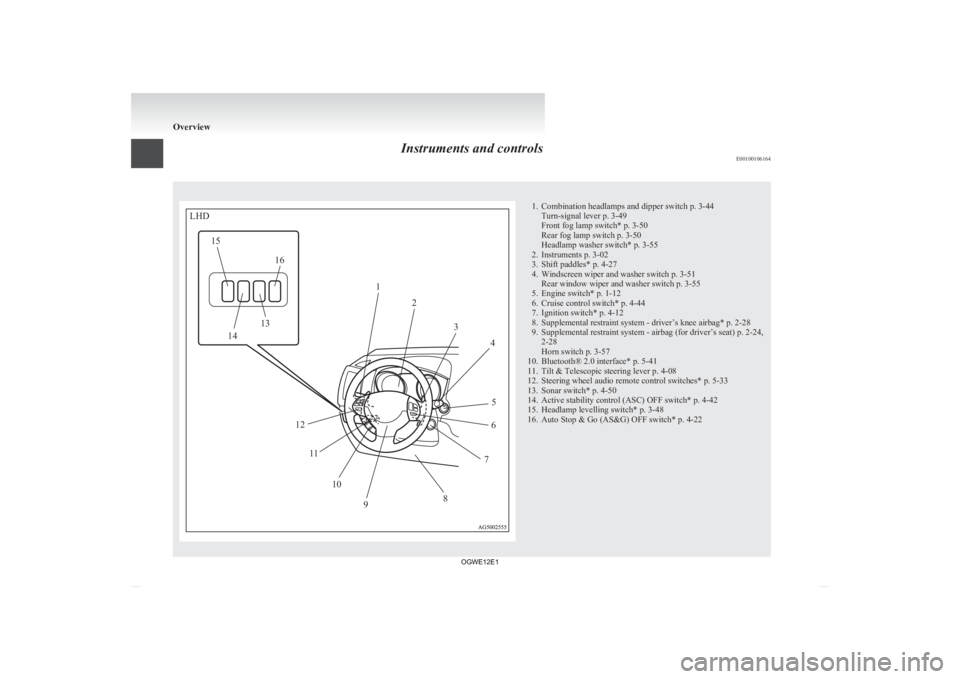
Instruments and controls
E00100106164 1. Combination headlamps and dipper switch p. 3-44
Turn-signal lever p. 3-49
Front fog lamp switch* p. 3-50
Rear fog lamp switch p. 3-50
Headlamp washer switch* p. 3-55
2.
Instruments p. 3-02
3. Shift paddles* p. 4-27
4. Windscreen wiper and washer switch p. 3-51 Rear window wiper and washer switch p. 3-55
5. Engine switch* p. 1-12
6. Cruise control switch* p. 4-44
7. Ignition switch* p. 4-12
8. Supplemental restraint system - driver’s knee airbag* p. 2-28
9. Supplemental restraint system - airbag (for driver’s seat) p. 2-24, 2-28
Horn switch p. 3-57
10. Bluetooth® 2.0 interface* p. 5-41
11. Tilt & Telescopic steering lever p. 4-08
12. Steering wheel audio remote control switches* p. 5-33
13. Sonar switch* p. 4-50
14. Active stability control (ASC) OFF switch* p. 4-42
15. Headlamp levelling switch* p. 3-48
16. Auto Stop & Go (AS&G) OFF switch* p. 4-22 OverviewLHD12
34
5
6
7
8
9
10
11
12
13
14
15
16
OGWE12E1
Page 5 of 378
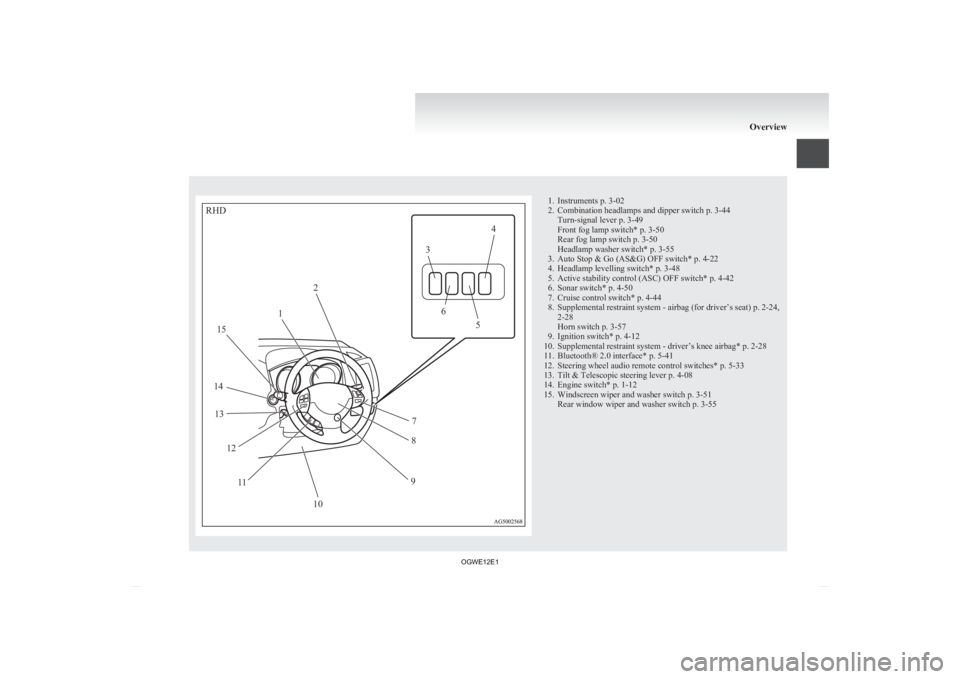
1. Instruments p. 3-02
2.
Combination headlamps and dipper switch p. 3-44Turn-signal lever p. 3-49
Front fog lamp switch* p. 3-50
Rear fog lamp switch p. 3-50
Headlamp washer switch* p. 3-55
3. Auto Stop & Go (AS&G) OFF switch* p. 4-22
4. Headlamp levelling switch* p. 3-48
5. Active stability control (ASC) OFF switch* p. 4-42
6. Sonar switch* p. 4-50
7. Cruise control switch* p. 4-44
8. Supplemental restraint system - airbag (for driver’s seat) p. 2-24, 2-28
Horn switch p. 3-57
9. Ignition switch* p. 4-12
10. Supplemental restraint system - driver’s knee airbag* p. 2-28
11. Bluetooth® 2.0 interface* p. 5-41
12. Steering wheel audio remote control switches* p. 5-33
13. Tilt & Telescopic steering lever p. 4-08
14. Engine switch* p. 1-12
15. Windscreen wiper and washer switch p. 3-51 Rear window wiper and washer switch p. 3-55 OverviewRHD12 3
4
5
6
7
8
9
10
11
12
13
14 15
OGWE12E1
Page 13 of 378
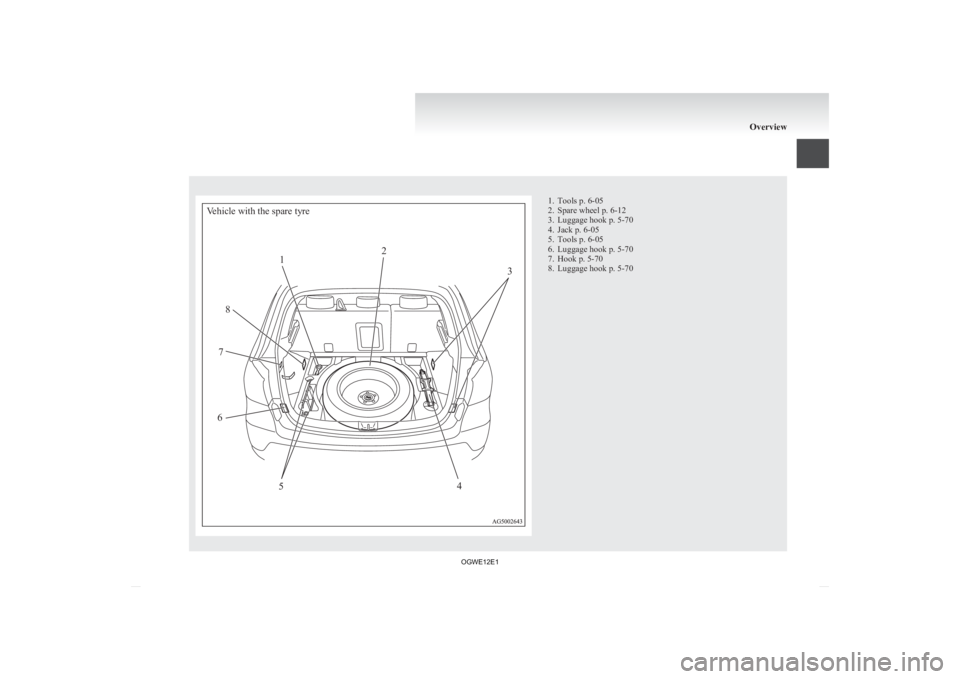
Vehicle with the spare tyre1 2
3
4
5
6
7
8 1. Tools p. 6-05
2.
Spare wheel p. 6-12
3. Luggage hook p. 5-70
4. Jack p. 6-05
5. Tools p. 6-05
6. Luggage hook p. 5-70
7. Hook p. 5-70
8. Luggage hook p. 5-70 Overview
OGWE12E1
Page 15 of 378
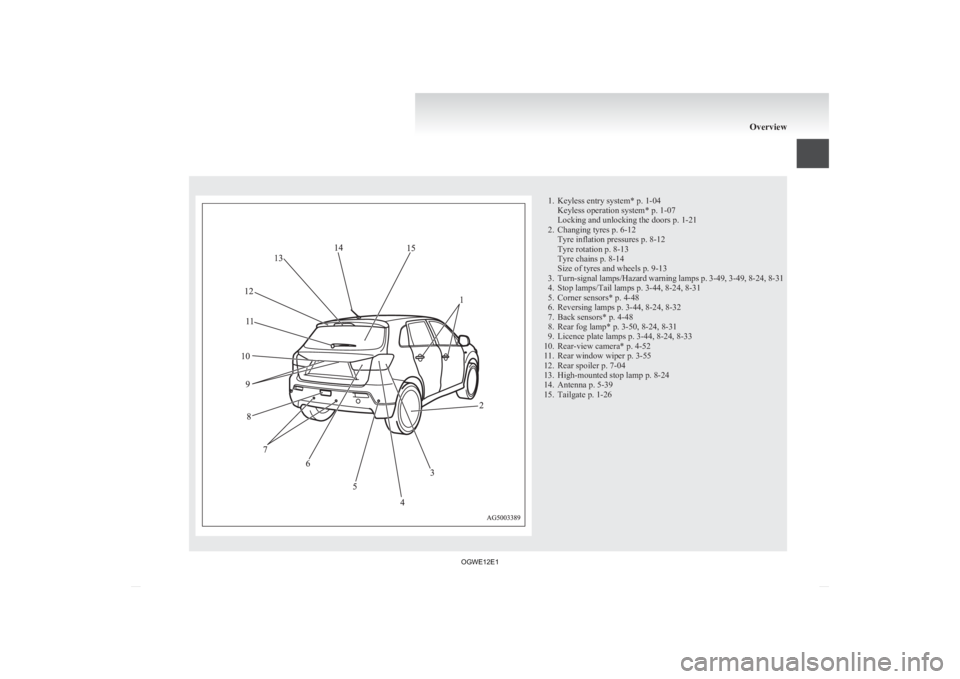
1. Keyless entry system* p. 1-04
Keyless operation system* p. 1-07
Locking and unlocking the doors
p. 1-21
2. Changing tyres p. 6-12 Tyre inflation pressures p. 8-12
Tyre rotation p. 8-13
Tyre chains p. 8-14
Size of tyres and wheels p. 9-13
3. Turn-signal lamps/Hazard warning lamps p. 3-49, 3-49, 8-24, 8-31
4. Stop lamps/Tail lamps p. 3-44, 8-24, 8-31
5. Corner sensors* p. 4-48
6. Reversing lamps p. 3-44, 8-24, 8-32
7. Back sensors* p. 4-48
8. Rear fog lamp* p. 3-50, 8-24, 8-31
9. Licence plate lamps p. 3-44, 8-24, 8-33
10. Rear-view camera* p. 4-52
11. Rear window wiper p. 3-55
12. Rear spoiler p. 7-04
13. High-mounted stop lamp p. 8-24
14. Antenna p. 5-39
15. Tailgate p. 1-26 Overview
OGWE12E1
Page 20 of 378
CAUTION
l
Since the fuel system may be under pres-
sure, remove the fuel cap slowly. This re-
lieves any pressure or vacuum that might
have built up in the fuel tank. If you hear
a hissing sound from the cap, wait until it
stops before removing the cap. Other-
wise, fuel may spray out, injuring you or
others.
5. Insert
the gun in the tank port as far as it goes. CAUTION
l
Do not tilt the gun.
6. When
the gun stops automatically, do not fill with fuel any more.
7. Close the fuel cap. To close, turn the fuel cap slowly clockwise
until you hear clicking sounds, then gently
push the fuel tank filler door closed. Installation of accessories
E00200300963
We
recommend you to consult a MITSUBISHI
MOTORS Authorized Service Point.
l The installation of accessories, optional
parts, etc., should only be carried out within
the limits prescribed by law in your country,
and in accordance with the guidelines and
warnings contained within the documents ac-
companying this vehicle.
l Installing electric components incorrectly
could lead to a fire. Please refer to Modifica-
tion/alteration to the electrical or fuel sys-
tems section within this owner’s manual.
l Using a cellular phone or radio set inside the
vehicle without an external antenna may
cause electrical system interference, which
could lead to unsafe vehicle operation.
l Tyres and wheels which do not meet specifi-
cations must not be used.
Refer to the “Specifications” section for in-
formation regarding wheel and tyre sizes.
Important points!
Due to large number of accessory and replacement
parts of different manufactures available in the mar-
ket, it is not possible, not only for MITSUBISHI
MOTORS, but also for a MITSUBISHI MOTORS
Authorized Service Point, to check whether the at-
tachment or installation of such parts affects the
overall safety of your MITSUBISHI-vehicle.
Even when such parts are officially authorized, for
example
by a “general operators permit” (an ap-
praisal for the part) or through the execution of the
part in an officially approved manner of construc-
tion, or when a single operation permit following
the attachment or installation of such parts, it can-
not be deduced from that alone, that the driving safe-
ty of your vehicle has not been affected.
Consider also that there basically exists no liability
on the part of the appraiser or the official. Maxi-
mum safety can only be ensured with parts recom-
mended, sold and fitted or installed by a
MITSUBISHI MOTORS Authorized Service Point
(MITSUBISHI MOTORS genuine replacement
parts and MITSUBISHI MOTORS accessories).
The same also pertains to modifications of
MITSUBISHI vehicles with respect to the produc-
tion specifications. For safety reasons, do not at-
tempt any modifications other than those that fol-
low the recommendations of a MITSUBISHI
MOTORS Authorized Service Point. General information
04
OGWE12E1
Page 37 of 378
CAUTION
l
When the engine is not running, put the
operation mode in OFF. Leaving the oper-
ation mode in ON or ACC for a long time
when the engine is not running may cause
the battery to be discharged, making it im-
possible to start the engine, lock and un-
lock the steering wheel.
l When the battery is disconnected, the cur-
rent operation mode is memorized. After
reconnecting the battery, the memorized
mode is selected automatically. Before dis-
connecting the battery for repair or re-
placement, make sure to put the opera-
tion mode in OFF.
Be careful if you are not sure which oper-
ation mode the vehicle is in when the bat-
tery is run down.
l The operation mode cannot be changed
from OFF to ACC or ON if the keyless op-
eration key is not detected to be in the ve-
hicle. Refer to “Keyless operation system:
Operating range for starting the engine
and changing the operation mode” on
page 1-09.
ACC power auto-cutout function E00312300033
After approximately 30 minutes has elapsed with
the
operation mode in ACC, the function automati-
cally cuts out the power for the audio system and
other electric devices that can be operated with that
mode.
When the engine switch is pressed while the opera-
tion mode is in ACC, the power is supplied again
to those devices. NOTE
l It is possible to modify functions as follows:
• The
time until the power cuts out can be
changed to approximately 60 minutes.
• The ACC power auto-cutout function can be deactivated.
For details, consult a MITSUBISHI
MOTORS Authorized Service Point.
On vehicles equipped with MITSUBISHI
Multi-Communication System (MMCS),
screen operations can be used to make the ad-
justment.
Refer to the separate owner’s manual for de-
tails.
Warning activation E00305900486
In order to prevent vehicle theft or the accidental op-
eration
of the keyless operation system, the buzzer
and the display on the information screen in the mul-
ti-information display are used to alert the driver.
If a warning is activated, always check the vehicle
and the keyless operation key. The warning is also
displayed if there is a fault in the keyless operation
system.
If any of the following warnings are activated,
please contact a MITSUBISHI MOTORS Author-
ized Service Point. There is a fault in the keyless opera-
tion system.
The battery in the keyless operation
system key has worn out.
Put the operation mode in OFF and
then start the engine again.
If
the warning is not cancelled, there
is a fault in the electronic immobiliz-
er (Anti-theft starting system).
Please contact a MITSUBISHI
MOTORS Authorized Service Point. In the following cases, a warning is activated, but it
can be cancelled if the correct actions are followed.
l The
ID codes for the keyless operation key
and vehicle do not match. You could be carrying another key-
less
operation key with a different
code, or the keyless operation key
could be outside the operating range.
Refer to “Keyless
operation key take-
out monitoring system” on page
1-14. l
Even
though you press the driver’s or front
passenger’s door lock/unlock switch, or the
tailgate LOCK switch, the doors and tailgate
are not locked. Locking and unlocking
1-13 1
OGWE12E1
Page 39 of 378
When the operation mode is in any mode other
than
OFF, if you close all the doors and the tailgate
then try to lock the doors and tailgate by pressing
the driver’s or front passenger’s door lock/unlock
switch, or the tailgate LOCK switch, a warning is
issued with the warning display and the buzzer buzz-
ing for approximately 3 seconds and you cannot
lock the doors and tailgate.
Steering wheel lock E00306800235
To lock
Press
the engine switch to put the operation mode
in OFF.
Open one of the doors.
To unlock
The following methods can be used to unlock the
steering wheel.
l Put the operation mode in ACC.
l Start the engine. CAUTION
l
If
the engine is stopped while driving, do
not open a door or press the UNLOCK
switch on the remote control switch until
the vehicle stops in a safe place.
This could cause the steering wheel to
lock, making it impossible to operate the
vehicle.
l Carry the key with you when leaving the
vehicle.
If your vehicle needs to be towed, put the
operation mode in ACC to unlock the
steering wheel. NOTE
l When
the following operation is performed
with the operation mode in OFF, the steering
wheel is locked. • Open or close one of the doors (exceptthe tailgate).
• Lock all doors and the tailgate with the keyless entry system or the keyless opera-
tion function.
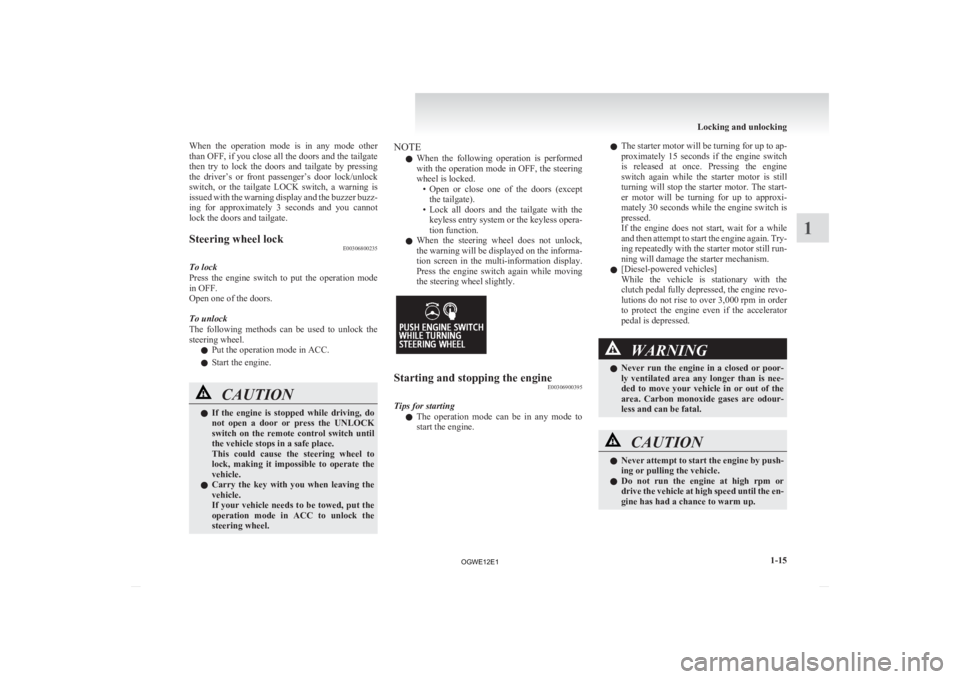
l When the steering wheel does not unlock,
the warning will be displayed on the informa-
tion screen in the multi-information display.
Press the engine switch again while moving
the steering wheel slightly. Starting and stopping the engine
E00306900395
Tips for starting l The
operation mode can be in any mode to
start the engine. l
The
starter motor will be turning for up to ap-
proximately 15 seconds if the engine switch
is released at once. Pressing the engine
switch again while the starter motor is still
turning will stop the starter motor. The start-
er motor will be turning for up to approxi-
mately 30 seconds while the engine switch is
pressed.
If the engine does not start, wait for a while
and then attempt to start the engine again. Try-
ing repeatedly with the starter motor still run-
ning will damage the starter mechanism.
l [Diesel-powered vehicles]
While the vehicle is stationary with the
clutch pedal fully depressed, the engine revo-
lutions do not rise to over 3,000 rpm in order
to protect the engine even if the accelerator
pedal is depressed. WARNING
l Never
run the engine in a closed or poor-
ly ventilated area any longer than is nee-
ded to move your vehicle in or out of the
area. Carbon monoxide gases are odour-
less and can be fatal. CAUTION
l
Never
attempt to start the engine by push-
ing or pulling the vehicle.
l Do not run the engine at high rpm or
drive the vehicle at high speed until the en-
gine has had a chance to warm up. Locking and unlocking
1-15 1
OGWE12E1
Page 40 of 378
Starting the engine (petrol-powered vehicles)
E00307000478
The starting procedure is as follows:
1.
Fasten the seat belt.
2. Make sure the parking brake is applied.
3. Depress and hold the brake pedal.
4. Fully depress the clutch pedal (M/T).
NOTE l On vehicles with the Auto Stop & Go
(AS&G) system, the starter will not operate
unless the clutch pedal is fully depressed
(Clutch interlock).
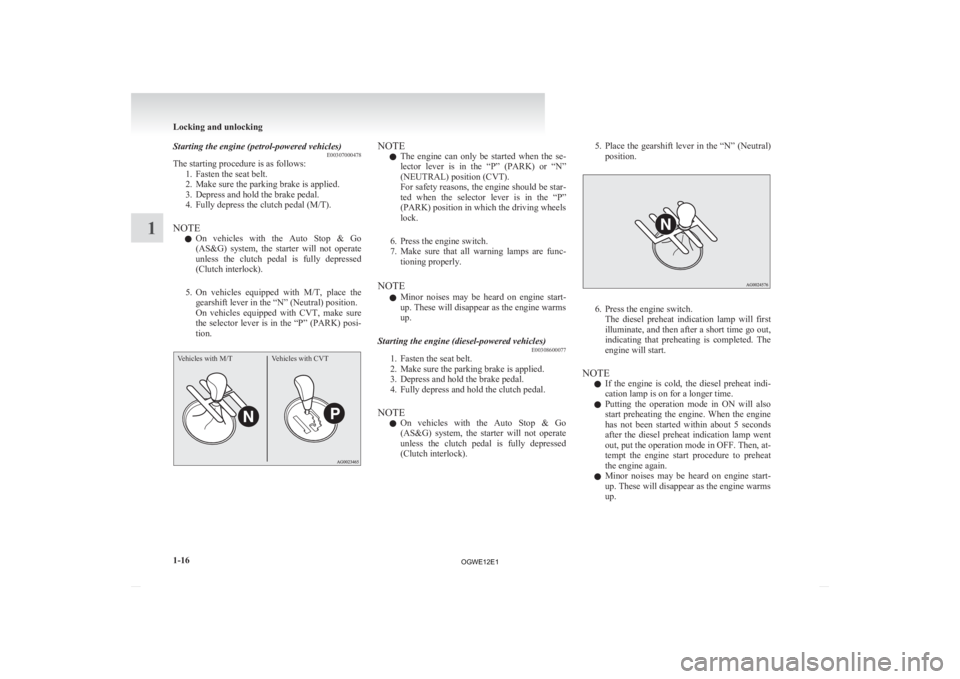
5. On vehicles equipped with M/T, place the gearshift lever in the “N” (Neutral) position.
On vehicles equipped with CVT, make sure
the selector lever is in the “P” (PARK) posi-
tion.
Vehicles with M/T Vehicles with CVT NOTE
l The
engine can only be started when the se-
lector lever is in the “P” (PARK) or “N”
(NEUTRAL) position (CVT).
For safety reasons, the engine should be star-
ted when the selector lever is in the “P”
(PARK) position in which the driving wheels
lock.
6. Press the engine switch.
7. Make sure that all warning lamps are func- tioning properly.
NOTE l Minor noises may be heard on engine start-
up. These will disappear as the engine warms
up.
Starting the engine (diesel-powered vehicles) E00308600077
1. Fasten the seat belt.
2.
Make sure the parking brake is applied.
3. Depress and hold the brake pedal.
4. Fully depress and hold the clutch pedal.
NOTE l On vehicles with the Auto Stop & Go
(AS&G) system, the starter will not operate
unless the clutch pedal is fully depressed
(Clutch interlock). 5. Place
the gearshift lever in the “N” (Neutral)
position. 6. Press the engine switch.
The
diesel preheat indication lamp will first
illuminate, and then after a short time go out,
indicating that preheating is completed. The
engine will start.
NOTE l If the engine is cold, the diesel preheat indi-
cation lamp is on for a longer time.
l Putting the operation mode in ON will also
start preheating the engine. When the engine
has not been started within about 5 seconds
after the diesel preheat indication lamp went
out, put the operation mode in OFF. Then, at-
tempt the engine start procedure to preheat
the engine again.
l Minor noises may be heard on engine start-
up. These will disappear as the engine warms
up. Locking and unlocking
1-16
1
OGWE12E1
Page 65 of 378
Seat adjustment
E00400300271
Adjust
the driver’s seat so that you are comfortable
and that you can reach the pedals, steering wheel,
switches etc. while retaining a clear field of vision. WARNING
l Do
not attempt to adjust the seat while
driving. This can cause loss of vehicle con-
trol and result in an accident. After ad-
justments are made, ensure the seating is
locked in position by attempting to move
the seat forward and rearward without us-
ing the adjusting mechanism.
l Do not let children or adults ride in areas
of the vehicle that are not equipped with
seats or seat belts. Also, make sure that
all occupants are sitting in their seats and
wearing their seat belts, and that children
are sitting in child restraints.
l To minimize the risk of personal injury
in the event of a collision or sudden brak-
ing, the seatbacks should always be in the
almost upright position while the vehicle
is in motion. The protection provided by
the seat belts may be reduced significant-
ly when the seatback is reclined. There is
greater risk that the passenger will slide
under the seat belt, resulting in serious in-
jury, when the seatback is reclined. CAUTION
l
Make
sure the seat is adjusted by an
adult or with adult supervision for cor-
rect and safe operation.
l Do not place a cushion or the like be-
tween your back and the seatback while
driving. The effectiveness of the head re-
straints will be reduced in the event of an
accident.
l When sliding the seat rearward, be care-
ful not to catch your hand or foot. Front seat
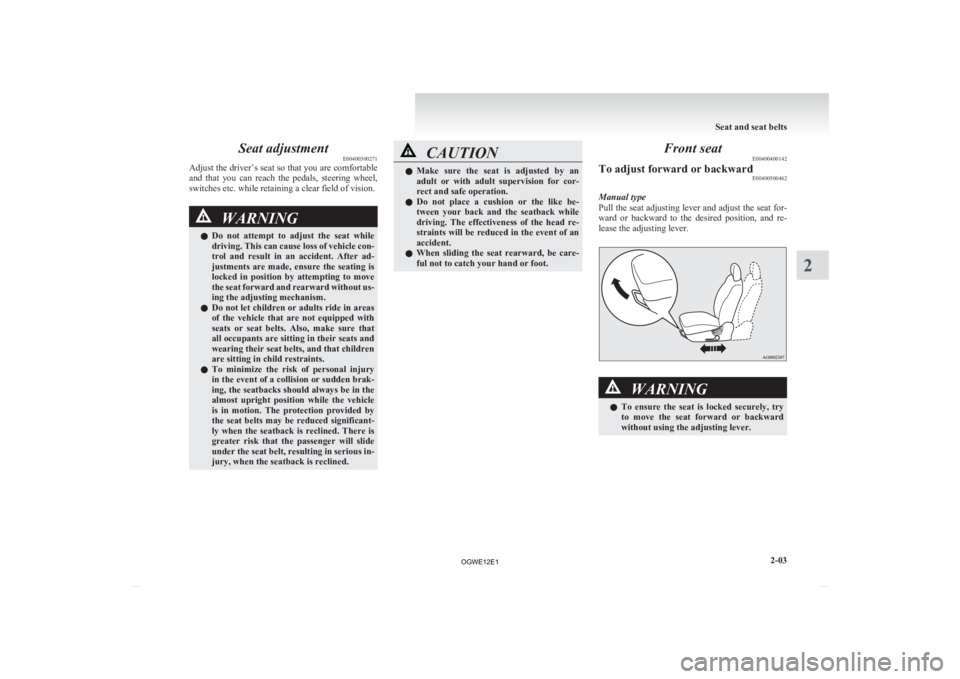
E00400400142
To adjust forward or backward E00400500462
Manual type
Pull
the seat adjusting lever and adjust the seat for-
ward or backward to the desired position, and re-
lease the adjusting lever. WARNING
l To
ensure the seat is locked securely, try
to move the seat forward or backward
without using the adjusting lever. Seat and seat belts
2-03 2
OGWE12E1
Page 87 of 378
![MITSUBISHI ASX 2012 Owners Manual (in English) Only when the ignition switch or the operation
mode
is under the following conditions, the airbags
will operate.
[Except vehicles equipped with keyless operation
system]
The ignition swit](/img/19/34862/w960_34862-86.png "MITSUBISHI ASX 2012 Owners Manual (in English) Only when the ignition switch or the operation
mode
is under the following conditions, the airbags
will operate.
[Except vehicles equipped with keyless operation
system]
The ignition swit")
Only when the ignition switch or the operation
mode
is under the following conditions, the airbags
will operate.
[Except vehicles equipped with keyless operation
system]
The ignition switch is in the “ON” or “START” po-
sition.
[Vehicles equipped with keyless operation system]
The operation mode is in ON.
The airbags deployment produces a sudden, loud
noise, and releases some smoke and powder, but
these conditions are not injurious, and do not indi-
cate a fire in the vehicle. People with respiratory
problems may feel some temporary irritation from
chemicals used to produce the deployment; open
the windows after airbag deployment, if safe to do
so.
The airbags deflate very rapidly after deployment,
so there is little danger of obscured vision. CAUTION
l
Airbags
inflate at an extremely rapid
speed. In certain situations, contact with
inflating airbags can result in abrasions,
bruises, and the like. WARNING
l IT
IS VERY IMPORTANT TO BE PROP-
ERLY SEATED.
A driver or front passenger too close to
the steering wheel or instrument panel
during airbag deployment can be killed
or seriously injured.
Airbags inflate very fast, and with great
force.
If the driver and front passenger are not
properly seated and restrained, the air-
bags may not protect you properly, and
could cause serious or fatal injuries when
it inflates.
l Do not sit on the edge of the seat or sit
with your lower legs too close to the in-
strument panel, or lean head or chest
close to the steering wheel or instrument
panel. Do not put feet or legs on or
against the instrument panel.
l Place all infants and small children in the
rear seat and properly restrained using
an appropriate child restraint system.
The rear seat is the safest place for in-
fants and children. WARNING
l Infants and small children should never
be unrestrained, stand up against the in-
strument panel or be held in your arms
or on your lap. They could be seriously in-
jured or killed in a collision, including
when the airbag inflates. They should be
properly seated in the rear seat in an ap-
propriate child restraint system. See the
“Child restraint” section of this owner’s
manual. Seat and seat belts
2-25 2
OGWE12E1