wheel MITSUBISHI ASX 2015 (in English) Owner's Guide
[x] Cancel search | Manufacturer: MITSUBISHI, Model Year: 2015, Model line: ASX, Model: MITSUBISHI ASX 2015Pages: 452, PDF Size: 20.1 MB
Page 175 of 452
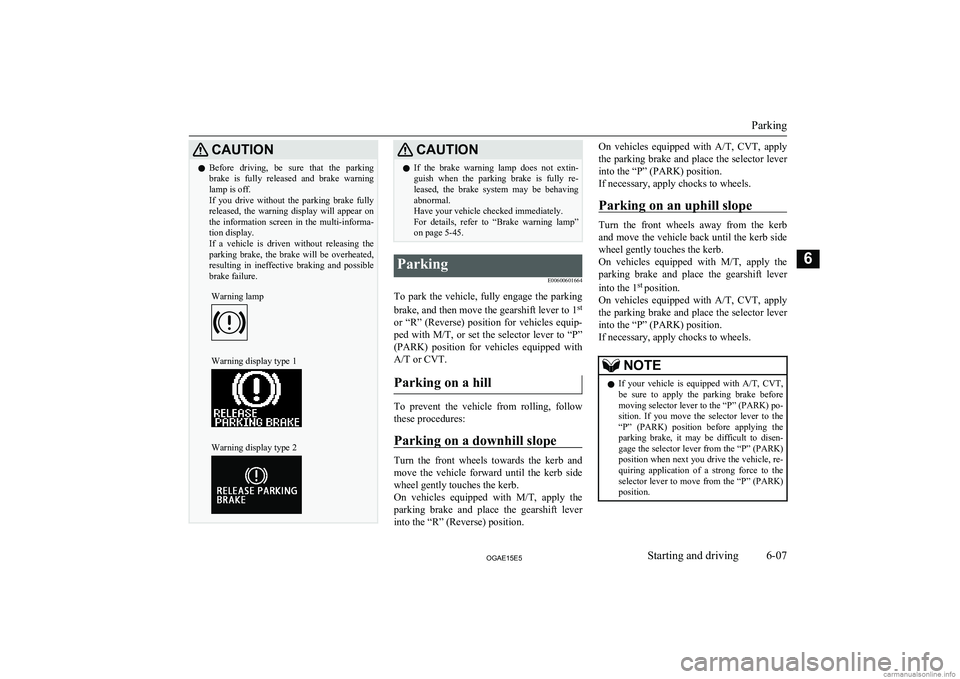
CAUTIONlBefore driving, be sure that the parking
brake is fully released and brake warning lamp is off.
If you drive without the parking brake fully
released, the warning display will appear on the information screen in the multi-informa-tion display.
If a vehicle is driven without releasing the
parking brake, the brake will be overheated, resulting in ineffective braking and possible
brake failure.Warning lampWarning display type 1Warning display type 2CAUTIONl If the brake warning lamp does not extin-
guish when the parking brake is fully re- leased, the brake system may be behavingabnormal.
Have your vehicle checked immediately.
For details, refer to “Brake warning lamp” on page 5-45.Parking
E00600601664
To park the vehicle, fully engage the parkingbrake, and then move the gearshift lever to 1 st
or “R” (Reverse) position for vehicles equip-
ped with M/T, or set the selector lever to “P”
(PARK) position for vehicles equipped with
A/T or CVT.
Parking on a hill
To prevent the vehicle from rolling, followthese procedures:
Parking on a downhill slope
Turn the front wheels towards the kerb and
move the vehicle forward until the kerb side wheel gently touches the kerb.
On vehicles equipped with M/T, apply the
parking brake and place the gearshift lever
into the “R” (Reverse) position.
On vehicles equipped with A/T, CVT, apply
the parking brake and place the selector lever
into the “P” (PARK) position.
If necessary, apply chocks to wheels.
Parking on an uphill slope
Turn the front wheels away from the kerb and move the vehicle back until the kerb side
wheel gently touches the kerb.
On vehicles equipped with M/T, apply the
parking brake and place the gearshift lever
into the 1 st
position.
On vehicles equipped with A/T, CVT, apply
the parking brake and place the selector lever
into the “P” (PARK) position.
If necessary, apply chocks to wheels.
NOTEl If your vehicle is equipped with
A/T, CVT,
be sure to apply the parking brake before
moving selector lever to the “P” (PARK) po- sition. If you move the selector lever to the
“P” (PARK) position before applying the parking brake, it may be difficult to disen-
gage the selector lever from the “P” (PARK) position when next you drive the vehicle, re-
quiring application of a strong force to the selector lever to move from the “P” (PARK)
position.
Parking
6-07OGAE15E5Starting and driving6
Page 176 of 452
Parking with the engine run-ning
Never leave the engine running while you
take a short sleep/rest. Also, never leave the engine running in a closed or poorly ventila-
ted place.
WARNINGl Leaving the engine running carries the
riskof injury or death from accidentally
moving the gearshift lever ( M/T) or the
selector lever ( A/T or CVT) or the accu-
mulation of toxic exhaust fumes in the
passenger compartment.
Where you park
WARNINGl Do not park your vehicle in areas where
combustible materials such as dry grass
or leaves can come in contact with a hot exhaust, since a fire could occur.
Do not keep the steering wheel
fully turned for a long time
More effort could be required to turn the
steering wheel.
Refer to “Electric power steering system (EPS)” on page 6-50.
When leaving the vehicle
Always carry the key and lock all doors and
the tailgate when leaving the vehicle unatten-
ded.
Always try to park your vehicle in a well lit
area.
Steering wheel height and
reach adjustment E00600700512
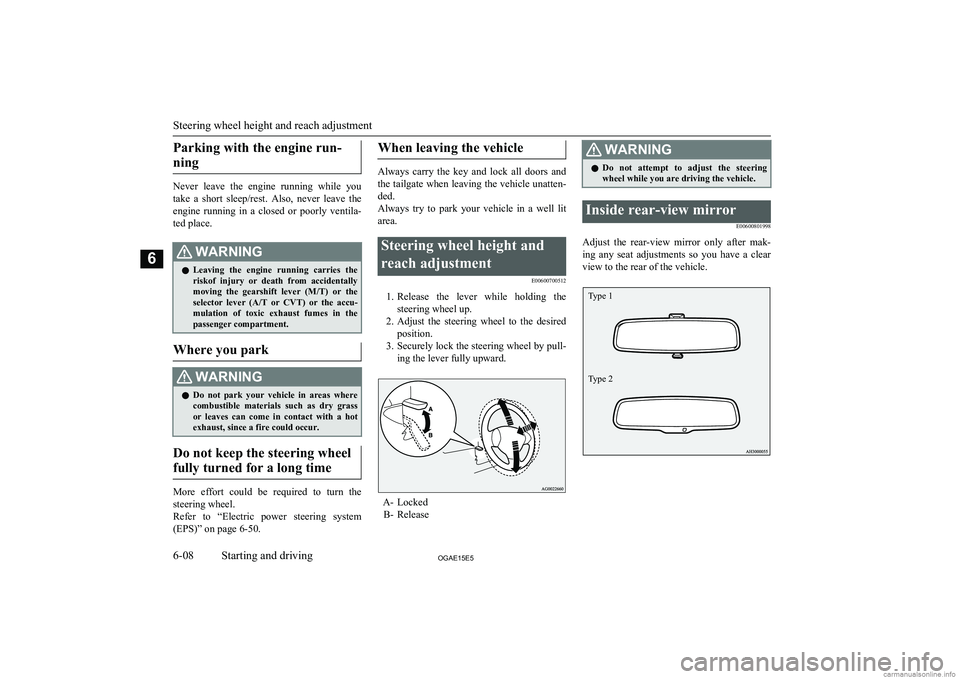
1.Release the lever while holding the
steering wheel up.
2. Adjust the steering wheel to the desired
position.
3. Securely lock the steering wheel by pull-
ing the lever fully upward.
A- Locked B- Release
WARNINGl Do not attempt to adjust the steering
wheel while you are driving the vehicle.Inside rear-view mirror
E00600801998
Adjust the rear-view mirror only after mak-
ing any seat adjustments so you have a clear
view to the rear of the vehicle.
Steering wheel height and reach adjustment
6-08OGAE15E5Starting and driving6 Type 1
Type 2
Page 180 of 452
The mirrors automatically retract or extendwhen the doors are locked or unlocked using the remote control switches of the keyless en-
try system.
Refer to “Keyless entry system” on page 3-04.
[Vehicles equipped with keyless operation
system]
The mirrors automatically retract or extend when the doors are locked or unlocked using the remote control switches or the keyless op-eration function of the keyless operation sys-
tem.
Refer to “Keyless operation system: To oper- ate using the keyless operation function, Key-
less entry system” on pages 3-11 and 3-22.NOTEl Functions can be modified as stated below.
Consult a MITSUBISHI MOTORS Author-
ized Service Point.
• Automatically extend when the following
operation is performed.
[Except vehicles equipped with keyless operation system]
Turn the ignition switch to the “ON” or
“ACC” position.
[Vehicles equipped with keyless operation
system]
Put the operation mode in ON or ACC.NOTE• Automatically retract when the driver’s
door is opened after turning the ignition switch to the “LOCK” position or putting the operation mode in OFF.
• Automatically extend when the vehicle
speed reaches 30 km/h (19 mph).
• Deactivate the automatic extension func-
tion.Heated mirror
E00601200497
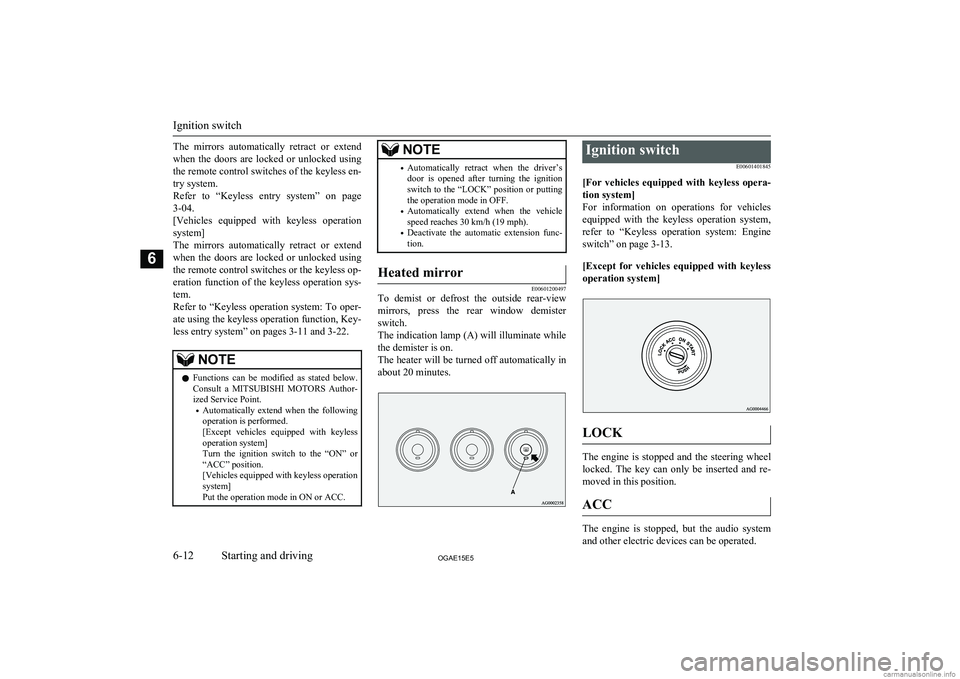
To demist or defrost the outside rear-view
mirrors, press the rear window demister
switch.
The indication lamp (A) will illuminate while the demister is on.
The heater will be turned off automatically in
about 20 minutes.
Ignition switch
E00601401845
[For vehicles equipped with keyless opera- tion system]
For information on operations for vehicles equipped with the keyless operation system,
refer to “Keyless operation system: Engine
switch” on page 3-13.
[Except for vehicles equipped with keyless operation system]
LOCK
The engine is stopped and the steering wheel
locked. The key can only be inserted and re- moved in this position.
ACC
The engine is stopped, but the audio system
and other electric devices can be operated.
Ignition switch
6-12OGAE15E5Starting and driving6
Page 181 of 452
ON
The engine is running, and all the vehicle’selectrical devices can be operated.
START
The starter motor operates. After the engine has started, release the key and it will auto-
matically return to the “ON” position.
NOTEl Your vehicle is equipped with an electronic
immobilizer.
To start the engine, the ID code transmitted
by the transponder inside the key must match the code registered in the immobilizer
computer.
Refer to “Electronic immobilizer (Anti-theft
starting system)” on page 3-03.ACC power auto-cutout func-
tion
E00620300224
After about 30 minutes has elapsed with the ignition switch in the “ACC” position, the
function automatically cuts out the power for
the audio system and other electric devices that can be operated with that position.
When the ignition switch is turned from the
“ACC” position, the power is supplied again to those devices.
NOTEl It is possible to modify functions as follows:
• The time until the power cuts out can be
changed to approximately 60 minutes.
• The ACC power auto-cutout function can
be deactivated.
For details, we recommend you to consult
a MITSUBISHI MOTORS Authorized
Service Point.To remove the key
E00620400528
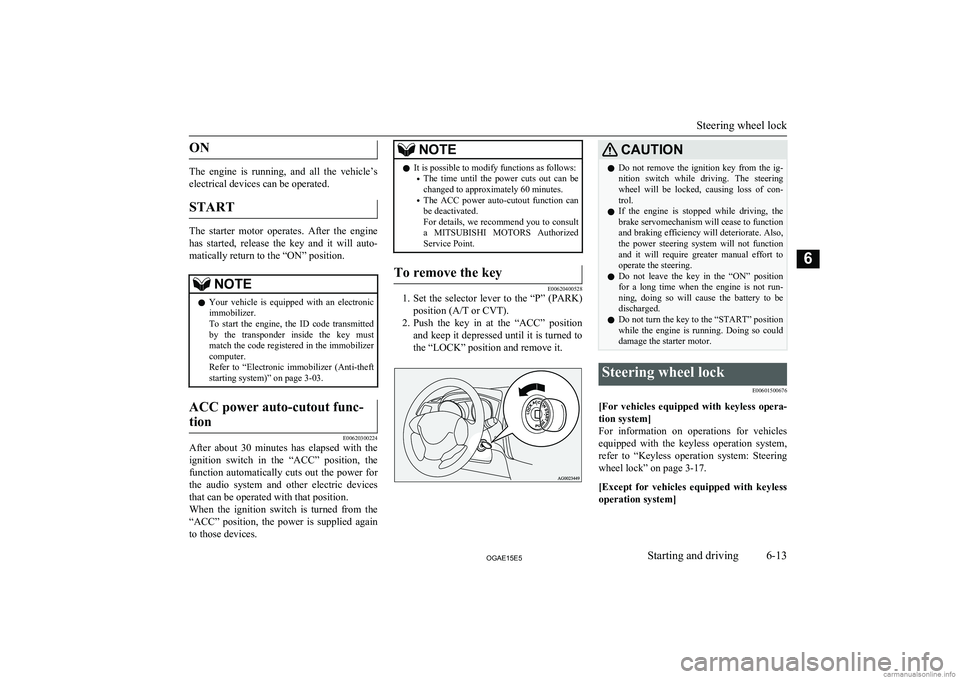
1. Set the selector lever to the “P” (PARK)
position (A/T or CVT).
2. Push the key in at the “ACC” position
and keep it depressed until it is turned tothe “LOCK” position and remove it.
CAUTIONl Do not remove the ignition key from the ig-
nition switch while driving. The steeringwheel will be locked, causing loss of con-
trol.
l If the engine is stopped while driving, the
brake servomechanism will cease to function and braking efficiency will deteriorate. Also,
the power steering system will not function
and it will require greater manual effort to
operate the steering.
l Do not leave the key in the “ON” position
for a long time when the engine is not run-
ning, doing so will cause the battery to be discharged.
l Do not turn the key to the “START” position
while the engine is running. Doing so could damage the starter motor.Steering wheel lock
E00601500676
[For vehicles equipped with keyless opera-tion system]
For information on operations for vehicles equipped with the keyless operation system,
refer to “Keyless operation system: Steering
wheel lock” on page 3-17.
[Except for vehicles equipped with keyless operation system]
Steering wheel lock
6-13OGAE15E5Starting and driving6
Page 182 of 452
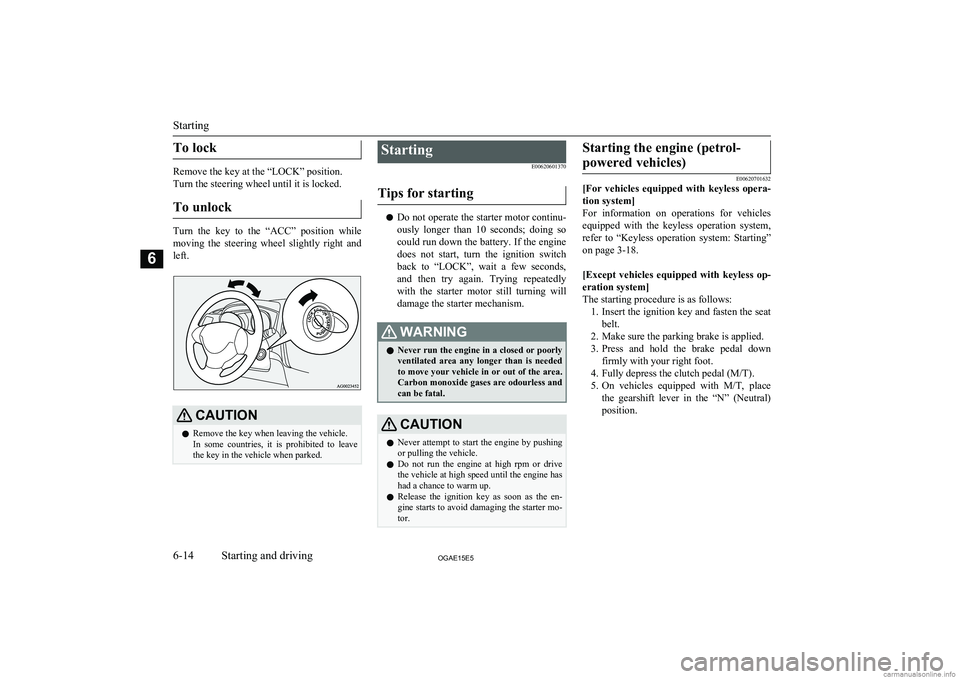
To lock
Remove the key at the “LOCK” position.
Turn the steering wheel until it is locked.
To unlock
Turn the key to the “ACC” position while
moving the steering wheel slightly right and left.
CAUTIONl Remove the key when leaving the vehicle.
In some countries, it is prohibited to leave the key in the vehicle when parked.Starting
E00620601370
Tips for starting
l Do not operate the starter motor continu-
ously longer than 10 seconds; doing so
could run down the battery. If the engine
does not start, turn the ignition switch
back to “LOCK”, wait a few seconds,
and then try again. Trying repeatedly with the starter motor still turning will damage the starter mechanism.
WARNINGl Never run the engine in a closed or poorly
ventilated area any longer than is needed
to move your vehicle in or out of the area. Carbon monoxide gases are odourless and can be fatal.CAUTIONl Never attempt to start the engine by pushing
or pulling the vehicle.
l Do not run the engine at high rpm or drive
the vehicle at high speed until the engine has had a chance to warm up.
l Release the ignition key as soon as the en-
gine starts to avoid damaging the starter mo-
tor.Starting the engine (petrol-
powered vehicles)
E00620701632
[For vehicles equipped with keyless opera-
tion system]
For information on operations for vehicles equipped with the keyless operation system,
refer to “Keyless operation system: Starting”
on page 3-18.
[Except vehicles equipped with keyless op-
eration system]
The starting procedure is as follows: 1. Insert the ignition key and fasten the seat
belt.
2. Make sure the parking brake is applied.
3. Press and hold the brake pedal down
firmly with your right foot.
4. Fully depress the clutch pedal (M/T).
5. On vehicles equipped with M/T, place
the gearshift lever in the “N” (Neutral) position.Starting
6-14OGAE15E5Starting and driving6
Page 183 of 452
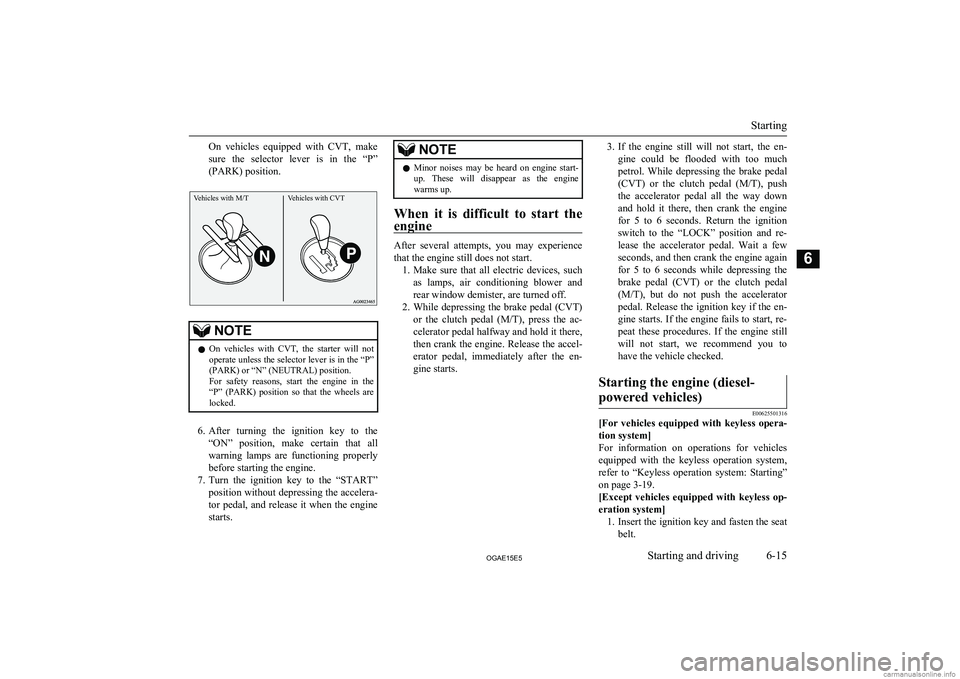
On vehicles equipped with CVT, make
sure the selector lever is in the “P”
(PARK) position.Vehicles with M/TVehicles with CVT
NOTEl On vehicles with CVT, the starter will not
operate unless the selector lever is in the “P”
(PARK) or “N” (NEUTRAL) position. For safety reasons, start the engine in the
“P” (PARK) position so that the wheels are locked.
6. After turning the ignition key to the
“ON” position, make certain that all
warning lamps are functioning properly before starting the engine.
7. Turn the ignition key to the “START”
position without depressing the accelera-
tor pedal, and release it when the engine starts.
NOTEl Minor noises may be heard on engine start-
up. These will disappear as the engine
warms up.
When it is difficult to start the
engine
After several attempts, you may experience that the engine still does not start. 1. Make sure that all electric devices, such
as lamps, air conditioning blower and
rear window demister, are turned off.
2. While depressing the brake pedal ( CVT)
or the clutch pedal ( M/T), press the ac-
celerator pedal halfway and hold it there,
then crank the engine. Release the accel- erator pedal, immediately after the en-
gine starts.
3. If the engine still will not start, the en-
gine could be flooded with too much
petrol. While depressing the brake pedal (CVT ) or the clutch pedal ( M/T), push
the accelerator pedal all the way down
and hold it there, then crank the engine for 5 to 6 seconds. Return the ignition
switch to the “LOCK” position and re- lease the accelerator pedal. Wait a fewseconds, and then crank the engine again
for 5 to 6 seconds while depressing the
brake pedal ( CVT) or the clutch pedal
(M/T ), but do not push the accelerator
pedal. Release the ignition key if the en-
gine starts. If the engine fails to start, re- peat these procedures. If the engine still will not start, we recommend you to
have the vehicle checked.Starting the engine (diesel-
powered vehicles)
E00625501316
[For vehicles equipped with keyless opera- tion system]
For information on operations for vehicles equipped with the keyless operation system,
refer to “Keyless operation system: Starting”
on page 3-19.
[Except vehicles equipped with keyless op- eration system] 1. Insert the ignition key and fasten the seat
belt.
Starting
6-15OGAE15E5Starting and driving6
Page 188 of 452
NOTElWhen the engine is automatically stopped,
changes will occur in the driving operations.
Pay close attention to the following.
• The brake booster becomes inoperative
and the pedal effort will increase. If the
vehicle is moving, press down the brake pedal harder than usual.
• The electric power steering system (EPS)
becomes inoperative and it will become
harder to turn the steering wheel.CAUTIONl Observe the following precautions when the
engine is stopped automatically. Otherwise,
an unexpected accident might occur when the engine restarts automatically.
• Do not depress the accelerator pedal to
race the engine while the vehicle is stop-
ped (regardless of whether the engine is running or stopped).
Otherwise, an unexpected accident might
occur when the engine restarts automati- cally.
• When the engine is automatically stopped,
do not attempt to exit the vehicle.
Because the engine restarts automatically when the driver’s seat belt is unfastened
or the driver’s door is opened, an unex- pected accident might occur when the ve-
hicle starts moving.CAUTION• Do not move the gearshift lever to a posi-
tion other than the “N” (Neutral) position.
If the gearshift lever is moved to a posi-
tion other than the “N” (Neutral) position,
the “
” display/indicator blinks and the
buzzer sounds.
If the gearshift lever is returned to the “N”
(Neutral) position, the display/indicator
stops blinking and the buzzer stops sound- ing. The engine will not restart if the gear-
shift lever is in a position other than the “N” (Neutral) position.
NOTEl In the following cases, the Auto Stop & Go
(AS&G) system will not operate and the en- gine will not stop automatically even if thevehicle is stopped.
• Driver’s seat belt is not fastened.
• Driver’s door is open.
• Bonnet is open.
• After the engine restarts automatically,
the vehicle speed has not exceeded ap-
proximately 5 km/h (3 mph).
• Brake booster vacuum pressure is low be-
cause the brake pedal is depressed repeat- edly or depressed harder than usual.
• After the ignition switch is turned from
the “ON” position to the “START” posi- tion, approximately 30 seconds or more
have not elapsed.NOTE• After the engine restarts automatically
and the vehicle stops again within 10 sec- onds.
• After presing the engine switch to start
the engine from the operation mode is in ON, approximately 30 seconds or morehave not elapsed.
• Engine coolant temperature is low.
• Ambient temperature is lower than ap-
proximately 3 °C.
• Air conditioning is operating and passen-
ger compartment has not sufficiently cooled.
• Mode selection dial is set to the demister
position.
Refer to “Demisting of the windscreen
and door windows: For quick demisting”
on page 7-09.
• When the air conditioning is operated in
AUTO mode where the temperature con-
trol dial is set to the max. hot or the max. cool position (for vehicles with automatic
air conditioning).
• Electric power consumption is high, such
as when the rear window demister or oth- er electrical components are operating or
the blower speed is set to a high setting.
• Battery voltage or battery performance is
low.
• Check engine warning lamp is illuminated
or the “
” display/indicator is blinking.
Auto Stop & Go (AS&G) system*
6-20OGAE15E5Starting and driving6
Page 197 of 452
Sports mode
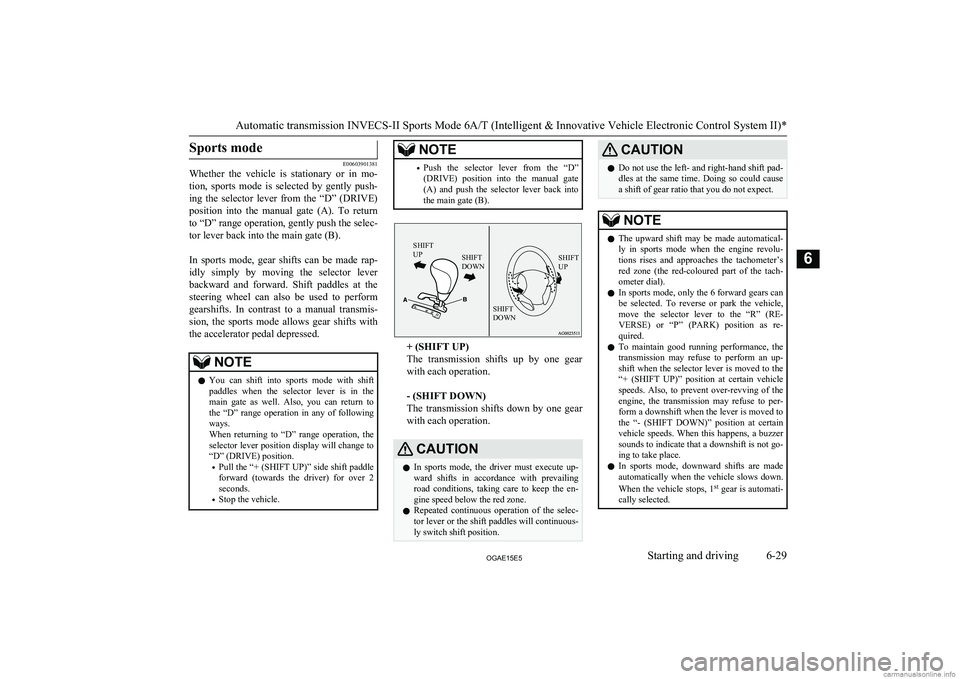
E00603901381
Whether the vehicle is stationary or in mo-
tion, sports mode is selected by gently push-
ing the selector lever from the “D” (DRIVE) position into the manual gate (A). To return
to “D” range operation, gently push the selec- tor lever back into the main gate (B).
In sports mode, gear shifts can be made rap- idly simply by moving the selector leverbackward and forward. Shift paddles at the steering wheel can also be used to perform
gearshifts. In contrast to a manual transmis- sion, the sports mode allows gear shifts with
the accelerator pedal depressed.
NOTEl You can shift into sports mode with shift
paddles when the selector lever is in the main gate as well. Also, you can return to
the “D” range operation in any of following ways.
When returning to “D” range operation, the selector lever position display will change to
“D” (DRIVE) position.
• Pull the “+ (SHIFT UP)” side shift paddle
forward (towards the driver) for over 2 seconds.
• Stop the vehicle.NOTE•Push the selector lever from the “D”
(DRIVE) position into the manual gate
(A) and push the selector lever back into the main gate (B).SHIFT
UPSHIFT
DOWNSHIFT
UPSHIFT
DOWN
+ (SHIFT UP)
The transmission shifts up by one gear
with each operation.
- (SHIFT DOWN)
The transmission shifts down by one gear
with each operation.
CAUTIONl In sports mode, the driver must execute up-
ward shifts in accordance with prevailingroad conditions, taking care to keep the en-
gine speed below the red zone.
l Repeated continuous operation of the selec-
tor lever or the shift paddles will continuous- ly switch shift position.CAUTIONl Do not use the left- and right-hand shift pad-
dles at the same time. Doing so could cause
a shift of gear ratio that you do not expect.NOTEl The upward shift may be made automatical-
ly in sports mode when the engine revolu-
tions rises and approaches the tachometer’s
red zone (the red-coloured part of the tach- ometer dial).
l In sports mode, only the
6 forward gears can
be selected. To reverse or park the vehicle, move the selector lever to the “R” (RE-
VERSE) or “P” (PARK) position as re- quired.
l To maintain good running performance, the
transmission may refuse to perform an up- shift when the selector lever is moved to the“+ (SHIFT UP)” position at certain vehicle
speeds. Also, to prevent over-revving of the engine, the transmission may refuse to per-
form a downshift when the lever is moved to
the “- (SHIFT DOWN)” position at certain vehicle speeds. When this happens, a buzzer
sounds to indicate that a downshift is not go-
ing to take place.
l In sports mode, downward shifts are made
automatically when the vehicle slows down.
When the vehicle stops, 1 st
gear is automati-
cally selected.
Automatic transmission INVECS-II Sports Mode 6A/T (Intelligent & Innovative Vehicle Electronic Control System II)*
6-29OGAE15E5Starting and driving6
Page 199 of 452
CAUTIONlIf malfunction occurs in the
A/T while driv-
ing, the warning display or the warning
display will appear on the information screen in the multi-information display.
In this case, immediately park your vehicle
in a safe place and follow these procedures:
When
warning display is showing
The automatic transmission fluid is over- heating.
Stop the vehicle in a safe place, place the se- lector lever in the “P” (PARK) position, and
open the bonnet with the engine running to allow the engine to cool down.
After a while, confirm that the
warning
display is no longer showing. It is safe to
continue driving if the display is no longer showing. If the warning display remains orappears frequently, we recommend you to have your vehicle inspected.
When
warning display is showing
It may be that there is something unusual happening in the A/T, causing a safety de-
vice to activate. We recommend you to have
your vehicle inspected as soon as possible.
Operation of the A/T
E00604200704
CAUTIONl Before selecting a gear with the engine run-
ning and the vehicle stationary, fully depressthe brake pedal to prevent the vehicle from
creeping.
The vehicle will begin to move as soon as the gear is engaged, especially when the en-
gine speed is high, at fast idle or with the air conditioning operating, the brakes should
only be released when you are ready to drive
away.
l Depress the brake pedal with the right foot at
all times.
Using the left foot could cause driver move- ment delay in case of an emergency.
l To prevent sudden acceleration, never race
the engine when shifting from the “P”
(PARK) or “N” (NEUTRAL) position.
l Operating the accelerator pedal while the
other foot is resting on the brake pedal will affect braking efficiency and may cause pre-
mature wear of brake pads.
l Use the selector lever in the correct shift po-
sition in accordance with driving conditions.
Never coast downhill backward with the se-
lector lever in the “D” (DRIVE) or sports mode position or coast forward with the se-
lector lever in the “R” (REVERSE) position.
The engine may stop and the unexpected in- crease in brake pedal effort and steeringwheel weight could lead to an accidentCAUTIONl Do not race the engine with brake pedal
pressed when the vehicle is stationary.
This can damage the A/T.
Also, when you depress the accelerator ped- al while holding down the brake pedal withthe selector lever in the “D” (DRIVE) posi-
tion, the engine revolutions may not rise as high as when performing the same operation
with the selector lever in the “N” (NEU-
TRAL) position.Passing acceleration
E00604500358
To gain extra acceleration in “D” (DRIVE)
position, push the accelerator to the floor.The A/T will automatically downshift.
NOTEl In “Sports mode”, downshifts do not take
place when the accelerator is depressed all
the way to the floor.Uphill/downhill driving
E00610500207
DRIVING UPHILL
The transmission prevents unnecessary up-
shifts even when the accelerator pedal is re- leased and ensures smooth driving.
Automatic transmission INVECS-II Sports Mode 6A/T (Intelligent & Innovative Vehicle Electronic Control System II)*
6-31OGAE15E5Starting and driving6
Page 204 of 452
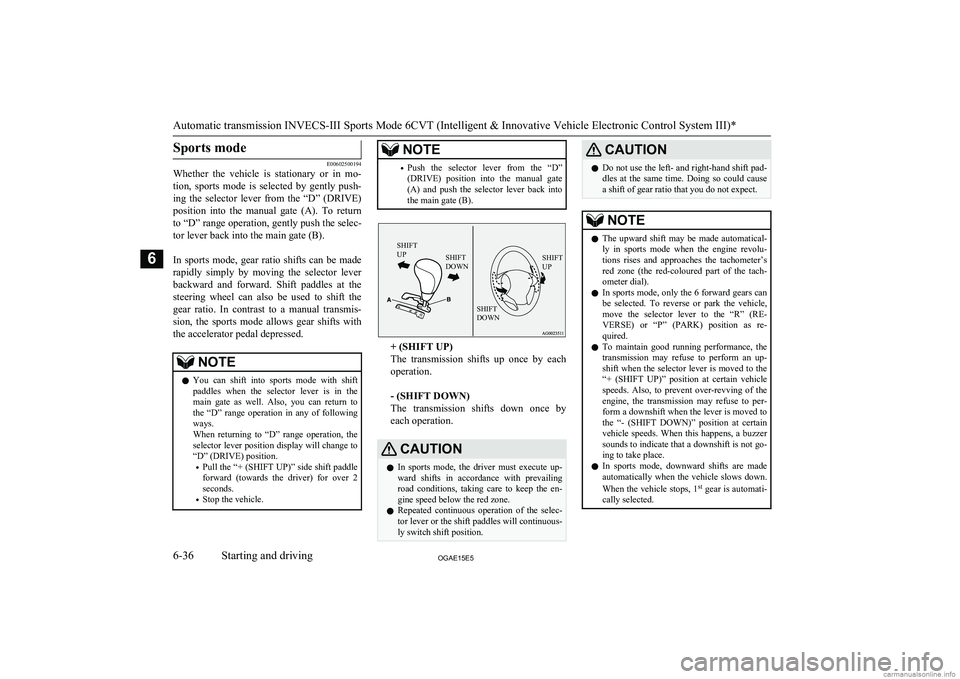
Sports mode
E00602500194
Whether the vehicle is stationary or in mo-
tion, sports mode is selected by gently push-
ing the selector lever from the “D” (DRIVE) position into the manual gate (A). To return
to “D” range operation, gently push the selec- tor lever back into the main gate (B).
In sports mode, gear ratio shifts can be made rapidly simply by moving the selector leverbackward and forward. Shift paddles at the
steering wheel can also be used to shift the gear ratio. In contrast to a manual transmis-
sion, the sports mode allows gear shifts with the accelerator pedal depressed.
NOTEl You can shift into sports mode with shift
paddles when the selector lever is in the main gate as well. Also, you can return to
the “D” range operation in any of following ways.
When returning to “D” range operation, the selector lever position display will change to
“D” (DRIVE) position.
• Pull the “+ (SHIFT UP)” side shift paddle
forward (towards the driver) for over 2 seconds.
• Stop the vehicle.NOTE•Push the selector lever from the “D”
(DRIVE) position into the manual gate
(A) and push the selector lever back into the main gate (B).SHIFT
UPSHIFT
DOWNSHIFT
UPSHIFT
DOWN
+ (SHIFT UP)
The transmission shifts up once by each operation.
- (SHIFT DOWN)
The transmission shifts down once by
each operation.
CAUTIONl In sports mode, the driver must execute up-
ward shifts in accordance with prevailingroad conditions, taking care to keep the en-
gine speed below the red zone.
l Repeated continuous operation of the selec-
tor lever or the shift paddles will continuous- ly switch shift position.CAUTIONl Do not use the left- and right-hand shift pad-
dles at the same time. Doing so could cause
a shift of gear ratio that you do not expect.NOTEl The upward shift may be made automatical-
ly in sports mode when the engine revolu-
tions rises and approaches the tachometer’s
red zone (the red-coloured part of the tach- ometer dial).
l In sports mode, only the 6 forward gears can
be selected. To reverse or park the vehicle, move the selector lever to the “R” (RE-
VERSE) or “P” (PARK) position as re- quired.
l To maintain good running performance, the
transmission may refuse to perform an up- shift when the selector lever is moved to the“+ (SHIFT UP)” position at certain vehicle
speeds. Also, to prevent over-revving of the engine, the transmission may refuse to per-
form a downshift when the lever is moved to
the “- (SHIFT DOWN)” position at certain vehicle speeds. When this happens, a buzzer
sounds to indicate that a downshift is not go-
ing to take place.
l In sports mode, downward shifts are made
automatically when the vehicle slows down.
When the vehicle stops, 1 st
gear is automati-
cally selected.
Automatic transmission INVECS-III Sports Mode 6CVT (Intelligent & Innovative Vehicle Electronic Control System III)*
6-36OGAE15E5Starting and driving6