motor oil MITSUBISHI ASX 2015 Owner's Manual (in English)
[x] Cancel search | Manufacturer: MITSUBISHI, Model Year: 2015, Model line: ASX, Model: MITSUBISHI ASX 2015Pages: 452, PDF Size: 20.1 MB
Page 2 of 452

Foreword
E09200106344
Thank you for selecting an ASX as your new vehicle.
This owner’s
manual will add to your understanding and full enjoyment of
the many fine features of this vehicle.
It contains information prepared to acquaint you with the proper way to oper-
ate and maintain your vehicle for the utmost in driving pleasure.
MITSUBISHI MOTORS Europe B.V. reserves the right to make changes in
design and specifications and/or to make additions to or improvements in
this product without obligation to install them on products previously manu- factured.
It is an absolute requirement for the driver to strictly observe all laws and
regulations concerning vehicles.
This owner’s manual has been written in compliance with such laws and reg-
ulations, but some of the contents may become contradictory with later amendment of the laws and regulations.
Please leave this owner’s manual in this vehicle at time of resale. The next
owner will appreciate having access to the information contained in this
owner’s manual.
Repairs to your vehicle:
Vehicles in the warranty period:
All warranty repairs must be carried out by a MITSUBISHI MOTORS Au- thorized Service Point.
Vehicles outside the warranty period:
Where the vehicle is repaired is at the discretion of the owner. Throughout this owner’s manual the words
WARNING and CAUTION
appear.
These
serve as reminders to be especially careful. Failure to follow instruc-
tions could result in personal injury or damage to your vehicle. WARNING
indicates a strong possibility of severe personal injury or death if in- structions are not followed. CAUTION
means hazards or unsafe practices that could cause minor personal in-
jury or damage to your vehicle.
You will see another important symbol: NOTE: gives helpful information.
*: indicates optional equipment.It may
differ according to the sales classification; refer
to the sales catalogue.
Abbreviations used in this owner’s manual:
LHD: Left-Hand Drive
RHD: Right-Hand Drive
M/T : Manual Transmission
A/T: Automatic Transmission
CVT: Continuously Variable Transmission
The symbol used on the vehicles: : See owner’s manual Information for station service
E09300104149 Fuel Capacity
Petrol-powered vehicles 2WD models
58 litres
*1
63 litres *2
4WD models 60 litres
Diesel-powered vehicles 60 litres Fuel requirements
Petrol-powered vehicles
Unleaded petrol octane number (EN228)1600 models, 1800 models: 95 RON or higher
2000 models: 90 RON or higher
Diesel-powered vehicles Cetane number (EN590): 51 or higher
Refer to the “General information” section for the fuel selection. Engine oil
Refer to the “Maintenance” section for the selection of engine oil. Tyre inflation pressure
Refer to the “Maintenance” section for the tyre inflation pressure.
*1 : For vehicles with vehicle identification numbers that begin with “4”
*2 : For vehicles with vehicle identification numbers that begin with “J” CAUTION
l Diesel-powered vehicles are designed to use only diesel fuel that meets the EN 590 standard.
Use of any other type of diesel fuel can adversely affect the engine. NOTE
l
For the location of the vehicle identification number, refer to “Vehicle identification number” on page 11-02. © 2015 Mitsubishi Motors Corporation
15 OGAE15E5
BLO-15-000456
Page 141 of 452
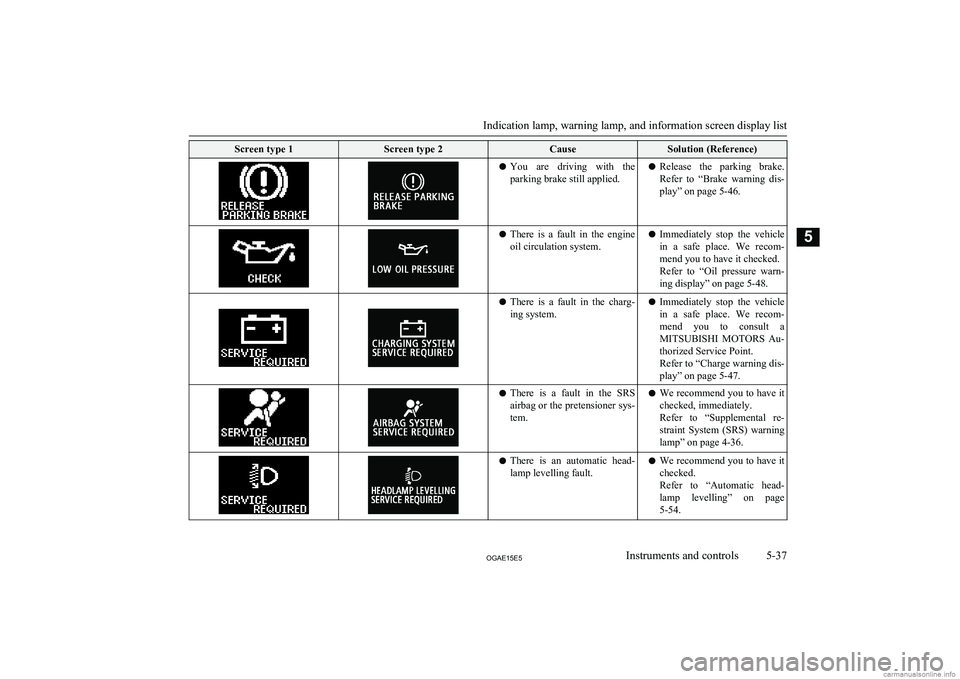
Screen type 1Screen type 2CauseSolution (Reference)lYou are driving with the
parking brake still applied.l Release the parking brake.
Refer to “Brake warning dis- play” on page 5-46.l There is a fault in the engine
oil circulation system.l Immediately stop the vehicle
in a safe place. We recom- mend you to have it checked.
Refer to “Oil pressure warn-
ing display” on page 5-48.l There is a fault in the charg-
ing system.l Immediately stop the vehicle
in a safe place. We recom-mend you to consult a
MITSUBISHI MOTORS Au-
thorized Service Point.
Refer to “Charge warning dis-
play” on page 5-47.l There is a fault in the SRS
airbag or the pretensioner sys-tem.l We recommend you to have it
checked, immediately.
Refer to “Supplemental re-
straint System (SRS) warning
lamp” on page 4-36.l There is an automatic head-
lamp levelling fault.l We recommend you to have it
checked.
Refer to “Automatic head-
lamp levelling” on page 5-54.
Indication lamp, warning lamp, and information screen display list
5-37OGAE15E5Instruments and controls5
Page 143 of 452
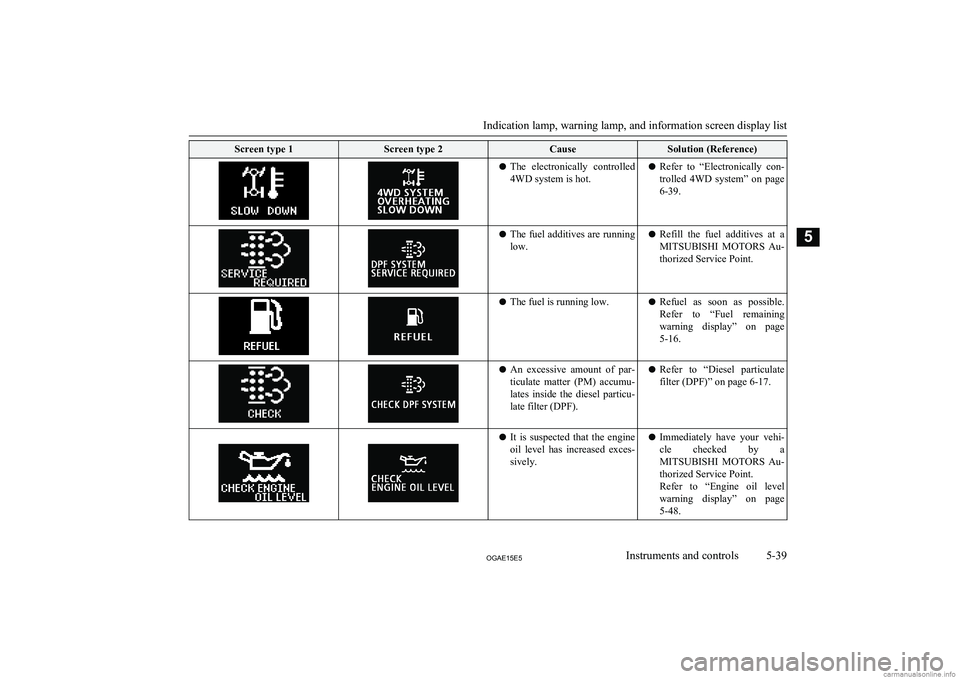
Screen type 1Screen type 2CauseSolution (Reference)lThe electronically controlled
4WD system is hot.l Refer to “Electronically con-
trolled 4WD system” on page 6-39.l The fuel additives are running
low.l Refill the fuel additives at a
MITSUBISHI MOTORS Au-
thorized Service Point.l The fuel is running low.lRefuel as soon as possible.
Refer to “Fuel remaining
warning display” on page 5-16.l An excessive amount of par-
ticulate matter (PM) accumu- lates inside the diesel particu-
late filter (DPF).l Refer to “Diesel particulate
filter (DPF)” on page 6-17.l It is suspected that the engine
oil level has increased exces- sively.l Immediately have your vehi-
cle checked by a
MITSUBISHI MOTORS Au-
thorized Service Point.
Refer to “Engine oil level warning display” on page5-48.
Indication lamp, warning lamp, and information screen display list
5-39OGAE15E5Instruments and controls5
Page 152 of 452
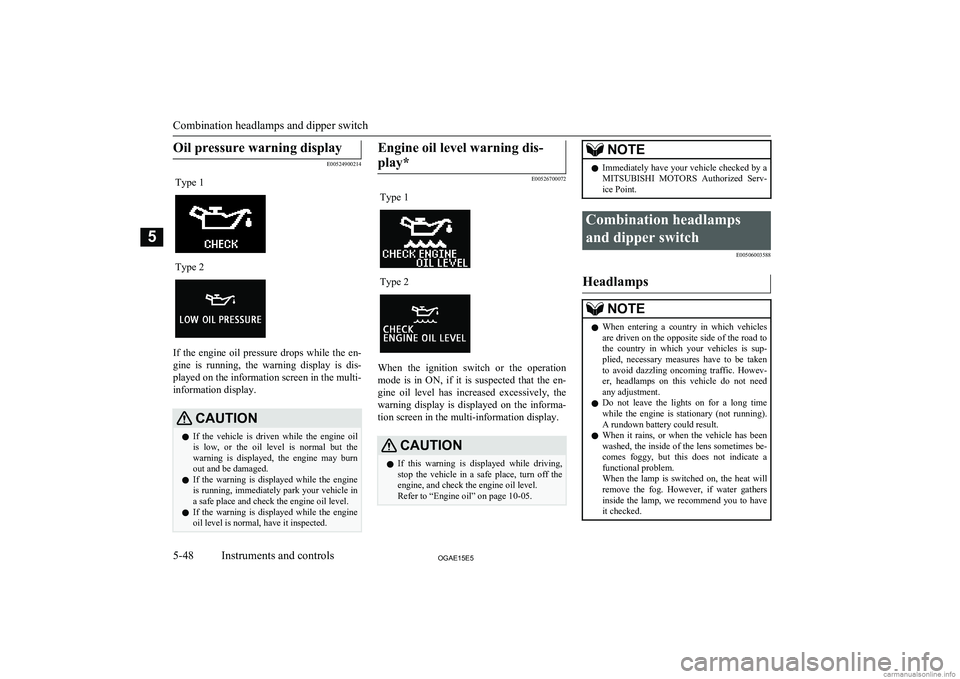
Oil pressure warning display
E00524900214
Type 1Type 2
If the engine oil pressure drops while the en-gine is running, the warning display is dis-
played on the information screen in the multi- information display.
CAUTIONl If the vehicle is driven while the engine oil
is low, or the oil level is normal but the
warning is displayed, the engine may burn out and be damaged.
l If the warning is displayed while the engine
is running, immediately park your vehicle in
a safe place and check the engine oil level.
l If the warning is displayed while the engine
oil level is normal, have it inspected.Engine oil level warning dis-
play*
E00526700072
Type 1Type 2
When the ignition switch or the operation mode is in ON, if it is suspected that the en-
gine oil level has increased excessively, the warning display is displayed on the informa-
tion screen in the multi-information display.
CAUTIONl If this warning is displayed while driving,
stop the vehicle in a safe place, turn off the engine, and check the engine oil level.
Refer to “Engine oil” on page 10-05.NOTEl Immediately have your vehicle checked by a
MITSUBISHI MOTORS Authorized Serv-
ice Point.Combination headlamps
and dipper switch E00506003588
Headlamps
NOTElWhen entering a country in which vehicles
are driven on the opposite side of the road tothe country in which your vehicles is sup- plied, necessary measures have to be takento avoid dazzling oncoming traffic. Howev-
er, headlamps on this vehicle do not need any adjustment.
l Do not leave the lights on for a long time
while the engine is stationary (not running).A rundown battery could result.
l When it rains, or when the vehicle has been
washed, the inside of the lens sometimes be-
comes foggy, but this does not indicate a functional problem.
When the lamp is switched on, the heat will
remove the fog. However, if water gathers
inside the lamp, we recommend you to have it checked.
Combination headlamps and dipper switch
5-48OGAE15E5Instruments and controls5
Page 346 of 452

To install
1.Make sure the tabs (A) of the back of the
wheel cover are not broken and correctly fitted on the rings (B). If in doubt, do not install the wheel cover and consult aMITSUBISHI MOTORS Authorized
Service Point.
2. Align the air valve (C) of the tyre with
the notch (D) in the wheel cover.
NOTEl Full wheel covers have a symbol mark (E)
provided on the reverse side to show the air
valve location.
Before installing the wheel cover to the wheel, make sure that the opening with the
symbol mark is correctly aligned with the air valve.
3. Push the underside (F) of the wheel cov-
er into the wheel.
4. Gently push both sides (G) of the wheel
cover and hold them in place with both knees.
5. Gently tap around the circumference of
the wheel cover at the top (H), then push
the wheel cover into place.
Towing
E00801505064
If your vehicle needs to be tow- ed
If you need to tow your vehicle, we recom- mend that you contact a MITSUBISHI
MOTORS Authorized Service Point or tow
truck company.
In the following cases, transport the vehicle
using a tow truck.
l The engine runs but the vehicle does not
move or abnormal noise is produced.
l Inspection of the vehicle’s underside re-
veals that oil or some other fluid is leak- ing.
If a wheel gets stuck in a ditch, do not try to
tow the vehicle.
Please contact your MITSUBISHI MOTORS
Authorized Service Point or a commercial
tow truck service for assistance.
Only when you cannot receive a towing serv-
ice from a MITSUBISHI MOTORS Author-
ized Service Point or commercial tow truck service, tow your vehicle carefully in accord-
ance with the instructions given in “Emer- gency towing” in this part.
Towing
8-20OGAE15E5For emergencies8
Page 356 of 452
CAUTIONTherefore;• Maintain a distance of approx. 70 cm
or
more between the vehicle body and the
washing nozzle.
• When washing around the door glass,
hold the nozzle at a distance of more than
70 cm and at right angles to the glass sur-
face.
l After washing the vehicle, drive the vehicle
slowly while lightly depressing the brake
pedal several times in order to dry out the brakes.
Leaving the brakes wet could result in re- duced braking performance. Also, there is a
possibility that they could freeze up or be- come inoperative due to rust, rendering the
vehicle unable to move.
l When using an automatic car wash, pay at-
tention to the following items, referring to the operation manual or consulting a car
wash operator. If the following procedure is not followed, it could result in damage to your vehicle.
• The outside mirrors are retracted.
• The antenna is removed.
• The wiper arms are secured in place with
tape.
• If your vehicle is equipped with a rear
spoiler or roof rails, consult a car wash operator before using the car wash.
• If your vehicle has rain sensor wipers,
place the wiper switch lever in the “OFF” position to deactivate the rain sensor.During cold weather
Salt and other chemicals spread on the roads
in some areas in winter can have a harmful effect on the vehicle body. You should there-
fore wash the vehicle as often as possible in accordance with our care-instructions. It is
recommended to have a preservative applied
and the underfloor protection checked before and after the cold weather season.
After washing your vehicle, wipe off all wa- terdrops from the rubber parts around the
doors to prevent the doors from freezing.
NOTEl To prevent freezing of the weatherstripping
on the doors, bonnet, etc., they should be treated with silicone spray.Waxing
E00901000863
Waxing the vehicle will help prevent the ad-
herence of dust and road chemicals to the paintwork. Apply a wax solution after wash- ing the vehicle, or at least once every three
months to assist displacing of water.
Do not wax your vehicle in direct sunlight.
You should wax after the surfaces have
cooled.
CAUTIONl Waxes containing high abrasive compounds
should not be used. Such waxes remove rust and stains effectively from the paintwork but
they are harmful to the lustre on the painted
surface and the plated surface.
Further, they are harmful to glossy surfaces such as grille, garnish, mouldings, etc.
l Do not use petrol or paint thinners to remove
road tar or other contamination to the pain-
ted surface.
l Do not apply wax to sections that have a
black mat paint coating, as doing so could cause uneven discolouration, spots or stains.
If wax gets on such areas, wipe it off using
lukewarm water and a soft cloth.Polishing
E00901100066
The vehicle should only be polished if the
paintwork has become stained or lost its lus- tre. Do not polish parts with a mat coating
and the plastic bumpers. Doing so could cause stains or damage the finish.
Damaged paint
E00901200201
Small cracks and scratches in the paint coat
should be touched up as soon as possible
with MITSUBISHI MOTORS GENUINE
touch-up paint to prevent corrosion.
Cleaning the exterior of your vehicle
9-04OGAE15E5Vehicle care9
Page 365 of 452
lUse engine oil conforming to the follow-
ing classification: • ACEA classification: “For service C1, C2, C3 or C4”
• JASO classification: “For service DL-1”
If those classifications are not available,
contact a MITSUBISHI MOTORS Au-
thorized Service Point.NOTEl Use of additives is not recommended since
they may reduce the effectiveness of addi-
tives already included in the engine oil. It may result in failure of the mechanical as-
sembly.Engine coolant
E01000503437
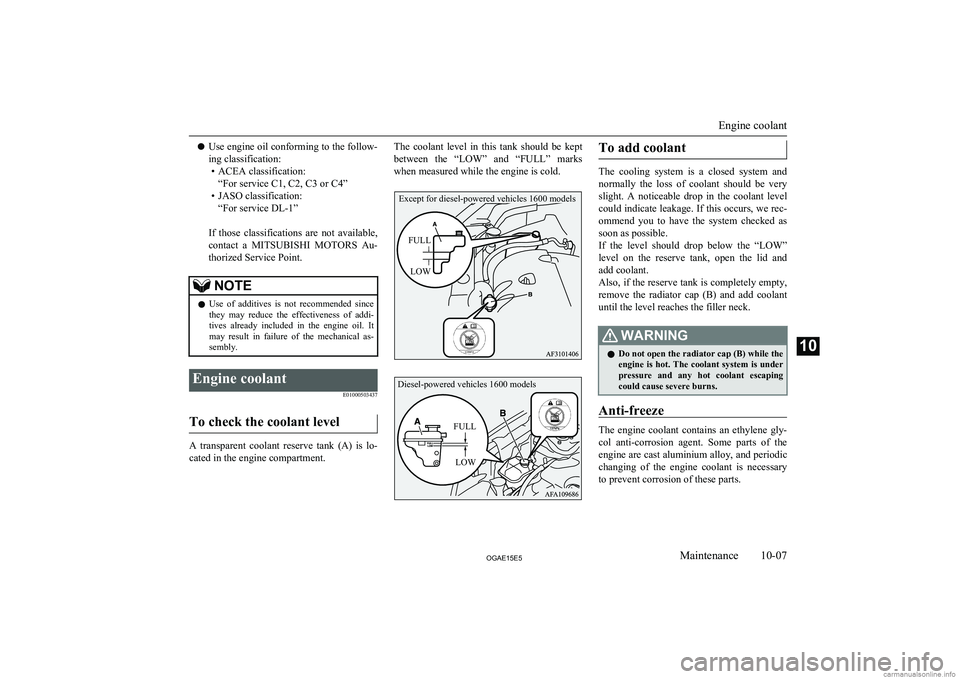
To check the coolant level
A transparent coolant reserve tank (A) is lo-cated in the engine compartment.
The coolant level in this tank should be kept
between the “LOW” and “FULL” marks when measured while the engine is cold.To add coolant
The cooling system is a closed system andnormally the loss of coolant should be very
slight. A noticeable drop in the coolant level
could indicate leakage. If this occurs, we rec- ommend you to have the system checked as
soon as possible.
If the level should drop below the “LOW” level on the reserve tank, open the lid and
add coolant.
Also, if the reserve tank is completely empty, remove the radiator cap (B) and add coolant until the level reaches the filler neck.
WARNINGl Do not open the radiator cap (B) while the
engine is hot. The coolant system is under
pressure and any hot coolant escaping
could cause severe burns.
Anti-freeze
The engine coolant contains an ethylene gly-
col anti-corrosion agent. Some parts of the engine are cast aluminium alloy, and periodic
changing of the engine coolant is necessary to prevent corrosion of these parts.
Engine coolant
10-07OGAE15E5Maintenance10 Except for diesel-powered vehicles 1600 models
FULLLOW Diesel-powered vehicles 1600 modelsFULLLOW
Page 366 of 452

Except for diesel-powered 1600models
Use “ MITSUBISHI MOTORS GENUINE
SUPER LONG LIFE COOLANT PREMI-
UM” or equivalent*.
*: similar high quality ethylene glycol based
non-silicate, non-amine, non-nitrate and non- borate coolant with long life hybrid organic acid technology.
MITSUBISHI MOTORS GENUINE Coolant
has excellent protection against corrosion and rust formation of all metals including alumi-
nium and can avoid blockages in the radiator,
heater, cylinder head, engine block, etc.
Diesel-powered 1600 models
Use “ALTECO Freecor DSC, BASF Glysan- tin Alu Protect Premium/G30 or G33, or Bru-
garolas Bradol 497”.
This coolant has excellent protection against
corrosion and rust formation of all metals in-
cluding aluminium and can avoid clogs in the
radiator, heater, cylinder head, engine block,
etc.
Because of the necessity of this anti-corro-
sion agent, the coolant must not be replaced with plain water even in summer.
Because of the necessity of this anti-corro-
sion agent, the coolant must not be replaced with plain water even in summer. The re-
quired concentration of anti-freeze differs de-
pending on the expected ambient tempera- ture.
Above -35 °C: 50 % concentration of anti-
freeze
Below -35 °C: 60 % concentration of anti-
freezeCAUTIONl Do not use alcohol or methanol anti-freeze
or any engine coolants mixed with alcohol or methanol anti-freeze. The use of an im-
proper anti-freeze can cause corrosion of the aluminium components.
l Do not use water to adjust the concentration
of coolant.
l Concentrations exceeding 60 % will result in
a reduction of both the anti-freeze and cool-
ing performance thus adversely affecting the engine.
l Do not top up with water only.
Water by itself reduces the rust-protective
and anti-freeze qualities of the coolant and has a lower boiling point. It can also causedamage to the cooling system if it should freeze. Do not use tapwater, as it can causecorrosion and rust formation.During cold weather
If the temperatures in your area drop below
freezing, there is the danger that the coolant
in the engine or radiator could freeze and cause severe damage to the engine and/or ra-diator. Add a sufficient amount of anti-freeze
to the coolant to prevent it from freezing. The concentration should be checked before the start of cold weather and anti-freeze add- ed to the system if necessary.
Washer fluid
E01000702227
Open the washer fluid reservoir cap andcheck the level of washer fluid with the dip- stick.
If the level is low, replenish the container with washer fluid.
Washer fluid
10-08OGAE15E5Maintenance10 FULLEMPTY
Page 372 of 452

Check the tyre inflation pressure of all the tyres while they are cold; if insufficient or excessive, adjust to the specified value.
After the tyre inflation pressure has been adjusted, check the tyres for damage and air leaks. Be sure to put caps on the valves.
Wheel condition
E01001800885
1- Location of the tread wear indicator
2- Tread wear indicator
Check the tyres for cuts, cracks and other damage. Replace the tyres if there are deep
cuts or cracks. Also check each tyre for pieces of metal or pebbles.
The use of worn tyres can be very dangerous
because of the greater chance of skidding or
hydroplaning. The tread depth of the tyres
must exceed 1.6 mm in order for the tyres to meet the minimum requirement for use.
Tread wear indicators will appear on the sur-
face of the tyre as the tyre wears, thereby in-
dicating that the tyre no longer meets the
minimum requirement for use. When these wear indicators appear, the tyres must be re-
placed with new ones.
On 4-wheel drive vehicles, when replacement of any of the tyres is necessary, replace all of
them.CAUTIONl Always use tyres of the same size, same
type, and same brand, and which have no wear differences.
Using tyres of different size, type, brands or degree of wear, will increase the differential
oil temperature, resulting in possible damage
to the driving system. Further, the drive train will be subjected to excessive loading, possi-bly leading to oil leakage, component seiz-ure, or other serious faults.Replacing tyres and wheels
E01007201514
CAUTIONl Avoid using different size tyres from the one
listed and the combined use of different
types of tyres, as this can affect driving safe- ty.
Refer to “Tyres and wheels” on page
11-13.
l Even if a wheel has the same rim size and
offset as the specified type of wheel, its
shape may prevent it from being fitted cor- rectly. We recommend you to consult a spe-
cialist before using wheels that you have.
l As your vehicle is equipped with a tyre pres-
sure monitoring system, only MITSUBISHI
MOTORS genuine wheels should be used.
Use of another type of wheel risks air leaks and sensor damage, as it will not be possible
to install the tyre inflation pressure sensors
properly.
Refer to “Tyre pressure monitoring system
(TPMS)*” on page 6-59.
Tyres
10-14OGAE15E5Maintenance10
Page 377 of 452

General maintenanceE01002700520
Fuel, engine coolant, oil and ex- haust gas leakage
Look under the body of your vehicle to check
for fuel, engine coolant, oil and exhaust gas
leaks.
WARNINGl If you see a suspicious fuel leak or if you
smell fuel, do not operate the vehicle; call
your MITSUBISHI MOTORS Author-
ized Service Point for assistance.
Exterior and interior lamp op-
eration
Operate the combination lamp switch to
check that all lamps are functioning properly.
If the lamps do not illuminate, the probable cause is a blown fuse or defective lamp bulb.
Check the fuses first. If there is no blown
fuse, check the lamp bulbs.
For information regarding the inspection and
replacement of the fuses and the lamp bulbs, refer to “Fuses” on page 10-20 and “Re-
placement of lamp bulbs” on page 10-26.
If the fuses and bulbs are all OK, we recom-
mend you to have your vehicle checked and
repaired.
Meter, gauge and indicator/warning lamps operation
Start the engine and check the operation of all instruments, gauges and indication andwarning lamps.
If there is anything wrong, we recommend you to have your vehicle inspected.
Hinges and latches lubrication
Check all latches and hinges, and, if necessa- ry, have them lubricated.
For cold and snowy weather
E01002800361
Ventilation slots
The ventilation slots in front of the wind-
screen should be kept clear of leaves or brushed clear after heavy snowfall, so that
the operation of the heating and ventilation
systems will not be impaired.
Weatherstripping
To prevent freezing of the weatherstripping
on the doors, bonnet, etc., they should be treated with silicone grease.
Additional equipment
It is a good idea to carry a shovel or a short-
handled spade in the vehicle during the win- ter so that you can clear away snow if you get stranded. A small hand-brush for sweeping
snow off the vehicle and a plastic scraper for the windscreen and rear window are also use-ful.
Fusible links
E01002900564
The fusible links will melt to prevent a fire if
a large current attempts to flow through cer- tain electrical systems.
In case of a melted fusible link, we recom- mend you to have your vehicle inspected.
For the fusible links, please refer to “Fuse
load capacity” on page 10-22.
General maintenance
10-19OGAE15E5Maintenance10