height MITSUBISHI ASX 2018 (in English) User Guide
[x] Cancel search | Manufacturer: MITSUBISHI, Model Year: 2018, Model line: ASX, Model: MITSUBISHI ASX 2018Pages: 514, PDF Size: 34.89 MB
Page 233 of 514
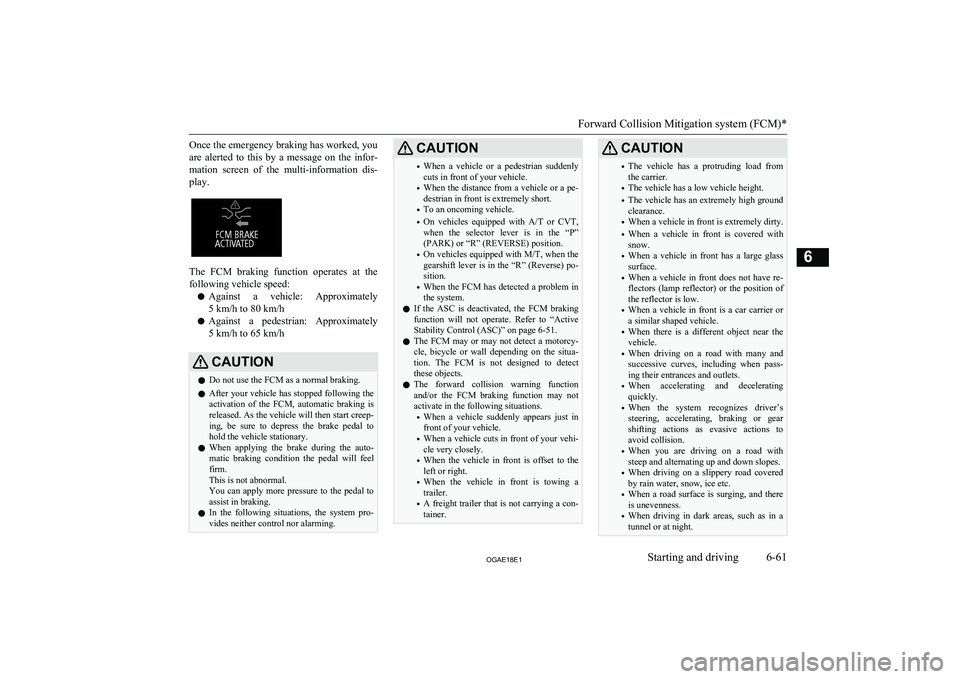
Once the emergency braking has worked, you
are alerted to this by a message on the infor- mation screen of the multi-information dis- play.
The FCM braking function operates at the
following vehicle speed:
l Against a vehicle: Approximately
5 km/h to 80 km/h
l Against a pedestrian: Approximately
5 km/h to 65 km/h
CAUTIONl Do not use the FCM as a normal braking.
l After your vehicle has stopped following the
activation of the FCM, automatic braking is
released. As the vehicle will then start creep-
ing, be sure to depress the brake pedal to hold the vehicle stationary.
l When applying the brake during the auto-
matic braking condition the pedal will feel
firm.
This is not abnormal.
You can apply more pressure to the pedal to
assist in braking.
l In the following situations, the system pro-
vides neither control nor alarming.CAUTION• When a vehicle or a pedestrian suddenly
cuts in front of your vehicle.
• When the distance from a vehicle or a pe-
destrian in front is extremely short.
• To an oncoming vehicle.
• On vehicles equipped with
A/T or CVT,
when the selector lever is in the “P” (PARK) or “R” (REVERSE) position.
• On vehicles equipped with
M/T, when the
gearshift lever is in the “R” (Reverse) po-
sition.
• When the FCM has detected a problem in
the system.
l If the ASC is deactivated, the FCM braking
function will not operate. Refer to “Active
Stability Control (ASC)” on page 6-51.
l The FCM may or may not detect a motorcy-
cle, bicycle or wall depending on the situa-
tion. The FCM is not designed to detect these objects.
l The forward collision warning function
and/or the FCM braking function may not
activate in the following situations.
• When a vehicle suddenly appears just in
front of your vehicle.
• When a vehicle cuts in front of your vehi-
cle very closely.
• When the vehicle in front is offset to the
left or right.
• When the vehicle in front is towing a
trailer.
• A freight trailer that is not carrying a con-
tainer.CAUTION• The vehicle has a protruding load from
the carrier.
• The vehicle has a low vehicle height.
• The vehicle has an extremely high ground
clearance.
• When a vehicle in front is extremely dirty.
• When a vehicle in front is covered with
snow.
• When a vehicle in front has a large glass
surface.
• When a vehicle in front does not have re-
flectors (lamp reflector) or the position of the reflector is low.
• When a vehicle in front is a car carrier or
a similar shaped vehicle.
• When there is a different object near the
vehicle.
• When driving on a road with many and
successive curves, including when pass- ing their entrances and outlets.
• When accelerating and decelerating
quickly.
• When the system recognizes driver’s
steering, accelerating, braking or gear
shifting actions as evasive actions to
avoid collision.
• When you are driving on a road with
steep and alternating up and down slopes.
• When driving on a slippery road covered
by rain water, snow, ice etc.
• When a road surface is surging, and there
is unevenness.
• When driving in dark areas, such as in a
tunnel or at night.
Forward Collision Mitigation system (FCM)*
6-61OGAE18E1Starting and driving6
Page 251 of 514
NOTElThe sensors do not detect objects located in
the area directly below or near the bumper. If the height of an object is lower than the
mounted position of the corner or back sen-
sors, the sensors may not continue detecting it even if they detected it initially.
For information on how to change the detec-
tion areas, please refer to “Changing the de- tection areas” on page 6-80.
CAUTIONl The reversing sensor system may not operate
properly under the following conditions:
• The sensors or surroundings are covered
with ice, snow, or mud.
• The sensors are frozen.
• The system receives ultrasonic noise from
other sources (the horns of other vehicles, motorcycle engines, brakes, radios, pour-
ing rain, splashing water, tyre chains, etc.).
• The sensors are extremely hot or cold
(while the vehicle is parked for a long pe- riod of time under a blazing sun or in coldweather).
• The vehicle tilts significantly.
• The vehicle is driven on a rough road
(with a bumpy, gravel, hilly, or grassy surface).
• The vehicle is too close to an obstacle.CAUTION•The sensors or surroundings have been
wiped by hand, or stickers or accessorieshave been attached.
l The reversing sensor system may not proper-
ly detect the following:
• Objects that are thin, such as wire nets or
ropes.
• Objects that absorb sound waves, such as
snow.
• Objects that are shaped with a sharp an-
gle.
• Objects with a smooth surface, such as
glass.
• Objects that are low, such as kerbstones.NOTEl The buzzer may sound lower than the nor-
mal warning sound when the reversing sen-sor system is receiving ultrasonic noise from
other sources, but this is not a malfunction.
The buzzer will stop sounding and the sys- tem will return to normal operation after thenoise is no longer received.To operate
E00615700738
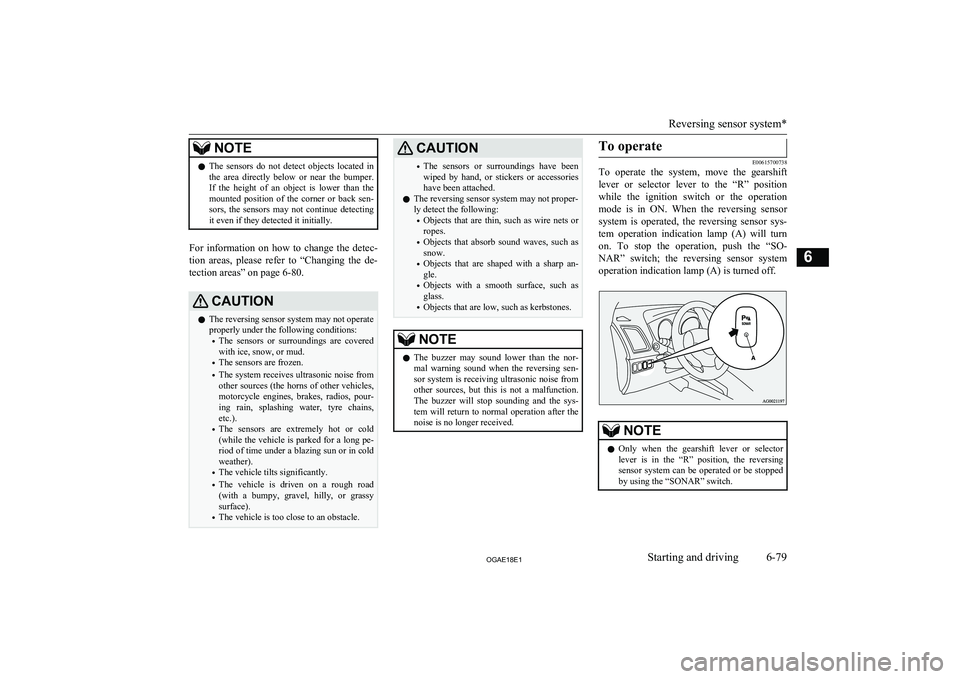
To operate the system, move the gearshift
lever or selector lever to the “R” position while the ignition switch or the operationmode is in ON. When the reversing sensor
system is operated, the reversing sensor sys-
tem operation indication lamp (A) will turn on. To stop the operation, push the “SO-
NAR” switch; the reversing sensor system operation indication lamp (A) is turned off.
NOTEl Only when the gearshift lever or selector
lever is in the “R” position, the reversing
sensor system can be operated or be stopped by using the “SONAR” switch.
Reversing sensor system*
6-79OGAE18E1Starting and driving6
Page 341 of 514
Coat hook*E00725600597
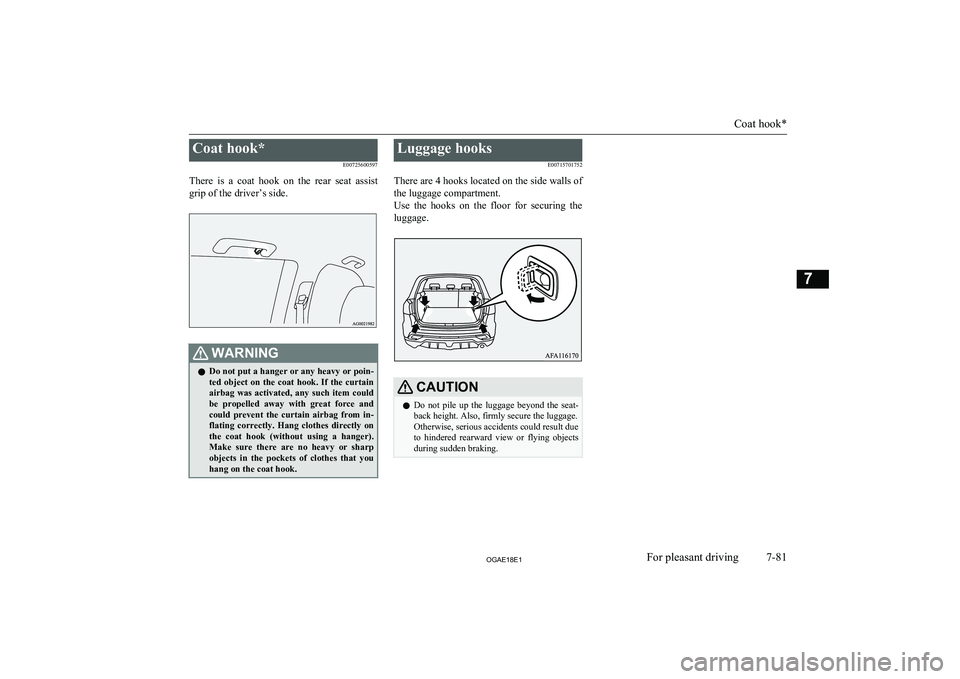
There is a coat hook on the rear seat assist
grip of the driver’s side.WARNINGl Do not put a hanger or any heavy or poin-
ted object on the coat hook. If the curtain
airbag was activated, any such item could
be propelled away with great force and could prevent the curtain airbag from in-
flating correctly. Hang clothes directly on the coat hook (without using a hanger).
Make sure there are no heavy or sharp objects in the pockets of clothes that you
hang on the coat hook.Luggage hooks
E00715701752
There are 4 hooks located on the side walls of
the luggage compartment.
Use the hooks on the floor for securing the luggage.CAUTIONl Do not pile up the luggage beyond the seat-
back height. Also, firmly secure the luggage.
Otherwise, serious accidents could result due
to hindered rearward view or flying objects
during sudden braking.
Coat hook*
7-81OGAE18E1For pleasant driving7
Page 390 of 514
CAUTIONlAvoid the combined use of different types of
tyres.
Using different types of tyres can affect ve-
hicle performance and safety.Snow tyres
E01002001852
The use of snow tyres is recommended for
driving on snow and ice. To preserve driving stability, mount snow tyres of the same size and tread pattern on all 4 wheels.
A snow tyre that is worn down more than
50% is no longer appropriate to use.
Snow tyres which do not meet specifications must not be used.
CAUTIONl Observe permissible maximum speed for
your snow tyres and the legal speed limit.
l As your vehicle is equipped with a tyre pres-
sure monitoring system, only MITSUBISHI
MOTORS genuine wheels should be used.
Use of another type of wheel risks air leaks and sensor damage, as it will not be possible
to install the tyre inflation pressure sensors
properly.
Refer to “Tyre pressure monitoring system (TPMS)*” on page 6-71.NOTEl The laws and regulations concerning snow
tyres (driving speed, required use, type, etc.)
vary. Find out and follow the laws and regu- lations in the area you intend to drive.
l If flange nuts are used on your vehicle,
change to tapered nuts when steel wheels are used.Tyre chains
E01002103394
If tyre chains have to be used, ensure that
they are fitted only on the drive wheels
(front) in accordance with the manufacturer’s instructions.
On 4WD vehicles in which the driving power
is distributed preferentially to the front wheels, ensure that the tyre chains are fitted on the front.
Use only tyre chains which are designed for use with the tyres mounted on the vehicle: use of the incorrect size or type of chain
could result in damage to the vehicle body.
Contact a MITSUBISHI MOTORS Author-
ized Service Point before putting on tyre chains. The max. chain height is as follows.
Tyre sizeWheel sizeMax. chain
height [mm]215/70R16
215/65R1616 x 6 1/2 J9 mmTyre sizeWheel sizeMax. chain
height [mm]215/60R1717 x 6 1/2 J225/55R1818x7 J
When driving with tyre chains on the tyres,
do not drive faster than 50 km/h (30 mph) .
When you reach roads that are not covered in snow, immediately remove the tyre chains.
CAUTIONl Practice fitting the chains before you need
them. Don’t expect help from other people
in the cold.
l Choose a clear straight stretch of road where
you can pull over and still be seen while you are fitting the chains.
l Do not fit chains before you need them. This
will wear out your tyres and the road sur- face.
l After driving around 100-300 metres, stop
and retighten the chains.
l Drive cautiously and do not exceed 50 km/h
(30 mph).
Remember that preventing accidents is not
the purpose of tyre chains.
l When tyre chains are installed, take care that
they do not damage the disc wheel or body.
Tyres
10-16OGAE18E1Maintenance10
Page 415 of 514
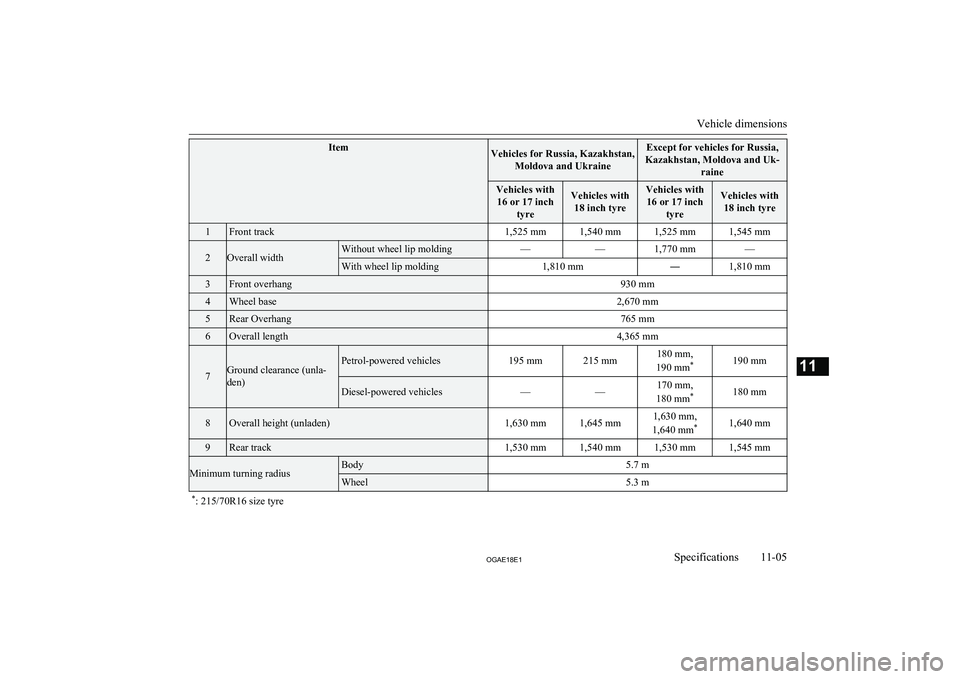
ItemVehicles for Russia, Kazakhstan,Moldova and UkraineExcept for vehicles for Russia,
Kazakhstan, Moldova and Uk- raineVehicles with16 or 17 inch tyreVehicles with18 inch tyreVehicles with16 or 17 inch tyreVehicles with18 inch tyre1Front track1,525 mm1,540 mm1,525 mm1,545 mm2Overall widthWithout wheel lip molding——1,770 mm—With wheel lip molding1,810 mm―1,810 mm3Front overhang930 mm4Wheel base2,670 mm5Rear Overhang765 mm6Overall length4,365 mm
7Ground clearance (unla-
den)
Petrol-powered vehicles195 mm215 mm180 mm,
190 mm *190 mmDiesel-powered vehicles——170 mm,
180 mm *180 mm8Overall height (unladen)1,630 mm1,645 mm1,630 mm,
1,640 mm *1,640 mm9Rear track1,530 mm1,540 mm1,530 mm1,545 mmMinimum turning radiusBody5.7 mWheel5.3 m*
: 215/70R16 size tyre
Vehicle dimensions
11-05OGAE18E1Specifications11
Page 434 of 514
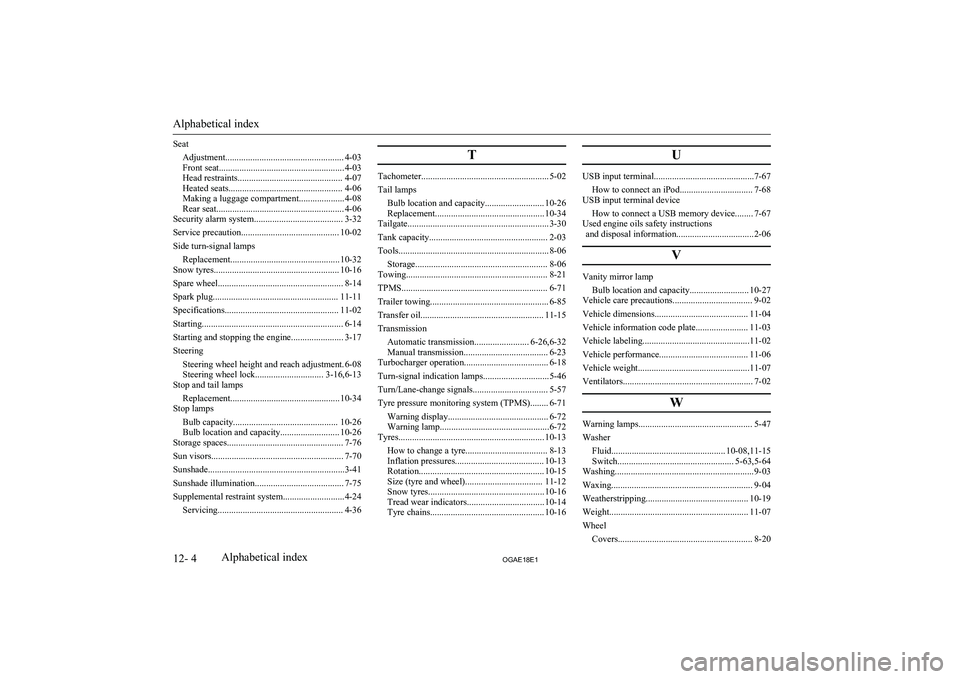
SeatAdjustment.................................................... 4-03
Front seat....................................................... 4-03
Head restraints.............................................. 4-07
Heated seats.................................................. 4-06
Making a luggage compartment....................4-08
Rear seat........................................................ 4-06
Security alarm system....................................... 3-32
Service precaution........................................... 10-02
Side turn-signal lamps Replacement................................................ 10-32
Snow tyres....................................................... 10-16
Spare wheel....................................................... 8-14
Spark plug....................................................... 11-11
Specifications.................................................. 11-02
Starting.............................................................. 6-14
Starting and stopping the engine....................... 3-17
Steering Steering wheel height and reach adjustment. 6-08
Steering wheel lock.............................. 3-16,6-13
Stop and tail lamps
Replacement................................................ 10-34
Stop lamps
Bulb capacity.............................................. 10-26
Bulb location and capacity.......................... 10-26
Storage spaces................................................... 7-76
Sun visors.......................................................... 7-70
Sunshade............................................................3-41
Sunshade illumination....................................... 7-75
Supplemental restraint system...........................4-24 Servicing....................................................... 4-36
T
Tachometer........................................................ 5-02
Tail lamps Bulb location and capacity.......................... 10-26
Replacement................................................ 10-34
Tailgate.............................................................. 3-30
Tank capacity.................................................... 2-03
Tools.................................................................. 8-06 Storage.......................................................... 8-06
Towing.............................................................. 8-21
TPMS................................................................ 6-71
Trailer towing.................................................... 6-85
Transfer oil...................................................... 11-15
Transmission Automatic transmission........................ 6-26,6-32
Manual transmission..................................... 6-23
Turbocharger operation..................................... 6-18
Turn-signal indication lamps.............................5-46
Turn/Lane-change signals................................. 5-57
Tyre pressure monitoring system (TPMS)........ 6-71 Warning display............................................ 6-72
Warning lamp................................................6-72
Tyres................................................................ 10-13
How to change a tyre.................................... 8-13
Inflation pressures....................................... 10-13
Rotation....................................................... 10-15
Size (tyre and wheel).................................. 11-12
Snow tyres................................................... 10-16
Tread wear indicators.................................. 10-14
Tyre chains.................................................. 10-16
U
USB input terminal............................................7-67
How to connect an iPod................................ 7-68
USB input terminal device
How to connect a USB memory device........ 7-67
Used engine oils safety instructions and disposal information..................................2-06
V
Vanity mirror lampBulb location and capacity.......................... 10-27
Vehicle care precautions................................... 9-02
Vehicle dimensions......................................... 11-04
Vehicle information code plate....................... 11-03 Vehicle labeling...............................................11-02
Vehicle performance....................................... 11-06
Vehicle weight.................................................11-07
Ventilators......................................................... 7-02
W
Warning lamps.................................................. 5-47
Washer Fluid.................................................. 10-08,11-15
Switch................................................... 5-63,5-64
Washing.............................................................9-03
Waxing.............................................................. 9-04
Weatherstripping............................................. 10-19
Weight............................................................. 11-07
Wheel Covers........................................................... 8-20
Alphabetical index
12- 4 OGAE18E1Alphabetical index