window MITSUBISHI CARISMA 2000 1.G User Guide
[x] Cancel search | Manufacturer: MITSUBISHI, Model Year: 2000, Model line: CARISMA, Model: MITSUBISHI CARISMA 2000 1.GPages: 280, PDF Size: 2.32 MB
Page 26 of 280
LOCKING AND UNLOCKING
2–14
F17A058a
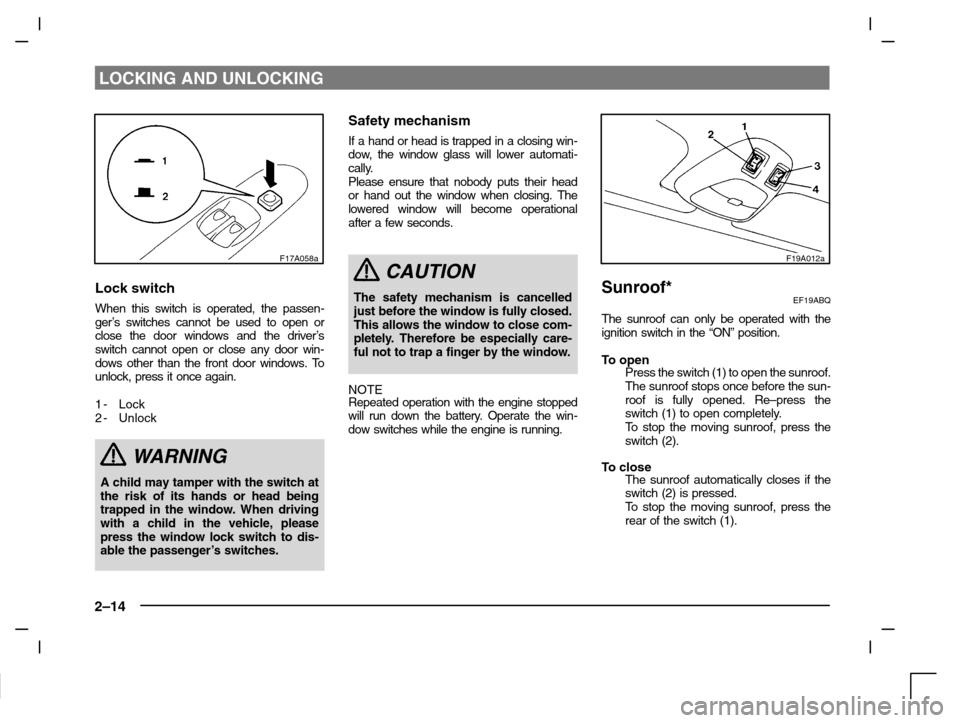
Lock switch
When this switch is operated, the passen-
ger’s switches cannot be used to open or
close the door windows and the driver’s
switch cannot open or close any door win-
dows other than the front door windows. To
unlock, press it once again.
1-Lock
2-Unlock
WARNING
A child may tamper with the switch at
the risk of its hands or head being
trapped in the window. When driving
with a child in the vehicle, please
press the window lock switch to dis-
able the passenger’s switches.
Safety mechanism
If a hand or head is trapped in a closing win-
dow, the window glass will lower automati-
cally.
Please ensure that nobody puts their head
or hand out the window when closing. The
lowered window will become operational
after a few seconds.
CAUTION
The safety mechanism is cancelled
just before the window is fully closed.
This allows the window to close com-
pletely. Therefore be especially care-
ful not to trap a finger by the window.
NOTE
Repeated operation with the engine stopped
will run down the battery. Operate the win-
dow switches while the engine is running.
F19A012a
Sunroof*EF19ABQ
The sunroof can only be operated with the
ignition switch in the “ON” position.
To openPress the switch (1) to open the sunroof.
The sunroof stops once before the sun-
roof is fully opened. Re–press the
switch (1) to open completely.
To s t o p the moving sunroof, press the
switch (2).
To closeThe sunroof automatically closes if the
switch (2) is pressed.
To s t o p the moving sunroof, press the
rear of the switch (1).
Page 54 of 280
SEATS AND SEATBELTS
3–26
When the impact sensors detect an impact
of sufficient frontal or side force, an auto-
mated circuit ignites materials in the inflator
to generate gas and inflate the air bags. The
air bags deployment produces a sudden,
loud noise, and releases some smoke and
powder, but these conditions are not injuri-
ous, and do not indicate a fire in the vehicle.
People with respiratory problems may feel
some temporary irritation from chemicals
used to produce the deployment; open the
windows after air bag deployment, if safe to
do so.
The air bags deflate very rapidly after de-
ployment, so there is little danger of ob-
scured vision.
The time required from the sensors detecting
an impact to deflation of the air bags after de-
ployment is shorter than a blink of an eye.
CAUTION
Air bags are inflated at an extremely
rapid speed. In certain situations,
contact with inflating air bags can re-
sult in light cuts, bruises, and the like.
G28G012a
Driver’s and passenger’s front air
bag system
EG29C-A
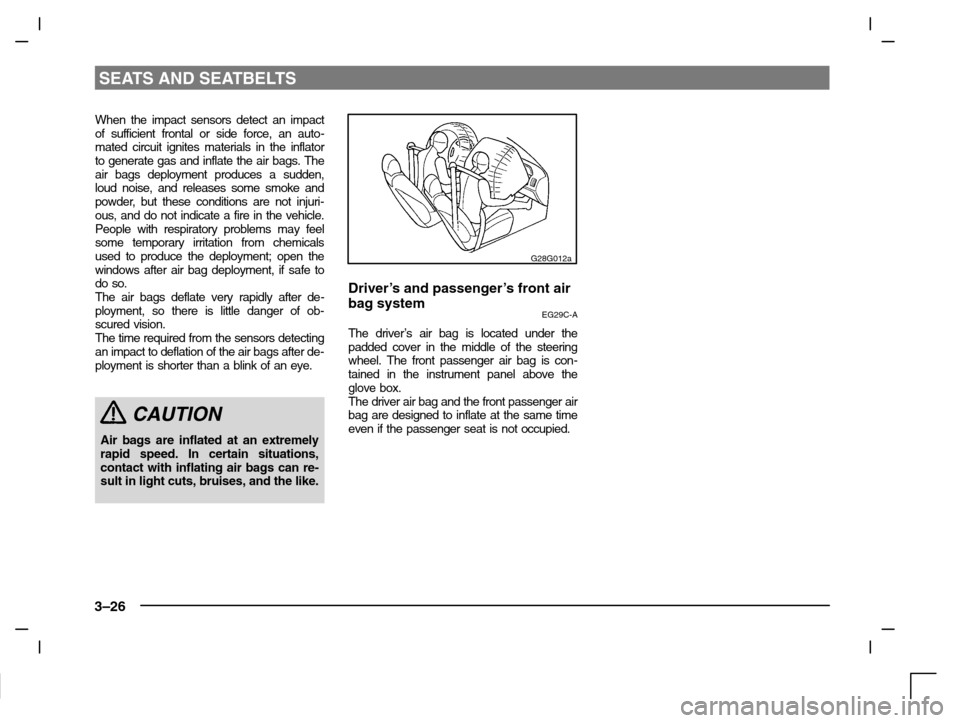
The driver’s air bag is located under the
padded cover in the middle of the steering
wheel. The front passenger air bag is con-
tained in the instrument panel above the
glove box.
The driver air bag and the front passenger air
bag are designed to inflate at the same time
even if the passenger seat is not occupied.
Page 63 of 280
SEATS AND SEATBELTS
3–35
WARNING
(1) The side air bags are designed to
supplement the driver and front
passenger seat belts in certain
side impacts. Seat belts should
always be worn properly, and the
driver and front passenger
should sit well back and upright
without leaning against the win-
dow or door.
G28L029a
WARNING
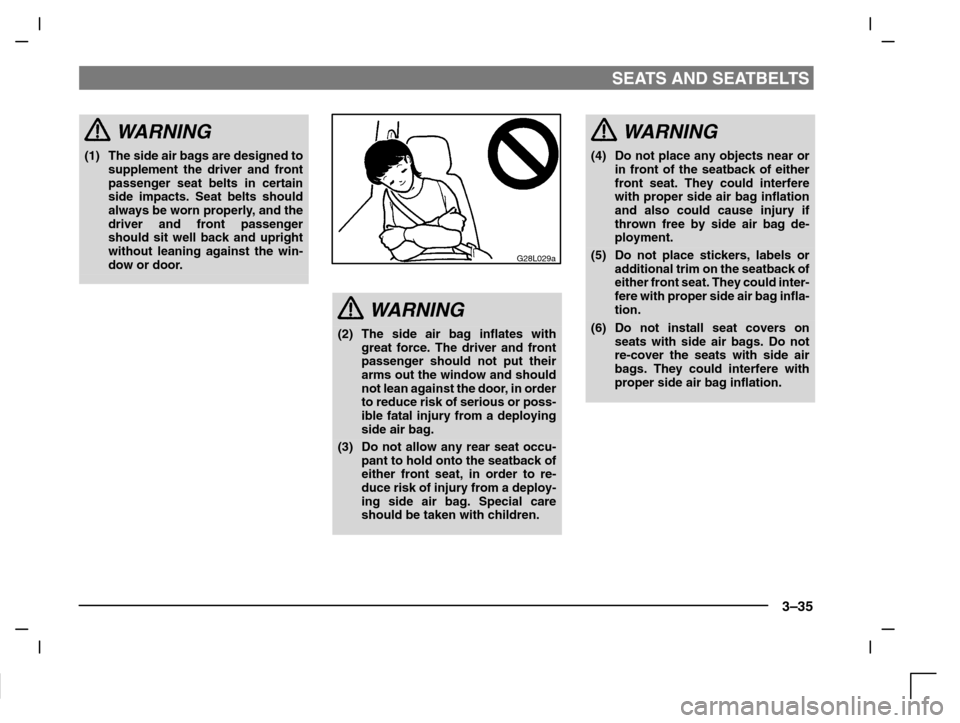
(2) The side air bag inflates with
great force. The driver and front
passenger should not put their
arms out the window and should
not lean against the door, in order
to reduce risk of serious or poss-
ible fatal injury from a deploying
side air bag.
(3) Do not allow any rear seat occu-
pant to hold onto the seatback of
either front seat, in order to re-
duce risk of injury from a deploy-
ing side air bag. Special care
should be taken with children.
WARNING
(4) Do not place any objects near or
in front of the seatback of either
front seat. They could interfere
with proper side air bag inflation
and also could cause injury if
thrown free by side air bag de-
ployment.
(5) Do not place stickers, labels or
additional trim on the seatback of
either front seat. They could inter-
fere with proper side air bag infla-
tion.
(6) Do not install seat covers on
seats with side air bags. Do not
re-cover the seats with side air
bags. They could interfere with
proper side air bag inflation.
Page 67 of 280
Instruments and controls
Instruments 4–2. . . . . . . . . . . . . . . . . . . . . . . . . . . . . .
Speedometer 4–2. . . . . . . . . . . . . . . . . . . . . . . . . . . . .
Odometer/Tripmeter 4–3. . . . . . . . . . . . . . . . . . . . . . .
Tachometer 4–4. . . . . . . . . . . . . . . . . . . . . . . . . . . . . . .
Fuel gauge 4–4. . . . . . . . . . . . . . . . . . . . . . . . . . . . . . .
Water temperature gauge 4–5. . . . . . . . . . . . . . . . . .
Indication and warning lamps 4–6. . . . . . . . . . . . . .
Combination headlamps, dipper and turn
signal switch 4–12. . . . . . . . . . . . . . . . . . . . . . . . . . . .
Headlamp levelling switch 4–13. . . . . . . . . . . . . . . . .
Windscreen wiper and washer switch 4–15. . . . . .
Rear window wiper and washer switch
(Hatchback) 4–16. . . . . . . . . . . . . . . . . . . . . . . . . . . . .
Headlamp washer switch* 4–17. . . . . . . . . . . . . . . . .
Hazard warning flasher switch 4–18. . . . . . . . . . . . .
Rear window demister switch 4–19. . . . . . . . . . . . .
Front fog lamp switch* 4–20. . . . . . . . . . . . . . . . . . . .
Rear fog lamp switch 4–21. . . . . . . . . . . . . . . . . . . . .
Rheostat
(meter illumination control) 4–21. . . . . . . . . . . . . . . .
Horn switch 4–22. . . . . . . . . . . . . . . . . . . . . . . . . . . . .
Room lamps 4–22. . . . . . . . . . . . . . . . . . . . . . . . . . . . .
Multi centre display 4–24. . . . . . . . . . . . . . . . . . . . . .
Digital clock 4–26. . . . . . . . . . . . . . . . . . . . . . . . . . . . .
Page 69 of 280
INSTRUMENTS AND CONTROLS
4–3
Type 2
D03A083a
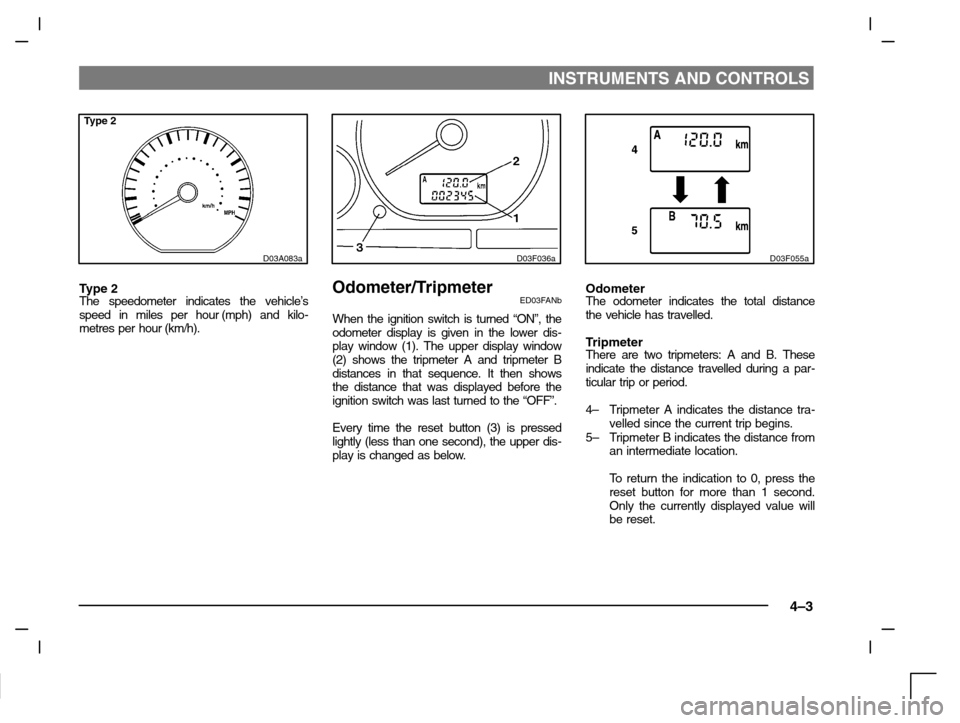
Type 2The speedometer indicates the vehicle’s
speed in miles per hour (mph) and kilo-
metres per hour (km/h).
D03F036a
Odometer/TripmeterED03FANb
When the ignition switch is turned “ON”, the
odometer display is given in the lower dis-
play window (1). The upper display window
(2) shows the tripmeter A and tripmeter B
distances in that sequence. It then shows
the distance that was displayed before the
ignition switch was last turned to the “OFF”.
Every time the reset button (3) is pressed
lightly (less than one second), the upper dis-
play is changed as below.
D03F055a
OdometerThe odometer indicates the total distance
the vehicle has travelled.
TripmeterThere are two tripmeters: A and B. These
indicate the distance travelled during a par-
ticular trip or period.
4– Tripmeter A indicates the distance tra-
velled since the current trip begins.
5– Tripmeter B indicates the distance from
an intermediate location.
To r e t u r n the indication to 0, press the
reset button for more than 1 second.
Only the currently displayed value will
be reset.
Page 78 of 280
INSTRUMENTS AND CONTROLS
4–12
E11A015a
Combination headlamps,
dipper and turn signal
switch
EE11AABi
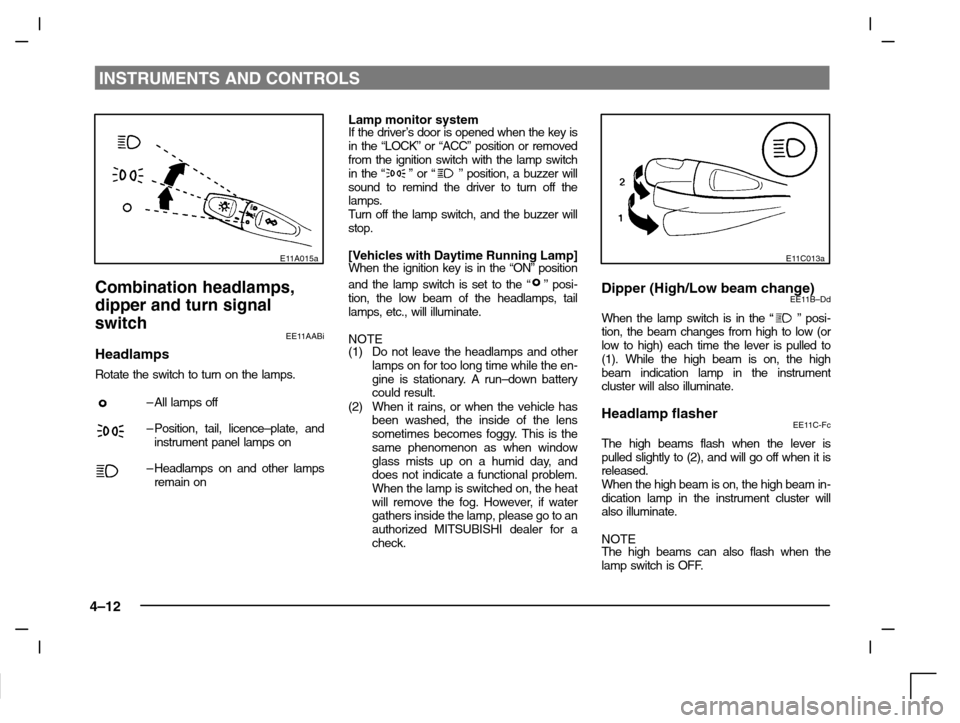
Headlamps
Rotate the switch to turn on the lamps.
–All lamps off
–Position, tail, licence–plate, and
instrument panel lamps on
–Headlamps on and other lamps
remain on
Lamp monitor systemIf the driver’s door is opened when the key is
in the “LOCK” or “ACC” position or removed
from the ignition switch with the lamp switch
in the “
” or “” position, a buzzer will
sound to remind the driver to turn off the
lamps.
Turn off the lamp switch, and the buzzer will
stop.
[Vehicles with Daytime Running Lamp]When the ignition key is in the “ON” position
and the lamp switch is set to the “
” posi-
tion, the low beam of the headlamps, tail
lamps, etc., will illuminate.
NOTE
(1) Do not leave the headlamps and other
lamps on for too long time while the en-
gine is stationary. A run–down battery
could result.
(2) When it rains, or when the vehicle has
been washed, the inside of the lens
sometimes becomes foggy. This is the
same phenomenon as when window
glass mists up on a humid day, and
does not indicate a functional problem.
When the lamp is switched on, the heat
will remove the fog. However, if water
gathers inside the lamp, please go to an
authorized MITSUBISHI dealer for a
check.
E11C013a
Dipper (High/Low beam change)EE11B–Dd
When the lamp switch is in the “” posi-
tion, the beam changes from high to low (or
low to high) each time the lever is pulled to
(1). While the high beam is on, the high
beam indication lamp in the instrument
cluster will also illuminate.
Headlamp flasherEE11C-Fc
The high beams flash when the lever is
pulled slightly to (2), and will go off when it is
released.
When the high beam is on, the high beam in-
dication lamp in the instrument cluster will
also illuminate.
NOTE
The high beams can also flash when the
lamp switch is OFF.
Page 82 of 280
INSTRUMENTS AND CONTROLS
4–16
E13A139a
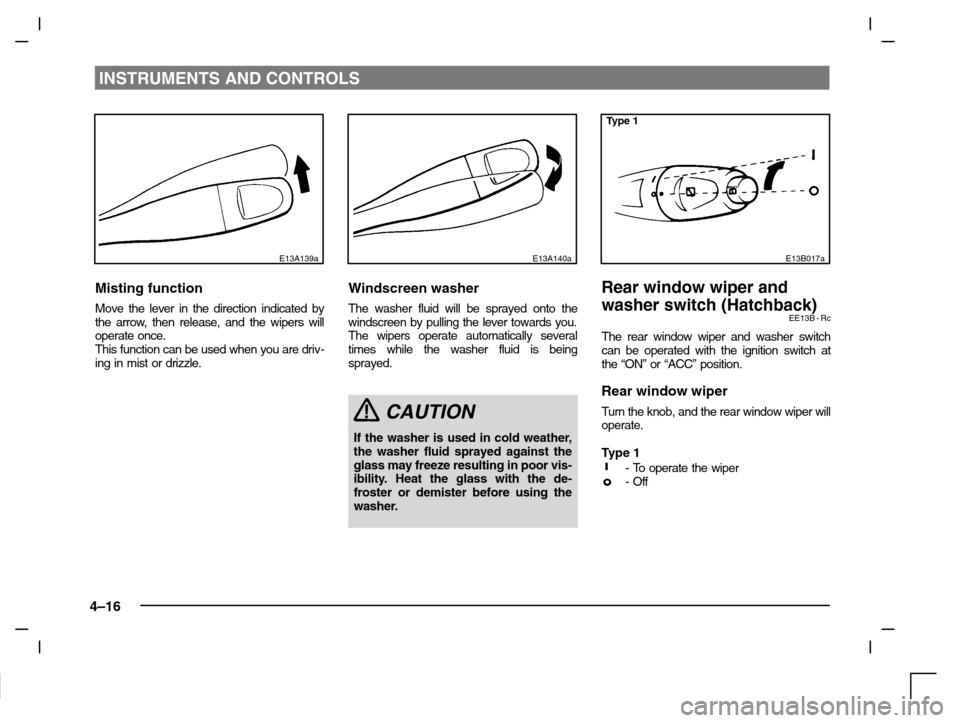
Misting function
Move the lever in the direction indicated by
the arrow, then release, and the wipers will
operate once.
This function can be used when you are driv-
ing in mist or drizzle.
E13A140a
Windscreen washer
The washer fluid will be sprayed onto the
windscreen by pulling the lever towards you.
The wipers operate automatically several
times while the washer fluid is being
sprayed.
CAUTION
If the washer is used in cold weather,
the washer fluid sprayed against the
glass may freeze resulting in poor vis-
ibility. Heat the glass with the de-
froster or demister before using the
washer.
Type 1
E13B017a
Rear window wiper and
washer switch (Hatchback)
EE13B - Rc
The rear window wiper and washer switch
can be operated with the ignition switch at
the “ON” or “ACC” position.
Rear window wiper
Turn the knob, and the rear window wiper will
operate.
Type 1
- To operate the wiper- Off
Page 83 of 280
INSTRUMENTS AND CONTROLS
4–17
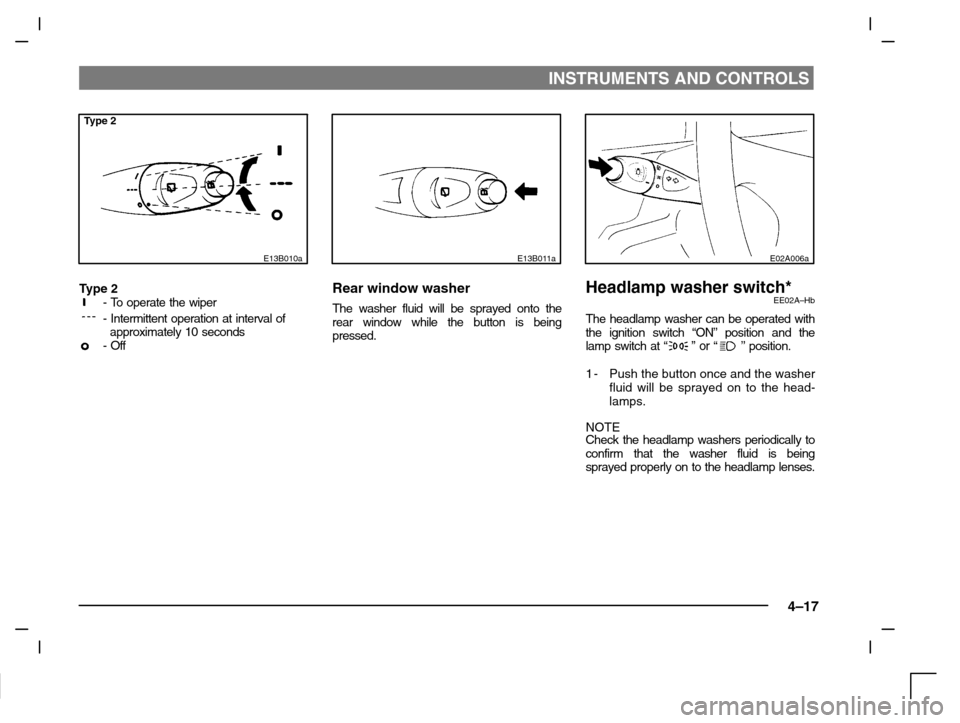
Type 2
E13B010a
Type 2- To operate the wiper
- Intermittent operation at interval of
approximately 10 seconds
- Off
E13B011a
Rear window washer
The washer fluid will be sprayed onto the
rear window while the button is being
pressed.
E02A006a
Headlamp washer switch*EE02A–Hb
The headlamp washer can be operated with
the ignition switch “ON” position and the
lamp switch at “
” or “” position.
1-Push the button once and the washer
fluid will be sprayed on to the head-
lamps.
NOTE
Check the headlamp washers periodically to
confirm that the washer fluid is being
sprayed properly on to the headlamp lenses.
Page 85 of 280
INSTRUMENTS AND CONTROLS
4–19
CAUTION
If the lamps are kept flashing for a
long time, the battery will be dis-
charged, resulting in hard engine
starting or no start condition at all.
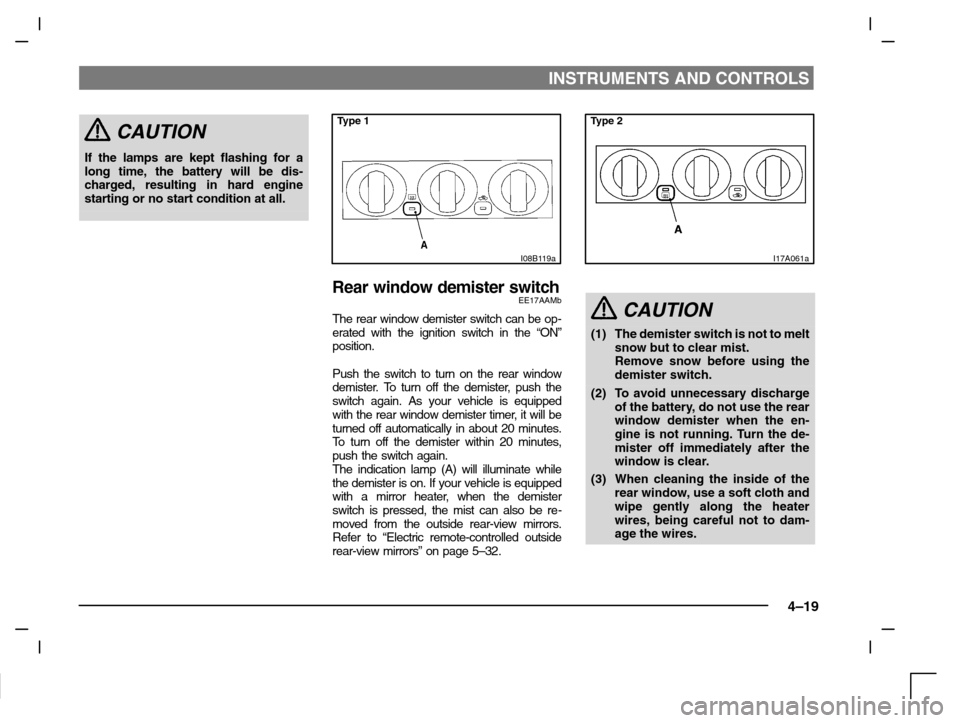
Type 1
I08B119a
Rear window demister switchEE17AAMb
The rear window demister switch can be op-
erated with the ignition switch in the “ON”
position.
Push the switch to turn on the rear window
demister. To turn off the demister, push the
switch again. As your vehicle is equipped
with the rear window demister timer, it will be
turned off automatically in about 20 minutes.
To turn off the demister within 20 minutes,
push the switch again.
The indication lamp (A) will illuminate while
the demister is on. If your vehicle is equipped
with a mirror heater, when the demister
switch is pressed, the mist can also be re-
moved from the outside rear-view mirrors.
Refer to “Electric remote-controlled outside
rear-view mirrors” on page 5–32.
Type 2
I17A061a
CAUTION
(1) The demister switch is not to melt
snow but to clear mist.
Remove snow before using the
demister switch.
(2) To avoid unnecessary discharge
of the battery, do not use the rear
window demister when the en-
gine is not running. Turn the de-
mister off immediately after the
window is clear.
(3) When cleaning the inside of the
rear window, use a soft cloth and
wipe gently along the heater
wires, being careful not to dam-
age the wires.
Page 86 of 280
INSTRUMENTS AND CONTROLS
4–20
CAUTION
(4) Do not allow objects to touch the
inside of the rear window glass,
damaged or broken wires may re-
sult.
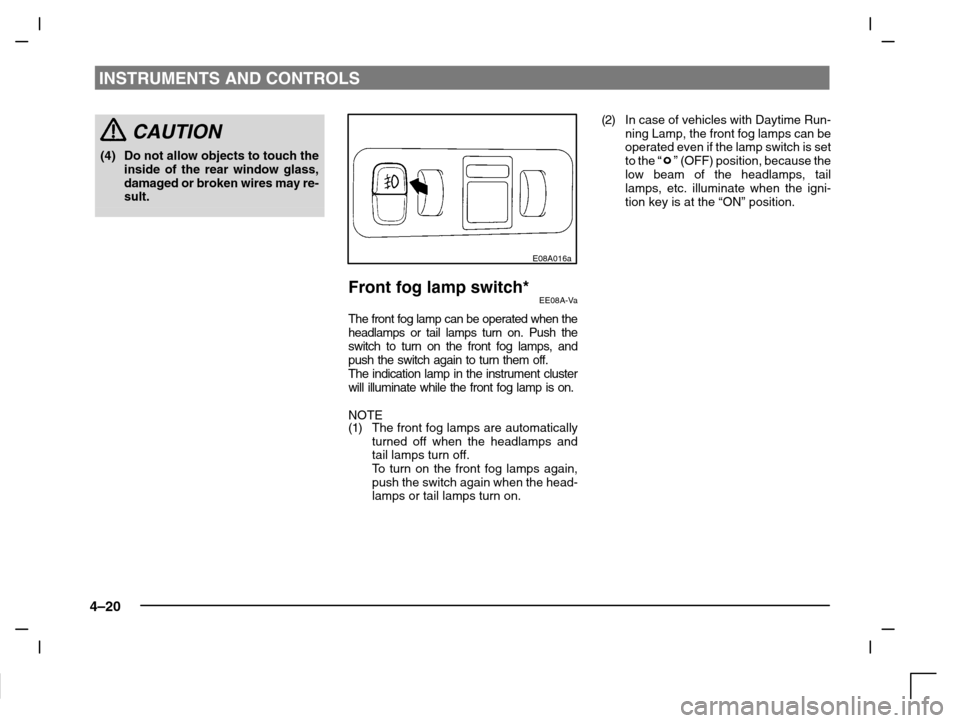
E08A016a
Front fog lamp switch*EE08A-Va
The front fog lamp can be operated when the
headlamps or tail lamps turn on. Push the
switch to turn on the front fog lamps, and
push the switch again to turn them off.
The indication lamp in the instrument cluster
will illuminate while the front fog lamp is on.
NOTE
(1)The front fog lamps are automatically
turned off when the headlamps and
tail lamps turn off.
To turn on the front fog lamps again,
push the switch again when the head-
lamps or tail lamps turn on.(2)In case of vehicles with Daytime Run-
ning Lamp, the front fog lamps can be
operated even if the lamp switch is set
to the
“” (OFF) position, because the
low beam of the headlamps, tail
lamps, etc. illuminate when the igni-
tion key is at the “ON” position.