brake MITSUBISHI CARISMA 2000 1.G Owner's Guide
[x] Cancel search | Manufacturer: MITSUBISHI, Model Year: 2000, Model line: CARISMA, Model: MITSUBISHI CARISMA 2000 1.GPages: 280, PDF Size: 2.32 MB
Page 198 of 280
VEHICLE CARE
7–6
Servicing of plastic partsEK29AMEc
Use a sponge or chamois leather.
If a car wax adheres on a grey or black rough
surface of the bumper, moulding or lamps,
the surface becomes white. In such a case,
wipe it off using lukewarm water and soft
cloth or chamois leather.
CAUTION
(1) Do not use a scrubbing brush or
other hard tools as they may dam-
age the plastic part surface.
(2) Do not use wax containing com-
pound (polishing powder) which
may damage the plastic part sur-
face.
(3) Do not bring the plastic parts into
contact with brake fluids, engine
oils, greases, paint thinners,
painting, and sulphuric acid (bat-
tery electrolyte) which may stain,
or discolour the plastic parts.
If they touch the plastic part, wipe
them off with soft cloth, chamois
or the like and an aqueous sol-
ution of neutral detergent, then
immediately rinse the affected
parts with water.
Aluminium wheels*EK35A-Af
A protective coating is provided over the alu-
minium type wheels.
Clean aluminium wheels with a cleaner de-
signed for use on aluminium and apply an
appropriate protection agent.
NOTE(1) When cleaning aluminium type wheels,
do not use abrasive cleaners. Wheels
exposed to sea water or road chemicals
should be cleaned as soon as possible.
(2) Brushes may damage the aluminium
wheel surface. Always use a sponge,
chamois leather, etc.
(3) Do not apply hot water directly from the
steam cleaner or similar to the wheel
surface.
Window glassEK10A-Ca
The window glass can normally be cleaned
using only a sponge and water.
Glass cleaner can be used to remove oil,
grease, dead insects, etc. After washing the
glass, wipe dry with a clean, dry, soft cloth.
Never use the same cloth to wipe the win-
dow glass as would be used to wipe the
paintwork; wax from the painted surfaces
could adhere to the glass and reduce its
transparency and visibility.
NOTETo clean the inside of the rear window, al-
ways use a soft cloth and wipe the window
glass along the demister heater element so
as not to cause damage.
Wiper bladesEK11A-Aa
Use a soft cloth and glass cleaner to remove
grease, dead insects, etc., from the wiper
blades. Replace the wiper blades when they
no longer wipe properly. (Refer to
page 9–18)
Page 202 of 280
FOR EMERGENCIES
8–2
If the vehicle breaks downEN40B-Bc
If the vehicle breaks down on the road, move
it to the shoulder and use the hazard warning
flashers.
If the engine stops/fails
Vehicle operation and control are affected if
the engine stops. Before moving the vehicle
to a safe area be aware of the following:
1. The brake booster becomes inoperat-
ive and the pedal effort will increase.
Press down the brake pedal harder
than usual.
2. Since the power steering pump is no
longer operative, the steering wheel
feels heavy when turning it. Turn the
wheel with more effort than usual.
Operation under adverse
driving conditions
EI43ABAa
If your vehicle is stuck: in sand,
mud or snow
If the vehicle becomes stuck in snow, sand,
or mud, it can often be moved by a rocking
motion. Move the gearshift lever or selector
lever alternately between the 1st and Re-
verse position (with manual transmission),
the “L” (LOW) and “R” (REVERSE) position
(with INVECS–II 4A/T), and the Sport mode
and “R” (REVERSE) position (with INVECS–
II Sport Mode 4A/T) while applying slight
pressure to the accelerator pedal.
Avoid racing the engine or spinning the
wheels. Prolonged efforts to free a stuck ve-
hicle may result in overheating and trans-
mission failure. Allow the engine to idle for a
few minutes to let the transmission cool be-
tween rocking attempts.
If the vehicle remains stuck after several
rocking attempts, seek other assistance.
WARNING
When attempting to rock your vehicle
out of a stuck position, be sure that
the area around the vehicle is clear of
people and physical objects. The
rocking motion may cause the ve-
hicle to suddenly launch forward or
backward causing injury or damage
to nearby people or objects.
On a flooded road
(1) Avoid flooded roads. Water could enter
the brake discs, resulting in temporarily
ineffective brakes. In such cases, lightly
depress the brake pedal to see if the
brakes operate properly. If they do not,
lightly depress the pedal several times
while driving in order to dry the brake
pads.
(2) When driving in rain or on a road with
many puddles a layer of water may form
between the tyres and the road surface.
This reduces a tyre’s frictional resis-
tance on the road, resulting in loss of
steering stability and braking capability.
To cope with this, observe the following
items:
(a) Drive your vehicle at a slow speed.
(b) Do not drive on worn tyres. Always
maintain the specified tyre inflation
pressures.
Page 203 of 280
FOR EMERGENCIES
8–3
On a snow-covered or frozen road
(1) When driving on a snow–covered or
frozen road, it is recommended that you
use snow tyres or tyre chains.
Refer to the “Snow tyres” and “Tyre
chains” sections.
(2) Avoid high–speed operation, sudden
acceleration, abrupt brake application
and sharp cornering.
(3) Depressing the brake pedal during
travel on such a road may cause tyre
slippage and skidding. When traction
between the tyres and the road is re-
duced, the wheels may skid, and the ve-
hicle cannot readily be brought to a stop
by conventional braking techniques.
Braking will differ, depending upon
whether you have anti–lock brakes
(ABS). If you do have ABS, brake by
pressing the brake pedal hard, and
keeping it pressed. If you do not have
ABS, pump the brake pedal with short
rapid jabs, each time fully applying and
fully releasing for greatest effect.
(4) Allow extra distance between your ve-
hicle and the vehicle in front of you, and
avoid sudden braking.
N01A026a
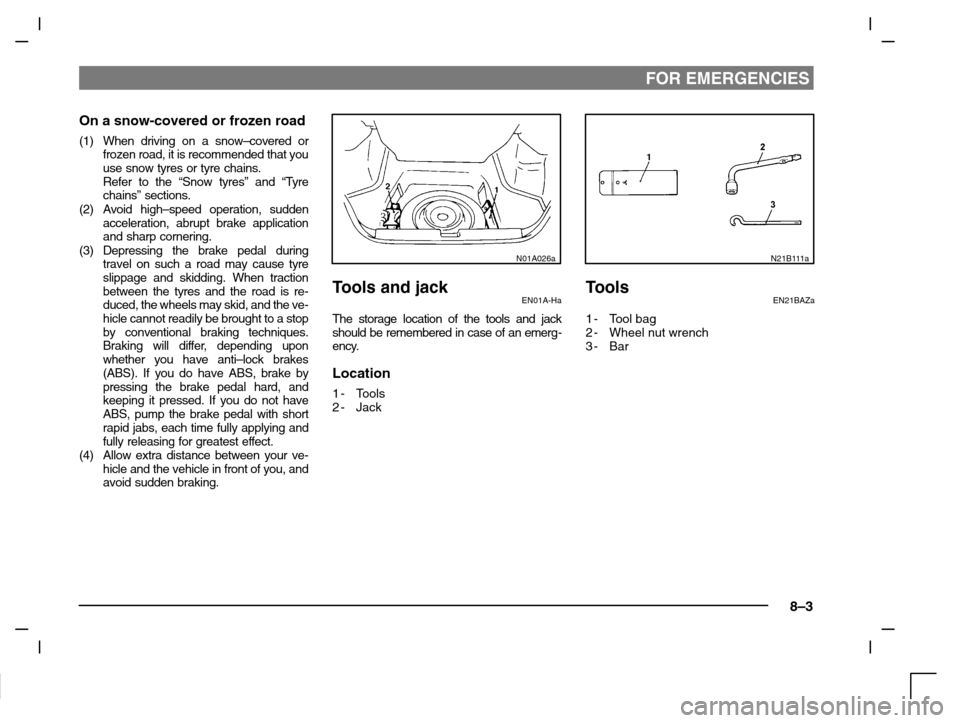
Tools and jackEN01A-Ha
The storage location of the tools and jack
should be remembered in case of an emerg-
ency.
Location
1-Tools
2-Jack
N21B111a
ToolsEN21BAZa
1- Tool bag
2-Wheel nut wrench
3-Bar
Page 204 of 280
FOR EMERGENCIES
8–4
N21C026a
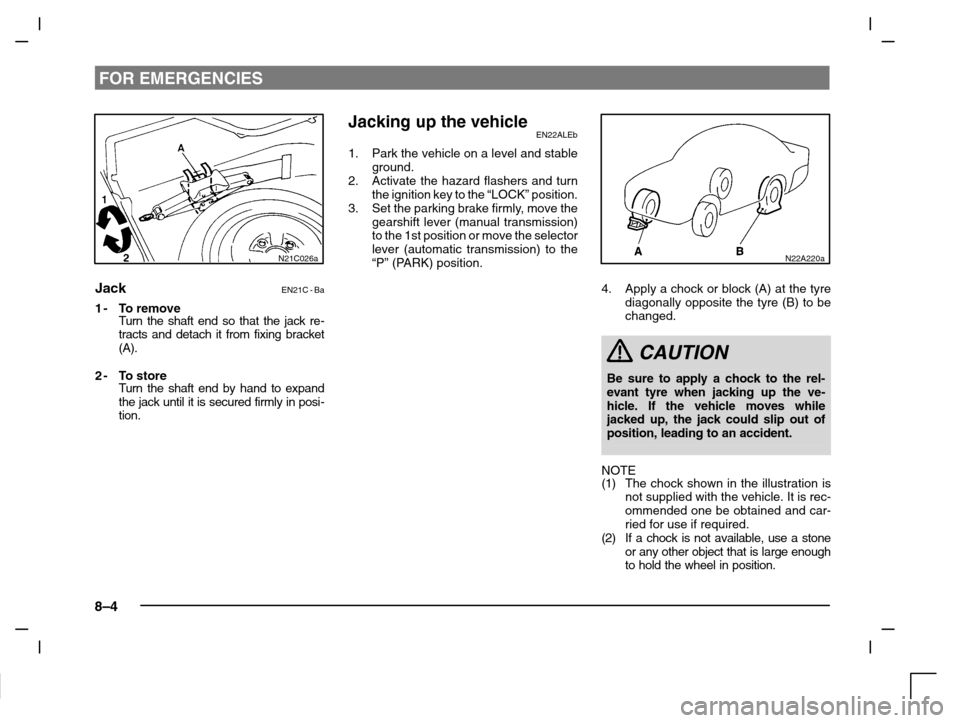
JackEN21C - Ba
1-To remove
Turn the shaft end so that the jack re-
tracts and detach it from fixing bracket
(A).
2-To store
Turn the shaft end by hand to expand
the jack until it is secured firmly in posi-
tion.
Jacking up the vehicleEN22ALEb
1. Park the vehicle on a level and stable
ground.
2. Activate the hazard flashers and turn
the ignition key to the “LOCK” position.
3. Set the parking brake firmly, move the
gearshift lever (manual transmission)
to the 1st position or move the selector
lever (automatic transmission) to the
“P” (PARK) position.
N22A220a
4. Apply a chock or block (A) at the tyre
diagonally opposite the tyre (B) to be
changed.
CAUTION
Be sure to apply a chock to the rel-
evant tyre when jacking up the ve-
hicle. If the vehicle moves while
jacked up, the jack could slip out of
position, leading to an accident.
NOTE
(1)The chock shown in the illustration is
not supplied with the vehicle. It is rec-
ommended one be obtained and car-
ried for use if required.
(2) If a chock is not available, use a stone
or any other object that is large enough
to hold the wheel in position.
Page 209 of 280
FOR EMERGENCIES
8–9
N23B083a
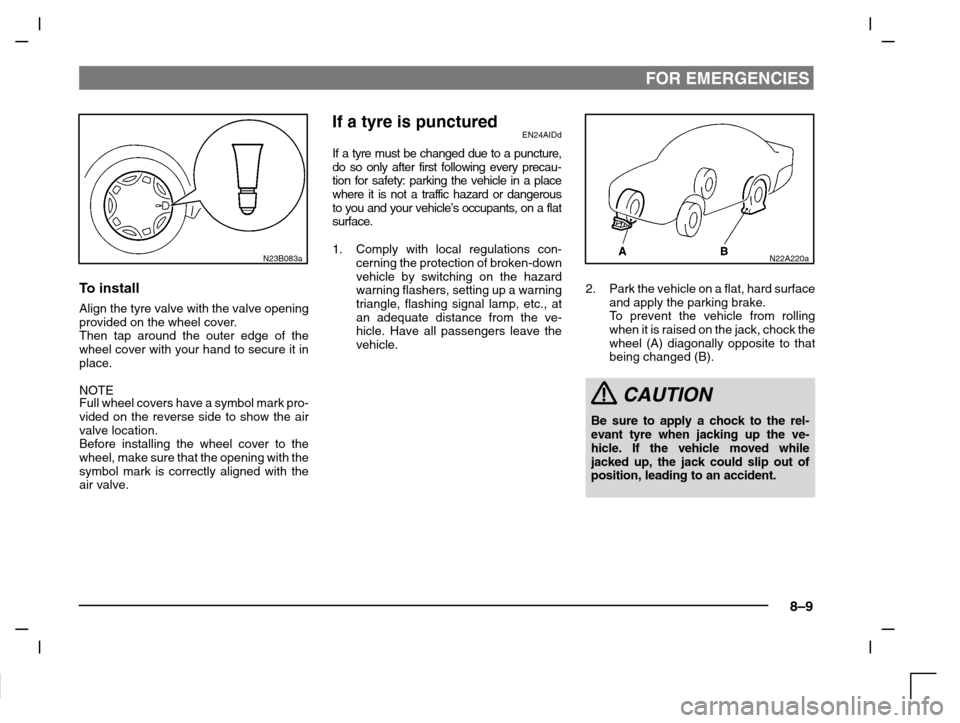
To install
Align the tyre valve with the valve opening
provided on the wheel cover.
Then tap around the outer edge of the
wheel cover with your hand to secure it in
place.
NOTE
Full wheel covers have a symbol mark pro-
vided on the reverse side to show the air
valve location.
Before installing the wheel cover to the
wheel, make sure that the opening with the
symbol mark is correctly aligned with the
air valve.
If a tyre is puncturedEN24AIDd
If a tyre must be changed due to a puncture,
do so only after first following every precau-
tion for safety: parking the vehicle in a place
where it is not a traffic hazard or dangerous
to you and your vehicle’s occupants, on a flat
surface.
1. Comply with local regulations con-
cerning the protection of broken-down
vehicle by switching on the hazard
warning flashers, setting up a warning
triangle, flashing signal lamp, etc., at
an adequate distance from the ve-
hicle. Have all passengers leave the
vehicle.
N22A220a
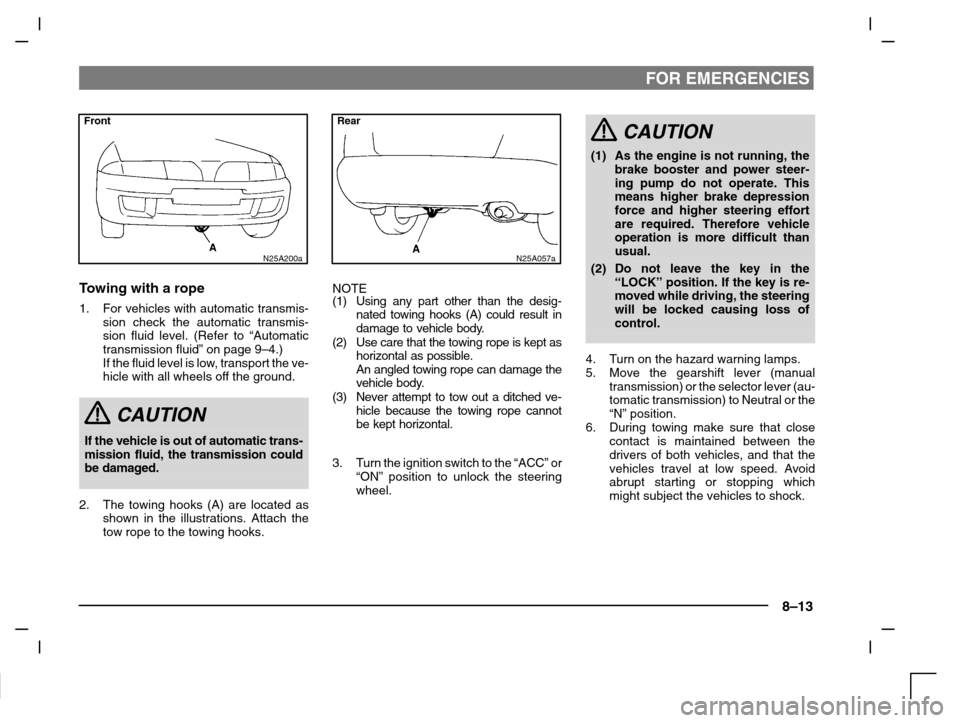
2. Park the vehicle on a flat, hard surface
and apply the parking brake.
To prevent the vehicle from rolling
when it is raised on the jack, chock the
wheel (A) diagonally opposite to that
being changed (B).
CAUTION
Be sure to apply a chock to the rel-
evant tyre when jacking up the ve-
hicle. If the vehicle moved while
jacked up, the jack could slip out of
position, leading to an accident.
Page 213 of 280
FOR EMERGENCIES
8–13
Front
N25A200a
Towing with a rope
1. For vehicles with automatic transmis-
sion check the automatic transmis-
sion fluid level. (Refer to “Automatic
transmission fluid” on page 9–4.)
If the fluid level is low, transport the ve-
hicle with all wheels off the ground.
CAUTION
If the vehicle is out of automatic trans-
mission fluid, the transmission could
be damaged.
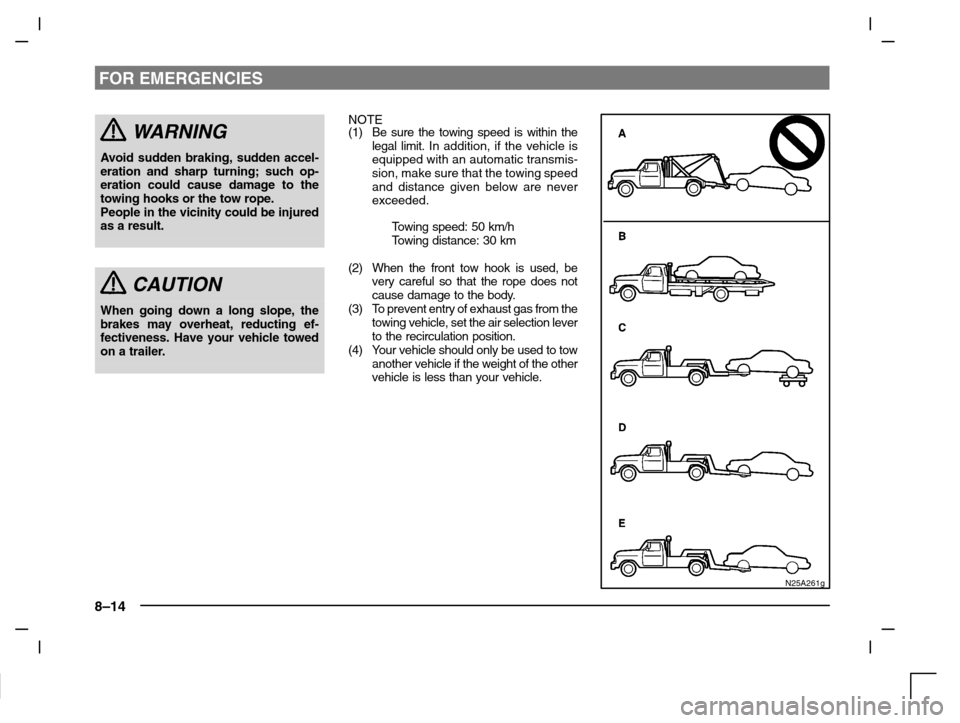
2. The towing hooks (A) are located as
shown in the illustrations. Attach the
tow rope to the towing hooks.
Rear
N25A057a
NOTE
(1) Using any part other than the desig-
nated towing hooks (A) could result in
damage to vehicle body.
(2) Use care that the towing rope is kept as
horizontal as possible.
An angled towing rope can damage the
vehicle body.
(3) Never attempt to tow out a ditched ve-
hicle because the towing rope cannot
be kept horizontal.
3. Turn the ignition switch to the “ACC” or
“ON” position to unlock the steering
wheel.
CAUTION
(1) As the engine is not running, the
brake booster and power steer-
ing pump do not operate. This
means higher brake depression
force and higher steering effort
are required. Therefore vehicle
operation is more difficult than
usual.
(2) Do not leave the key in the
“LOCK” position. If the key is re-
moved while driving, the steering
will be locked causing loss of
control.
4. Turn on the hazard warning lamps.
5. Move the gearshift lever (manual
transmission) or the selector lever (au-
tomatic transmission) to Neutral or the
“N” position.
6. During towing make sure that close
contact is maintained between the
drivers of both vehicles, and that the
vehicles travel at low speed. Avoid
abrupt starting or stopping which
might subject the vehicles to shock.
Page 214 of 280
FOR EMERGENCIES
8–14
WARNING
Avoid sudden braking, sudden accel-
eration and sharp turning; such op-
eration could cause damage to the
towing hooks or the tow rope.
People in the vicinity could be injured
as a result.
CAUTION
When going down a long slope, the
brakes may overheat, reducting ef-
fectiveness. Have your vehicle towed
on a trailer.
NOTE
(1) Be sure the towing speed is within the
legal limit. In addition, if the vehicle is
equipped with an automatic transmis-
sion, make sure that the towing speed
and distance given below are never
exceeded.
Towing speed: 50 km/h
To w i n g d i s tance: 30 km
(2) When the front tow hook is used, be
very careful so that the rope does not
cause damage to the body.
(3) To prevent entry of exhaust gas from the
towing vehicle, set the air selection lever
to the recirculation position.
(4) Your vehicle should only be used to tow
another vehicle if the weight of the other
vehicle is less than your vehicle.
N25A261g
Page 215 of 280
FOR EMERGENCIES
8–15
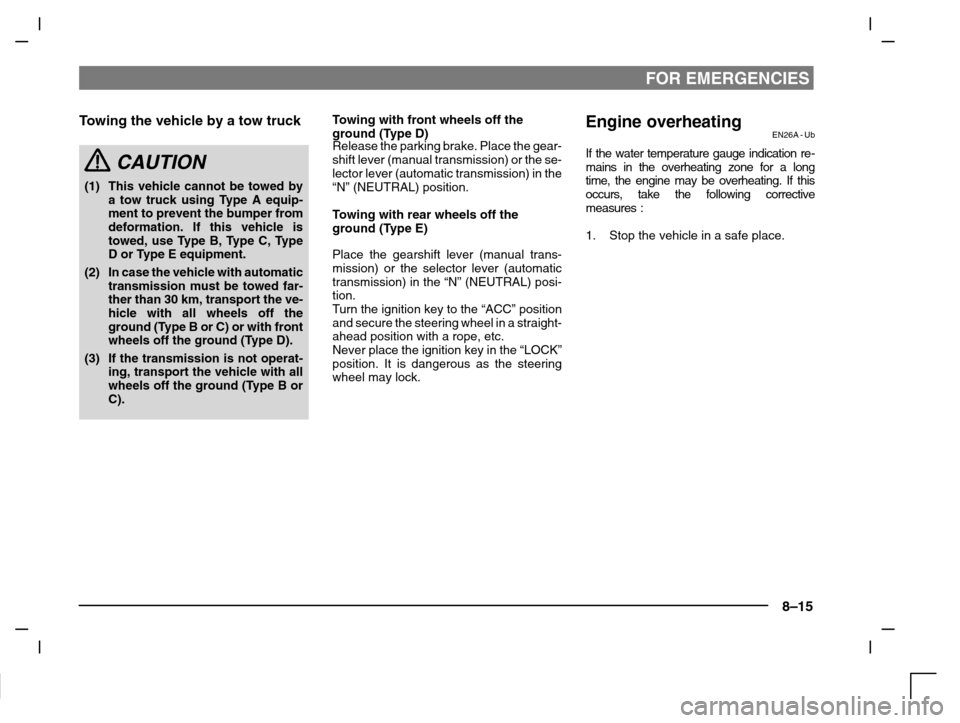
Towing the vehicle by a tow truck
CAUTION
(1) This vehicle cannot be towed by
a tow truck using Type A equip-
ment to prevent the bumper from
deformation. If this vehicle is
towed, use Type B, Type C, Type
D or Type E equipment.
(2) In case the vehicle with automatic
transmission must be towed far-
ther than 30 km, transport the ve-
hicle with all wheels off the
ground (Type B or C) or with front
wheels off the ground (Type D).
(3) If the transmission is not operat-
ing, transport the vehicle with all
wheels off the ground (Type B or
C).
Towing with front wheels off the
ground (Type D)
Release the parking brake. Place the gear-
shift lever (manual transmission) or the se-
lector lever (automatic transmission) in the
“N” (NEUTRAL) position.
Towing with rear wheels off the
ground (Type E)
Place the gearshift lever (manual trans-
mission) or the selector lever (automatic
transmission) in the “N” (NEUTRAL) posi-
tion.
Turn the ignition key to the “ACC” position
and secure the steering wheel in a straight-
ahead position with a rope, etc.
Never place the ignition key in the “LOCK”
position. It is dangerous as the steering
wheel may lock.
Engine overheatingEN26A - Ub
If the water temperature gauge indication re-
mains in the overheating zone for a long
time, the engine may be overheating. If this
occurs, take the following corrective
measures :
1. Stop the vehicle in a safe place.
Page 218 of 280
FOR EMERGENCIES
8–18
CAUTION
Check the other vehicle. It must have
a 12-volt battery.
If the other system isn’t 12-volt, short-
ing can damage both vehicles.
2. You could be injured if the vehicles roll.
Set the parking brake firmly on each
vehicle. Put an automatic trans-
mission in “P” (PARK) or a manual
transmission in “N” (Neutral). Turn off
the ignition switch.
WARNING
Tu r n o f f t h e ignition on both vehicles
beforehand. Use care to make sure
that the cables or your clothes do not
get caught by the fan or drive belt.
Personal injury could result.
NOTE
Turn off all lamps, heater and other electrical
loads. This will avoid sparks and help save
both batteries.
3. Make sure battery electrolyte is at the
proper level.
Refer to “Battery” on page 9–7.
WARNING
If electrolyte fluid is not visible, or ap-
pears to be frozen, do not attempt
jump starting!
A battery might rupture or explode if
the temperature is below the freezing
point or if it is not filled to the proper
level.
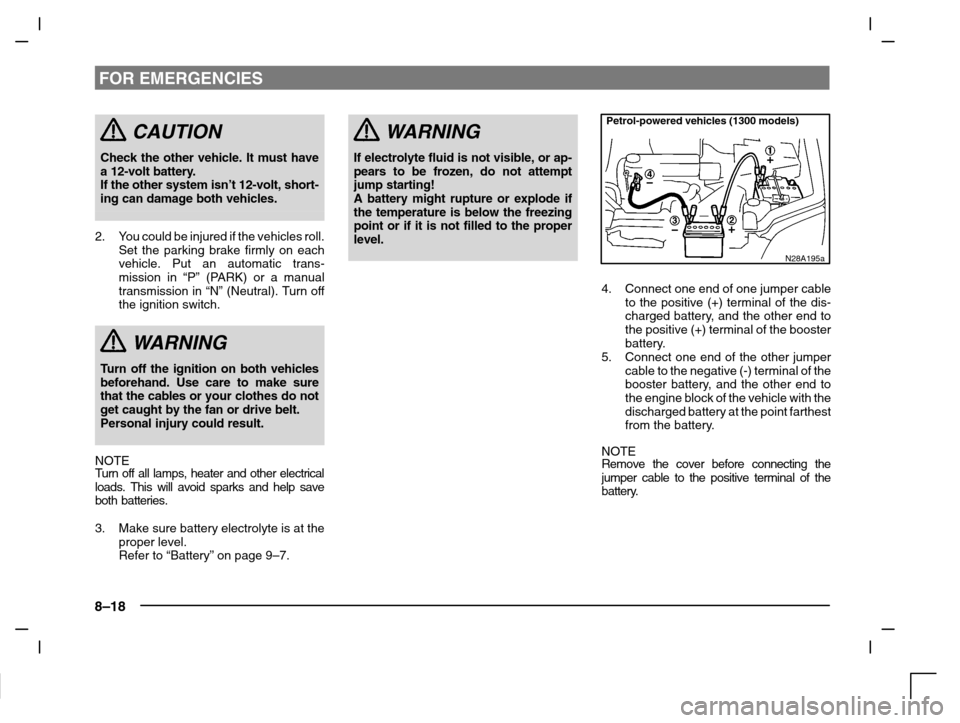
Petrol-powered vehicles (1300 models)
N28A195a
4. Connect one end of one jumper cable
to the positive (+) terminal of the dis-
charged battery, and the other end to
the positive (+) terminal of the booster
battery.
5. Connect one end of the other jumper
cable to the negative (-) terminal of the
booster battery, and the other end to
the engine block of the vehicle with the
discharged battery at the point farthest
from the battery.
NOTE
Remove the cover before connecting the
jumper cable to the positive terminal of the
battery.
Page 220 of 280
FOR EMERGENCIES
8–20
CAUTION
Keep the engine of the vehicle giving
assistance running.
7. After the engine is started, disconnect
the cables in the reverse order.
WARNING
(1) Charging the battery while it is in-
stalled in the vehicle might cause
the battery to catch fire and ex-
plode. Or damage to the vehicle
could result. If it has to be
charged in that condition for un-
avoidable reasons, disconnect
the vehicle side negative (-) ter-
minal connected to the battery.
(2) Keep sparks, cigarettes and
flames away from the battery be-
cause the battery may produce
an explosion.
(3) Use adequate ventilation when
charging or using the battery in
an enclosed space.
(4) Remove all the caps before
charging the battery.
WARNING
(5) Electrolyte is corrosive diluted
sulphuric acid.
If electrolyte (battery acid) comes
into contact with your hands,
eyes, clothes and the painted sur-
face of your vehicle, it should be
thoroughly flushed with water. If
electrolyte gets in your eyes,
flush them with water immediate-
ly and thoroughly, and get prompt
medical attention.
CAUTION
(1) Do not attempt to start the engine
by pulling or pushing the vehicle.
It could damage your vehicle.
(2) Always wear protective eye
goggles when working near the
battery.
(3) Keep the battery out of the reach
of children.
NOTE
On a vehicle with an anti-lock brake system,
if the vehicle is put in motion without fully
charging the battery it might cause the loss
of the smooth engine operation and the anti-
lock brake warning lamp to illuminate.
Refer to “Anti-lock brake system (ABS)” on
page 5–28.