ABS MITSUBISHI ECLIPSE 1991 User Guide
[x] Cancel search | Manufacturer: MITSUBISHI, Model Year: 1991, Model line: ECLIPSE, Model: MITSUBISHI ECLIPSE 1991Pages: 1216, PDF Size: 67.42 MB
Page 115 of 1216
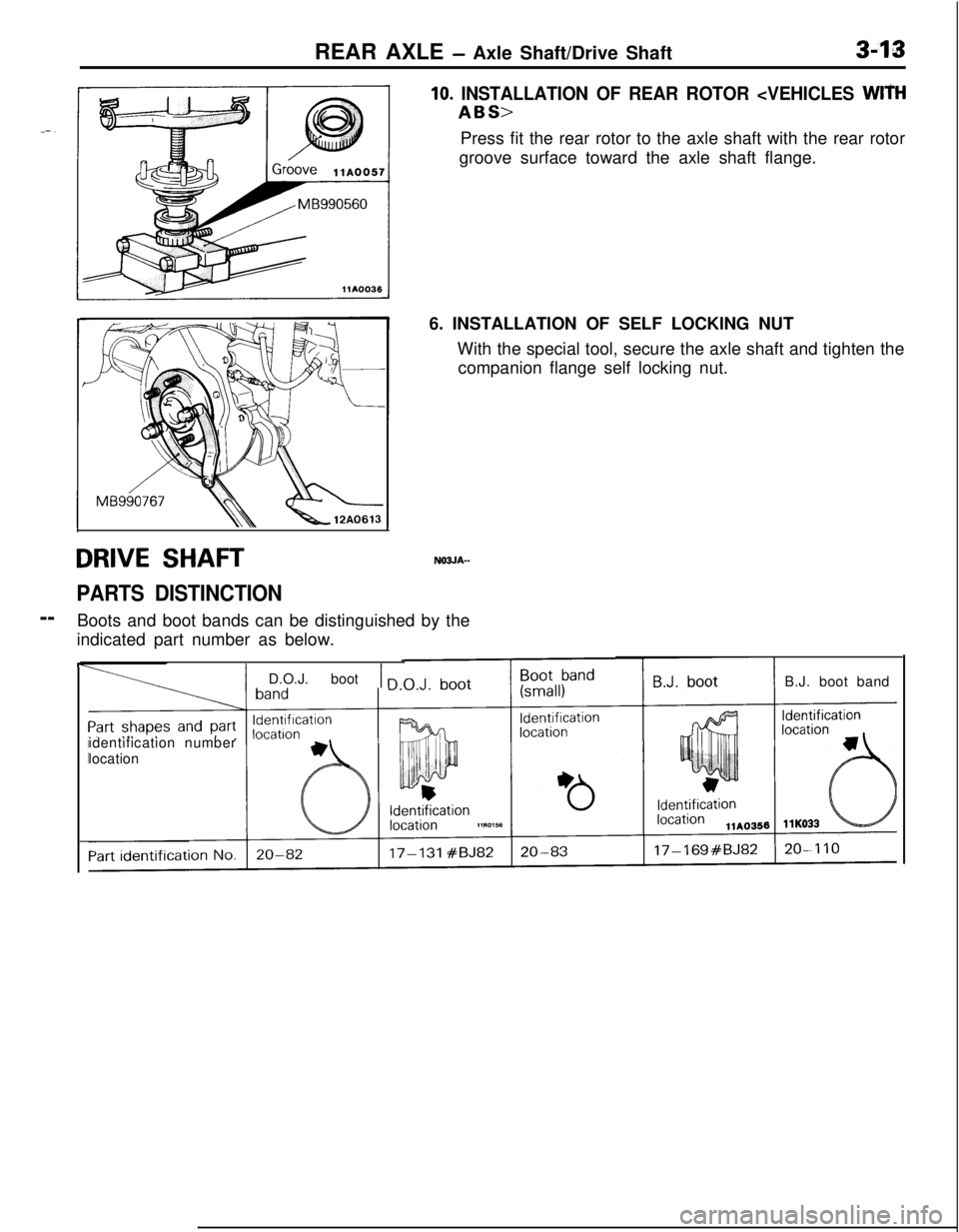
REAR AXLE - Axle Shaft/Drive Shaft3-13
DRIVE SHAFTN03JA--
PARTS DISTINCTION--
Boots and boot bands can be distinguished by the
indicated part number as below.
10. INSTALLATION OF REAR ROTOR
groove surface toward the axle shaft flange.
6. INSTALLATION OF SELF LOCKING NUT
With the special tool, secure the axle shaft and tighten the
companion flange self locking nut.
F
I
IIidentification number
location
1 D.O.J. boot 1 nB.J. boot band
Page 141 of 1216
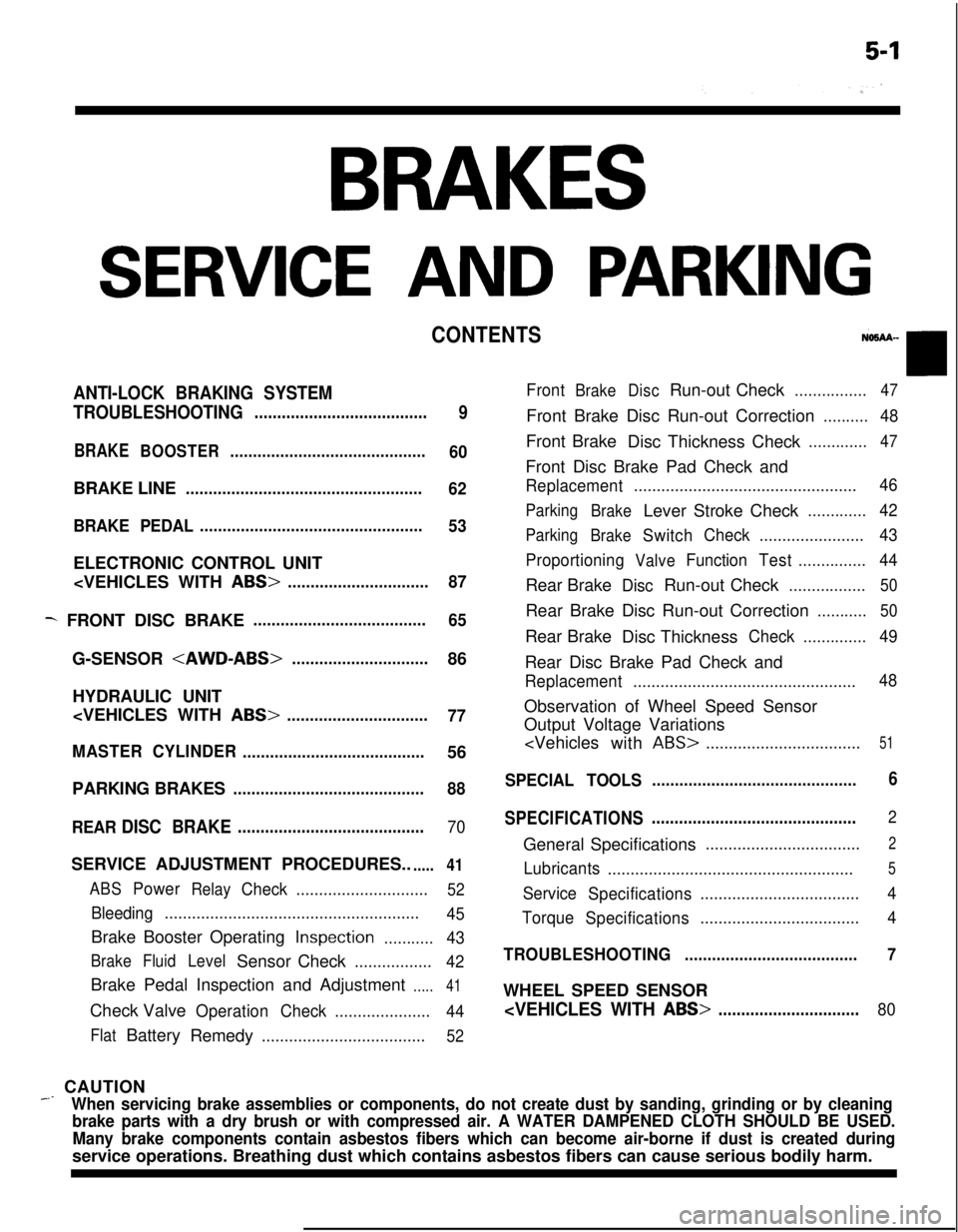
BRAKES
SERVICE AND PARKING
CONTENTS
ANTI-LOCK BRAKING SYSTEM
TROUBLESHOOTING
......................................
9
BRAKEBOOSTER...........................................
60BRAKE LINE
....................................................
62
BRAKE PEDAL.................................................
53ELECTRONIC CONTROL UNIT
- FRONT DISC BRAKE......................................
65G-SENSOR
HYDRAULIC UNIT
77
MASTERCYLINDER
........................................56
PARKING BRAKES
..........................................88
REAR
DISC BRAKE.........................................70SERVICE ADJUSTMENT PROCEDURES..
.....41
ABSPowerRelayCheck.............................52
Bleeding........................................................
45Brake Booster Operating
Inspection...........43
BrakeFluidLevelSensor Check.................
42Brake Pedal Inspection and Adjustment
.....41Check Valve
OperationCheck.....................
44
FlatBattery
Remedy....................................52
FrontBrakeDiscRun-out Check................47Front Brake Disc Run-out Correction
..........48Front Brake
Disc Thickness Check
.............47Front Disc Brake Pad Check and
Replacement.................................................46
Parking
BrakeLever Stroke Check.............42
Parking
BrakeSwitchCheck.......................43
Proportioning
ValveFunctionTest...............44Rear Brake
DiscRun-out Check.................50Rear Brake Disc Run-out Correction
...........50Rear Brake
Disc Thickness
Check..............49Rear Disc Brake Pad Check and
Replacement.................................................48Observation of Wheel Speed Sensor
Output Voltage Variations
ABS>..................................51
SPECIAL TOOLS.............................................6
SPECIFICATIONS.............................................
2General Specifications
..................................2
Lubricants
......................................................5
Service
Specifications...................................4
Torque
Specifications...................................4
TROUBLESHOOTING......................................7WHEEL SPEED SENSOR
_ CAUTION
When servicing brake assemblies or components, do not create dust by sanding, grinding or by cleaning
brake parts with a dry brush or with compressed air. A WATER DAMPENED CLOTH SHOULD BE USED.
Many brake components contain asbestos fibers which can become air-borne if dust is created duringservice operations. Breathing dust which contains asbestos fibers can cause serious bodily harm.
Page 142 of 1216
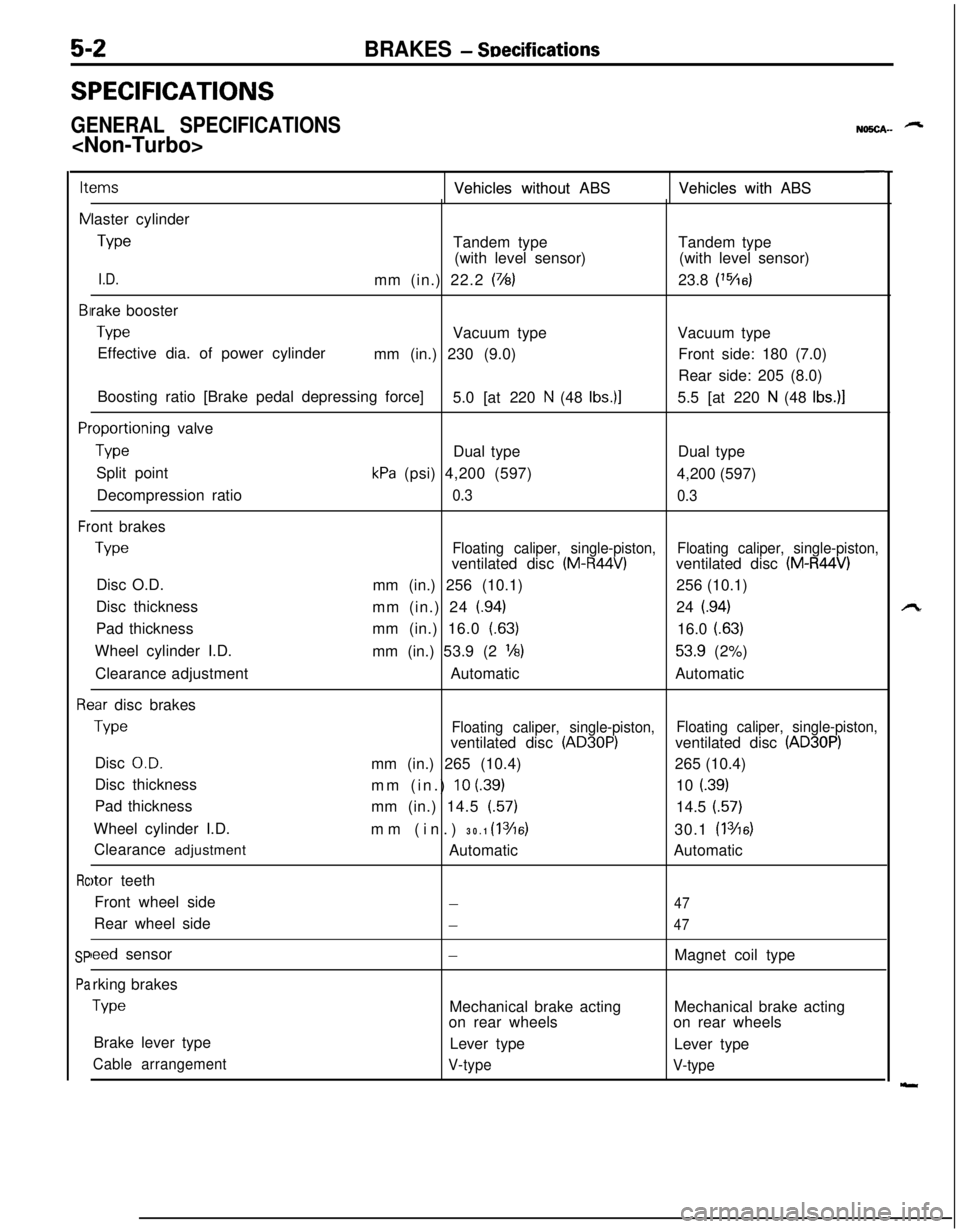
5-2BRAKES - SDecifications
SPECIFICATIONS
GENERAL SPECIFICATIONS
NO!iCA-- -
ItemsItems
NNVehicles without ABS Vehicles without ABSVehicles with ABS Vehicles with ABS
BIBI
PlPl
Fr Frlaster cylinder
TypeTandem typeTandem type
(with level sensor)(with level sensor)
I.D.mm (in.) 22.2 (7/8)23.8 (‘%6)rake booster
TypeVacuum typeVacuum type
Effective dia. of power cylinder
mm (in.) 230 (9.0)Front side: 180 (7.0)
Rear side: 205 (8.0)
Boosting ratio [Brake pedal depressing force]
5.0 [at 220
N (48 Ibs.)]5.5 [at 220 N (48 Ibs.)]
.oportioning valve
TypeDual typeDual type
Split point
kPa (psi) 4,200 (597)
4,200 (597)
Decompression ratio
0.3
0.3ont brakes
TypeFloating caliper, single-piston,ventilated disc (M-R44V)Floating caliper, single-piston,ventilated disc (M-R44V)Disc O.D.
mm (in.) 256 (10.1)256 (10.1)
Disc thickness
mm (in.) 24
(.94)24 (.94)Pad thicknessmm (in.) 16.0 (63)
16.0
(.63)Wheel cylinder I.D.
mm (in.) 53.9 (2
l/8)53.9 (2%)
Clearance adjustmentAutomaticAutomatic
3ar disc brakes
TypeFloating caliper, single-piston,Floating caliper, single-piston,ventilated disc (AD30P)ventilated disc (AD30P)Disc
O.D.mm (in.) 265 (10.4)265 (10.4)
Disc thickness
mm (in.)
10 (39)10 i.39)Pad thickness
mm (in.) 14.5 (57)
14.5 (57)
Wheel cylinder I.D.
mm (in.) 30.1
(1 3/16)30.1 (1 346)Clearance adjustment
AutomaticAutomatic
)tor teeth
Front wheel side
-47Rear wheel side
-47
leed sensor-Magnet coil type
rking brakes
TypeMechanical brake actingMechanical brake acting
on rear wheelson rear wheels
Brake lever type
Lever type
Lever type
Cable arrangement
V-type
V-type
Rc Rc
SP SP
Pa Pa
Page 143 of 1216
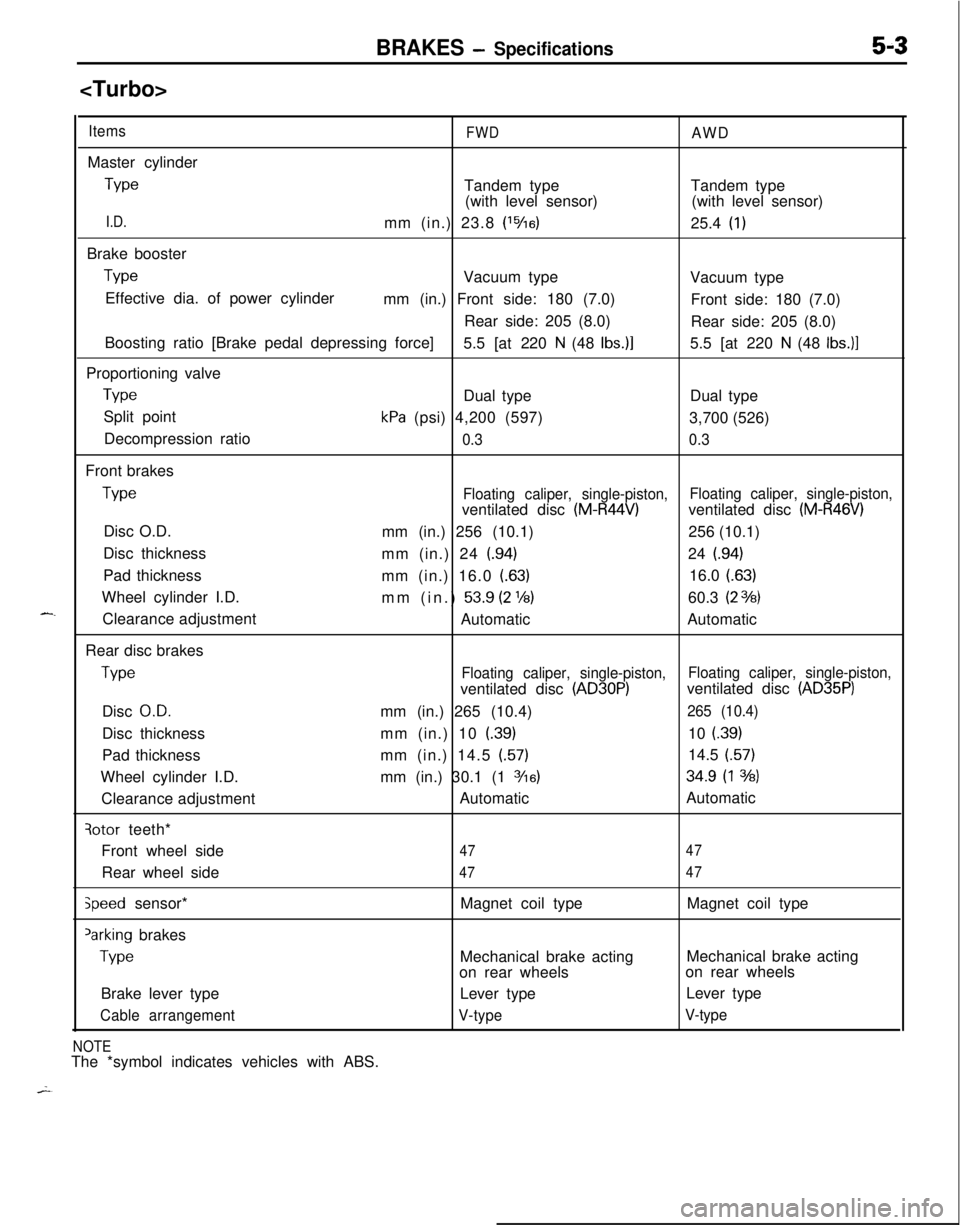
BRAKES - Specifications5-3
ItemsFWDAWDMaster cylinder
TypeTandem type
(with level sensor)Tandem type
(with level sensor)
I.D.mm (in.) 23.8 (‘%a)25.4 (1)Brake booster
TypeVacuum type
Vacuum type
Effective dia. of power cylinder
mm (in.) Front side: 180 (7.0)
Front side: 180 (7.0)
Rear side: 205 (8.0)
Rear side: 205 (8.0)
Boosting ratio [Brake pedal depressing force]
5.5 [at 220
N (48 Ibs.)]5.5 [at 220 N (48 Ibs.)]Proportioning valve
TypeDual typeDual type
Split point
kPa (psi) 4,200 (597)
3,700 (526)
Decompression ratio
0.30.3Front brakes
TypeFloating caliper, single-piston,Floating caliper, single-piston,ventilated disc (M-R44V)ventilated disc (M-R46V)Disc O.D.
mm (in.) 256 (10.1)256 (10.1)
Disc thickness
mm (in.) 24
(.94)24 (.94)Pad thickness
mm (in.) 16.0
(.63)16.0 (.63)Wheel cylinder I.D.
mm (in.)
53.9 (2 ‘16)60.3 (23%3)Clearance adjustment
AutomaticAutomatic
Rear disc brakes
TypeFloating caliper, single-piston,Floating caliper, single-piston,ventilated disc (AD30P)ventilated disc (AD35P)Disc
O.D.mm (in.) 265 (10.4)265 (10.4)Disc thicknessmm (in.) 10
(.39)10 f.39)Pad thicknessmm (in.) 14.5
(.57)14.5 (.57)Wheel cylinder I.D.mm (in.) 30.1 (1
3/16)34.9 (1 3h)Clearance adjustmentAutomaticAutomatic
qotor teeth*
Front wheel side
4747Rear wheel side
4747
speed sensor*Magnet coil typeMagnet coil type‘arking brakes
TypeMechanical brake actingMechanical brake acting
on rear wheelson rear wheels
Brake lever typeLever typeLever type
Cable arrangementV-typeV-type
NOTEThe *symbol indicates vehicles with ABS.
Page 144 of 1216
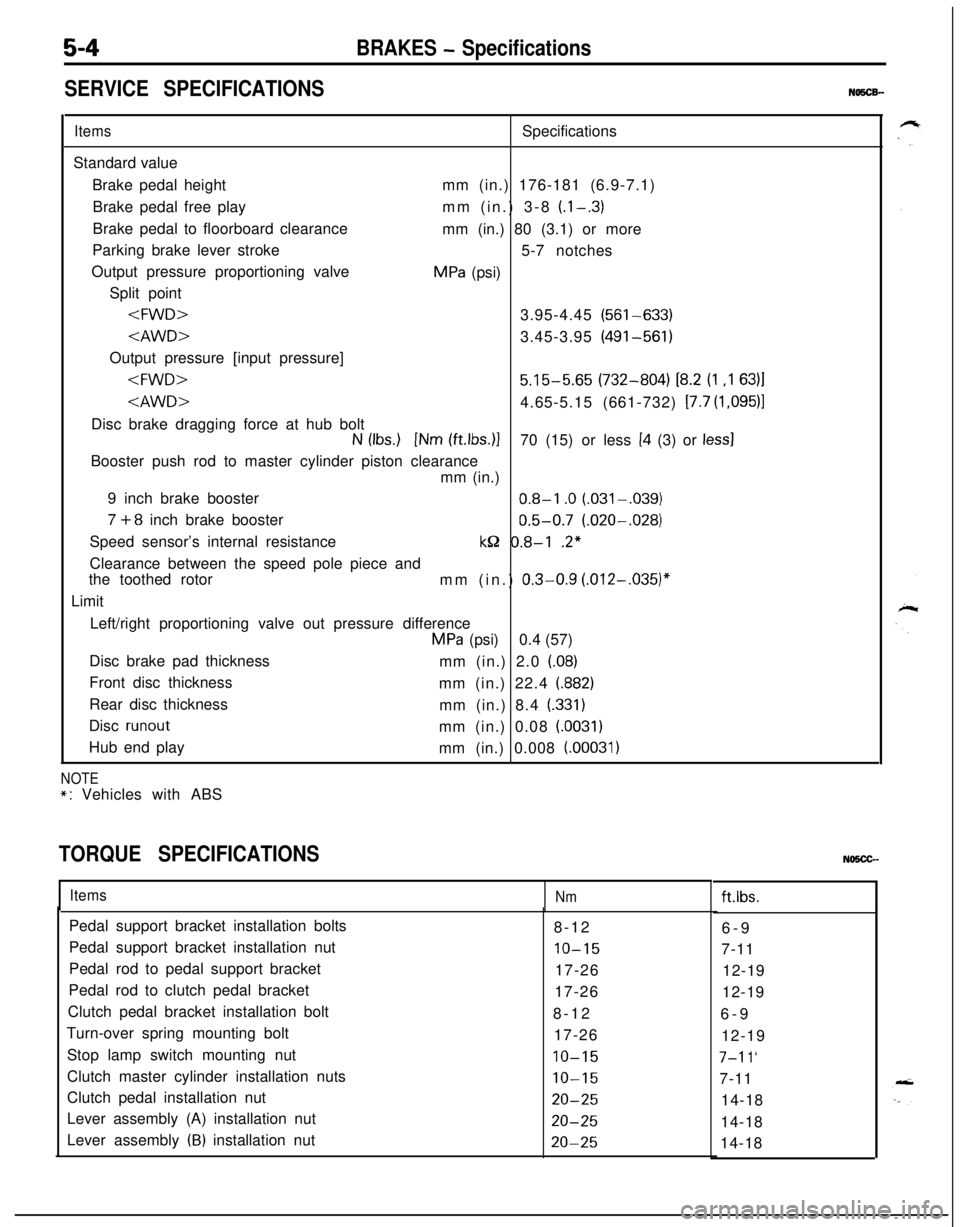
5-4BRAKES - Specifications
SERVICE SPECIFICATIONS
NO5CB-
ItemsSpecifications
Standard value
Brake pedal heightmm (in.) 176-181 (6.9-7.1)
Brake pedal free playmm (in.) 3-8
(l-.3)Brake pedal to floorboard clearance
mm (in.) 80 (3.1) or more
Parking brake lever stroke
5-7 notches
Output pressure proportioning valve
MPa (psi)
Split point
Output pressure [input pressure]
N (Ibs.) [Nm (ftlbs.)]70 (15) or less [4 (3) or less1Booster push rod to master cylinder piston clearance
mm (in.)
9 inch brake booster
0.8-l .O (.031-,039)
7
+8 inch brake booster0.5-0.7 (.020-.028)
Speed sensor’s internal resistance
kQ 0.8-l .2*
Clearance between the speed pole piece and
the toothed rotor
mm (in.)
0.3-0.9 (.012-,035)”Limit
Left/right proportioning valve out pressure difference
MPa (psi)0.4 (57)
Disc brake pad thickness
mm (in.) 2.0 (08)
Front disc thickness
mm (in.) 22.4 (882)
Rear disc thickness
mm (in.) 8.4
(.331)Disc
runoutmm (in.) 0.08 (.0031)Hub end play
mm (in.) 0.008
(.00031)
NOTE
*: Vehicles with ABS
TORQUE SPECIFICATIONS
ItemsNmft.lbs.
Pedal support bracket installation bolts
8-12
6-9
Pedal support bracket installation nut
IO-157-11
Pedal rod to pedal support bracket
17-26
12-19
Pedal rod to clutch pedal bracket
17-26
12-19
Clutch pedal bracket installation bolt
8-12
6-9
Turn-over spring mounting bolt
17-26
12-19
Stop lamp switch mounting nut
IO-157-l 1‘Clutch master cylinder installation nuts
10-157-11
Clutch pedal installation nut
20-2514-18
Lever assembly (A) installation nut
20-2514-18
Lever assembly
(B) installation nut20-2514-18
Page 149 of 1216

BRAKES - Anti-lock Braking System Troubleshooting5-9
ANTI-LOCK BRAKING SYSTEM
-- TROUBLESHOOTINGNO!JEBAE
PARTICULAR CHARACTERISTICS OF
THE ANTI-LOCK BRAKING SYSTEMModels equipped with the anti-lock braking system
(A.B.S.) may exhibit one or more of the following
characteristics from time to time, but none of these
is abnormal.
(1) A pulsing feeling in the brake pedal, or vibration
of the body or the steering wheel, when the
anti-lock braking system is activated by sudden
braking or by braking on a slippery road surface.Actually, this phenomenon is an indication that
the anti-lock braking system is functioning nor-
mally.(2) When the vehicle speed reaches approximately
6 km/h (4 mph) after the engine is started and
the vehicle starts off (for the first time), a
whining motor noise may be heard from the
engine compartment if the vehicle is traveling in
a quiet place, but this noise is simply the result
of a self-check being made of the anti-lock
braking system operation.
TROUBLESHOOTING METHODSProblems related to the anti-lock braking system
(A.B.S.) can be classified into two general categor-
ies: problems in the electrical system and those in
the hydraulic system.For problems in the electrical system, the
self-diagnosis function is built into the electronic control
unit (E.C.U.) causing the A.B.S. warning light to
illuminate as a warning to the driver.
Problems in the hydraulic system (poor braking,
etc.) can be located in the same way as for ordinary
brakes. There is, however, the necessity to check todetermine whether the problem is related to ordin-
ary brake components or to the components relatedto the A.B.S.
HOW TO USE THE TROUBLESHOOTING
FLOW CHART(1) Using the flow chart, check the ABS warning
light light-up sequence and check the condition
of braking operation.
(2) Following the check chart listed in the remedy
column, perform the checks. There are [Explana-tion] and [Hint] in each check chart. Refer to
them when troubleshooting.
NOTEECU: Electronic control unit
HU: Hydraulic unit
MUT: Multi-use tester
Page 150 of 1216
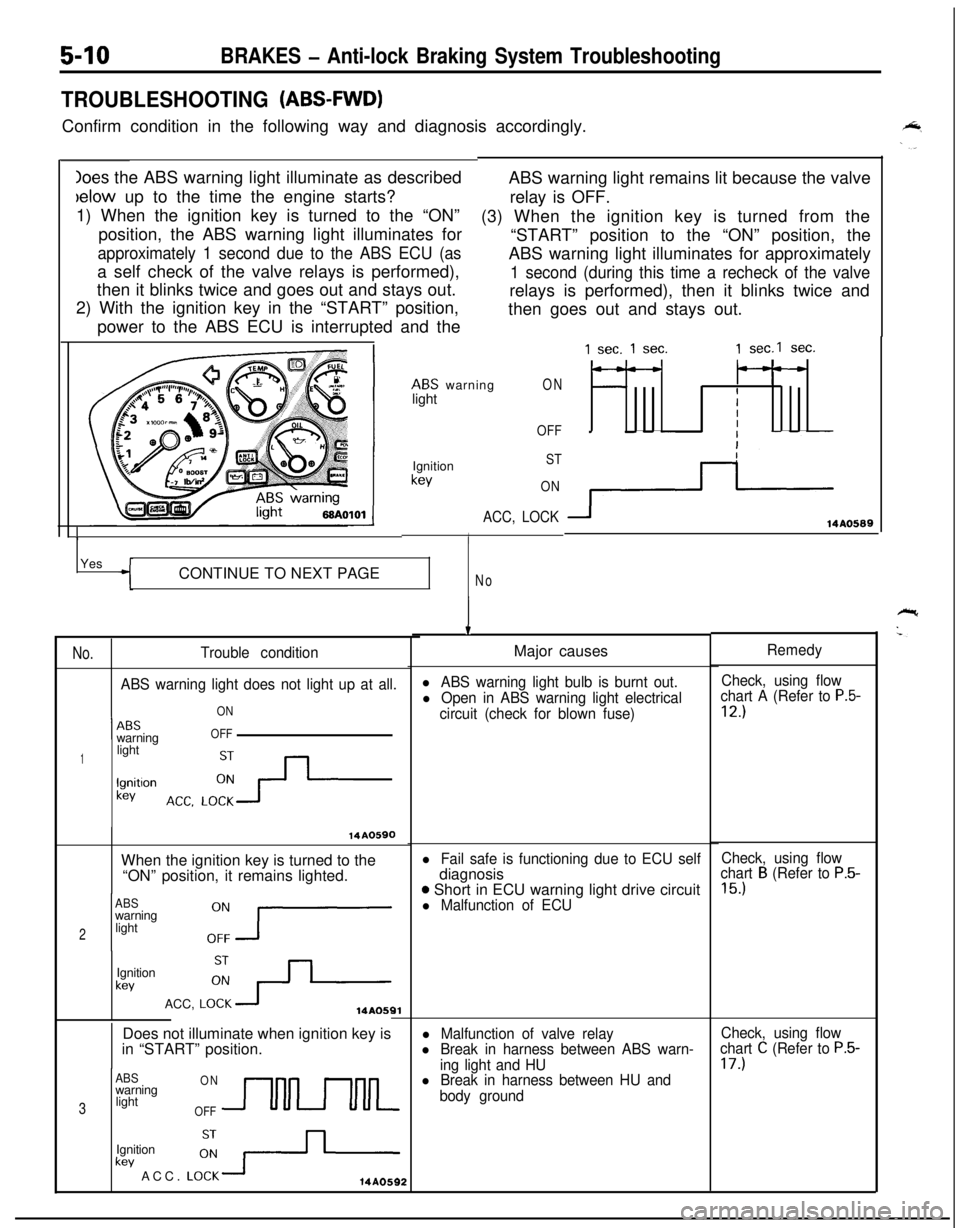
Ioes the ABS warning light illuminate as describedbelow up to the time the engine starts?
1) When the ignition key is turned to the “ON”
position, the ABS warning light illuminates for
approximately 1 second due to the ABS ECU (asa self check of the valve relays is performed),
then it blinks twice and goes out and stays out.
2) With the ignition key in the “START” position,
power to the ABS ECU is interrupted and the
5-10BRAKES - Anti-lock Braking System Troubleshooting
TROUBLESHOOTING (ABS-FWD)Confirm condition in the following way and diagnosis accordingly.
ABS warning light remains lit because the valve
relay is OFF.
(3) When the ignition key is turned from the
“START” position to the “ON” position, the
ABS warning light illuminates for approximately
1 second (during this time a recheck of the valverelays is performed), then it blinks twice and
then goes out and stays out.
ABS warning
lightON
OFF
1Ignition
kev
ST
ON
ACC, LOCK
IYes
CONTINUE TO NEXT PAGE
No
No.Trouble condition
ABS warning light does not light up at all.
ON
1 --ABSwarningOFF
1lightlgnitlon
kev
14A0590When the ignition key is turned to the
“ON” position, it remains lighted.
ABSwarning
2light
Ignition
kevACC,
LO:+14AOSQlDoes not illuminate when ignition key is
in “START” position.
ABSONwarning
3lightOFFUULkev ACC.
LO:-+-Ignition14A0592
1 sec. 1 sec.1 sec.1 sec.
---
IIII
3114AO589
IMajor causes
l ABS warning light bulb is burnt out.Check, using flow
l Open in ABS warning light electricalchart A (Refer to P.5-
circuit (check for blown fuse)12.)
l Fail safe is functioning due to ECU selfdiagnosis
o Short in ECU warning light drive circuitl Malfunction of ECU
l Malfunction of valve relayl Break in harness between ABS warn-
ing light and HU
l Break in harness between HU and
body groundRemedy
Check, using flow
chart
B (Refer to P.5-
15.)
Check, using flow
chart C (Refer to P.5-17.)
Page 151 of 1216
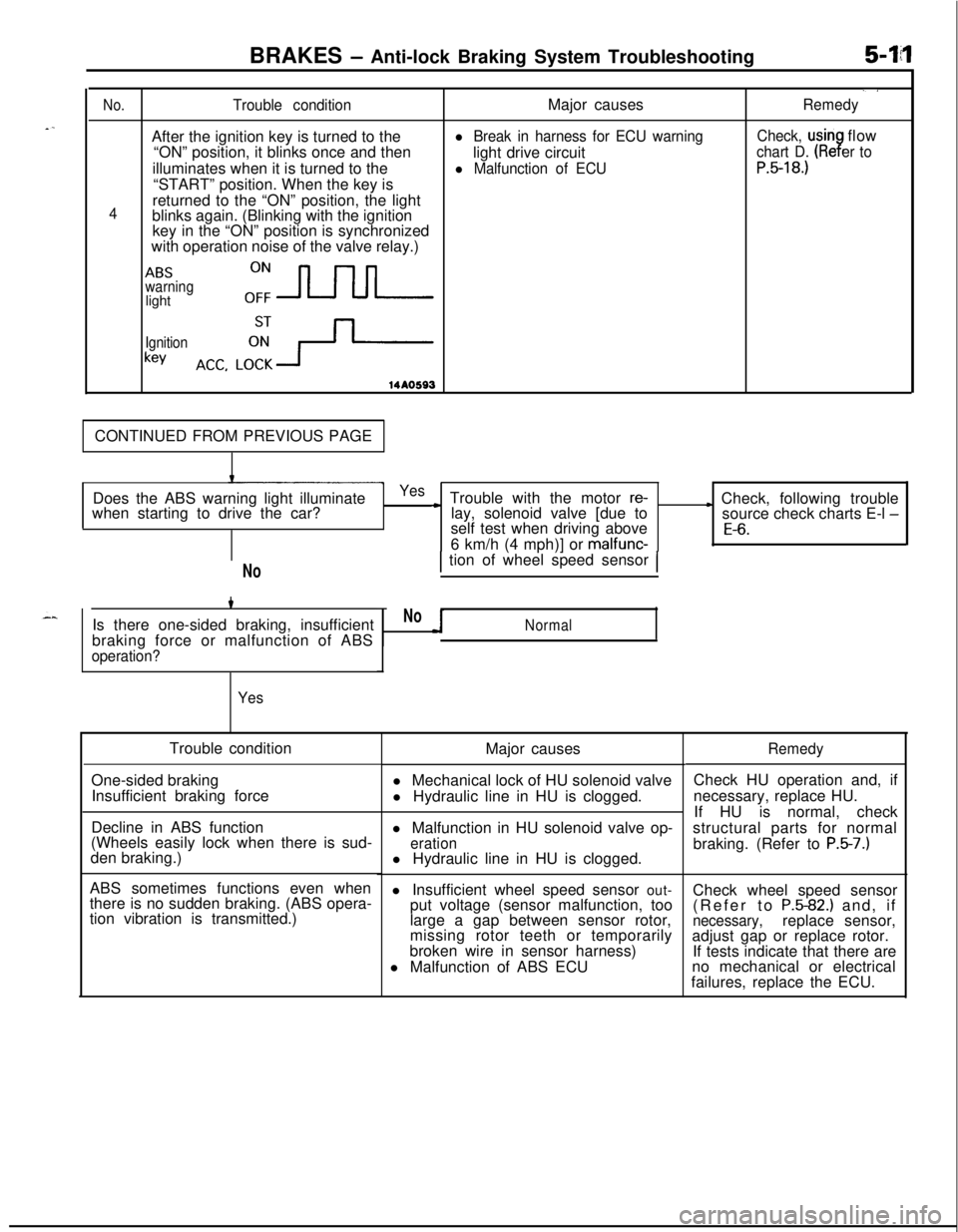
BRAKES - Anti-lock Braking System Troubleshooting5-14
./
No.Trouble conditionMajor causesRemedyAfter the ignition key is turned to the
l Break in harness for ECU warningCheck, usinflow
“ON” position, it blinks once and then
light drive circuit
chart D. (Re er to9illuminates when it is turned to the
l Malfunction of ECUP.5-18.)“START” position. When the key is
4returned to the “ON” position, the light
blinks again. (Blinking with the ignition
key in the “ON” position is synchronized
with operation noise of the valve relay.)
ABSwarninglighto:-
Ignition
keyACC. LCi+-
14*0593CONTINUED FROM PREVIOUS PAGE
Does the ABS warning light illuminate
when starting to drive the car?
Yes~ Trouble with the motor re-lay, solenoid valve [due toL Check, following trouble
source check charts E-l -self test when driving above
E-6.6 km/h (4 mph)] or malfunc-
NoIs there one-sided braking, insufficient
braking force or malfunction of ABS
operation?
YesTrouble condition
Major causes
One-sided braking
Insufficient braking forcel Mechanical lock of HU solenoid valve
l Hydraulic line in HU is clogged.
Decline in ABS function
(Wheels easily lock when there is sud-
den braking.)
ABS sometimes functions even when
there is no sudden braking. (ABS opera-
tion vibration is transmitted.)
1 tion of wheel speed sensor 1
NoNormall Malfunction in HU solenoid valve op-
erationl Hydraulic line in HU is clogged.
l Insufficient wheel speed sensor out-
put voltage (sensor malfunction, too
large a gap between sensor rotor,
missing rotor teeth or temporarily
broken wire in sensor harness)
l Malfunction of ABS ECU
RemedyCheck HU operation and, if
necessary, replace HU.
If HU is normal, check
structural parts for normal
braking. (Refer to
P.5-7.)Check wheel speed sensor
(Refer to
P.5-82.) and, ifnecessary,replace sensor,
adjust gap or replace rotor.
If tests indicate that there are
no mechanical or electrical
failures, replace the ECU.
Page 152 of 1216
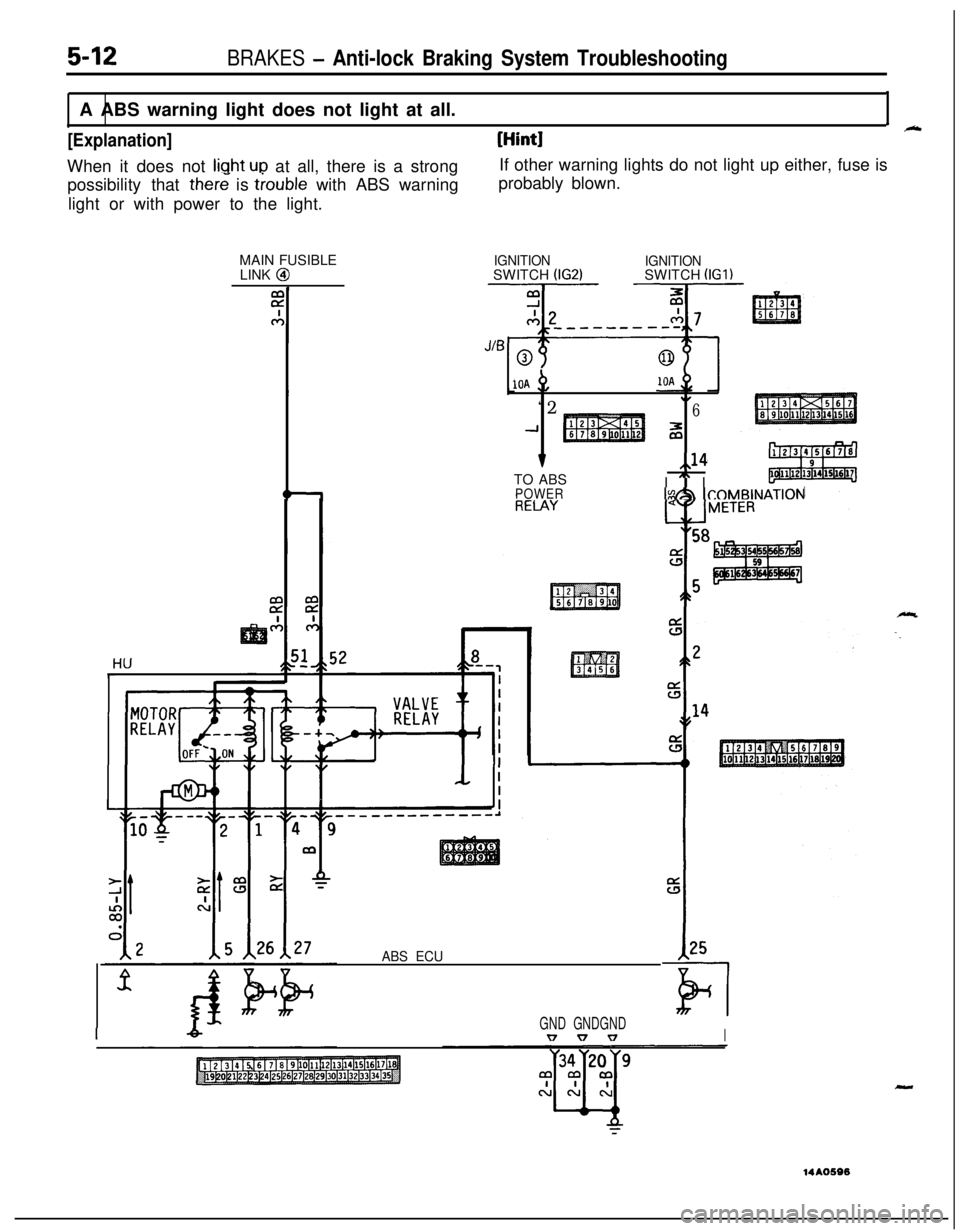
possibility that there is trouble with ABS warning
light or with power to the light.probably blown.
MAIN FUSIBLE
LINK @
5-12BRAKES - Anti-lock Braking System TroubleshootingA ABS warning light does not light at all.
I_
[Explanation][Hint]When it does not
liuht ULI at all, there is a strongIf other warning lights do not light up either, fuse is
IGNITIONSWITCH (IG2)IGNITIONSWITCH (IGl)
10A +,
“2.I6
-1z
v,,14TO ABS
I
” IPOWERIs&h ICOMBINAT~~N
ABS ECU
IGND GNDGNDv v vI
-14AO596
Page 153 of 1216
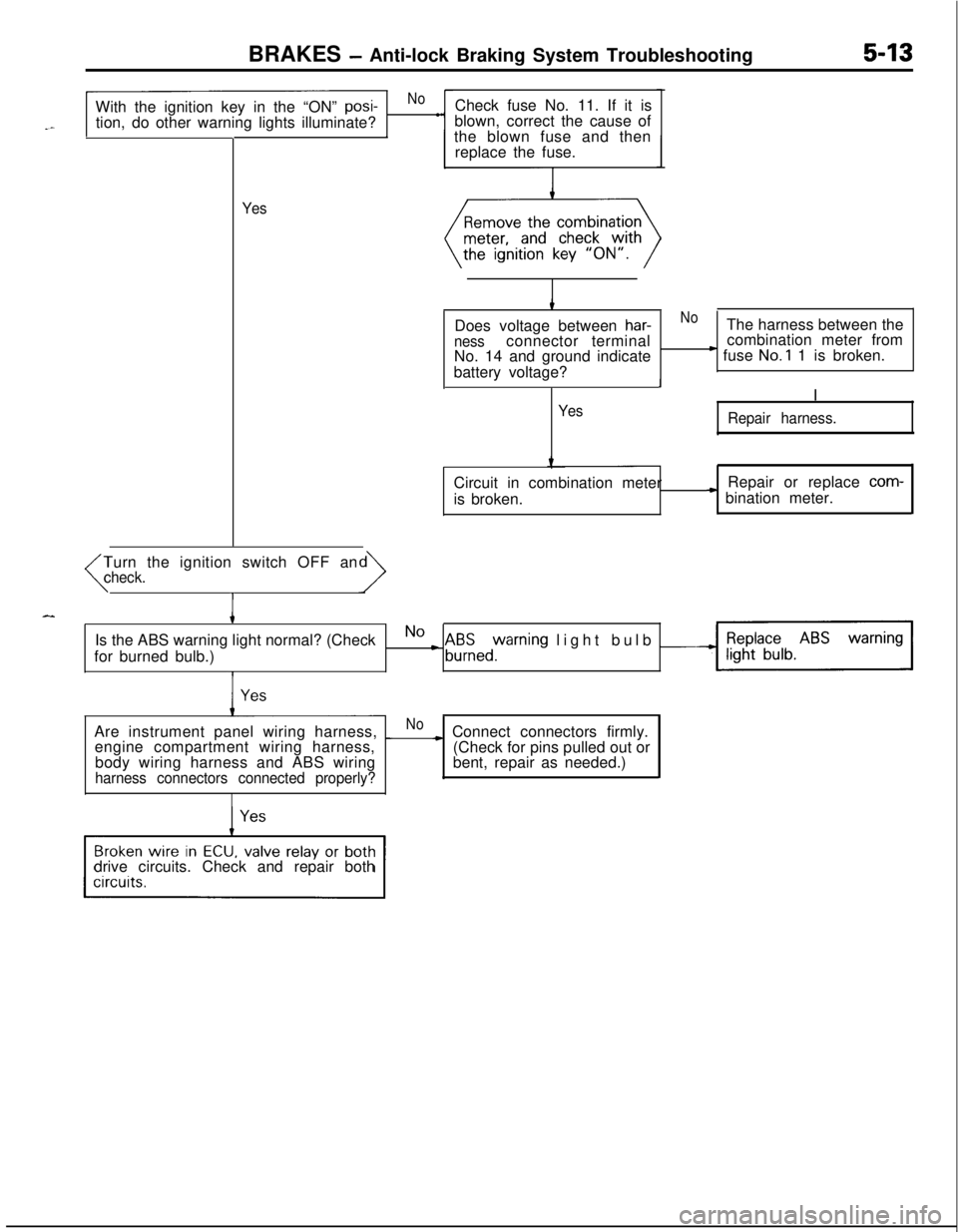
BRAKES - Anti-lock Braking System Troubleshooting5-13With the ignition key in the “ON”
posi-Nol
tion, do other warning lights illuminate?
II
YesCheck fuse No. 11. If it is
blown, correct the cause of
the blown fuse and then
replace the fuse.
Does voltage between
har-NoThe harness between thenessconnector terminalcombination meter from
No. 14 and ground indicate) fuse No.1 1 is broken.
battery voltage?
II
Yes
Repair harness.Circuit in combination meter
is broken.Repair or replace
com-
* bination meter.
Turn the ignition switch OFF an
(check.
IIs the ABS warning light normal? (Check
for burned bulb.)
No L A&zed%rning light bulb -Are instrument panel wiring harness,
_Noengine compartment wiring harness,~ Connect connectors firmly.
(Check for pins pulled out or
bent, repair as needed.) body wiring harness and ABS wiring
harness connectors connected properly?drive circuits. Check and repair both