flat MITSUBISHI GRANDIS 2008 (in English) User Guide
[x] Cancel search | Manufacturer: MITSUBISHI, Model Year: 2008, Model line: GRANDIS, Model: MITSUBISHI GRANDIS 2008Pages: 458, PDF Size: 18.52 MB
Page 102 of 458
2-54 Seat and seat belts
2
WARNING
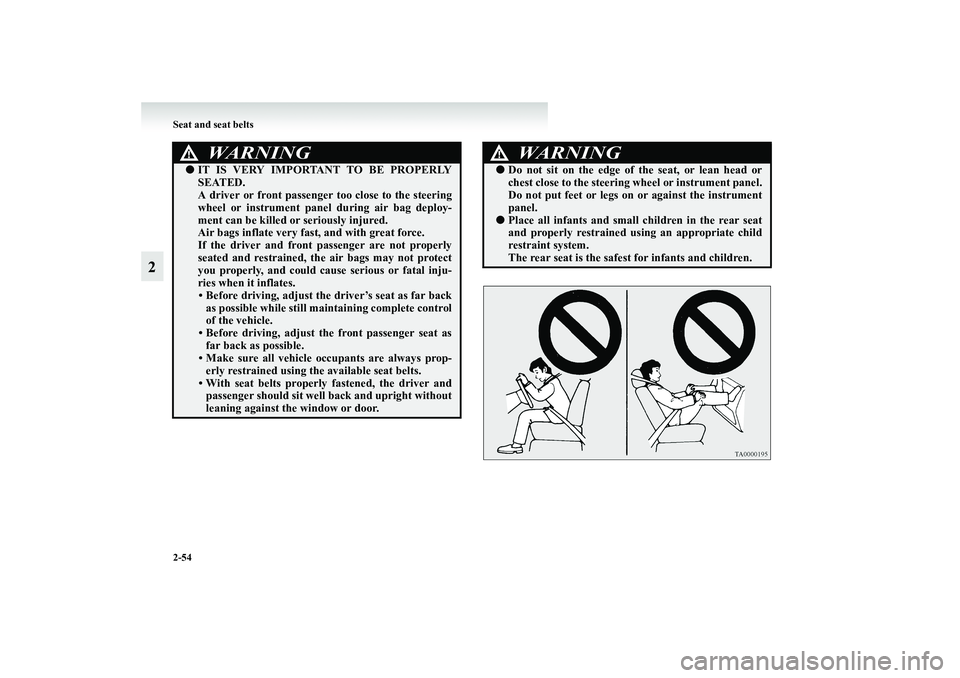
!●IT IS VERY IMPORTANT TO BE PROPERLY
SEATED.
A driver or front passenger too close to the steering
wheel or instrument panel during air bag deploy-
ment can be killed or seriously injured.
Air bags inflate very fast, and with great force.
If the driver and front passenger are not properly
seated and restrained, the air bags may not protect
you properly, and could cause serious or fatal inju-
ries when it inflates.
• Before driving, adjust the driver’s seat as far back
as possible while still maintaining complete control
of the vehicle.
• Before driving, adjust the front passenger seat as
far back as possible.
• Make sure all vehicle occupants are always prop-
erly restrained using the available seat belts.
• With seat belts properly fastened, the driver and
passenger should sit well back and upright without
leaning against the window or door.
WARNING
!●Do not sit on the edge of the seat, or lean head or
chest close to the steering wheel or instrument panel.
Do not put feet or legs on or against the instrument
panel.●Place all infants and small children in the rear seat
and properly restrained using an appropriate child
restraint system.
The rear seat is the safest for infants and children.
BK-XP08E1ENUK.en-uk.book Page 54 Monday, August 13, 2007 2:20 PM
Page 103 of 458
Seat and seat belts
2-55
2
WARNING
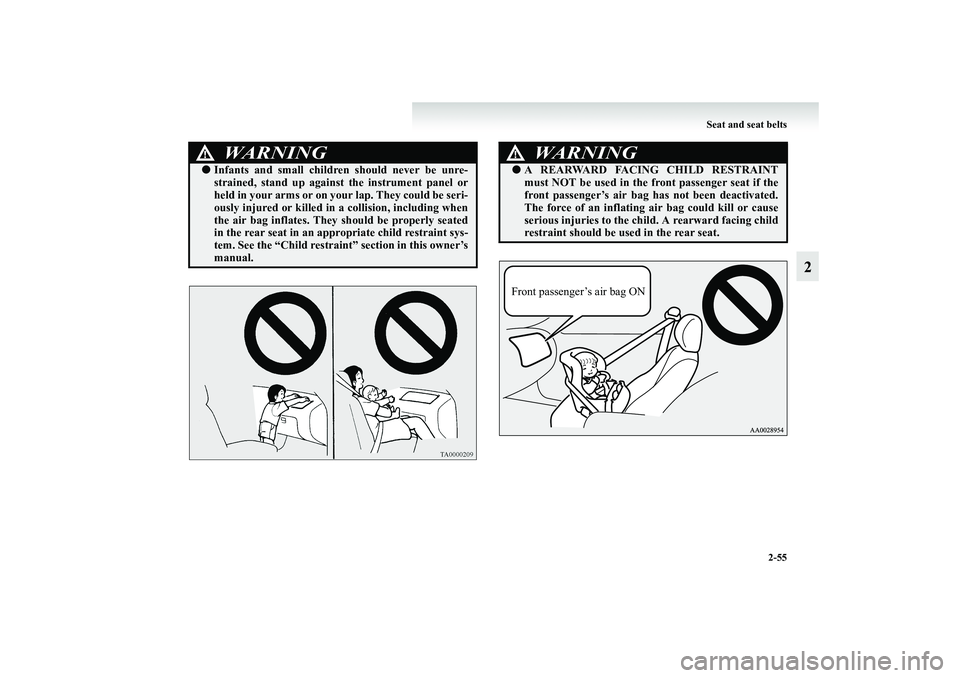
!●Infants and small children should never be unre-
strained, stand up against the instrument panel or
held in your arms or on your lap. They could be seri-
ously injured or killed in a collision, including when
the air bag inflates. They should be properly seated
in the rear seat in an appropriate child restraint sys-
tem. See the “Child restraint” section in this owner’s
manual.
WARNING
!●A REARWARD FACING CHILD RESTRAINT
must NOT be used in the front passenger seat if the
front passenger’s air bag has not been deactivated.
The force of an inflating air bag could kill or cause
serious injuries to the child. A rearward facing child
restraint should be used in the rear seat.Front passenger’s air bag ON
BK-XP08E1ENUK.en-uk.book Page 55 Monday, August 13, 2007 2:20 PM
Page 106 of 458
2-58 Seat and seat belts
2
The air bags will operate only when the ignition switch is in the
“ON” or “START” position.When the impact sensors detect an impact of sufficient frontal
or side force, an automated circuit ignites materials in the infla-
tor to generate gas and inflate the air bags.
The air bags deployment produces a sudden, loud noise, and
releases some smoke and powder, but these conditions are not
injurious, and do not indicate a fire in the vehicle. People with
respiratory problems may feel some temporary irritation from
chemicals used to produce the deployment; open the windows
after air bag deployment, if safe to do so.
The air bags deflate very rapidly after deployment, so there is
little danger of obscured vision.
The time required from the sensors detecting an impact to
deflation of the air bags after deployment is shorter than a blink
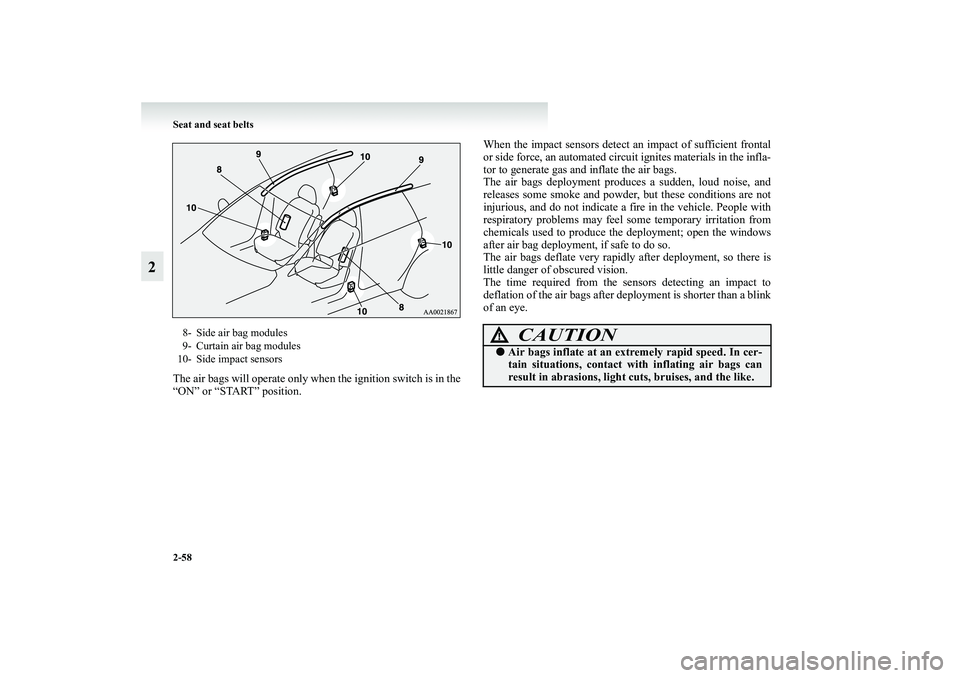
of an eye.8- Side air bag modules
9- Curtain air bag modules
10- Side impact sensors
CAUTION
!●Air bags inflate at an extremely rapid speed. In cer-
tain situations, contact with inflating air bags can
result in abrasions, light cuts, bruises, and the like.
BK-XP08E1ENUK.en-uk.book Page 58 Monday, August 13, 2007 2:20 PM
Page 111 of 458
Seat and seat belts
2-63
2
Driver’s and passenger’s front air bag system
E00407400356
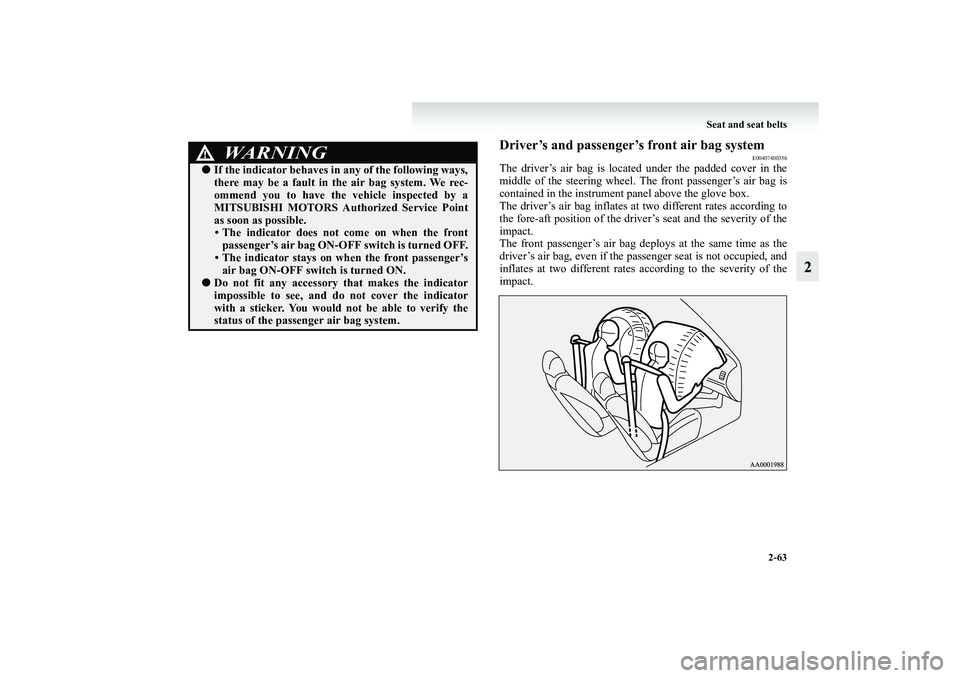
The driver’s air bag is located under the padded cover in the
middle of the steering wheel. The front passenger’s air bag is
contained in the instrument panel above the glove box.
The driver’s air bag inflates at two different rates according to
the fore-aft position of the driver’s seat and the severity of the
impact.
The front passenger’s air bag deploys at the same time as the
driver’s air bag, even if the passenger seat is not occupied, and
inflates at two different rates according to the severity of the
impact.
WARNING
!●If the indicator behaves in any of the following ways,
there may be a fault in the air bag system. We rec-
ommend you to have the vehicle inspected by a
MITSUBISHI MOTORS Authorized Service Point
as soon as possible.
• The indicator does not come on when the front
passenger’s air bag ON-OFF switch is turned OFF.
• The indicator stays on when the front passenger’s
air bag ON-OFF switch is turned ON.
●Do not fit any accessory that makes the indicator
impossible to see, and do not cover the indicator
with a sticker. You would not be able to verify the
status of the passenger air bag system.
BK-XP08E1ENUK.en-uk.book Page 63 Monday, August 13, 2007 2:20 PM
Page 112 of 458
2-64 Seat and seat belts
2
Deployment of front air bags
E00407501064
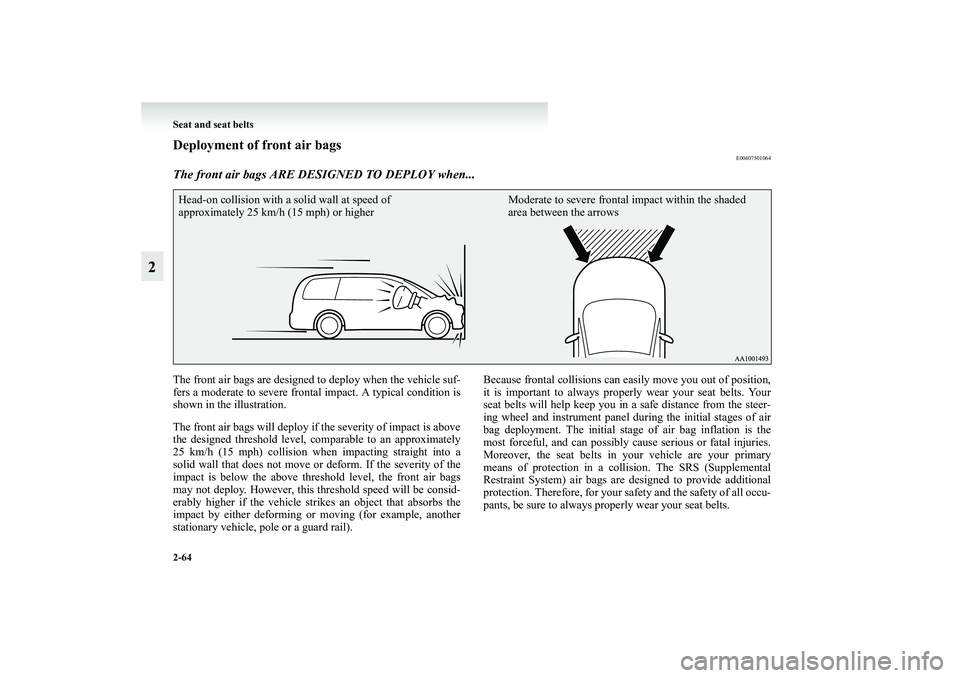
The front air bags ARE DESIGNED TO DEPLOY when...The front air bags are designed to deploy when the vehicle suf-
fers a moderate to severe frontal impact. A typical condition is
shown in the illustration.
The front air bags will deploy if the severity of impact is above
the designed threshold level, comparable to an approximately
25 km/h (15 mph) collision when impacting straight into a
solid wall that does not move or deform. If the severity of the
impact is below the above threshold level, the front air bags
may not deploy. However, this threshold speed will be consid-
erably higher if the vehicle strikes an object that absorbs the
impact by either deforming or moving (for example, another
stationary vehicle, pole or a guard rail).Because frontal collisions can easily move you out of position,
it is important to always properly wear your seat belts. Your
seat belts will help keep you in a safe distance from the steer-
ing wheel and instrument panel during the initial stages of air
bag deployment. The initial stage of air bag inflation is the
most forceful, and can possibly cause serious or fatal injuries.
Moreover, the seat belts in your vehicle are your primary
means of protection in a collision. The SRS (Supplemental
Restraint System) air bags are designed to provide additional
protection. Therefore, for your safety and the safety of all occu-
pants, be sure to always properly wear your seat belts.Head-on collision with a solid wall at speed of
approximately 25 km/h (15 mph) or higherModerate to severe frontal impact within the shaded
area between the arrowsBK-XP08E1ENUK.en-uk.book Page 64 Monday, August 13, 2007 2:20 PM
Page 115 of 458
Seat and seat belts
2-67
2
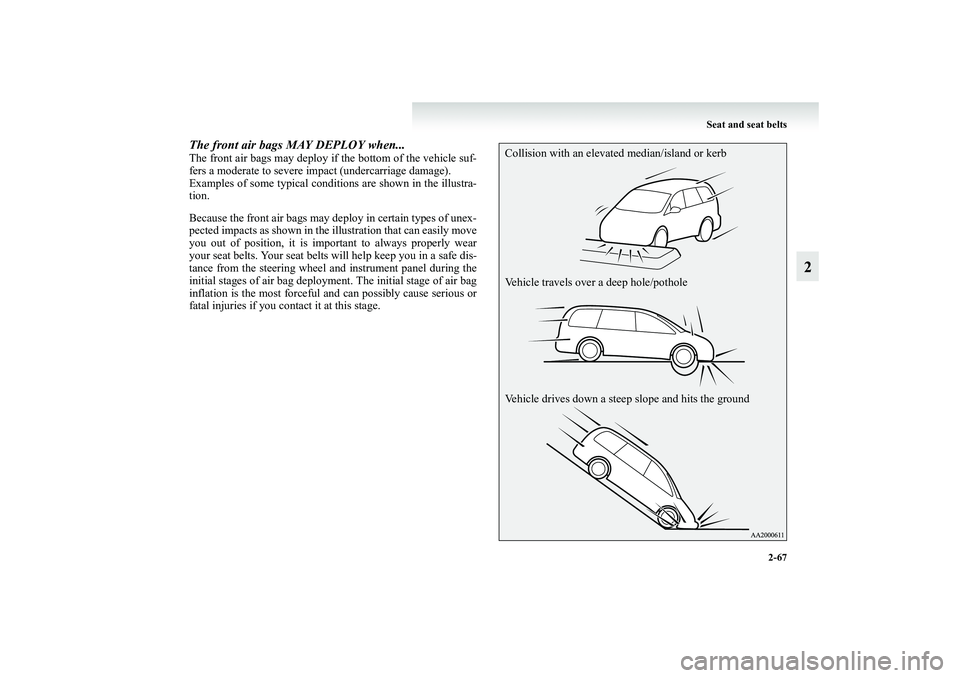
The front air bags MAY DEPLOY when... The front air bags may deploy if the bottom of the vehicle suf-
fers a moderate to severe impact (undercarriage damage).
Examples of some typical conditions are shown in the illustra-
tion.
Because the front air bags may deploy in certain types of unex-
pected impacts as shown in the illustration that can easily move
you out of position, it is important to always properly wear
your seat belts. Your seat belts will help keep you in a safe dis-
tance from the steering wheel and instrument panel during the
initial stages of air bag deployment. The initial stage of air bag
inflation is the most forceful and can possibly cause serious or
fatal injuries if you contact it at this stage.
Collision with an elevated median/island or kerb
Vehicle travels over a deep hole/pothole
Vehicle drives down a steep slope and hits the ground
BK-XP08E1ENUK.en-uk.book Page 67 Monday, August 13, 2007 2:20 PM
Page 116 of 458
2-68 Seat and seat belts
2
WARNING
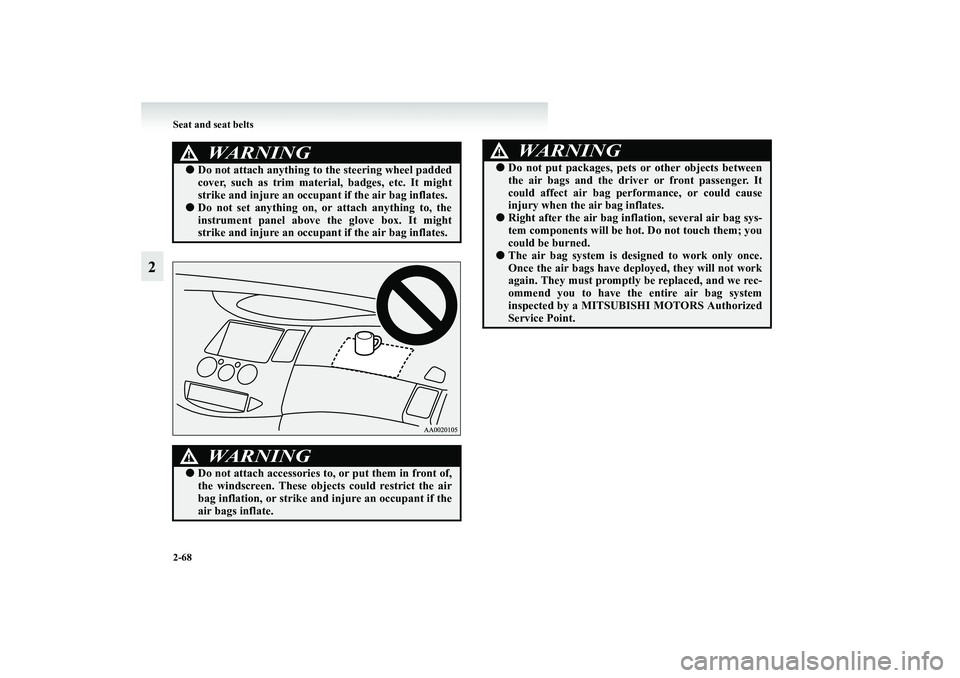
!●Do not attach anything to the steering wheel padded
cover, such as trim material, badges, etc. It might
strike and injure an occupant if the air bag inflates.●Do not set anything on, or attach anything to, the
instrument panel above the glove box. It might
strike and injure an occupant if the air bag inflates.
WARNING
!●Do not attach accessories to, or put them in front of,
the windscreen. These objects could restrict the air
bag inflation, or strike and injure an occupant if the
air bags inflate.
●Do not put packages, pets or other objects between
the air bags and the driver or front passenger. It
could affect air bag performance, or could cause
injury when the air bag inflates.●Right after the air bag inflation, several air bag sys-
tem components will be hot. Do not touch them; you
could be burned.●The air bag system is designed to work only once.
Once the air bags have deployed, they will not work
again. They must promptly be replaced, and we rec-
ommend you to have the entire air bag system
inspected by a MITSUBISHI MOTORS Authorized
Service Point.
WARNING
!
BK-XP08E1ENUK.en-uk.book Page 68 Monday, August 13, 2007 2:20 PM
Page 117 of 458
Seat and seat belts
2-69
2
Side air bag system
E00407600055
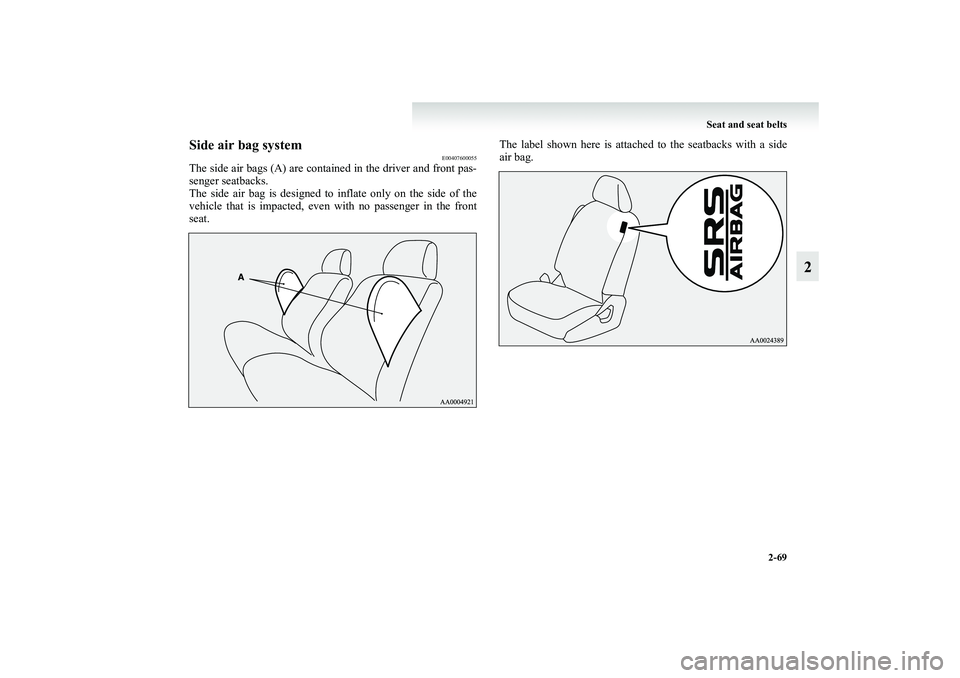
The side air bags (A) are contained in the driver and front pas-
senger seatbacks.
The side air bag is designed to inflate only on the side of the
vehicle that is impacted, even with no passenger in the front
seat.The label shown here is attached to the seatbacks with a side
air bag.
BK-XP08E1ENUK.en-uk.book Page 69 Monday, August 13, 2007 2:20 PM
Page 118 of 458
2-70 Seat and seat belts
2
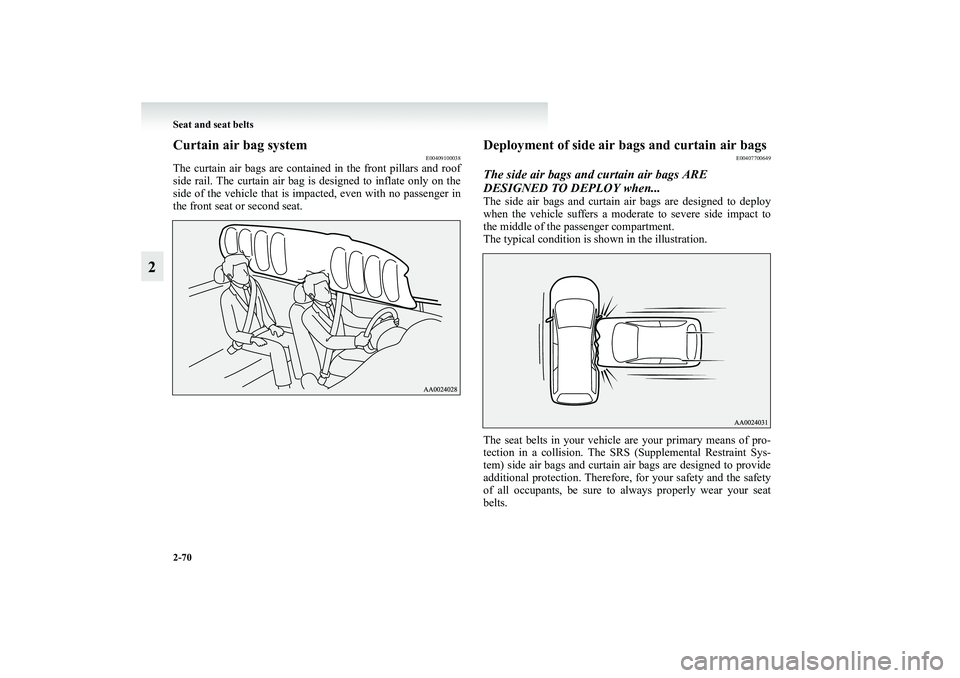
Curtain air bag system
E00409100038
The curtain air bags are contained in the front pillars and roof
side rail. The curtain air bag is designed to inflate only on the
side of the vehicle that is impacted, even with no passenger in
the front seat or second seat.
Deployment of side air bags and curtain air bags
E00407700649
The side air bags and curtain air bags ARE
DESIGNED TO DEPLOY when...The side air bags and curtain air bags are designed to deploy
when the vehicle suffers a moderate to severe side impact to
the middle of the passenger compartment.
The typical condition is shown in the illustration.
The seat belts in your vehicle are your primary means of pro-
tection in a collision. The SRS (Supplemental Restraint Sys-
tem) side air bags and curtain air bags are designed to provide
additional protection. Therefore, for your safety and the safety
of all occupants, be sure to always properly wear your seat
belts.
BK-XP08E1ENUK.en-uk.book Page 70 Monday, August 13, 2007 2:20 PM
Page 121 of 458
Seat and seat belts
2-73
2
Because the side air bags and curtain air bags do not protect the
occupant in all types of collisions, be sure to always properly
wear your seat belts.
WARNING
!●The side air bags and curtain air bags are designed
to supplement the driver and passenger seat belts in
certain side impacts. Seat belts should always be
worn properly, and the driver and passenger should
sit well back and upright without leaning against the
window or door.
WARNING
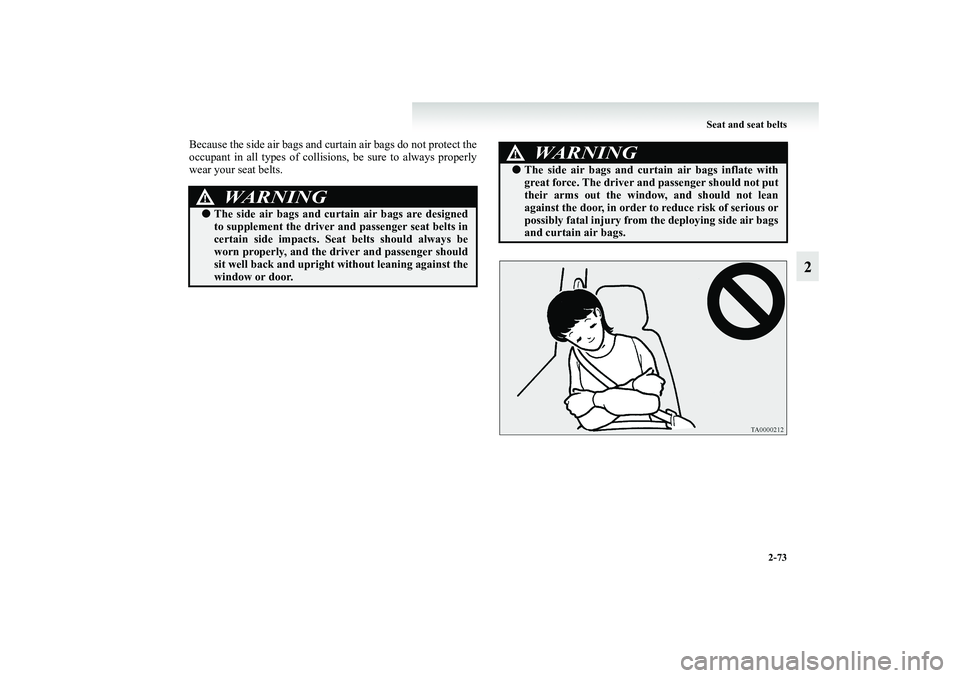
!●The side air bags and curtain air bags inflate with
great force. The driver and passenger should not put
their arms out the window, and should not lean
against the door, in order to reduce risk of serious or
possibly fatal injury from the deploying side air bags
and curtain air bags.
BK-XP08E1ENUK.en-uk.book Page 73 Monday, August 13, 2007 2:20 PM