Battery MITSUBISHI iMiEV 2014 1.G User Guide
[x] Cancel search | Manufacturer: MITSUBISHI, Model Year: 2014, Model line: iMiEV, Model: MITSUBISHI iMiEV 2014 1.GPages: 262, PDF Size: 26.84 MB
Page 23 of 262
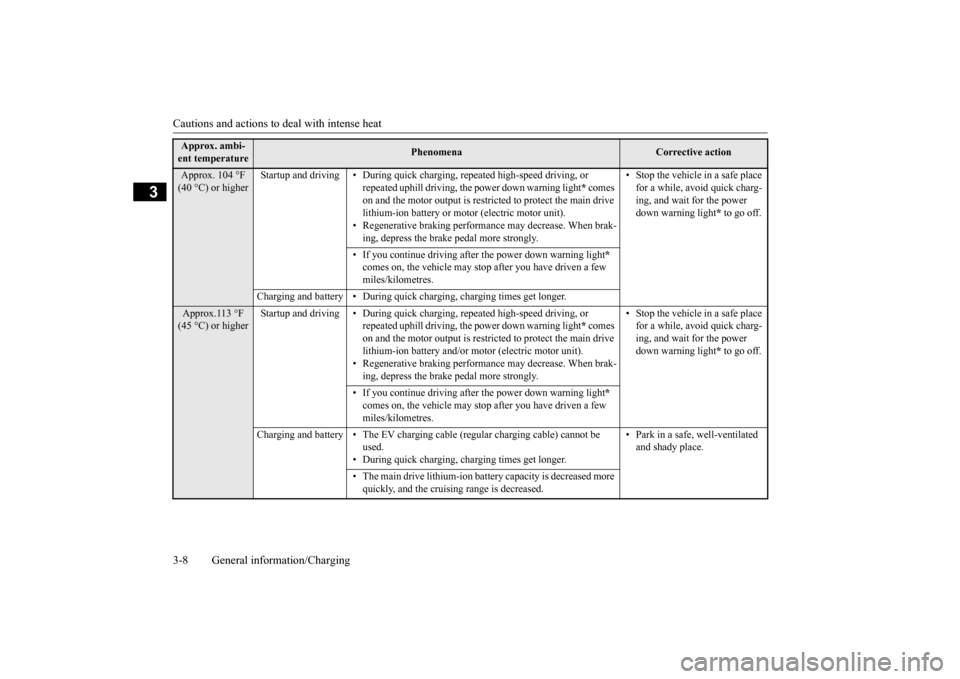
Cautions and actions to deal with intense heat 3-8 General information/Charging
3
Approx. ambi- ent temperature
Phenomena
Corrective action
Approx. 104 °F (40 °C) or higher
Startup and driving •
• During quick charging, repeated high-speed driving, or repeated uphill driving,
the power down warning light
* comes
on and the motor output is restrict
ed to protect the main drive
lithium-ion battery or mo
tor (electric motor unit).
Regenerative braking performance
may decrease. When brak-
ing, depress the brake pedal more strongly.
• Stop the vehicle in a safe place for a while, avoid quick charg- ing, and wait for the power down warning light
* to go off.
• If you continue driving after the power down warning light
*
comes on, the vehicle may stop
after you have driven a few
miles/kilometres.
Charging and battery • During quick
charging, charging times get longer.
Approx.113 °F (45 °C) or higher
Startup and driving •
• During quick charging, repeated high-speed driving, or repeated uphill driving,
the power down warning light
* comes
on and the motor output is restrict
ed to protect the main drive
lithium-ion battery and/or motor (electric motor unit). Regenerative braking performance
may decrease. When brak-
ing, depress the brake pedal more strongly.
• Stop the vehicle in a safe place for a while, avoid quick charg-ing, and wait for the power down warning light
* to go off.
• If you continue driving after the power down warning light
*
comes on, the vehicle may stop
after you have driven a few
miles/kilometres.
Charging and battery •
• The EV charging cable (regular charging cable) cannot be used. During quick charging, ch
arging times get longer.
• Park in a safe, well-ventilated and shady place.
• The main drive lithium-ion batt
ery capacity is decreased more
quickly, and the cruisi
ng range is decreased.
BK0209800US.book 8 ページ 2014年1月14日 火曜日 午前9時26分
Page 24 of 262
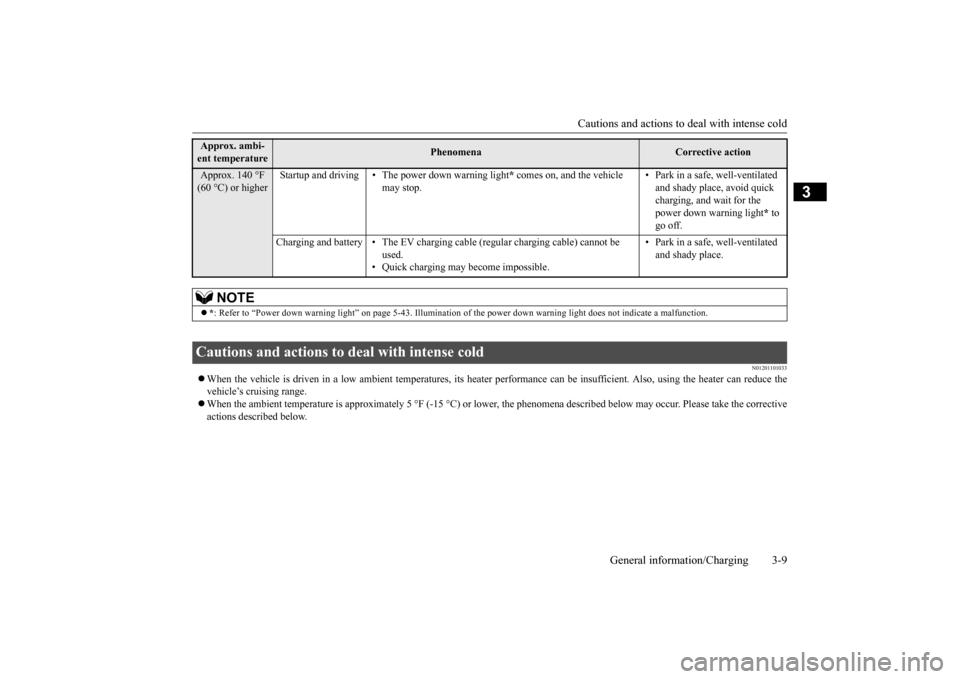
Cautions and actions to deal with intense cold
General information/Charging 3-9
3
N01201101033
When the vehicle is driven in a low ambient temperatures, its he
ater performance can be insuffic
ient. Also, using the heater ca
n reduce the
vehicle’s cruising range. When the ambient temperature is approximate
ly 5 °F (-15 °C) or lower, the phenomena de
scribed below may occu
r. Please take the
corrective
actions described below.Approx. 140 °F (60 °C) or higher
Startup and driving • The power down warning light
* comes on, and the vehicle
may stop.
• Park in a safe, well-ventilated and shady place,
avoid quick
charging, and wait for the power down warning light
* to
go off.
Charging and battery •
• The EV charging cable (regular
charging cable) cannot be
used.Quick charging may become impossible.
• Park in a safe, well-ventilated and shady place.
NOTE
*: Refer to “Power down warning light” on pa
ge 5-43. Illumination of the power down wa
rning light does not i
ndicate a malfunctio
n.
Cautions and actions to deal with intense cold Approx. ambi- ent temperature
Phenomena
Corrective action
BK0209800US.book 9 ページ 2014年1月14日 火曜日 午前9時26分
Page 25 of 262
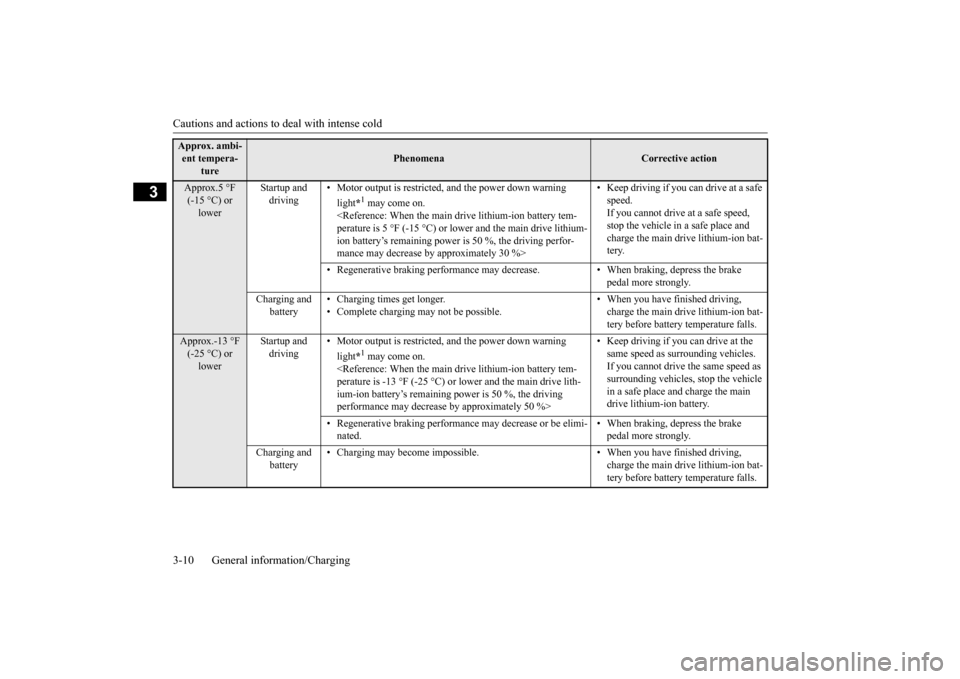
Cautions and actions to deal with intense cold 3-10 General information/Charging
3
Approx. ambi- ent tempera-
ture
Phenomena
Corrective action
Approx.5 °F (-15 °C) or lower
Startup and driving
• Motor output is restricted
, and the power down warning
light
*1 may come on.
• Keep driving if you can drive at a safe speed. If you cannot drive at
a safe speed,
stop the vehicle in a safe place and charge the main drive lithium-ion bat- tery.
• Regenerative braking performance may decr
ease. • When braking, depress the brake
pedal more strongly.
Charging and
battery
• • Charging times get longer. Complete charging may not be possible.
• When you have finished driving, charge the main drive lithium-ion bat- tery before battery temperature falls.
Approx.-13 °F (-25 °C) or lower
Startup and driving
• Motor output is restricted
, and the power down warning
light
*1 may come on.
• Keep driving if you can drive at the same speed as su
rrounding vehicles.
If you cannot drive th
e same speed as
surrounding vehicles, stop the vehicle in a safe place and charge the main drive lithium-ion battery.
• Regenerative braking performance
may decrease or be elimi-
nated.
• When braking, depress the brake pedal more strongly.
Charging and
battery
• Charging may become impossible. • W
hen you have finished driving, charge the main drive lithium-ion bat- tery before battery temperature falls.
BK0209800US.book 10 ページ 2014年1月14日 火曜日 午前9時26分
Page 26 of 262
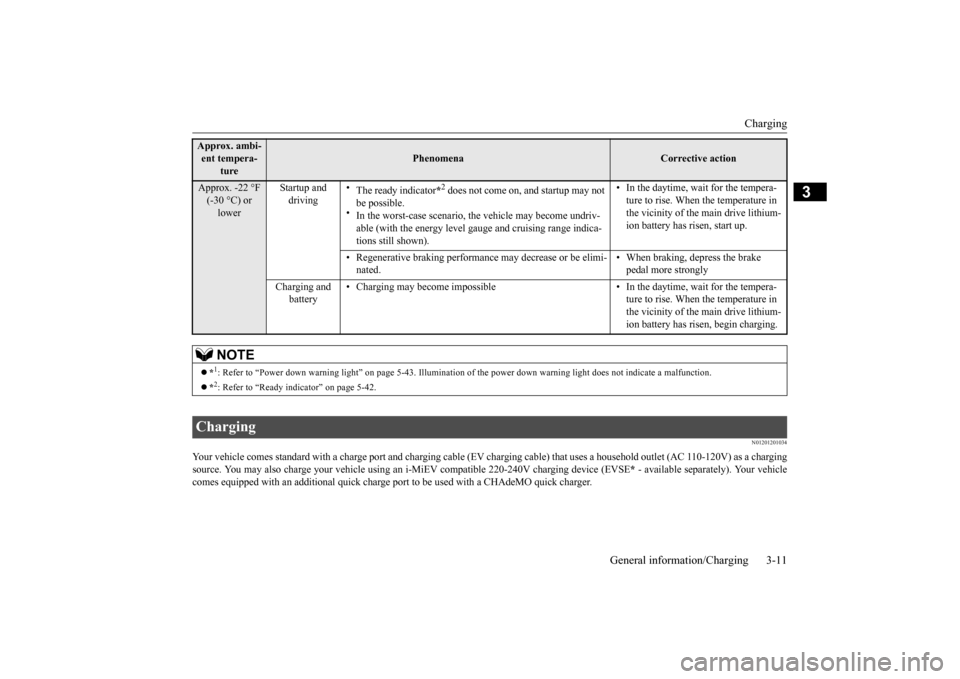
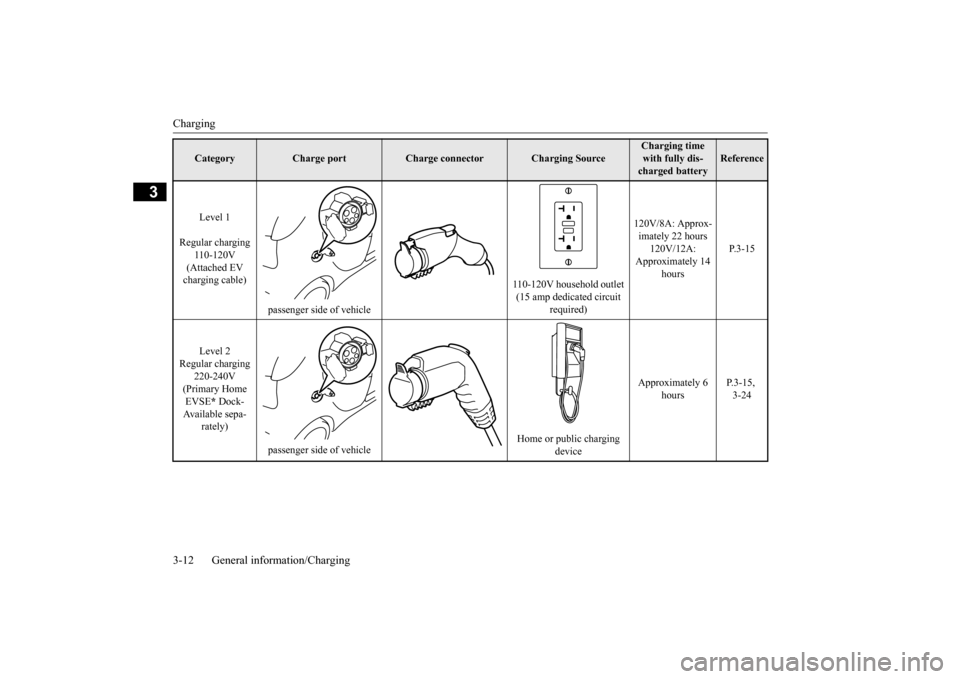
Charging
General information/Charging 3-11
3
N01201201034
Your vehicle comes standard with a charge
port and charging cable (EV charging cable)
that uses a household outlet (AC 110-120V
) as a charging
source. You may also charge your
vehicle using an i-MiEV compatib
le 220-240V charging device (EVSE
* - available separate
ly). Your vehicle
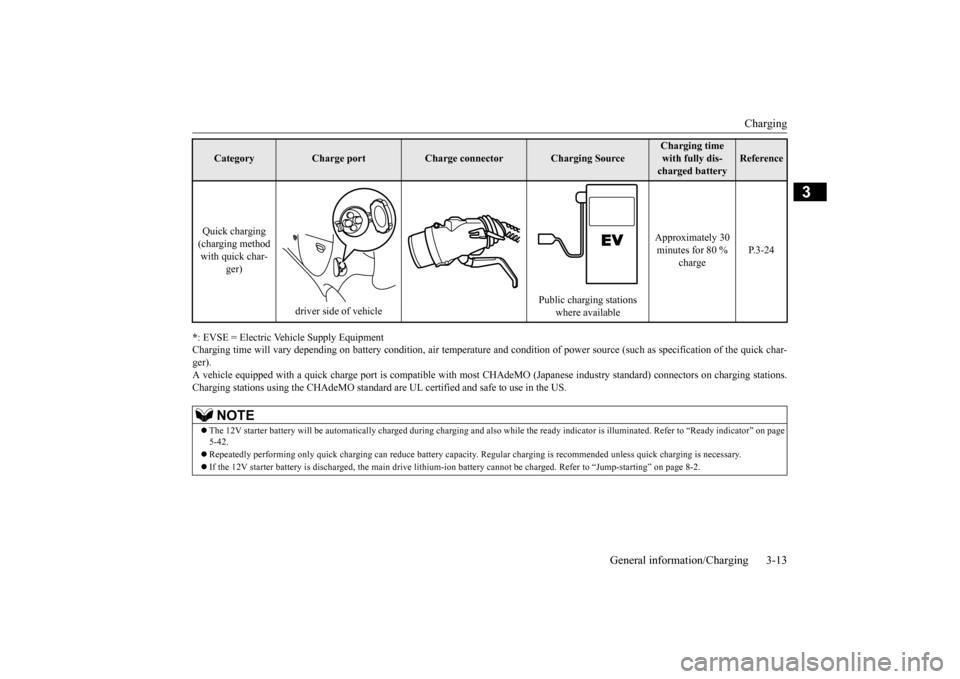
comes equipped with an additiona
l quick charge port to be used
with a CHAdeMO quick charger.
Approx. -22 °F (-30 °C) or lower
Startup and driving
• • The ready indicator
*2 does not come on, and startup may not
be possible. In the worst-case scenario,
the vehicle may become undriv-
able (with the energy level ga
uge and cruising
range indica-
tions still shown).
• In the daytime, wait for the tempera- ture to rise. When the temperature in the vicinity of the main drive lithium-ion battery has risen, start up.
• Regenerative braking performan
ce may decrease or be elimi-
nated.
• When braking, depress the brake pedal more strongly
Charging and
battery
• Charging may become impossible • In
the daytime, wait for the tempera- ture to rise. When the temperature in the vicinity of the main drive lithium- ion battery has risen, begin charging.
NOTE
*1: Refer to “Power down warning light” on
page 5-43. Illumination of
the power down warning light
does not indicate a malfunctio
n.
*2: Refer to “Ready indicator” on page 5-42.
Charging Approx. ambi- ent tempera-
ture
Phenomena
Corrective action
BK0209800US.book 11 ページ 2014年1月14日 火曜日 午前9時26分
Page 27 of 262
Charging 3-12 General information/Charging
3
Category
Charge port
Charge connector
Charging Source
Charging time with fully dis- charged battery
Reference
Level 1
Regular charging
110-120V (Attached EV charging cable)
passenger side of vehicle
110-120V household outlet (15 amp dedicated circuit
required)
120V/8A: Approx- imately 22 hours
120V/12A:
Approximately 14
hours
P.3-15
Level 2
Regular charging
220-240V(Primary Home EVSE
* Dock-
Available sepa-
rately)
passenger side of vehicle
Home or public charging
device
Approximately 6
hours
P.3-15, 3-24
BK0209800US.book 12 ページ 2014年1月14日 火曜日 午前9時26分
Page 28 of 262
Charging
General information/Charging 3-13
3
* : EVSE = Electric Ve
hicle Supply Equipment
Charging time will vary
depending on battery condition,
air temperature and condition of power
source (such as specification of
the quick char-
ger). A vehicle equipped with a
quick charge port is compatible with most CHAdeM
O (Japanese industry standa
rd) connectors on charging
stations.
Charging stations using the CHAdeMO standard ar
e UL certified and safe to use in the US.
Quick charging (charging method with quick char-
ger)
driver side of vehicle
Public charging stations
where available
Approximately 30 minutes for 80 %
charge
P. 3 - 2 4
NOTE
The 12V starter battery will be automatica
lly charged during charging and
also while the ready indicator is illuminated. Refer
to “Ready indicator” on page
5-42. Repeatedly performing only quick charging ca
n reduce battery capacity. Regular chargi
ng is recommended unless quick charging is
necessary.
If the 12V starter battery is di
scharged, the main drive lithium-ion battery cannot
be charged. Refer to “Jump-starting” on pag
e 8-2.
Category
Charge port
Charge connector
Charging Source
Charging time with fully dis- charged battery
Reference
BK0209800US.book 13 ページ 2014年1月14日 火曜日 午前9時26分
Page 29 of 262
Precautions during Charging the
Main Drive Lithium-ion Battery
3-14 General information/Charging
3
N01202601048
Precautions during Charg- ing the Main Drive Lithium-ion Battery
WA R N I N G Improper charging can result in a fire, property damage, and serious injury ordeath. Read the instructions described below carefully and follow
them. Also read and
follow the instructions for “Regular charging (charging me
thod with rated AC
120V outlet)” on page 3-15, Regularcharging (using 240V
Electric Vehicle
Supply Equipment)
on page 3-24 and
“Quick charging (c
harging method with
quick charger)”
on page 3-24 before using
the charging device.• Never connect or disconnect the chargeconnector or plug with wet hands.• Make sure there is no water or foreignmaterials in the char
ge port, charge con-
nector or plug, and that they are notdamaged or affected by rust or corro- sion. If any of these conditions are notice- able, do not charge
the main drive
lithium-ion battery.• Never touch the metal contacts of thecharge port, charge
connector or plug.
• Never charge the main drive lithium-ion battery or touch the vehicle when there islightning. A lightning strike may backfeed into the char
ger causing damage
and possible personal
injury or death.
• Never disassemble or modify the charge port or charging cable.• If you notice unus
ual odor or smoke
coming from the vehi
cle, charging cable
or plug, or if the ch
arging cable or plug
becomes hot to the touch, stop charging immediately.
Individuals using an
electro-medical
apparatus such as implantable pacemak- ers and implantable
cardiovascular-defi-
brillators should
check with the
manufacturer of the apparatus to confirm the effect of the el
ectromagnetic waves
from charging. The el
ectromagnetic waves
may affect the operations of the electro- medical apparatus. If you have an impl
antable cardiac pace-
maker or an implan
table cardiovascular
defibrillator, while the main drive lithium- ion battery is charging:• Keep away from the charge connector orcontrol box.• Do not stay inside the vehicle.• Do not go inside the
vehicle, for example
to remove or place an item in the passen- ger compartment.WA R N I N G
• Do not open the rear hatch, for example to remove or place an item in the cargoarea.Charging may affect
the operation of
electric medical devices and result in serious personal
injury or death.
Keep away from the cooling fan under the hood during charging. During charging,the cooling fan may automatically be operated even if the electric motor switch is in the “LOCK” position. CAUTION To prevent damage to the charging equip- ment:• Do not close the charge port lid withoutclosing the cap.• Do not subject the charging equipment toimpact.• Do not pull or twist the charge cable.• Do not drag the charge cable.• Do not store charging equipment in loca-tions where the temperature is above 185 °F (85 °C) or below -40 °F (-40 °C).• Do not place the charging equipment close to a heater or other heat source.
Make sure the inner
cap is closed on the
charge port when charging is finished. If the charge port lid is closed when the cap is opened, water or forei
gn materials may enter
the charge port.WA R N I N G
BK0209800US.book 14 ページ 2014年1月14日 火曜日 午前9時26分
Page 30 of 262
Regular charging (charging method with rated AC 120 V outlet)
General information/Charging 3-15
3
N01203101037
Carefully read instructions regarding “Pre- cautions during charging
the main drive lith-
ium-ion battery” on pa
ge 3-14 and described
in this section and al
so instructions on “EV
charging cable” on page 3-21 or instructions for a charging device you use, and follow them.
Do not charge when a vehicle body cover is in use. This may cause damage
to the charge con-
nector. Do not attempt to perform a jump start on the 12V starter battery at the same time that the main drive lithium-ion battery is being charged. Doing so ma
y damage the vehicle
or charging cable and could cause an injury. See “Jump-starting” in the “6. For emer- gency” section. Forcing the charge connector to connect may cause damage to the
charging equipment and
vehicle.NOTE
Repeatedly performi
ng only quick charging
can reduce the battery capacity. Regular charging is recommended unless quick charging is necessary. To help maintain the capacity of the main drive lithium-ion batter
y, the following is
recommended: • Fully charge the vehicle by regular charg- ing every 2 weeks. • Do not repeat charging when the main drive lithium-ion battery is at or near the fullcharge.
Both of the regular charging and quick charge cannot be performed at the same time. The quick charging is given priority.CAUTION
It is recommended that you perform regular charging from 2 bars or less on the energylevel gauge to full at
least once every three
months. This allows the energy level gauge to adjust to decrease
d battery capacity and
correctly display the remaining energy in themain drive lithium-ion battery. A certified i-MiEV dealer can also adjust the energy level gauge for you when requested.
Regular charging (charging method with rated AC 120 V outlet)
WA R N I N G Improper charging can result in a fire, property damage, and serious injury or death.NOTE
Always use an ground
ed outlet protected
by a ground-fault circuit interrupter,rated AC 120V and rated for 15A or more,and that is connected to a dedicated branch circuit. If the circuit is shar
ed, and another elec-
trical device is being used at the same time the vehicle is chargi
ng, the circuit may
heat abnormally, the breaker may tripand the circuit may cause adverse inter- ference on the household electrical appli- ances such as tele
visions and audio
systems. To reduce the risk of electric shock, con- nect only to a prop
erly grounded and
waterproofed outlet. Never use an extension cable or conver- sion adapter. Never force the connection if the charging cable or plug shows damage or is not eas- ily connected due to foreign materialentering the plug or the outlet. Never use an outlet that is worn, damaged, or will not hold the plug firmly. Make sure that the plug is inserted all the way into the outlet before use. While it is normal for the plug and charg- ing cable to become warm during charg- ing, discontinue use
immediately if the
plug or charging ca
ble becomes too hot to
touch. Never pull the cable to remove the plug.WA R N I N G
BK0209800US.book 15 ページ 2014年1月14日 火曜日 午前9時26分
Page 34 of 262
Regular charging (charging method with rated AC 120 V outlet)
General information/Charging 3-19
3
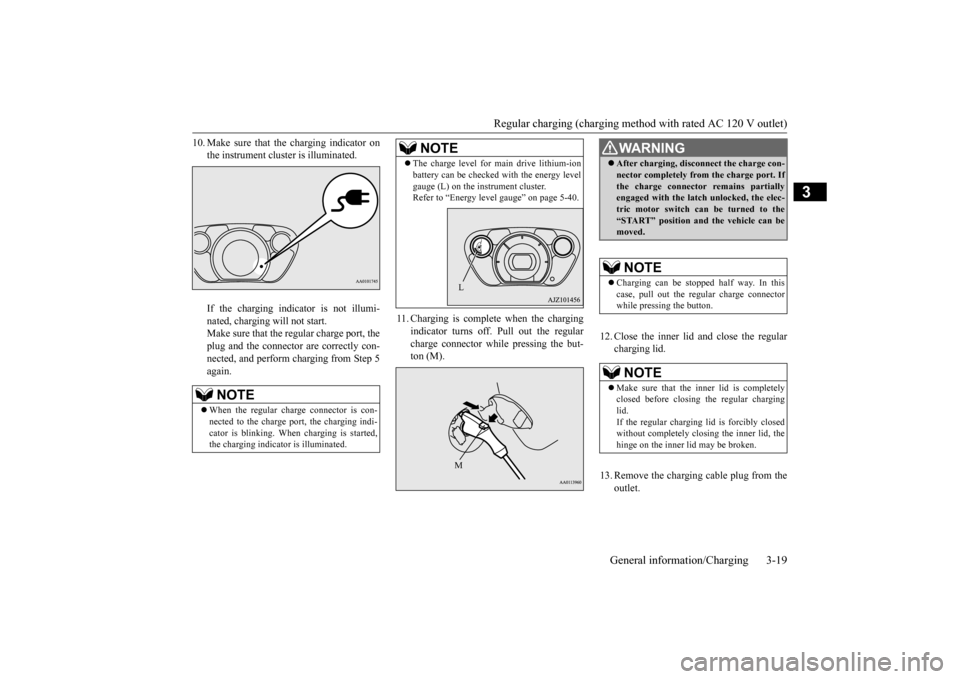
10. Make sure that the charging indicator on
the instrument cluster is illuminated. If the charging indicator is not illumi- nated, charging will not start. Make sure that the regular charge port, theplug and the connector are correctly con- nected, and perform charging from Step 5 again.
11. Charging is complete when the charging
indicator turns off. Pull out the regular charge connector while pressing the but- ton (M).
12. Close the inner lid and close the regular
charging lid.
13. Remove the charging cable plug from the
outlet.
NOTE
When the regular char
ge connector is con-
nected to the charge port, the charging indi-cator is blinking. When
charging is started,
the charging indicator is illuminated.
The charge level for main drive lithium-ion battery can be checked
with the energy level
gauge (L) on the instrument cluster.Refer to “Energy level gauge” on page 5-40.NOTE
LM
WA R N I N G After charging, discon
nect the charge con-
nector completely from the charge port. Ifthe charge connector remains partiallyengaged with the latch unlocked, the elec- tric motor switch can be turned to the “START” position an
d the vehicle can be
moved.NOTE
Charging can be stopped
half way. In this
case, pull out the regular charge connector while pressing the button.NOTE
Make sure that the inner lid is completely closed before closing the regular charging lid.If the regular charging
lid is forcibly closed
without completely clos
ing the inner lid, the
hinge on the inner
lid may be broken.
BK0209800US.book 19 ページ 2014年1月14日 火曜日 午前9時26分
Page 35 of 262

Regular charging (charging method with rated AC 120 V outlet) 3-20 General information/Charging
3
14. Install the cap on the regular charge con-
nector.
N01202501047
You cannot charge the main drive lithium-ionbattery when the main drive lithium-ion bat-tery temperature is -13 °F (-25 °C) or lower. The air conditioning will automatically oper- ate and the main drive lithium-ion batterywill be heated when all the following condi- tions are met.
The energy level gauge (A) in the instrument cluster and charging i
ndicator (B) illuminate
while the main drive lithium-ion battery warming system is operating. The main drive lithium-ion battery warmingsystem will automatically stop when the main drive lithium-ion batter
y temperature is -4°F
(-20°C) or higher.
WA R N I N G After charging, be sure to close the inner lid and the regular charging lid com- pletely.Be careful that water or dust does not enter in the regular charge port inner lid and regular charge connector.Entry of water or dust could cause electric leakage, resulting in
a fire or electric
shock. After charging, be sure
to disconnect the
plug from the outlet.If the plug is left connected to the outlet, immersion in water or tampering may cause leakage or an
electric shock.
Main drive lithium-ion battery warming system
• The main drive lithium-ion battery tem- perature is between -22 °F (-30 °C) and -13 °F (-25 °C).• The energy level gauge shows 4 bars or more of full charge. • The electric motor switch is in the“LOCK” position. • The regular charge connector is con- nected to the regular charge port.
A
B
NOTE
When the main drive lithium-ion battery warming system operates while the remoteclimate control is operating, the remote cli-mate control stops. When the main drive lith- ium-ion battery warming system stops, the remote climate cont
rol operates again.
BK0209800US.book 20 ページ 2014年1月14日 火曜日 午前9時26分