light MITSUBISHI iMiEV 2014 1.G User Guide
[x] Cancel search | Manufacturer: MITSUBISHI, Model Year: 2014, Model line: iMiEV, Model: MITSUBISHI iMiEV 2014 1.GPages: 262, PDF Size: 26.84 MB
Page 20 of 262
Familiarizing yourself with i-MiEV
General information/Charging 3-5
3
N01205900016
Put the selector lever in the “B” (REGEN- ERATIVE BRAKE MODE) or “Eco” (ECOMODE) position according to the road con-dition. Using appropriate regenerative brak- ing can help increase
the cruising range.
Refer to “Regenerative braking” on page3-3.NOTE
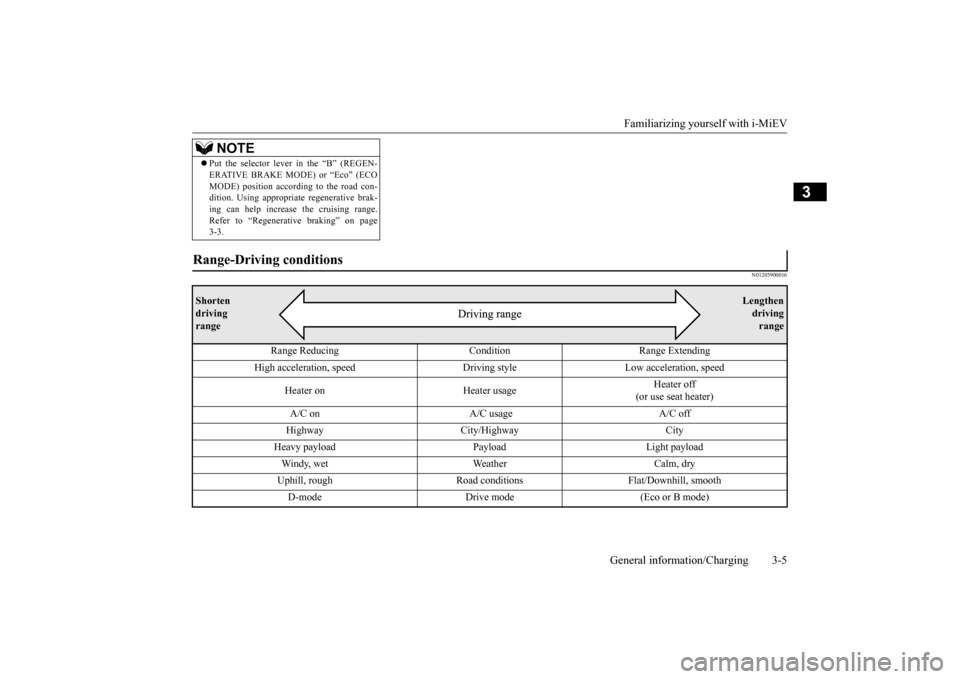
Range-Driving conditions Shorten driving range
Lengthen
driving range
Range Reducing Condition Range Extending
High acceleration, speed Driving
style Low acceleration, speed
Heater on Heater usage
Heater off
(or use seat heater)
A/C on A/C usage A/C off Highway City/Highway City
Heavy payload Payload Light payload Windy, wet Weather Calm, dry Uphill, rough Road conditio
ns Flat/Downhill, smooth
D-mode Drive mode (Eco or B mode)
BK0209800US.book 5 ページ 2014年1月14日 火曜日 午前9時26分
Page 23 of 262
Cautions and actions to deal with intense heat 3-8 General information/Charging
3
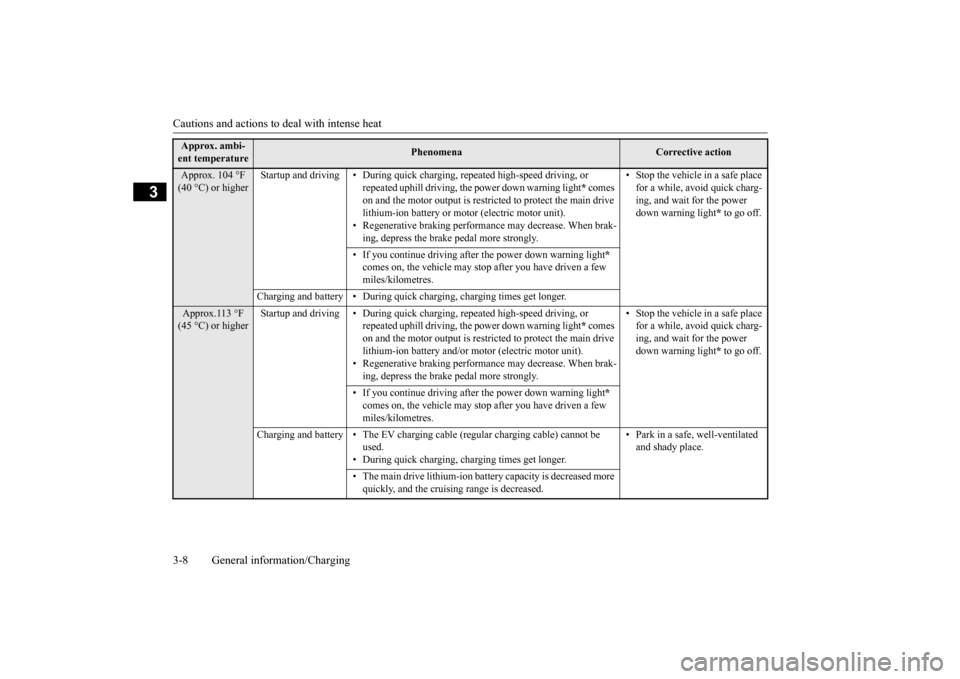
Approx. ambi- ent temperature
Phenomena
Corrective action
Approx. 104 °F (40 °C) or higher
Startup and driving •
• During quick charging, repeated high-speed driving, or repeated uphill driving,
the power down warning light
* comes
on and the motor output is restrict
ed to protect the main drive
lithium-ion battery or mo
tor (electric motor unit).
Regenerative braking performance
may decrease. When brak-
ing, depress the brake pedal more strongly.
• Stop the vehicle in a safe place for a while, avoid quick charg- ing, and wait for the power down warning light
* to go off.
• If you continue driving after the power down warning light
*
comes on, the vehicle may stop
after you have driven a few
miles/kilometres.
Charging and battery • During quick
charging, charging times get longer.
Approx.113 °F (45 °C) or higher
Startup and driving •
• During quick charging, repeated high-speed driving, or repeated uphill driving,
the power down warning light
* comes
on and the motor output is restrict
ed to protect the main drive
lithium-ion battery and/or motor (electric motor unit). Regenerative braking performance
may decrease. When brak-
ing, depress the brake pedal more strongly.
• Stop the vehicle in a safe place for a while, avoid quick charg-ing, and wait for the power down warning light
* to go off.
• If you continue driving after the power down warning light
*
comes on, the vehicle may stop
after you have driven a few
miles/kilometres.
Charging and battery •
• The EV charging cable (regular charging cable) cannot be used. During quick charging, ch
arging times get longer.
• Park in a safe, well-ventilated and shady place.
• The main drive lithium-ion batt
ery capacity is decreased more
quickly, and the cruisi
ng range is decreased.
BK0209800US.book 8 ページ 2014年1月14日 火曜日 午前9時26分
Page 24 of 262
Cautions and actions to deal with intense cold
General information/Charging 3-9
3
N01201101033
When the vehicle is driven in a low ambient temperatures, its he
ater performance can be insuffic
ient. Also, using the heater ca
n reduce the
vehicle’s cruising range. When the ambient temperature is approximate
ly 5 °F (-15 °C) or lower, the phenomena de
scribed below may occu
r. Please take the
corrective
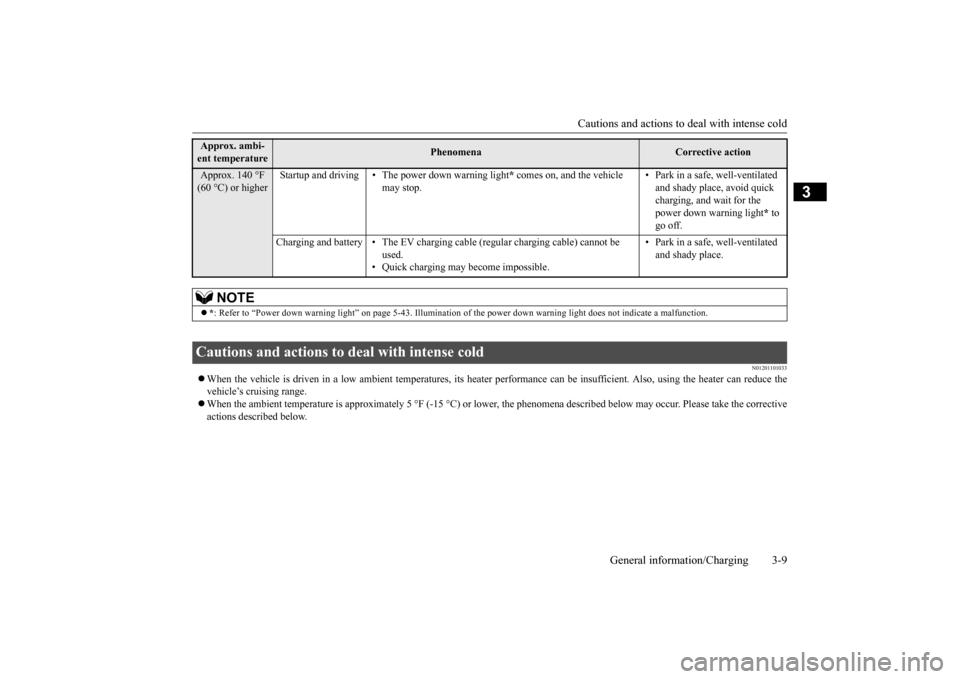
actions described below.Approx. 140 °F (60 °C) or higher
Startup and driving • The power down warning light
* comes on, and the vehicle
may stop.
• Park in a safe, well-ventilated and shady place,
avoid quick
charging, and wait for the power down warning light
* to
go off.
Charging and battery •
• The EV charging cable (regular
charging cable) cannot be
used.Quick charging may become impossible.
• Park in a safe, well-ventilated and shady place.
NOTE
*: Refer to “Power down warning light” on pa
ge 5-43. Illumination of the power down wa
rning light does not i
ndicate a malfunctio
n.
Cautions and actions to deal with intense cold Approx. ambi- ent temperature
Phenomena
Corrective action
BK0209800US.book 9 ページ 2014年1月14日 火曜日 午前9時26分
Page 25 of 262
Cautions and actions to deal with intense cold 3-10 General information/Charging
3
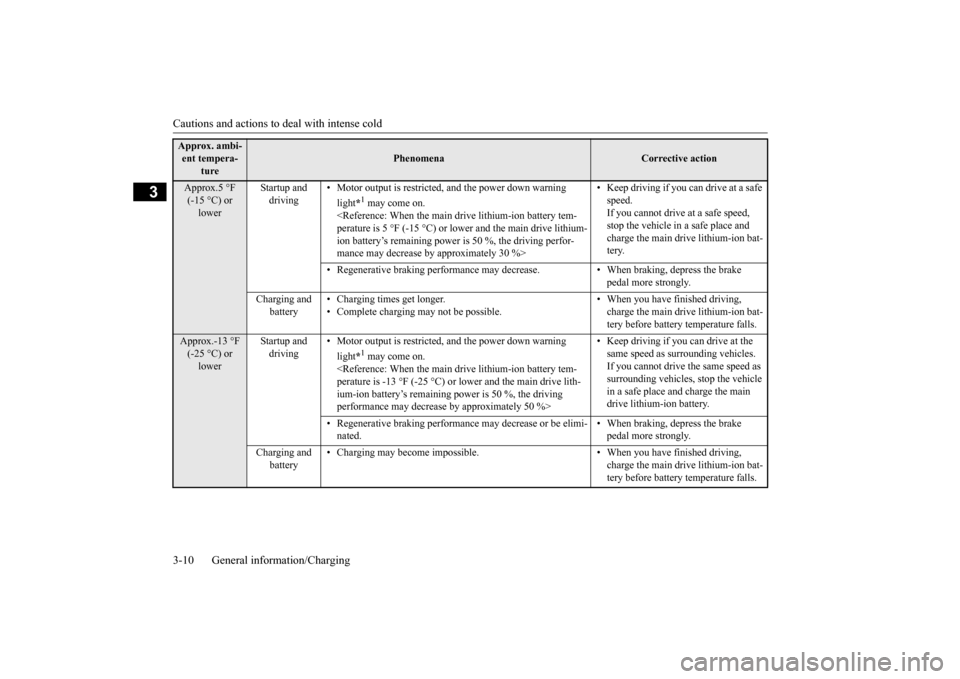
Approx. ambi- ent tempera-
ture
Phenomena
Corrective action
Approx.5 °F (-15 °C) or lower
Startup and driving
• Motor output is restricted
, and the power down warning
light
*1 may come on.
• Keep driving if you can drive at a safe speed. If you cannot drive at
a safe speed,
stop the vehicle in a safe place and charge the main drive lithium-ion bat- tery.
• Regenerative braking performance may decr
ease. • When braking, depress the brake
pedal more strongly.
Charging and
battery
• • Charging times get longer. Complete charging may not be possible.
• When you have finished driving, charge the main drive lithium-ion bat- tery before battery temperature falls.
Approx.-13 °F (-25 °C) or lower
Startup and driving
• Motor output is restricted
, and the power down warning
light
*1 may come on.
• Keep driving if you can drive at the same speed as su
rrounding vehicles.
If you cannot drive th
e same speed as
surrounding vehicles, stop the vehicle in a safe place and charge the main drive lithium-ion battery.
• Regenerative braking performance
may decrease or be elimi-
nated.
• When braking, depress the brake pedal more strongly.
Charging and
battery
• Charging may become impossible. • W
hen you have finished driving, charge the main drive lithium-ion bat- tery before battery temperature falls.
BK0209800US.book 10 ページ 2014年1月14日 火曜日 午前9時26分
Page 26 of 262
Charging
General information/Charging 3-11
3
N01201201034
Your vehicle comes standard with a charge
port and charging cable (EV charging cable)
that uses a household outlet (AC 110-120V
) as a charging
source. You may also charge your
vehicle using an i-MiEV compatib
le 220-240V charging device (EVSE
* - available separate
ly). Your vehicle
comes equipped with an additiona
l quick charge port to be used
with a CHAdeMO quick charger.
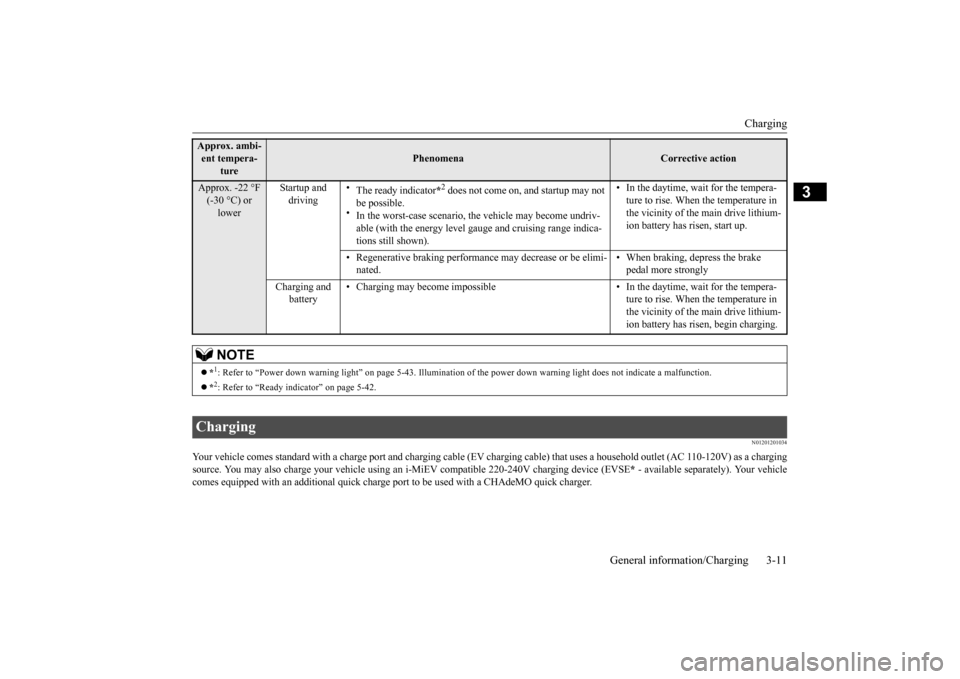
Approx. -22 °F (-30 °C) or lower
Startup and driving
• • The ready indicator
*2 does not come on, and startup may not
be possible. In the worst-case scenario,
the vehicle may become undriv-
able (with the energy level ga
uge and cruising
range indica-
tions still shown).
• In the daytime, wait for the tempera- ture to rise. When the temperature in the vicinity of the main drive lithium-ion battery has risen, start up.
• Regenerative braking performan
ce may decrease or be elimi-
nated.
• When braking, depress the brake pedal more strongly
Charging and
battery
• Charging may become impossible • In
the daytime, wait for the tempera- ture to rise. When the temperature in the vicinity of the main drive lithium- ion battery has risen, begin charging.
NOTE
*1: Refer to “Power down warning light” on
page 5-43. Illumination of
the power down warning light
does not indicate a malfunctio
n.
*2: Refer to “Ready indicator” on page 5-42.
Charging Approx. ambi- ent tempera-
ture
Phenomena
Corrective action
BK0209800US.book 11 ページ 2014年1月14日 火曜日 午前9時26分
Page 29 of 262
Precautions during Charging the
Main Drive Lithium-ion Battery
3-14 General information/Charging
3
N01202601048
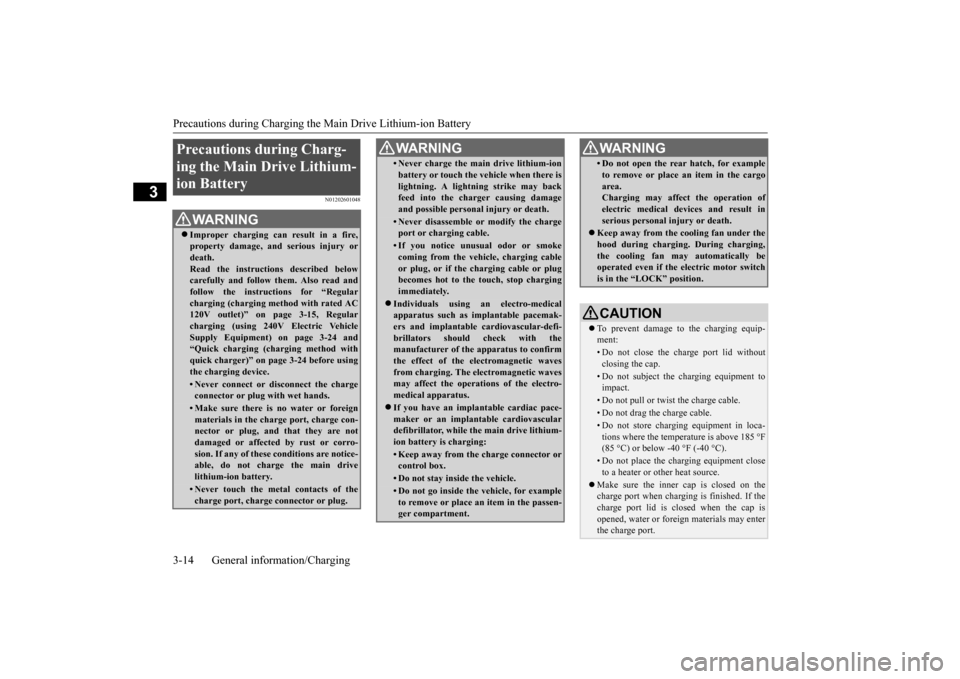
Precautions during Charg- ing the Main Drive Lithium-ion Battery
WA R N I N G Improper charging can result in a fire, property damage, and serious injury ordeath. Read the instructions described below carefully and follow
them. Also read and
follow the instructions for “Regular charging (charging me
thod with rated AC
120V outlet)” on page 3-15, Regularcharging (using 240V
Electric Vehicle
Supply Equipment)
on page 3-24 and
“Quick charging (c
harging method with
quick charger)”
on page 3-24 before using
the charging device.• Never connect or disconnect the chargeconnector or plug with wet hands.• Make sure there is no water or foreignmaterials in the char
ge port, charge con-
nector or plug, and that they are notdamaged or affected by rust or corro- sion. If any of these conditions are notice- able, do not charge
the main drive
lithium-ion battery.• Never touch the metal contacts of thecharge port, charge
connector or plug.
• Never charge the main drive lithium-ion battery or touch the vehicle when there islightning. A lightning strike may backfeed into the char
ger causing damage
and possible personal
injury or death.
• Never disassemble or modify the charge port or charging cable.• If you notice unus
ual odor or smoke
coming from the vehi
cle, charging cable
or plug, or if the ch
arging cable or plug
becomes hot to the touch, stop charging immediately.
Individuals using an
electro-medical
apparatus such as implantable pacemak- ers and implantable
cardiovascular-defi-
brillators should
check with the
manufacturer of the apparatus to confirm the effect of the el
ectromagnetic waves
from charging. The el
ectromagnetic waves
may affect the operations of the electro- medical apparatus. If you have an impl
antable cardiac pace-
maker or an implan
table cardiovascular
defibrillator, while the main drive lithium- ion battery is charging:• Keep away from the charge connector orcontrol box.• Do not stay inside the vehicle.• Do not go inside the
vehicle, for example
to remove or place an item in the passen- ger compartment.WA R N I N G
• Do not open the rear hatch, for example to remove or place an item in the cargoarea.Charging may affect
the operation of
electric medical devices and result in serious personal
injury or death.
Keep away from the cooling fan under the hood during charging. During charging,the cooling fan may automatically be operated even if the electric motor switch is in the “LOCK” position. CAUTION To prevent damage to the charging equip- ment:• Do not close the charge port lid withoutclosing the cap.• Do not subject the charging equipment toimpact.• Do not pull or twist the charge cable.• Do not drag the charge cable.• Do not store charging equipment in loca-tions where the temperature is above 185 °F (85 °C) or below -40 °F (-40 °C).• Do not place the charging equipment close to a heater or other heat source.
Make sure the inner
cap is closed on the
charge port when charging is finished. If the charge port lid is closed when the cap is opened, water or forei
gn materials may enter
the charge port.WA R N I N G
BK0209800US.book 14 ページ 2014年1月14日 火曜日 午前9時26分
Page 31 of 262
Regular charging (charging method with rated AC 120 V outlet) 3-16 General information/Charging
3
N01216200019
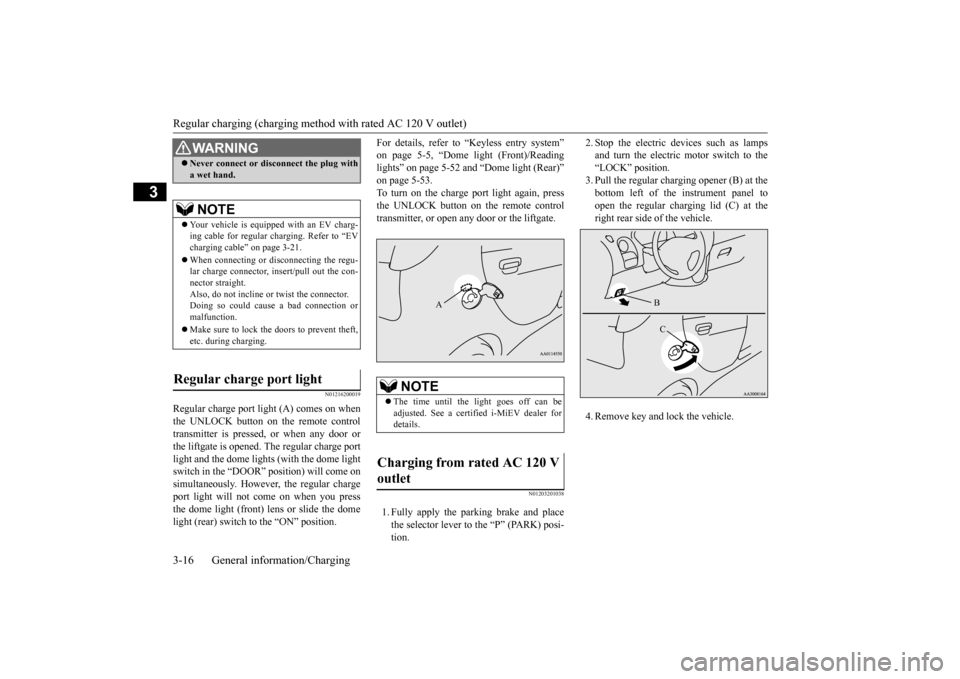
Regular charge port light (A) comes on when the UNLOCK button on the remote control transmitter is pressed, or when any door orthe liftgate is opened. The regular charge port light and the dome lights (with the dome light switch in the “DOOR” position) will come onsimultaneously. However, the regular charge port light will not co
me on when you press
the dome light (front) lens or slide the domelight (rear) switch to the “ON” position.
For details, refer to “Keyless entry system” on page 5-5, “Dome
light (Front)/Reading
lights” on page 5-52 a
nd “Dome light (Rear)”
on page 5-53. To turn on the charge port light again, pressthe UNLOCK button on the remote control transmitter, or open any
door or the liftgate.
N01203201038
1. Fully apply the parking brake and place the selector lever to the “P” (PARK) posi- tion.
2. Stop the electric devices such as lamps and turn the electric motor switch to the“LOCK” position. 3. Pull the regular charging opener (B) at the bottom left of the instrument panel toopen the regular charging lid (C) at the right rear side of the vehicle. 4. Remove key and lock the vehicle.
Never connect or disconnect the plug with a wet hand.NOTE
Your vehicle is equipped with an EV charg- ing cable for regular charging. Refer to “EV charging cable” on page 3-21. When connecting or disconnecting the regu- lar charge connector, in
sert/pull out the con-
nector straight. Also, do not incline or twist the connector. Doing so could cause a bad connection ormalfunction. Make sure to lock the doors to prevent theft, etc. during charging.
Regular charge port light
WA R N I N G
NOTE
The time until the light goes off can be adjusted. See a certified i-MiEV dealer fordetails.
Charging from rated AC 120 V outlet
A
B C
BK0209800US.book 16 ページ 2014年1月14日 火曜日 午前9時26分
Page 37 of 262
EV charging cable 3-22 General information/Charging
3
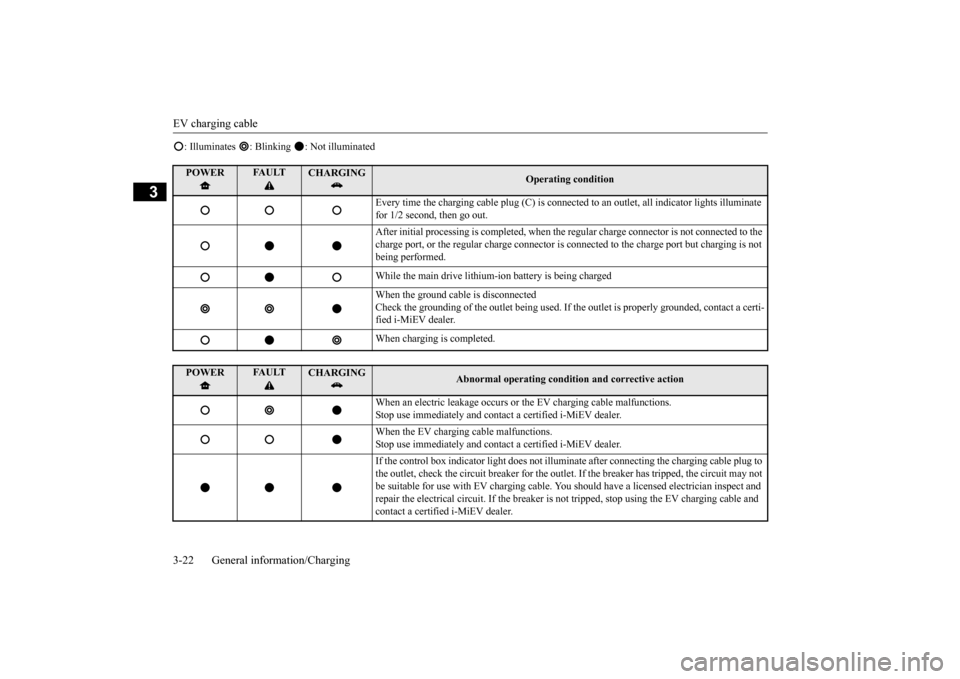
: Illuminates : Blinking : Not illuminatedPOWER
FAULT
CHARGING
Operating condition
Every time the charging cable plug (C) is connected
to an outlet, all indicator lights illuminate
for 1/2 second, then go out. After initial processing is comple
ted, when the regular charge c
onnector is not connected to the
charge port, or the regular charge connector is
connected to the charge port but charging is not
being performed. While the main drive lithium-i
on battery is being charged
When the ground cable is disconnected Check the grounding of the outlet being used. If
the outlet is properly gr
ounded, contact a certi-
fied i-MiEV dealer. When charging is completed.
POWER
FAULT
CHARGING
Abnormal operating conditi
on and corrective action
When an electric leakage occurs or the EV charging cable malfunctions. Stop use immediately and contac
t a certified i-MiEV dealer.
When the EV chargi
ng cable malfunctions.
Stop use immediately and contac
t a certified i-MiEV dealer.
If the control box indicator light
does not illuminate after connect
ing the charging cable plug to
the outlet, check the circuit breaker for the outlet.
If the breaker has tripped, the circuit may not
be suitable for use with EV charging cable. Y
ou should have a licensed
electrician inspect and
repair the electrical circuit. If the breaker is
not tripped, stop using the EV charging cable and
contact a certifie
d i-MiEV dealer.
BK0209800US.book 22 ページ 2014年1月14日 火曜日 午前9時26分
Page 43 of 262

Charging troubleshooting guide 3-28 General information/Charging
3
N01202300022
Charging troubleshooting guide
Symptom
Possible cause
Possible solution
Charging cannot be started.
The electric motor switch is in the ON position.
Before charging, place the electric motor switch in the “LOCK” position.
The main drive lithium-ion battery is already fully charged.
Charging cannot be performed if the ma
in drive lithium-ion
battery is already
fully charged. Charging automatically turns off if the main drive lithium-ion battery is fully charged.
The temperature of the main drive lithium-ion battery
is too high or too
low to charge.
Confirm the main drive lithium-ion battery temperature. Refer to “Cautions and acti
ons to deal with intense heat” on page 3-7 and “Cau-
tions and actions to deal wi
th intense cold” on page 3-9.
The 12V starter battery is dis- charged.
The main drive lithium-ion battery can be charged if the vehicle electrical sys- tems cannot be turned on. If the battery is
discharged, charge or jump start the
12V starter battery. Refer to
“Jump-starting” on page 8-2.
The vehicle has a malf
unction. The vehicle or charger
may have a malfunction. Confir
m if the warning light on
the meter is illuminated. Confirm if the indicator on the charger is indicating a malfunction. If a warning is displayed,
stop charging and contact a certified i-
MiEV dealer.
Regular charging can- not be started.
There is no electrical power coming from the outlet.
Confirm that there has not been a power fa
ilure. Make sure the breaker is on. If
an outlet with a timer device installed
is used, power will onl
y be available at
the time set by the timer. Confirm if the POWER indicator on
the control box
is illuminated.
The charge connector is not con- nected correctly.
Confirm the charge connector
is connected correctly.
Charging Timer by MiEV remote cannot be started.
Refer to “Action to be taken when the MiEV Remote
system does not operate correctly” on page 3-48.
BK0209800US.book 28 ページ 2014年1月14日 火曜日 午前9時26分
Page 46 of 262
High-Voltage components
General information/Charging 3-31
3
Leaks or damage to the main drive lith- ium-ion battery may result in a fire. If youdiscover them, contact emergency servicesimmediately. Since the fluid leak may be lithium manganite from the Lithium-ion battery, never touch any fluid leakingfrom the inside or outs
ide of the vehicle. If
the fluid contacts you
r skin or eyes, wash
it off immediately with a large amount ofwater and receive immediate medical attention to help
avoid serious injury.
If you are unable to sa
fely assess the vehi-
cle due to vehicle damage, do not touch the vehicle. Leave the vehicle and contactemergency services. Advise emergency responders that this is
an electric vehicle.
If a fire occurs in th
is vehicle,
leave the
vehicle as soon as possible and contact emergency services. Do not attempt toextinguish a fire by yourself. If the fire involves a lithium-ion battery, it will require large, sustained volumes of waterfor extinguishment. Using a small amount of water or the incorrect fire extinguisher can result in serious injury or death fromelectrical shock. When you leave the ve
hicle, if possible,
open the windows,
doors and liftgate to
prevent accumulation of poisonous/com- bustible gasses. This will also assist in therescue and fire fighting process.WA R N I N G
As with any vehicle fi
re, the byproducts of
combustion can be toxic. Do not inhalesmoke, vapors, or gas
from the vehicle.
Move to a safe distance upwind and uphill from the vehicle fire
and out of the way of
any oncoming traffic
while awaiting the
arrival of emergency responders. If you detect leaking
fluids, sparks, smoke,
flames, gurgling, popping or hissing noises originating from the
high voltage battery
compartment, contact emergency servicesimmediately. This may result in a fire. Physical damage to
the vehicle or high
voltage battery may re
sult in immediate or
delayed release of t
oxic and/or flammable
gases and fire. If your vehicle needs
to be towed, trans-
port the vehicle on a flatbed truck or towthe vehicle either with all wheels or the rear wheels (drive
wheels) off the ground.
If the rear wheels ar
e on the ground when
towing, this may cause damage to the elec- tric motors. This may also cause a fire, if wiring in the electric motor unit roombecomes damaged. Refer to “Towing” on page 8-12. Do not attempt to repair a damaged elec- tric vehicle yourself. Please contact a cer- tified i-MiEV dealer for service.WA R N I N G
In the event of an ac
cident that requires
body repair and painting, the vehicleshould be delivered to a Certified i-MiEVdealer to have the main drive lithium-ion battery and high voltage parts such as the inverter, including the attached wiringharness, removed prior to painting. If exposed to heat in the paint booth, the main drive lithium-ion battery will experi-ence battery capacity loss. A damaged main drive lithium-ion battery can also pose safety risks to untrainedmechanics and repair personnel.NOTE
The emergency shut-off
system will be acti-
vated and the high-voltage
system will auto-
matically turn off under the following conditions: • Certain front, side or rear collisions. • Certain EV (Electric Vehicle) system mal- functions.
When the emergency shut
-off system is acti-
vated, the ready indicato
r is turned off. Refer
to “Indicator and warning light package” onpage 5-41. If the emergency shut-off system activates, contact a Certifie
d i-MiEV dealer.
WA R N I N G
BK0209800US.book 31 ページ 2014年1月14日 火曜日 午前9時26分