light MITSUBISHI iMiEV 2014 1.G Owner's Manual
[x] Cancel search | Manufacturer: MITSUBISHI, Model Year: 2014, Model line: iMiEV, Model: MITSUBISHI iMiEV 2014 1.GPages: 262, PDF Size: 26.84 MB
Page 47 of 262
MiEV Remote System 3-32 General information/Charging
3
N01203401043
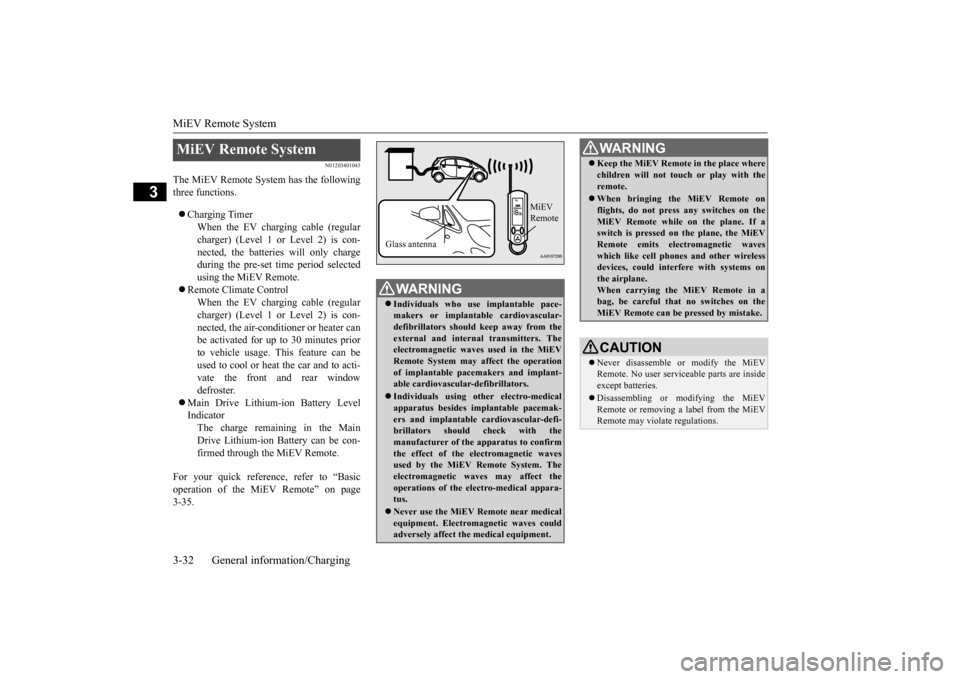
The MiEV Remote System has the following three functions. Charging Timer When the EV charging cable (regularcharger) (Level 1 or Level 2) is con- nected, the batteries will only charge during the pre-set ti
me period selected
using the MiEV Remote.
Remote Climate Control When the EV charging cable (regular charger) (Level 1 or Level 2) is con- nected, the air-conditioner or heater canbe activated for up to 30 minutes prior to vehicle usage. This feature can be used to cool or heat the car and to acti-vate the front and rear window defroster.
Main Drive Lithium-ion Battery Level Indicator The charge remaining in the Main Drive Lithium-ion Battery can be con-firmed through the MiEV Remote.
For your quick reference, refer to “Basic operation of the MiEV Remote” on page 3-35.MiEV Remote System
WA R N I N G Individuals who use
implantable pace-
makers or implanta
ble cardiovascular-
defibrillators
should keep away from the
external and internal
transmitters. The
electromagnetic wave
s used in the MiEV
Remote System may affect the operation of implantable pacemakers and implant- able cardiovascular-defibrillators. Individuals using ot
her electro-medical
apparatus besides implantable pacemak-ers and implantable
cardiovascular-defi-
brillators should
check with the
manufacturer of the apparatus to confirmthe effect of the el
ectromagnetic waves
used by the MiEV Remote System. The electromagnetic wave
s may affect the
operations of the el
ectro-medical appara-
tus. Never use the MiEV Remote near medical equipment. Electrom
agnetic waves could
adversely affect th
e medical equipment.
MiEV Remote
Glass antenna
Keep the MiEV Remote in the place where children will not touch or play with theremote. When bringing the MiEV Remote on flights, do not press any switches on theMiEV Remote while on the plane. If a switch is pressed on the plane, the MiEV Remote emits electromagnetic waveswhich like cell phones and other wireless devices, could interfere with systems on the airplane.When carrying the MiEV Remote in a bag, be careful that no switches on the MiEV Remote can be pressed by mistake.CAUTION Never disassemble or modify the MiEV Remote. No user servic
eable parts are inside
except batteries. Disassembling or modifying the MiEV Remote or removing a label from the MiEV Remote may violate regulations. WA R N I N G
BK0209800US.book 32 ページ 2014年1月14日 火曜日 午前9時26分
Page 49 of 262
MiEV Remote System 3-34 General information/Charging
3
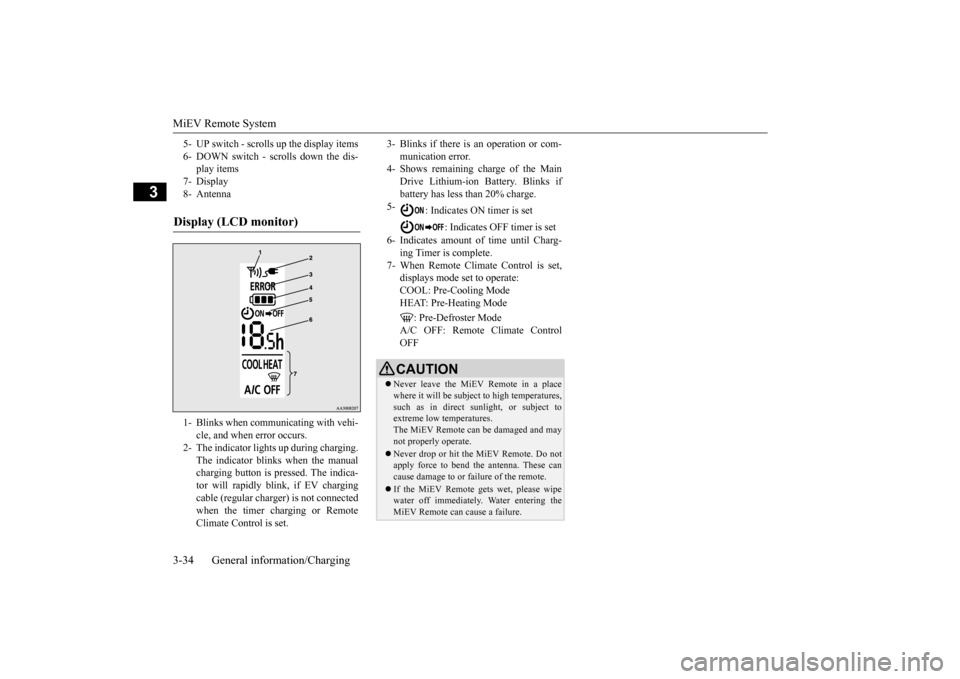
5- UP switch - scrolls up the display items 6- DOWN switch - scrolls down the dis-
play items
7- Display 8- AntennaDisplay (LCD monitor) 1- Blinks when communicating with vehi-
cle, and when error occurs.
2- The indicator lights up during charging.
The indicator blinks when the manualcharging button is pressed. The indica- tor will rapidly blink, if EV charging cable (regular charge
r) is not connected
when the timer charging or Remote Climate Control is set.
3- Blinks if there is an operation or com-
munication error.
4- Shows remaining charge of the Main
Drive Lithium-ion Battery. Blinks if battery has less than 20% charge.
5-
: Indicates ON timer is set
: Indicates OFF timer is set
6- Indicates amount of time until Charg-
ing Timer is complete.
7- When Remote Climate Control is set,
displays mode set to operate:COOL: Pre-Cooling Mode HEAT: Pre-Heating Mode
: Pre-Defroster Mode
A/C OFF: Remote Climate ControlOFFCAUTION Never leave the MiEV Remote in a place where it will be subject to high temperatures,such as in direct s
unlight, or subject to
extreme low temperatures. The MiEV Remote can
be damaged and may
not properly operate. Never drop or hit the MiEV Remote. Do not apply force to bend the antenna. These can cause damage to or fa
ilure of the remote.
If the MiEV Remote gets wet, please wipe water off immediately.
Water entering the
MiEV Remote can cause a failure.
BK0209800US.book 34 ページ 2014年1月14日 火曜日 午前9時26分
Page 58 of 262
MiEV Remote System
General information/Charging 3-43
3
N01204201035
N01204301036
The following conditions must be met to operate the Remote Climate Control. Selector lever:
P (PARK) position.
Electric motor switch: LOCK position. EV charging cable (re
gular charger): Con-
nected. Quick charging: Not used. Main Drive Lithium-ion Battery Level Indicator: Shows one bar or more. Refer to “Main Drive Lithium-ion Battery LevelIndicator” on page 3-45. All doors and the liftgate: Closed. 1. Start charging. Refer to “Regular charging (charging method with rated AC 120 V outlet)” on page 3-15.
Remote Climate Control
WA R N I N G The Remote Climate Control, even when set, cannot be relied upon to maintain safevehicle cabin temperatures while the vehi- cle is stopped or park
ed. Never leave chil-
dren or persons requiringsupervision/nursing unattended inside the vehicle. Temperature inside the vehicle could become extremely high or lowresulting in a risk of
heat stroke or hyper-
thermia that could result in death. In addition, children
can activate switches
and controls, resulting in an injury or fatal accident. While the Remote Climate Control is acti- vated, keep away from
the cooling fan
under the front hood,
since the cooling fan
may automatically operate even if the electric motor switch is in the “LOCK” position.NOTE
The Remote Climate Control works regard- less the position of the air conditioningswitch or dial on the vehicle. While the Remote Climate Control is activated, the air conditioning switch or di
al on the vehicle
will not affect operation
of the cooler, heater
or defroster.
The Remote Climate Control will automati- cally stop 30 minutes after the Remote Cli-mate Control has been set. The Remote Climate Control is operated by electric power s
upplied through the EV
charging cable (regular charger). Under the following c
onditions, the effect of
the Remote Climate Control can be decreased. • When the outside temperature is very high. • When the sunlight is strong.• When the outside temperature is very low. When Remote Climate Control is activated while charging the Main Drive Lithium-ion Battery, the time required to fully charge theMain Drive Lithium-ion Battery will become longer or the amount of charge may decrease if the OFF timer has been set. If the Main Drive Lithium-ion Battery Warming System is operated while theRemote Climate Control is activated, the Remote Climate Control will stop. When the Main Drive Lithium-ion Battery WarmingSystem stops, the Remote Climate Control will resume. Refer to “Main Drive Lithium- ion Battery Warming System” on page 3-20. While the Remote Climate Control is acti- vated, if a heated seat switch is ON, theheated seat will operate.NOTE
To operate the Remote Climate Control
WA R N I N G Improper charging can result in a fire, property damage, and serious injury ordeath. Carefully read and fo
llow instructions in
“Precaution during Charging the MainDrive Lithium-ion Battery” on page 3-14 and “Regular chargi
ng (charging method
with rated AC 120 V ou
tlet)” on page 3-15.
BK0209800US.book 43 ページ 2014年1月14日 火曜日 午前9時26分
Page 63 of 262
MiEV Remote System 3-48 General information/Charging
3
N01204901032
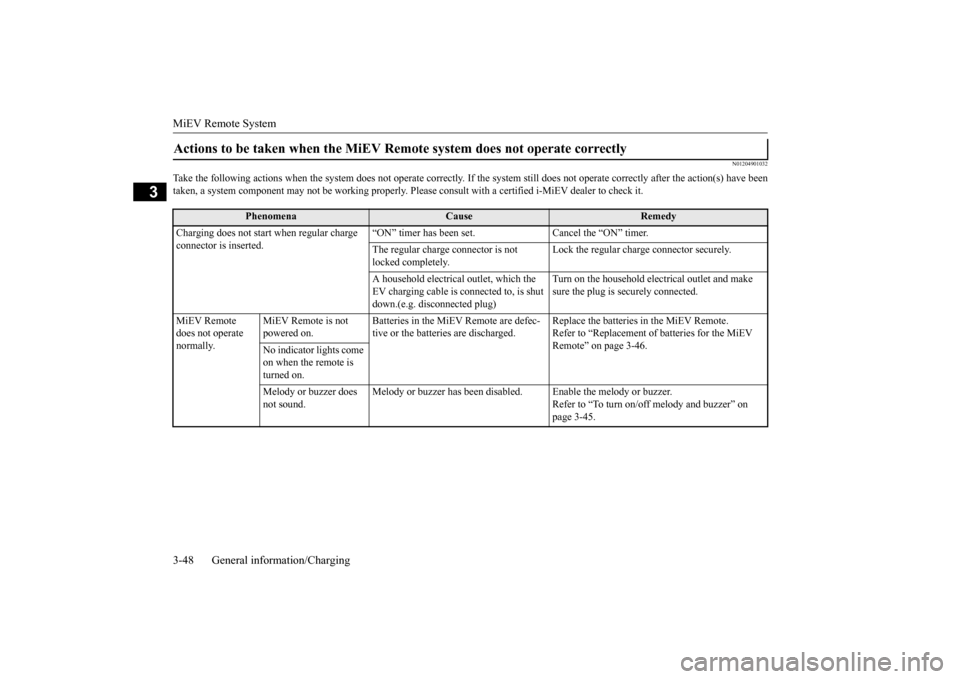
Take the following actions when the system does not operate correctly. If the system still does not operate correctly after the
action(s) have been
taken, a system component may not be wo
rking properly. Please consult with a
certified i-MiEV de
aler to check it.
Actions to be taken when the MiEV Remo
te system does not operate correctly
Phenomena
Cause
Remedy
Charging does not start when regular charge connector is inserted.
“ON” timer has been set. Cancel the “ON” timer. The regular charge connector is not locked completely.
Lock the regular charge connector securely.
A household electrical
outlet, which the
EV charging cable is connected to, is shut down.(e.g. disconnected plug)
Turn on the household elec
trical outlet and make
sure the plug is securely connected.
MiEV Remote does not operate normally.
MiEV Remote is not powered on.
Batteries in the MiEV Remote are defec- tive or the batteries are discharged.
Replace the batteries in the MiEV Remote. Refer to “Replacement of batteries for the MiEV Remote” on page 3-46.
No indicator lights come on when the remote is turned on. Melody or buzzer does not sound.
Melody or buzzer has been disabl
ed. Enable the melody or buzzer.
Refer to “To turn on/off melody and buzzer” on page 3-45.
BK0209800US.book 48 ページ 2014年1月14日 火曜日 午前9時26分
Page 72 of 262
Front seats
Seat and restraint systems 4-3
4
Safety equipment cannot prevent injury or death in all motor vehi
cle accidents. You can
help reduce the risk of injury or death, how- ever, by following the instructions in this manual.
N00401800386
Position the driver’s seat
as far back as possi-
ble while maintaining a position that still enables you to fully apply the pedals, easily control the steering wh
eel and safely operate
the vehicle.
N00401900303
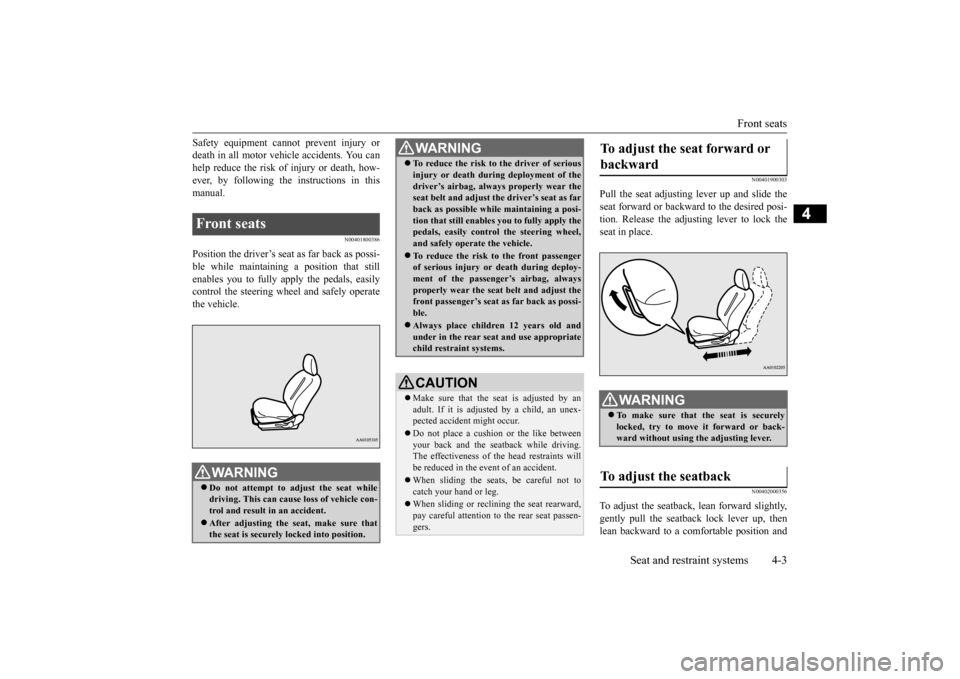
Pull the seat adjusting lever up and slide theseat forward or backwa
rd to the desired posi-
tion. Release the adjusting lever to lock the seat in place.
N00402000356
To adjust the seatback,
lean forward slightly,
gently pull the seatback lock lever up, then lean backward to a comfortable position and
Front seats
WA R N I N G Do not attempt to adjust the seat while driving. This can cause loss of vehicle con- trol and result
in an accident.
After adjusting the se
at, make sure that
the seat is securely locked into position.
To reduce the risk to the driver of serious injury or death during deployment of thedriver’s airbag, always
properly wear the
seat belt and adjust th
e driver’s seat as far
back as possible while maintaining a posi- tion that still enables
you to fully apply the
pedals, easily control the steering wheel, and safely operate the vehicle. To reduce the risk to the front passenger of serious injury or
death during deploy-
ment of the passeng
er’s airbag, always
properly wear the seat
belt and adjust the
front passenger’s seat as far back as possi- ble. Always place childr
en 12 years old and
under in the rear seat
and use appropriate
child restraint systems.CAUTION Make sure that the seat is adjusted by an adult. If it is adjusted by a child, an unex- pected accident might occur. Do not place a cushion
or the like between
your back and the seatback while driving. The effectiveness of the head restraints willbe reduced in the event of an accident. When sliding the seats, be careful not to catch your hand or leg. When sliding or reclining the seat rearward, pay careful attention to
the rear seat passen-
gers.WA R N I N G
To adjust the seat forward or backward
WA R N I N G To make sure that the seat is securely locked, try to move
it forward or back-
ward without using th
e adjusting lever.
To adjust the seatback
BK0209800US.book 3 ページ 2014年1月14日 火曜日 午前9時26分
Page 74 of 262
Rear seats
Seat and restraint systems 4-5
4
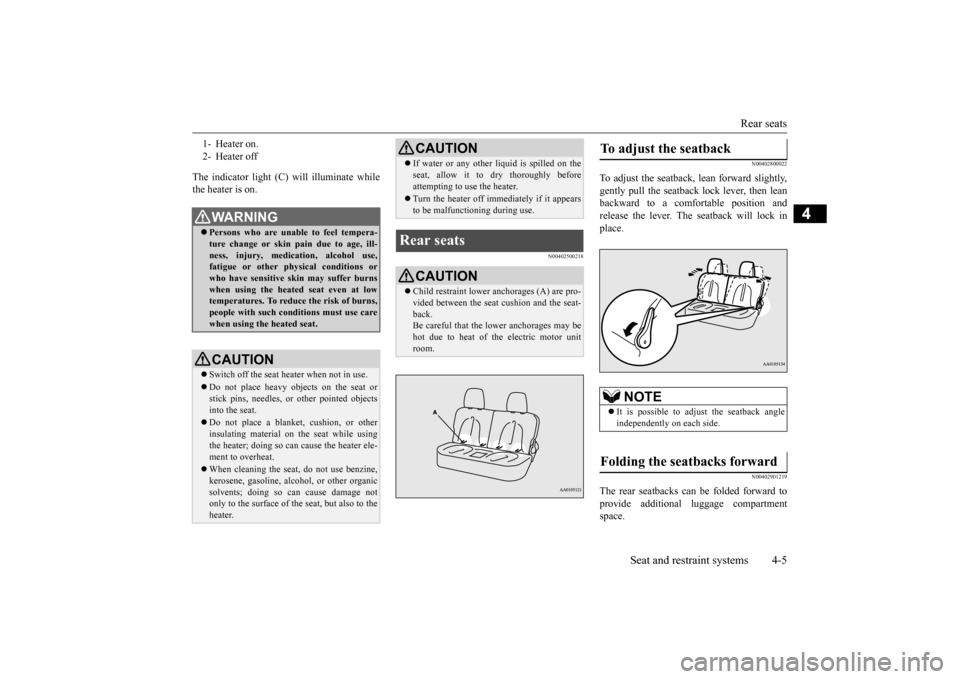
The indicator light (C) will illuminate while the heater is on.
N00402500218
N00402800022
To adjust the seatback,
lean forward slightly,
gently pull the seatback lock lever, then lean backward to a comfortable position andrelease the lever. The seatback will lock in place.
N00402901219
The rear seatbacks can be folded forward to provide additional luggage compartmentspace.
1- Heater on. 2- Heater offWA R N I N G Persons who are unable to feel tempera- ture change or skin
pain due to age, ill-
ness, injury, medication, alcohol use, fatigue or other phys
ical conditions or
who have sensitive sk
in may suffer burns
when using the heated seat even at low temperatures. To reduce the risk of burns,people with such conditions must use care when using the heated seat.CAUTION Switch off the seat heater when not in use.Do not place heavy objects on the seat or stick pins, needles, or
other pointed objects
into the seat. Do not place a blanket,
cushion, or other
insulating material on the seat while usingthe heater; doing so can
cause the heater ele-
ment to overheat. When cleaning the seat, do not use benzine, kerosene, gasoli
ne, alcohol, or other organic
solvents; doing so can cause damage not only to the surface of the seat, but also to theheater.
If water or any other li
quid is spilled on the
seat, allow it to dry thoroughly beforeattempting to use the heater. Turn the heater off immediately if it appears to be malfunctioning during use.
Rear seats
CAUTION Child restraint lower anchorages (A) are pro- vided between the seat
cushion and the seat-
back.Be careful that the lower anchorages may be hot due to heat of th
e electric motor unit
room.CAUTION
To adjust the seatback
NOTE
It is possible to adjust the seatback angle independently on each side.
Folding the seatbacks forward
BK0209800US.book 5 ページ 2014年1月14日 火曜日 午前9時26分
Page 79 of 262
Seat belts 4-10 Seat and restraint systems
4
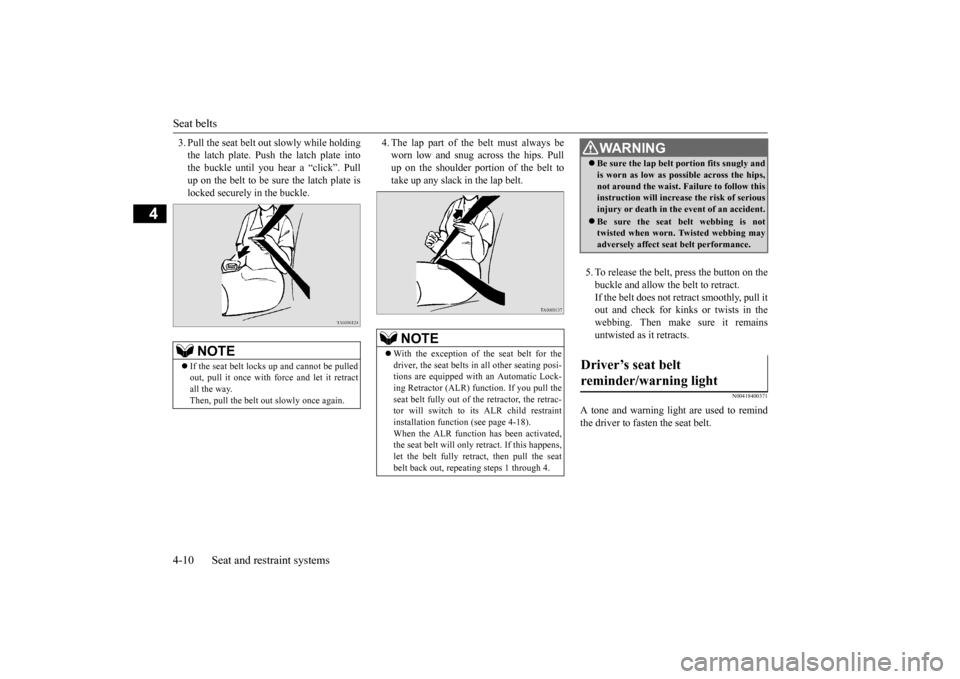
3. Pull the seat belt out slowly while holding the latch plate. Push the latch plate intothe buckle until you hear a “click”. Pull up on the belt to be su
re the latch plate is
locked securely in the buckle.
4. The lap part of the belt must always be worn low and snug across the hips. Pullup on the shoulder portion of the belt to take up any slack
in the lap belt.
5. To release the belt,
press the button on the
buckle and allow the belt to retract. If the belt does not retract smoothly, pull it out and check for kinks or twists in thewebbing. Then make sure it remains untwisted as it retracts.
N00418400371
A tone and warning light are used to remind the driver to fasten the seat belt.
NOTE
If the seat belt locks
up and cannot be pulled
out, pull it once with force and let it retract all the way. Then, pull the belt out
slowly once again.
NOTE
With the exception of the seat belt for the driver, the seat belts in all other seating posi-tions are equipped with an Automatic Lock- ing Retractor (ALR) function. If you pull the seat belt fully out of th
e retractor, the retrac-
tor will switch to its ALR child restraint installation function
(see page 4-18).
When the ALR function has been activated,the seat belt will only re
tract. If this happens,
let the belt fully retract, then pull the seat belt back out, repeating steps 1 through 4.
WA R N I N G Be sure the lap belt portion fits snugly and is worn as low as possible across the hips,not around the waist. Failure to follow thisinstruction will increase the risk of serious injury or death in the
event of an accident.
Be sure the seat belt webbing is not twisted when worn. Twisted webbing may adversely affect seat belt performance.
Driver’s seat belt reminder/warning light
BK0209800US.book 10 ページ 2014年1月14日 火曜日 午前9時26分
Page 80 of 262
Seat belts
Seat and restraint systems 4-11
4
If the electric motor switch is turned to the “ON” position without the driver’s seat beltbeing fastened, a warning light will come on, and a tone will sound for approximately 6 seconds to remind you to fasten your seatbelt. If the seat belt remains unfastened approxi- mately 1 minute later, the warning light willflash and the tone wi
ll sound intermittently
for approximately 90 seconds when the vehi- cle is driven.If the seat belt subse
quently remains unfas-
tened, the warning light
and tone will issue
further warnings each time the vehicle startsmoving from a stop. And if the driver unfas- tens the seat belt while driving, the warning will operate in the same way. When the seatbelt is fastened, the warnings will stop.
N00418300224
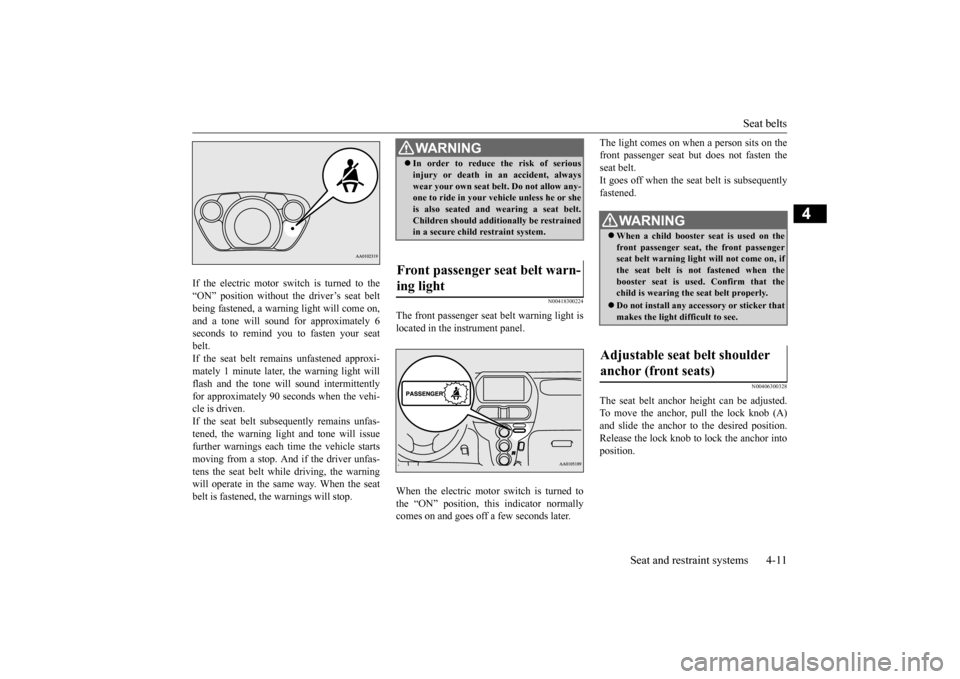
The front passenger seat
belt warning light is
located in the instrument panel. When the electric motor switch is turned to the “ON” position, this indicator normally comes on and goes off a few seconds later.
The light comes on when a person sits on the front passenger seat bu
t does not fasten the
seat belt. It goes off when the seat belt is subsequently fastened.
N00406300328
The seat belt anchor height can be adjusted.To move the anchor, pull the lock knob (A) and slide the anchor to the desired position. Release the lock knob to lock the anchor intoposition.
WA R N I N G In order to reduce the risk of serious injury or death in
an accident, always
wear your own seat belt. Do not allow any-one to ride in your ve
hicle unless he or she
is also seated and
wearing a seat belt.
Children should additi
onally be restrained
in a secure child restraint system.
Front passenger seat belt warn- ing light
WA R N I N G When a child booster se
at is used on the
front passenger seat, the front passenger seat belt warning ligh
t will not come on, if
the seat belt is not fastened when thebooster seat is used
. Confirm that the
child is wearing the
seat belt properly.
Do not install any acce
ssory or sticker that
makes the light difficult to see.
Adjustable seat belt shoulder anchor (front seats)
BK0209800US.book 11 ページ 2014年1月14日 火曜日 午前9時26分
Page 82 of 262
Child restraint systems
Seat and restraint systems 4-13
4
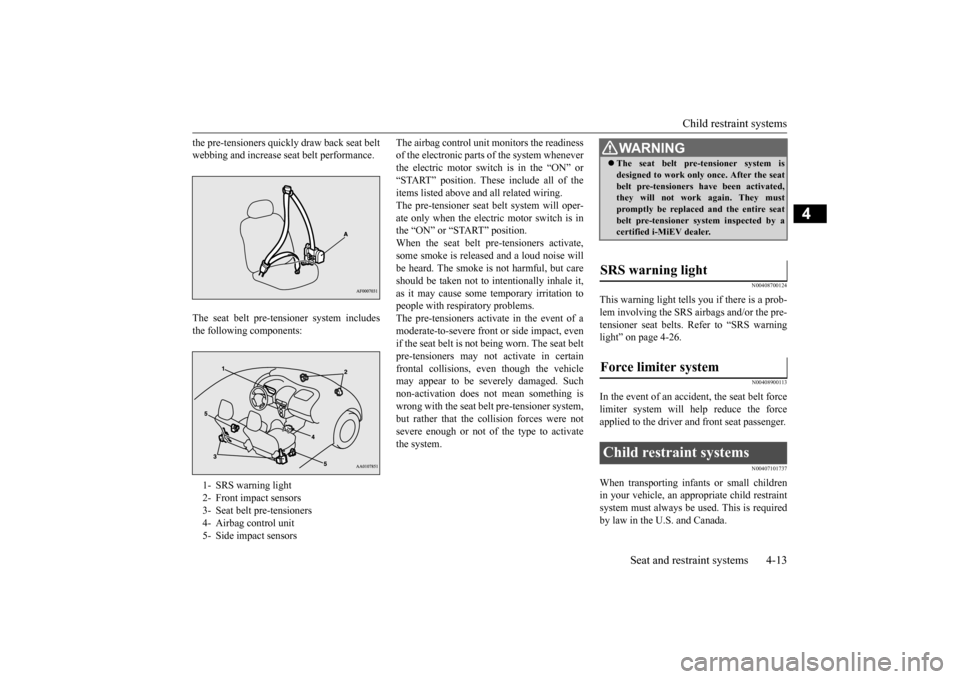
the pre-tensioners quickly
draw back seat belt
webbing and increase se
at belt performance.
The seat belt pre-tensioner system includes the following components:
The airbag control unit
monitors the readiness
of the electronic parts of the system wheneverthe electric motor switch is in the “ON” or “START” position. Thes
e include all of the
items listed above a
nd all related wiring.
The pre-tensioner seat
belt system will oper-
ate only when the electric motor switch is in the “ON” or “START” position.When the seat belt pre-tensioners activate, some smoke is released
and a loud noise will
be heard. The smoke is
not harmful, but care
should be taken not to in
tentionally inhale it,
as it may cause some
temporary irritation to
people with respiratory problems. The pre-tensioners activa
te in the event of a
moderate-to-severe front
or side impact, even
if the seat belt is not being worn. The seat belt pre-tensioners may not
activate in certain
frontal collisions, even though the vehiclemay appear to be se
verely damaged. Such
non-activation does not mean something is wrong with the seat belt pre-tensioner system,but rather that the collision forces were not severe enough or not of the type to activate the system.
N00408700124
This warning light tells you if there is a prob-lem involving the SRS airbags and/or the pre- tensioner seat belts. Refer to “SRS warning light” on page 4-26.
N00408900113
In the event of an accident, the seat belt forcelimiter system will help reduce the forceapplied to the driver a
nd front seat passenger.
N00407101737
When transporting infants or small children in your vehicle, an appr
opriate child restraint
system must always be
used. This is required
by law in the U.S. and Canada.
1- SRS warning light 2- Front impact sensors 3- Seat belt pr
e-tensioners
4- Airbag control unit 5- Side impact sensors
WA R N I N G The seat belt pre-tensioner system is designed to work only
once. After the seat
belt pre-tensioners have been activated,they will not work again. They must promptly be replaced and the entire seat belt pre-tensioner system inspected by acertified i-MiEV dealer.
SRS warning light Force limiter system Child restraint systems
BK0209800US.book 13 ページ 2014年1月14日 火曜日 午前9時26分
Page 92 of 262
Supplemental Restraint System (SRS) - airbag
Seat and restraint systems 4-23
4
N00407800489
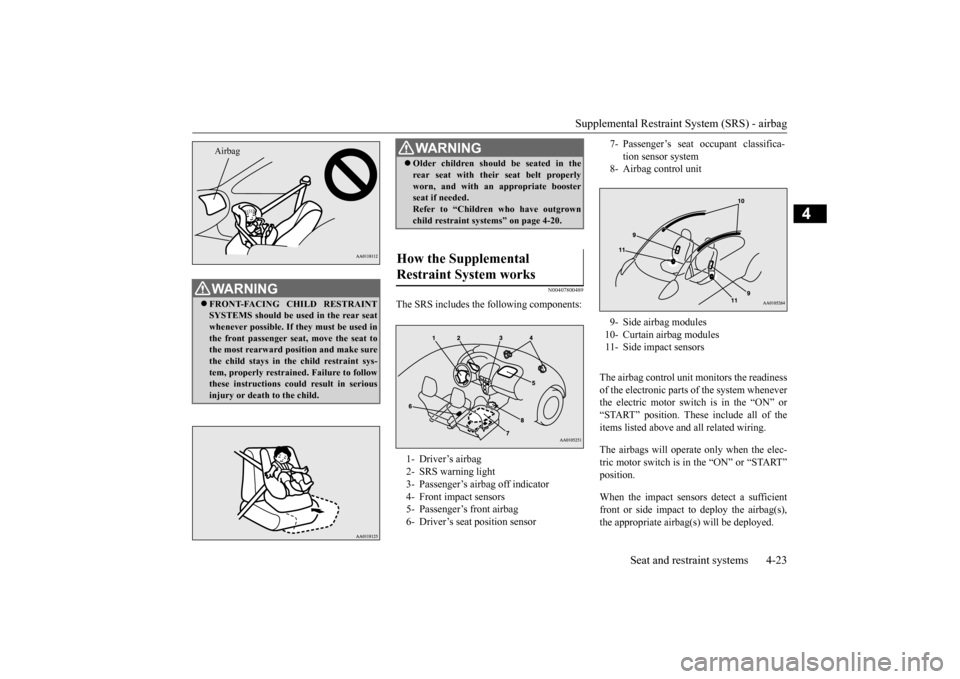
The SRS includes the following components:
The airbag control unit monitors the readiness of the electronic parts of the system wheneverthe electric motor switch is in the “ON” or “START” position. These include all of the items listed above a
nd all related wiring.
The airbags will operate only when the elec- tric motor switch is in the “ON” or “START” position. When the impact sensors detect a sufficient front or side impact to deploy the airbag(s),the appropriate airbag
(s) will be deployed.
WA R N I N GFRONT-FACING CHILD RESTRAINT SYSTEMS should be used in the rear seatwhenever possible. If they must be used in the front passenger seat, move the seat to the most rearward po
sition and make sure
the child stays in the child restraint sys- tem, properly restrained. Failure to follow these instructions could result in seriousinjury or death to the child.Airbag
WA R N I N G Older children should be seated in the rear seat with thei
r seat belt properly
worn, and with an
appropriate booster
seat if needed. Refer to “Children
who have outgrown
child restraint systems” on page 4-20.
How the Supplemental Restraint System works 1- Driver’s airbag 2- SRS warning light 3- Passenger’s airbag off indicator 4- Front impact sensors5- Passenger’s front airbag 6- Driver’s seat position sensor
7- Passenger’s seat oc
cupant classifica-
tion sensor system
8- Airbag control unit 9- Side airbag modules 10- Curtain airbag modules 11- Side impact sensors
BK0209800US.book 23 ページ 2014年1月14日 火曜日 午前9時26分