Wheel MITSUBISHI iMiEV 2014 1.G Service Manual
[x] Cancel search | Manufacturer: MITSUBISHI, Model Year: 2014, Model line: iMiEV, Model: MITSUBISHI iMiEV 2014 1.GPages: 262, PDF Size: 26.84 MB
Page 225 of 262
Tires 9-14 Vehicle care and maintenance
9
Safety Too little pressure increases flexing in thetire and can cause tire failure. Too much pressure can cause a tire to lose its ability to cushion shock. Objects on the road andpotholes could then cause tire damage that may result in tire failure. Economy The wrong tire pressure can cause uneven wear patterns in the tire tread. These abnormal wear patterns will reduce the tread life, and the tire will have to be replaced sooner.Too little pressure also makes it harder for the tire to roll, and this uses up more power. Ride comfort and vehicle stability The superior riding
experience built into
your vehicle partly depends on the correcttire pressure. Too mu
ch pressure gives an
uncomfortable and ja
rring ride. Too little
pressure feels as if your vehicle is slow torespond. Unequal tire pressures can make steering your vehicle uneven and unpredictable.
The correct tire pressure for your vehicle is listed on the placard attached to the sill of the driver’s door. (Refer to “Tire and loading information plac-ard” on page 11-3.)
The recommended inflation pressures should be used for the tires listed below. Tire pressures should be checked, and adjusted if necessary, at least once a month. Pressures should be checked more often whenever weather temperatures changeseverely, becaus
e tire pressures change with
outdoor temperatures. The pressures listed on the placard are always
“cold inflation pres-
sure”. Cold inflation pressure is measured after the vehicle has been parked
for at least three
hours or is driven less than 1 mile (1.6 km) after having been parked for three hours. Cold inflation pressure must not go above themaximum values molded into the tire side- wall. After driving se
veral miles, your tire
inflation pressure may increase 14 to 41 KPA,2 to 6 PSI from the cold inflation pressure. Do not let air out of the tires to get back to the specified cold pressure, or your tire pressurewill be too low. You should also take the following safety pre- cautions:
Keep your tires inflated to the recom- mended pressures. (See the tire and load-ing information placard attached to the sill of the driver’s door.) Stay within the recommended load limits. Make sure that the weight of any load in your vehicle is evenly distributed. Drive at safe speeds. After filling your tires to the correct pres- sure, check them for damage and air leaks. Be sure to reinstall the caps on the valve stems.
N00939600427
Tire size
Front
Rear
145/65R15
72H
250 KPA, 36 PSI
—
175/60R15
81H
—
250 KPA, 36 PSI
Replacing tires and wheels
CAUTION Avoid using different size tires and wheels from the ones listed, and avoid the combined use of different types
of tires and wheels.
Using different size or
type tires and wheels
may affect driving safety. Refer to “Tires and wheels” on page 11-5. Even if a wheel has the same rim size and offset as the specifie
d type of wheel, its
shape may prevent it
from being fitted cor-
rectly. Consult a certified i-MiEV dealer before
using wheels that you
have.
BK0209800US.book 14 ページ 2014年1月14日 火曜日 午前9時26分
Page 226 of 262
Tires
Vehicle care and maintenance 9-15
9
N00939700170
The following maintenance steps are recom- mended: Check tire pressures regularly. Have regular maintenance done on the wheel balance and front
and rear suspen-
sion alignment.
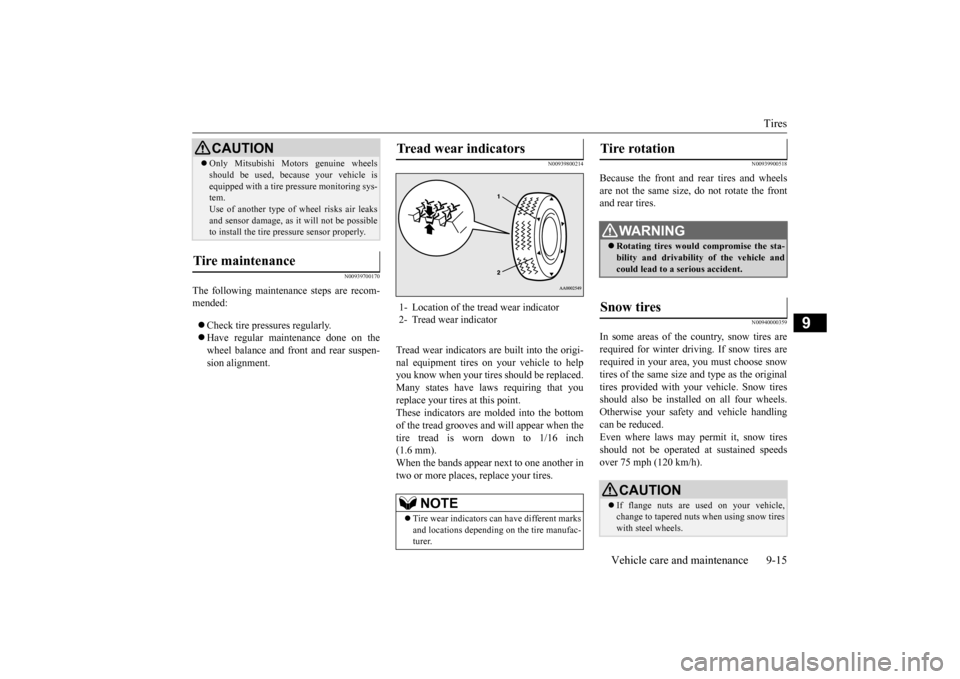
N00939800214
Tread wear indicators are built into the origi-nal equipment tires on your vehicle to helpyou know when your tires should be replaced. Many states have la
ws requiring that you
replace your tires at this point.These indicators are molded into the bottom of the tread grooves and will appear when the tire tread is worn down to 1/16 inch(1.6 mm). When the bands appear next to one another in two or more places,
replace your tires.
N00939900518
Because the front and
rear tires and wheels
are not the same size, do not rotate the front and rear tires.
N00940000359
In some areas of the country, snow tires arerequired for winter driving. If snow tires arerequired in your area, you must choose snow tires of the same size
and type as the original
tires provided with your
vehicle. Snow tires
should also be
installed on all four wheels.
Otherwise your safety
and vehicle handling
can be reduced.Even where laws may permit it, snow tires should not be operated
at sustained speeds
over 75 mph (120 km/h).
Only Mitsubishi Motors genuine wheels should be used, beca
use your vehicle is
equipped with a tire pr
essure monitoring sys-
tem. Use of another type of wheel risks air leaks and sensor damage, as it
will not be possible
to install the tire pressure sensor properly.
Tire maintenance
CAUTION
Tread wear indicators 1- Location of the tread wear indicator 2- Tread wear indicator
NOTE
Tire wear indicators ca
n have different marks
and locations depending on the tire manufac- turer.
Tire rotation
WA R N I N G Rotating tires would compromise the sta- bility and drivabilit
y of the vehicle and
could lead to a
serious accident.
Snow tires
CAUTIONIf flange nuts are used on your vehicle, change to tapered nuts
when using snow tires
with steel wheels.
BK0209800US.book 15 ページ 2014年1月14日 火曜日 午前9時26分
Page 227 of 262
Brake pedal free play 9-16 Vehicle care and maintenance
9
N00940100129 N00940300310
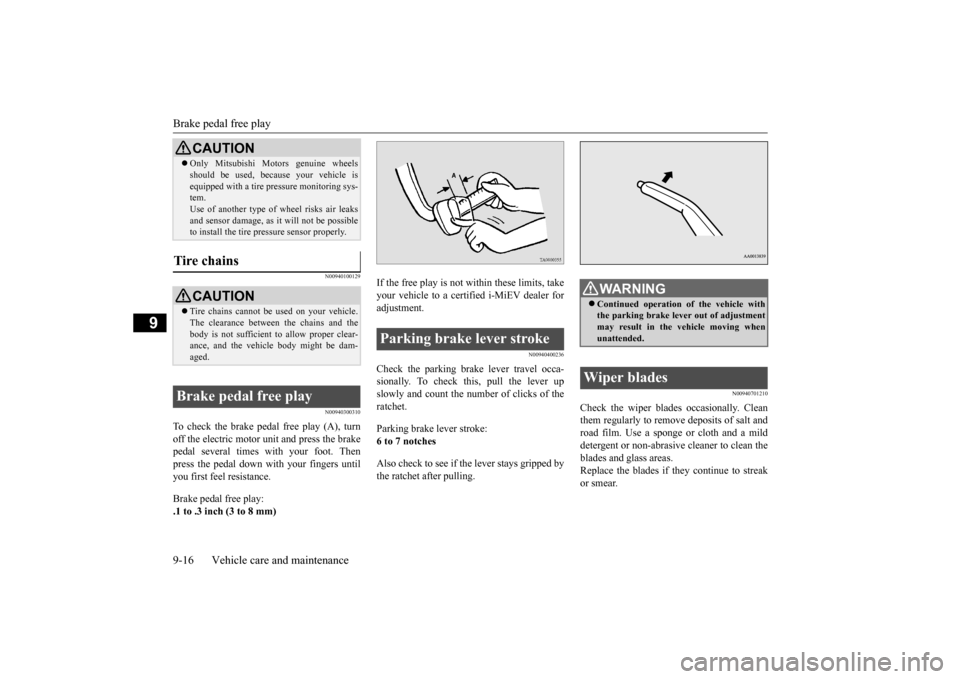
To check the brake pedal free play (A), turn off the electric motor unit and press the brakepedal several times
with your foot. Then
press the pedal down wi
th your fingers until
you first feel resistance. Brake pedal free play: .1 to .3 inch (3 to 8 mm)
If the free play is not within these limits, take your vehicle to a certified i-MiEV dealer for adjustment.
N00940400236
Check the parking brake lever travel occa- sionally. To check this, pull the lever upslowly and count the number of clicks of the ratchet. Parking brake lever stroke: 6 to 7 notches Also check to see if the lever stays gripped by the ratchet after pulling.
N00940701210
Check the wiper blades occasionally. Cleanthem regularly to remove
deposits of salt and
road film. Use a sponge or cloth and a mild detergent or non-abrasive
cleaner to clean the
blades and glass areas. Replace the blades if th
ey continue to streak
or smear.
Only Mitsubishi Motors genuine wheels should be used, beca
use your vehicle is
equipped with a tire pr
essure monitoring sys-
tem. Use of another type of
wheel risks air leaks
and sensor damage, as
it will not be possible
to install the tire pressure sensor properly.
Tire chains
CAUTION Tire chains cannot be used on your vehicle. The clearance between
the chains and the
body is not sufficient to allow proper clear- ance, and the vehicle body might be dam- aged.
Brake pedal free play
CAUTION
Parking brake lever stroke
WA R N I N G Continued operation
of the vehicle with
the parking brake leve
r out of adjustment
may result in the
vehicle moving when
unattended.
Wiper blades
BK0209800US.book 16 ページ 2014年1月14日 火曜日 午前9時26分
Page 228 of 262
General maintenance
Vehicle care and maintenance 9-17
9
If the blades are frozen to the windshield or rear window, do not operate the wipers until the ice has melted and the blades are freed,otherwise the wiper mo
tor may be damaged.
N00941500289
The next pages list th
e maintenance service
recommended by Mitsubishi Motors Corpo- ration. In addition to the general maintenancethat needs to be performed at the times listed, there are other parts which do not usually need regular maintenance.But, if any of these parts stops working prop- erly, your vehicle performance could suffer. Have these items checked if you notice a problem with them. See a certified i-MiEV dealer for assistance, if you have any questions.
N00941600033
Good brakes are essential to safe driving. Check the brake pads and brake linings for wear and check the rear wheel cylinders forleaks. For good braking performance, replace the brake pads with the same type pads as the originals.
N00941700047
Brake hoses and tubing should be checked for: Severe surface cracki
ng, scuffing or worn
spots. If the fabric casing of the hose isshowing through any cracks or worn spots in the rubber hose cover, the hose should be replaced. The brakes can fail if the hose wears through. Improper installation may cause twisting, or wheel, tire or
chassis interference.
N00941800077
Check the following parts for damage and grease leaks: Ball joint boots of the front suspension and steering linkage Bellows on both ends of the drive shaft
N00942500114
The hood lock release mechanism and hood safety catch should be
checked, cleaned, and
oiled when needed for easy movement and to
NOTE
Do not run the wipers on dry glass for a long time. This wears out the rubber and canscratch the glass.
During cold weather
NOTE
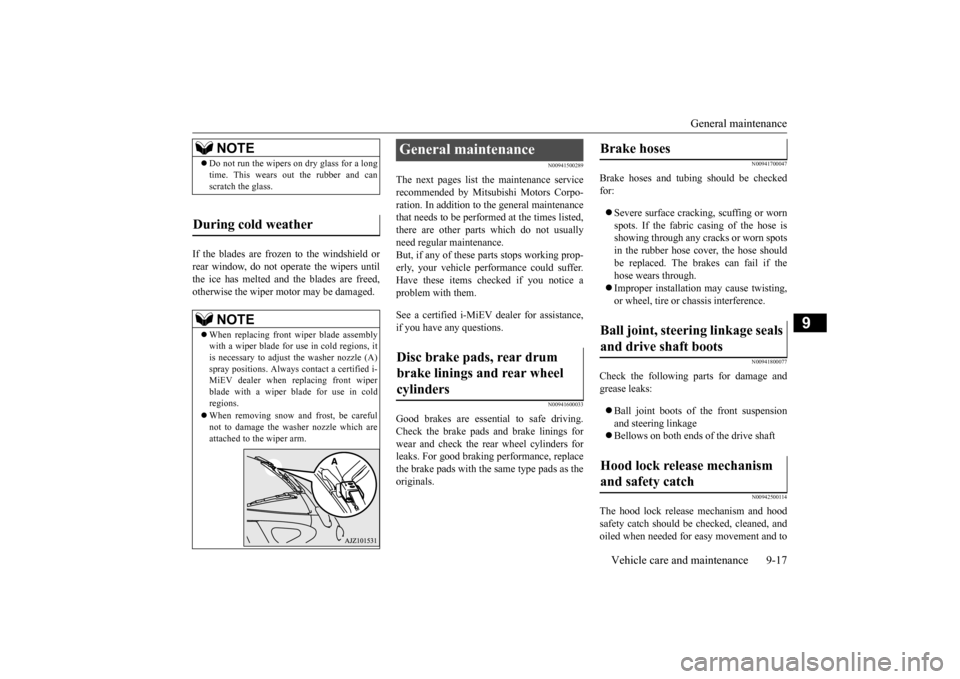
When replacing front wiper blade assembly with a wiper blade for use in cold regions, it is necessary to adjust the washer nozzle (A) spray positions. Always
contact a certified i-
MiEV dealer when re
placing front wiper
blade with a wiper blade for use in cold regions. When removing snow and frost, be careful not to damage the wash
er nozzle which are
attached to the wiper arm.
General maintenance Disc brake pads, rear drum brake linings and rear wheel cylinders
Brake hoses Ball joint, steering linkage seals and drive shaft boots Hood lock release mechanism and safety catch
BK0209800US.book 17 ページ 2014年1月14日 火曜日 午前9時26分
Page 235 of 262
Replacement of light bulbs 9-24 Vehicle care and maintenance
9
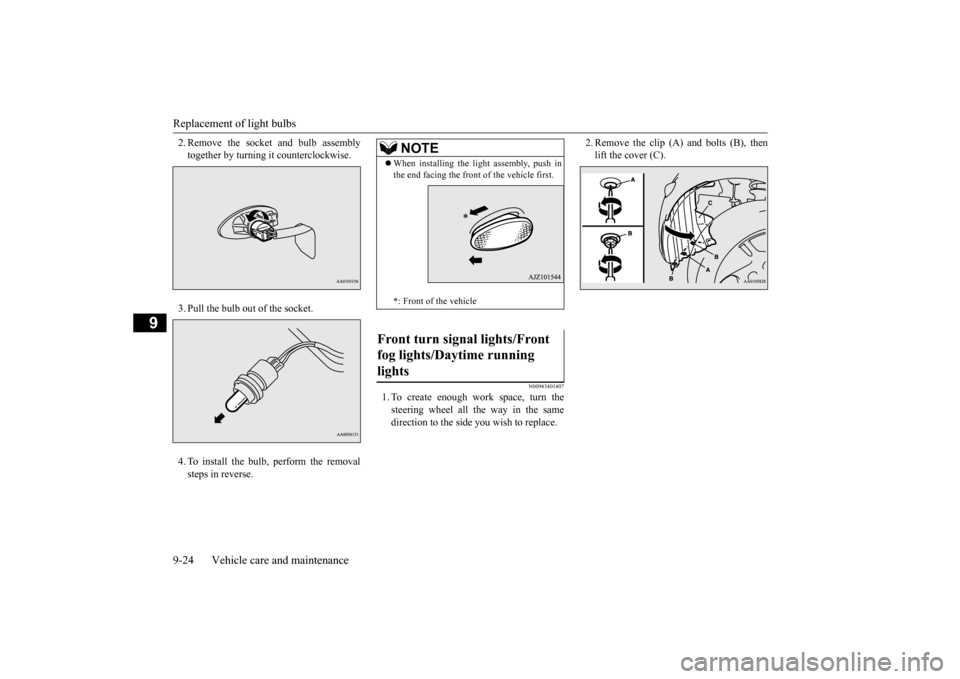
2. Remove the socket and bulb assembly together by turning it counterclockwise. 3. Pull the bulb out of the socket.4. To install the bulb, perform the removal steps in reverse.
N00943401407
1. To create enough work space, turn the steering wheel all the way in the same direction to the side
you wish to replace.
2. Remove the clip (A) and bolts (B), then lift the cover (C).
NOTE
When installing the light assembly, push in the end facing the front
of the vehicle first.
* : Front of the vehicle
Front turn signal lights/Front fog lights/Daytime running lights
BK0209800US.book 24 ページ 2014年1月14日 火曜日 午前9時26分
Page 242 of 262
Cleaning the outside of your vehicle Vehicle care and maintenance 9-31
9
Salt and other chemicals spread on winter roads in some geographical areas can have a detrimental effect on the vehicle underbody.You should flush the underbody with a high pressure hose every time you wash the out- side of your vehicle.Take special care to
remove mud or other
debris which could trap and hold salt and moisture. After washing your vehicle, wipe off all waterdrops from the rubber parts around thedoors to prevent the doors from freezing.
N00946000247
Wax your vehicle once or twice a year, orwhen water does not bead up on the paint.
Use a soft cloth to put a small amount of wax on the painted surfaces. After the wax hasdried, polish with a dry soft cloth. Do not wax your vehicle
in direct sunlight.
You should wax when the painted surfacesare cool.
N00946100059
If painted surfaces have been severely dam- aged and lost their original luster and color tone, polish the surface lightly with a finepolishing compound. Avoid limiting your polishing to the damage
d surface only; polish
a somewhat wider area, moving the polishing
When washing the underside of your vehicle or the wheels, wear a pair of gloves to pro-tect your hands. Never spray or splash water on the electrical parts in under the hood. This may damagethem. Be careful also when washing the underbody. Do not spray water up under the hood. Avoid automatic car washers that use rotat- ing brushes. These brushes may scratch thepaint surface and make it dull. Scratches are more not
iceable on darker col-
ored vehicles. Some hot water wash
ing equipment uses
high pressure and heat to clean your vehicle.This heated water ma
y damage your vehi-
cle’s resin parts. It
can flood the interior of
the vehicle. Therefore, be sure of the follow-ing:• Keep the washing nozzle at least 28 inches(70 cm) away from the vehicle body.• When washing around the door glass, holdthe nozzle at a distance of more than 28 inches (70 cm) and at right angles to the glass surface.
Make sure to do the following when using an automatic car wash, with help from eitherthis manual or the car wash operator, to avoid damaging your vehicle:• Fold the outside mirrors.• Remove the antenna.• Tape the wiper arm assembly.CAUTION
During cold weather
NOTE
When the door is frozen, opening it by force may tear off or crack the rubber gasket installed around the door. Pour warm water to melt the ice. Be sure to thoroughly wipeoff the water after opening the door. To pre- vent freezing of the we
atherstripping on the
doors, hood, etc., treat with silicone lubri-cant.
Waxing
CAUTION Waxes containing high abrasive compounds should not be used. These waxes remove rustand stain effectively from the paintwork, but are harmful to the finish on the paint and the plate, because they also remove clearcoat.They are also harmful to other glossy sur- faces such as the grille, trim, moldings, etc. Do not use gasoline, kerosene, benzine or paint thinners to remove road tar or other dirt from the vehicle surface. Do not put wax on the areas having black matte coating because
it can cause uneven
discoloration, patches, bl
urs, etc. If these get
wax on them, wipe the wax off right away with a soft clot
h and warm water.
Polishing
BK0209800US.book 31 ページ 2014年1月14日 火曜日 午前9時26分
Page 243 of 262
Cleaning the outside of your vehicle 9-32 Vehicle care and maintenance
9
cloth in one direction.
After polishing, flush
the compound from the surface and apply acoat of wax to regain a beautiful luster.
N00946200089
Small cracks and scratches in the paint coatshould be touched up as soon as possible with touch-up paint to prevent corrosion. Check body areas facing the road or the tires carefully for damage to the paint caused by flying stones, etc. The
paint code number for
your vehicle can be found on the vehicle information code plate. Refer to “Vehicle information code plate” on page 11-2.
N00946300211
Use a sponge or chamois to clean these parts.If a vehicle wax sticks
to a gray or black
rough surface of the bumper, molding or lights, the surface may appear white in color. In this case, wipe it off using lukewarm waterand a soft cloth or chamois.
N00946400065
To prevent spots and corrosion of chromeparts, wash with water, dry thoroughly, andapply a nonabrasive automotive wax. If the chrome is severely damaged or pitted, use a commercially available chrome polish.
N00946500196
1. Remove dirt using a wet sponge.2. Use a mild detergent
on any dirt that can-
not be removed easily with water. Rinse off the detergent after washing thewheel.
3. Dry the wheel thoroughly using a chamois leather or a soft cloth.
N00946600067
The window glass can usually be cleanedusing only a sponge and
water. Glass cleaner
can be used to remove
wax, oil, grease, dead
insects, etc. After washing the glass, wipe it dry with a clean, dry, soft cloth.
N00946700097
Use a soft cloth and glass cleaner to removegrease, dead insects,
etc., from the wiper
blades.
Damaged paint Cleaning plastic parts
CAUTION Do not use a scrubbing brush or other rough scrubber as these may damage the plastic surface.
Do not use wax containing compounds (pol- ishing powder) which
may damage the plas-
tic surface. Do not let the plastic parts get soiled with gasoline, oil, brake fl
uids, greases, paint
thinner, and sulfuric
acid (battery electro-
lyte). These fluids, etc., may crack, stain or discolor the plastic parts.If any of these get on the plastic parts, wipe them up with a soft cloth or chamois and a mild solution of soap and water. Then rinsethem immediately with water.
Chrome parts Aluminum wheels (if so equipped)
CAUTION
CAUTION Do not use a brush or other hard implement on the wheels. Doing so could scratch the wheels. Do not use any cleaner th
at contains an abra-
sive substance or is ac
idic or alkaline. Doing
so could cause the coating on the wheels topeel or become disc
olored or stained.
Do not directly apply
hot water using a steam
cleaner or by any other means. Contact with seawater or road salt used for de-icing can cause corro
sion. Rinse off such
substances as s
oon as possible.
Window glass Wiper blades
BK0209800US.book 32 ページ 2014年1月14日 火曜日 午前9時26分
Page 247 of 262
Consumer information (For vehicles sold in U.S.A.) 10-2 Customer assistance/Re
porting Safety Defects
10
N01047100171
This information is provided in compliance with the requirements of the National High- way Traffic Safety Ad
ministration, Depart-
ment of Transportation. It provides the purchasers and/or prospective purchasers with information on repor
ting safety defects.
DOT quality grades - Al
l passenger vehicle
tires must conform to
Federal Safety Require-
ments in addition to these grades. The spe- cific grade rating in each grade category isshown on the side wall of the tires on your vehicle. The treadwear grade is a comparative rating based on the wear rate of
the tire when tested
under controlled conditions on a specifiedgovernment test course
. For example, a tire
graded 150 would wear one and one-half (11/2) times as well on the government course
as a tire graded 100.
The relative performance
of tires depends upon the actual conditions of
their use, however, and may depart signifi- cantly from the norm due to variations indriving habits, service practices and differ- ences in road characteristics and climate. The traction grades, from highest to lowest, are AA, A, B and C. Those grades represent the tire’s ability to
stop on wet pavement as
measured under controlled conditions on specified government te
st surfaces of asphalt
and concrete. A tire marked C may have poor traction performance. The temperature grades are A (the highest), B and C, representing the ti
re’s resistance to the
generation of heat and it
s ability to dissipate
heat when tested un
der controlled conditions
on a specified indoor
laboratory test wheel.
Sustained high temperature can cause the
material of the tire to
degenerate and reduce
tire life, and excessive temperature can leadto sudden tire failure. The grade C corre- sponds to a level of performance which all passenger car tires must meet under the Fed-eral Motor Vehicle Safety Standard No. 109. Grades B and A represent higher levels of performance on the labora
tory test wheel than
the minimum required by law.
N01047201515
If you believe that your vehicle has a defect which could cause a crash or could cause injury or death, you should immediately inform theNational Highway Traffic Safety Administration (NHTSA) in addi- tion to notifying Mitsubishi MotorsCorporation.
Consumer information (For vehicles sold in U.S.A.) Uniform tire quality grading Treadwear
Traction AA, A, B, C
WA R N I N G The traction grade assi
gned to this tire is
based on straight-ahead braking tractiontests, and does not include acceleration, cornering, hydroplani
ng, or peak traction
characteristics.
Temperature A, B, C
WA R N I N G The temperature grade for this tire is established for a tire that is properlyinflated and not overloaded. Excessive speed, underinflation
, or excessive load-
ing, either separately
or in combination,
can cause heat buildup and possible tire failure.
Reporting Safety Defects
BK0209800US.book 2 ページ 2014年1月14日 火曜日 午前9時26分
Page 250 of 262

11
SpecificationsVehicle labeling ............................................................................. 11-2 Vehicle dimensions ........................................................................ 11-3 Vehicle weights .............................................................................. 11-3Charging system specifications ..................................................... 11-4 Electric motor specifications ......................................................... 11-5 12V starter battery ......................................................................... 11-5Tires and wheels ............................................................................ 11-5 Refill capacities ............................................................................. 11-6
BK0209800US.book 1 ページ 2014年1月14日 火曜日 午前9時26分
Page 252 of 262
Vehicle dimensions
Specifications 11-3
11
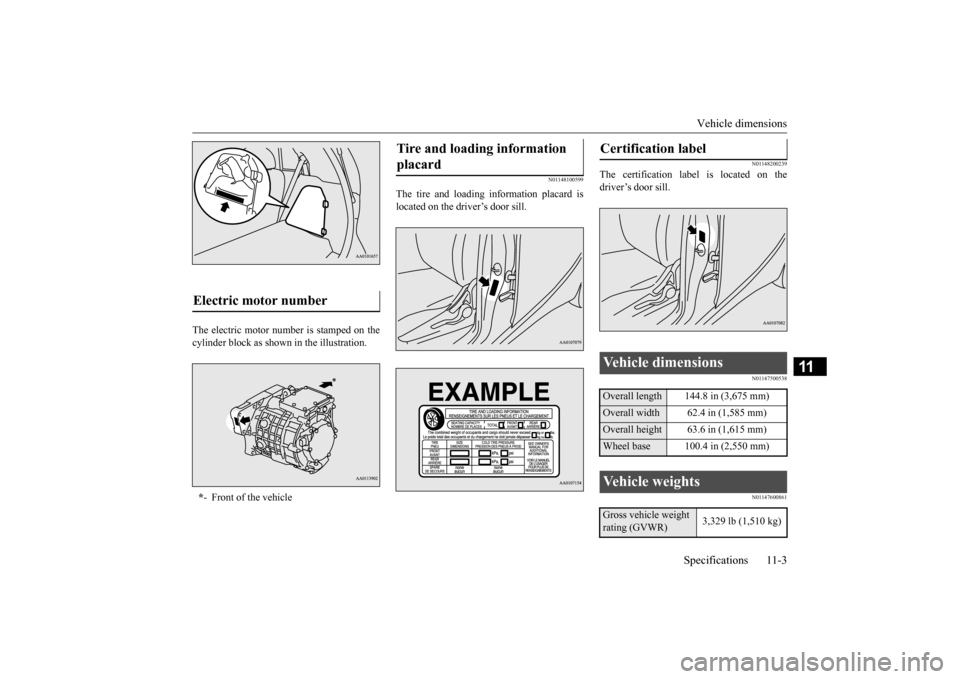
The electric motor number is stamped on the cylinder block as shown
in the illustration.
N01148100599
The tire and loading information placard is located on the driver’s door sill.
N01148200239
The certification label is located on the driver’s door sill.
N01147500538 N01147600861
Electric motor number * - Front of the vehicle
Tire and loading information placard
Certification label Vehicle dimensions Overall length 144.8 in (3,675 mm) Overall width 62.4 in (1,585 mm) Overall height 63.6 in (1,615 mm)Wheel base 100.4 in (2,550 mm)Vehicle weights Gross vehicle weight rating (GVWR)
3,329 lb (1,510 kg)
BK0209800US.book 3 ページ 2014年1月14日 火曜日 午前9時26分