Wheel MITSUBISHI iMiEV 2014 1.G Owner's Guide
[x] Cancel search | Manufacturer: MITSUBISHI, Model Year: 2014, Model line: iMiEV, Model: MITSUBISHI iMiEV 2014 1.GPages: 262, PDF Size: 26.84 MB
Page 167 of 262
Parking 6-6 Driving safety
6
effective use of the re
generative brake and
prevent the service brake from overheating.If the brake pedal is continuously or fre- quently depressed on downhill roads, the ser- vice brake could overheat and the brakeperformance will be reduced.
N00629600317
When parking on a hill, set the parking brake, and turn the front wheels toward the curb on a downhill, or away from the curb on an uphill.If necessary, apply
chocks to wheels.
Never leave the electric motor unit running while you take a short sleep/rest.
Your front bumper can be damaged if you scrape it over curbs or parking stop blocks. Be careful when traveling up or down steep slopes where your bumper can scrape theroad. Always remove the key from the electric motor switch and lock all doors and the lift- gate when leaving
the vehicle unattended.
Always try to park your vehicle in a well litarea. More effort could be required to turn the steering wheel. Refer to “Electric power steering system(EPS)” on page 5-27.
NOTE
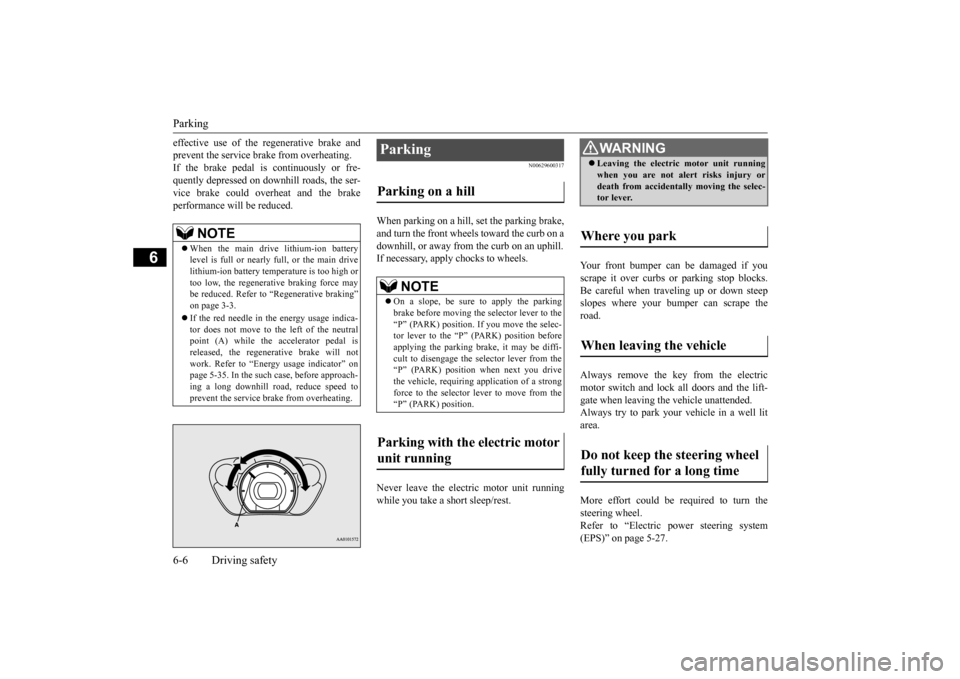
When the main drive lithium-ion battery level is full or nearly full, or the main drivelithium-ion battery temperature is too high or too low, the regenerative braking force may be reduced. Refer to “Regenerative braking”on page 3-3. If the red needle in the energy usage indica- tor does not move to the left of the neutral point (A) while the accelerator pedal is released, the regenera
tive brake will not
work. Refer to “Ener
gy usage indicator” on
page 5-35. In the such case, before approach- ing a long downhill road, reduce speed toprevent the service brake from overheating.
Parking Parking on a hill
NOTE
On a slope, be sure to apply the parking brake before moving the selector lever to the“P” (PARK) position. If you move the selec- tor lever to the “P” (PARK) position before applying the parking br
ake, it may be diffi-
cult to disengage the
selector lever from the
“P” (PARK) position when next you drive the vehicle, requiring a
pplication of a strong
force to the selector lever to move from the “P” (PARK) position.
Parking with the electric motor unit running
WA R N I N G Leaving the electric motor unit running when you are not alert risks injury ordeath from accidental
ly moving the selec-
tor lever.
Where you park When leaving the vehicle Do not keep the steering wheel fully turned for a long time
BK0209800US.book 6 ページ 2014年1月14日 火曜日 午前9時26分
Page 171 of 262
Cargo loads 6-10 Driving safety
6
N00629700510
To determine the cargo load capacity for your vehicle, subtract the
weight of all vehicle
occupants from the vehi
cle capacity weight.
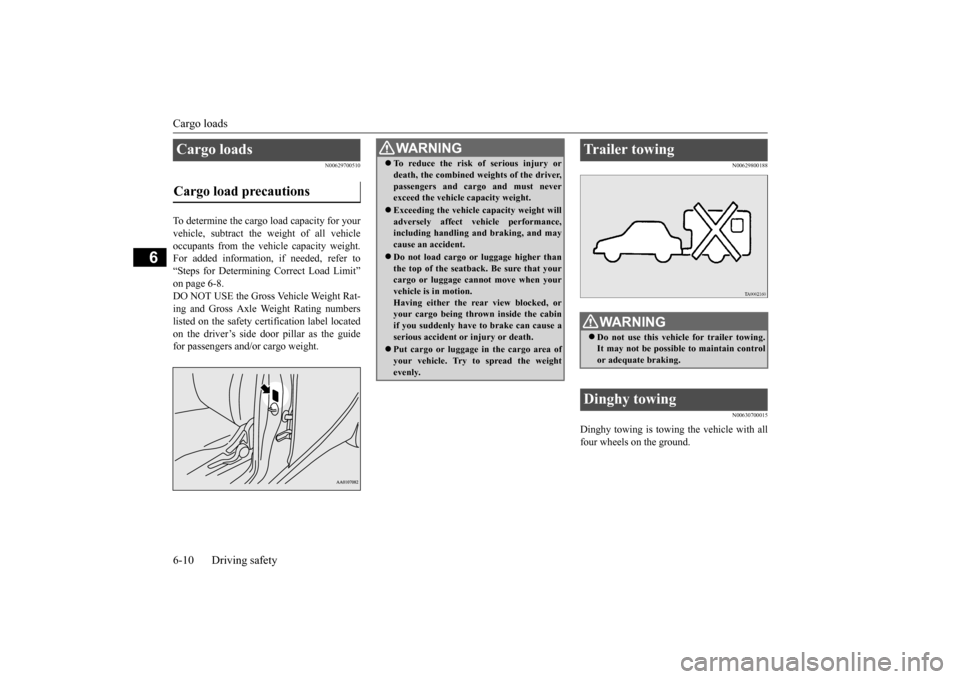
For added information, if needed, refer to “Steps for Determining Correct Load Limit” on page 6-8. DO NOT USE the Gross Vehicle Weight Rat- ing and Gross Axle Weight Rating numberslisted on the safety certification label located on the driver’s side door pillar as the guide for passengers and/or cargo weight.
N00629800188 N00630700015
Dinghy towing is towing the vehicle with all four wheels on the ground.
Cargo loads Cargo load precautions
WA R N I N G To reduce the risk of serious injury or death, the combined weights of the driver,passengers and cargo and must neverexceed the vehicle capacity weight. Exceeding the vehicle capacity weight will adversely affect ve
hicle performance,
including handling and braking, and may cause an accident. Do not load cargo or luggage higher than the top of the seatback. Be sure that yourcargo or luggage cann
ot move when your
vehicle is in motion. Having either the re
ar view blocked, or
your cargo being thrown
inside the cabin
if you suddenly have to brake can cause a serious accident or
injury or death.
Put cargo or luggage in the cargo area of your vehicle. Try to spread the weightevenly.
Trailer towing
WA R N I N G Do not use this vehicle for trailer towing. It may not be possible to maintain control or adequate braking.
Dinghy towing
BK0209800US.book 10 ページ 2014年1月14日 火曜日 午前9時26分
Page 202 of 262
Tire repair kit
For emergencies 8-5
8
If you drive your vehicle with a low battery charge, after the electric motor unit has beenstarted by using jumper
cables, it can cause
the anti-lock braking sy
stem warning light to
illuminate. This is only due to the low batteryvoltage. It is not a problem with the brake system. If this happens, fully charge the 12V starter battery and ensure the charging system is operating properly.
N00836600366
This vehicle is equipped
with a tire repair kit
which can be used to repair a minor puncture in tread area caused by
a nail, screw or simi-
lar object. A spare tire
is not provided with
this vehicle.
N00837700016
The tire repair kit is
stowed under the rear
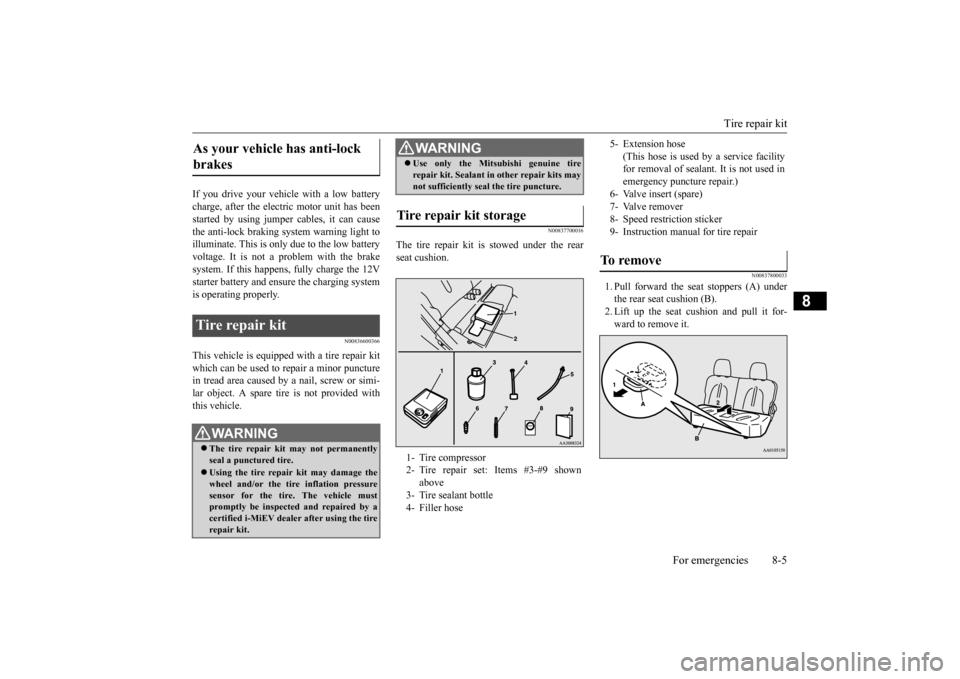
seat cushion.
N00837800033
1. Pull forward the seat stoppers (A) underthe rear seat cushion (B). 2. Lift up the seat
cushion and pull it for-
ward to remove it.
As your vehicle has anti-lock brakes Tire repair kit
WA R N I N G The tire repair kit may not permanently seal a punctured tire. Using the tire repair
kit may damage the
wheel and/or the tire inflation pressuresensor for the tire. The vehicle must promptly be inspected and repaired by a certified i-MiEV dealer after using the tirerepair kit.
Use only the Mitsubishi genuine tire repair kit. Sealant in other repair kits maynot sufficiently seal the tire puncture.
Tire repair kit storage 1- Tire compressor 2- Tire repair set: Items #3-#9 shown
above
3- Tire sealant bottle4- Filler hoseWA R N I N G
5- Extension hose
(This hose is used
by a service facility
for removal of sealant. It is not used inemergency puncture repair.)
6- Valve insert (spare) 7- Valve remover8- Speed restriction sticker 9- Instruction manual for tire repairTo remove
BK0209800US.book 5 ページ 2014年1月14日 火曜日 午前9時26分
Page 203 of 262
Tire repair kit 8-6 For emergencies
8
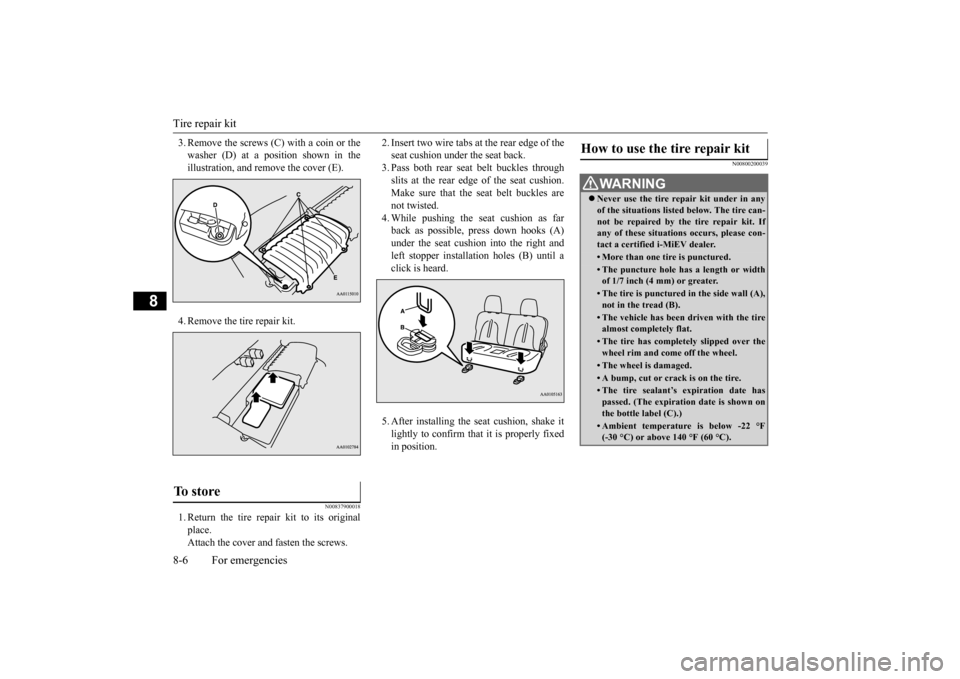
3. Remove the screws (C) with a coin or the washer (D) at a position shown in theillustration, and remove the cover (E). 4. Remove the tire repair kit.
N00837900018
1. Return the tire repair kit to its original place. Attach the cover and fasten the screws.
2. Insert two wire tabs at the rear edge of the seat cushion under the seat back. 3. Pass both rear seat
belt buckles through
slits at the rear edge of the seat cushion. Make sure that the seat belt buckles arenot twisted. 4. While pushing the seat cushion as far back as possible, press down hooks (A)under the seat cushion into the right and left stopper installa
tion holes (B) until a
click is heard. 5. After installing the seat cushion, shake it lightly to confirm that it is properly fixed in position.
N00800200039
To store
How to use the tire repair kit
WA R N I N G Never use the tire repair kit under in any of the situations listed below. The tire can-not be repaired by the tire repair kit. If any of these situations occurs, please con- tact a certified i-MiEV dealer.• More than one tire is punctured.• The puncture hole has a length or width of 1/7 inch (4 mm) or greater.• The tire is punctured in the side wall (A),not in the tread (B).• The vehicle has been driven with the tirealmost completely flat.• The tire has completely slipped over thewheel rim and come off the wheel.• The wheel is damaged.• A bump, cut or crack is on the tire.• The tire sealant’s expiration date has passed. (The expiration date is shown onthe bottle label (C).)• Ambient temperature is below -22 °F(-30 °C) or above 140 °F (60 °C).
BK0209800US.book 6 ページ 2014年1月14日 火曜日 午前9時26分
Page 206 of 262
Tire repair kit
For emergencies 8-9
8
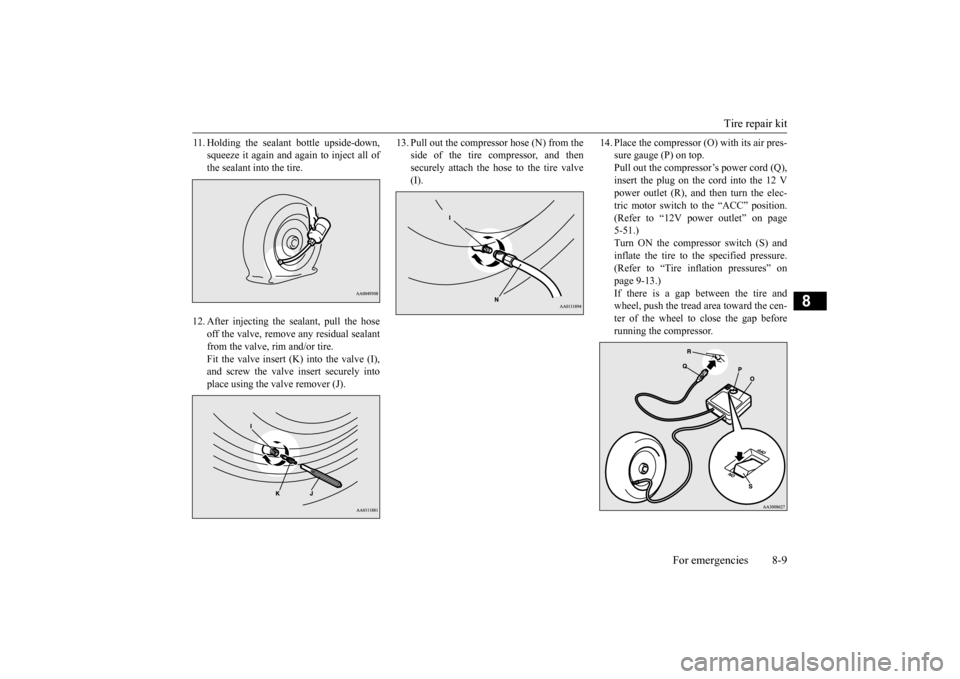
11. Holding the sealant bottle upside-down,
squeeze it again and again to inject all ofthe sealant into the tire.
12. After injecting the sealant, pull the hose
off the valve, remove any residual sealant from the valve, rim and/or tire. Fit the valve insert (K) into the valve (I),and screw the valve insert securely into place using the valve remover (J).
13. Pull out the compre
ssor hose (N) from the
side of the tire compressor, and thensecurely attach the hose to the tire valve (I).
14. Place the compressor (O) with its air pres-
sure gauge (P) on top.Pull out the compressor’s power cord (Q), insert the plug on the cord into the 12 V power outlet (R), and then turn the elec-tric motor switch to the “ACC” position. (Refer to “12V power outlet” on page 5-51.)Turn ON the compressor switch (S) and inflate the tire to the specified pressure. (Refer to “Tire inflation pressures” on page 9-13.) If there is a gap between the tire andwheel, push the tread area toward the cen- ter of the wheel to close the gap before running the compressor.
BK0209800US.book 9 ページ 2014年1月14日 火曜日 午前9時26分
Page 207 of 262
Tire repair kit 8-10 For emergencies
8
15. Check and adjust the tire pressure with
reference to the air pressure gauge on thecompressor. If you overinflate the tire, release air by loosening the hose’s end fit- ting.If there is a gap between the tire and wheel because the ti
re has moved inward
from the wheel rim, press the tire treadtowards the wheel to close the gap before running the compressor. (With no gaps, the tire pressure will rise.)
16. Turn OFF the compressor switch, then
pull the power cord plug out of the 12 Vpower outlet.
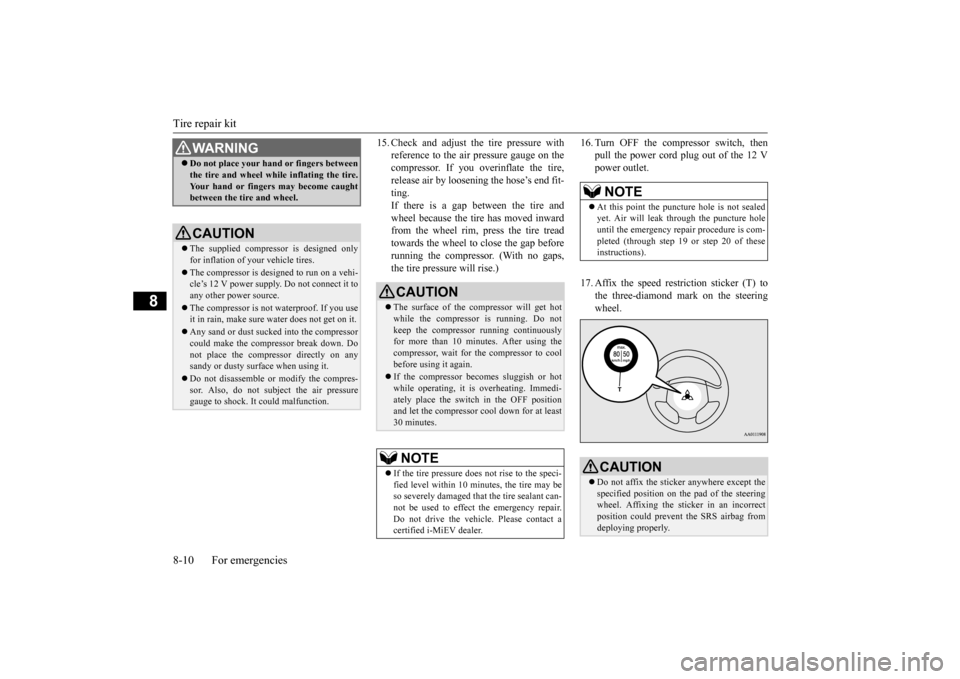
17. Affix the speed restriction sticker (T) to
the three-diamond mark on the steering wheel.
WA R N I N G Do not place your hand or fingers between the tire and wheel while inflating the tire.Your hand or fingers may become caughtbetween the tire and wheel.CAUTION The supplied compressor is designed only for inflation of your vehicle tires. The compressor is designed to run on a vehi- cle’s 12 V power supply. Do not connect it to any other power source. The compressor is not waterproof. If you use it in rain, make sure
water does not get on it.
Any sand or dust sucked into the compressor could make the compressor break down. Donot place the compressor directly on any sandy or dusty surface when using it. Do not disassemble or modify the compres- sor. Also, do not subject the air pressure gauge to shock. It could malfunction.
CAUTION The surface of the compressor will get hot while the compressor is running. Do not keep the compressor running continuouslyfor more than 10 minutes. After using the compressor, wait for the compressor to cool before using it again. If the compressor becomes sluggish or hot while operating, it is
overheating. Immedi-
ately place the switch in the OFF position and let the compressor c
ool down for at least
30 minutes.NOTE
If the tire pressure does not rise to the speci- fied level within 10 minutes, the tire may beso severely damaged that
the tire sealant can-
not be used to effect
the emergency repair.
Do not drive the vehicl
e. Please contact a
certified i-MiEV dealer.
NOTE
At this point the puncture hole is not sealed yet. Air will leak
through the puncture hole
until the emergency repa
ir procedure is com-
pleted (through step 19 or step 20 of theseinstructions).CAUTION Do not affix the sticke
r anywhere except the
specified position on th
e pad of the steering
wheel. Affixing the sticker in an incorrect position could prevent the SRS airbag fromdeploying properly.
BK0209800US.book 10 ページ 2014年1月14日 火曜日 午前9時26分
Page 209 of 262
Towing 8-12 For emergencies
8
21. Immediately drive with great care to a
certified i-MiEV de
aler and have tire
repair/replacement performed.
N00837001931
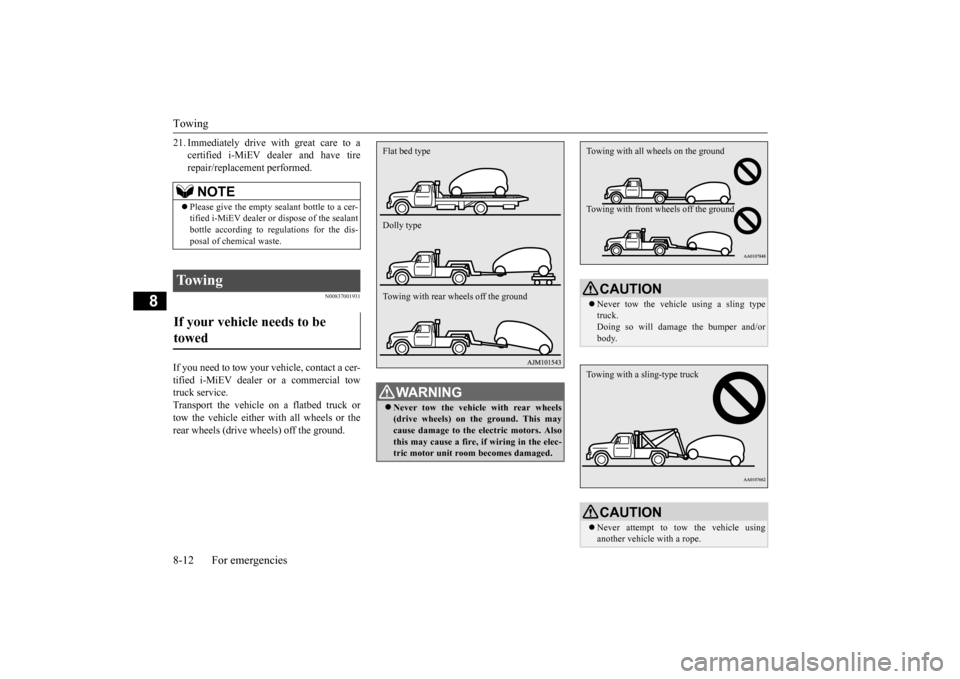
If you need to tow your ve
hicle, contact a cer-
tified i-MiEV dealer or a commercial towtruck service. Transport the vehicle on a flatbed truck or tow the vehicle either with all wheels or therear wheels (drive wheels) off the ground.
NOTE
Please give the empty
sealant bottle to a cer-
tified i-MiEV dealer or
dispose of the sealant
bottle according to re
gulations for the dis-
posal of chemical waste.
To w i n g If your vehicle needs to be towed
WA R N I N G Never tow the vehicle with rear wheels (drive wheels) on th
e ground. This may
cause damage to the electric motors. Also this may cause a fire, if wiring in the elec- tric motor unit room becomes damaged.Towing with rear wheels off the ground Dolly type Flat bed type
CAUTION Never tow the vehicl
e using a sling type
truck.Doing so will damage the bumper and/or body.CAUTION Never attempt to tow the vehicle using another vehicle with a rope.Towing with all wheels on the ground Towing with front wheels off the groundTowing with a sling-type truck
BK0209800US.book 12 ページ 2014年1月14日 火曜日 午前9時26分
Page 210 of 262
Operation under adverse driving conditions
For emergencies 8-13
8
If a wheel gets stuck in
a ditch, do not try to
tow the vehicle. Please contact a certifie
d i-MiEV dealer or a
commercial tow truck service for assistance.There may be local re
gulations concerning
towing in your area. Obey the regulations in the area where you are driving your vehicle.
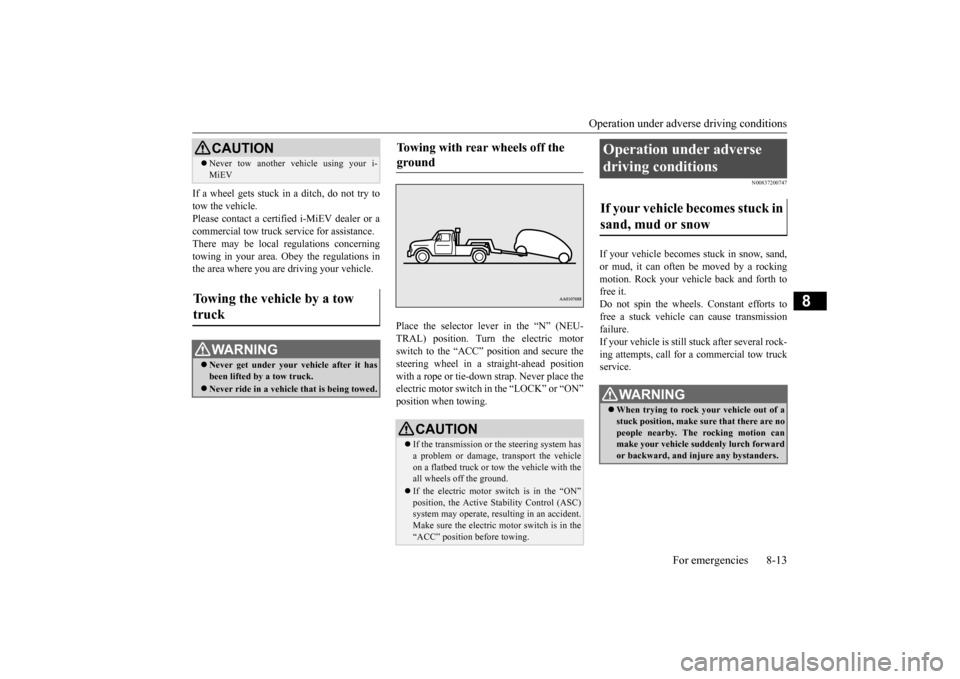
Place the selector lever in the “N” (NEU- TRAL) position. Turn the electric motorswitch to the “ACC” position and secure the steering wheel in a st
raight-ahead position
with a rope or tie-down strap. Never place theelectric motor switch in the “LOCK” or “ON” position when towing.
N00837200747
If your vehicle becomes stuck in snow, sand, or mud, it can often be moved by a rocking motion. Rock your vehicle back and forth to free it.Do not spin the wheels. Constant efforts to free a stuck vehicle can cause transmission failure.If your vehicle is still
stuck after several rock-
ing attempts, call for a commercial tow truck service.
Never tow another ve
hicle using your i-
MiEV
Towing the vehicle by a tow truck
WA R N I N G Never get under your vehicle after it has been lifted by a tow truck. Never ride in a vehicl
e that is being towed.
CAUTION
Towing with rear wheels off the ground
CAUTION If the transmission or the steering system has a problem or damage,
transport the vehicle
on a flatbed truck or to
w the vehicle with the
all wheels off the ground. If the electric motor switch is in the “ON” position, the Active St
ability Control (ASC)
system may operate, resu
lting in an accident.
Make sure the electric motor switch is in the “ACC” position before towing.
Operation under adverse driving conditions If your vehicle becomes stuck in sand, mud or snow
WA R N I N G When trying to rock
your vehicle out of a
stuck position, make sure that there are no people nearby. The rocking motion canmake your vehicle suddenly lurch forward or backward, and inju
re any bystanders.
BK0209800US.book 13 ページ 2014年1月14日 火曜日 午前9時26分
Page 211 of 262
Operation under adverse driving conditions 8-14 For emergencies
8
When driving on a road covered with snow or ice, use snow tires. Tire chains cannot be used on your vehicle. There may be state or local regulations aboutusing snow tires. Always check the regu- lations in your local area before using them. Refer to the section entitled “Snowtires” on page 9-15 and “Tire chains” on page 9-16. Drive slowly. Do not make sudden starts or stops, sharp turns, or slam on the brakes. Allow extra distance
between your vehi-
cle and the vehicle in front of you, and avoid sudden braking. If a skid occurs when the accelerator pedal is depressed, take your foot off the pedal. Steer gently in the direction of theskid. Your vehicle is equippe
d with an anti-lock
braking system (ABS), hold the brakepedal down firmly and
keep it depressed.
Do not pump the brake pedal which will result in reduced braking performance. After parking on snowy or icy road, it may be difficult to move your vehicle due to freeze-up of the brake. Depress theaccelerator pedal little by little to move the vehicle after confirming safety of the vehicle.
Drive as slow as possible when driving on bumpy or rutted roads or over potholesetc.
On wet roads
CAUTION Do not drive on a flooded road. If you drive on a flooded road, not only the electric motorunit stops but also a fail
ure like electric leak-
age or short circuit may occur. If you inevitably had to run on a floodedroad and the vehicle was exposed to water, be sure to have your vehicle inspected by a certified i-MiEV dealer. When driving in rain, on water-covered roads, or through a car wash, water could getinto the brake discs and make them fail tem- porarily. In such cases, lightly press the brake pedal to see if they are working prop-erly. If they are not, press the pedal lightly several times while driving to dry the brake pads or linings, then check them again. When driving in rain, a layer of water may form between the tires and the road surface(aquaplaning). This l
oosens your tires’ grip
on the road, making it difficult to steer or brake properly. When driving on a wet road:• Drive your vehicle at a safe speed.• Do not drive on worn tires.• Always keep the tires at the correct infla-tion pressures.
On snowy or icy roads
CAUTION Do not depress the acce
lerator pedal rapidly.
The vehicle could start moving when itbreaks free from the ice, possibly resulting inan accident.
On a bumpy or rutted road
CAUTION Driving on bumpy, rutted roads or over pot- holes can damage the tires and wheels. Wheels with low-profiles tires or under- inflated tires are especially at risk for dam-age. The vehicle’s body, bumper, muffler and other parts may be dama
ged if the vehicle is:
• driven over a step (for example, at the entrance or exit of a parking lot);• parked too closely against a curb or parkingblock, or by the side of a road with curb-stones;• driven on a steep slope.
BK0209800US.book 14 ページ 2014年1月14日 火曜日 午前9時26分
Page 224 of 262

Tires
Vehicle care and maintenance 9-13
9
code may only be on one side. Look for the TIN on the outboard side of tires as mounted on the vehicle. If the TIN is not found on the outboard sidethen you will find it on the inboard side of the tire. EXAMPLE: DOT MA L9 ABCD 1504
The treadwear grade is a comparative rating based on the wear rate of the tire when testedunder controlled conditions on a specified government test course
. For example, a tire
graded 150 would wear one and one-half (11/2) times as well on the government course
as a tire graded 100. The relative performance of tires depends upon the actual conditions of their use, however, and may depart signifi-cantly from the norm due to variations in driving habits, service practices and differ- ences in road characteristics and climate. The traction grades, from highest to lowest, are AA, A, B and C. Those grades represent the tire’s ability to stop on wet pavement as measured under contro
lled conditions on
specified government te
st surfaces of asphalt
and concrete. A tire marked C may have poor traction performance. The temperature grades are A (the highest), B and C, representing the ti
re’s resistance to the
generation of heat and it
s ability to dissipate
heat when tested u
nder controlled conditions
on a specified indoor
laboratory test wheel.
Sustained high temperature can cause the material of the tire to
degenerate and reduce
tire life, and excessive temperature can lead to sudden tire failure. The grade C corre-sponds to a level of
performance which all
passenger car tires must
meet under the Fed-
eral Motor Vehicle Safety Standard No. 109.Grades B and A represent higher levels of performance on the laboratory test wheel than the minimum required by law.
N00939300873
Proper tire inflation pre
ssure is essential for
the safe and satisfac
tory operation of your
vehicle. The wrong tire pressure will cause problems in three major areas:
DOT
Department of Transporta- tion This symbol certifies that the tire is in compliance with the U.S.
Department
of Transportation tire safety standards, and is approved for highway use.
MA
Code representing the tire manufacturing location. (2 digits)
L9 ABCD
Code representing the tire size. (2 digits)Code used by tire manufac- turer. (1 to 4 digits)
15
Number representing the week in which the tire was manufactured. (2 digits)
04
Number representing the year in which the tire was manufactured. (2 digits)
Treadwear, Traction and Temper- ature Grades Treadwear Tr a c t i o n
TemperatureTire inflation pressures
BK0209800US.book 13 ページ 2014年1月14日 火曜日 午前9時26分