lock MITSUBISHI iMiEV 2014 1.G Manual Online
[x] Cancel search | Manufacturer: MITSUBISHI, Model Year: 2014, Model line: iMiEV, Model: MITSUBISHI iMiEV 2014 1.GPages: 262, PDF Size: 26.84 MB
Page 196 of 262
General information about your radio
Comfort controls 7-23
7
4. When the time is set, press the clock but- ton to stop the clock display from flash-ing.
N00733900439
Your vehicle’s radio receives both AM andFM stations. The quality of your reception is affected by distance, obstacles, a
nd signal interference.
This radio complies with
Part 15 of Federal
Communications Commission (FCC) Rules (for vehicles sold in U.S.A.). Operation is subject to the following conditions: The device may not cause harmful inter- ference. This device must ac
cept any interference
recieved, including interference that maycause undesirable operation.
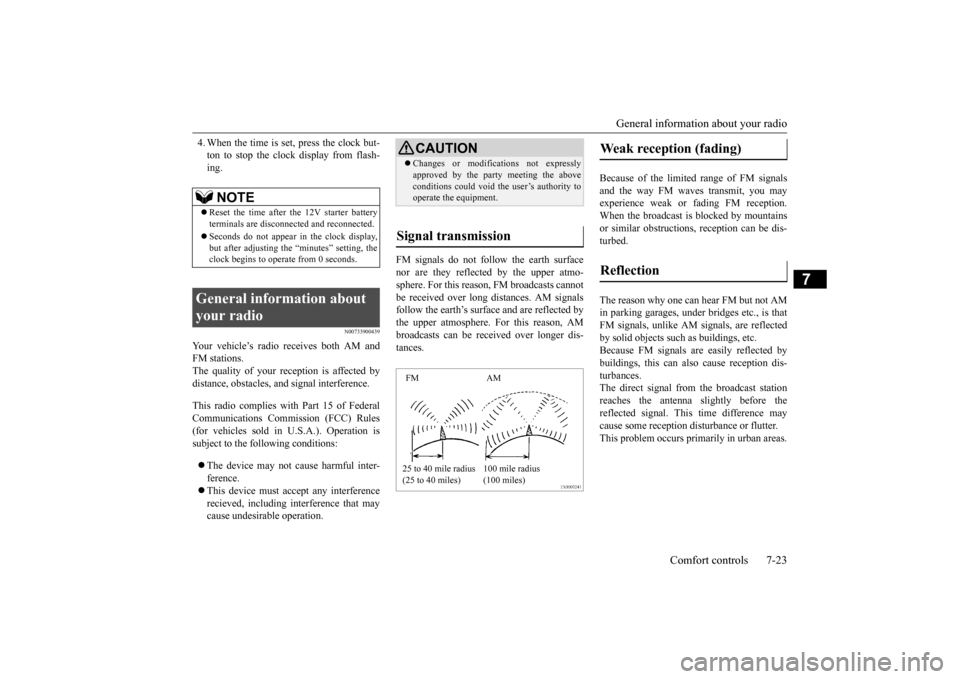
FM signals do not follow the earth surface nor are they reflected by the upper atmo-sphere. For this reason
, FM broadcasts cannot
be received over long
distances. AM signals
follow the earth’s surface and are reflected bythe upper atmosphere. For this reason, AM broadcasts can be rece
ived over longer dis-
tances.
Because of the limited
range of FM signals
and the way FM waves transmit, you may experience weak or
fading FM reception.
When the broadcast is blocked by mountains or similar obstructions,
reception can be dis-
turbed. The reason why one can hear FM but not AM in parking garages, under
bridges etc., is that
FM signals, unlike AM
signals, are reflected
by solid objects such
as buildings, etc.
Because FM signals ar
e easily reflected by
buildings, this can also cause reception dis- turbances.The direct signal from
the broadcast station
reaches the antenna sl
ightly before the
reflected signal. This
time difference may
cause some reception di
sturbance or flutter.
This problem occurs primarily in urban areas.
NOTE
Reset the time after the 12V starter battery terminals are disconnect
ed and reconnected.
Seconds do not appear
in the clock display,
but after adjusting the “minutes” setting, theclock begins to operate from 0 seconds.
General information about your radio
CAUTION Changes or modifica
tions not expressly
approved by the party meeting the aboveconditions could void the user’s authority tooperate the equipment.
Signal transmission FM AM 25 to 40 mile radius (25 to 40 miles)
100 mile radius (100 miles)
Weak reception (fading) Reflection
BK0209800US.book 23 ページ 2014年1月14日 火曜日 午前9時26分
Page 199 of 262
If the vehicle breaks down 8-2 For emergencies
8
N00836300220
If your vehicle breaks down on the road, move to the shoulder and turn on the hazard warning flashers. If there is no shoulder, orthe shoulder is not safe, drive in the right lane slowly, with the hazard lights flashing, until you come to a safe stopping place. Keep theflashers flashing. If the ready indicator light goes out while driving, the brakes a
nd steering will continue
to work, but without power assist, so more effort will be required
for braking and steer-
ing. Stop the vehicle on the shoulder of the road and turn on the hazard warning flashers.
N00836400742
If the electric motor unit cannot be energizedbecause the 12V starter battery is weak or dead, you can start it with the battery fromanother vehicle using jumper cables.
1. Take off any metal jewelry such as watch bands or bracelets
that might make an
accidental electrical contact. 2. Position the vehi
cles close enough
together so that the jumper cables can reach, but be sure the vehicles are nottouching each other.
3. Set the parking brake firmly on your vehi- cle and move the selector lever into the“P” (PARK) position. 4. Set the parking brake firmly on the other vehicle. Put the automatic transaxle in “P”(PARK) or the manual transaxle in “N” (Neutral). 5. Turn the ignition switch (the electricmotor switch) on each vehicle to the “LOCK” position. 6. Remove the battery
cover, and then make
sure your 12V starter
battery electrolyte is
at the proper level. (Refer to “Checking 12V starter battery electrolyte level” on page 9-8.)
If the vehicle breaks down Jump-starting
WA R N I N G To reduce the risk of igniting flammable gas that may be emitted from the 12V starter battery, carefully read this section before jump-starting the vehicle.
Do not try to start the electric motor unit by pushing or towing the vehicle. This cancause an accident re
sulting in serious
injury or death and
can damage the vehi-
cle.CAUTION Do not attempt jump st
arting the 12V starter
battery while the main
drive lithium-ion bat-
tery is being charged. Doing so could dam-age the vehicle or charging equipment.NOTE
Do not use jumper cables if they have dam- age or corrosion.CAUTION Check the other vehicle. It must have a 12V battery. If the other system is not 12V, both systems can be damaged.WA R N I N G
NOTE
Turn off all lights, heat
er, and othe
r electrical
loads. This will
help avoid sparks.
WA R N I N GIf the electrolyte fluid is not visible, or looks frozen, DO NOT ATTEMPT JUMPSTARTING!! The battery might spli
t open or explode if
the temperature is below the freezing point or if it is not filled to the properlevel.
BK0209800US.book 2 ページ 2014年1月14日 火曜日 午前9時26分
Page 201 of 262
Jump-starting 8-4 For emergencies
8
11. Keep the jumper cables to each vehicle
connected and turn
the electric motor
switch of your vehicle to the “LOCK” position.
12. Charge the main drive lithium-ion battery
by regular charging. The 12V starter bat-tery will automatically charge while the main drive lithium-ion battery is charging. (Refer to “Regular charging” on page3-15.)
13. When the charging indicator on the instru-
ment cluster is ill
uminated, stop the
engine of the other
vehicle and disconnect
the jumper cables in the reverse order.
14. Charge the main dr
ive lithium-ion battery
for more than 1 hour.
15. Disconnect the charging cable.
(Refer to “Regular charging” on page 3-15.)
16. Turn the electric motor switch to the
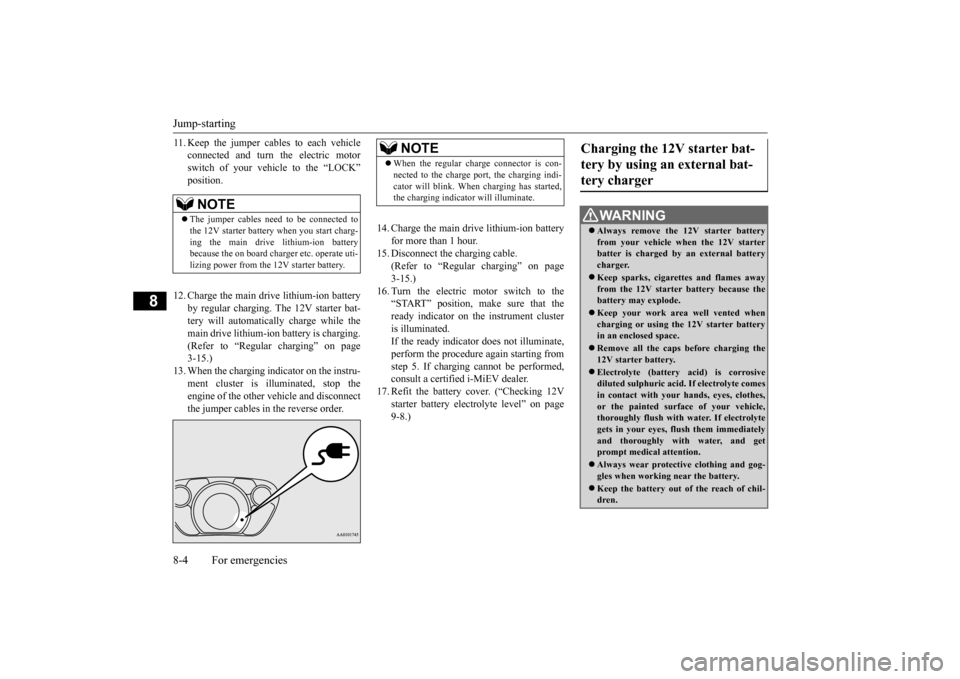
“START” position, make sure that the ready indicator on the instrument cluster is illuminated.If the ready indicator
does not illuminate,
perform the procedure again starting from step 5. If charging
cannot be performed,
consult a certified i-MiEV dealer.
17. Refit the battery cover. (“Checking 12V
starter battery electr
olyte level” on page
9-8.)
NOTE
The jumper cables need to be connected to the 12V starter battery when you start charg-ing the main drive lithium-ion battery because the on board char
ger etc. operate uti-
lizing power from the
12V starter battery.
NOTE
When the regular charge connector is con- nected to the charge port, the charging indi-cator will blink. When charging has started,the charging indicator will illuminate.
Charging the 12V starter bat- tery by using an external bat-tery charger
WA R N I N G Always remove the
12V starter battery
from your vehicle wh
en the 12V starter
batter is charged by an external battery charger. Keep sparks, cigare
ttes and flames away
from the 12V starter battery because thebattery may explode. Keep your work area well vented when charging or using the 12V starter battery in an enclosed space. Remove all the caps before charging the 12V starter battery. Electrolyte (battery acid) is corrosive diluted sulphuric acid.
If electrolyte comes
in contact with your hands, eyes, clothes,or the painted surf
ace of your vehicle,
thoroughly flush with water. If electrolyte gets in your eyes, flush them immediatelyand thoroughly with
water, and get
prompt medical attention. Always wear protective clothing and gog- gles when working near the battery. Keep the battery out of the reach of chil- dren.
BK0209800US.book 4 ページ 2014年1月14日 火曜日 午前9時26分
Page 202 of 262
Tire repair kit
For emergencies 8-5
8
If you drive your vehicle with a low battery charge, after the electric motor unit has beenstarted by using jumper
cables, it can cause
the anti-lock braking sy
stem warning light to
illuminate. This is only due to the low batteryvoltage. It is not a problem with the brake system. If this happens, fully charge the 12V starter battery and ensure the charging system is operating properly.
N00836600366
This vehicle is equipped
with a tire repair kit
which can be used to repair a minor puncture in tread area caused by
a nail, screw or simi-
lar object. A spare tire
is not provided with
this vehicle.
N00837700016
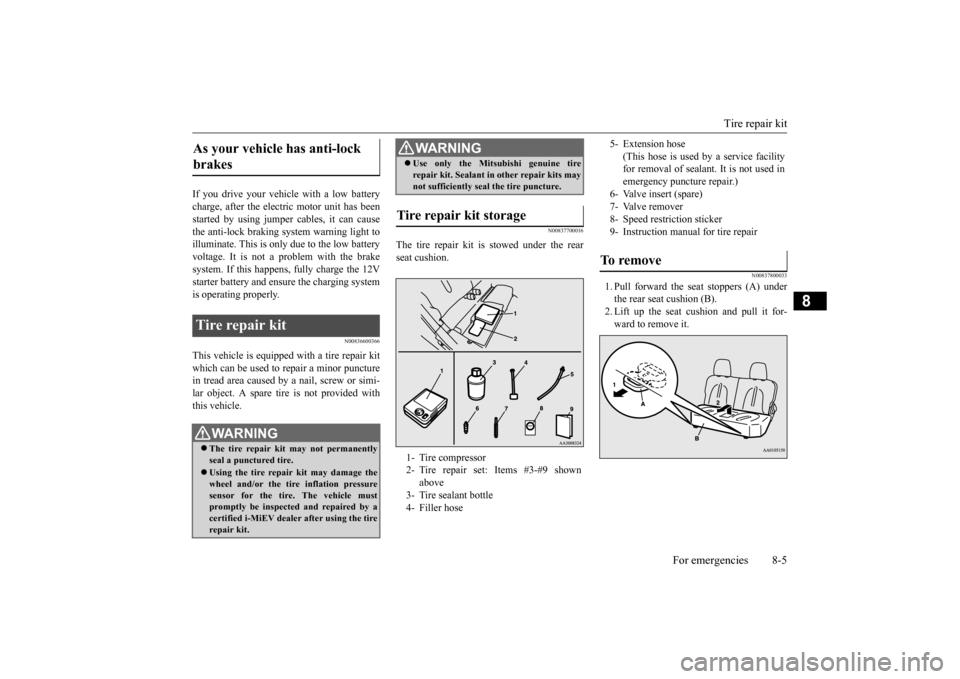
The tire repair kit is
stowed under the rear
seat cushion.
N00837800033
1. Pull forward the seat stoppers (A) underthe rear seat cushion (B). 2. Lift up the seat
cushion and pull it for-
ward to remove it.
As your vehicle has anti-lock brakes Tire repair kit
WA R N I N G The tire repair kit may not permanently seal a punctured tire. Using the tire repair
kit may damage the
wheel and/or the tire inflation pressuresensor for the tire. The vehicle must promptly be inspected and repaired by a certified i-MiEV dealer after using the tirerepair kit.
Use only the Mitsubishi genuine tire repair kit. Sealant in other repair kits maynot sufficiently seal the tire puncture.
Tire repair kit storage 1- Tire compressor 2- Tire repair set: Items #3-#9 shown
above
3- Tire sealant bottle4- Filler hoseWA R N I N G
5- Extension hose
(This hose is used
by a service facility
for removal of sealant. It is not used inemergency puncture repair.)
6- Valve insert (spare) 7- Valve remover8- Speed restriction sticker 9- Instruction manual for tire repairTo remove
BK0209800US.book 5 ページ 2014年1月14日 火曜日 午前9時26分
Page 204 of 262
Tire repair kit
For emergencies 8-7
8
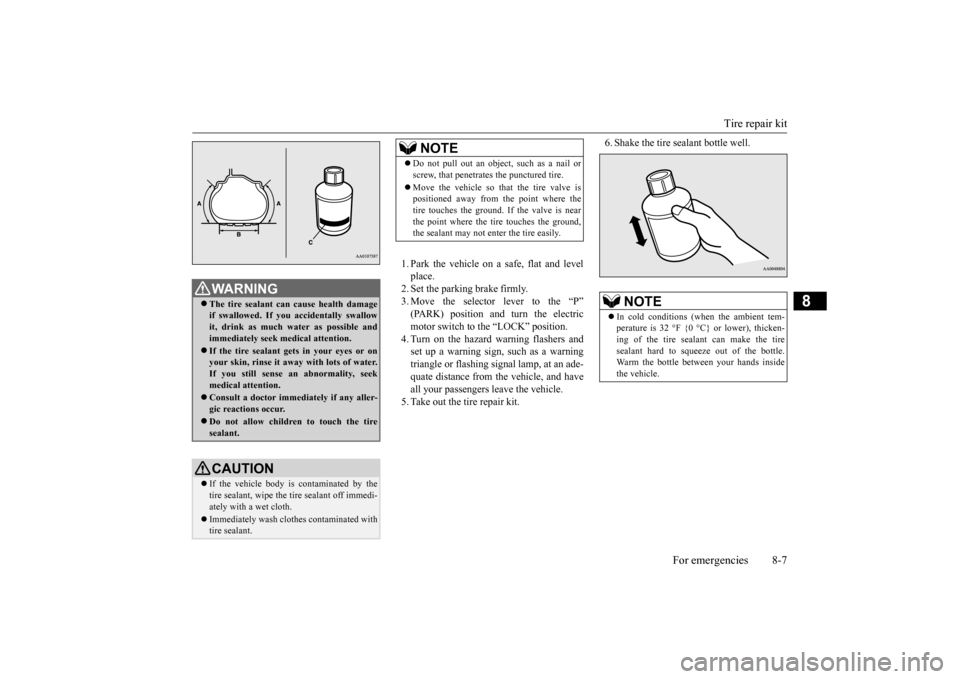
1. Park the vehicle on a
safe, flat and level
place. 2. Set the parking brake firmly. 3. Move the selector
lever to the “P”
(PARK) position and turn the electric motor switch to the “LOCK” position. 4. Turn on the hazard warning flashers andset up a warning sign, such as a warning triangle or flashing signal lamp, at an ade- quate distance from the vehicle, and haveall your passengers leave the vehicle. 5. Take out the tire repair kit.
6. Shake the tire sealant bottle well.
WA R N I N G The tire sealant can
cause health damage
if swallowed. If you
accidentally swallow
it, drink as much water as possible and immediately seek medical attention. If the tire sealant gets in your eyes or on your skin, rinse it away with lots of water. If you still sense an
abnormality, seek
medical attention. Consult a doctor immediately if any aller- gic reactions occur. Do not allow children to touch the tire sealant.CAUTION If the vehicle body is contaminated by the tire sealant, wipe the tire sealant off immedi- ately with a wet cloth. Immediately wash clothes contaminated with tire sealant.
NOTE
Do not pull out an object, such as a nail or screw, that penetrat
es the punctured tire.
Move the vehicle so that the tire valve is positioned away from the point where the tire touches the ground. If the valve is nearthe point where the tire touches the ground, the sealant may not enter the tire easily.
NOTE
In cold conditions (when the ambient tem- perature is 32 °F {0 °C} or lower), thicken- ing of the tire sealan
t can make the tire
sealant hard to squeeze out of the bottle. Warm the bottle between your hands inside the vehicle.
BK0209800US.book 7 ページ 2014年1月14日 火曜日 午前9時26分
Page 205 of 262
Tire repair kit 8-8 For emergencies
8
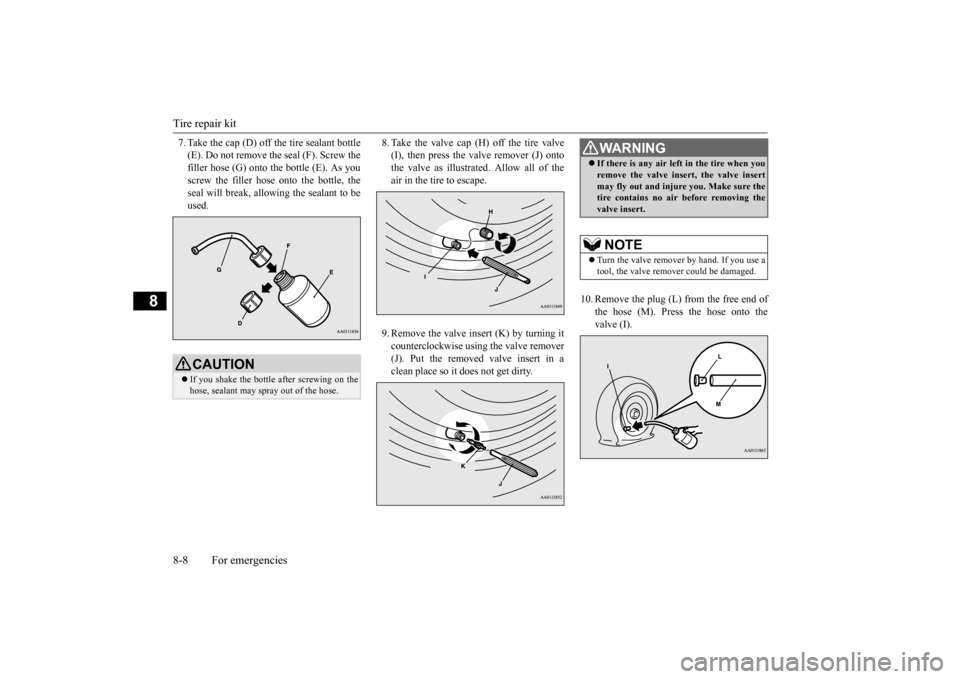
7. Take the cap (D) off the tire sealant bottle (E). Do not remove the seal (F). Screw thefiller hose (G) onto th
e bottle (E). As you
screw the filler hose onto the bottle, the seal will break, allowing the sealant to beused.
8. Take the valve cap (H) off the tire valve (I), then press the valve remover (J) ontothe valve as illustrated. Allow all of the air in the tire to escape. 9. Remove the valve insert (K) by turning it counterclockwise usi
ng the valve remover
(J). Put the removed valve insert in a clean place so it
does not get dirty.
10. Remove the plug (L) from the free end of
the hose (M). Press the hose onto the valve (I).
CAUTION If you shake the bottle after screwing on the hose, sealant may spray out of the hose.
WA R N I N G If there is any air left in the tire when you remove the valve inse
rt, the valve insert
may fly out and injure you. Make sure thetire contains no air before removing the valve insert.NOTE
Turn the valve remover by hand. If you use a tool, the valve remove
r could be damaged.
BK0209800US.book 8 ページ 2014年1月14日 火曜日 午前9時26分
Page 210 of 262
Operation under adverse driving conditions
For emergencies 8-13
8
If a wheel gets stuck in
a ditch, do not try to
tow the vehicle. Please contact a certifie
d i-MiEV dealer or a
commercial tow truck service for assistance.There may be local re
gulations concerning
towing in your area. Obey the regulations in the area where you are driving your vehicle.
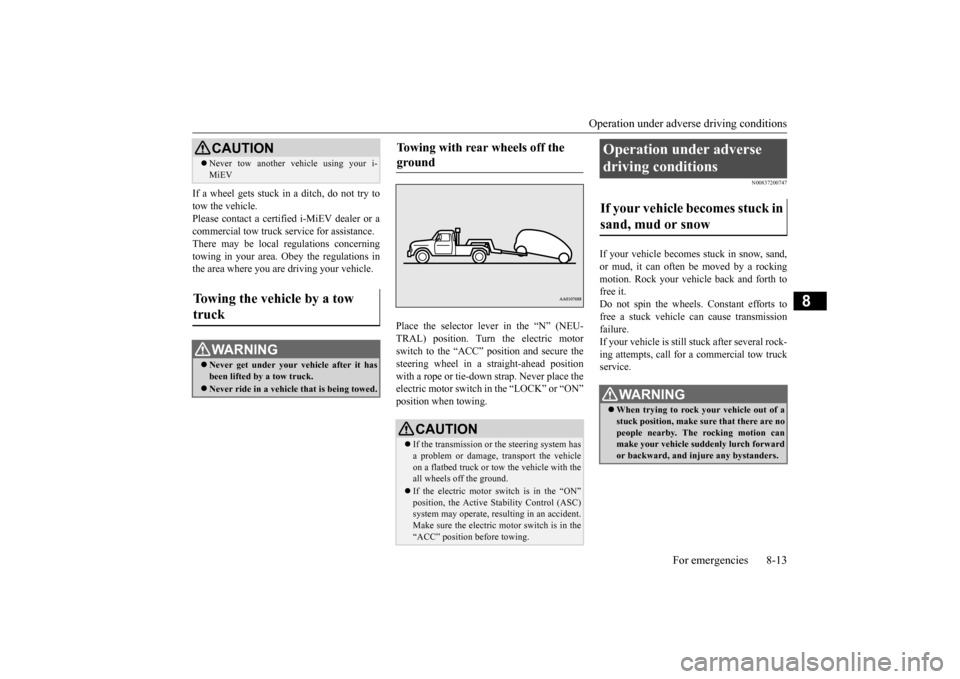
Place the selector lever in the “N” (NEU- TRAL) position. Turn the electric motorswitch to the “ACC” position and secure the steering wheel in a st
raight-ahead position
with a rope or tie-down strap. Never place theelectric motor switch in the “LOCK” or “ON” position when towing.
N00837200747
If your vehicle becomes stuck in snow, sand, or mud, it can often be moved by a rocking motion. Rock your vehicle back and forth to free it.Do not spin the wheels. Constant efforts to free a stuck vehicle can cause transmission failure.If your vehicle is still
stuck after several rock-
ing attempts, call for a commercial tow truck service.
Never tow another ve
hicle using your i-
MiEV
Towing the vehicle by a tow truck
WA R N I N G Never get under your vehicle after it has been lifted by a tow truck. Never ride in a vehicl
e that is being towed.
CAUTION
Towing with rear wheels off the ground
CAUTION If the transmission or the steering system has a problem or damage,
transport the vehicle
on a flatbed truck or to
w the vehicle with the
all wheels off the ground. If the electric motor switch is in the “ON” position, the Active St
ability Control (ASC)
system may operate, resu
lting in an accident.
Make sure the electric motor switch is in the “ACC” position before towing.
Operation under adverse driving conditions If your vehicle becomes stuck in sand, mud or snow
WA R N I N G When trying to rock
your vehicle out of a
stuck position, make sure that there are no people nearby. The rocking motion canmake your vehicle suddenly lurch forward or backward, and inju
re any bystanders.
BK0209800US.book 13 ページ 2014年1月14日 火曜日 午前9時26分
Page 211 of 262
Operation under adverse driving conditions 8-14 For emergencies
8
When driving on a road covered with snow or ice, use snow tires. Tire chains cannot be used on your vehicle. There may be state or local regulations aboutusing snow tires. Always check the regu- lations in your local area before using them. Refer to the section entitled “Snowtires” on page 9-15 and “Tire chains” on page 9-16. Drive slowly. Do not make sudden starts or stops, sharp turns, or slam on the brakes. Allow extra distance
between your vehi-
cle and the vehicle in front of you, and avoid sudden braking. If a skid occurs when the accelerator pedal is depressed, take your foot off the pedal. Steer gently in the direction of theskid. Your vehicle is equippe
d with an anti-lock
braking system (ABS), hold the brakepedal down firmly and
keep it depressed.
Do not pump the brake pedal which will result in reduced braking performance. After parking on snowy or icy road, it may be difficult to move your vehicle due to freeze-up of the brake. Depress theaccelerator pedal little by little to move the vehicle after confirming safety of the vehicle.
Drive as slow as possible when driving on bumpy or rutted roads or over potholesetc.
On wet roads
CAUTION Do not drive on a flooded road. If you drive on a flooded road, not only the electric motorunit stops but also a fail
ure like electric leak-
age or short circuit may occur. If you inevitably had to run on a floodedroad and the vehicle was exposed to water, be sure to have your vehicle inspected by a certified i-MiEV dealer. When driving in rain, on water-covered roads, or through a car wash, water could getinto the brake discs and make them fail tem- porarily. In such cases, lightly press the brake pedal to see if they are working prop-erly. If they are not, press the pedal lightly several times while driving to dry the brake pads or linings, then check them again. When driving in rain, a layer of water may form between the tires and the road surface(aquaplaning). This l
oosens your tires’ grip
on the road, making it difficult to steer or brake properly. When driving on a wet road:• Drive your vehicle at a safe speed.• Do not drive on worn tires.• Always keep the tires at the correct infla-tion pressures.
On snowy or icy roads
CAUTION Do not depress the acce
lerator pedal rapidly.
The vehicle could start moving when itbreaks free from the ice, possibly resulting inan accident.
On a bumpy or rutted road
CAUTION Driving on bumpy, rutted roads or over pot- holes can damage the tires and wheels. Wheels with low-profiles tires or under- inflated tires are especially at risk for dam-age. The vehicle’s body, bumper, muffler and other parts may be dama
ged if the vehicle is:
• driven over a step (for example, at the entrance or exit of a parking lot);• parked too closely against a curb or parkingblock, or by the side of a road with curb-stones;• driven on a steep slope.
BK0209800US.book 14 ページ 2014年1月14日 火曜日 午前9時26分
Page 213 of 262
Service precautions 9-2 Vehicle care and maintenance
9
N00937301414
Taking regular care of your vehicle helps pre- serve its value and appe
arance as long as pos-
sible.This vehicle is an electric vehicle and is equipped with many high-voltage compo- nents. Refer to “High-voltage components”on page 3-30. You can do some of the maintenance work described in this manual by yourself, but the rest must be performed
only by a certified i-
MiEV dealer.If you discover a malfunction or other prob- lem, have it corrected by a certified i-MiEV dealer.Also follow the instru
ctions and take note of
the precautions for each procedure.
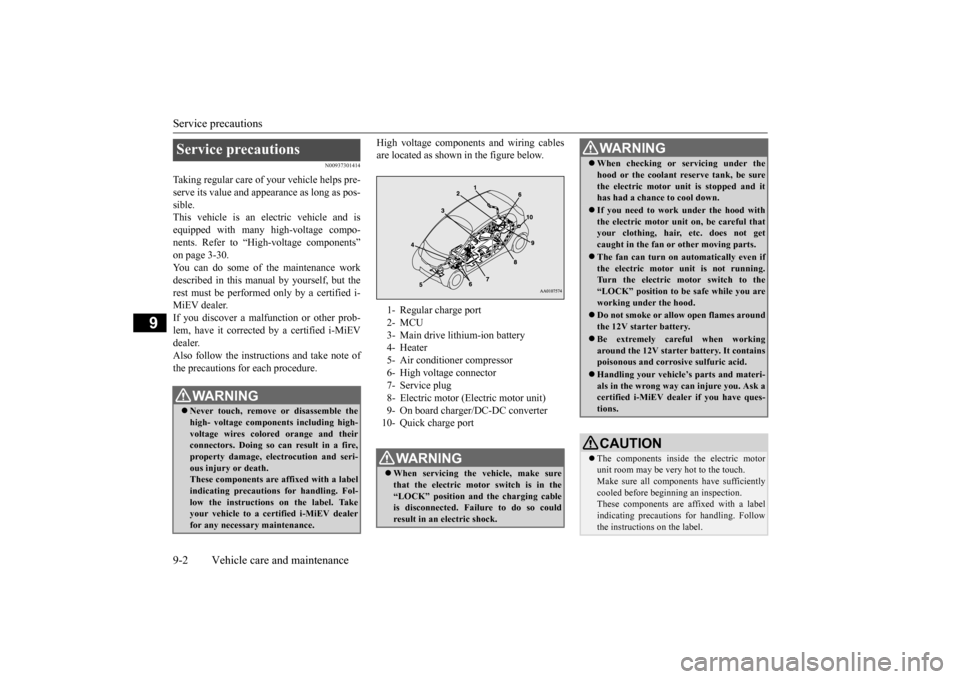
High voltage components and wiring cables are located as shown in the figure below.
Service precautions
WA R N I N G Never touch, remove or disassemble the high- voltage componen
ts including high-
voltage wires colore
d orange and their
connectors. Doing so can result in a fire, property damage, elec
trocution and seri-
ous injury or death. These components are affixed with a label indicating precautions for handling. Fol-low the instructions on the label. Take your vehicle to a cert
ified i-MiEV dealer
for any necessary maintenance.
1- Regular charge port 2- MCU 3- Main drive lithium-ion battery4- Heater 5- Air conditioner compressor 6- High voltage connector7- Service plug 8- Electric motor (Electric motor unit) 9- On board charger/DC-DC converter10- Quick charge port
WA R N I N G When servicing the vehicle, make sure that the electric motor switch is in the“LOCK” position and
the charging cable
is disconnected. Failure to do so could result in an electric shock.
When checking or servicing under the hood or the coolant reserve tank, be surethe electric motor unit is stopped and ithas had a chance to cool down. If you need to work
under the hood with
the electric motor unit on, be careful that your clothing, hair, etc. does not get caught in the fan or other moving parts. The fan can turn on automatically even if the electric motor unit is not running.Turn the electric motor switch to the “LOCK” position to be
safe while you are
working under the hood. Do not smoke or allow open flames around the 12V starter battery. Be extremely careful when working around the 12V starter battery. It containspoisonous and corros
ive sulfuric acid.
Handling your vehicle’s parts and materi- als in the wrong way can injure you. Ask a certified i-MiEV dealer
if you have ques-
tions. CAUTION The components inside
the electric motor
unit room may be very
hot to the touch.
Make sure all components have sufficientlycooled before beginning an inspection. These components are affixed with a label indicating precautions
for handling. Follow
the instructions on the label.WA R N I N G
BK0209800US.book 2 ページ 2014年1月14日 火曜日 午前9時26分
Page 214 of 262
Hood
Vehicle care and maintenance 9-3
9
Have you purchased the Mitsubishi Motors Diamond Care Protec
tion Plan? The Plan
supplements your new
vehicle warranties.
See a certified i-MiEV dealer for details.
N00937500549
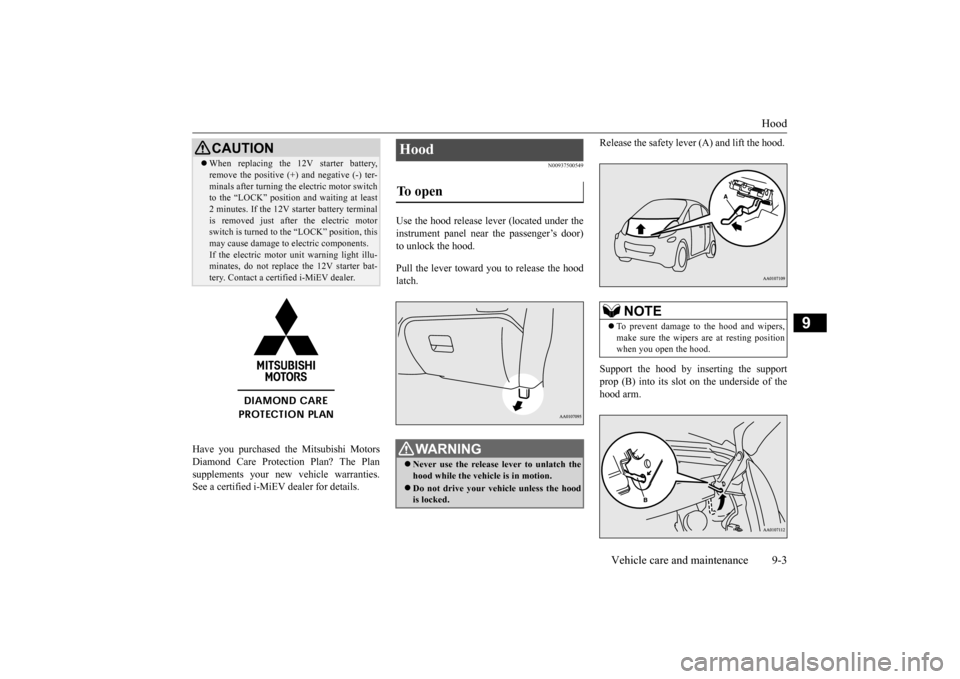
Use the hood release lever (located under the instrument panel near the passenger’s door) to unlock the hood. Pull the lever toward you to release the hood latch.
Release the safety leve
r (A) and lift the hood.
Support the hood by inserting the support prop (B) into its slot on the underside of the hood arm.
When replacing the
12V starter battery,
remove the positive (+
) and negative (-) ter-
minals after turning the electric motor switchto the “LOCK” position
and waiting at least
2 minutes. If the 12V st
arter battery terminal
is removed just after the electric motorswitch is turned to the “LOCK” position, this may cause damage to
electric components.
If the electric motor unit warning light illu-minates, do not replac
e the 12V starter bat-
tery. Contact a certified i-MiEV dealer.CAUTION
Hood To open
WA R N I N G Never use the release lever to unlatch the hood while the vehicle is in motion. Do not drive your vehicle unless the hood is locked.
NOTE
To prevent damage to the hood and wipers, make sure the wipers
are at resting position
when you open the hood.
BK0209800US.book 3 ページ 2014年1月14日 火曜日 午前9時26分