ECU MITSUBISHI L200 2004 Owner's Manual (in English)
[x] Cancel search | Manufacturer: MITSUBISHI, Model Year: 2004, Model line: L200, Model: MITSUBISHI L200 2004Pages: 264, PDF Size: 4.14 MB
Page 14 of 264
GENERAL INFORMATION
Installation of accessories
EB24A-E
Before fitting any accessories, please con-
sult your authorized MITSUBISHI dealer.
(1) The installation of accessories, op-
tional parts, etc., should only be car-
ried out within the limits prescribed by
law in your country, and in accord-
ance with the guidelines and warn-
ings contained within the documents
accompanying this vehicle.
Only MITSUBISHI approved acces-
sories should be fitted to your vehicle.
(2) Improper installation of electrical
parts could cause fire, please refer to
the Modification/Alteration to the elec-
trical or fuel systems section within
this manual.
(3) When using a communication system
such as a cellular phone or a radio set
inside the vehicle, a separate external
antenna must be fitted. When a
cellular phone or a radio set is used
by using an internal antenna alone, it
may interfere with the vehicle’s elec-
trical system and adversely affect
safe operation of the vehicle.
(4) Tyres and wheels which do not meet
specifications must not be used.
Refer to the “Specification” section for
information regarding wheel and tyre
sizes.Consider also that there basically exists
no liability on the part of the appraiser
or the official. Only in the case of parts
(MITSUBISHI original replacement or ex-
change parts as well as MITSUBISHI
accessories) that are recommended and
released by an authorized MITSUBISHI
dealer and that are attached or installed
by an authorized MITSUBISHI dealer can
you assume, that optimal safety has been
provided. The same also pertains to modi-
fications of MITSUBISHI vehicles with re-
spect to the production specifications. For
your own safety, in such cases as well,
you should only undertake modifications
according to the recommendations of an
authorized MITSUBISHI dealer. (5) Do not fail to read all relative instruc-
tions before first putting into service
the attachment or installation of
accessories, parts or other modifica-
tions to the vehicle!
Important points!
Due to the large number of accessory and
replacement parts of different manufac-
turers in the market, it is not possible, not
only for MITSUBISHI, but also for an au-
thorized MITSUBISHI dealer, to check
whether the attachment or installation of
such parts affects the driving safety of
your MITSUBISHI-vehicle.
Even when such parts are officially au-
thorized, for example by a general opera-
tors “permit” (an appraisal for the part) or
through the execution of the part in an offi-
cially approved manner of construction, or
when a single operation permit following
the attachment or installation of such
parts, it cannot be deduced from that
alone, that the driving safety of your vehi-
cles has not been affected.
1-14
01engL2_240082_4 22-01-2004 12:58 Page 1-14
Page 16 of 264
GENERAL INFORMATION
CAUTION(2) When luggage is loaded onto
the vehicle, please make sure to
drive slowly and avoid exces-
sive manoeuvres such as sud-
den braking or quick turning.
In addition, place the luggage on
the carrier so that its weight is
distributed evenly with the heav-
iest items on the bottom. Do not
load items that are wider than
the roof carrier.
The additional weight on the
roof could heighten the vehi-
cle’s centre of gravity and affect
the vehicle's handling charac-
teristics.
As a result, driving errors or
emergency manoeuvres could
lead to loss of control and result
in an accident.
(3) Before driving and after travel-
ling a short distance, always
check the load to make sure it is
securely fastened to the roof
carrier. Check periodically dur-
ing your travel that the load re-
mains secure. If the load is not
secure, it could fall from the ve-
hicle and damage your vehicle,
another vehicle or create road
hazard.
Genuine partsEB05A-Fi
Don’t play around with substitutes.
MITSUBISHI has gone to great lengths to
bring you a superbly crafted vehicle offer-
ing the highest quality and dependability.
Don’t reduce that quality and dependability
by using substitute parts.
Always use MITSUBISHI Genuine Parts
designed and manufactured to maintain
your MITSUBISHI vehicle at top perform-
ance. The operation of vehicle compo-
nents can be less efficient in case of using
Non-Genuine Parts.
Failure to use Genuine Parts, may in-
validate any future warranty claim.
MITSUBISHI will not be liable for any mal-
function of your vehicle that may have
been caused by the use of substitute parts
in place of MITSUBISHI Genuine Parts.
At the MITSUBISHI dealer you can also
get appropriate advise and the assem-
bling of Genuine Parts will be handled pro-
fessionally.
MITSUBISHI Genuine Parts are identified
by this mark, and are available at all au-
thorized MITSUBISHI dealers. NOTE
(1) To prevent wind noise or reduction in
gas mileage, remove the roof carrier
when not in use.
(2) Before using an automatic car wash,
check with the attendant to determine
if the roof carrier should be removed.
1-16
01engL2_240082_4 22-01-2004 12:58 Page 1-16
Page 26 of 264
LOCKING AND UNLOCKING
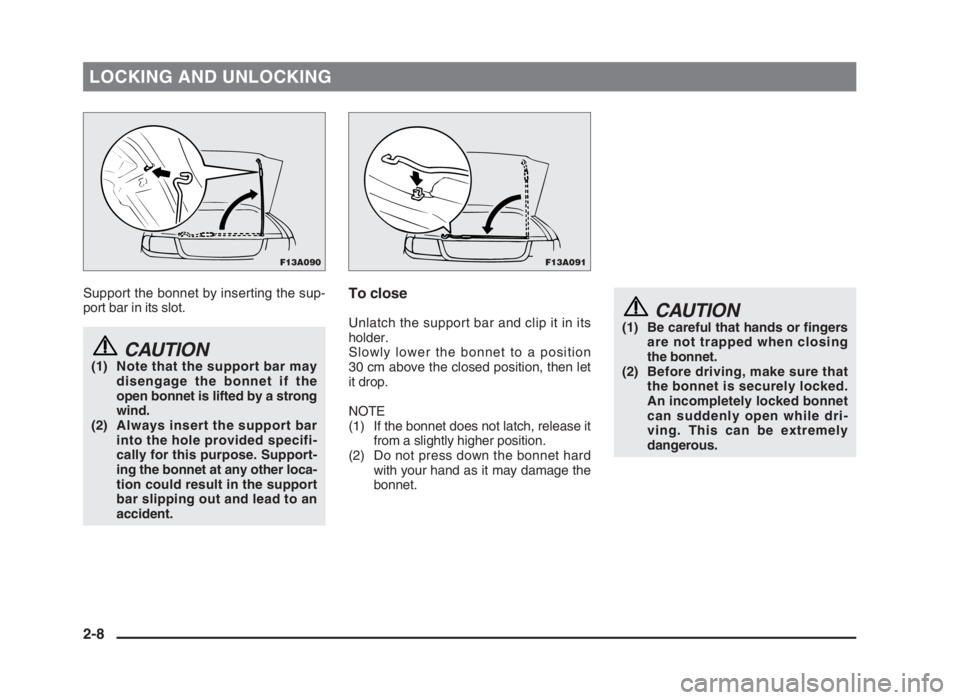
Support the bonnet by inserting the sup-
port bar in its slot.
CAUTION(1) Note that the support bar may
disengage the bonnet if the
open bonnet is lifted by a strong
wind.
(2) Always insert the support bar
into the hole provided specifi-
cally for this purpose. Support-
ing the bonnet at any other loca-
tion could result in the support
bar slipping out and lead to an
accident.
To close
Unlatch the support bar and clip it in its
holder.
Slowly lower the bonnet to a position
30 cm above the closed position, then let
it drop.
NOTE
(1) If the bonnet does not latch, release it
from a slightly higher position.
(2) Do not press down the bonnet hard
with your hand as it may damage the
bonnet.CAUTION
(1) Be careful that hands or fingers
are not trapped when closing
the bonnet.
(2) Before driving, make sure that
the bonnet is securely locked.
An incompletely locked bonnet
can suddenly open while dri-
ving. This can be extremely
dangerous.
2-8
F13A090F13A091
02engL2_240082_4 22-01-2004 12:59 Page 2-8
Page 29 of 264
LOCKING AND UNLOCKING
Safety mechanism
If a hand or head is trapped in a closing
window, the window glass will lower auto-
matically.
Nonetheless, be sure that nobody sticks
their head or hand out the window when
closing a window.
The lowered window will become opera-
tional after a few seconds.
WARNINGThe safety mechanism is cancelled
just before the window is fully
closed. This allows the window to
close completely. Therefore be es-
pecially careful that no fingers are
trapped in the window.
To close
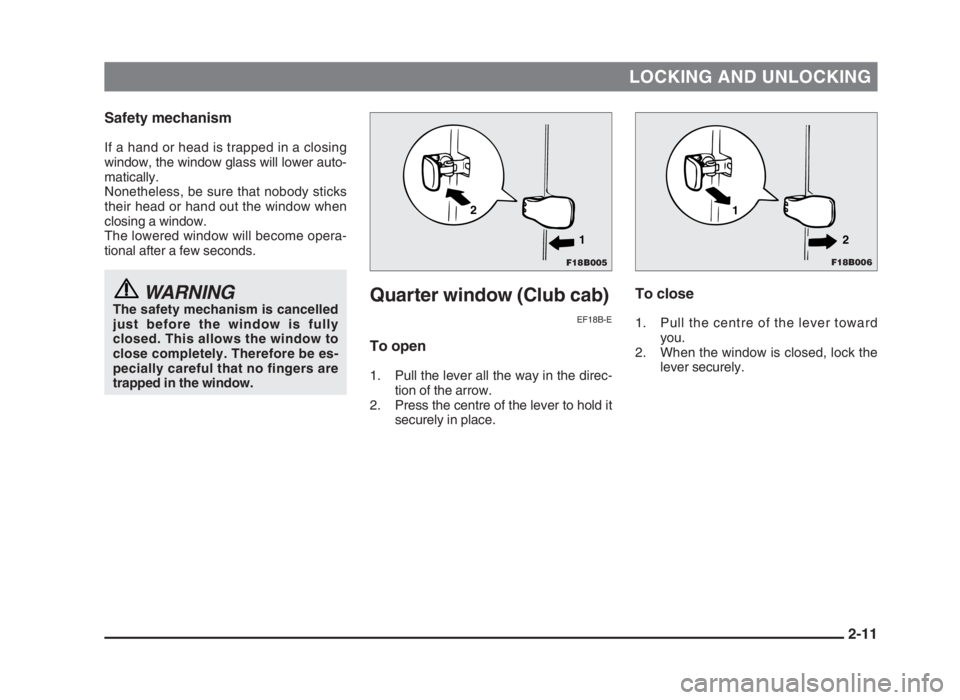
1. Pull the centre of the lever toward
you.
2. When the window is closed, lock the
lever securely.
Quarter window (Club cab)
EF18B-E
To open
1. Pull the lever all the way in the direc-
tion of the arrow.
2. Press the centre of the lever to hold it
securely in place.
2-11
F18B006
1
2
F18B005
1 2
02engL2_240082_4 22-01-2004 12:59 Page 2-11
Page 30 of 264
LOCKING AND UNLOCKING
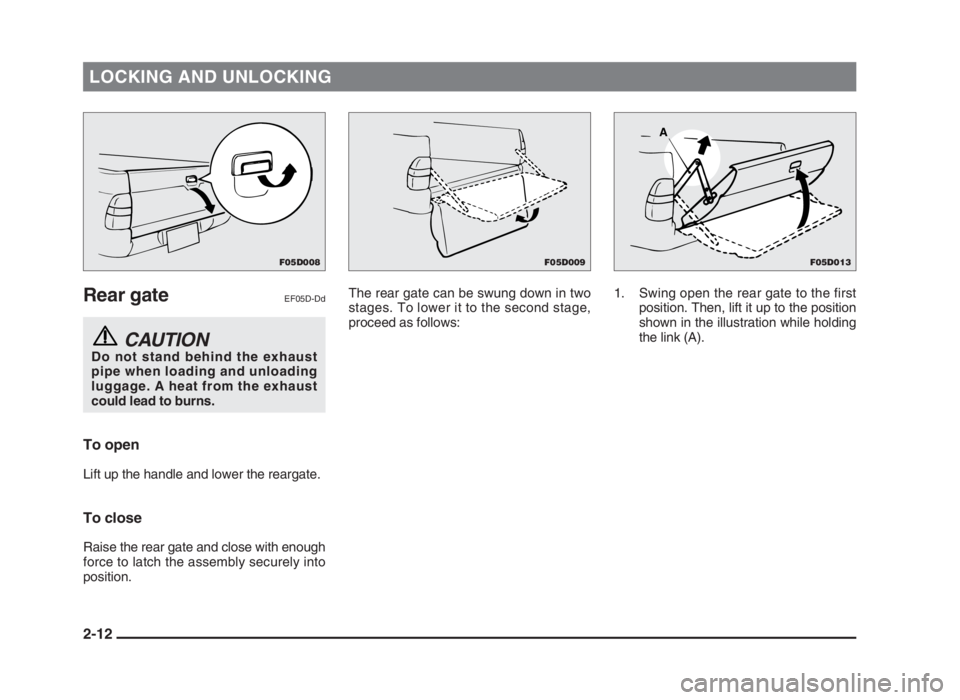
Rear gateEF05D-Dd
CAUTIONDo not stand behind the exhaust
pipe when loading and unloading
luggage. A heat from the exhaust
could lead to burns.
To open
Lift up the handle and lower the reargate.
To close
Raise the rear gate and close with enough
force to latch the assembly securely into
position.
The rear gate can be swung down in two
stages. To lower it to the second stage,
proceed as follows:1. Swing open the rear gate to the first
position. Then, lift it up to the position
shown in the illustration while holding
the link (A).
2-12
F05D013
A
F05D008F05D009
02engL2_240082_4 22-01-2004 12:59 Page 2-12
Page 31 of 264
LOCKING AND UNLOCKING
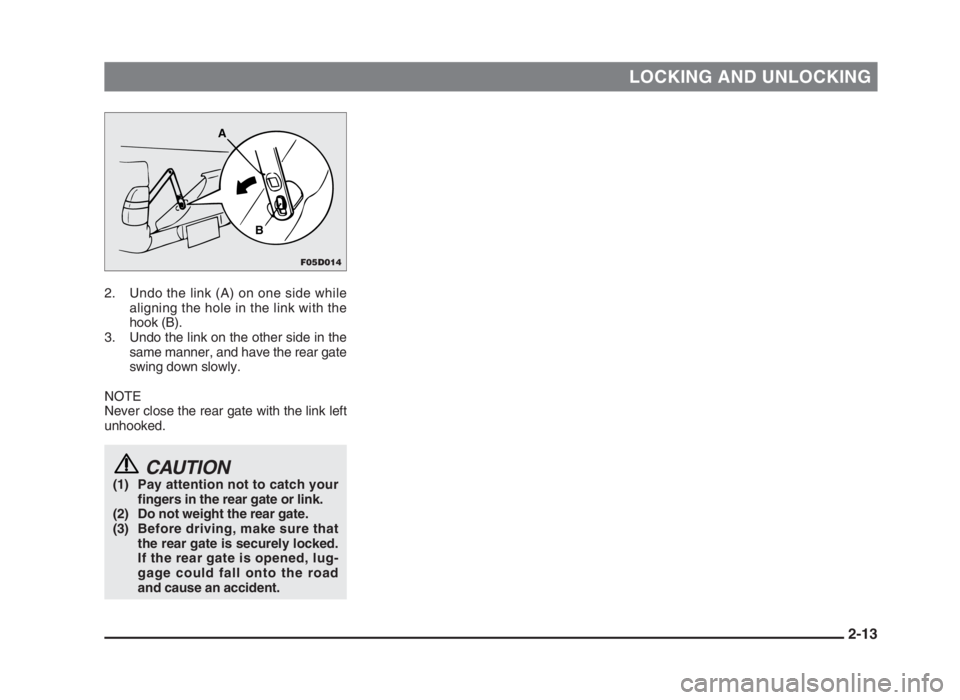
2. Undo the link (A) on one side while
aligning the hole in the link with the
hook (B).
3. Undo the link on the other side in the
same manner, and have the rear gate
swing down slowly.
NOTE
Never close the rear gate with the link left
unhooked.
CAUTION(1) Pay attention not to catch your
fingers in the rear gate or link.
(2) Do not weight the rear gate.
(3) Before driving, make sure that
the rear gate is securely locked.
If the rear gate is opened, lug-
gage could fall onto the road
and cause an accident.
2-13
F05D014
A
B
02engL2_240082_4 22-01-2004 12:59 Page 2-13
Page 37 of 264
SEAT AND SEAT BELTS
Rear seat*EG02C-R
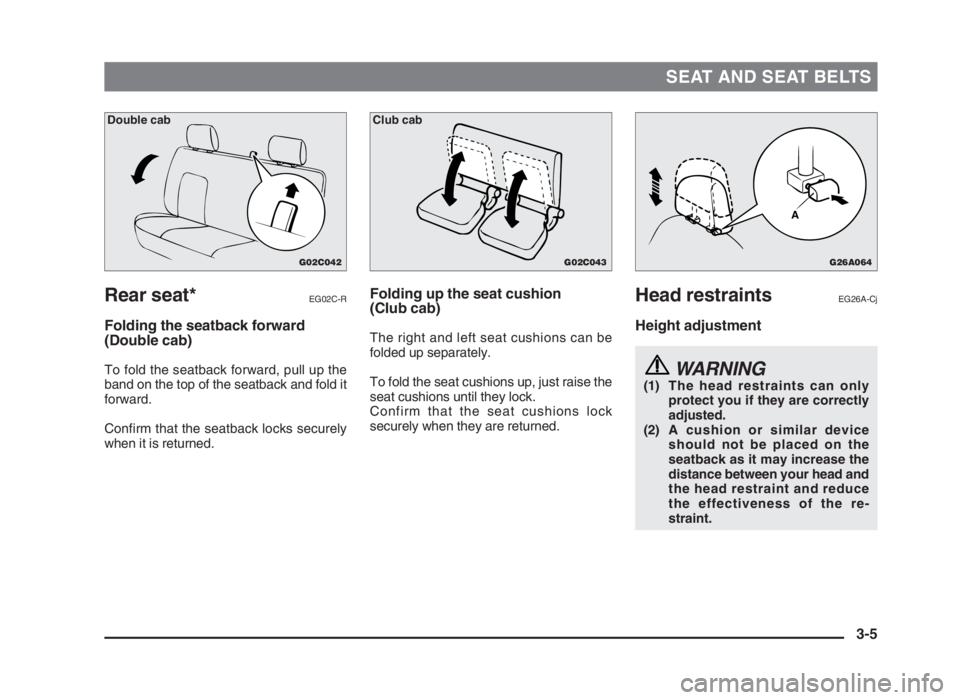
Folding the seatback forward
(Double cab)
To fold the seatback forward, pull up the
band on the top of the seatback and fold it
forward.
Confirm that the seatback locks securely
when it is returned.
Head restraintsEG26A-Cj
Height adjustment
WARNING(1) The head restraints can only
protect you if they are correctly
adjusted.
(2) A cushion or similar device
should not be placed on the
seatback as it may increase the
distance between your head and
the head restraint and reduce
the effectiveness of the re-
straint.
Folding up the seat cushion
(Club cab)
The right and left seat cushions can be
folded up separately.
To fold the seat cushions up, just raise the
seat cushions until they lock.
Confirm that the seat cushions lock
securely when they are returned.
3-5
G02C042
Double cab
G02C043
Club cab
G26A064
A
03engL2_240082_4 22-01-2004 13:01 Page 3-5
Page 45 of 264
SEAT AND SEAT BELTS
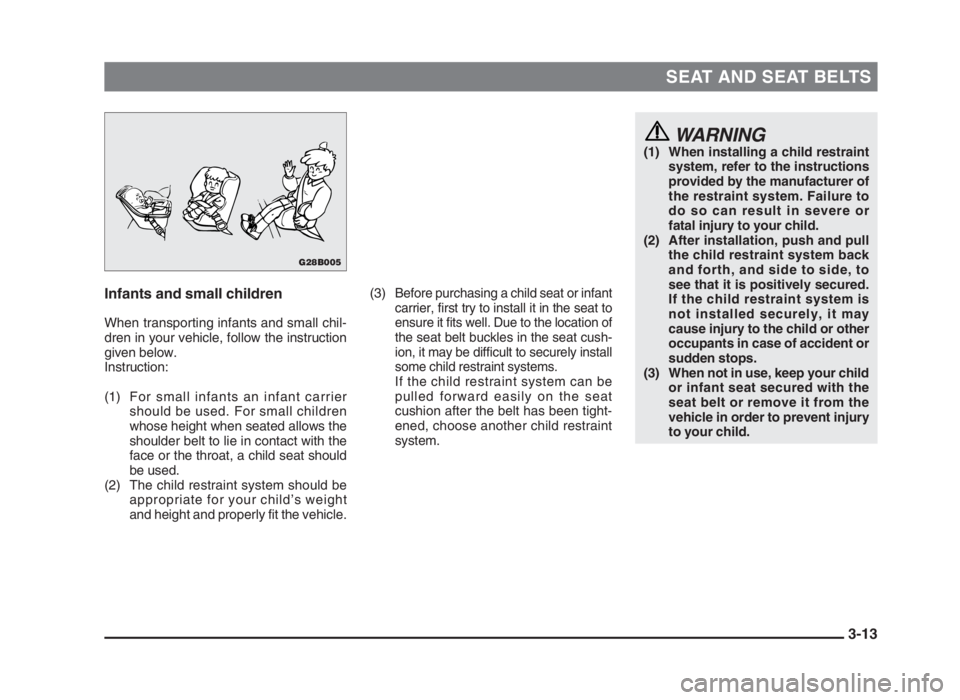
Infants and small children
When transporting infants and small chil-
dren in your vehicle, follow the instruction
given below.
Instruction:
(1) For small infants an infant carrier
should be used. For small children
whose height when seated allows the
shoulder belt to lie in contact with the
face or the throat, a child seat should
be used.
(2) The child restraint system should be
appropriate for your child’s weight
and height and properly fit the vehicle.
WARNING(1) When installing a child restraint
system, refer to the instructions
provided by the manufacturer of
the restraint system. Failure to
do so can result in severe or
fatal injury to your child.
(2) After installation, push and pull
the child restraint system back
and forth, and side to side, to
see that it is positively secured.
If the child restraint system is
not installed securely, it may
cause injury to the child or other
occupants in case of accident or
sudden stops.
(3) When not in use, keep your child
or infant seat secured with the
seat belt or remove it from the
vehicle in order to prevent injury
to your child.
(3)Before purchasing a child seat or infant
carrier, first try to install it in the seat to
ensure it fits well. Due to the location of
the seat belt buckles in the seat cush-
ion, it may be difficult to securely install
some child restraint systems.
If the child restraint system can be
pulled forward easily on the seat
cushion after the belt has been tight-
ened, choose another child restraint
system.
3-13
G28B005
03engL2_240082_4 22-01-2004 13:01 Page 3-13
Page 50 of 264
SEAT AND SEAT BELTS
3-18
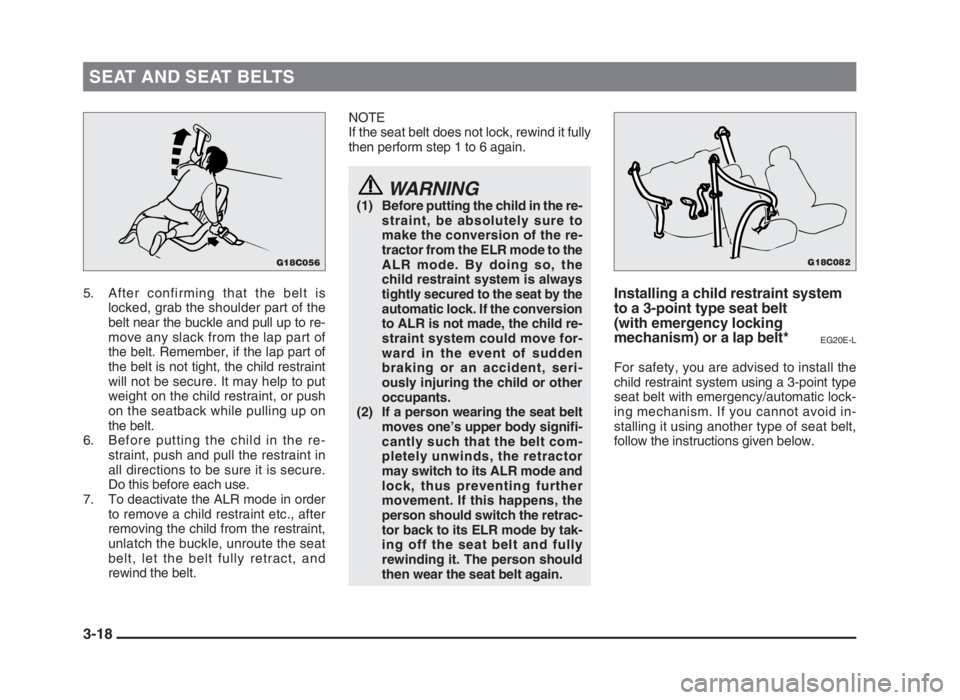
5. After confirming that the belt is
locked, grab the shoulder part of the
belt near the buckle and pull up to re-
move any slack from the lap part of
the belt. Remember, if the lap part of
the belt is not tight, the child restraint
will not be secure. It may help to put
weight on the child restraint, or push
on the seatback while pulling up on
the belt.
6. Before putting the child in the re-
straint, push and pull the restraint in
all directions to be sure it is secure.
Do this before each use.
7. To deactivate the ALR mode in order
to remove a child restraint etc., after
removing the child from the restraint,
unlatch the buckle, unroute the seat
belt, let the belt fully retract, and
rewind the belt.NOTE
If the seat belt does not lock, rewind it fully
then perform step 1 to 6 again.
WARNING(1) Before putting the child in the re-
straint, be absolutely sure to
make the conversion of the re-
tractor from the ELR mode to the
ALR mode. By doing so, the
child restraint system is always
tightly secured to the seat by the
automatic lock. If the conversion
to ALR is not made, the child re-
straint system could move for-
ward in the event of sudden
braking or an accident, seri-
ously injuring the child or other
occupants.
(2) If a person wearing the seat belt
moves one’s upper body signifi-
cantly such that the belt com-
pletely unwinds, the retractor
may switch to its ALR mode and
lock, thus preventing further
movement. If this happens, the
person should switch the retrac-
tor back to its ELR mode by tak-
ing off the seat belt and fully
rewinding it. The person should
then wear the seat belt again.
Installing a child restraint system
to a 3-point type seat belt
(with emergency locking
mechanism) or a lap belt*
EG20E-L
For safety, you are advised to install the
child restraint system using a 3-point type
seat belt with emergency/automatic lock-
ing mechanism. If you cannot avoid in-
stalling it using another type of seat belt,
follow the instructions given below.
G18C056G18C082
03engL2_240082_4 22-01-2004 13:01 Page 3-18
Page 51 of 264
SEAT AND SEAT BELTS
3-19
Installation:
1. Fasten the seat belt to secure the
child restraint system. Make sure you
hear a “click” when you insert the
latch plate in the buckle.
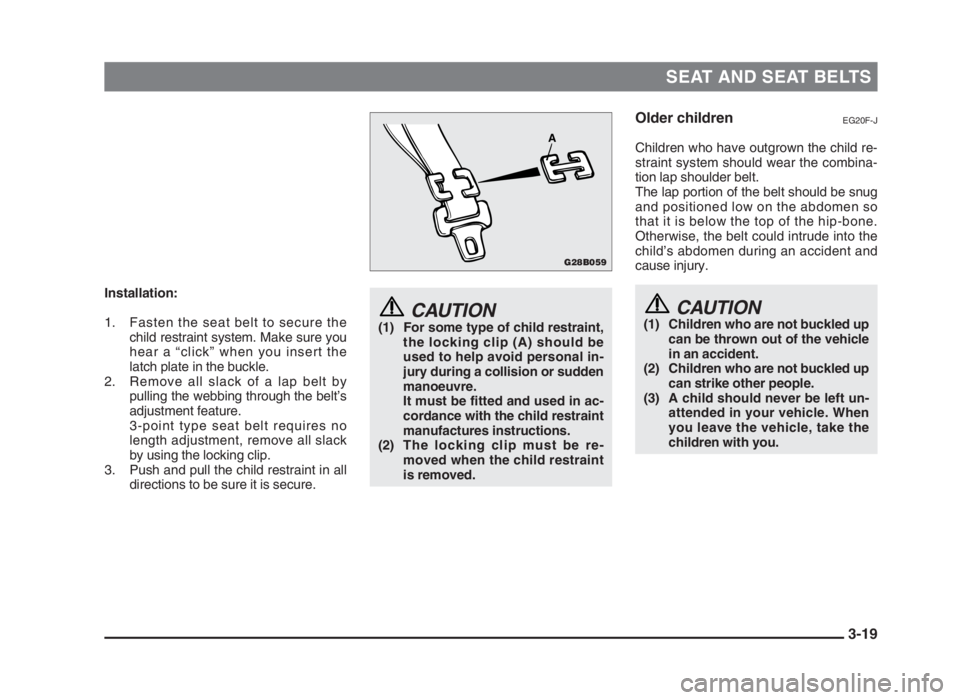
2. Remove all slack of a lap belt by
pulling the webbing through the belt’s
adjustment feature.
3-point type seat belt requires no
length adjustment, remove all slack
by using the locking clip.
3. Push and pull the child restraint in all
directions to be sure it is secure.
Older childrenEG20F-J
Children who have outgrown the child re-
straint system should wear the combina-
tion lap shoulder belt.
The lap portion of the belt should be snug
and positioned low on the abdomen so
that it is below the top of the hip-bone.
Otherwise, the belt could intrude into the
child’s abdomen during an accident and
cause injury.
CAUTION(1) Children who are not buckled up
can be thrown out of the vehicle
in an accident.
(2) Children who are not buckled up
can strike other people.
(3) A child should never be left un-
attended in your vehicle. When
you leave the vehicle, take the
children with you.CAUTION(1) For some type of child restraint,
the locking clip (A) should be
used to help avoid personal in-
jury during a collision or sudden
manoeuvre.
It must be fitted and used in ac-
cordance with the child restraint
manufactures instructions.
(2) The locking clip must be re-
moved when the child restraint
is removed.
G28B059
A
03engL2_240082_4 22-01-2004 13:01 Page 3-19