engine oil MITSUBISHI L200 2004 Owner's Manual (in English)
[x] Cancel search | Manufacturer: MITSUBISHI, Model Year: 2004, Model line: L200, Model: MITSUBISHI L200 2004Pages: 264, PDF Size: 4.14 MB
Page 17 of 264
GENERAL INFORMATION
Used engine oils safety
instructions
EB12A-A
WARNING(1) Prolonged and repeated contact
may cause serious skin disor-
ders, including dermatitis and
cancer.
(2) Avoid contact with the skin as
far as possible and wash thor-
oughly after any contact.
(3) Keep out of reach of children.
Protect the environment
It is illegal to pollute drains, water courses
and soil. Use authorized waste collection
facilities, including civic amenity sites and
garages providing facilities for disposal of
used oil and used oil filters. If in doubt,
contact your local authority for advice on
disposal.
Driving and alcoholEB25A-Aa
Driving under the influence of alcohol is
one of the most frequent causes of acci-
dents.
Your driving ability can even be seriously
impaired with blood alcohol levels below
the legal minimum. If you are drinking,
don’t drive. Ride with a designated non-
drinking driver, call a cab, a friend, or use
public transportation.
WARNINGDriving after drinking can lead to an
accident. Your perceptions are less
sharp, your reflexes are slower, and
your judgement is impaired when
you have been drinking.
NEVER DRINK AND THEN DRIVE.
Safe driving techniques
EB26A-Cb
Driving safety and protection against in-
jury cannot be fully ensured. However, we
recommend that you pay extra attention to
the following:
(1) Before starting the vehicle, make sure
that you and your passengers have
fastened your seat belts.
(2) Never leave your vehicle unattended
with the key in the ignition and
children inside the vehicle. Children
may play with the driving controls and
this could lead to an accident.
(3) Make sure that infants and small chil-
dren are properly restrained in accor-
dance with the laws and regulations,
and for maximum protection in case
of an accident.
1-17
01engL2_240082_4 22-01-2004 12:58 Page 1-17
Page 70 of 264
INSTRUMENTS AND CONTROLS
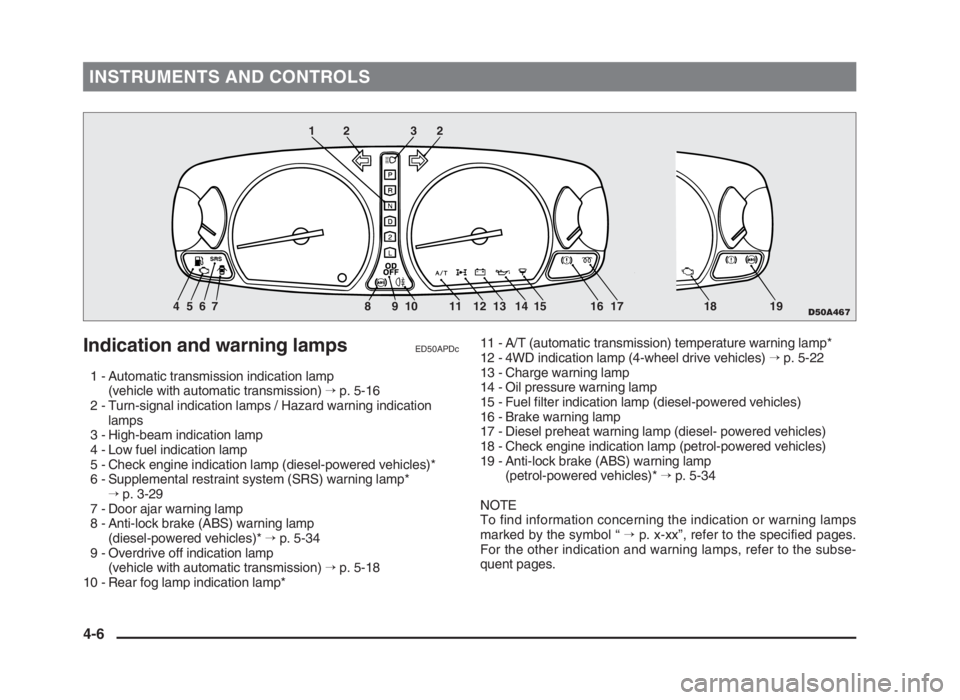
Indication and warning lampsED50APDc
1 - Automatic transmission indication lamp
(vehicle with automatic transmission) →p. 5-16
2 - Turn-signal indication lamps / Hazard warning indication
lamps
3 - High-beam indication lamp
4 - Low fuel indication lamp
5 - Check engine indication lamp (diesel-powered vehicles)*
6 - Supplemental restraint system (SRS) warning lamp*
→p. 3-29
7 - Door ajar warning lamp
8 - Anti-lock brake (ABS) warning lamp
(diesel-powered vehicles)* →p. 5-34
9 - Overdrive off indication lamp
(vehicle with automatic transmission) →p. 5-18
10 - Rear fog lamp indication lamp*11 - A/T (automatic transmission) temperature warning lamp*
12 - 4WD indication lamp (4-wheel drive vehicles) →p. 5-22
13 - Charge warning lamp
14 - Oil pressure warning lamp
15 - Fuel filter indication lamp (diesel-powered vehicles)
16 - Brake warning lamp
17 - Diesel preheat warning lamp (diesel- powered vehicles)
18 - Check engine indication lamp (petrol-powered vehicles)
19 - Anti-lock brake (ABS) warning lamp
(petrol-powered vehicles)* →p. 5-34
NOTE
To find information concerning the indication or warning lamps
marked by the symbol “ →p. x-xx”, refer to the specified pages.
For the other indication and warning lamps, refer to the subse-
quent pages.
4-6
D50A467
12 32
4 5 6 7 8 9 10 11 12 13 14 15 16 17 18 19
04engL2_240082_4 22-01-2004 13:19 Page 4-6
Page 73 of 264
INSTRUMENTS AND CONTROLS
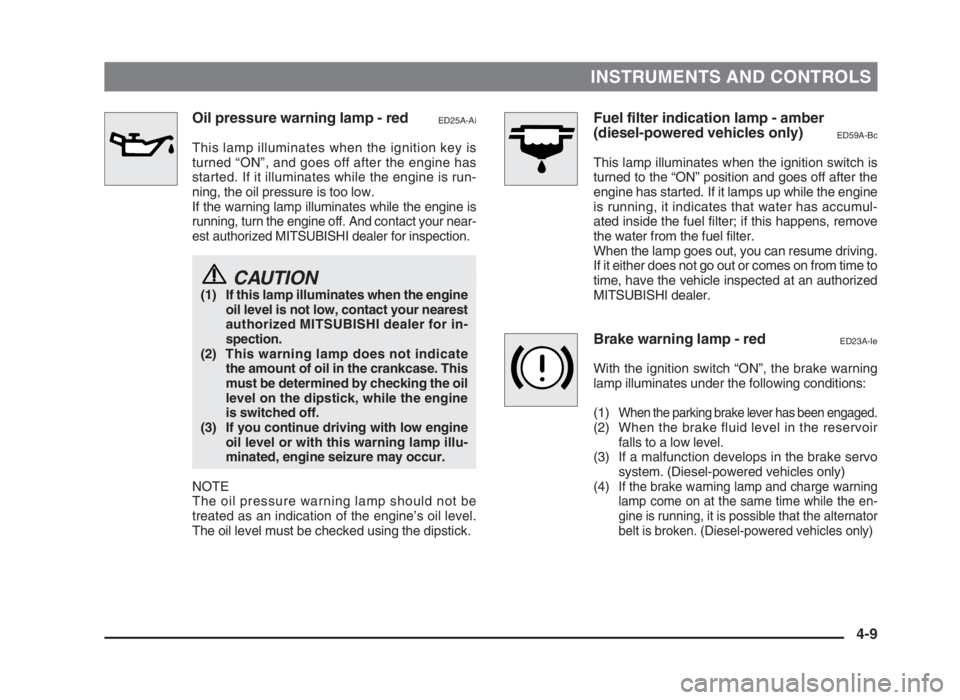
Oil pressure warning lamp - redED25A-Ai
This lamp illuminates when the ignition key is
turned “ON”, and goes off after the engine has
started. If it illuminates while the engine is run-
ning, the oil pressure is too low.
If the warning lamp illuminates while the engine is
running, turn the engine off. And contact your near-
est authorized MITSUBISHI dealer for inspection.
CAUTION(1) If this lamp illuminates when the engine
oil level is not low, contact your nearest
authorized MITSUBISHI dealer for in-
spection.
(2) This warning lamp does not indicate
the amount of oil in the crankcase. This
must be determined by checking the oil
level on the dipstick, while the engine
is switched off.
(3) If you continue driving with low engine
oil level or with this warning lamp illu-
minated, engine seizure may occur.
NOTE
The oil pressure warning lamp should not be
treated as an indication of the engine’s oil level.
The oil level must be checked using the dipstick.
Fuel filter indication lamp - amber
(diesel-powered vehicles only)
ED59A-Bc
This lamp illuminates when the ignition switch is
turned to the “ON” position and goes off after the
engine has started. If it lamps up while the engine
is running, it indicates that water has accumul-
ated inside the fuel filter; if this happens, remove
the water from the fuel filter.
When the lamp goes out, you can resume driving.
If it either does not go out or comes on from time to
time, have the vehicle inspected at an authorized
MITSUBISHI dealer.
Brake warning lamp - redED23A-Ie
With the ignition switch “ON”, the brake warning
lamp illuminates under the following conditions:
(1)
When the parking brake lever has been engaged.(2) When the brake fluid level in the reservoir
falls to a low level.
(3) If a malfunction develops in the brake servo
system. (Diesel-powered vehicles only)
(4)
If the brake warning lamp and charge warning
lamp come on at the same time while the en-
gine is running, it is possible that the alternator
belt is broken. (Diesel-powered vehicles only)
4-9
04engL2_240082_4 22-01-2004 13:19 Page 4-9
Page 112 of 264
STARTING AND DRIVING
5-26
Correct 4-wheel drive
operation
EI32ABDa
By shifting lock to 4-wheel drive (4H, 4L),
both axles of the vehicle are rigidly con-
nected with each other. This improves the
traction characteristics. When turning
sharp corners or moving forward and
backward repeatedly, however, the drive
line is stressed, which is felt as a braking
effect. A 4-wheel drive vehicle can accele-
rate more quickly and smoothly.
However, note that the braking distance is
not shorter than that of a rear-wheel drive
vehicle.
When using 4-wheel drive on rough roads
(snow, mud, sand, etc.), it is important to
operate the vehicle correctly.
NOTE
(1) The driving posture should be more
upright and closer to the wheel than
usual; adjust the seat to a good posi-
tion for easy steering and pedal oper-
ation. Be sure to wear the seat belt.
(2) After driving on rough roads, check
each part of the vehicle and wash it
thoroughly with water. Refer to the
“Vehicle care” section and “Inspection
and maintenance following rough
road operation” sections.Driving on dry paved road and highway
Select 2WD (2H) to drive on dry paved
roads. Especially on dry highway, never
select the 4WD (4H or 4L).
CAUTIONSelecting 4-wheel drive to drive on
dry paved road will increase the fuel
consumption with possible noise
generation and early tyre wear.
It may also increase the differential
oil temperature, resulting in possible
damage to the driving system. Fur-
ther, the drive train will be subjected
to excessive loading, possibly lead-
ing to oil leakage, component
seizure, or other serious faults.
Driving on snowy or icy roads
Set the transfer shift lever to “4H” or “4L” in
accordance with the road conditions, and
then gradually depress the accelerator
pedal for a smooth start.
NOTE
(1) The use of snow tyres and/or tyre
chains is recommended.
(2) Maintain a safe distance between
vehicles, avoid sudden braking, and
use engine braking (downshifting).
CAUTIONAvoid sudden braking, sudden ac-
celeration, and sharp turning; such
operations could cause skidding
and spinouts.
Driving on sandy or muddy roads
Set the transfer shift lever to “4H” or “4L”,
and then gradually depress the accelera-
tor pedal for a smooth start. Keep the
pressure on the accelerator pedal as con-
stant as possible, and drive at low speed.
05engL2_240082_4 22-01-2004 13:05 Page 5-26
Page 115 of 264
STARTING AND DRIVING
5-29
CAUTIONNever cross a stream where the
water is deep.
Do not change gears while crossing
the stream.
Frequent crossing of streams can
adversely affect the life span of the
vehicle; consult an authorized
MITSUBISHI dealer and take the ne-
cessary measures to prepare, in-
spect, and repair the vehicle.
After crossing a stream, apply the brakes
to be sure they are functioning properly. If
the brakes are wet and not functioning
properly, dry them out by driving slowly
while lightly depressing the brake pedal.
Inspect each part of the vehicle carefully.
Refer to the “Inspection and maintenance
following rough road operation” section.
Cautions on handling of
4WD vehicles
EI49A-Ce
Tyres and wheels
Since the driving torque can be applied to
the 4 wheels, the performance of the vehi-
cle when operating in 4WD is greatly
affected by the condition of the tyres.
Pay close attention to the tyres.
• Install specified tyres on all wheels. Re-
fer to the “Tyres and wheels” on page
10-8, 10-14, 10-22.
• All tyres should be rotated whenever the
wear difference between front and rear
tyres is recognizable.
Good vehicle performance cannot be
expected if there is a difference in wear
between tyres. Refer to the “Tyre rota-
tion” on page 9-11.
• Check the tyre inflation pressure regu-
larly.
Inspection and maintenance
following rough road operation
After operating the vehicle in rough road
conditions, be sure to perform the following
inspection and maintenance procedures:
(1) Check that the vehicle has not been
damaged by rocks, gravel, etc.
(2) Carefully wash the vehicle with water.
Drive the vehicle slowly while lightly
depressing the brake pedal in order to
dry out the brakes. If the brakes still
do not function properly, contact an
authorized MITSUBISHI dealer as
soon as possible to have the brakes
checked.
(3) Remove the insects, dried grass, etc.
clogging the radiator core.
(4) If a stream has been crossed, check
the engine, transmission, and differ-
ential oil and propeller shaft grease. If
the oil or grease is milky or cloudy
because of water contamination, it
must be replaced with new oil.
(5) Check the inside of the vehicle. If
ingress of water is found, dry the car-
pet etc.
(6) Inspect the headlamps. If the head-
lamp bulb is flooded with water, have
the headlamp drained off at an autho-
rized MITSUBISHI dealer.
(7) Have an authorized MITSUBISHI
dealer replace grease in the wheel
bearing.
05engL2_240082_4 22-01-2004 13:05 Page 5-29
Page 116 of 264
STARTING AND DRIVING
5-30
CAUTIONAlways use tyres of the same size,
same type, and same brand, and
which have no wear differences. Us-
ing tyres which differ in size, type,
brand or the degree of wear will in-
crease the differential oil tempera-
ture, resulting in possible damage to
the driving system.
Further, the drive train will be sub-
jected to excessive loading, possi-
bly leading to oil leakage, compo-
nent seizure, or other serious faults.
Jacking up vehicle on 4-wheel
drive vehicles
CAUTIONDo not crank the engine while jack-
ing up the vehicle.
The tyre on the ground may turn and
the vehicle may roll off the jack.
Operate clutch pedal slowly and
positively
Quick or slight clutch engagement made
while the engine is running at high speed
will cause damage to the clutch and trans-
mission because the tractive force is very
great.
Operate the pedal slowly and positively.
Parking brakeEI07A-Tb
To park the vehicle, first bring it to a com-
plete stop, fully engage the parking brake,
and then move the gearshift level to 1st
(on an uphill) or Reverse (on a downhill)
position for vehicles with a manual trans-
mission or set the selector lever to the “P”
(PARK) position on automatic transmis-
sion vehicles.
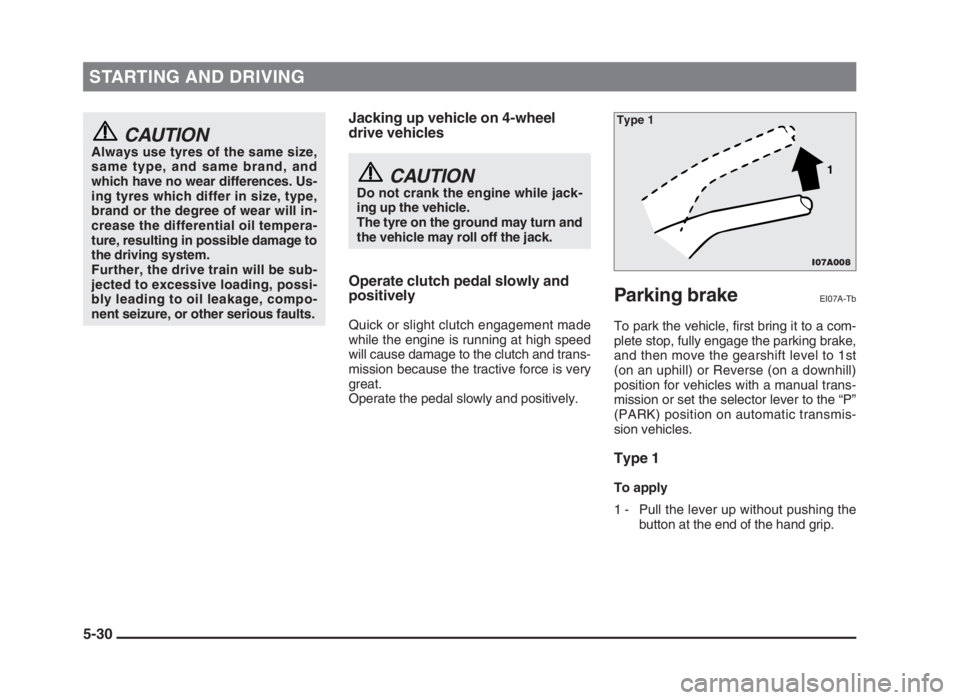
Type 1
To apply
1 - Pull the lever up without pushing the
button at the end of the hand grip.
I07A008
1
Type 1
05engL2_240082_4 22-01-2004 13:05 Page 5-30
Page 172 of 264
VEHICLE CARE
PolishingEK04A-Ac
The vehicle should only be polished if the
paintwork has become stained or lost its
lustre. Matt-finish parts and plastic
bumpers must not be polished, polishing
these parts will stain them or damage their
finish.
Damaged paintEK08A-Ac
Small cracks and scratches in the paint
coat should be touched up as soon as
possible with MITSUBISHI touch-up paint
to prevent corrosion.
Check body areas facing the road or the
tyres carefully for damage to the paint coat
caused by flying stones, etc. The paint
code number for your vehicle can be
found on the vehicle information code
plate in the engine compartment.
Servicing of plastic partsEK29APDc
Use a sponge or chamois leather.
If car wax adheres to the gray or black
rough surface of the bumper or moulding,
the surface becomes white. If this hap-
pens, wipe it off using lukewarm water and
soft cloth or chamois leather.
CAUTION(1) Do not use a scrubbing brush or
other hard tools as they may
damage the plastic part surface.
(2) Do not use wax containing com-
pound (polishing powder) which
may damage the plastic part sur-
face.
(3) Do not bring the plastic parts
into contact with brake fluids,
engine oils, greases, paint thin-
ners, and sulphuric acid (battery
electrolyte) which may stain,
crack or discolour the plastic
parts.
If they touch the plastic part,
wipe them off with soft cloth,
chamois or the like and an aque-
ous solution of neutral deter-
gent, then immediately rinse the
affected parts with water.
Chrome partsEK06A-Aa
In order to prevent spots and corrosion of
chrome parts, wash with water, dry thor-
oughly, and apply a special protective
coating. This should be done more fre-
quently in winter.
Aluminium wheels*EK35A-Af
A protective coating is provided over the
aluminium type wheels.
Clean aluminium wheels with a cleaner
designed for use on aluminium and apply
an appropriate protection agent.
NOTE
(1) When cleaning aluminium type
wheels, do not use abrasive cleaners.
Wheels exposed to sea water or road
chemicals should be cleaned as soon
as possible.
(2) Brushes may damage the aluminium
wheel surface. Always use a sponge,
chamois leather, etc.
(3) Do not apply hot water directly from
the steam cleaner or similar to the
wheel surface.
7-6
07engL2_240082_4 22-01-2004 13:09 Page 7-6
Page 173 of 264
VEHICLE CARE
Window glassEK10A-A
The window glass can normally be
cleaned using only a sponge and water.
Glass cleaner can be used to remove oil,
grease, dead insects, etc. After washing
the glass, wipe dry with a clean, dry, soft
cloth. Never use the same cloth to wipe
the window glass as would be used to
wipe the paintwork; wax from the painted
surfaces could adhere to the glass and re-
duce its transparency and visibility.
Wiper bladesEK11A-A
Use a soft cloth and glass cleaner to re-
move grease, dead insects, etc., from the
wiper blades. Replace the wiper blades
when they no longer wipe properly.
Engine compartmentEK13A-Aa
Clean the engine compartment at the
beginning and end of winter. Pay particu-
lar attention to flanges, crevices and
peripheral parts where dust containing
road chemicals and other corrosive mater-
ials might collect.
If salt and other chemicals are used on the
roads in your area, clean the engine
compartment at least once every three
months.
Chassis and underbody protection
EK12A-Jc
Your vehicle’s underbody has been
treated at the factory in order to protect it
from rust and corrosion. Some areas have
been injected with anti-corrosion agents
and wax.
The effectiveness of these measures,
however, will be reduced by flying stones,
road chemicals, etc., as the vehicle is
driven. You should take your vehicle to
your authorized MITSUBISHI dealer every
12 months to have body sheet metal
inspected, and it is recommended to have
the underbody checked regularly (autumn
and spring) and have additional protection
treatment carried out as required.
As not all of the commercially available
materials are suitable for use on your
vehicle, it is recommended that you have
this work carried out by an authorized
MITSUBISHI dealer.
When washing the vehicle, especially in
winter, spray the underbody with water to
remove dirt and dust which might contain
salts, road chemicals, etc.
7-7
07engL2_240082_4 22-01-2004 13:09 Page 7-7
Page 198 of 264
FOR EMERGENCIES
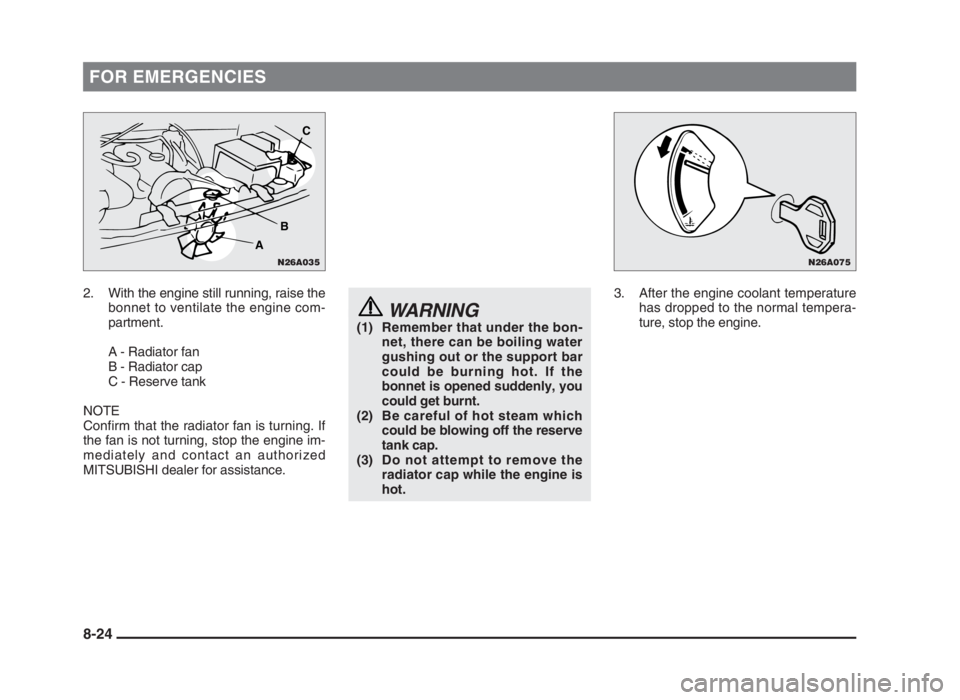
2. With the engine still running, raise the
bonnet to ventilate the engine com-
partment.
A - Radiator fan
B - Radiator cap
C - Reserve tank
NOTE
Confirm that the radiator fan is turning. If
the fan is not turning, stop the engine im-
mediately and contact an authorized
MITSUBISHI dealer for assistance.
WARNING
(1) Remember that under the bon-
net, there can be boiling water
gushing out or the support bar
could be burning hot. If the
bonnet is opened suddenly, you
could get burnt.
(2) Be careful of hot steam which
could be blowing off the reserve
tank cap.
(3) Do not attempt to remove the
radiator cap while the engine is
hot.
3. After the engine coolant temperature
has dropped to the normal tempera-
ture, stop the engine.
8-24
N26A075N26A035
ABC
08engL2_240082_4 22-01-2004 13:10 Page 8-24
Page 199 of 264
FOR EMERGENCIES
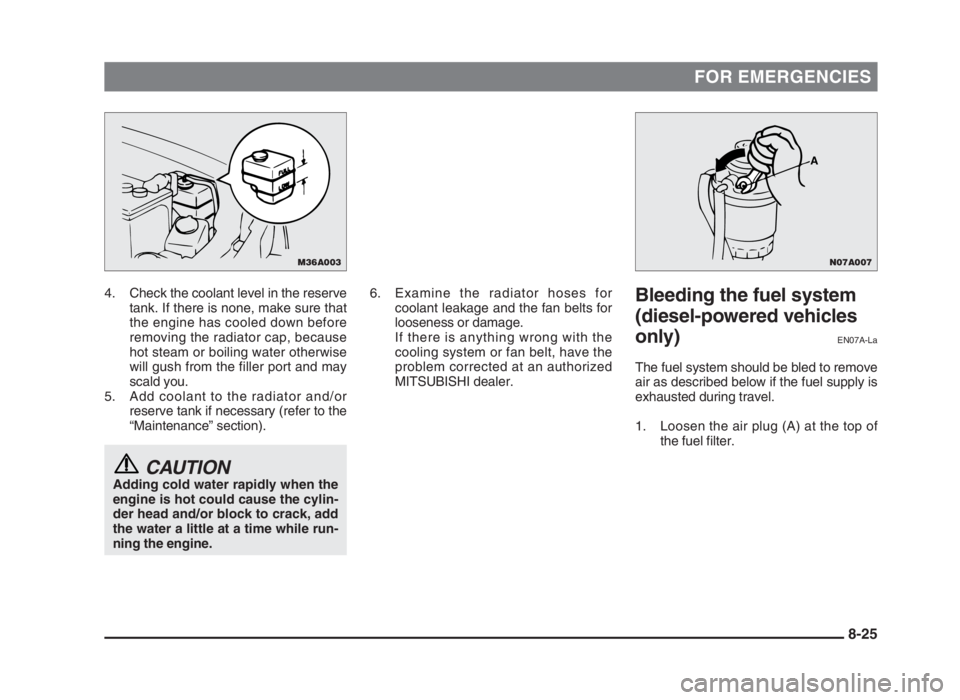
4. Check the coolant level in the reserve
tank. If there is none, make sure that
the engine has cooled down before
removing the radiator cap, because
hot steam or boiling water otherwise
will gush from the filler port and may
scald you.
5. Add coolant to the radiator and/or
reserve tank if necessary (refer to the
“Maintenance” section).
CAUTIONAdding cold water rapidly when the
engine is hot could cause the cylin-
der head and/or block to crack, add
the water a little at a time while run-
ning the engine.
Bleeding the fuel system
(diesel-powered vehicles
only)
EN07A-La
The fuel system should be bled to remove
air as described below if the fuel supply is
exhausted during travel.
1. Loosen the air plug (A) at the top of
the fuel filter. 6. Examine the radiator hoses for
coolant leakage and the fan belts for
looseness or damage.
If there is anything wrong with the
cooling system or fan belt, have the
problem corrected at an authorized
MITSUBISHI dealer.
8-25
M36A003N07A007
A
08engL2_240082_4 22-01-2004 13:10 Page 8-25