fuel MITSUBISHI L200 2015 (in English) Owner's Guide
[x] Cancel search | Manufacturer: MITSUBISHI, Model Year: 2015, Model line: L200, Model: MITSUBISHI L200 2015Pages: 418, PDF Size: 25.8 MB
Page 115 of 418
User customization
E00519600183
You can set the indication of unit, language,
and the time notation.
In addition, you can return these settings to
the factory default settings.
Selecting the item to set
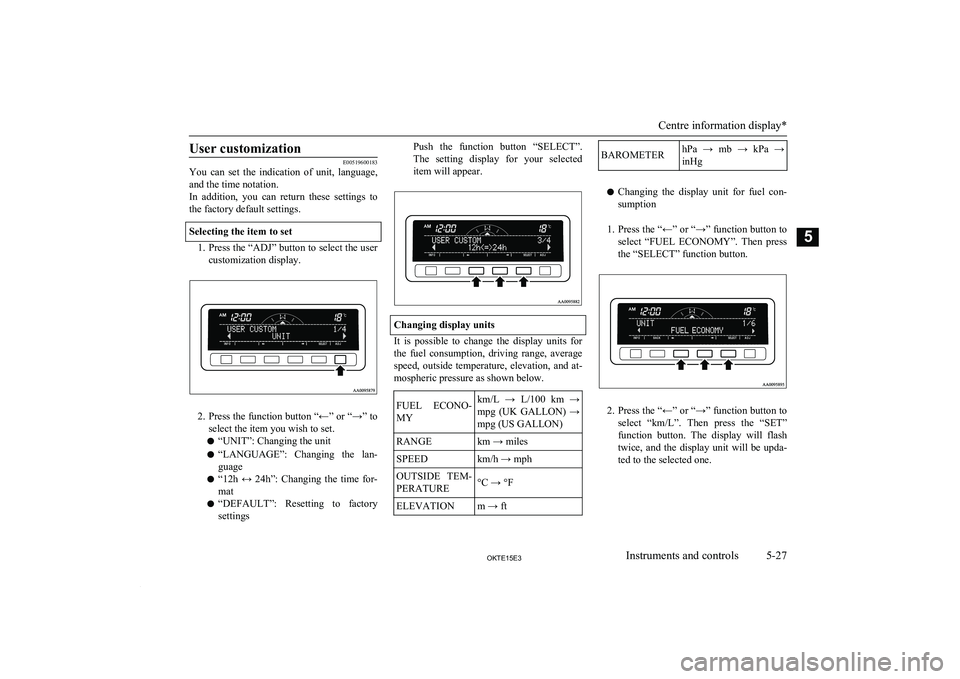
1. Press the “ADJ” button to select the user
customization display.
2. Press the function button “←” or “→” to
select the item you wish to set.
l “UNIT”: Changing the unit
l “LANGUAGE”: Changing the lan-
guage
l “12h ↔ 24h”: Changing the time for-
mat
l “DEFAULT”: Resetting to factory
settings
Push the function button “SELECT”.
The setting display for your selected
item will appear.
Changing display units
It is possible to change the display units for the fuel consumption, driving range, average
speed, outside temperature, elevation, and at- mospheric pressure as shown below.
FUEL ECONO-
MYkm/L → L/100 km →
mpg (UK GALLON) → mpg (US GALLON)RANGEkm → milesSPEEDkm/h → mphOUTSIDE TEM-
PERATURE°C → °FELEVATIONm → ftBAROMETERhPa → mb → kPa →
inHg
l Changing the display unit for fuel con-
sumption
1. Press the “←” or “→” function button to
select “FUEL ECONOMY”. Then press the “SELECT” function button.
2. Press the “←” or “→” function button to
select “km/L”. Then press the “SET”
function button. The display will flash
twice, and the display unit will be upda- ted to the selected one.
Centre information display*
5-27OKTE15E3Instruments and controls5
Page 117 of 418
NOTElYou can return to the previous display by
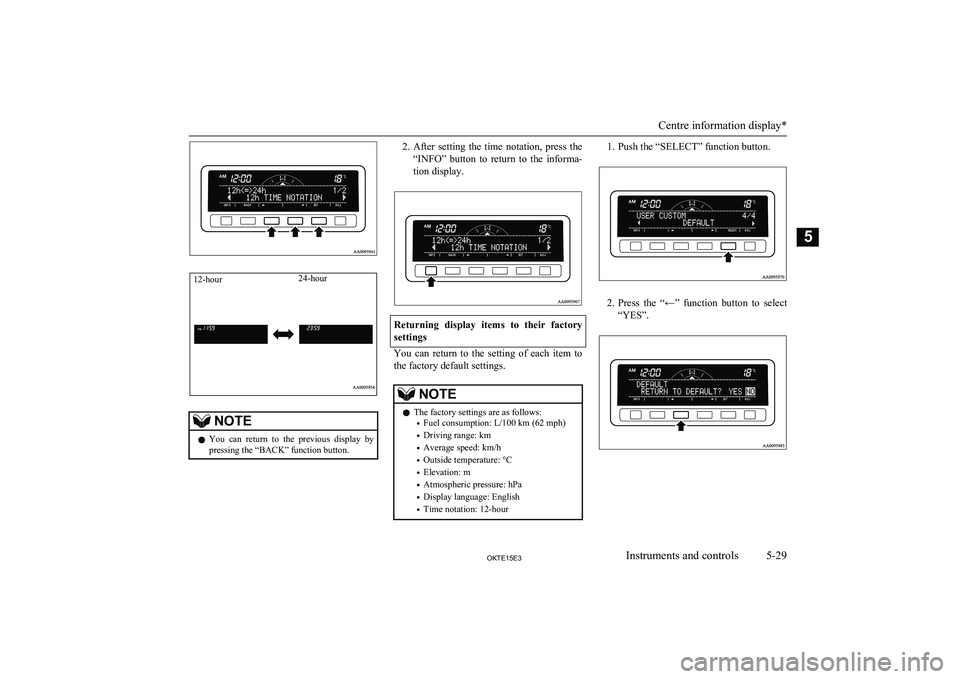
pressing the “BACK” function button.2. After setting the time notation, press the
“INFO” button to return to the informa- tion display.
Returning display items to their factorysettings
You can return to the setting of each item to
the factory default settings.
NOTEl The factory settings are as follows:
• Fuel consumption: L/100 km (62 mph)
• Driving range: km
• Average speed: km/h
• Outside temperature: °C
• Elevation: m
• Atmospheric pressure: hPa
• Display language: English
• Time notation: 12-hour1. Push the “SELECT” function button.
2.
Press the “←” function button to select
“YES”.
Centre information display*
5-29OKTE15E3Instruments and controls5 12-hour24-hour
Page 134 of 418
Economical drivingE00600100620
For economical driving, there are some tech- nical requirements that have to be met. Theprerequisite for low fuel consumption is a
properly adjusted engine. In order to achieve longer life of the vehicle and the most eco- nomical operation, we recommend you tohave the vehicle checked at regular intervals in accordance with the service standards.
Fuel economy and generation of exhaust gas
and noise are highly influenced by personal
driving habits as well as the particular operat- ing conditions. The following points shouldbe observed in order to minimize wear of
brakes, tyres and engine as well as to reduce
environmental pollution.
Starting
Avoid rapid acceleration and sudden starts;
such operation will result in higher fuel con-
sumption.
Shifting
Shift only at an appropriate speed and engine speed. Always use the highest gear possible.
The transfer shift lever should be set to “2H” when driving 4WD vehicles on normal roads
and express ways to obtain best possible fuel economy.
City traffic
Frequent starting and stopping increases the
average fuel consumption. Use roads with smooth traffic flow whenever possible. When driving on congested roads, avoid use of a
low gear at high engine speeds.
Idling
The vehicle consumes fuel even during
idling. Avoid extended idling whenever pos- sible.
Speed
The higher the vehicle speed, the more fuel
consumed. Avoid driving at full speed. Even a slight release of the accelerator pedal will
save a significant amount of fuel.
Tyre inflation pressure
Check the tyre inflation pressures at regularintervals. Low tyre inflation pressure increa-ses road resistance and fuel consumption. In addition, low tyre pressures adversely affect tyre wear and driving stability.
Load
Do not drive with unnecessary articles in the
cargo area. Especially during city driving where frequent starting and stopping is nec-
essary, the increased weight of the vehicle will greatly affect fuel consumption.
Cold engine starting
Starting of a cold engine consumes morefuel.
Unnecessary fuel consumption is also caused by keeping a hot engine running. After the
engine is started, commence driving as soon
as possible.
Air conditioning*
The use of the air conditioning will increase the fuel consumption.
Driving, alcohol and drugs
E00600200012
Driving after drinking alcohol is one of the
most frequent causes of accidents.
Your driving ability can be seriously im- paired even with blood alcohol levels far be-
low the legal minimum. If you have been drinking, don’t drive. Ride with a designated non-drinking driver, call a cab or a friend, or
use public transportation.
Economical driving
6-02OKTE15E3Starting and driving6
Page 145 of 418
CAUTIONlDo not remove the ignition key from the ig-
nition switch while driving. The steeringwheel will lock, causing loss of control.
l If the engine is stopped while driving, the
brake servomechanism will cease to function and braking efficiency will deteriorate. Also,
the power steering system will not function
and it will require greater manual effort to
operate the steering.
l Do not leave the key in the “ON” position
for a long time when the engine is not run- ning, doing so will cause the battery to be
discharged.
l Do not turn the key to the “START” position
when the engine is running, doing so could damage the starter motor.NOTEl For vehicles with an
A/T, when the selector
lever is in the “P” (PARK) position, do not operate the lock button of selector lever re-
peatedly for more than 30 seconds. You may
not be able to remove the key from the igni-
tion switch, because the protection circuit is
activated. If this occurs, wait a few moments before removing the key.
Refer to “Selector lever operation” on page
6-19.Steering wheel lock
E00601500227
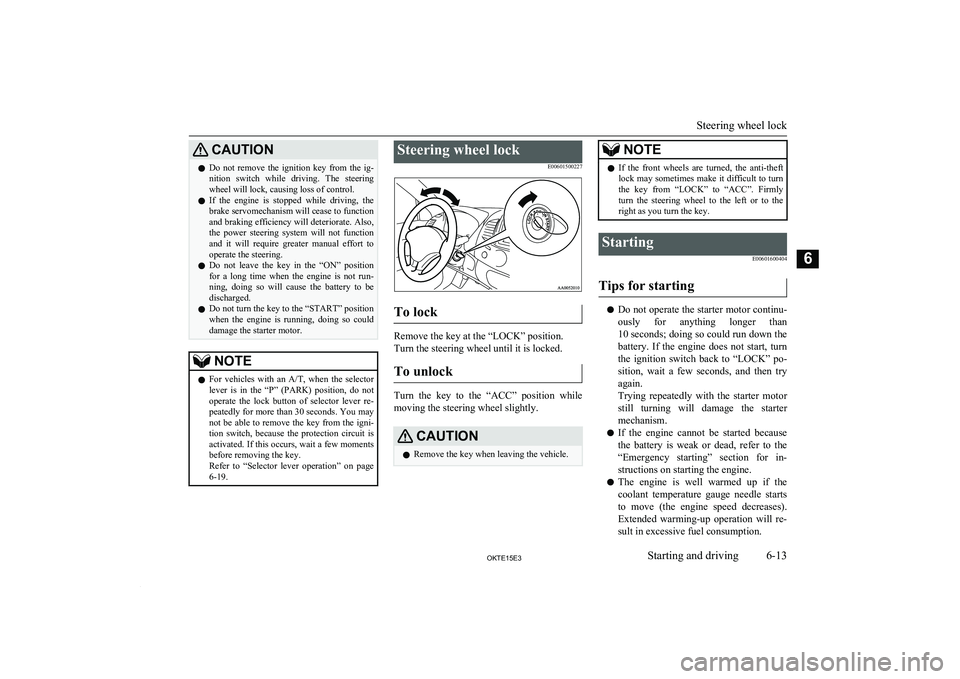
To lock
Remove the key at the “LOCK” position.
Turn the steering wheel until it is locked.
To unlock
Turn the key to the “ACC” position while
moving the steering wheel slightly.
CAUTIONl Remove the key when leaving the vehicle.NOTElIf the front wheels are turned, the anti-theft
lock may sometimes make it difficult to turnthe key from “LOCK” to “ACC”. Firmly
turn the steering wheel to the left or to the right as you turn the key.Starting
E00601600404
Tips for starting
lDo not operate the starter motor continu-
ously for anything longer than10 seconds ; doing so could run down the
battery. If the engine does not start, turn
the ignition switch back to “LOCK” po-
sition, wait a few seconds, and then try again.
Trying repeatedly with the starter motor still turning will damage the starter
mechanism.
l If the engine cannot be started because
the battery is weak or dead, refer to the“Emergency starting” section for in- structions on starting the engine.
l The engine is well warmed up if the
coolant temperature gauge needle starts
to move (the engine speed decreases).
Extended warming-up operation will re-
sult in excessive fuel consumption.
Steering wheel lock
6-13OKTE15E3Starting and driving6
Page 147 of 418
Fuel injection amount learningprocess
E00616000028
To keep exhaust emissions and engine noise
low, the engine very occasionally performs a
learning process for the fuel injection
amount.
The engine sounds slightly different from
usual while the learning process is taking place. The change in the engine sound does
not indicate a fault.
Diesel particulate filter
(DPF)* E00619800232
The diesel particulate filter (DPF) is a devicethat captures most of the particulate matter
(PM) in the exhaust emissions of the diesel engine. The DPF automatically burns away trapped PM during vehicle operation. Under
certain driving conditions, however, the DPF is not able to burn away all of the trapped PM
and, as a result, an excessive amount of PM accumulates inside it.
WARNINGl The DPF reaches very high temperatures.
Do not park your vehicle in areas where
combustible materials such as dry grass
or leaves can come in contact with a hot exhaust system since a fire could occur.CAUTIONl Do not use any type of fuel or engine oil that
is not specified for your vehicle. Also, do not use any moisture-removing agent or oth-
er fuel additive. Such substances could have a detrimental effect on the DPF.
Refer to “Fuel selection” on page 2-02 and
“Engine oil” on page 10-04.NOTEl To minimize the likelihood of excessive ac-
cumulation of PM, try to avoid driving for long periods at low speeds and repeatedly
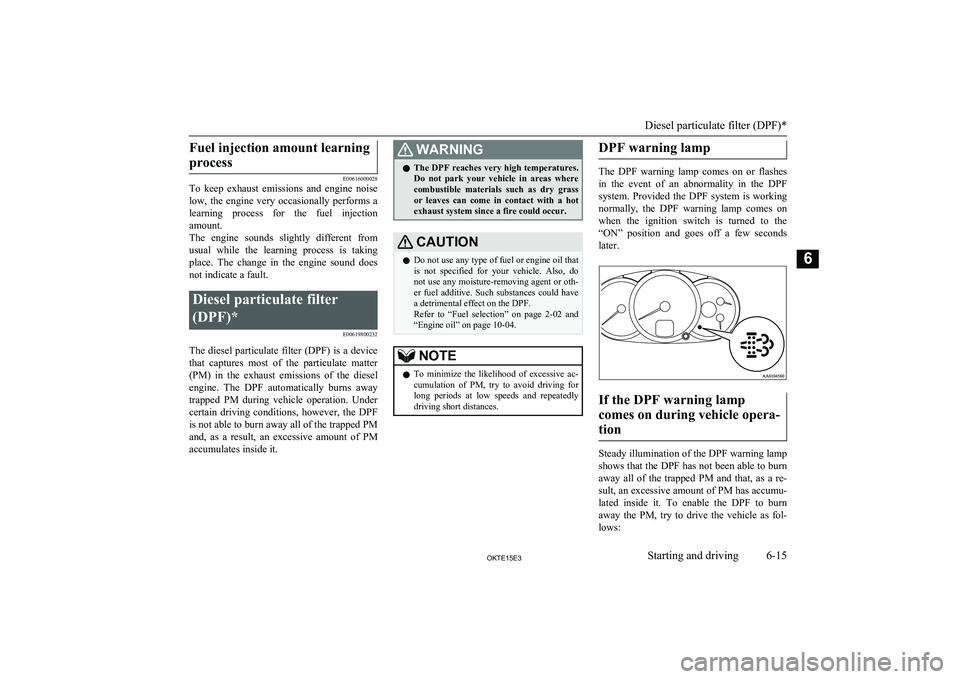
driving short distances.DPF warning lamp
The DPF warning lamp comes on or flashes
in the event of an abnormality in the DPF system. Provided the DPF system is workingnormally, the DPF warning lamp comes on
when the ignition switch is turned to the “ON” position and goes off a few seconds
later.
If the DPF warning lamp
comes on during vehicle opera- tion
Steady illumination of the DPF warning lamp shows that the DPF has not been able to burn
away all of the trapped PM and that, as a re-
sult, an excessive amount of PM has accumu- lated inside it. To enable the DPF to burn
away the PM, try to drive the vehicle as fol-
lows:
Diesel particulate filter (DPF)*
6-15OKTE15E3Starting and driving6
Page 150 of 418

Possible driving speed
E00610802637
2WDShift pointSpeed limitVehicles with 15 inch tyreVehicles with 16 inch tyre1st
gear30 km/h (19 mph)35 km/h (22 mph)2nd
gear60 km/h (37 mph)65 km/h (40 mph)3rd
gear100 km/h (62 mph)110 km/h (68 mph)4th
gear145 km/h (90 mph)160 km/h (99 mph)4WDShift pointSpeed limitVehicles with easy select 4WDVehicles with super select 4WD2H, 4H4L2H, 4H, 4HLc4LLc1st
gear35 km/h (22 mph)15 km/h (9 mph)35 km/h (22 mph)15 km/h (9 mph)2 nd
gear65 km/h (40 mph)35 km/h (22 mph)65 km/h (40 mph)30 km/h (19 mph)3rd
gear105 km/h (65 mph)55 km/h (34 mph)105 km/h (65 mph)55 km/h (34 mph)4th
gear155 km/h (96 mph)80 km/h (50 mph)150 km/h (93 mph)80 km/h (50 mph)
5th
gear is an overdrive ratio and its use reduces engine speed below that of the 4 th
gear. Use 5 th
gear whenever vehicle speed allows, for maxi-
mum fuel economy.
Manual transmission
6-18OKTE15E3Starting and driving6
Page 158 of 418

Transfer shiftlever position
2WD/4WD operation
indication lamp
Driving
conditions
4L
Low range 4-wheel drive
When driv-
ing up or down steep
hills, on rough or
muddy
roads (es- pecially
when in-
creased tor-
que is re- quired).
: Illuminate
: Remain off
NOTEl On vehicles with automatic transmission,
when the transfer shift lever is in “4L”, the transmission will not shift into the overdrivegear.CAUTIONl The “4L” range gives maximum torque for
lowspeed driving on steep slopes, as well assandy, muddy, and other difficult surfaces.
On vehicles with automatic transmission, do not exceed speeds of approximately 70 km/h
(43 mph) in “4L” range.
l Do not drive your vehicle in the “4H” or
“4L” on dry paved roads and highways. Do-
ing so may result in excessive tyre wear, in-
creased fuel consumption, and possible noise
generation. It may also increase the differen-
tial oil temperature, which may damage the drive system. Further, the drive train will besubjected to excessive loading, resulting in
oil leakage, component seizure, or other seri-
ous problems. On dry paved roads and high- ways, drive the vehicle in “2H” only.Transfer shift lever operation
E00614900111
The shift pattern is shown on the transfer
shift lever knob.
The transfer shift lever should be positioned
in accordance with the following operating conditions:
To shift fromToProcedureVehicles with manual transmissionVehicles with automatic transmission2H4HThe transfer shift lever can be operated while the ve-
hicle is either moving or stationary.The transfer shift lever can be operated while thevehicle is either moving or stationary.
Easy select 4WD*
6-26OKTE15E3Starting and driving6
Page 162 of 418
Transfer shift lever positionand 2WD/4WD operation indi- cation lamp
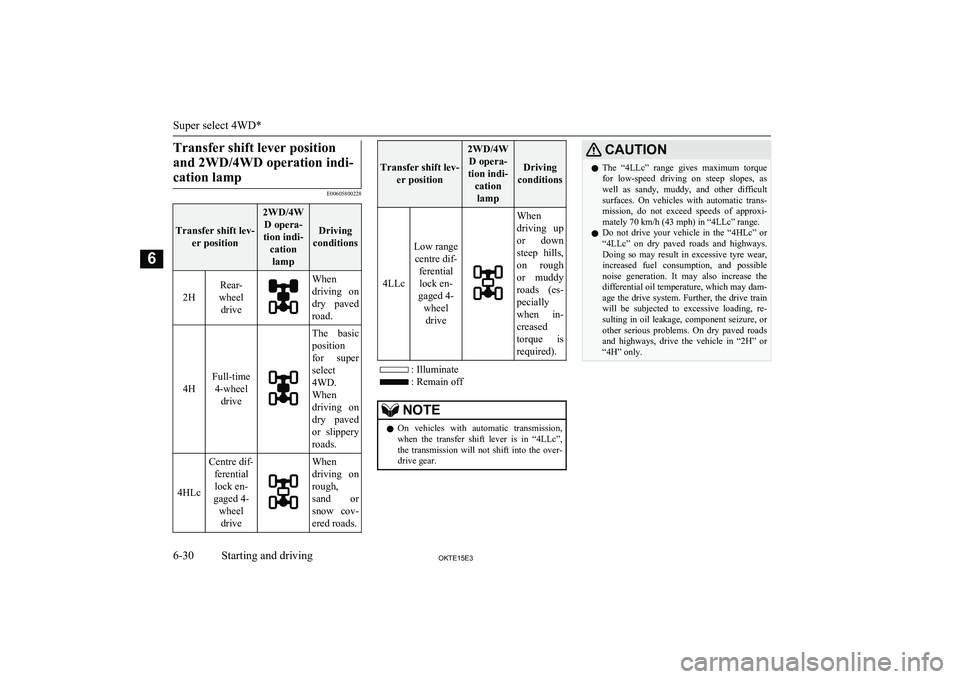
E00605800228
Transfer shift lev- er position
2WD/4WD opera-
tion indi- cationlamp
Driving
conditions2H
Rear-
wheel driveWhen
driving on
dry paved road.
4H
Full-time 4-wheel drive
The basic
position
for super select
4WD.
When
driving on
dry paved
or slippery roads.
4HLc
Centre dif- ferentiallock en-
gaged 4- wheeldriveWhen
driving on
rough,
sand or snow cov-ered roads.
Transfer shift lev- er position
2WD/4WD opera-
tion indi- cationlamp
Driving
conditions
4LLc
Low range centre dif- ferentiallock en-
gaged 4- wheeldrive
When
driving up
or down steep hills,on rough or muddy
roads (es- pecially
when in-
creased
torque is required).
: Illuminate
: Remain off
NOTEl On vehicles with automatic transmission,
when the transfer shift lever is in “4LLc”, the transmission will not shift into the over-drive gear.CAUTIONl The “4LLc” range gives maximum torque
for low-speed driving on steep slopes, as
well as sandy, muddy, and other difficult
surfaces. On vehicles with automatic trans- mission, do not exceed speeds of approxi- mately 70 km/h (43 mph) in “4LLc” range.
l Do not drive your vehicle in the “4HLc” or
“4LLc” on dry paved roads and highways. Doing so may result in excessive tyre wear, increased fuel consumption, and possible
noise generation. It may also increase the
differential oil temperature, which may dam- age the drive system. Further, the drive train will be subjected to excessive loading, re-
sulting in oil leakage, component seizure, or other serious problems. On dry paved roads
and highways, drive the vehicle in “2H” or
“4H” only.
Super select 4WD*
6-30OKTE15E3Starting and driving6
Page 171 of 418
CAUTIONlSelecting “4H” or “4L” position (easy select
4WD), “4HLc” or “4LLc” position (super
select 4WD) to drive on dry paved road will
increase the fuel consumption with possible noise generation and early tyre wear.
It may also increase the differential oil tem- perature, resulting in possible damage to the
driving system.
Further, the drive train will be subjected to excessive loading, possibly leading to oilleakage, component seizure, or other serious faults.
Driving on snowy or icy roads
Set the transfer shift lever to “4H” or “4L”
position (easy select 4WD), “4H” or “4HLc” position (super select 4WD) in accordance
with the road conditions, and then gradually
depress the accelerator pedal for a smooth start.
NOTEl The use of snow tyres and/or tyre chains is
recommended.
l Maintain a safe distance between vehicles,
avoid sudden braking, and use engine brak-
ing (downshifting).CAUTIONl Avoid sudden braking, sudden acceleration,
and sharp turning; such operations could
cause skidding and spinouts.
Driving on sandy or muddy
roads
Set the transfer shift lever to “4H” or “4L”
position (easy select 4WD), “4HLc” or “4LLc” position (super select 4WD) and then
gradually depress the accelerator pedal for a
smooth start. Keep the pressure on the accel-
erator pedal as constant as possible, and drive at low speed.
CAUTIONl Do not force the vehicle or drive recklessly
on sandy surfaces. In comparison with nor-
mal road surfaces, the engine and other
drive-system components are put under ex- cessive strain when driving on such a sur-
face, and this could lead to accidents.
l If any of following conditions occur while
the vehicle is being driven, immediately park your vehicle in a safe place and follow these procedures:
• The needle in the temperature gauge ap-
proaches the overheating zone.
Refer to “Engine overheating” on page
8-04.CAUTION• Automatic transmission fluid temperature
warning lamp comes on.
Refer to “When the A/T (automatic trans-
mission) fluid temperature warning lamp comes on” on page 6-23.WARNINGl When attempting to rock your vehicle out
of a stuck position, be sure that the area
around the vehicle is clear of people and physical objects. The rocking motion may
cause the vehicle to suddenly launch for- ward or backward, causing injury or damage to nearby people or objects.NOTEl Avoid sudden braking, acceleration, and
turning; such operations could result in thevehicle becoming stuck.
l If the vehicle becomes stuck in sandy or
muddy roads, it can often be moved a rock-
ing motion. Move the selector lever rhythmi- cally between the “D” (DRIVE) and “R”
(REVERSE) position (with M/T, between 1 st
and Reverse), while applying slight pressure
to the accelerator pedal.
4-wheel drive operation
6-39OKTE15E3Starting and driving6
Page 190 of 418
lBe sure that the driving speed does not
exceed the maximum speed for trailer
operation.
l To prevent shocks from the overrun
brake, depress the brake pedal lightly at first and then more strongly.
l To make full use of engine braking,
change to a lower gear before descend-
ing a slope.
l The body, brakes, clutch, and chassis
will be under additional strain when
towing a trailer.
l The heavier weight and higher rolling
and air resistance will increase fuel con- sumption.
Additional precautions for vehi-
cles equipped with an automatic
transmission
The 2 nd
gear (in “Sports mode”) is recom-
mended on slopes or at low speed. Use the 1 st
gear (in “Sports mode”) in mountainous areas
in order to make better use of engine braking and to assist the brake system. However, be
sure that the speed does not exceed the maxi- mum speed limit for the selected gear.
Trailer towing
6-58OKTE15E3Starting and driving6