air condition MITSUBISHI L200 2015 Owner's Manual (in English)
[x] Cancel search | Manufacturer: MITSUBISHI, Model Year: 2015, Model line: L200, Model: MITSUBISHI L200 2015Pages: 418, PDF Size: 25.8 MB
Page 6 of 418
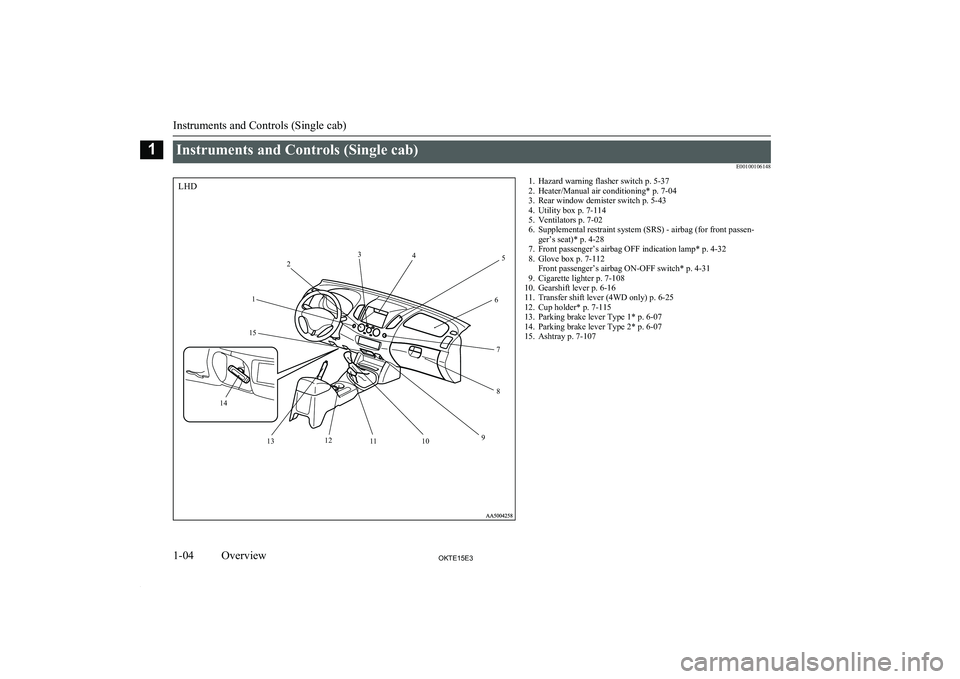
Instruments and Controls (Single cab)E001001061481. Hazard warning flasher switch p. 5-37
2. Heater/Manual air conditioning* p. 7-04
3. Rear window demister switch p. 5-43
4. Utility box p. 7-114
5. Ventilators p. 7-02
6. Supplemental restraint system (SRS) - airbag (for front passen- ger’s seat)* p. 4-28
7. Front passenger’s airbag OFF indication lamp* p. 4-32
8. Glove box p. 7-112 Front passenger’s airbag ON-OFF switch* p. 4-31
9. Cigarette lighter p. 7-108
10. Gearshift lever p. 6-16
11. Transfer shift lever (4WD only) p. 6-25
12. Cup holder* p. 7-115
13. Parking brake lever Type 1* p. 6-07
14. Parking brake lever Type 2* p. 6-07
15. Ashtray p. 7-107
Instruments and Controls (Single cab)
1-04OKTE15E3Overview112
3
4
5
6
78
9
10
11
12
13
14 15
LHD
Page 7 of 418
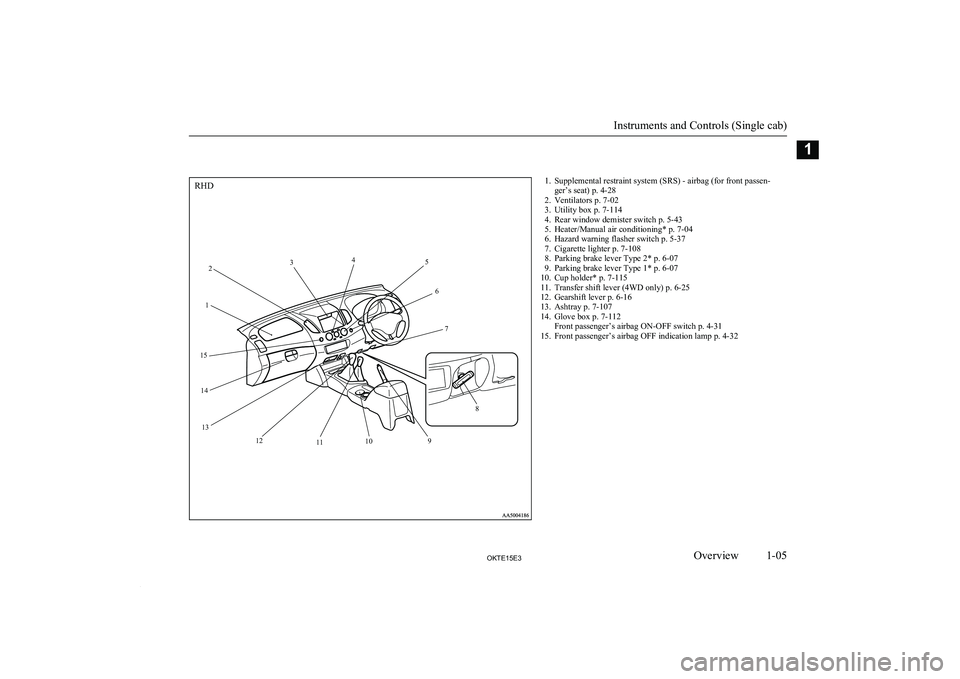
1. Supplemental restraint system (SRS) - airbag (for front passen-ger’s seat) p. 4-28
2. Ventilators p. 7-02
3. Utility box p. 7-114
4. Rear window demister switch p. 5-43
5. Heater/Manual air conditioning* p. 7-04
6. Hazard warning flasher switch p. 5-37
7. Cigarette lighter p. 7-108
8. Parking brake lever Type 2* p. 6-07
9. Parking brake lever Type 1* p. 6-07
10. Cup holder* p. 7-115
11. Transfer shift lever (4WD only) p. 6-25
12. Gearshift lever p. 6-16
13. Ashtray p. 7-107
14. Glove box p. 7-112 Front passenger’s airbag ON-OFF switch p. 4-31
15. Front passenger’s airbag OFF indication lamp p. 4-32
Instruments and Controls (Single cab)
1-05OKTE15E3Overview112
3
4
5
6
7
8
9
10
11
12
13
14
15
RHD
Page 8 of 418
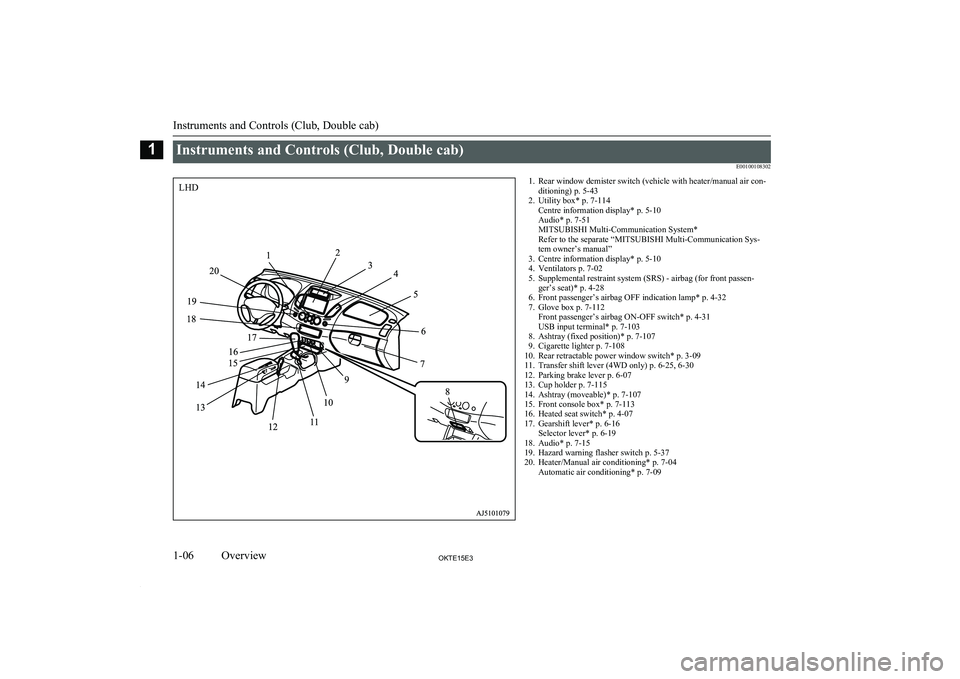
Instruments and Controls (Club, Double cab)E001001083021. Rear window demister switch (vehicle with heater/manual air con-ditioning) p. 5-43
2. Utility box* p. 7-114 Centre information display* p. 5-10
Audio* p. 7-51
MITSUBISHI Multi-Communication System*
Refer to the separate “MITSUBISHI Multi-Communication Sys-
tem owner’s manual”
3. Centre information display* p. 5-10
4. Ventilators p. 7-02
5. Supplemental restraint system (SRS) - airbag (for front passen- ger’s seat)* p. 4-28
6. Front passenger’s airbag OFF indication lamp* p. 4-32
7. Glove box p. 7-112 Front passenger’s airbag ON-OFF switch* p. 4-31
USB input terminal* p. 7-103
8. Ashtray (fixed position)* p. 7-107
9. Cigarette lighter p. 7-108
10. Rear retractable power window switch* p. 3-09
11. Transfer shift lever (4WD only) p. 6-25, 6-30
12. Parking brake lever p. 6-07
13. Cup holder p. 7-115
14. Ashtray (moveable)* p. 7-107
15. Front console box* p. 7-113
16. Heated seat switch* p. 4-07
17. Gearshift lever* p. 6-16 Selector lever* p. 6-19
18. Audio* p. 7-15
19. Hazard warning flasher switch p. 5-37
20. Heater/Manual air conditioning* p. 7-04 Automatic air conditioning* p. 7-09
Instruments and Controls (Club, Double cab)
1-06OKTE15E3Overview1LHD
Page 9 of 418
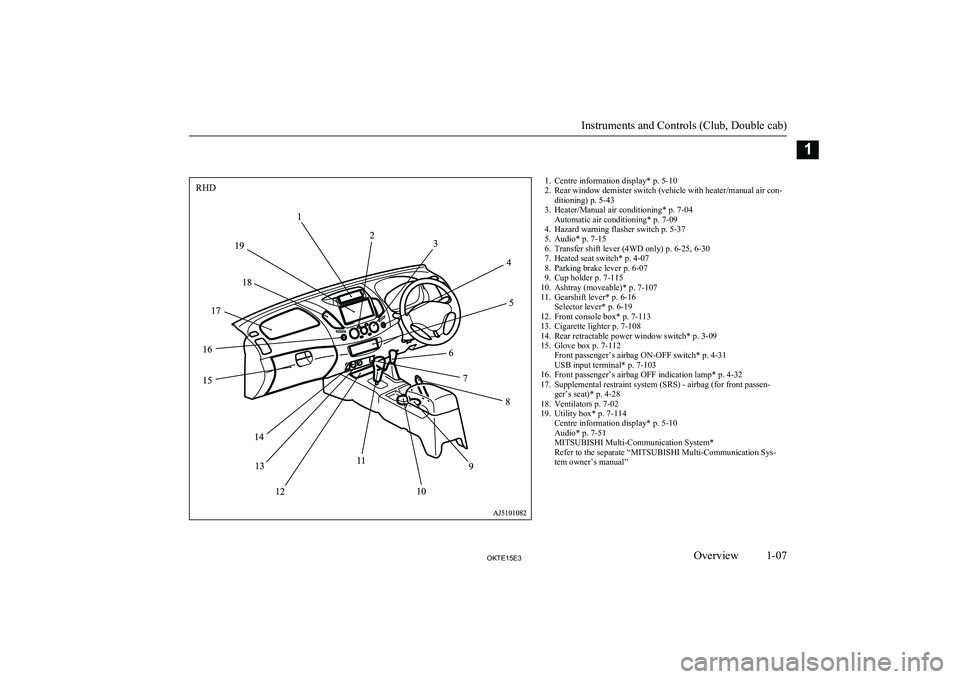
1. Centre information display* p. 5-10
2. Rear window demister switch (vehicle with heater/manual air con- ditioning) p. 5-43
3. Heater/Manual air conditioning* p. 7-04 Automatic air conditioning* p. 7-09
4. Hazard warning flasher switch p. 5-37
5. Audio* p. 7-15
6. Transfer shift lever (4WD only) p. 6-25, 6-30
7. Heated seat switch* p. 4-07
8. Parking brake lever p. 6-07
9. Cup holder p. 7-115
10. Ashtray (moveable)* p. 7-107
11. Gearshift lever* p. 6-16 Selector lever* p. 6-19
12. Front console box* p. 7-113
13. Cigarette lighter p. 7-108
14. Rear retractable power window switch* p. 3-09
15. Glove box p. 7-112 Front passenger’s airbag ON-OFF switch* p. 4-31
USB input terminal* p. 7-103
16. Front passenger’s airbag OFF indication lamp* p. 4-32
17. Supplemental restraint system (SRS) - airbag (for front passen- ger’s seat)* p. 4-28
18. Ventilators p. 7-02
19. Utility box* p. 7-114 Centre information display* p. 5-10
Audio* p. 7-51
MITSUBISHI Multi-Communication System*
Refer to the separate “MITSUBISHI Multi-Communication Sys-
tem owner’s manual”
Instruments and Controls (Club, Double cab)
1-07OKTE15E3Overview1RHD
Page 56 of 418
Seat beltsE00404800825
To protect you and your passengers in the event of an accident, it is most important thatthe seat belts are worn correctly while driv-ing.
A seat belt for a front seat equipped with an
airbag has a pretensioner system. These belts are used the same way as a conventional seatbelt.
Refer to “Seat belt pretensioner system and force limiter system” on page 4-13 .WARNINGl Always place the shoulder belt over your
shoulder and across your chest. Never put it behind you or under your arm.
l One seat belt should be used by only one
person. Doing otherwise can be danger-
ous.
l The seat belt will provide its wearer with
maximum protection if the recliner seat- back is placed in fully upright position.
When the seatback is reclined, there is
greater risk that the passenger will slide
under the belt, especially in a forward im- pact accident, and may be injured by the
belt or by striking the instrument panel or seatbacks.
l Seat belts should always be worn by every
adult who drives or rides in this vehicle, and by all children who are tall enough to
wear seat belts properly.WARNINGl Remove any twists when using the belt.
l No modifications or additions should be
made by the user which will either pre-
vent the seat belt adjusting devices from operating to remove slack, or prevent the
seat belt assembly from being adjusted to
remove slack.
l To reduce risk of serious or fatal injury in
an accident, including the deploying driv-
er’s airbag, adjust the driver’s seat as far back as possible while maintaining a posi- tion that still allows good visibility andgood control of the steering wheel, the
brake and accelerator, and vehicle con- trols.
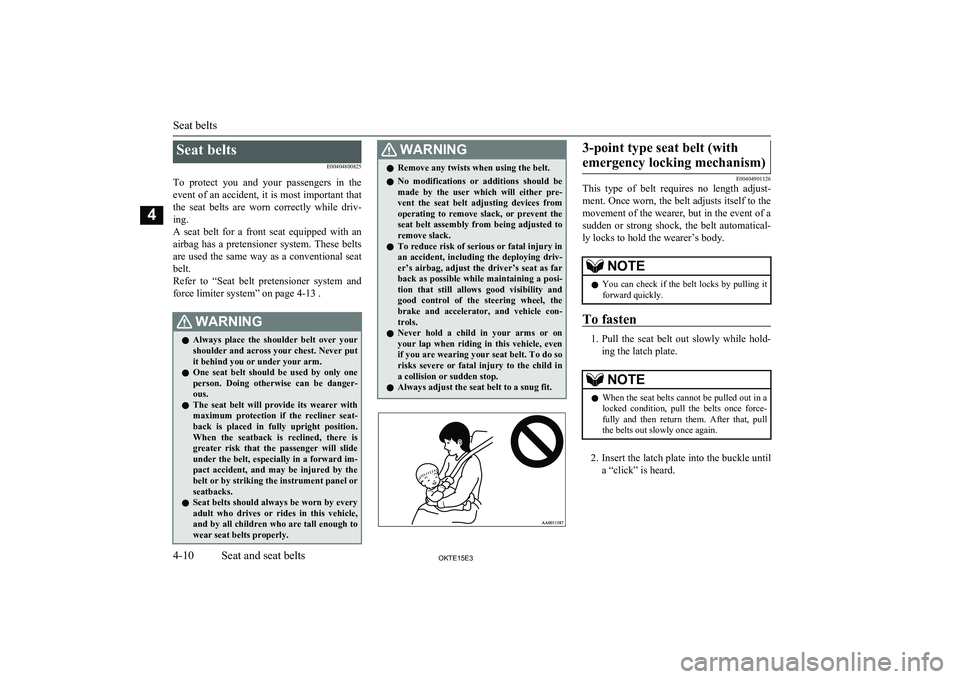
l Never hold a child in your arms or on
your lap when riding in this vehicle, even if you are wearing your seat belt. To do so
risks severe or fatal injury to the child in a collision or sudden stop.
l Always adjust the seat belt to a snug fit.3-point type seat belt (with
emergency locking mechanism)
E00404901126
This type of belt requires no length adjust-
ment. Once worn, the belt adjusts itself to the
movement of the wearer, but in the event of a sudden or strong shock, the belt automatical-
ly locks to hold the wearer’s body.
NOTEl You can check if the belt locks by pulling it
forward quickly.
To fasten
1. Pull the seat belt out slowly while hold-
ing the latch plate.
NOTEl When the seat belts cannot be pulled out in a
locked condition, pull the belts once force-
fully and then return them. After that, pull
the belts out slowly once again.
2. Insert the latch plate into the buckle until
a “click” is heard.
Seat belts
4-10OKTE15E3Seat and seat belts4
Page 76 of 418
WARNINGlOlder children should be seated, properly
wearing the seat belt, with an appropriatebooster seat if needed.Caution for installing the child
restraint on vehicles with a front passenger airbag
E00408800588
The label shown here is attached on vehicles with a front passenger airbag.
WARNINGl Extreme Hazard!
Do not use a rearward facing child re- straint on a seat protected by an airbag in
front of it!How the Supplemental Re-
straint System works
E00407301352
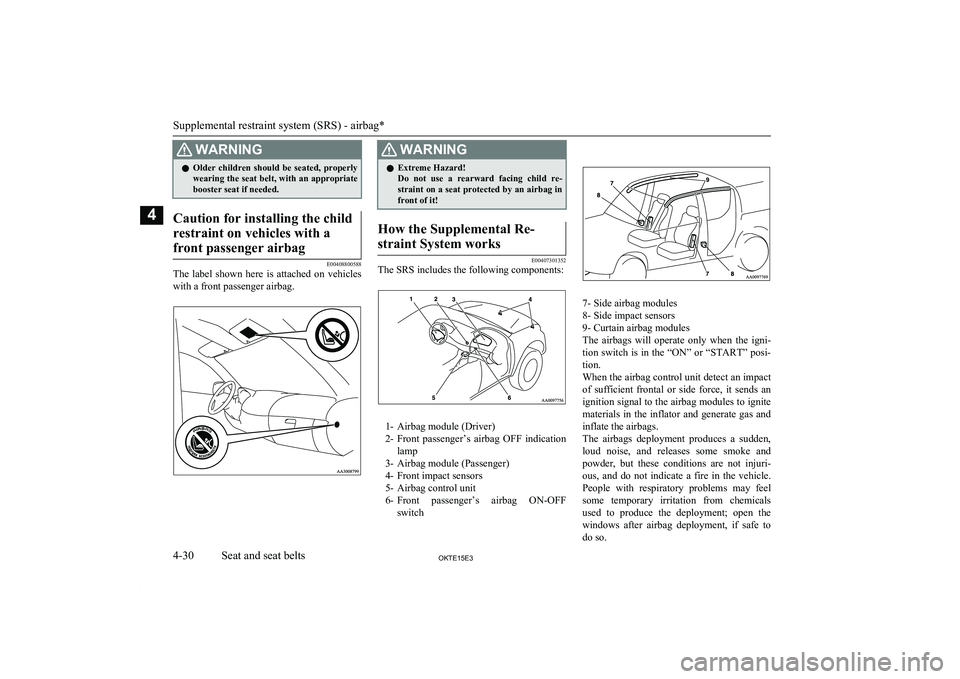
The SRS includes the following components:
1- Airbag module (Driver)
2- Front passenger’s airbag OFF indication
lamp
3- Airbag module (Passenger)
4- Front impact sensors
5- Airbag control unit
6- Front passenger’s airbag ON-OFF
switch
7- Side airbag modules
8- Side impact sensors
9- Curtain airbag modules
The airbags will operate only when the igni- tion switch is in the “ON” or “START” posi-
tion.
When the airbag control unit detect an impact of sufficient frontal or side force, it sends an
ignition signal to the airbag modules to ignite
materials in the inflator and generate gas and
inflate the airbags.
The airbags deployment produces a sudden, loud noise, and releases some smoke andpowder, but these conditions are not injuri-
ous, and do not indicate a fire in the vehicle. People with respiratory problems may feel
some temporary irritation from chemicals
used to produce the deployment; open the
windows after airbag deployment, if safe to do so.
Supplemental restraint system (SRS) - airbag*
4-30OKTE15E3Seat and seat belts4
Page 80 of 418
Head-on collision with a solid wall at speed of
approximately 25 km/h (16 mph) or higher Moderate to severe frontal impact within the shaded
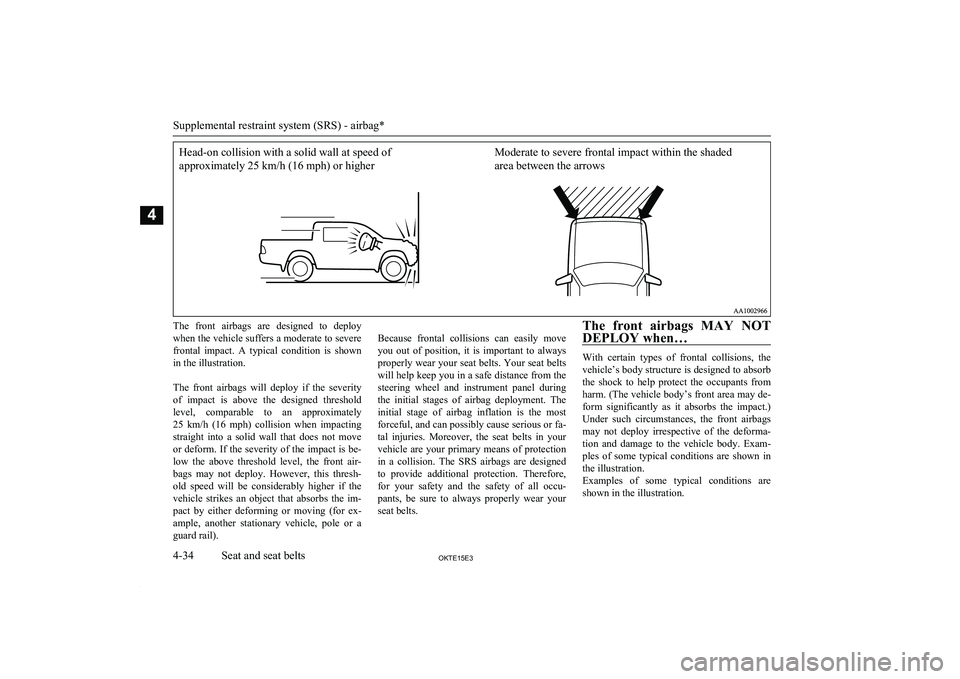
area between the arrowsThe front airbags are designed to deploy
when the vehicle suffers a moderate to severe frontal impact. A typical condition is shown
in the illustration.
The front airbags will deploy if the severity of impact is above the designed threshold level, comparable to an approximately
25 km/h (16 mph) collision when impacting
straight into a solid wall that does not move or deform. If the severity of the impact is be-low the above threshold level, the front air- bags may not deploy. However, this thresh-
old speed will be considerably higher if the
vehicle strikes an object that absorbs the im- pact by either deforming or moving (for ex-
ample, another stationary vehicle, pole or a
guard rail).
Because frontal collisions can easily move you out of position, it is important to always
properly wear your seat belts. Your seat belts will help keep you in a safe distance from thesteering wheel and instrument panel during
the initial stages of airbag deployment. The
initial stage of airbag inflation is the most
forceful, and can possibly cause serious or fa- tal injuries. Moreover, the seat belts in your
vehicle are your primary means of protection in a collision. The SRS airbags are designed
to provide additional protection. Therefore,
for your safety and the safety of all occu-
pants, be sure to always properly wear your seat belts.The front airbags MAY NOT
DEPLOY when…
With certain types of frontal collisions, the vehicle’s body structure is designed to absorbthe shock to help protect the occupants fromharm. (The vehicle body’s front area may de-form significantly as it absorbs the impact.) Under such circumstances, the front airbags
may not deploy irrespective of the deforma- tion and damage to the vehicle body. Exam-
ples of some typical conditions are shown in
the illustration.
Examples of some typical conditions are shown in the illustration.
Supplemental restraint system (SRS) - airbag*
4-34OKTE15E3Seat and seat belts4
Page 81 of 418
Because the front airbags do not protect theoccupant in all types of frontal collisions, be sure to always properly wear your seat belts.Collision with a utility pole, tree or other narrow objectsVehicle slides under the rear body of a truckOblique frontal impactsThe front airbags ARE NOT DESIGNED TO DEPLOYwhen…
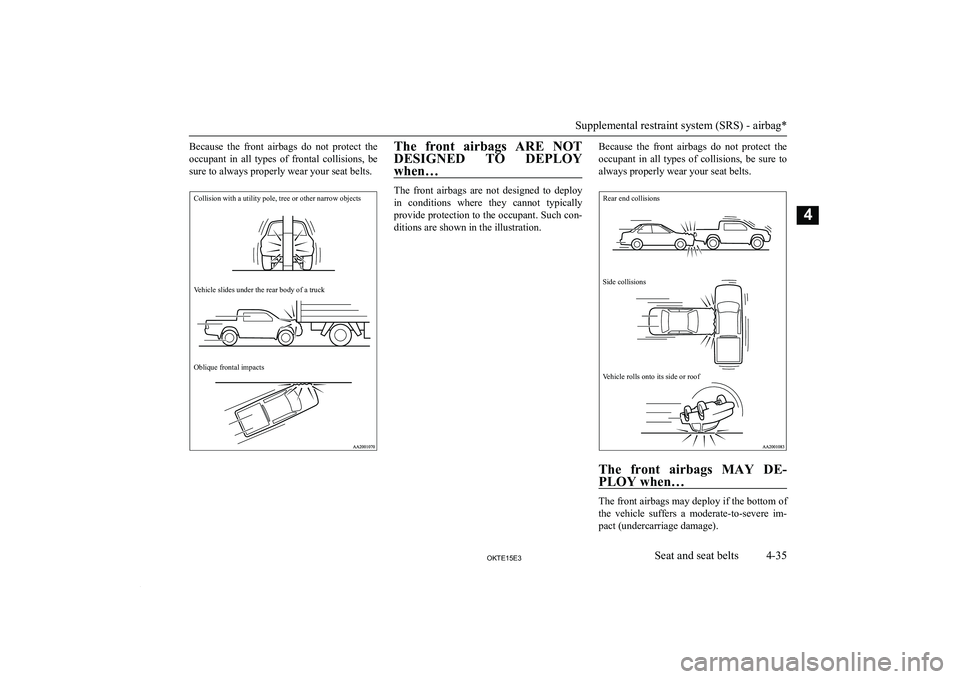
The front airbags are not designed to deploy
in conditions where they cannot typically
provide protection to the occupant. Such con-ditions are shown in the illustration.
Because the front airbags do not protect the occupant in all types of collisions, be sure to
always properly wear your seat belts.Rear end collisionsSide collisionsVehicle rolls onto its side or roof
The front airbags MAY DE- PLOY when…
The front airbags may deploy if the bottom ofthe vehicle suffers a moderate-to-severe im-
pact (undercarriage damage).
Supplemental restraint system (SRS) - airbag*
4-35OKTE15E3Seat and seat belts4
Page 82 of 418
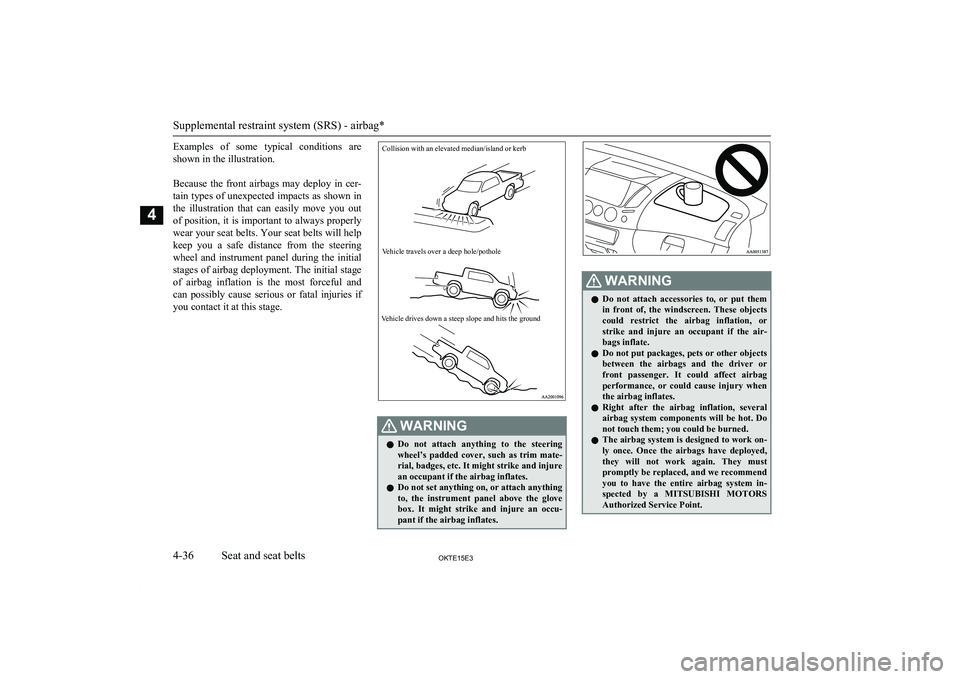
Examples of some typical conditions areshown in the illustration.
Because the front airbags may deploy in cer- tain types of unexpected impacts as shown in
the illustration that can easily move you out
of position, it is important to always properly wear your seat belts. Your seat belts will help
keep you a safe distance from the steering
wheel and instrument panel during the initial
stages of airbag deployment. The initial stage of airbag inflation is the most forceful andcan possibly cause serious or fatal injuries if
you contact it at this stage.
Collision with an elevated median/island or kerbVehicle travels over a deep hole/potholeVehicle drives down a steep slope and hits the ground
WARNINGl Do not attach anything to the steering
wheel’s padded cover, such as trim mate-
rial, badges, etc. It might strike and injure
an occupant if the airbag inflates.
l Do not set anything on, or attach anything
to, the instrument panel above the glove box. It might strike and injure an occu-
pant if the airbag inflates.WARNINGl Do not attach accessories to, or put them
in front of, the windscreen. These objects
could restrict the airbag inflation, or strike and injure an occupant if the air-
bags inflate.
l Do not put packages, pets or other objects
between the airbags and the driver orfront passenger. It could affect airbagperformance, or could cause injury when the airbag inflates.
l Right after the airbag inflation, several
airbag system components will be hot. Do
not touch them; you could be burned.
l The airbag system is designed to work on-
ly once. Once the airbags have deployed, they will not work again. They must
promptly be replaced, and we recommend
you to have the entire airbag system in- spected by a MITSUBISHI MOTORS
Authorized Service Point.
Supplemental restraint system (SRS) - airbag*
4-36OKTE15E3Seat and seat belts4
Page 83 of 418
Side airbag system
E00407600563
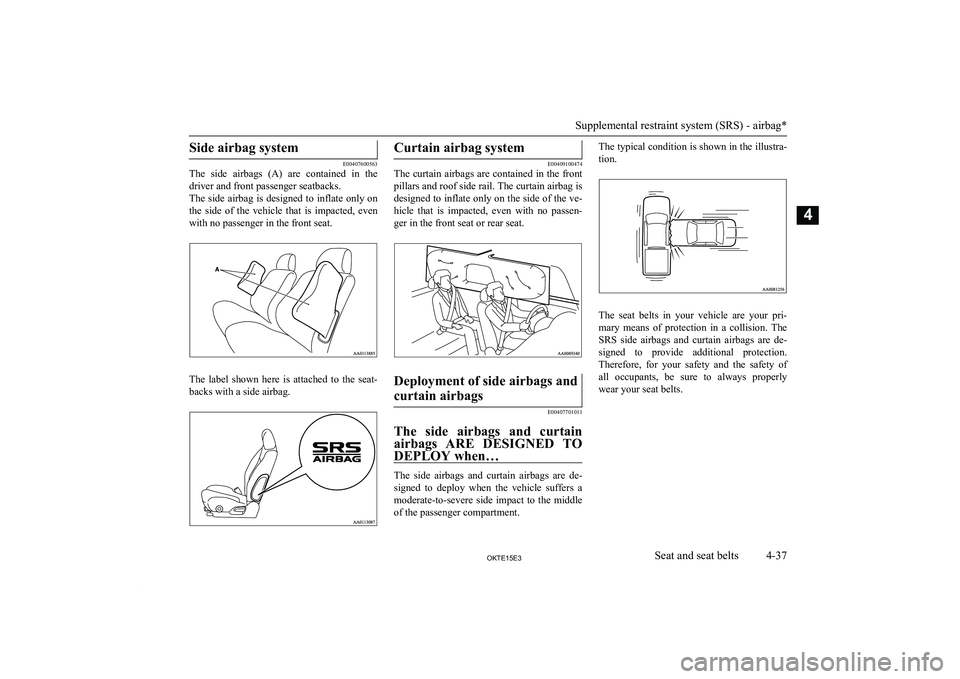
The side airbags (A) are contained in the
driver and front passenger seatbacks.
The side airbag is designed to inflate only on the side of the vehicle that is impacted, evenwith no passenger in the front seat.
The label shown here is attached to the seat- backs with a side airbag.
Curtain airbag system
E00409100474
The curtain airbags are contained in the front
pillars and roof side rail. The curtain airbag is
designed to inflate only on the side of the ve- hicle that is impacted, even with no passen- ger in the front seat or rear seat.
Deployment of side airbags and
curtain airbags
E00407701011
The side airbags and curtain airbags ARE DESIGNED TO
DEPLOY when…
The side airbags and curtain airbags are de- signed to deploy when the vehicle suffers a moderate-to-severe side impact to the middleof the passenger compartment.
The typical condition is shown in the illustra-
tion.
The seat belts in your vehicle are your pri- mary means of protection in a collision. The SRS side airbags and curtain airbags are de-
signed to provide additional protection. Therefore, for your safety and the safety of all occupants, be sure to always properly
wear your seat belts.
Supplemental restraint system (SRS) - airbag*
4-37OKTE15E3Seat and seat belts4