window MITSUBISHI LANCER 2014 8.G Workshop Manual
[x] Cancel search | Manufacturer: MITSUBISHI, Model Year: 2014, Model line: LANCER, Model: MITSUBISHI LANCER 2014 8.GPages: 434, PDF Size: 57.5 MB
Page 387 of 434
For cold and snowy weather 9-28 Vehicle care and maintenance
9
N00942500114
The hood lock release mechanism and hood safety catch should be checked, cleaned, and oiled when needed for easy movement and to stop rust and wear. Use Multipurpose GreaseNLGI Grade 2 sparingly for all sliding parts of the hood latch and release lever. Work the grease into the hood lock mechanism until allthe movable surfaces are covered.Also, put a light coat of the same grease on the safety catch wherever moving parts touch.
N00942600102
The ventilation slots in front of the wind-shield should be brushed clear after a heavy snowfall so that the operation of the heatingand ventilation systems will not be impaired. To prevent freezing of the weatherstripping on the doors, engine hood, etc., they should be treated with silicone grease.
It is a good idea to carry a shovel or a short- handled spade in the vehicle during the win- ter so that you can clear away snow if you getstranded. A small hand-brush for sweeping snow off the vehicle and a plastic scraper for the windshield, side and rear window are alsouseful.
N00942700259
The fusible links will melt
to prevent a fire if
a large current attempts to flow through cer-tain electrical systems. In case of a melted fusible link, see your authorized Mitsubishi Motors dealer or arepair facility of your choice for inspection and replacement. For the fusible links, please refer to “Fuseload capacities” on page 9-29.
N00942800801
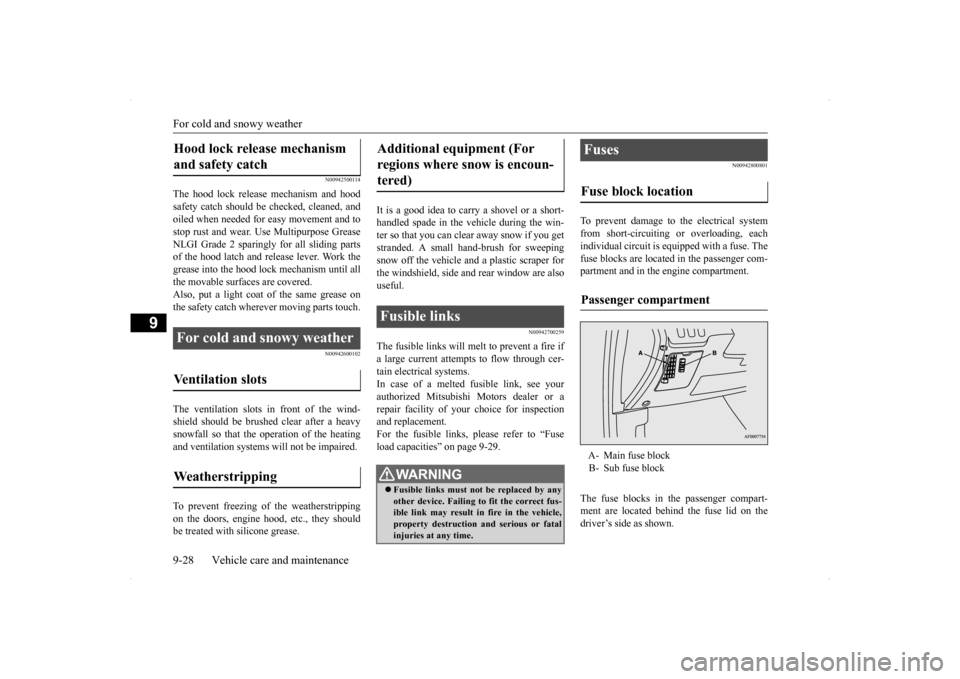
To prevent damage to the electrical systemfrom short-circuiting or overloading, eachindividual circuit is equipped with a fuse. The fuse blocks are located in the passenger com- partment and in the engine compartment. The fuse blocks in the passenger compart- ment are located behind the fuse lid on the driver’s side as shown.
Hood lock release mechanism and safety catch For cold and snowy weather Ventilation slots Weatherstripping
Additional equipment (For regions where snow is encoun- tered) Fusible links
WA R N I N G Fusible links must not be replaced by any other device. Failing to fit the correct fus- ible link may result in fire in the vehicle,property destruction and serious or fatal injuries at any time.
Fuses Fuse block location Passenger compartment A- Main fuse block B- Sub fuse block
Page 389 of 434
Fuses 9-30 Vehicle care and maintenance
9
* - Fusible link Some fuses may not be installed on your vehicle, depending on the vehicle model or specifications. The table above shows the main equip- ment corresponding to each fuse.
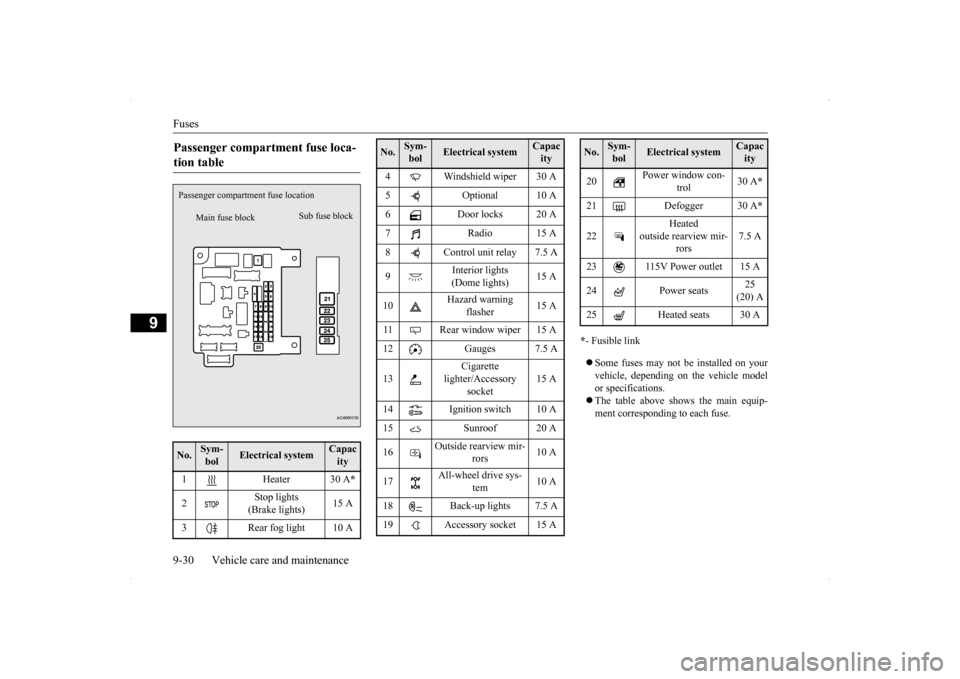
Passenger compartment fuse loca- tion table No.
Sym- bol
Electrical system
Capacity
1 Heater 30 A
*
2
Stop lights (Brake lights)
15 A
3 Rear fog light 10 A
Main fuse block
Sub fuse block
Passenger compartme
nt fuse location
4 Windshield wiper 30 A 5 Optional 10 A 6 Door locks 20 A 7 Radio 15 A8 Control unit relay 7.5 A 9
Interior lights (Dome lights)
15 A
10
Hazard warning
flasher
15 A
11 Rear window wiper 15 A 12 Gauges 7.5 A 13
Cigarette
lighter/Accessory
socket
15 A
14 Ignition switch 10 A 15 Sunroof 20 A 16
Outside rearview mir-
rors
10 A
17
All-wheel drive sys-
tem
10 A
18 Back-up lights 7.5 A 19 Accessory socket 15 ANo.
Sym- bol
Electrical system
Capacity
20
Power window con-
trol
30 A
*
21 Defogger 30 A
*
22
Heated
outside rearview mir-
rors
7.5 A
23 115V Power outlet 15 A 24 Power seats
25 (20) A
25 Heated seats 30 ANo.
Sym- bol
Electrical system
Capacity
Page 393 of 434
Replacement of light bulbs 9-34 Vehicle care and maintenance
9
N00943000099
The bulb should only be replaced with a new bulb with the same ra
ting and type. The type
and rating are listed on the base of the bulb.
N00950300805
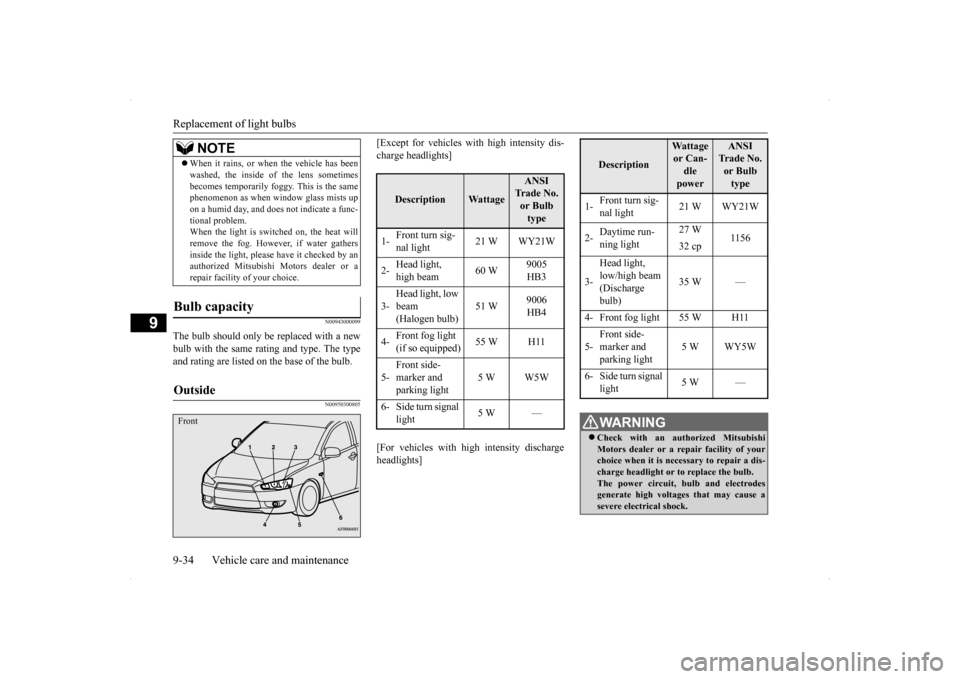
[Except for vehicles with high intensity dis-charge headlights] [For vehicles with high intensity discharge headlights]
When it rains, or when the vehicle has been washed, the inside of the lens sometimes becomes temporarily foggy. This is the same phenomenon as when window glass mists up on a humid day, and does not indicate a func-tional problem. When the light is switched on, the heat will remove the fog. However, if water gathersinside the light, please have it checked by an authorized Mitsubishi Motors dealer or a repair facility of your choice.
Bulb capacity Outside
NOTE
Front
Description
Wattage
ANSI Trade No. or Bulb type
1-
Front turn sig- nal light
21 W WY21W
2-
Head light, high beam
60 W
9005 HB3
3-
Head light, low beam (Halogen bulb)
51 W
9006 HB4
4-
Front fog light (if so equipped)
55 W H11
5-
Front side- marker and parking light
5 W W5W
6- Side turn signal
light
5 W —
Description
Wattage or Can- dle power
ANSI Trade No. or Bulb type
1-
Front turn sig- nal light
21 W WY21W
2-
Daytime run- ning light
27 W
1156
32 cp
3-
Head light, low/high beam (Discharge bulb)
35 W —
4- Front fog light 55 W H11 5-
Front side- marker and parking light
5 W WY5W
6- Side turn signal
light
5 W —
WA R N I N G Check with an authorized Mitsubishi Motors dealer or a repair facility of yourchoice when it is necessary to repair a dis- charge headlight or to replace the bulb. The power circuit, bulb and electrodesgenerate high voltages that may cause a severe electrical shock.
Page 407 of 434
Vehicle care precautions 9-48 Vehicle care and maintenance
9
N00944800094
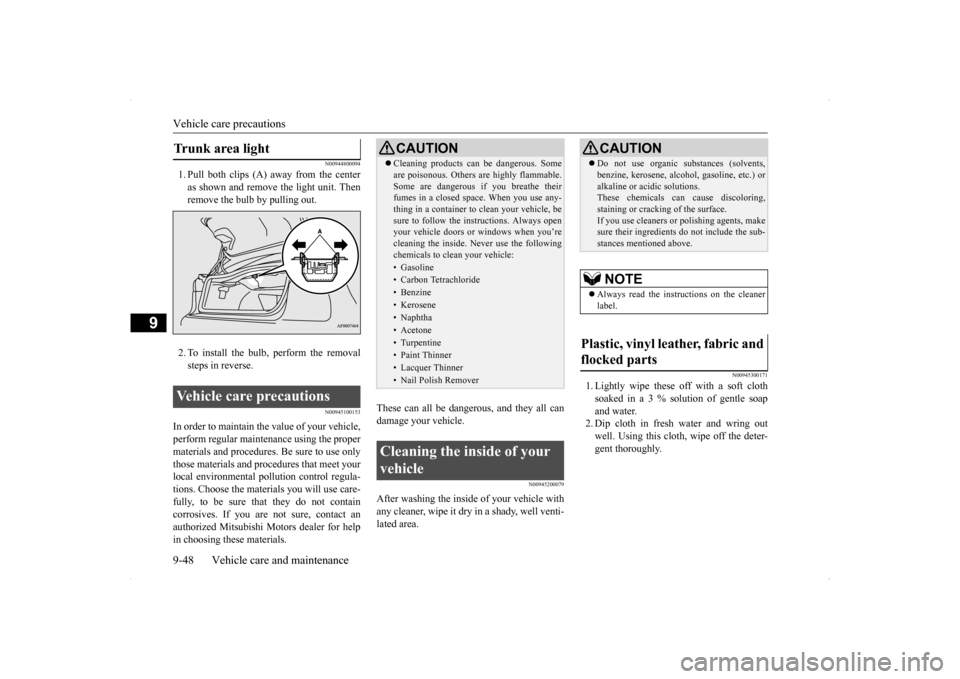
1. Pull both clips (A) away from the center as shown and remove the light unit. Thenremove the bulb by pulling out. 2. To install the bulb, perform the removal steps in reverse.
N00945100153
In order to maintain the value of your vehicle, perform regular maintenance using the proper materials and procedures. Be sure to use only those materials and procedures that meet yourlocal environmental pollution control regula- tions. Choose the materials you will use care- fully, to be sure that they do not containcorrosives. If you are not sure, contact an authorized Mitsubishi Motors dealer for help in choosing these materials.
These can all be dangerous, and they all can damage your vehicle.
N00945200079
After washing the inside of your vehicle withany cleaner, wipe it dry in a shady, well venti-lated area.
N00945300171
1. Lightly wipe these off with a soft clothsoaked in a 3 % solution of gentle soapand water. 2. Dip cloth in fresh water and wring out well. Using this cloth, wipe off the deter-gent thoroughly.
Trunk area light Vehicle care precautions
CAUTION Cleaning products can be dangerous. Some are poisonous. Others are highly flammable. Some are dangerous if you breathe their fumes in a closed space. When you use any- thing in a container to clean your vehicle, besure to follow the instructions. Always open your vehicle doors or windows when you’re cleaning the inside. Never use the followingchemicals to clean your vehicle:• Gasoline• Carbon Tetrachloride• Benzine• Kerosene• Naphtha• Acetone• Turpentine• Paint Thinner• Lacquer Thinner• Nail Polish Remover
Cleaning the inside of your vehicle
CAUTION Do not use organic substances (solvents, benzine, kerosene, alcohol, gasoline, etc.) or alkaline or acidic solutions. These chemicals can cause discoloring, staining or cracking of the surface.If you use cleaners or polishing agents, make sure their ingredients do not include the sub- stances mentioned above.NOTE
Always read the instructions on the cleaner label.
Plastic, vinyl leather, fabric and flocked parts
Page 411 of 434
Cleaning the outside of your vehicle 9-52 Vehicle care and maintenance
9
N00946400065
To prevent spots and corrosion of chrome parts, wash with water, dry thoroughly, and apply a nonabrasive automotive wax. If thechrome is severely damaged or pitted, use a commercially available chrome polish.
N00946500196
1. Remove dirt using a wet sponge. 2. Use a mild detergent on any dirt that can-not be removed easily with water. Rinse off the detergent after washing the wheel.3. Dry the wheel thoroug
hly using a chamois
leather or a soft cloth.
N00946600067
The window glass can usually be cleaned using only a sponge and water. Glass cleanercan be used to remove
wax, oil, grease, dead
insects, etc. After washing the glass, wipe it dry with a clean, dry, soft cloth.
N00946700097
Use a soft cloth and glass cleaner to removegrease, dead insects, etc., from the wiperblades. Replace the wiper blades when they no longer clean the windshield and rear window prop-erly.
N00946800072
Clean the inside of the sunroof with a soft cloth. Hard deposits should be wiped away with a cloth dipped in warm, neutral deter-gent solution. Wipe away the solution with a sponge dipped in fresh water.
N00947000042
Never spray or splash water on the electricalcomponents in the engine compartment, as this may cause damage.Do not allow any nearby parts (such as plastic parts) come into contact with sulphuric acid (battery electrolyte), which may crack, stain,or discolour them. If this occurs, wipe the parts with a soft cloth saturated with a mild detergent and watersolution. Then immediately rinse the affected parts with plenty of water.
Do not let the plastic parts get soiled with gasoline, oil, brake fluids, engine oils, greases, paint thinner, and sulfuric acid (bat- tery electrolyte). These fluids, etc., may crack, stain or discolor the plastic parts.If any of these get on the plastic parts, wipe them up with a soft cloth or chamois and a mild solution of soap and water. Then rinsethem immediately with water.
Chrome parts Aluminum wheels (if so equipped)
CAUTION
CAUTION Do not use a brush or other hard implement on the wheels. Doing so could scratch the wheels. Do not use any cleaner that contains an abra- sive substance or is acidic or alkaline. Doing so could cause the coating on the wheels to peel or become discolored or stained. Do not directly apply hot water using a steam cleaner or by any other means. Contact with seawater or road salt used for de-icing can cause corrosion. Rinse off suchsubstances as soon as possible.
Window glass Wiper blades
Cleaning the sunroof
(if so
equipped)
NOTE
The surface treatment on the inside of the glass may be removed if a hard cloth or organic solvent is used.
Engine compartment
Page 427 of 434

Alphabetical index 12-2
12
Coming home light
...........................
5-153
Consumer information
........................
10-2
Continuously variable transmission (CVT)
....
5-62Fluid
.....................
...............
9-11
, 11-6
Selector lever operation
...................
5-63
Sports mode
..................
.................
5-67
Coolant (engine)
..........................
9-8
, 11-6
Cruise control
....................
.................
5-99
Indicator
...................
...................
5-100
Cup holder
....................
...................
5-192
D
Daytime running lights
Bulb capacity
................
.................
9-34
Replacement
.................
.................
9-38
Defogger (rear window)
....................
5-160
Defrosting or defogging (windshield, door windows)
...............
7-12
, 7-17
, 7-22
, 7-27
Digital clock
Time setting
..................
.................
7-59
Dimensions
...................
.....................
11-4
Dimmer (high/low beam change)
.......
5-152
Disc brake pads
.................
.................
9-27
Dome light
Bulb capacity
................
.................
9-35
Replacement
.................
.................
9-47
Switch
......................
...................
5-189
Dome light/Reading lights
Bulb capacity
..................
................
9-35
Replacement
...................
................
9-46
Switch
.....................
.....................
5-188
Doors
Lock
.......................
.......................
5-36
Power door locks
............................
5-38
Drive mode indicator
...........................
5-86
Drive mode-selector
............................
5-85
Driving during cold weather
..................
6-4
Driving, alcohol and drugs
....................
6-2
E
Electric rear window defogger switch
..5-160
Electronic immobilizer (Anti-theft starting system)
.....................
................
5-4
, 5-28
Electronically controlled 4WD system
..5-85
Drive mode indicator
.......................
5-86
Drive mode-selector
........................
5-85
Emergency key
...................
................
5-23
Emission-control system maintenance
...
9-25
Engine
Compartment
..................
.................
9-5
Coolant
...................
................
9-8
, 11-6
Hood
.......................
........................
9-3
Oil and oil filter
.......................
9-6
, 11-6
Overheating
....................
.................
8-4
Serial number
.................
................
11-2
Specifications
.................
................
11-5
Engine coolant temperature display
....
5-119
Exhaust system
..................
.................
9-27
F
Filling the fuel tank
...............
................
3-4
Floor console box
.............................
5-192
Floor mat
......................
.......................
6-2
Fluid
..........................
........................
11-6
AWC control fluid
..........................
9-12
Brake fluid
............................
9-13
, 11-6
Clutch fluid
...........................
9-13
, 11-6
Continuously variable transmission (CVT) fluid
....................
...............
9-11
, 11-6
Engine coolant
........................
9-8
, 11-6
Power steering fluid
...............
9-14
, 11-6
Twin Clutch Sportron
ic shift transmission
(Twin Clutch SST) fluid
.......
9-11
, 11-6
Washer fluid
.................
.................
11-6
Fluid capacities and lubricants
.............
11-6
Fog lights
Bulb capacity
................
.................
9-34
Indicator
...................
...................
5-145
Replacement
.........................
9-41
, 9-42
Switch
......................
...................
5-156
Free-hand advanced security transmitter (F.A.S.T.-key)
.................
.................
5-12
Front console boxes
..........................
5-191
Front console tray
.............................
5-191
Front seats
.........................
...................
4-3
Page 429 of 434

Alphabetical index 12-4
12
Shift points (recommended speed)
....
5-61
Mirror
Inside day/night rearview mirror
......
5-51
Outside rearview mirrors
.................
5-53
Modifications to and racing of your vehicle
...
3-5 Multi-information display
..................
5-112
O
Octane requirement
...............
................
3-2
Oil
Engine oil
...............................
9-6
, 11-6
Manual transaxle oil
..............
9-11
, 11-6
Rear axle oil
..................
.................
9-12
Transfer oil
...................
.................
9-12
Operation under adverse driving conditions
...
8-15 Outside rearview mirrors
.....................
5-53
Overheating
......................
...................
8-4
P
Parking
.........................
.......................
6-6
Parking brake
................
.................
5-49
Parking brake lever stroke
...............
9-24
Polishing
.......................
.....................
9-51
Power brakes
.....................
.................
5-90
Power door locks
...............
.................
5-38
Power steering
Fluid
....................
.................
9-14
, 11-6
System
........................
...................
5-98
Power windows
...................
................
5-45
Puncture (Tire changing)
.......................
8-6
R
Radiator cap
....................
....................
9-9
Radio
General information about your radio 7-63
Rain sensor
..................
.....................
5-157
Rear axle oil
....................
...................
9-12
Rear side-marker lights
Bulb capacity
..................
................
9-34
Replacement
...................
................
9-44
Rear turn signal lights
Bulb capacity
..................
................
9-34
Replacement
...................
................
9-44
Rear window defogger switch
............
5-160
Rear-view camera
.............................
5-108
Rearview mirror
Inside
......................
.......................
5-51
Outside
.......................
...................
5-53
Refrigerant (air conditioning)
...............
11-6
Replacement of light bulbs
...................
9-33
Replacing tires and wheels
...................
9-22
Reporting Safety Defects
.....................
10-2
Roof antenna
.............................
7-62
, 7-63
S
Safe driving techniques
.........................
6-4
Seat
...........................
..........................
4-2
Arm rest
.......................
...................
4-6
Front seats
....................
...................
4-3
Heated seats
.....................
................
4-5
Rear seats
.....................
...................
4-5
Seats and restraint systems
................
4-2
Seat belt
........................
.......................
4-8
Adjustable seat belt shoulder anchor
.4-12
Child restraint
...............
.................
4-14
Driver’s seat belt reminder/warning
..4-11
Force limiter
.................
.................
4-14
Front passenger seat belt warning light
.....
4-12Maintenance and inspection
.............
4-21
Pre-tensioner
.................
.................
4-13
Seat belt extender
...........................
4-13
Seat belt instructions
.........................
4-9
Seat belt use during pregnancy
.........
4-13
Service brake
.....................
.................
5-90
Service precautions
...............
................
9-2
Snow tires
.....................
.....................
9-24
Spark plugs
...................
.....................
9-26
Steering
Power steering fluid
...............
9-14
, 11-6
Tilt lock lever
................
.................
5-51
Wheel lock
............................
5-20
, 5-56
Storage spaces
...................
...............
5-190