ECU MITSUBISHI LANCER 2015 8.G User Guide
[x] Cancel search | Manufacturer: MITSUBISHI, Model Year: 2015, Model line: LANCER, Model: MITSUBISHI LANCER 2015 8.GPages: 434, PDF Size: 16.59 MB
Page 46 of 434
Child restraint systems
Seat and restraint systems 4-17
4
N00418800131
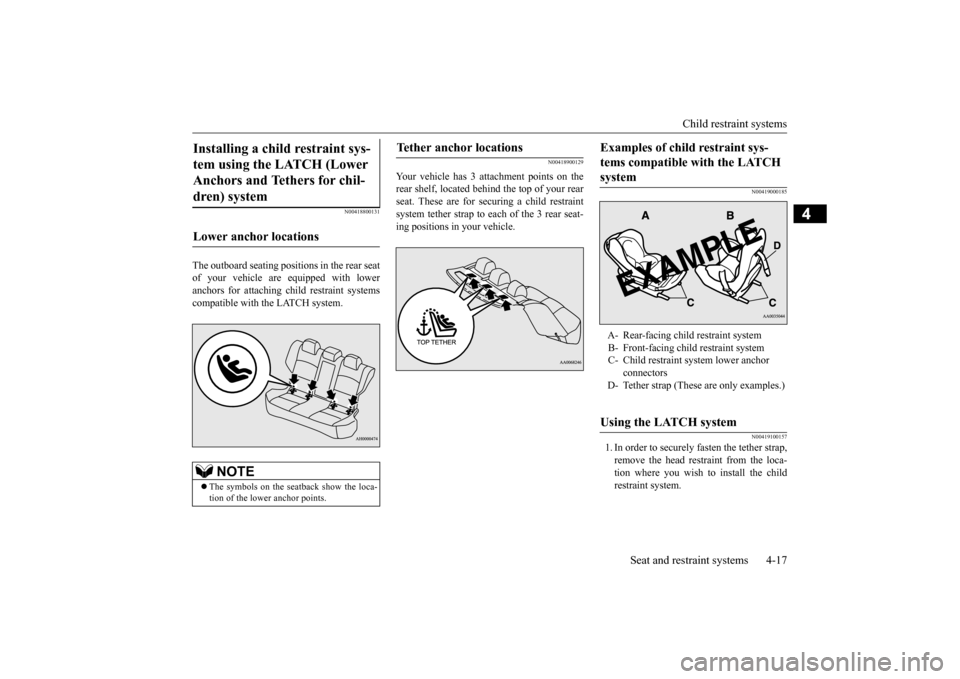
The outboard seating positions in the rear seat of your vehicle are equipped with loweranchors for attaching child restraint systemscompatible with the LATCH system.
N00418900129
Your vehicle has 3 attachment points on therear shelf, located behind the top of your rearseat. These are for securing a child restraint system tether strap to each of the 3 rear seat- ing positions in your vehicle.
N00419000185 N00419100157
1. In order to securely fasten the tether strap, remove the head restraint from the loca- tion where you wish to install the child restraint system.
Installing a child restraint sys- tem using the LATCH (Lower Anchors and Tethers for chil- dren) system Lower anchor locations
NOTE
The symbols on the seatback show the loca- tion of the lower anchor points.
Tether anchor locations
Examples of child restraint sys- tems compatible with the LATCH system A- Rear-facing child restraint system B- Front-facing child restraint systemC- Child restraint system lower anchor
connectors
D- Tether strap (These are only examples.)Using the LATCH system
BK0210300US.bo
ok 17 ページ 2014年4月8日 火曜日 午前10時46分
Page 47 of 434
Child restraint systems 4-18 Seat and restraint systems
4
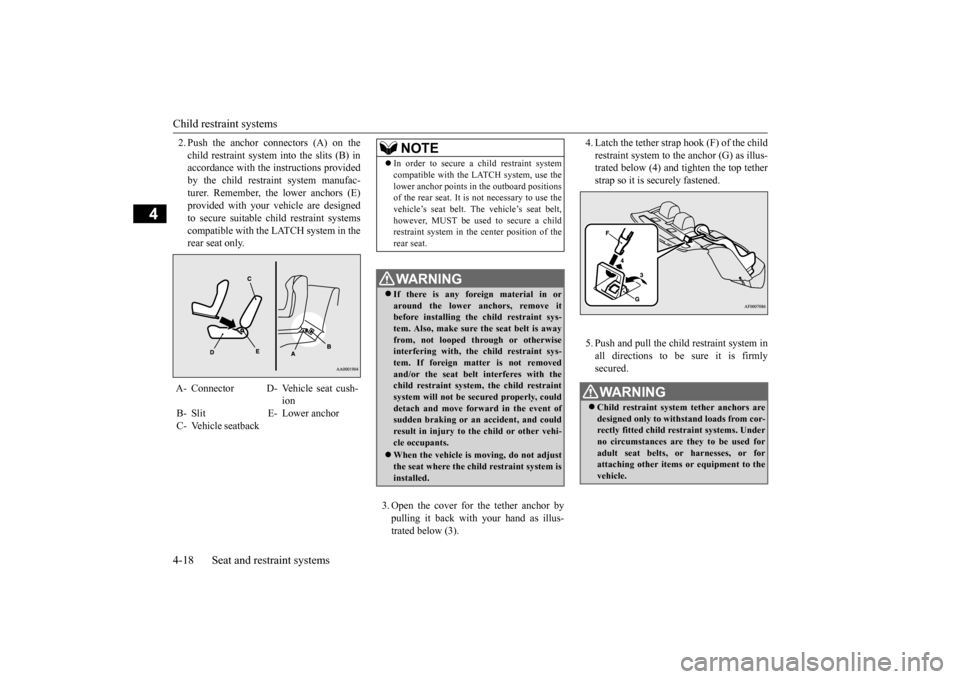
2. Push the anchor connectors (A) on the child restraint system into the slits (B) in accordance with the instructions provided by the child restraint system manufac-turer. Remember, the lower anchors (E) provided with your vehicle are designed to secure suitable child restraint systemscompatible with the LATCH system in the rear seat only.
3. Open the cover for the tether anchor by pulling it back with your hand as illus-trated below (3).
4. Latch the tether strap hook (F) of the child restraint system to the anchor (G) as illus- trated below (4) and tighten the top tether strap so it is securely fastened. 5. Push and pull the ch
ild restraint system in
all directions to be sure it is firmlysecured.
A- Connector D- Vehicle seat cush-
ion
B- Slit E- Lower anchorC- Vehicle seatback
NOTE
In order to secure a child restraint system compatible with the LATCH system, use the lower anchor points in the outboard positions of the rear seat. It is not necessary to use the vehicle’s seat belt. The vehicle’s seat belt,however, MUST be used to secure a child restraint system in the center position of the rear seat.WA R N I N G If there is any foreign material in or around the lower anchors, remove it before installing the child restraint sys-tem. Also, make sure the seat belt is away from, not looped through or otherwise interfering with, the child restraint sys-tem. If foreign matter is not removed and/or the seat belt interferes with the child restraint system, the child restraintsystem will not be secured properly, could detach and move forward in the event of sudden braking or an accident, and couldresult in injury to the child or other vehi- cle occupants. When the vehicle is moving, do not adjust the seat where the child restraint system isinstalled.
WA R N I N G Child restraint system tether anchors are designed only to withstand loads from cor-rectly fitted child restraint systems. Under no circumstances are they to be used for adult seat belts, or harnesses, or forattaching other items or equipment to the vehicle.
BK0210300US.bo
ok 18 ページ 2014年4月8日 火曜日 午前10時46分
Page 48 of 434
Child restraint systems
Seat and restraint systems 4-19
4
N00407301508
With the exception of the driver, the seat belt in all other seating positions can be convertedfrom normal Emergency Locking Retractor (ELR) mode to Automatic Locking Retractor (ALR) mode. This means that when you pullthe seat belt fully out of the retractor, theretractor will switch to its ALR child restraint installation function. Always use the ALR child restraint installation function when youinstall a child restraint system using the seat belt. Children 12 years old and under should always be restrained in the rear seat, when-ever possible, although the front passenger seat belt can also be converted to ALR mode.
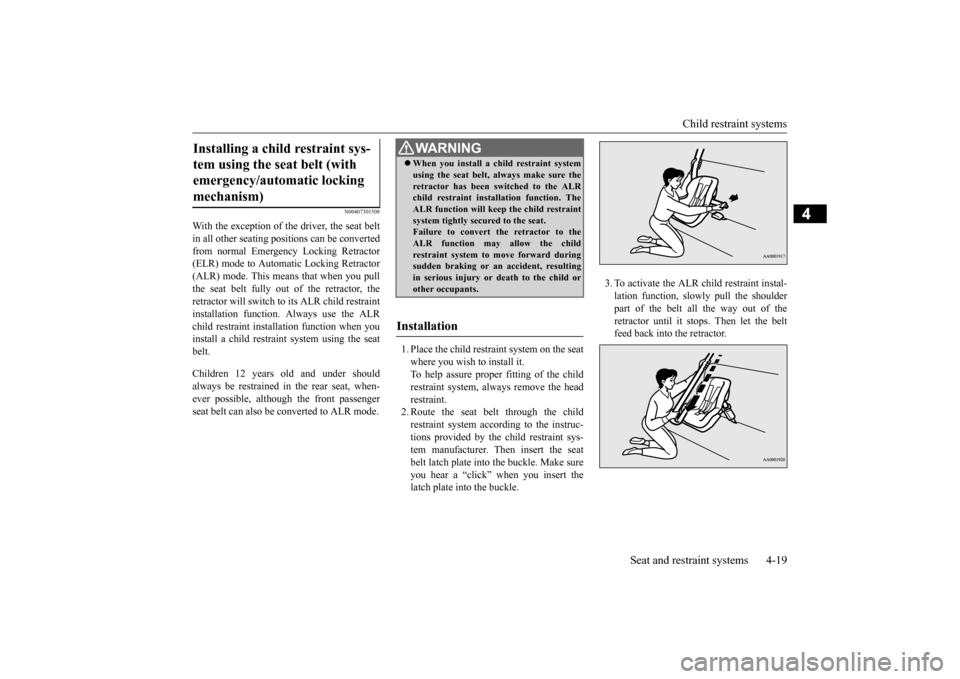
1. Place the child restraint system on the seat where you wish to install it. To help assure proper fitting of the childrestraint system, always remove the head restraint. 2. Route the seat belt through the childrestraint system according to the instruc- tions provided by the child restraint sys- tem manufacturer. Then insert the seatbelt latch plate into the buckle. Make sure you hear a “click” when you insert the latch plate into the buckle.
3. To activate the ALR child restraint instal- lation function, slowly pull the shoulder part of the belt all the way out of theretractor until it stops. Then let the belt feed back into the retractor.
Installing a child restraint sys- tem using the seat belt (with emergency/automatic locking mechanism)
WA R N I N G When you install a child restraint system using the seat belt, always make sure the retractor has been switched to the ALR child restraint installation function. The ALR function will keep the child restraintsystem tightly secured to the seat. Failure to convert the retractor to the ALR function may allow the childrestraint system to move forward during sudden braking or an accident, resulting in serious injury or death to the child orother occupants.
Installation
BK0210300US.bo
ok 19 ページ 2014年4月8日 火曜日 午前10時46分
Page 49 of 434
Child restraint systems 4-20 Seat and restraint systems
4
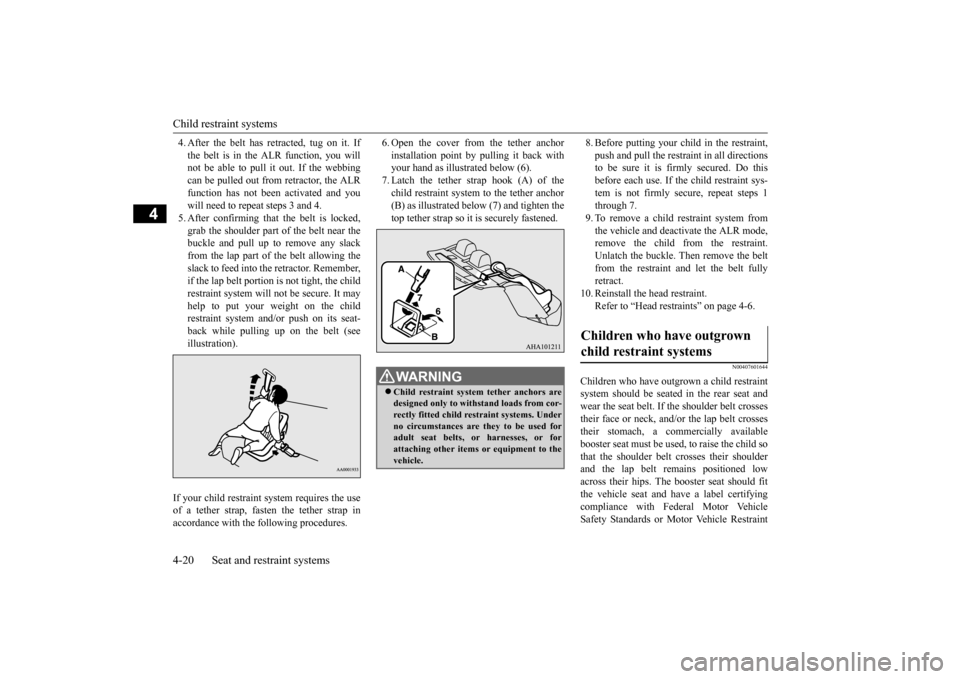
4. After the belt has retracted, tug on it. If the belt is in the ALR function, you will not be able to pull it out. If the webbing can be pulled out from retractor, the ALRfunction has not been activated and you will need to repeat steps 3 and 4. 5. After confirming that the belt is locked,grab the shoulder part of the belt near the buckle and pull up to remove any slack from the lap part of the belt allowing theslack to feed into the retractor. Remember,if the lap belt portion is not tight, the child restraint system will not be secure. It may help to put your weight on the childrestraint system and/or push on its seat- back while pulling up on the belt (see illustration).
6. Open the cover from the tether anchor installation point by pulling it back with your hand as illustrated below (6). 7. Latch the tether strap hook (A) of thechild restraint system to the tether anchor (B) as illustrated below (7) and tighten the top tether strap so it is securely fastened.
8. Before putting your child in the restraint, push and pull the restraint in all directions to be sure it is firmly secured. Do this before each use. If the child restraint sys-tem is not firmly secure, repeat steps 1 through 7. 9. To remove a child restraint system fromthe vehicle and deactivate the ALR mode, remove the child from the restraint. Unlatch the buckle. Then remove the beltfrom the restraint and let the belt fullyretract.
10. Reinstall the head restraint.
Refer to “Head restraints” on page 4-6.
N00407601644
Children who have outgrown a child restraintsystem should be seated in the rear seat and wear the seat belt. If the shoulder belt crosses their face or neck, and/or the lap belt crossestheir stomach, a commercially available booster seat must be used, to raise the child so that the shoulder belt crosses their shoulderand the lap belt remains positioned low across their hips. The booster seat should fit the vehicle seat and have a label certifyingcompliance with Federal Motor Vehicle Safety Standards or Motor Vehicle Restraint
If your child restraint system requires the use of a tether strap, fasten the tether strap in accordance with the following procedures.
WA R N I N G Child restraint system tether anchors are designed only to withstand loads from cor- rectly fitted child restraint systems. Under no circumstances are they to be used foradult seat belts, or harnesses, or for attaching other items or equipment to the vehicle.
Children who have outgrown child restraint systems
BK0210300US.bo
ok 20 ページ 2014年4月8日 火曜日 午前10時46分
Page 55 of 434
Supplemental Restraint System (SRS) - airbag 4-26 Seat and restraint systems
4
N00418100277
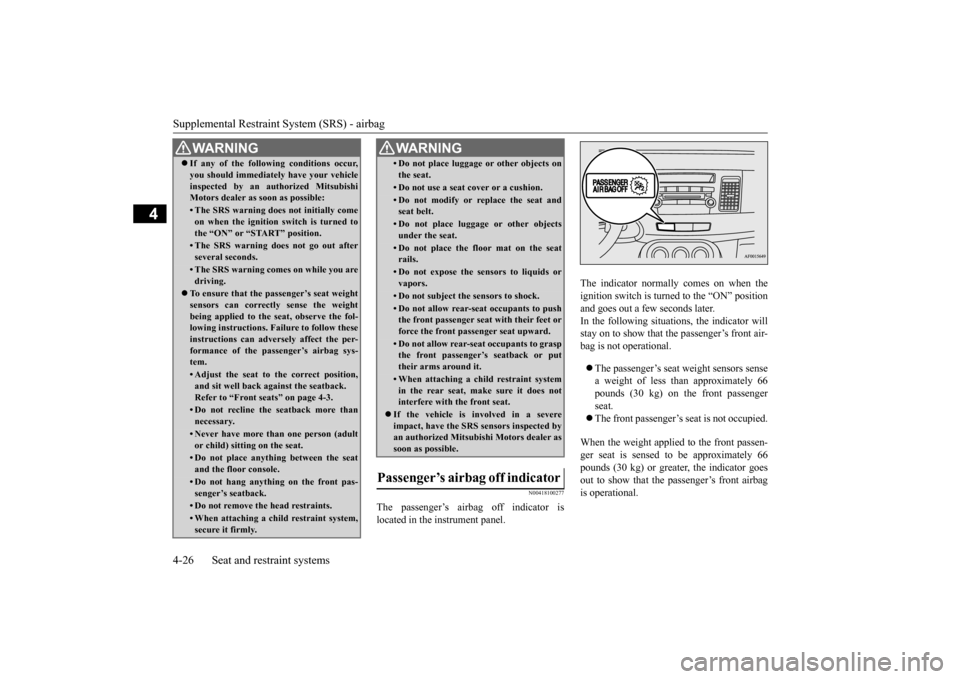
The passenger’s airbag off indicator is located in the instrument panel.
The indicator normally comes on when the ignition switch is turned to the “ON” positionand goes out a few seconds later. In the following situa
tions, the indicator will
stay on to show that the passenger’s front air-bag is not operational. The passenger’s seat weight sensors sense a weight of less than approximately 66 pounds (30 kg) on the front passenger seat. The front passenger’s seat is not occupied.
When the weight applied to the front passen- ger seat is sensed to be approximately 66 pounds (30 kg) or greater, the indicator goesout to show that the passenger’s front airbag is operational.
WA R N I N G If any of the following conditions occur, you should immediately have your vehicle inspected by an authorized Mitsubishi Motors dealer as soon as possible:• The SRS warning does not initially comeon when the ignition switch is turned to the “ON” or “START” position.• The SRS warning does not go out afterseveral seconds.• The SRS warning comes on while you aredriving.
To ensure that the passenger’s seat weight sensors can correctly sense the weightbeing applied to the seat, observe the fol- lowing instructions. Failure to follow these instructions can adversely affect the per-formance of the passenger’s airbag sys- tem.• Adjust the seat to the correct position,and sit well back against the seatback. Refer to “Front seats” on page 4-3.• Do not recline the seatback more thannecessary.• Never have more than one person (adultor child) sitting on the seat.• Do not place anything between the seatand the floor console.• Do not hang anything on the front pas-senger’s seatback.• Do not remove the head restraints.• When attaching a child restraint system,secure it firmly.
• Do not place luggage or other objects on the seat.• Do not use a seat cover or a cushion.• Do not modify or replace the seat andseat belt.• Do not place luggage or other objectsunder the seat.• Do not place the floor mat on the seatrails.• Do not expose the sensors to liquids orvapors.• Do not subject the sensors to shock.• Do not allow rear-seat occupants to push the front passenger seat with their feet or force the front passenger seat upward.• Do not allow rear-seat occupants to graspthe front passenger’s seatback or put their arms around it.• When attaching a child restraint systemin the rear seat, make sure it does notinterfere with the front seat.
If the vehicle is involved in a severe impact, have the SRS sensors inspected by an authorized Mitsubishi Motors dealer as soon as possible.
Passenger’s airbag off indicator
WA R N I N G
BK0210300US.bo
ok 26 ページ 2014年4月8日 火曜日 午前10時46分
Page 70 of 434
5
Features and controlsBreak-in recommendation
s ..............................................................5-3
Keys ..........................................
.......................................................5-3
Electronic immobilizer (Anti-thef
t starting system) ........................5-4
Keyless entry system (if so equipped) ..............................................5-7Free-hand Advanced Security Transmitter (F.A.S.T.-key) (if so
equipped) ..................................................5-12
Door locks .......................
...............................................................5-35
Power door locks ............
...............................................................5-37
“Child safety locks” for
rear door ..................................................5-39
Trunk lid ...................................
.....................................................5-39
Inside emergency trunk lid
release ................................................5-41
Theft-alarm system
................................................
........................5-42
Power windows ...............
...............................................................5-44
Sunroof (if so equipped
) .........................................
........................5-46
Parking brake ..................
...............................................................5-48
Steering wheel tilt lock lever .........................................................5-50Inside day/night rearview
mirror ...................................................5-50
Outside rearview mirr
ors ...............................................................5-52
Ignition switch ......
.................................................
........................5-53
Steering wheel lock
................................................
........................5-55
Starting and stopping the e
ngine ....................................................5-55
Turbocharger operation (if so equipped) ........................................5-59Manual transaxle (if so equipped) ..................................................5-59Continuously variable transmissi
on (CVT) (if so equipped)..........5-61
Twin Clutch SST (Sportronic Shift Transmission) (if so equipped) .
.................................................
........................5-70
ACD (Active center differential system) (if so equipped)..............5-82 Electronically controlled 4WD system (if so equipped).................5-84
All-wheel driving opera
tion .................................
......................... 5-86
Cautions on handling of all-wheel drive vehicles ......................... 5-87 Limited-slip differential (i
f so equipped) ....................................... 5-88
Service brake .................
.................................................
............... 5-89
Brake assist system
...............................................
......................... 5-90
Hill start assist (vehicles with
Twin Clutch SST) .......................... 5-90
Anti-lock braking syst
em .....................................
......................... 5-91
Active Stability Control (ASC
) (if so equipped) ............................ 5-94
Power steering system
..........................................
......................... 5-96
Cruise control (if so eq
uipped) ....................................................... 5-97
Tire pressure monitoring
system ................................................. 5-102
Rear-view camera (if so
equipped)..............
................................. 5-106
Instrument cluster
.................................................
....................... 5-108
Multi-information display ........................................................... 5-110 Indicator light, warning light, and information screen display list .......................................
.................................................... 5-131
Indicators .................................
.................................................... 5-143
Warning lights ................
.................................................
............. 5-144
Information screen disp
lay ...................................
....................... 5-145
Combination headlights and dimmer switch ............................... 5-147 Headlight leveling switch (if
so equipped)................................... 5-152
Turn signal lever ..
.................................................
....................... 5-152
Hazard warning flasher
switch .................................................... 5-153
Front fog light switch (if so
equipped) ......................................... 5-153
Wiper and washer swit
ch ......................................
....................... 5-154
Electric rear window def
ogger switch ......................................... 5-158
Horn switch .............................
.................................................... 5-159
Link System (if so equi
pped) ....................................................... 5-159
BK0210300US.bo
ok 1 ページ 2014年4月8日 火曜日 午前10時46分
Page 72 of 434
Break-in recommendations
Features and controls 5-3
5
N00508700297
Advanced automobile manufacturing tech- niques permit you to operate your new vehi-cle without requiring a long break-in period of low-speed driving. However, you can add to the future perfor-mance and economy of your vehicle by observing the following precautions during the first 300 miles (500 km).Drive your vehicle at moderate speeds duringthe break-in period. Avoid revving the engine. For vehicles with turbocharger, do not exceed 5,000 rpm for the first 600 miles (1,000 km). Avoid rough driving such as fast starts, sudden acceleration, prolonged high- speed driving and sudden braking. Thesewould have a detrimental effect on the engine and also cause increased fuel and oil consumption, which could result inmalfunction of the engine components. Be particularly careful to avoid full accelera- tion while in low gear. Do not overload the vehicle. Observe the seating capacity (See “Cargo load precau- tions” on page 6-10). Do not use this vehicle for trailer towing.
N00508800559
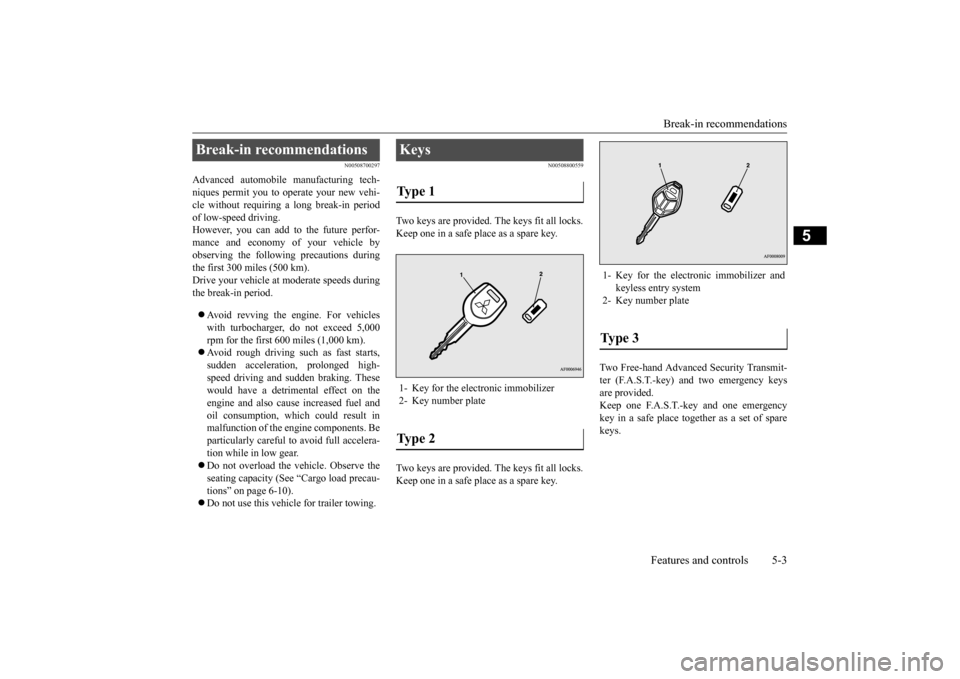
Two keys are provided. The keys fit all locks. Keep one in a safe place as a spare key. Two keys are provided. The keys fit all locks. Keep one in a safe place as a spare key.
Two Free-hand Advanced Security Transmit- ter (F.A.S.T.-key) and two emergency keysare provided. Keep one F.A.S.T.-key and one emergency key in a safe place together as a set of sparekeys.
Break-in recommendations
Keys Type 1 1- Key for the electronic immobilizer2- Key number plateType 2
1- Key for the electronic immobilizer and
keyless entry system
2- Key number plateType 3
BK0210300US.bo
ok 3 ページ 2014年4月8日 火曜日 午前10時46分
Page 73 of 434
![MITSUBISHI LANCER 2015 8.G User Guide Electronic immobilizer (Anti-theft starting system) 5-4 Features and controls
5
N00509101804
[For vehicles equipped with the Free-hand Advanced Security Transmitter (F.A.S.T.-key)] For information on](/img/19/7462/w960_7462-72.png "MITSUBISHI LANCER 2015 8.G User Guide Electronic immobilizer (Anti-theft starting system) 5-4 Features and controls
5
N00509101804
[For vehicles equipped with the Free-hand Advanced Security Transmitter (F.A.S.T.-key)] For information on")
Electronic immobilizer (Anti-theft starting system) 5-4 Features and controls
5
N00509101804
[For vehicles equipped with the Free-hand Advanced Security Transmitter (F.A.S.T.-key)] For information on operations for vehicles equipped with the Free-hand Advanced Secu-rity Transmitter (F.A.S.T.-key), refer to “Free-hand Advanced Security Transmitter (F.A.S.T.-key)”: “Electronic immobilizer(Anti-theft starting system)” on page 5-28. [Except for vehicles equipped with the Free- hand Advanced Security Transmitter (F.A.S.T.-key)] The electronic immobilizer is designed to sig-nificantly reduce the possibility of vehicle theft. The purpose of the system is to immo- bilize the vehicle if an invalid start isattempted. A valid start attempt can only be achieved (subject to certain conditions) using a key “registered” to the immobilizer system.All of the keys provided with your new vehi- cle have been programmed to the vehicle’s electronics.
1- Free-hand Advanced Security Transmit-
ter (F.A.S.T.-key) (with electronic immo
bilizer and keyless
entry system function)
2- Emergency key 3- Key number plate
NOTE
The key is a precision electronic device with a built-in signal transmitter. Please observethe following in order to prevent damage. • Do not leave where it may be exposed to heat caused by direct sunlight, such as on top of the dashboard. • Do not take the remote control transmitter apart. • Do not excessively bend the key or subject it to strong impacts. • Keep the remote control transmitter dry. • Keep away from magnetic objects such as key holders.
• Keep away from devices that produce mag- netism, such as audio systems, computers and televisions. • Keep away from devices that emit strong electromagnetic waves, such as cellular phones, wireless devices and high fre- quency equipment (including medicaldevices). • Do not clean with ultrasonic cleaners.• Do not leave the key where it may be exposed to high temperature or high humid-ity.
If you lose your key, to prevent the theft of the vehicle immediately contact an autho- rized Mitsubishi Motors dealer. If you notify an authorized MitsubishiMotors dealer of the key number, they can make a new key. The key number is stamped on the key number plate. Keep the key num-ber plate in a safe place separate from the key itself. No keys other than those registered in advance can be used to start the engine. Refer to “Electronic immobilizer (Anti-theftstarting system)” on page 5-4. Refer to “Free-hand Advanced Security Transmitter (F.A.S.T.-key)”: “Electronic immobilizer (Anti-theft starting system)” on page 5-28.NOTE
Electronic immobilizer (Anti-theft starting system)
BK0210300US.bo
ok 4 ページ 2014年4月8日 火曜日 午前10時46分
Page 74 of 434
Electronic immobilizer (Ant
i-theft starting system)
Features and controls 5-5
5
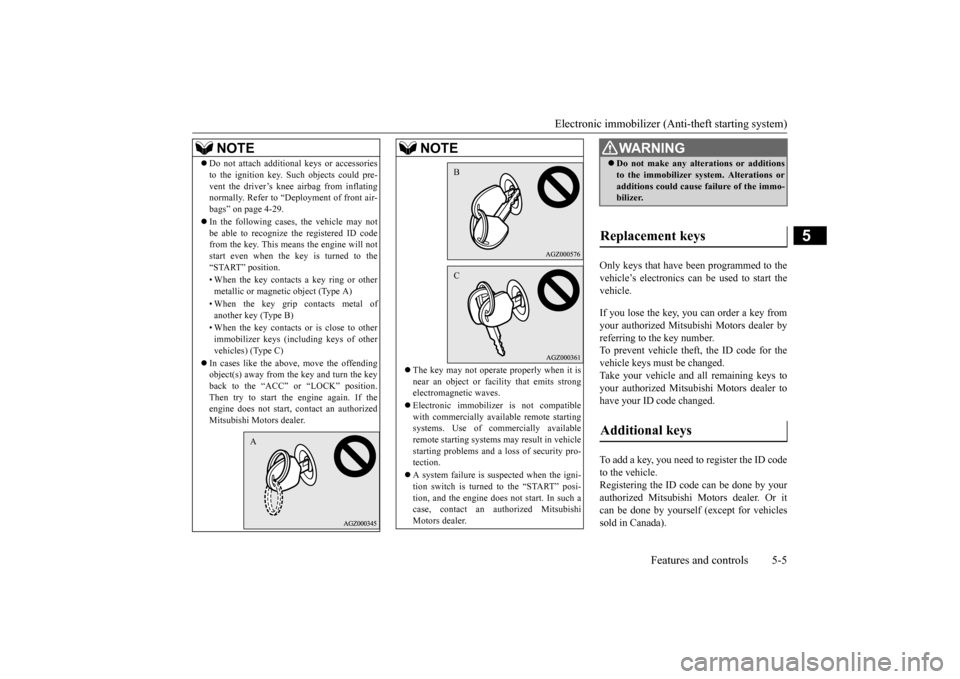
Only keys that have been programmed to the vehicle’s electronics can be used to start the vehicle. If you lose the key, you can order a key from your authorized Mitsubishi Motors dealer by referring to the key number. To prevent vehicle theft, the ID code for thevehicle keys must be changed. Take your vehicle and all remaining keys to your authorized Mitsubishi Motors dealer tohave your ID code changed. To add a key, you need to register the ID code to the vehicle. Registering the ID code can be done by your authorized Mitsubishi Motors dealer. Or itcan be done by yourself (except for vehicles sold in Canada).
NOTE
Do not attach additional keys or accessories to the ignition key. Such objects could pre- vent the driver’s knee airbag from inflating normally. Refer to “Deployment of front air- bags” on page 4-29. In the following cases, the vehicle may not be able to recognize the registered ID codefrom the key. This means the engine will not start even when the key is turned to the “START” position. • When the key contacts a key ring or other metallic or magnetic object (Type A) • When the key grip contacts metal of another key (Type B) • When the key contacts or is close to other immobilizer keys (including keys of othervehicles) (Type C)
In cases like the above, move the offending object(s) away from the key and turn the key back to the “ACC” or “LOCK” position. Then try to start the
engine again. If the
engine does not start, contact an authorized Mitsubishi Motors dealer.
A
The key may not operate properly when it is near an object or facility that emits strong electromagnetic waves. Electronic immobilizer is not compatible with commercially available remote startingsystems. Use of commercially available remote starting systems may result in vehicle starting problems and a lo
ss of security pro-
tection. A system failure is suspected when the igni- tion switch is turned to the “START” posi- tion, and the engine does not start. In such a case, contact an authorized MitsubishiMotors dealer.NOTE
BC
WA R N I N G Do not make any alterations or additions to the immobilizer system. Alterations or additions could cause failure of the immo- bilizer.
Replacement keys Additional keys
BK0210300US.bo
ok 5 ページ 2014年4月8日 火曜日 午前10時46分
Page 80 of 434
Keyless entry system (if so equipped)
Features and controls 5-11
5
This device must accept any interference received, including interference that may cause undesired operation.
N00544100077
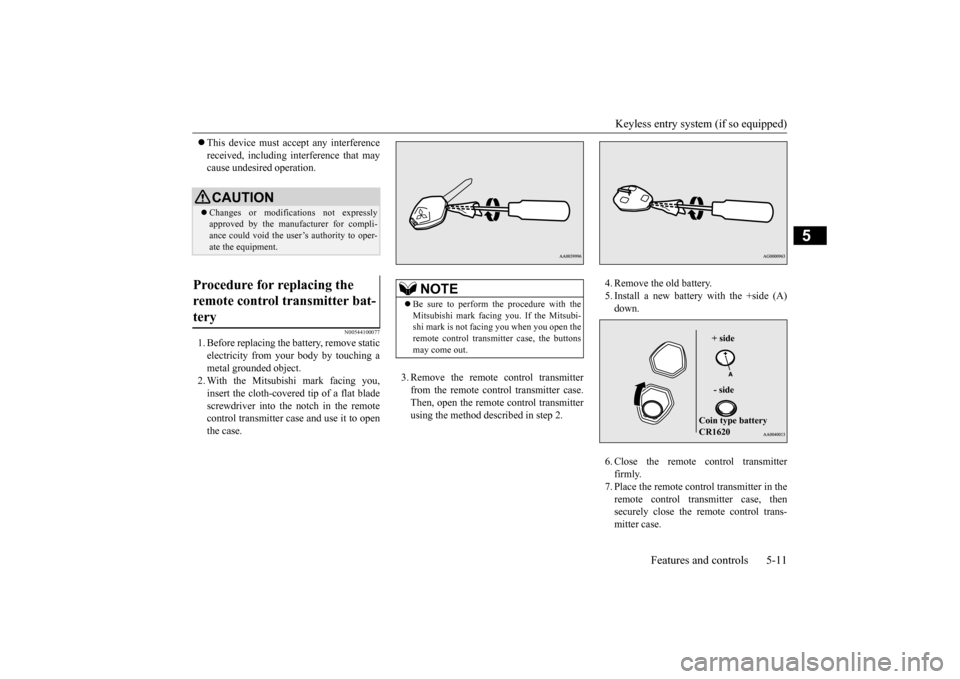
1. Before replacing the battery, remove static electricity from your body by touching ametal grounded object. 2. With the Mitsubishi mark facing you, insert the cloth-covered tip of a flat bladescrewdriver into the notch in the remote control transmitter case and use it to open the case.
3. Remove the remote control transmitter from the remote control transmitter case. Then, open the remote control transmitter using the method described in step 2.
4. Remove the old battery. 5. Install a new battery with the +side (A) down. 6. Close the remote control transmitter firmly.7. Place the remote control transmitter in theremote control transmitter case, then securely close the remote control trans- mitter case.
CAUTION Changes or modifications not expressly approved by the manufacturer for compli- ance could void the user’s authority to oper- ate the equipment.
Procedure for replacing the remote control transmitter bat- tery
NOTE
Be sure to perform the procedure with the Mitsubishi mark facing you. If the Mitsubi- shi mark is not facing you when you open theremote control transmitter case, the buttons may come out.
+ side - side
Coin type battery CR1620
BK0210300US.bo
ok 11 ページ 2014年4月8日 火曜日 午前10時46分